Iodide-methylammonium interaction is responsible for ferroelectricity in CH3NH3PbI3
Pith reviewed 2026-05-24 21:17 UTC · model grok-4.3
The pith
The methylammonium cation distorts iodide positions to break centrosymmetry and produce ferroelectricity in CH3NH3PbI3.
A machine-rendered reading of the paper's core claim, the machinery that carries it, and where it could break.
Core claim
The iodide-methylammonium interaction distorts the iodide positions from their centrosymmetric locations, breaking symmetry on the crystallographic scale and thereby making CH3NH3PbI3 ferroelectric.
What carries the argument
Distortion of iodide positions induced by the disordered CH3NH3+ cation
Load-bearing premise
Local iodide distortions around the disordered cations produce a non-centrosymmetric average structure on the long crystallographic scale.
What would settle it
A diffraction or polarization measurement showing the average structure remains centrosymmetric with no macroscopic polarization.
Figures
read the original abstract
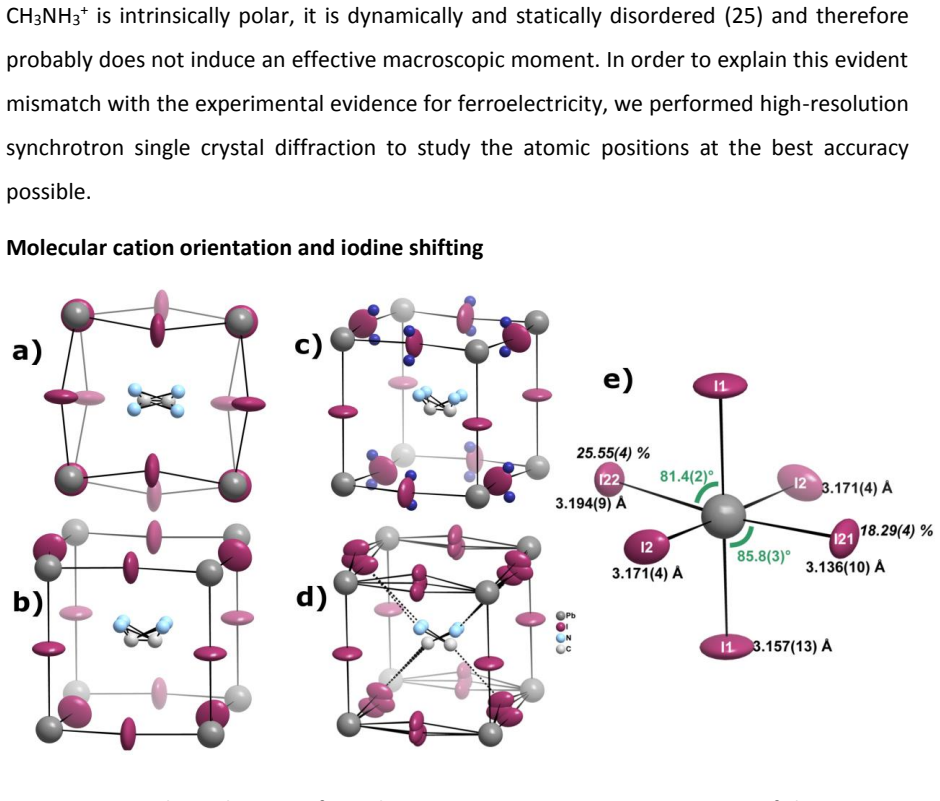
Excellent conversion efficiencies of over 20 % and facile cell production have placed hybrid perovskites at the forefront of novel solar cell materials with CH3NH3PbI3 being its archetypal compound. The question why CH3NH3PbI3 has such extraordinary characteristics, particularly a hugely efficient light absorption, is hotly debated with ferroelectricity being a promising candidate. This does, however, afford the crystal structure to be non-centrosymmetric and we herein present crystallographic evidence as to how the symmetry breaking occurs on a crystallographic, and therefore long-scale, level. While the molecular cation CH3NH3+ is intrinsically polar, it is heavily disordered and cannot be the sole reason for ferroelectricity. We show that it, nonetheless, plays an important role as it distorts the neighboring iodide positions from their centrosymmetric positions.
Editorial analysis
A structured set of objections, weighed in public.
Referee Report
Summary. The manuscript claims that although the CH3NH3+ cation in CH3NH3PbI3 is heavily disordered and thus cannot alone account for ferroelectricity, its interaction with the inorganic framework distorts neighboring iodide positions away from centrosymmetric locations, producing a non-centrosymmetric structure on long crystallographic scales; this is asserted on the basis of crystallographic data.
Significance. If substantiated with coherent long-range order, the result would identify a concrete structural mechanism linking local cation-anion interactions to macroscopic symmetry breaking in hybrid perovskites, offering a potential explanation for their photovoltaic performance beyond simple disorder averaging.
major comments (2)
- [Abstract] Abstract: the assertion that 'crystallographic data demonstrate' long-scale symmetry breaking via iodide distortions lacks any reported space-group refinement, displacement magnitudes with esds, or correlation-length analysis; without these, it is impossible to verify that the shifts are coherently ordered rather than locally fluctuating.
- [Abstract] Abstract and implied results: the central claim that disordered CH3NH3+ produces net non-centrosymmetry requires evidence that the iodide displacements do not average to zero over many unit cells; the text provides no test (e.g., temperature-dependent diffraction, diffuse scattering, or supercell modeling) to rule out random orientation of the local distortions.
minor comments (1)
- The abstract would be clearer if it briefly stated the diffraction technique, temperature, and whether the refinement was performed in a non-centrosymmetric space group.
Simulated Author's Rebuttal
We thank the referee for their careful reading and constructive comments on our manuscript. We address each major comment point by point below.
read point-by-point responses
-
Referee: [Abstract] Abstract: the assertion that 'crystallographic data demonstrate' long-scale symmetry breaking via iodide distortions lacks any reported space-group refinement, displacement magnitudes with esds, or correlation-length analysis; without these, it is impossible to verify that the shifts are coherently ordered rather than locally fluctuating.
Authors: We agree the abstract is concise and omits these specifics. The full manuscript refines the structure in the non-centrosymmetric space group P4mm, with iodide displacements reported along with their estimated standard deviations. We will revise the abstract and add a results subsection that tabulates the full refinement statistics, lists the displacement magnitudes with esds, and discusses the correlation length implied by the sharp Bragg peaks observed in the single-crystal data. This will make the long-range character explicit. revision: yes
-
Referee: [Abstract] Abstract and implied results: the central claim that disordered CH3NH3+ produces net non-centrosymmetry requires evidence that the iodide displacements do not average to zero over many unit cells; the text provides no test (e.g., temperature-dependent diffraction, diffuse scattering, or supercell modeling) to rule out random orientation of the local distortions.
Authors: Successful refinement to a non-centrosymmetric space group with statistically significant iodide displacements already shows that the displacements do not average to zero; purely random local orientations would produce a centrosymmetric average structure that would not refine in P4mm. We will add an explicit paragraph in the discussion section explaining this point. We lack new temperature-dependent or diffuse-scattering measurements in the present data set, but the existing single-crystal diffraction supports coherent order on crystallographic length scales. revision: partial
Circularity Check
No circularity; experimental claim rests on diffraction data
full rationale
The paper reports crystallographic evidence from diffraction observations that the disordered CH3NH3+ cation distorts neighboring iodide positions away from centrosymmetry. No derivation chain, equations, fitted parameters renamed as predictions, or self-citation load-bearing steps are present. The central claim is an interpretation of observed atomic positions in the refined structure and does not reduce to its own inputs by construction. This is a standard experimental report whose validity can be checked against the raw diffraction data and refinement statistics independently of the present text.
Axiom & Free-Parameter Ledger
axioms (1)
- standard math X-ray diffraction data can be used to refine atomic positions and determine crystal symmetry with sufficient precision to detect small distortions from centrosymmetry.
Reference graph
Works this paper leans on
- [1]
-
[2]
P. Gao, M. Grätzel, M. K. Nazeeruddin, Organohalide lead perovskites for photovoltaic applications. Energy Environ. Sci. 7, 2448–2463 (2014)
work page 2014
-
[3]
M. A. Green, A. Ho-Baillie, H. J. Snaith, The emergence of perovskite solar cells. Nature Photonics 8, 506–514 (2014)
work page 2014
-
[4]
Correa-Baena et al., The rapid evolution of highly efficient perovskite solar cells
J.-P. Correa-Baena et al., The rapid evolution of highly efficient perovskite solar cells. Energy Environ. Sci. 10, 710–727 (2017)
work page 2017
-
[5]
K. X. Steirer et al., Defect Tolerance in Methylammonium Lead Triiodide Perovskite. ACS Energy Lett. 1, 360–366 (2016)
work page 2016
-
[6]
O. Selig et al., Organic Cation Rotation and Immobilization in Pure and Mixed Methylammonium Lead-Halide Perovskites. J. Am. Chem. Soc. 139, 4068–4074 (2017)
work page 2017
-
[7]
J. Haruyama, K. Sodeyama, L. Han, Y. Tateyama, First-Principles Study of Ion Diffusion in Perovskite Solar Cell Sensitizers. J. Am. Chem. Soc. 137, 10048–10051 (2015)
work page 2015
-
[8]
Y. Yuan, J. Huang, Ion Migration in Organometal Trihalide Perovskite and Its Impact on Photovoltaic Efficiency and Stability. Acc. Chem. Res. 49, 286–293 (2016)
work page 2016
-
[9]
M. T. Weller, O. J. Weber, P. F. Henry, A. M. D. Pumpo, T. C. Hansen, Complete structure and cation orientation in the perovskite photovoltaic methylammonium lead iodide between 100 and 352 K. Chem. Commun. 51, 4180–4183 (2015)
work page 2015
-
[10]
Y. Kutes et al., Direct Observation of Ferroelectric Domains in Solution-Processed CH3NH3PbI3 Perovskite Thin Films. J. Phys. Chem. Lett. 5, 3335–3339 (2014)
work page 2014
-
[11]
Rakita et al., Tetragonal CH3NH3PbI3 is ferroelectric
Y. Rakita et al., Tetragonal CH3NH3PbI3 is ferroelectric. PNAS 114, E5504–E5512 (2017)
work page 2017
-
[12]
S. M. Vorpahl et al., Orientation of Ferroelectric Domains and Disappearance upon Heating Methylammonium Lead Triiodide Perovskite from Tetragonal to Cubic Phase. ACS Appl. Energy Mater. 1, 1534–1539 (2018)
work page 2018
-
[13]
H. Röhm et al., Ferroelectric Properties of Perovskite Thin Films and Their Implications for Solar Energy Conversion. Adv. Mater., 1806661 (2019)
work page 2019
-
[14]
I. Anusca et al., Dielectric Response: Answer to Many Questions in the Methylammonium Lead Halide Solar Cell Absorbers. Adv. Energy Mater. 7, 1700600 (2017)
work page 2017
-
[15]
Barren plateaus in quantum neural network training landscapes,
K. Frohna et al., Inversion symmetry and bulk Rashba effect in methylammonium lead iodide perovskite single crystals. Nat. Commun. 9 (2018), doi:10.1038/s41467-018- 04212-w
-
[16]
Fan et al., Ferroelectricity of CH3NH3PbI3 Perovskite
Z. Fan et al., Ferroelectricity of CH3NH3PbI3 Perovskite. J. Phys. Chem. Lett. 6, 1155–1161 (2015)
work page 2015
-
[17]
G et al., Is CH3NH3PbI3 Polar? J
S. G et al., Is CH3NH3PbI3 Polar? J. Phys. Chem. Lett. 7, 2412–2419 (2016)
work page 2016
-
[18]
W. Kleber, H.-J. Bautsch, J. Bohm, D. Klimm, “Kristallphysik” in Einführung in die Kristallographie (Oldenbourg, München, ed. 19, 2010), pp. 282-289
work page 2010
- [19]
-
[20]
A. Jaffe et al., High-Pressure Single-Crystal Structures of 3D Lead-Halide Hybrid Perovskites and Pressure Effects on their Electronic and Optical Properties. ACS Central Sci. 2, 201–209 (2016)
work page 2016
-
[21]
A. Arakcheeva, D. Chernyshov, M. Spina, L. Forro, E. Horvath, CH3NH3PbI3: precise structural consequences of water absorption at ambient conditions. Acta Crystallogr. B 72, 716–722 (2016)
work page 2016
-
[22]
Q. Dong et al., Electron-hole diffusion lengths greater 175 µm in solution-grown CH3NH3PbI3 single crystals. Science 347, 967–970 (2015)
work page 2015
-
[23]
C. C. Stoumpos, C. D. Malliakas, M. G. Kanatzidis, Semiconducting Tin and Lead Iodide Perovskites with Organic Cations: Phase Transitions, High Mobilities, and Near-Infrared Photoluminescent Properties. Inorg. Chem. 52, 9019–9038 (2013)
work page 2013
-
[24]
V. K. Pecharsky, P. Y. Zavalij, “Structure Factor” in Fundamentals of Powder Diffraction and Structural Characterization of Materials (Springer, New York, ed. 2, 2009), pp. 225- 234
work page 2009
-
[25]
J. M. Frost, A. Walsh, What Is Moving in Hybrid Halide Perovskite Solar Cells? Acc. Chem. Res. 49, 528–535 (2016)
work page 2016
-
[26]
R. J. D. Tilley, “Dielectric Properties” in Perovskites (Wiley, Chichester, 2016) pp. 182- 189
work page 2016
-
[27]
C. Richter et al., Picometer polar atomic displacements in strontium titanate determined by resonant X-ray diffraction. Nat. Commun. 9 (2018), doi:10.1038/s41467-017-02599-6
-
[28]
Liu et al., Twin Domains in Organometallic Halide Perovskite Thin-Films
W. Liu et al., Twin Domains in Organometallic Halide Perovskite Thin-Films. Crystals 8, 216 (2018)
work page 2018
-
[29]
M. U. Rothmann et al., Direct observation of intrinsic twin domains in tetragonal CH3NH3PbI3. Nat. Commun. 8 (2017), doi:10.1038/ncomms14547
-
[30]
Liu et al., Dynamic behavior of CH3NH3PbI3 perovskite twin domains
Y. Liu et al., Dynamic behavior of CH3NH3PbI3 perovskite twin domains. Appl. Phys. Lett. 113, 72102 (2018)
work page 2018
-
[31]
Y. Ren, I. W. H. Oswald, X. Wang, G. T. McCandless, J. Y. Chan, Orientation of Organic Cations in Hybrid Inorganic-Organic Perovskite CH3NH3PbI3 from Subatomic Resolution Single Crystal Neutron Diffraction Structural Studies. Cryst. Growth Design 16, 2945– 2951 (2016)
work page 2016
-
[32]
V Petříček, M Dušek, L Palatinus, Crystallographic Computing System JANA2006: General features. Z. Kristallogr. Cryst. Mater. 229, 345–352 (2014)
work page 2014
-
[33]
APEX3 suite, Bruker AXS Inc. (2015)
work page 2015
-
[34]
N. T. Johnson, M. R. Probert, cbf_to_sfrm.py (Alpha Version). 2016. Available online: https://github.com/nu-xtal-tools/cbf_to_sfrm (accessed 12/07/19)
work page 2016
-
[35]
SHELXL2017-1, G. M. Sheldrick, Universität Göttingen, Germany (2017). Acknowledgments: The authors would like to acknowledge Natalie Johnson and Mike Probert for using their data conversion program. We are deeply grateful to Prof. Hartmut Bärnighausen for discussion on the topic and Dr. David Allan for discussion on the beamtime proposal. Funding: The aut...
work page 2017
-
[36]
Twinning in Arakcheeva et al. (21) and Jaffe et al. (20) To test for possible twinning as cause for the supposedly observed breaking of the c-glide plane, a twin-law according to pseudo-merohedral pseudo-cubic axial twinning using the command: TWIN 0.5 0.5 -0.5 0.5 0.5 0.5 1 -1 0 According to a 90° rotation around the <110> direction in the tetragonal uni...
-
[37]
Experimental details Crystals were grown at room temperature according to the antisolvent vapor method described by Rakita et al. PbI2 (99 %, ACROS Organics), ethyl acetate (ChemCruz, HPLC grade), acetonitrile (Sigma- Aldrich, 99.5 %), diethyl ether (Merck, 99.7 %), methylammonium iodide (Sigma-Aldrich, 98 %) and HI solution (stabilized 57 wt.-%in H2O, 99...
work page 2016
-
[38]
Refinement without split site model Table S1: Crystal data CH6I3NPb Z = 4 Mr = 619.96 F(000) = 1040 Tetragonal, I4cm Dx = 4.171 Mg m-3 a = 8.8438 (3) Å = 26.39 mm-1 c = 12.6215 (5) Å T = 293 K V = 987.16 (8) Å3 Table S2: Data collection 5668 measured reflections max = 34.5°, min = 3.7° 768 independent reflections h = -1212 674 reflections with I > 2...
work page 2013
-
[39]
Split site model refinement Refined as a 2-component inversion twin with a twin fraction of Table S7: Crystal data CH6I3NPb Z = 4 Mr = 619.96 F(000) = 1040 Tetragonal, I4cm Dx = 4.171 Mg m-3 a = 8.8438 (3) Å = 26.39 mm-1 c = 12.6215 (5) Å T = 293 K V = 987.16 (8) Å3 Table S8: Data collection 5668 measured reflections max = 34.5°, min = 3.7° 768 indepe...
work page 2078
discussion (0)
Sign in with ORCID, Apple, or X to comment. Anyone can read and Pith papers without signing in.