A Space-based All-sky MeV gamma-ray Survey with the Electron Tracking Compton Camera
Pith reviewed 2026-05-24 21:09 UTC · model grok-4.3
The pith
Electron tracking in Compton cameras allows degree-resolution MeV gamma-ray imaging that supports an all-sky space survey.
A machine-rendered reading of the paper's core claim, the machinery that carries it, and where it could break.
Core claim
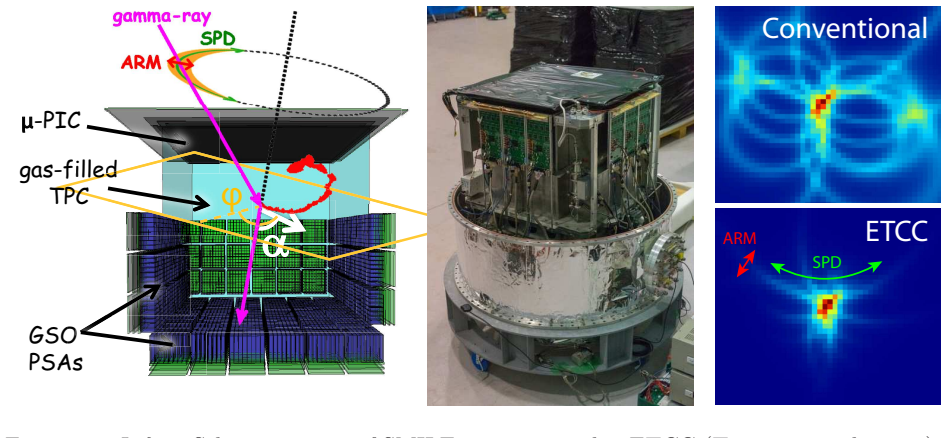
The ETCC reconstructs the incoming direction of each MeV photon to roughly one degree while suppressing background through electron trajectory information; the SMILE-2+ balloon flight demonstrated this capability by detecting Galactic diffuse emission and the 511 keV annihilation line at high significance in 2.5 hours, supporting the claim that a space-based array of upgraded ETCCs would deliver a transformative all-sky MeV survey.
What carries the argument
The Electron Tracking Compton Camera (ETCC), which records both the scattered photon and the recoil electron track to reconstruct photon direction and reject background events.
If this is right
- Continuous monitoring of the full sky at MeV energies would capture gamma-ray bursts at higher redshifts than current instruments allow.
- Line and continuum maps would constrain the sites and rates of Type Ia supernova progenitors.
- Improved sensitivity to the 511 keV line and diffuse emission would test dark-matter annihilation or decay models.
- The survey would provide the first uniform reference map for comparing with higher- and lower-energy observations.
Where Pith is reading between the lines
- An all-sky MeV catalog would immediately enable population studies of transient sources that are currently known only through sporadic detections.
- The same electron-tracking method could be adapted for pointed observations of individual objects once the survey identifies interesting targets.
- Data downlink and onboard processing requirements for multiple ETCCs would need separate engineering studies not addressed in the paper.
Load-bearing premise
The angular resolution, background rejection, and sensitivity shown in a short balloon flight will hold when the instrument operates for years in the space radiation and thermal environment.
What would settle it
A space-qualified ETCC that fails to reach the balloon-flight angular resolution or background rejection level after accounting for radiation damage and thermal cycling would falsify the claim that the technology can be scaled directly to an all-sky mission.
Figures


read the original abstract
A sensitive survey of the MeV gamma-ray sky is needed to understand important astrophysical problems such as gamma-ray bursts in the early universe, progenitors of Type Ia supernovae, and the nature of dark matter. However, the study has not progressed remarkably since the limited survey by COMPTEL onboard CGRO in the 1990s. Tanimori et al. have developed a Compton camera that tracks the trajectory of each recoil electron in addition to the information obtained by the conventional Compton cameras, leading to superior imaging. This Electron Tracking Compton Camera (ETCC) facilitates accurate reconstruction of the incoming direction of each MeV photon from a wide sky at ~degree angular resolution and with minimized particle background using trajectory information. The latest ETCC model, SMILE-2+, made successful astronomical observations during a day balloon flight in 2018 April and detected diffuse continuum and 511 keV annihilation line emission from the Galactic Center region at a high significance in ~2.5 hours. We believe that MeV observations from space with upgraded ETCCs will dramatically improve our knowledge of the MeV universe. We advocate for a space-based all-sky survey mission with multiple ETCCs onboard and detail its expected benefits.
Editorial analysis
A structured set of objections, weighed in public.
Referee Report
Summary. The manuscript advocates for a space-based all-sky MeV gamma-ray survey mission using multiple upgraded Electron Tracking Compton Cameras (ETCCs). It reviews the limitations of prior MeV observations since COMPTEL, describes the ETCC's electron-tracking capability for improved direction reconstruction and background rejection, reports a high-significance detection of Galactic Center diffuse continuum and 511 keV emission by the SMILE-2+ balloon instrument in ~2.5 hours of the 2018 flight, and outlines the scientific benefits of the proposed space mission.
Significance. The paper correctly identifies a long-standing observational gap in the MeV band and presents the ETCC as a technically promising approach based on demonstrated balloon performance. If the scaling from short balloon flights to multi-year space operation holds, the proposed survey could deliver new constraints on GRB progenitors, Type Ia supernovae, and dark matter. The manuscript receives credit for grounding the advocacy in a concrete recent flight result rather than purely conceptual arguments.
major comments (2)
- [Abstract] Abstract: the claim of detection 'at a high significance in ~2.5 hours' is presented without any quantitative metrics (significance in sigma, flux values, background-subtracted counts, or direct comparison to COMPTEL sensitivity). This quantitative grounding is load-bearing for the central advocacy that the technology is ready for space deployment.
- [Abstract] Abstract and main text: the headline assertion that upgraded ETCCs 'will dramatically improve our knowledge of the MeV universe' depends on the unverified extrapolation that one-day balloon performance (angular resolution, background rejection via electron tracking, and sensitivity) will scale without major degradation to long-duration space conditions. No analysis or modeling of radiation-induced degradation, thermal stability over years, or downlink bandwidth limits for the expected event rate is provided, which directly undermines the feasibility claim.
Simulated Author's Rebuttal
We thank the referee for the constructive comments and positive evaluation of the manuscript's significance. We address each major comment below with honest responses and indicate revisions where the manuscript will be updated.
read point-by-point responses
-
Referee: [Abstract] Abstract: the claim of detection 'at a high significance in ~2.5 hours' is presented without any quantitative metrics (significance in sigma, flux values, background-subtracted counts, or direct comparison to COMPTEL sensitivity). This quantitative grounding is load-bearing for the central advocacy that the technology is ready for space deployment.
Authors: We agree that the abstract would be strengthened by including quantitative metrics. The full manuscript contains the supporting details from the SMILE-2+ flight (including significance levels and flux estimates), but these were not summarized in the abstract. We will revise the abstract to incorporate key quantitative values such as detection significance in sigma, approximate flux levels, and a brief comparison to prior COMPTEL results. revision: yes
-
Referee: [Abstract] Abstract and main text: the headline assertion that upgraded ETCCs 'will dramatically improve our knowledge of the MeV universe' depends on the unverified extrapolation that one-day balloon performance (angular resolution, background rejection via electron tracking, and sensitivity) will scale without major degradation to long-duration space conditions. No analysis or modeling of radiation-induced degradation, thermal stability over years, or downlink bandwidth limits for the expected event rate is provided, which directly undermines the feasibility claim.
Authors: The manuscript is an advocacy paper grounded in the recent balloon flight results rather than a full mission feasibility study. We acknowledge that no detailed modeling of radiation degradation, long-term thermal stability, or downlink constraints is included, as these require dedicated engineering analyses beyond the paper's scope. We have added a clarifying sentence in the discussion noting that such space-environment studies would be essential for any future mission proposal. The central claim rests on the demonstrated balloon performance as a necessary first step, not on a claim of already-verified space scaling. revision: partial
Circularity Check
No derivations, fits, or self-referential predictions present; claim is qualitative advocacy
full rationale
The paper contains no equations, parameter fits, or claimed first-principles derivations. Its central statement is a qualitative belief that space-based ETCCs will improve MeV knowledge, resting on cited prior balloon-flight results and instrument papers. No load-bearing step reduces by construction to a self-citation, fitted input, or renamed ansatz. This is the expected honest outcome for a mission-advocacy document without mathematical modeling.
Axiom & Free-Parameter Ledger
Reference graph
Works this paper leans on
- [1]
- [2]
- [3]
-
[4]
Chiu, J. L., Boggs, S. E., Kierans, C. A., et al. 2017, International C osmic Ray Conference, 301, 796
work page 2017
-
[5]
Churazov, E., Sunyaev, R., Isern, J., et al. 2014, Nature, 512, 406
work page 2014
-
[6]
Diehl, R., Siegert, T., Hillebrandt, W., et al. 2014, Science, 345, 1162
work page 2014
-
[7]
Horiuchi, S., & Beacom, J. F. 2010, ApJ, 723, 329
work page 2010
- [8]
-
[9]
Krivonos, R., Tsygankov, S., Lutovinov, A., et al. 2015, MNRAS, 448, 3766
work page 2015
-
[10]
2010, Nuclear Instrumen ts and Methods in Physics Research A, 623, 249
Kurosawa, S., Kubo, H., Hattori, K., et al. 2010, Nuclear Instrumen ts and Methods in Physics Research A, 623, 249
work page 2010
-
[11]
2018, arXiv e-prints, arXiv:1 805.07939 12
Mizumura, Y., Takada, A., & Tanimori, T. 2018, arXiv e-prints, arXiv:1 805.07939 12
work page 2018
-
[12]
2014, Journal of Instrum entation, 9, C05045
Mizumura, Y., Tanimori, T., Kubo, H., et al. 2014, Journal of Instrum entation, 9, C05045
work page 2014
-
[13]
2018, in Society of Phot o-Optical Instrumen- tation Engineers (SPIE) Conference Series, Vol
Nakamura, Y., Tanimori, T., Takada, A., et al. 2018, in Society of Phot o-Optical Instrumen- tation Engineers (SPIE) Conference Series, Vol. 10699, Proc. SPIE, 106995W Sch¨ onfelder, V. 2004,New Astronomy , 48, 193 Sch¨ onfelder, V., Aarts, H., Bennett, K., et al. 1993, ApJS, 86, 657
work page 2018
-
[14]
Siegert, T., Diehl, R., Khachatryan, G., et al. 2016, A&A, 586, A84
work page 2016
- [15]
-
[16]
2016, in Society of Photo-Op tical Instrumentation Engineers (SPIE) Conference Series, Vol
Takada, A., Tanimori, T., Kubo, H., et al. 2016, in Society of Photo-Op tical Instrumentation Engineers (SPIE) Conference Series, Vol. 9905, Proc. SPIE, 99052M
work page 2016
- [17]
-
[18]
2017, Scientific Reports , 7, 41511
Tanimori, T., Mizumura, Y., Takada, A., et al. 2017, Scientific Reports , 7, 41511
work page 2017
-
[19]
2017, Scientific Reports , 7, 41972
Tomono, D., Mizumoto, T., Takada, A., et al. 2017, Scientific Reports , 7, 41972
work page 2017
-
[20]
Tsurutani, B. T., Park, S. A., Falkowski, B. J., et al. 2018, Journal o f Geophysical Research: Space Physics, 123, 10,009
work page 2018
-
[21]
2011, Nuclear Instruments an d Methods in Physics Research A, 628, 158 13
Ueno, K., Tanimori, T., Kubo, H., et al. 2011, Nuclear Instruments an d Methods in Physics Research A, 628, 158 13
work page 2011
discussion (0)
Sign in with ORCID, Apple, or X to comment. Anyone can read and Pith papers without signing in.