Study of Max-Link Relay Selection with Buffers for Multi-Way Cooperative Multi-Antenna Systems
Pith reviewed 2026-05-24 21:06 UTC · model grok-4.3
The pith
Multi-Way Buffer-Aided Max-Link relay selection outperforms existing techniques in cooperative multi-antenna systems
A machine-rendered reading of the paper's core claim, the machinery that carries it, and where it could break.
Core claim
The authors present a novel multi-way relay selection strategy called Multi-Way Buffer-Aided Max-Link (MW-Max-Link) based on the selection of the best link, exploiting the use of buffers and physical-layer network coding. This strategy is shown through simulations to outperform existing techniques in bit error rate, pairwise error probability, sum rate and computational complexity for multi-way cooperative multi-antenna systems aided by a central processor node.
What carries the argument
The Multi-Way Buffer-Aided Max-Link (MW-Max-Link) strategy, which selects the best link among relays using buffers and physical-layer network coding to facilitate simultaneous transmissions between user clusters.
Load-bearing premise
The simulations described in the abstract are sufficient to demonstrate that MW-Max-Link outperforms existing techniques in bit error rate, pairwise error probability, sum rate, and computational complexity.
What would settle it
An independent simulation or real-world experiment in which MW-Max-Link fails to outperform existing techniques in at least one of bit error rate, pairwise error probability, sum rate, or computational complexity.
Figures


read the original abstract
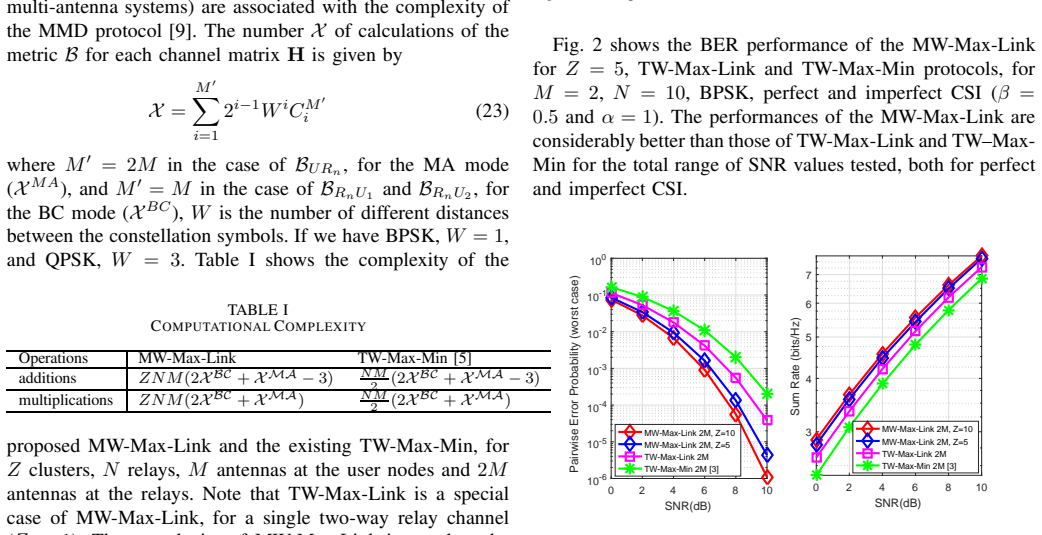
In this paper, we present a relay-selection strategy for multi-way cooperative multi-antenna systems that are aided by a central processor node, where a cluster formed by two users is selected to simultaneously transmit to each other with the help of relays. In particular, we present a novel multi-way relay selection strategy based on the selection of the best link, exploiting the use of buffers and physical-layer network coding, that is called Multi-Way Buffer-Aided Max-Link (MW-Max-Link). We compare the proposed MW-Max-Link to existing techniques in terms of bit error rate, pairwise error probability, sum rate and computational complexity. Simulations are then employed to evaluate the performance of the proposed and existing techniques.
Editorial analysis
A structured set of objections, weighed in public.
Referee Report
Summary. The paper proposes a novel Multi-Way Buffer-Aided Max-Link (MW-Max-Link) relay selection strategy for multi-way cooperative multi-antenna systems aided by a central processor. The strategy selects the best link for simultaneous transmission between selected user clusters, exploiting buffers and physical-layer network coding. It compares MW-Max-Link to existing techniques on bit error rate, pairwise error probability, sum rate, and computational complexity, with performance evaluated via simulations.
Significance. If the simulation results hold, the work provides a practical buffer-aided max-link selection approach for multi-way relay systems that incorporates physical-layer network coding, which is a standard evaluation method in cooperative communications. The explicit comparison across multiple metrics (BER, PEP, sum-rate, complexity) and the parameter-free nature of the selection rule (as described) are strengths.
minor comments (2)
- The abstract states that simulations are used to evaluate performance but does not specify the channel model, number of antennas, buffer sizes, or Monte Carlo trial count; the full manuscript should include these details in the simulation section for reproducibility.
- Notation for the multi-way system model (e.g., definitions of the selected user cluster and the central processor) should be introduced with a clear system diagram or equation reference in §II.
Simulated Author's Rebuttal
We thank the referee for the careful review and for recommending minor revision. The referee summary accurately reflects the paper's contributions regarding the MW-Max-Link strategy, its use of buffers and physical-layer network coding, and the comparisons across BER, PEP, sum rate, and complexity.
Circularity Check
No significant circularity
full rationale
The paper proposes the MW-Max-Link relay selection strategy for multi-way cooperative multi-antenna systems using buffers and physical-layer network coding, then evaluates it via simulations against existing techniques on BER, PEP, sum rate, and complexity. No derivation, equation, or claim reduces by construction to a fitted parameter, self-citation, or renamed input; the central contribution is the strategy definition plus external empirical comparison, which is self-contained and does not invoke load-bearing self-citations or uniqueness theorems from the authors' prior work.
Axiom & Free-Parameter Ledger
Reference graph
Works this paper leans on
-
[1]
D. Gündüz; AylinY ener; A. Goldsmith; H. Poor, "The Multi way Relay Channel", in IEEE Transactions on Information Theory , vol. 59, no. 1, January 2013
work page 2013
-
[2]
Two-Timeslot Two-Way Full-Duplex Relaying for 5G Wir eless Communication Networks,
Z. Zhang, Z. Ma, M. Xiao, G. K. Karagiannidis, Z. Ding and P . Fan, "Two-Timeslot Two-Way Full-Duplex Relaying for 5G Wir eless Communication Networks," in IEEE Transactions on Communications , vol. 64, no. 7, pp. 2873-2887, July 2016
work page 2016
-
[3]
P . Clarke and R. C. de Lamare, "Joint Transmit Diversity O ptimization and Relay Selection for Multi-Relay Cooperative MIMO Syste ms Using Discrete Stochastic Algorithms," in IEEE Communications L etters, vol. 15, no. 10, pp. 1035-1037, October 2011
work page 2011
-
[4]
Transmit Diversity and Rel ay Selec- tion Algorithms for Multirelay Cooperative MIMO Systems,
P . Clarke and R. C. de Lamare, "Transmit Diversity and Rel ay Selec- tion Algorithms for Multirelay Cooperative MIMO Systems," in IEEE Transactions on V ehicular Technology, vol. 61, no. 3, pp. 10 84-1098, March 2012
work page 2012
-
[5]
Relay Selection for Two-Way Relay Channel s With MABC DF: A Diversity Perspective,
I. Krikidis, "Relay Selection for Two-Way Relay Channel s With MABC DF: A Diversity Perspective," in IEEE Transactions on V ehicular Technology, vol. 59, no. 9, pp. 4620-4628, Nov. 2010
work page 2010
-
[6]
J. Gu, R. C. de Lamare and M. Huemer, "Buffer-Aided Physic al-Layer Network Coding With Optimal Linear Code Designs for Coopera tive Networks," in IEEE Transactions on Communications , vol. 66, no. 6, pp. 2560-2575, June 2018
work page 2018
-
[7]
Buffer- Aided Re- lay Selection for Cooperative Diversity Systems Without De lay Con- straints
I. Krikidis, T. Charalambous, and J. Thompson, “Buffer- Aided Re- lay Selection for Cooperative Diversity Systems Without De lay Con- straints",IEEE Transactions on Wireless Communications , vol. 11, no. 5, pp. 1957-1967, May 2012
work page 1957
-
[8]
Buffer-Aided Max-Link R elay Selection for Multi-Way Cooperative Multi-Antenna System s,
F. L. Duarte and R. C. de Lamare, “Buffer-Aided Max-Link R elay Selection for Multi-Way Cooperative Multi-Antenna System s," IEEE Communications Letters , 2019
work page 2019
-
[9]
Switched Max-Link Buffe r-Aided Relay Selection for Cooperative Multiple-Antenna Systems ,
F. L. Duarte and R. C. de Lamare, "Switched Max-Link Buffe r-Aided Relay Selection for Cooperative Multiple-Antenna Systems ," SCC 2019; 12th International ITG Conference on Systems, Commun ications and Coding , Rostock, Germany, 2019, pp. 1-6
work page 2019
-
[10]
T. Peng, R. C. de Lamare and A. Schmeink, “Adaptive Distr ibuted Space-Time Coding Based on Adjustable Code Matrices for Coo perative MIMO Relaying Systems", IEEE Transactions on Communications , vol. 61, no. 7, pp. 2692-2703, July 2013
work page 2013
-
[11]
Cooperative D iversity in Wireless Networks: Efficient Protocols and Outage Behavior
J. N. Laneman; D. N. C. Tse; G. W. Wornell, "Cooperative D iversity in Wireless Networks: Efficient Protocols and Outage Behavior ", in IEEE Transactions on Information Theory , vol. 50, no. 12, pp. 3062-3080, Dec. 2004
work page 2004
-
[12]
Low-Complex ity Set-Membership Channel Estimation for Cooperative Wirele ss Sensor Networks,
T. Wang, R. C. de Lamare and P . D. Mitchell, “Low-Complex ity Set-Membership Channel Estimation for Cooperative Wirele ss Sensor Networks," IEEE Transactions on V ehicular Technology, vol. 60, no. 6, pp. 2594-2607, July 2011
work page 2011
-
[13]
S. Zhang, F. Gao, C. Pei, X. He, “Segment Training Based I ndividual Channel Estimation in One-Way Relay Network with Power Allo cation", IEEE Transactions on Wireless Communications , vol. 12, no. 3, pp. 1300-1309, 2013
work page 2013
-
[14]
Joint maximum l ikelihood detection and link selection for cooperative MIMO relay sys tems
T. Hesketh, R. C. De Lamare and S. Wales, “Joint maximum l ikelihood detection and link selection for cooperative MIMO relay sys tems", IET Communications, vol. 8, no. 14, pp. 2489-2499, 25 Sept. 2014
work page 2014
-
[15]
A p erformance study of MIMO detectors
C. Windpassinger, L. Lampe, R. F. H. Fischer, T Hehn, “A p erformance study of MIMO detectors", IEEE Transactions on Wireless Communi- cations, vol. 5, no. 8, pp. 2004-2008, Aug. 2006
work page 2004
-
[16]
R. C. De Lamare and R. Sampaio-Neto, “Minimum Mean-Squa red Error Iterative Successive Parallel Arbitrated Decision Feedba ck Detectors for DS-CDMA Systems", IEEE Transactions on Communications , vol. 56, no. 5, pp. 778-789, May 2008
work page 2008
-
[17]
Multiple Feedback Succe ssive Interference Cancellation Detection for Multiuser MIMO Sy stems
P . Li, R. C. de Lamare and R. Fa, “Multiple Feedback Succe ssive Interference Cancellation Detection for Multiuser MIMO Sy stems", IEEE Transactions on Wireless Communications , vol. 10, no. 8, pp. 2434-2439, August 2011
work page 2011
-
[18]
R. C. de Lamare, “Adaptive and Iterative Multi-Branch M MSE Decision Feedback Detection Algorithms for Multi-Antenna Systems" , IEEE Transactions on Wireless Communications , vol. 12, no. 10, pp. 5294- 5308, October 2013
work page 2013
-
[19]
R. C. de Lamare, “Joint iterative power allocation and l inear interfer- ence suppression algorithms for cooperative DS-CDMA netwo rks", IET Communications, vol. 6, no. 13, pp. 1930-1942, 5 Sept. 2012
work page 1930
-
[20]
T. Wang, R. C. de Lamare and A. Schmeink, “Joint Linear Re ceiver Design and Power Allocation Using Alternating Optimizatio n Algo- rithms for Wireless Sensor Networks", IEEE Transactions on V ehicular Technology, vol. 61, no. 9, pp. 4129-4141, Nov. 2012
work page 2012
-
[21]
T. Wang, R. C. de Lamare and A. Schmeink, “Alternating Op timiza- tion Algorithms for Power Adjustment and Receive Filter Des ign in Multihop Wireless Sensor Networks", IEEE Transactions on V ehicular Technology, vol. 64, no. 1, pp. 173-184, Jan. 2015
work page 2015
-
[22]
J. Gu and R. C. de Lamare, “Joint interference cancellat ion and relay selection algorithms based on greedy techniques for cooper ative DS- CDMA systems", EURASIP Journal on Wireless Communications and Networking, 2016
work page 2016
-
[23]
Joint Power and Bandwidth Allocation f or Energy- Efficient Heterogeneous Cellular Networks,
Y . Jiang et al., "Joint Power and Bandwidth Allocation f or Energy- Efficient Heterogeneous Cellular Networks," in IEEE Transa ctions on Communications, 2019
work page 2019
-
[24]
Capacity of multi-antenna Gaussian chann els
E. Telatar, "Capacity of multi-antenna Gaussian chann els"; in European Transactions on Telecommunications, vol. 10, no. 6, pp. 585–596, Nov. 1999
work page 1999
-
[25]
H. Joudeh and B. Clerckx, "Sum-Rate Maximization for Li nearly Precoded Downlink Multiuser MISO Systems With Partial CSIT : A Rate-Splitting Approach," in IEEE Transactions on Communications , vol. 64, no. 11, pp. 4847-4861, Nov. 2016
work page 2016
discussion (0)
Sign in with ORCID, Apple, or X to comment. Anyone can read and Pith papers without signing in.