Machine learning without a feature set for detecting bursts in the EEG of preterm infants
Pith reviewed 2026-05-24 20:39 UTC · model grok-4.3
The pith
A gradient boosting method applied to time-frequency slices of preterm EEG detects bursts as accurately as multi-feature approaches without any hand-designed feature set.
A machine-rendered reading of the paper's core claim, the machinery that carries it, and where it could break.
Core claim
The central claim is that the time-frequency representation of the EEG, when fed slice-by-slice into a gradient boosting machine, contains sufficient information to detect bursts in preterm infants at the same accuracy level as a multi-feature expert system, while requiring far less manual engineering and computational resources.
What carries the argument
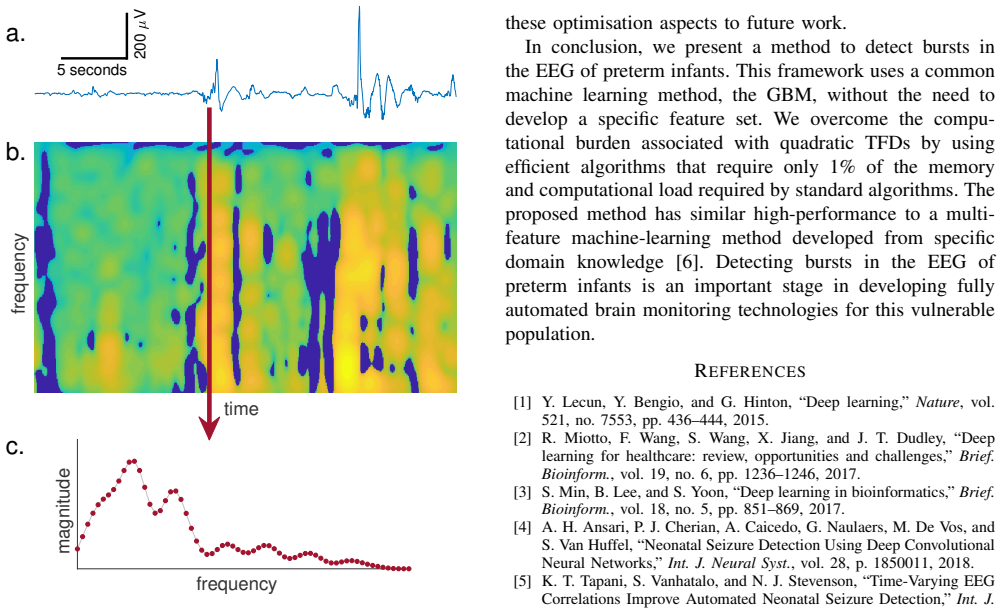
Gradient boosting trained independently on each time slice of the time-frequency distribution of the EEG signal, with an explicit reduction step to control oversampling.
If this is right
- Detection accuracy reaches an AUC of 0.98 with 95 percent median sensitivity and 94 percent median specificity, matching existing multi-feature methods.
- Memory and computational demands drop by more than 99 percent through the controlled oversampling step.
- The method serves as a direct alternative both to deep neural networks and to manual feature engineering for this task.
- The framework applies to any time-series detection problem where a time-frequency view can be formed without additional domain-specific feature design.
Where Pith is reading between the lines
- The slice-wise approach could shorten development time for burst or event detectors in other neonatal or adult EEG applications by removing the need for iterative feature selection.
- Because each time slice is handled separately, the method lends itself to streaming or low-latency implementations in bedside monitors.
- If the same slice-wise gradient boosting pattern works on other biomedical signals such as ECG or EMG, it would reduce reliance on domain experts for initial detector design.
Load-bearing premise
The time-frequency representation alone, when processed slice-by-slice with gradient boosting, already holds all the information required to match the accuracy of a detector built from multiple expert-designed features.
What would settle it
Running the method on a fresh, independent cohort of preterm EEG recordings and finding the area under the curve falls below 0.90 or median sensitivity drops below 85 percent would falsify the claim of comparable performance.
Figures
read the original abstract
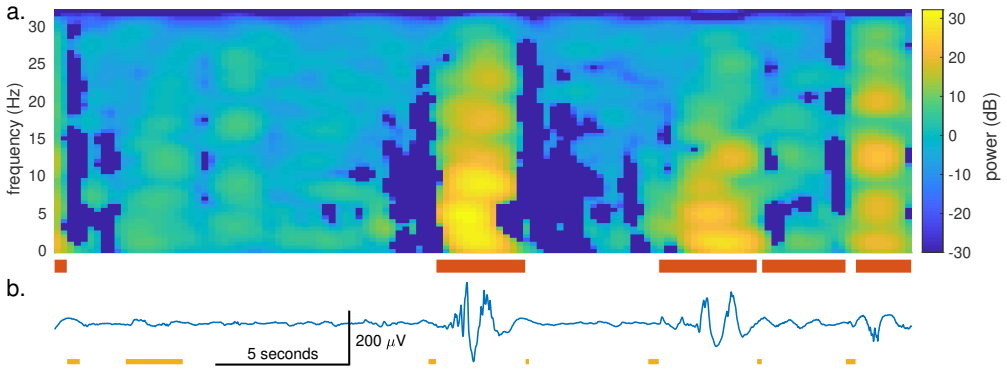
Deep neural networks enable learning directly on the data without the domain knowledge needed to construct a feature set. This approach has been extremely successful in almost all machine learning applications. We propose a new framework that also learns directly from the data, without extracting a feature set. We apply this framework to detecting bursts in the EEG of premature infants. The EEG is recorded within days of birth in a cohort of infants without significant brain injury and born <30 weeks of gestation. The method first transforms the time-domain signal to the time--frequency domain and then trains a machine learning method, a gradient boosting machine, on each time-slice of the time--frequency distribution. We control for oversampling the time--frequency distribution with a significant reduction (<1%) in memory and computational complexity. The proposed method achieves similar accuracy to an existing multi-feature approach: area under the characteristic curve of 0.98 (with 95% confidence interval of 0.96 to 0.99), with a median sensitivity of 95% and median specificity of 94%. The proposed framework presents an accurate, simple, and computational efficient implementation as an alternative to both the deep learning approach and to the manual generation of a feature set.
Editorial analysis
A structured set of objections, weighed in public.
Referee Report
Summary. The paper proposes a framework for burst detection in preterm infant EEG that transforms the time-domain signal to a time-frequency representation and applies a gradient boosting machine independently to each time slice of the distribution. It claims this achieves performance equivalent to an existing multi-feature detector, with AUC 0.98 (95% CI 0.96-0.99), median sensitivity 95%, and median specificity 94%, while avoiding manual feature engineering and deep learning, and with reduced computational cost via oversampling control.
Significance. If validated, the result would demonstrate that a simple per-slice TF+GBM pipeline can match expert-designed multi-feature detectors for this task, offering a low-complexity alternative that reduces reliance on domain knowledge for feature construction. The reported memory/complexity reduction (<1%) is a concrete practical strength.
major comments (2)
- [Methods/Results] Methods/Results: The manuscript provides no description of the data partitioning, cross-validation folds, or exact protocol used to compute and compare the AUC, sensitivity, and specificity against the multi-feature baseline (including whether the baseline was re-implemented on the same splits). This detail is load-bearing for the central equivalence claim.
- [Methods] Methods: The per-slice GBM design omits any cross-slice or sequence-level features (e.g., burst duration or inter-burst interval continuity). No ablation study or analysis tests whether temporal dependencies are implicitly captured or whether performance would hold on datasets where such features are critical, leaving the weakest assumption unexamined.
minor comments (2)
- [Abstract] Abstract and text: The phrase 'area under the characteristic curve' should be corrected to 'area under the receiver operating characteristic curve' for standard terminology.
- [Introduction/Methods] The manuscript should include a reference or brief description of the 'existing multi-feature approach' used for comparison to allow readers to assess the baseline.
Simulated Author's Rebuttal
We thank the referee for their detailed and constructive review. We address each major comment below. Where the manuscript is incomplete, we will revise accordingly.
read point-by-point responses
-
Referee: [Methods/Results] Methods/Results: The manuscript provides no description of the data partitioning, cross-validation folds, or exact protocol used to compute and compare the AUC, sensitivity, and specificity against the multi-feature baseline (including whether the baseline was re-implemented on the same splits). This detail is load-bearing for the central equivalence claim.
Authors: We agree that the absence of these details weakens the central claim. The original manuscript omitted a description of the partitioning protocol. In revision we will add a Methods subsection that specifies the cross-validation scheme (subject-wise partitioning), the number of folds, how AUC/sensitivity/specificity were aggregated, and explicit confirmation that the multi-feature baseline was re-run on identical splits. This will make the equivalence result reproducible and address the referee's concern directly. revision: yes
-
Referee: [Methods] Methods: The per-slice GBM design omits any cross-slice or sequence-level features (e.g., burst duration or inter-burst interval continuity). No ablation study or analysis tests whether temporal dependencies are implicitly captured or whether performance would hold on datasets where such features are critical, leaving the weakest assumption unexamined.
Authors: The framework is deliberately per-slice to avoid manual sequence features. On the reported preterm EEG cohort the per-slice model already reaches AUC 0.98, indicating that slice-wise time-frequency patterns suffice for this population. We did not conduct an ablation on temporal continuity because the study focus was on removing feature engineering rather than comparing against sequence models. We will add a short discussion paragraph acknowledging that the approach may require augmentation on datasets where burst-duration statistics are decisive, but we maintain that the current design meets the paper's stated goal of a low-complexity, feature-free alternative. revision: partial
Circularity Check
No significant circularity; empirical ML pipeline compared to external baseline
full rationale
The paper applies a standard time-frequency transform followed by independent per-slice gradient boosting classification to EEG data and reports empirical performance (AUC 0.98) against an external multi-feature detector. No equations, derivations, or self-citations reduce the reported metrics or method to fitted parameters or inputs by construction. The central claim rests on direct data-driven evaluation rather than any self-referential reduction.
Axiom & Free-Parameter Ledger
axioms (1)
- domain assumption Time-frequency representation preserves all burst-relevant information without loss relative to expert features.
Reference graph
Works this paper leans on
-
[1]
Y . Lecun, Y . Bengio, and G. Hinton, “Deep learning,” Nature, vol. 521, no. 7553, pp. 436–444, 2015
work page 2015
-
[2]
Deep learning for healthcare: review, opportunities and challenges,
R. Miotto, F. Wang, S. Wang, X. Jiang, and J. T. Dudley, “Deep learning for healthcare: review, opportunities and challenges,” Brief. Bioinform., vol. 19, no. 6, pp. 1236–1246, 2017
work page 2017
-
[3]
Deep learning in bioinformatics,
S. Min, B. Lee, and S. Yoon, “Deep learning in bioinformatics,” Brief. Bioinform., vol. 18, no. 5, pp. 851–869, 2017
work page 2017
-
[4]
Neonatal Seizure Detection Using Deep Convolutional Neural Networks,
A. H. Ansari, P. J. Cherian, A. Caicedo, G. Naulaers, M. De V os, and S. Van Huffel, “Neonatal Seizure Detection Using Deep Convolutional Neural Networks,” Int. J. Neural Syst. , vol. 28, p. 1850011, 2018
work page 2018
-
[5]
Time-Varying EEG Correlations Improve Automated Neonatal Seizure Detection,
K. T. Tapani, S. Vanhatalo, and N. J. Stevenson, “Time-Varying EEG Correlations Improve Automated Neonatal Seizure Detection,” Int. J. Neural Syst. , p. 1850030, 2018
work page 2018
-
[6]
Detecting bursts in the EEG of very and extremely premature infants using a multi-feature approach,
J. M. O’Toole, G. B. Boylan, R. O. Lloyd, R. M. Goulding, S. Van- hatalo, and N. J. Stevenson, “Detecting bursts in the EEG of very and extremely premature infants using a multi-feature approach,” Med. Eng. Phys. , vol. 45, pp. 42–50, 2017
work page 2017
-
[7]
A review of important EEG features for the assessment of brain maturation in premature infants,
E. Pavlidis, R. O. Lloyd, S. Mathieson, and G. B. Boylan, “A review of important EEG features for the assessment of brain maturation in premature infants,” Acta Paediatr ., vol. 38, no. 1, pp. 42–49, 2017
work page 2017
-
[8]
J. M. O’Toole, G. B. Boylan, S. Vanhatalo, and N. J. Stevenson, “Estimating functional brain maturity in very and extremely preterm neonates using automated analysis of the electroencephalogram,” Clin. Neurophysiol., vol. 127, no. 8, pp. 2910–2918, 2016
work page 2016
-
[9]
B. Boashash, G. Azemi, and J. M. O’ Toole, “Time–frequency processing of nonstationary signals: advanced TFD design to aid diagnosis with highlights from medical applications,” IEEE Signal Process. Mag., vol. 30, no. 6, pp. 108–119, 2013
work page 2013
-
[10]
A new discrete analytic signal for reducing aliasing in the discrete Wigner–Ville distribution,
J. M. O’ Toole, M. Mesbah, and B. Boashash, “A new discrete analytic signal for reducing aliasing in the discrete Wigner–Ville distribution,” IEEE Trans. Signal Process. , vol. 56, no. 11, pp. 5427–5434, 2008
work page 2008
-
[11]
Fast and memory-efficient algo- rithms for computing quadratic time–frequency distributions,
J. M. O’ Toole and B. Boashash, “Fast and memory-efficient algo- rithms for computing quadratic time–frequency distributions,” Appl. Comput. Harmon. Anal. , vol. 35, no. 2, pp. 350–358, 2013
work page 2013
-
[12]
Memory-Efficient Algorithms for Quadratic TFDs,
——, “Memory-Efficient Algorithms for Quadratic TFDs,” in Time– Frequency Signal Analysis and Processing , 2nd ed., B. Boualem, Ed. Academic Press, 2016, ch. 6.6, pp. 374–385
work page 2016
-
[13]
Greedy function aproximation: A gradient boost- ing machine,
B. J. H. Friedman, “Greedy function aproximation: A gradient boost- ing machine,” Ann. Stat. , vol. 29, no. 5, pp. 1189–1232, 2001
work page 2001
-
[14]
XGBoost: A Scalable Tree Boosting System,
T. Chen and C. Guestrin, “XGBoost: A Scalable Tree Boosting System,” in ACM SIGKDD Int. Conf. Knowl. Disc. Data Min. , vol. 42, no. 8. San Francisco: ACM Press, 2016, pp. 785–794
work page 2016
-
[15]
K. Palmu, N. Stevenson, S. Wikstr ¨om, L. Hellstr¨om-Westas, S. Vanhat- alo, and J. M. Palva, “Optimization of an NLEO-based algorithm for automated detection of spontaneous activity transients in early preterm EEG.” Physiol. Meas. , vol. 31, no. 11, pp. N85–93, 2010
work page 2010
-
[16]
N. Koolen, K. Jansen, J. Vervisch, V . Matic, M. De V os, G. Naulaers, and S. Van Huffel, “Line length as a robust method to detect high- activity events: automated burst detection in premature EEG record- ings.” Clin. Neurophysiol., vol. 125, no. 10, pp. 1985–94, 2014
work page 1985
-
[17]
Assessing instanta- neous energy in the EEG: a non-negative, frequency-weighted energy operator,
J. M. O’ Toole, A. Temko, and N. J. Stevenson, “Assessing instanta- neous energy in the EEG: a non-negative, frequency-weighted energy operator,” in Int. Conf. IEEE Eng. Med. Biol. Soc. , Chicago, 2014, pp. 3288–3291
work page 2014
discussion (0)
Sign in with ORCID, Apple, or X to comment. Anyone can read and Pith papers without signing in.