Rate Splitting with Finite Constellations: The Benefits of Interference Exploitation vs Suppression
Pith reviewed 2026-05-24 19:22 UTC · model grok-4.3
The pith
Rate splitting with constructive interference precoding for PSK inputs yields higher ergodic sum-rate than zero-forcing rate splitting or non-rate-splitting in MU-MIMO.
A machine-rendered reading of the paper's core claim, the machinery that carries it, and where it could break.
Core claim
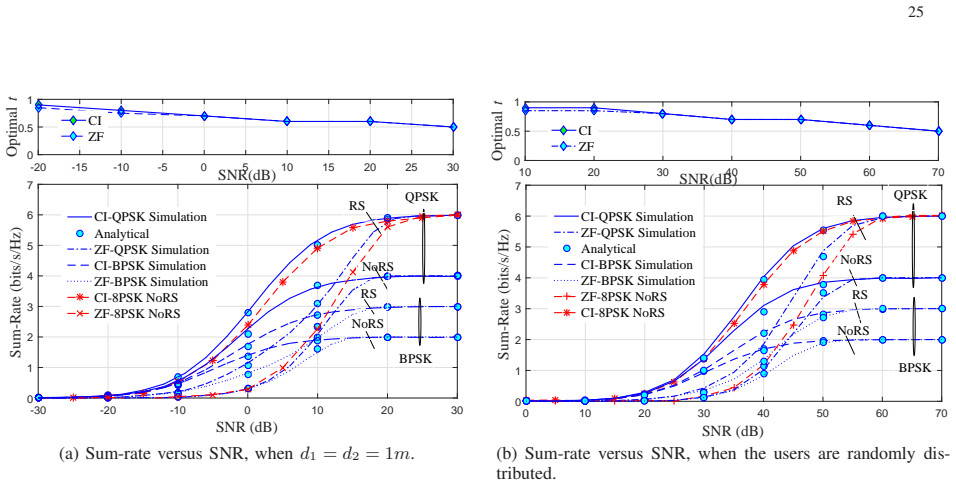
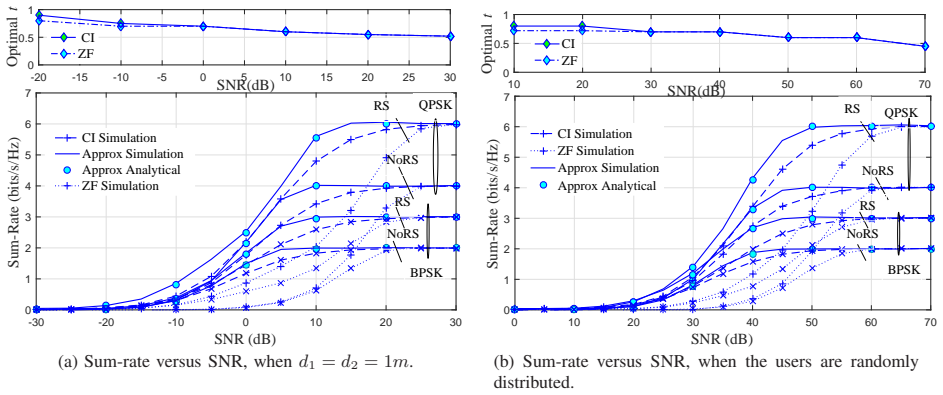
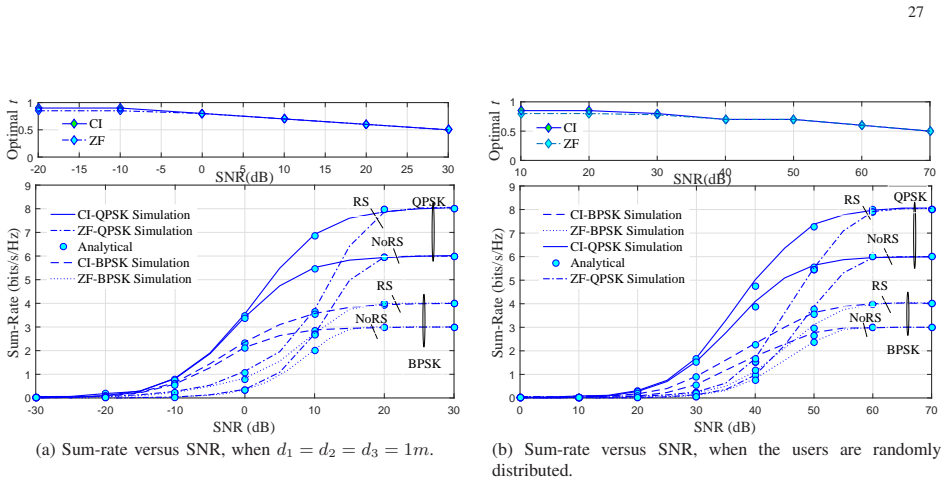
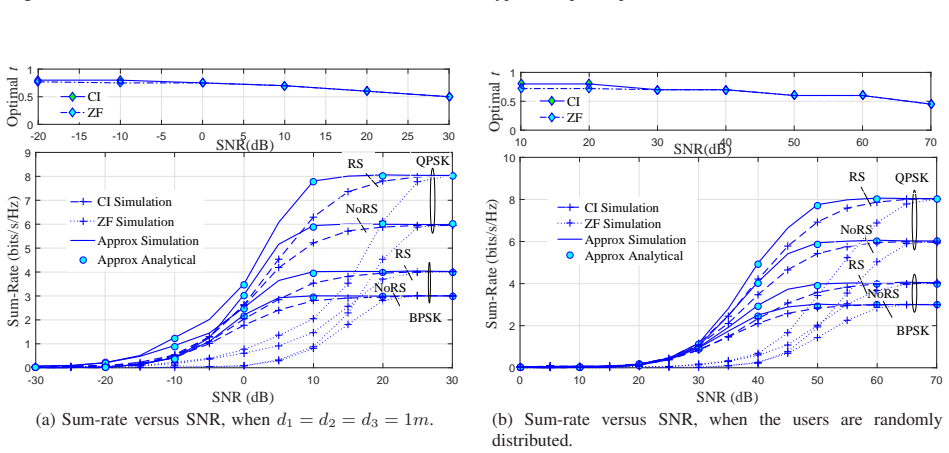
Under phase-shift keying inputs, rate splitting combined with closed-form constructive-interference precoding of the private messages produces higher ergodic sum-rate than rate splitting that uses zero-forcing suppression of the private messages or than transmission without rate splitting; the advantage is shown analytically for perfect CSIT and extended to imperfect CSIT, with a new power-allocation procedure that accounts for the finite alphabet.
What carries the argument
Constructive-interference precoding of the private messages inside the rate-splitting structure, which rotates the interference vectors so they add constructively to the desired signal at each receiver.
If this is right
- RS with CI precoding of private messages outperforms both RS with ZF and NoRS under perfect CSIT.
- The same ordering holds when only imperfect CSIT is available.
- Analytical ergodic sum-rate expressions are obtained in closed form for both the ZF and CI private-message precoders.
- The finite-alphabet power allocation rule produces measurable sum-rate gains relative to conventional linear precoding.
Where Pith is reading between the lines
- The same interference-exploitation logic may extend to other discrete constellations such as QAM once suitable phase-alignment rules are derived.
- Hardware implementations could trade the extra phase-rotation logic for reduced transmit power or fewer antennas while keeping the same rate.
- In systems already using finite alphabets, the benefit of rate splitting may be larger than Gaussian analyses predict because the interference-exploitation gain is explicitly captured.
Load-bearing premise
The novel power allocation derived for the finite-alphabet case is optimal and accounts for the observed performance advantage over zero-forcing rate splitting and non-rate-splitting baselines.
What would settle it
Monte-Carlo simulation of the ergodic sum-rate under the same PSK constellation, channel distribution, and power constraint that shows the proposed rate-splitting constructive-interference scheme with the new power allocation does not exceed the rates of rate-splitting zero-forcing or non-rate-splitting transmission.
Figures
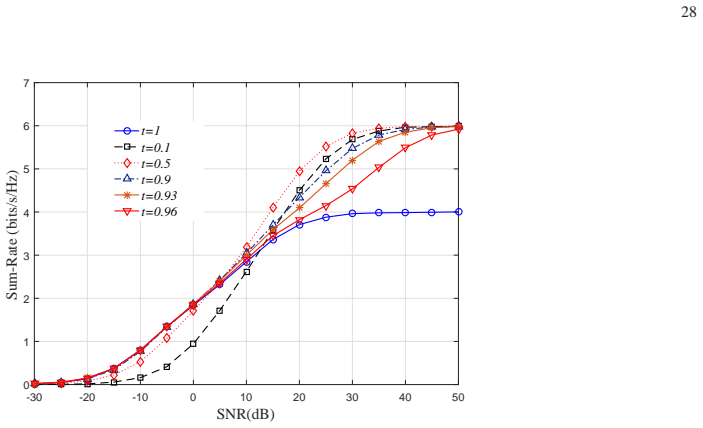
read the original abstract
Rate-Splitting (RS) has been proposed recently to enhance the performance of multi-user multiple-input multiple-output (MU-MIMO) systems. In RS, a user message is split into a common and a private part, where the common part is decoded by all users, while the private part is decoded only by the intended user. In this paper, we study RS under a phase-shift keying (PSK) input alphabet for multi-user multi-antenna system and propose a constructive interference (CI) exploitation approach to further enhance the sum-rate achieved by RS under PSK signaling. To that end, new analytical expressions for the ergodic sum-rate are derived for two precoding techniques of the private messages, namely, 1) a traditional interference suppression zero-forcing (ZF) precoding approach, 2) a closed-form CI precoding approach. Our analysis is presented for perfect channel state information at the transmitter (CSIT), and is extended to imperfect CSIT knowledge. A novel power allocation strategy, specifically suited for the finite alphabet setup, is derived and shown to lead to superior performance for RS over conventional linear precoding not relying on RS (NoRS). The results in this work validate the significant sum-rate gain of RS with CI over the conventional RS with ZF and NoRS.
Editorial analysis
A structured set of objections, weighed in public.
Referee Report
Summary. The paper investigates rate-splitting (RS) in multi-user MIMO systems using phase-shift keying (PSK) finite constellations. It derives new analytical expressions for the ergodic sum-rate under zero-forcing (ZF) and constructive interference (CI) precoding for the private messages, considering both perfect and imperfect channel state information at the transmitter (CSIT). A novel power allocation strategy tailored to finite alphabets is proposed, and numerical results are presented to show that RS with CI achieves significant sum-rate gains compared to RS with ZF and conventional NoRS precoding.
Significance. If the analytical expressions are accurate and the power allocation strategy is effective, this work demonstrates the benefits of interference exploitation in finite-alphabet MU-MIMO systems, providing closed-form tools for performance evaluation that could aid in system design. The comparison between CI and ZF approaches under RS is a useful contribution to understanding interference management with discrete inputs. The derivation of closed-form CI precoder expressions under PSK is a clear strength.
major comments (1)
- [Power allocation strategy] Power allocation strategy (central to abstract and all numerical results): The novel power allocation between common and private streams is presented as specifically derived for the finite-alphabet case and responsible for the claimed superiority over NoRS. However, the manuscript provides no proof of optimality for this allocation in the non-convex finite-alphabet ergodic rate maximization; the split appears obtained via heuristic search or low-dimensional enumeration rather than a globally optimal solution. This assumption is load-bearing for the central claim that RS-CI yields significant gains.
minor comments (2)
- [Imperfect CSIT analysis] The extension of the ergodic rate expressions to imperfect CSIT would benefit from an explicit statement of the error model (e.g., variance of the estimation error) in the relevant section.
- [Numerical results] Figure captions for the sum-rate plots should specify the number of Monte Carlo channel realizations used to generate the curves.
Simulated Author's Rebuttal
We thank the referee for the constructive feedback. We address the sole major comment below.
read point-by-point responses
-
Referee: [Power allocation strategy] Power allocation strategy (central to abstract and all numerical results): The novel power allocation between common and private streams is presented as specifically derived for the finite-alphabet case and responsible for the claimed superiority over NoRS. However, the manuscript provides no proof of optimality for this allocation in the non-convex finite-alphabet ergodic rate maximization; the split appears obtained via heuristic search or low-dimensional enumeration rather than a globally optimal solution. This assumption is load-bearing for the central claim that RS-CI yields significant gains.
Authors: We agree that the optimization is non-convex and that a closed-form global optimum is unavailable. The allocation is obtained by a one-dimensional numerical search over the common-stream power fraction using the derived ergodic-rate expressions (exact for PSK), which is computationally tractable. This procedure is tailored to finite alphabets because it employs the constellation-specific mutual-information expressions rather than Gaussian approximations. We do not claim global optimality but demonstrate consistent gains over NoRS. We will revise the manuscript to explicitly describe the numerical search method and its motivation in Section IV. revision: yes
Circularity Check
No significant circularity; derivations use standard rate expressions
full rationale
The paper derives closed-form ergodic sum-rate expressions for ZF and CI precoders under PSK inputs using conventional MIMO mutual information formulas and extends them to imperfect CSIT. The novel power allocation is presented as a derived strategy for the finite-alphabet case and validated numerically against baselines, but no step reduces a claimed prediction or result to a quantity defined by the same fitted parameters or self-citation chain. All load-bearing analytical steps rest on external standard techniques rather than internal redefinition or heuristic search renamed as optimality proof. This is the expected self-contained case.
Axiom & Free-Parameter Ledger
free parameters (1)
- power allocation factor between common and private streams
axioms (1)
- domain assumption Standard assumptions on i.i.d. Rayleigh fading channels and additive white Gaussian noise for ergodic rate calculation.
Lean theorems connected to this paper
-
IndisputableMonolith/Cost/FunctionalEquation.leanwashburn_uniqueness_aczel unclear?
unclearRelation between the paper passage and the cited Recognition theorem.
A novel power allocation strategy, specifically suited for the finite alphabet setup, is derived and shown to lead to superior performance for RS over conventional linear precoding not relying on RS (NoRS).
-
IndisputableMonolith/Foundation/RealityFromDistinction.leanreality_from_one_distinction unclear?
unclearRelation between the paper passage and the cited Recognition theorem.
new analytical expressions for the ergodic sum-rate are derived for two precoding techniques of the private messages, namely, 1) a traditional interference suppression zero-forcing (ZF) precoding approach, 2) a closed-form CI precoding approach.
What do these tags mean?
- matches
- The paper's claim is directly supported by a theorem in the formal canon.
- supports
- The theorem supports part of the paper's argument, but the paper may add assumptions or extra steps.
- extends
- The paper goes beyond the formal theorem; the theorem is a base layer rather than the whole result.
- uses
- The paper appears to rely on the theorem as machinery.
- contradicts
- The paper's claim conflicts with a theorem or certificate in the canon.
- unclear
- Pith found a possible connection, but the passage is too broad, indirect, or ambiguous to say the theorem truly supports the claim.
Reference graph
Works this paper leans on
-
[1]
Rate splitting approach under psk signaling using constructive interference precoding technique,
A. Salem and C. Masouros, “Rate splitting approach under psk signaling using constructive interference precoding technique,” in Proc. IEEE Wireless Commun. Netw. Conf. (WCNC) , 2019
work page 2019
-
[2]
M. S. John G. Proakis, Digital Communications, Fifth Edition . McGraw-Hill, NY USA, 2008
work page 2008
-
[3]
C. B. P . Howard Huang and S. V enkatesan, MIMO Communication for cellular Networks . Springer, 2012, 2008
work page 2012
-
[4]
Linear p recoder design for mimo interference channels with finite-alphabet signaling,
Y . Wu, C. Xiao, X. Gao, J. D. Matyjas, and Z. Ding, “Linear p recoder design for mimo interference channels with finite-alphabet signaling,” IEEE Transactions on Communications , vol. 61, no. 9, pp. 3766–3780, September 2013
work page 2013
-
[5]
D. Lee, “Performance analysis of zero-forcing-precode d scheduling system with adaptive modulation for multiuser -multiple input multiple output transmission,” IET Communications , vol. 9, no. 16, pp. 2007–2012, 2015
work page 2007
-
[6]
Wireless power transfer in mult i-pair two-way af relaying networks,
A. Salem and K. A. Hamdi, “Wireless power transfer in mult i-pair two-way af relaying networks,” IEEE Transactions on Communications, vol. 64, no. 11, pp. 4578–4591, Nov 2016
work page 2016
-
[7]
Ra te splitting for mimo wireless networks: a promising phy-la yer strategy for lte evolution,
B. Clerckx, H. Joudeh, C. Hao, M. Dai, and B. Rassouli, “Ra te splitting for mimo wireless networks: a promising phy-la yer strategy for lte evolution,” IEEE Communications Magazine , vol. 54, no. 5, pp. 98–105, May 2016
work page 2016
-
[8]
Robust transmission in downli nk multiuser miso systems: A rate-splitting approach,
H. Joudeh and B. Clerckx, “Robust transmission in downli nk multiuser miso systems: A rate-splitting approach,” IEEE Transactions on Signal Processing , vol. 64, no. 23, pp. 6227–6242, Dec 2016
work page 2016
-
[9]
C. Hao, Y . Wu, and B. Clerckx, “Rate analysis of two-recei ver miso broadcast channel with finite rate feedback: A rate-splitting approach,” IEEE Transactions on Communications , vol. 63, no. 9, pp. 3232–3246, Sept 2015
work page 2015
-
[10]
Rate-splitt ing robustness in multi-pair massive mimo relay systems,
A. Papazafeiropoulos and T. Ratnarajah, “Rate-splitt ing robustness in multi-pair massive mimo relay systems,” IEEE Transactions on Wireless Communications , vol. 17, no. 8, pp. 5623–5636, Aug 2018
work page 2018
-
[11]
H. Joudeh and B. Clerckx, “Sum-rate maximization for li nearly precoded downlink multiuser miso systems with parti al csit: A rate-splitting approach,” IEEE Transactions on Communications , vol. 64, no. 11, pp. 4847–4861, Nov 2016
work page 2016
-
[12]
A rate spli tting strategy for massive mimo with imperfect csit,
M. Dai, B. Clerckx, D. Gesbert, and G. Caire, “A rate spli tting strategy for massive mimo with imperfect csit,” IEEE Transactions on Wireless Communications , vol. 15, no. 7, pp. 4611–4624, July 2016
work page 2016
-
[13]
Miso networks with imperfect csi t: A topological rate-splitting approach,
C. Hao and B. Clerckx, “Miso networks with imperfect csi t: A topological rate-splitting approach,” IEEE Transactions on Communications, vol. 65, no. 5, pp. 2164–2179, May 2017
work page 2017
-
[14]
Rate-splitting for max-min f air multigroup multicast beamforming in overloaded system s,
H. Joudeh and B. Clerckx, “Rate-splitting for max-min f air multigroup multicast beamforming in overloaded system s,” IEEE Transactions on Wireless Communications , vol. 16, no. 11, pp. 7276–7289, Nov 2017
work page 2017
-
[15]
Y . Mao, B. Clerckx, and V . O. Li, “Rate-splitting multip le access for downlink communication systems: bridging, generalizing, and outperforming sdma and noma,” EURASIP Journal on Wireless Communications and Networking , vol. 2018, no. 1, p. 133, May 2018. [Online]. Available: https:// doi.org/10.1186/s13638-018-1104-7
-
[16]
Dynamic linear precoding fo r the exploitation of known interference in mimo broadcast systems,
C. Masouros and E. Alsusa, “Dynamic linear precoding fo r the exploitation of known interference in mimo broadcast systems,” IEEE Transactions on Wireless Communications , vol. 8, no. 3, pp. 1396–1404, March 2009. 30
work page 2009
-
[17]
V ecto r perturbation based on symbol scaling for limited feedback miso downlinks,
C. Masouros, M. Sellathurai, and T. Ratnarajah, “V ecto r perturbation based on symbol scaling for limited feedback miso downlinks,” IEEE Transactions on Signal Processing , vol. 62, no. 3, pp. 562–571, Feb 2014
work page 2014
-
[18]
Exploiting known interferen ce as green signal power for downlink beamforming optimizat ion,
C. Masouros and G. Zheng, “Exploiting known interferen ce as green signal power for downlink beamforming optimizat ion,” IEEE Transactions on Signal Processing , vol. 63, no. 14, pp. 3628–3640, July 2015
work page 2015
-
[19]
S. Timotheou, G. Zheng, C. Masouros, and I. Krikidis, “E xploiting constructive interference for simultaneous wir eless information and power transfer in multiuser downlink syste ms,” IEEE Journal on Selected Areas in Communications , vol. 34, no. 5, pp. 1772–1784, May 2016
work page 2016
-
[20]
Construc tive multiuser interference in symbol level precoding for t he miso downlink channel,
M. Alodeh, S. Chatzinotas, and B. Ottersten, “Construc tive multiuser interference in symbol level precoding for t he miso downlink channel,” IEEE Transactions on Signal Processing , vol. 63, no. 9, pp. 2239–2252, May 2015
work page 2015
-
[21]
Symbol- level precoding design based on distance preserving constr uctive interference regions,
A. Haqiqatnejad, F. Kayhan, and B. Ottersten, “Symbol- level precoding design based on distance preserving constr uctive interference regions,” IEEE Transactions on Signal Processing , vol. 66, no. 22, pp. 5817–5832, Nov 2018
work page 2018
-
[22]
Constructive interference for generic constella tions,
——, “Constructive interference for generic constella tions,” IEEE Signal Processing Letters , vol. 25, no. 4, pp. 586–590, April 2018
work page 2018
-
[23]
Constru ctive interference based secure precoding: A new dimension in physical layer security,
M. R. A. Khandaker, C. Masouros, and K. K. Wong, “Constru ctive interference based secure precoding: A new dimension in physical layer security,” IEEE Transactions on Information F orensics and Security , vol. 13, no. 9, pp. 2256–2268, Sept 2018
work page 2018
-
[24]
Large scale antenna sele ction and precoding for interference exploitation,
P . V . Amadori and C. Masouros, “Large scale antenna sele ction and precoding for interference exploitation,” IEEE Transactions on Communications , vol. 65, no. 10, pp. 4529–4542, Oct 2017
work page 2017
-
[25]
A. Li and C. Masouros, “Interference exploitation prec oding made practical: Optimal closed-form solutions for ps k modulations,” IEEE Transactions on Wireless Communications , pp. 1–1, 2018
work page 2018
-
[26]
R. J. Muirhead, Aspects of Multivariate Statistical Theory , 1982
work page 1982
-
[27]
Cooperativ e multi-cell mimo downlink precoding with finite-alphabet inputs,
W. Wu, K. Wang, W. Zeng, Z. Ding, and C. Xiao, “Cooperativ e multi-cell mimo downlink precoding with finite-alphabet inputs,” IEEE Transactions on Communications , vol. 63, no. 3, pp. 766–779, March 2015
work page 2015
-
[28]
Linear precoder design for mimo interference channels with finite-alphabet signaling,
Y . Wu, C. Xiao, X. Gao, J. D. Matyjas, and Z. Ding, “Linear precoder design for mimo interference channels with finite-alphabet signaling,” IEEE Transactions on Communications , vol. 61, no. 9, pp. 3766–3780, September 2013
work page 2013
-
[29]
Linear preco ding for mimo broadcast channels with finite-alphabet constraints,
Y . Wu, M. Wang, C. Xiao, Z. Ding, and X. Gao, “Linear preco ding for mimo broadcast channels with finite-alphabet constraints,” IEEE Transactions on Wireless Communications , vol. 11, no. 8, pp. 2906–2920, August 2012
work page 2012
-
[30]
M. Abramowitz and I. A. Stegun, Handbook of Mathematical Functions With F ormulas, Graphs, and Mathematical Tabl , Washington,D.C.: U.S. Dept. Commerce, 1972
work page 1972
-
[31]
——, Handbook of Mathematical Functions With F ormulas, Graphs, and Mathematical Tabl, Washington,D.C.: U.S. Dept. Commerce, 1972
work page 1972
-
[32]
Energy and s pectral efficiency of very large multiuser mimo systems,
H. Q. Ngo, E. G. Larsson, and T. L. Marzetta, “Energy and s pectral efficiency of very large multiuser mimo systems,” IEEE Transactions on Communications , vol. 61, no. 4, pp. 1436–1449, April 2013
work page 2013
-
[33]
Area spectral efficien cy of cellular mobile radio systems,
M. . Alouini and A. J. Goldsmith, “Area spectral efficien cy of cellular mobile radio systems,” IEEE Transactions on V ehicular Technology, vol. 48, no. 4, pp. 1047–1066, July 1999
work page 1999
-
[34]
Sum throughput maximization for multi-user mimo cognitive wireless power ed communication networks,
J. Kim, H. Lee, C. Song, T. Oh, and I. Lee, “Sum throughput maximization for multi-user mimo cognitive wireless power ed communication networks,” IEEE Transactions on Wireless Communications , vol. 16, no. 2, pp. 913–923, Feb 2017
work page 2017
discussion (0)
Sign in with ORCID, Apple, or X to comment. Anyone can read and Pith papers without signing in.