ITMD factorization and broadening effects in production of forward di-jets
Pith reviewed 2026-05-24 18:57 UTC · model grok-4.3
The pith
ITMD calculations require broadening from gluon saturation and Sudakov resummation to describe ATLAS forward di-jet data.
A machine-rendered reading of the paper's core claim, the machinery that carries it, and where it could break.
Core claim
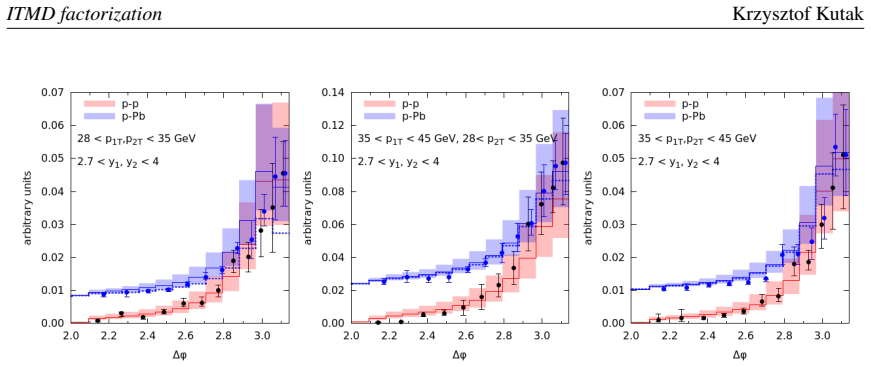
The comparison shows that the broadening effect due to interplay of both the gluon saturation and the Sudakov resummation is necessary to describe the data.
What carries the argument
ITMD factorization framework applied to forward di-jet azimuthal correlations, incorporating gluon saturation in TMD distributions together with Sudakov resummation for broadening.
If this is right
- Models omitting either gluon saturation or Sudakov resummation will underpredict the azimuthal broadening seen in forward di-jets.
- The same interplay should affect other small-x observables measured in proton-nucleus collisions.
- Nuclear enhancement of broadening in p-Pb data provides a direct test of saturation contributions.
- The framework allows extraction of small-x gluon distributions once the broadening is properly accounted for.
Where Pith is reading between the lines
- The result suggests that similar combined treatments will be needed for other processes like forward hadron or photon production at the LHC.
- It implies that pure saturation models without resummation, or pure perturbative calculations without saturation, are incomplete for forward kinematics.
- Future higher-precision measurements at the LHC or EIC could isolate the relative size of each broadening source.
Load-bearing premise
That mismatches between ITMD results and data arise specifically from missing saturation-Sudakov broadening rather than other unmodeled effects or experimental uncertainties.
What would settle it
New data or refined analysis showing that ITMD predictions with saturation and Sudakov broadening still deviate significantly from the measured azimuthal distributions beyond uncertainties.
Figures
read the original abstract
I report on the recent result of comparison of forward-forward dijet correlations in azimuthal angle as measured by the ATLAS collaboration in the proton-proton and proton-lead collisions to calculations within ITMD factorization framework [1]. The comparison shows that the broadening effect due to interplay of both the gluon saturation and the Sudakov resummation is necessary to describe the data.
Editorial analysis
A structured set of objections, weighed in public.
Referee Report
Summary. The manuscript compares forward-forward dijet azimuthal correlations measured by ATLAS in pp and pPb collisions to calculations performed in the ITMD factorization framework. It concludes that the broadening effect due to the interplay of gluon saturation and Sudakov resummation is necessary to describe the data.
Significance. If the central claim is robust, the result would provide evidence that both saturation and Sudakov effects must be included simultaneously to model forward dijet decorrelation at the LHC, offering a potential constraint on small-x gluon distributions in a kinematic regime where both effects are relevant.
major comments (2)
- [Results and comparison section (exact section number not specified in provided text)] The necessity claim for broadening rests on the assumption that mismatches between data and the ITMD baseline (without saturation+Sudakov broadening) are specifically due to the omitted broadening rather than other unmodeled effects. The manuscript should include explicit side-by-side comparisons (with/without broadening) together with quantitative measures such as χ² per degree of freedom or residual plots to demonstrate that alternative adjustments (e.g., different UGD parametrizations or scale choices) cannot restore agreement.
- [Theoretical framework and numerical setup] The ITMD framework implementation requires specification of the unintegrated gluon distributions, kinematic cuts, and factorization/renormalization scale choices used for the baseline calculations. Without variation of these inputs or an assessment of their impact on the azimuthal decorrelation, it remains unclear whether the observed discrepancy is uniquely attributable to missing broadening.
minor comments (1)
- [Abstract] The abstract states the conclusion but does not indicate the specific observables (e.g., Δφ distributions or moments) or collision systems used in the comparison; this should be clarified for readers.
Simulated Author's Rebuttal
We thank the referee for the constructive comments on our manuscript comparing ATLAS forward dijet data to ITMD factorization. The points raised concern the robustness of attributing discrepancies to broadening effects and the need for more explicit documentation of the numerical setup. We address each major comment below and indicate where revisions will be made.
read point-by-point responses
-
Referee: The necessity claim for broadening rests on the assumption that mismatches between data and the ITMD baseline (without saturation+Sudakov broadening) are specifically due to the omitted broadening rather than other unmodeled effects. The manuscript should include explicit side-by-side comparisons (with/without broadening) together with quantitative measures such as χ² per degree of freedom or residual plots to demonstrate that alternative adjustments (e.g., different UGD parametrizations or scale choices) cannot restore agreement.
Authors: We agree that strengthening the uniqueness of the broadening interpretation requires more explicit comparisons. The original manuscript presents the ITMD baseline without broadening and the version including saturation plus Sudakov effects, but does not include χ² values or residual plots. In the revised version we will add side-by-side azimuthal correlation plots (with and without broadening) for both pp and pPb data sets, together with χ² per degree of freedom for each case. A comprehensive scan over all alternative UGD parametrizations lies outside the scope of the present study; however, we will discuss the sensitivity to the two main UGD choices employed and note that scale variations alone do not restore agreement with the data in the region where broadening is relevant. revision: partial
-
Referee: The ITMD framework implementation requires specification of the unintegrated gluon distributions, kinematic cuts, and factorization/renormalization scale choices used for the baseline calculations. Without variation of these inputs or an assessment of their impact on the azimuthal decorrelation, it remains unclear whether the observed discrepancy is uniquely attributable to missing broadening.
Authors: The manuscript references the specific ITMD implementation and the UGD parametrizations used, but we acknowledge that a consolidated description of the numerical setup is missing. In the revision we will add a dedicated paragraph (or subsection) that explicitly lists: (i) the UGD parametrizations and their parameters, (ii) the kinematic cuts applied to match the ATLAS forward dijet selection, and (iii) the default factorization and renormalization scale choices. We will also include a short assessment of scale variation (varying μ by a factor of two) and its effect on the azimuthal decorrelation, showing that such variations do not eliminate the need for the broadening term. revision: yes
Circularity Check
No significant circularity in phenomenological data comparison
full rationale
The paper performs a comparison of existing ITMD factorization calculations (referenced to prior work) against external ATLAS data on di-jet azimuthal correlations. The claim that broadening from saturation and Sudakov effects is necessary follows directly from the degree of agreement or mismatch with that independent dataset. No derivation, ansatz, or prediction is constructed within the paper that reduces by definition or self-citation to its own inputs; the result is externally falsifiable against measured data rather than self-referential.
Axiom & Free-Parameter Ledger
Reference graph
Works this paper leans on
-
[1]
A. van Hameren, P. Kotko, K. Kutak, and S. Sapeta, “Broadening and saturation effects in dijet azimuthal correlations in p-p and p-Pb collisions at√s = 5.02 TeV,” Phys. Lett., vol. B795, pp. 511–515, 2019
work page 2019
-
[2]
Gluon saturation and initial conditions for relativistic heavy ion collisions,
J. L. Albacete and C. Marquet, “Gluon saturation and initial conditions for relativistic heavy ion collisions,” Prog. Part. Nucl. Phys., vol. 76, pp. 1–42, 2014
work page 2014
-
[3]
M. Aaboud et al., “Dijet azimuthal correlations and conditional yields in pp and p+Pb collisions at√sNN = 5.02 TeV with the ATLAS detector,” 2019
work page 2019
-
[4]
Y . V . Kovchegov and E. Levin,Quantum chromodynamics at high energy, vol. 33. Cambridge University Press, 2012
work page 2012
-
[5]
F. Gelis, E. Iancu, J. Jalilian-Marian, and R. Venugopalan, “The Color Glass Condensate,” Ann. Rev. Nucl. Part. Sci., vol. 60, pp. 463–489, 2010
work page 2010
-
[6]
The Color glass condensate and hadron production in the forward region,
A. Dumitru, A. Hayashigaki, and J. Jalilian-Marian, “The Color glass condensate and hadron production in the forward region,” Nucl. Phys., vol. A765, pp. 464–482, 2006
work page 2006
-
[7]
Forward inclusive dijet production and azimuthal correlations in p(A) collisions,
C. Marquet, “Forward inclusive dijet production and azimuthal correlations in p(A) collisions,” Nucl. Phys., vol. A796, pp. 41–60, 2007
work page 2007
-
[8]
Universality of Unintegrated Gluon Distributions at small x,
F. Dominguez, C. Marquet, B.-W. Xiao, and F. Yuan, “Universality of Unintegrated Gluon Distributions at small x,” Phys. Rev., vol. D83, p. 105005, 2011
work page 2011
-
[9]
Improved TMD factorization for forward dijet production in dilute-dense hadronic collisions,
P. Kotko, K. Kutak, C. Marquet, E. Petreska, S. Sapeta, and A. van Hameren, “Improved TMD factorization for forward dijet production in dilute-dense hadronic collisions,” JHEP, vol. 09, p. 106, 2015
work page 2015
-
[10]
High-energy factorization and small x heavy flavor production,
S. Catani, M. Ciafaloni, and F. Hautmann, “High-energy factorization and small x heavy flavor production,” Nucl. Phys., vol. B366, pp. 135–188, 1991
work page 1991
-
[11]
Heavy quark production in very high-energy hadron collisions,
J. C. Collins and R. K. Ellis, “Heavy quark production in very high-energy hadron collisions,” Nucl. Phys., vol. B360, pp. 3–30, 1991
work page 1991
-
[12]
Forward Jet Production at the Large Hadron Collider,
M. Deak, F. Hautmann, H. Jung, and K. Kutak, “Forward Jet Production at the Large Hadron Collider,” JHEP, vol. 09, p. 121, 2009
work page 2009
-
[13]
Interplay of the CGC and TMD frameworks to all orders in kinematic twist,
T. Altinoluk, R. Boussarie, and P. Kotko, “Interplay of the CGC and TMD frameworks to all orders in kinematic twist,” 2019
work page 2019
-
[14]
TMD gluon distributions for multiparton processes,
M. Bury, P. Kotko, and K. Kutak, “TMD gluon distributions for multiparton processes,” 2018
work page 2018
-
[15]
TMD factorization for dijets + photon production from the dilute-dense CGC framework,
T. Altinoluk, R. Boussarie, C. Marquet, and P. Taels, “TMD factorization for dijets + photon production from the dilute-dense CGC framework,” 2018
work page 2018
-
[16]
Forward di-jet production in p+Pb collisions in the small-x improved TMD factorization framework,
A. van Hameren, P. Kotko, K. Kutak, C. Marquet, E. Petreska, and S. Sapeta, “Forward di-jet production in p+Pb collisions in the small-x improved TMD factorization framework,” JHEP, vol. 12, p. 034, 2016
work page 2016
-
[17]
P. Kotko, K. Kutak, S. Sapeta, A. M. Stasto, and M. Strikman, “Estimating nonlinear effects in forward dijet production in ultra-peripheral heavy ion collisions at the LHC,” Eur . Phys. J., vol. C77, no. 5, p. 353, 2017. 4 ITMD factorization Krzysztof Kutak
work page 2017
-
[18]
Forward dihadron back-to-back correlations in pA collisions,
J. L. Albacete, G. Giacalone, C. Marquet, and M. Matas, “Forward dihadron back-to-back correlations in pA collisions,” Phys. Rev., vol. D99, no. 1, p. 014002, 2019
work page 2019
-
[19]
Small-x dynamics in forward-central dijet decorrelations at the LHC,
A. van Hameren, P. Kotko, K. Kutak, and S. Sapeta, “Small-x dynamics in forward-central dijet decorrelations at the LHC,” Phys. Lett., vol. B737, pp. 335–340, 2014
work page 2014
-
[20]
Resummation effects in the forward production of Z0+jet at the LHC,
A. van Hameren, P. Kotko, and K. Kutak, “Resummation effects in the forward production of Z0+jet at the LHC,” Phys. Rev., vol. D92, no. 5, p. 054007, 2015
work page 2015
-
[21]
Sudakov Resummation in Small-x Saturation Formalism,
A. H. Mueller, B.-W. Xiao, and F. Yuan, “Sudakov Resummation in Small-x Saturation Formalism,” Phys. Rev. Lett., vol. 110, no. 8, p. 082301, 2013
work page 2013
-
[22]
Sudakov double logarithms resummation in hard processes in the small-x saturation formalism,
A. H. Mueller, B.-W. Xiao, and F. Yuan, “Sudakov double logarithms resummation in hard processes in the small-x saturation formalism,” Phys. Rev., vol. D88, no. 11, p. 114010, 2013
work page 2013
-
[23]
Soft Gluon Resummations in Dijet Azimuthal Angular Correlations in Hadronic Collisions,
P. Sun, C. P. Yuan, and F. Yuan, “Soft Gluon Resummations in Dijet Azimuthal Angular Correlations in Hadronic Collisions,” Phys. Rev. Lett., vol. 113, no. 23, p. 232001, 2014
work page 2014
-
[24]
Sudakov Resummations in Mueller-Navelet Dijet Production,
A. H. Mueller, L. Szymanowski, S. Wallon, B.-W. Xiao, and F. Yuan, “Sudakov Resummations in Mueller-Navelet Dijet Production,” JHEP, vol. 03, p. 096, 2016
work page 2016
-
[25]
The evolution of the small x gluon TMD,
J. Zhou, “The evolution of the small x gluon TMD,” JHEP, vol. 06, p. 151, 2016
work page 2016
-
[26]
Transverse Momentum Dependent Parton Distributions at Small-x,
B.-W. Xiao, F. Yuan, and J. Zhou, “Transverse Momentum Dependent Parton Distributions at Small-x,” Nucl. Phys., vol. B921, pp. 104–126, 2017
work page 2017
-
[27]
Sudakov suppression of the Balitsky-Kovchegov kernel,
D.-X. Zheng and J. Zhou, “Sudakov suppression of the Balitsky-Kovchegov kernel,” 2019
work page 2019
-
[28]
Hard scale dependent gluon density, saturation and forward-forward dijet production at the LHC,
K. Kutak, “Hard scale dependent gluon density, saturation and forward-forward dijet production at the LHC,” Phys. Rev., vol. D91, no. 3, p. 034021, 2015
work page 2015
-
[29]
Multi-gluon helicity amplitudes with one off-shell leg within high energy factorization,
A. van Hameren, P. Kotko, and K. Kutak, “Multi-gluon helicity amplitudes with one off-shell leg within high energy factorization,” JHEP, vol. 12, p. 029, 2012
work page 2012
-
[30]
Helicity amplitudes for high-energy scattering,
A. van Hameren, P. Kotko, and K. Kutak, “Helicity amplitudes for high-energy scattering,” JHEP, vol. 01, p. 078, 2013
work page 2013
-
[31]
Wilson lines and gauge invariant off-shell amplitudes,
P. Kotko, “Wilson lines and gauge invariant off-shell amplitudes,” JHEP, vol. 07, p. 128, 2014
work page 2014
-
[32]
Feynman rules for effective Regge action,
E. N. Antonov, L. N. Lipatov, E. A. Kuraev, and I. O. Cherednikov, “Feynman rules for effective Regge action,” Nucl. Phys., vol. B721, pp. 111–135, 2005
work page 2005
-
[33]
TMD gluon distributions at small x in the CGC theory,
E. Petreska, “TMD gluon distributions at small x in the CGC theory,” Int. J. Mod. Phys., vol. E27, no. 05, p. 1830003, 2018
work page 2018
-
[34]
Gluon saturation in dijet production in p-Pb collisions at Large Hadron Collider,
K. Kutak and S. Sapeta, “Gluon saturation in dijet production in p-Pb collisions at Large Hadron Collider,” Phys. Rev., vol. D86, p. 094043, 2012. 5
work page 2012
discussion (0)
Sign in with ORCID, Apple, or X to comment. Anyone can read and Pith papers without signing in.