Circularly Symmetric Light Waves: An Overview
Pith reviewed 2026-05-24 18:47 UTC · model grok-4.3
The pith
An operator approach based on the two-dimensional rotation group classifies all families of vortex solutions to the homogeneous Helmholtz equation.
A machine-rendered reading of the paper's core claim, the machinery that carries it, and where it could break.
Core claim
All possible families of vortex solutions to the homogeneous Helmholtz equation, in both scalar and vector forms, can be generated and analyzed through an operator approach that makes explicit their connection to the two-dimensional rotation group; this same approach yields the propagation properties of the most studied paraxial OAM beams.
What carries the argument
The operator approach tied to the two-dimensional rotation group, which produces the solutions as eigenfunctions of the angular momentum operator and organizes their scalar and vector families.
If this is right
- Every scalar and vector vortex solution belongs to a family generated by the rotation-group operators.
- Propagation characteristics of paraxial OAM beams follow directly from the same group-theoretic construction.
- The scalar and vector cases share an intimate structural link through the angular-momentum operators.
- The framework applies to the full homogeneous Helmholtz equation, not only its paraxial limit.
Where Pith is reading between the lines
- Design of new beams could proceed by choosing operators rather than solving the wave equation from scratch.
- Similar symmetry methods might classify vortex solutions in other linear wave equations that share rotational invariance.
- Extensions to inhomogeneous or bounded media would require additional operators beyond the free-space rotation group.
Load-bearing premise
Operators from the two-dimensional rotation group alone suffice to generate and classify every vortex solution to the homogeneous Helmholtz equation.
What would settle it
A concrete vortex solution to the homogeneous Helmholtz equation whose form or propagation cannot be obtained from any operator constructed from the two-dimensional rotation group.
Figures


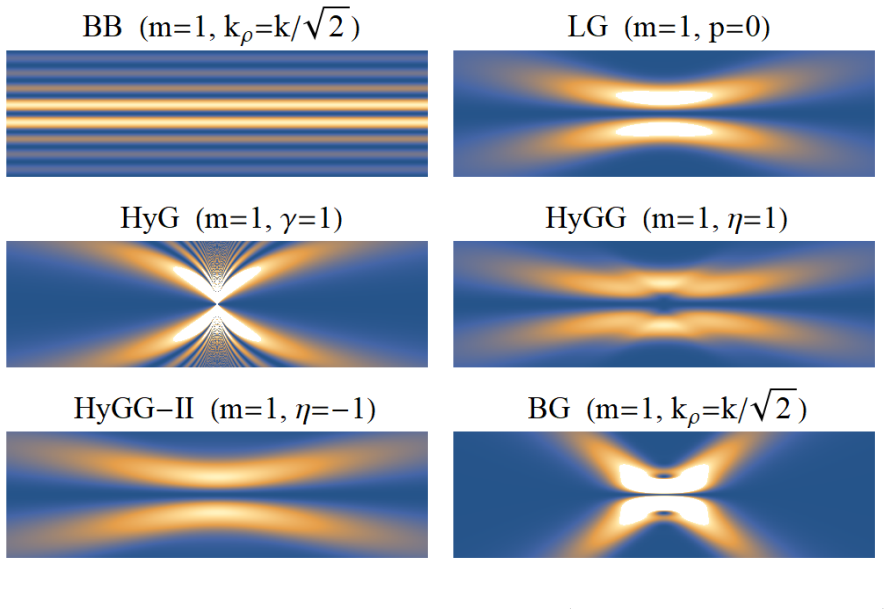


read the original abstract
Orbital Angular Momentum (OAM) waves were first recognized as those specific vortex solutions of the paraxial Helmholtz equation for which the orbital contribution to the total angular momentum of the beam yields an integer multiple of $\hbar$ along the propagation direction. However, this class of solutions can be generalized to include more sophisticated vector vortex waves with coupled polarization and spatial complexity, that are eigenfunctions of the third component of the angular momentum operator. In this work, a rigorous framework is proposed for the analysis of all the possible families of vortex solutions to the homogeneous Helmholtz equation. Both the scalar and vector cases are studied in depth, making use of an operator approach which emphasizes their intimate connection with the two-dimensional rotation group. Furthermore, a special focus is given to the characterization of the propagation properties of the most popular families of paraxial OAM beams.
Editorial analysis
A structured set of objections, weighed in public.
Referee Report
Summary. The manuscript proposes a rigorous framework for classifying all families of vortex solutions (scalar and vector) to the homogeneous Helmholtz equation via an operator approach tied to the two-dimensional rotation group SO(2), with additional focus on the propagation properties of common paraxial OAM beams such as those generalizing Bessel and Laguerre-Gaussian modes.
Significance. If the operator method yields a complete, symmetry-based taxonomy that recovers known families without ad-hoc assumptions and clarifies their angular-momentum eigenfunction properties, the work would offer a useful unifying perspective for structured-light research, though its novelty would rest on the depth of synthesis rather than new derivations.
minor comments (3)
- The abstract states that the framework is 'rigorous' and studies cases 'in depth,' yet the provided text contains no explicit derivations, operator definitions, or validation against known solutions; if the full manuscript similarly lacks these, the central claim of a new framework requires explicit equations in §2 or §3 to be load-bearing.
- Clarify the precise scope: the abstract limits the treatment to the homogeneous Helmholtz equation, but the title refers to 'Circularly Symmetric Light Waves' more broadly; add a sentence in the introduction distinguishing free-space homogeneous cases from guided or inhomogeneous media.
- Figure captions and axis labels for any propagation plots should explicitly state the normalization and the value of the azimuthal index m used, to allow direct comparison with standard Bessel or LG literature.
Simulated Author's Rebuttal
We thank the referee for their positive assessment of the manuscript, the recognition of its unifying perspective on vortex solutions via the SO(2) operator approach, and the recommendation for minor revision. No specific major comments were provided in the report.
Circularity Check
No significant circularity; derivation is self-contained via standard group theory
full rationale
The paper's framework applies the standard operator method linking homogeneous Helmholtz solutions to irreducible representations of the SO(2) rotation group, yielding the usual azimuthal indices and known families (Bessel, Laguerre-Gaussian, etc.). This is an external mathematical fact, not derived from the paper's own fitted data or prior self-citations. No self-definitional steps, no parameters fitted to a subset then relabeled as predictions, and no load-bearing uniqueness theorems imported from the authors' own work appear in the described derivation chain. The approach is scoped to homogeneous media and circular symmetry, where the symmetry group directly produces the integer labels without circular reduction to the target results.
Axiom & Free-Parameter Ledger
axioms (1)
- domain assumption Vortex solutions are eigenfunctions of the angular momentum operator component along propagation.
Lean theorems connected to this paper
-
IndisputableMonolith/Cost/FunctionalEquation.lean (J-cost uniqueness)washburn_uniqueness_aczel unclear?
unclearRelation between the paper passage and the cited Recognition theorem.
Bessel equation... Laguerre-Gaussian... hypergeometric beams
What do these tags mean?
- matches
- The paper's claim is directly supported by a theorem in the formal canon.
- supports
- The theorem supports part of the paper's argument, but the paper may add assumptions or extra steps.
- extends
- The paper goes beyond the formal theorem; the theorem is a base layer rather than the whole result.
- uses
- The paper appears to rely on the theorem as machinery.
- contradicts
- The paper's claim conflicts with a theorem or certificate in the canon.
- unclear
- Pith found a possible connection, but the passage is too broad, indirect, or ambiguous to say the theorem truly supports the claim.
Reference graph
Works this paper leans on
-
[1]
Circularly Symmetric Light Waves: An Overview
Introduction Electromagnetic waves carry energy and both linear and angular momenta. Whereas a contribution to the total angular momentum is realized by the spin of the photon, the fundamental physical quantity associated with polarization, an orbital angular momentum (OAM) component can also be present. Such contribution is often said to be “quasi-intrin...
work page internal anchor Pith review Pith/arXiv arXiv 1992
-
[2]
Vortex solutions of the scalar wave equation As it is known in group theory, separable coordinate systems for second-order linear partial differential equations can be characterized in terms of sets of operators in the algebra relative to the underlying continuous symmetry group [73]. In this framework, the separated solutions of the considered equations a...
-
[3]
Paraxial OAM waves In the event that the angle between the wavevector k and the propagation direction ( z-axis) is small and assuming a beam amplitude of the form ψ (ρ, ϕ, z) = f (ρ, ϕ, z) exp (−ikz), where f (ρ, ϕ, z) represents a slowly varying function of the z-coordinate, such that: ⏐⏐⏐⏐⏐ ∂2f (ρ, ϕ, z) ∂z 2 ⏐⏐⏐⏐⏐≪ k ⏐⏐⏐⏐ ∂f (ρ, ϕ, z) ∂z ⏐⏐⏐⏐ ; ⏐⏐⏐⏐⏐ ∂...
-
[4]
and leads to: f LG pm (ρ, ϕ, z) = CLG pm w (z) ρ w (z) |m| L|m| p ) 2ρ2 w2 (z) [ exp (imϕ) × exp ) )− ρ2 w2 0 ( 1− i z zR )− iΘ ( z zR )( [ . (33) In expression (33), the definition w (z) = w0 µ (z/zR) has been introduced, w0 corresponds to the waist of the Gaussian beam, zR is the Rayleigh distance (see Figure 2) and Θ ( ζ) the Gouy phase [100]. The co...
-
[5]
Vortex solutions of the vector wave equation As shown in the two previous sections, exact and paraxial solutions of the scalar wave equation which are eigenfunctions of the ˆJz operator can be easily derived by means of standard mathematical techniques; indeed, such scalar OAM solutions have been deeply explored in the literature. However, an electromagne...
-
[6]
A general vector solution of (67) can be constructed from {gm} via the superposition: ψ = i ω m (amMm + bmNm + cmLm) , (72) where am, bm and cm represent suitable expansion coefficients and the vector fields in the set {Mm, Nm, Lm} are provided by (69) with g = gm. Therefore, the transformation of ψ under an infinitesimal rotation about the z-axis leads bac...
-
[7]
Conclusions In this work, an in-depth overview on the exact and paraxial vortex solutions of the homogeneous wave equation has been presented. These solutions have been interpreted as eigenstates of the ˆJz operator, leading to a mixture of polarization and spatial modes in the case of a general vector vortex wave. Whereas a scalar approach is often conve...
-
[8]
Zambrini R and Barnett S M 2006 Phys. Rev. Lett. 96(11) 113901 URL https://link.aps.org/doi/10. 1103/PhysRevLett.96.113901
work page 2006
-
[9]
O’Neil A T, MacVicar I, Allen L and Padgett M J 2002 Phys. Rev. Lett. 88(5) 053601 URL https: //link.aps.org/doi/10.1103/PhysRevLett.88.053601
-
[10]
Allen L, Beijersbergen M W, Spreeuw R J C and Woerdman J P 1992 Phys. Rev. A 45(11) 8185–8189 URL https://link.aps.org/doi/10.1103/PhysRevA.45.8185
-
[11]
Jauch J M and Rohrlich F 1976 The Theory of Photons and Electrons 2nd ed (Springer-Verlag, Berlin)
work page 1976
-
[12]
Simmons J W and Guttmann M J 1970 States, Waves and Photons (Addison-Wesley Publishing Co., Inc., Reading, Massachusetts)
work page 1970
-
[14]
Enk S V and Nienhuis G 1994 Journal of Modern Optics 41 963–977 (Preprint https://doi.org/10.1080/ 09500349414550911) URL https://doi.org/10.1080/09500349414550911
-
[15]
Barnett S M, Allen L, Cameron R P, Gilson C R, Padgett M J, Speirits F C and Yao A M 2016 Journal of Optics 18 064004 URL http://stacks.iop.org/2040-8986/18/i=6/a=064004
work page 2016
-
[16]
Beth R A 1936 Phys. Rev. 50(2) 115–125 URL https://link.aps.org/doi/10.1103/PhysRev.50.115
-
[17]
Friese M E J, Enger J, Rubinsztein-Dunlop H and Heckenberg N R 1996 Phys. Rev. A 54(2) 1593–1596 URL https://link.aps.org/doi/10.1103/PhysRevA.54.1593
-
[18]
Simpson N B, Dholakia K, Allen L and Padgett M J 1997 Opt. Lett. 22 52–54 URL http://ol.osa.org/ abstract.cfm?URI=ol-22-1-52
work page 1997
-
[19]
The Journal of Chemical Physics 132(21), 214102 (2010)
Galajda P and Ormos P 2001 Applied Physics Letters 78 249–251 (Preprint https://doi.org/10.1063/1. 1339258) URL https://doi.org/10.1063/1.1339258
work page doi:10.1063/1 2001
-
[20]
Grier D G 2003 Nature 424 810–816 URL http://dx.doi.org/10.1038/nature01935
-
[21]
Padgett M and Bowman R 2011 Nature Photonics 5 343–348 URL http://dx.doi.org/10.1038/nphoton. 2011.81
-
[22]
Paterson L, MacDonald M P, Arlt J, Sibbett W, Bryant P E and Dholakia K 2001 Science 292 912–914
work page 2001
-
[23]
Jeffries G D M, Edgar J S, Zhao Y, Shelby J P, Fong C and Chiu D T 2007 Nano Letters 7 415–420 pMID: 17298009 (Preprint https://doi.org/10.1021/nl0626784) URL https://doi.org/10.1021/nl0626784
-
[24]
Lorenz R M, Edgar J S, Jeffries G D M and Chiu D T 2006 Analytical Chemistry 78 6433–6439 pMID: 16970318 (Preprint https://doi.org/10.1021/ac060748l) URL https://doi.org/10.1021/ac060748l
-
[25]
Andersen M F, Ryu C, Clad´ e P, Natarajan V, Vaziri A, Helmerson K and Phillips W D 2006 Phys. Rev. Lett. 97(17) 170406 URL https://link.aps.org/doi/10.1103/PhysRevLett.97.170406
-
[26]
Tabosa J W R and Petrov D V 1999 Phys. Rev. Lett. 83(24) 4967–4970 URL https://link.aps.org/doi/ 10.1103/PhysRevLett.83.4967
-
[27]
Wright K C, Leslie L S and Bigelow N P 2008 Phys. Rev. A 77(4) 041601 URL https://link.aps.org/ doi/10.1103/PhysRevA.77.041601
-
[28]
Express 14 3792–3805 URL http://www.opticsexpress.org/abstract.cfm?URI=oe-14-9-3792
Bernet S, Jesacher A, F¨ urhapter S, Maurer C and Ritsch-Marte M 2006 Opt. Express 14 3792–3805 URL http://www.opticsexpress.org/abstract.cfm?URI=oe-14-9-3792
work page 2006
-
[29]
F¨ urhapter S, Jesacher A, Bernet S and Ritsch-Marte M 2005 Opt. Lett. 30 1953–1955 URL http: //ol.osa.org/abstract.cfm?URI=ol-30-15-1953
work page 2005
-
[30]
Wang J, Zhang W, Qi Q, Zheng S and Chen L 2015 Scientific Reports 5 URL http://dx.doi.org/10. 1038/srep15826
work page 2015
-
[31]
Dada A C, Leach J, Buller G S, Padgett M J and Andersson E 2011 Nature Physics 7 677–680 URL http://dx.doi.org/10.1038/nphys1996
-
[32]
Fickler R, Lapkiewicz R, Plick W N, Krenn M, Schaeff C, Ramelow S and Zeilinger A 2012 Science 338 640–643
work page 2012
-
[33]
Mair A, Vaziri A, Weihs G and Zeilinger A 2001 Nature 412 313–316 URL http://dx.doi.org/10.1038/ 35085529
work page 2001
-
[34]
Molina-Terriza G, Torres J P and Torner L 2007 Nature Physics 3 305–310 URL http://dx.doi.org/10. 1038/nphys607
work page 2007
-
[35]
Vaziri A, Weihs G and Zeilinger A 2002 Journal of Optics B: Quantum and Semiclassical Optics 4 S47 URL http://stacks.iop.org/1464-4266/4/i=2/a=367
work page 2002
-
[36]
Bovino F A, Braccini M, Giardina M and Sibilia C 2011 J. Opt. Soc. Am. B 28 2806–2811 URL http://josab.osa.org/abstract.cfm?URI=josab-28-11-2806
work page 2011
-
[37]
Dholakia K, Simpson N B, Padgett M J and Allen L 1996 Phys. Rev. A 54(5) R3742–R3745 URL https://link.aps.org/doi/10.1103/PhysRevA.54.R3742
-
[38]
Fang X, Wei D, Liu D, Zhong W, Ni R, Chen Z, Hu X, Zhang Y, Zhu S N and Xiao M 2015 Applied Physics Letters 107 URL https://doi.org/10.1063/1.4934488
-
[39]
Bigelow M S, Zerom P and Boyd R W 2004 Phys. Rev. Lett. 92(8) 083902 URL https://link.aps.org/ doi/10.1103/PhysRevLett.92.083902
-
[40]
Express 12 817–822 URL http://www.opticsexpress.org/abstract.cfm?URI=oe-12-5-817
Ferrando A, Zacar´ es M, de C´ ordoba P F, Binosi D and Monsoriu J A 2004Opt. Express 12 817–822 URL http://www.opticsexpress.org/abstract.cfm?URI=oe-12-5-817
-
[41]
Firth W J and Skryabin D V 1997 Phys. Rev. Lett. 79(13) 2450–2453 URL https://link.aps.org/doi/ 10.1103/PhysRevLett.79.2450
-
[42]
Minardi S, Molina-Terriza G, Trapani P D, Torres J P and Torner L 2001 Opt. Lett. 26 1004–1006 URL http://ol.osa.org/abstract.cfm?URI=ol-26-13-1004
work page 2001
-
[43]
Kruglov V and Vlasov R 1985 Physics Letters A 111 401 – 404 ISSN 0375-9601 URL http://www. sciencedirect.com/science/article/pii/0375960185904815
-
[44]
Law C T and Swartzlander G A 1993 Opt. Lett. 18 586–588 URL http://ol.osa.org/abstract.cfm?URI= ol-18-8-586
work page 1993
-
[45]
Swartzlander G A and Law C T 1992 Phys. Rev. Lett. 69(17) 2503–2506 URL https://link.aps.org/doi/ 10.1103/PhysRevLett.69.2503
-
[46]
Jack B, Leach J, Romero J, Franke-Arnold S, Ritsch-Marte M, Barnett S M and Padgett M J 2009 Phys. Rev. Lett. 103(8) 083602 URL https://link.aps.org/doi/10.1103/PhysRevLett.103.083602
-
[47]
Tamburini F, Anzolin G, Umbriaco G, Bianchini A and Barbieri C 2006 Phys. Rev. Lett. 97(16) 163903 URL https://link.aps.org/doi/10.1103/PhysRevLett.97.163903
-
[48]
Berkhout G C G and Beijersbergen M W 2008 Phys. Rev. Lett. 101(10) 100801 URL https://link.aps. org/doi/10.1103/PhysRevLett.101.100801
-
[49]
Elias II N M 2008 Astronomy and Astrophysics 492 883–922
work page 2008
-
[50]
Foo G, Palacios D M and Swartzlander G A 2005 Opt. Lett. 30 3308–3310 URL http://ol.osa.org/ abstract.cfm?URI=ol-30-24-3308
work page 2005
-
[51]
Harwit M 2003 The Astrophysical Journal 597 1266 URL http://stacks.iop.org/0004-637X/597/i=2/ a=1266
work page 2003
-
[52]
Tamburini F, Thid´ e B, Molina-Terriza G and Anzolin G 2011 Nature Physics 7 195–197 URL http: //dx.doi.org/10.1038/nphys1907
-
[53]
Allen L, Barnett S M and Padgett M J 2003 Optical Angular Momentum (Institute of Physics Publishing, Bristol)
work page 2003
-
[54]
Andrews D L 2008 Structured Light and Its Applications: An Introduction to Phase-Structured Beams and Nanoscale Optical Forces (Academic Press, Elsevier, USA)
work page 2008
-
[55]
Andrews D L and Babiker M 2013 The Angular Momentum of Light (Cambridge University Press)
work page 2013
-
[56]
Rubinsztein-Dunlop H, Forbes A, Berry M V, Dennis M R, Andrews D L, Mansuripur M, Denz C, Alpmann C, Banzer P, Bauer T, Karimi E, Marrucci L, Padgett M, Ritsch-Marte M, Litchinitser N M, Bigelow N P, Rosales-Guzm´ an C, Belmonte A, Torres J P, Neely T W, Baker M, Gordon R, Stilgoe A B, Romero J, White A G, Fickler R, Willner A E, Xie G, McMorran B and Wei...
work page 2017
-
[57]
Torres J P and Torner L 2011 Twisted Photons (WILEY-VCH Verlag and Co. KGaA, Weinheim, Germany)
work page 2011
-
[58]
Yao A M and Padgett M J 2011 Adv. Opt. Photon. 3 161–204 URL http://aop.osa.org/abstract.cfm? URI=aop-3-2-161
work page 2011
-
[59]
Express 12 5448–5456 URL http://www.opticsexpress.org/abstract.cfm?URI=oe-12-22-5448
Gibson G, Courtial J, Padgett M J, Vasnetsov M, Pas’ko V, Barnett S M and Franke-Arnold S 2004 Opt. Express 12 5448–5456 URL http://www.opticsexpress.org/abstract.cfm?URI=oe-12-22-5448
work page 2004
-
[60]
Franke-Arnold S, Barnett S M, Yao E, Leach J, Courtial J and Padgett M 2004 New Journal of Physics 6 103 URL http://stacks.iop.org/1367-2630/6/i=1/a=103
work page 2004
-
[61]
Anguita J A, Neifeld M A and Vasic B V 2008Appl. Opt. 47 2414–2429 URL http://ao.osa.org/abstract. cfm?URI=ao-47-13-2414
-
[62]
Bozinovic N, Yue Y, Ren Y, Tur M, Kristensen P, Huang H, Willner A E and Ramachandran S 2013Science 340 1545–1548
-
[63]
Express 19 14277–14289 URL http://www.opticsexpress.org/abstract.cfm? URI=oe-19-15-14277
Djordjevic I B 2011 Opt. Express 19 14277–14289 URL http://www.opticsexpress.org/abstract.cfm? URI=oe-19-15-14277
work page 2011
-
[64]
Qu Z and Djordjevic I B 2016 Opt. Lett. 41 3285–3288 URL http://ol.osa.org/abstract.cfm?URI= ol-41-14-3285
work page 2016
-
[65]
Wang J, Yang J Y, Fazal I M, Ahmed N, Yan Y, Huang H, Ren Y, Yue Y, Dolinar S, Tur M and Willner A E 2012 Nature Photonics 6 488–496 URL http://dx.doi.org/10.1038/nphoton.2012.138
-
[66]
Willner A E, Huang H, Yan Y, Ren Y, Ahmed N, Xie G, Bao C, Li L, Cao Y, Zhao Z, Wang J, Lavery M P J, Tur M, Ramachandran S, Molisch A F, Ashrafi N and Ashrafi S 2015 Adv. Opt. Photon. 7 66–106 URL http://aop.osa.org/abstract.cfm?URI=aop-7-1-66
work page 2015
-
[67]
Zhu L, Wang A, Chen S, Liu J, Du C, Mo Q and Wang J 2016 Experimental demonstration of orbital angular momentum (oam) modes transmission in a 2.6 km conventional graded-index multimode fiber assisted by high efficient mode-group excitation Optical Fiber Communication Conference (Optical Society of America) p W2A.32 URL http://www.osapublishing.org/abstract.c...
work page 2016
-
[68]
Gaffoglio R, Cagliero A, De Vita A and Sacco B 2016 Radio Science 51 645–658 URL https://doi.org/ 10.1002/2015RS005862
-
[69]
Mohammadi S M, Daldorff L K S, Bergman J E S, Karlsson R L, Thid´ e B, Forozesh K and D C T 2010 IEEE Transactions on Antennas and Propagation 58 565–572
work page 2010
-
[70]
Tamburini F, Mari E, Sponselli A, Thid´ e B, Bianchini A and Romanato F 2012New Journal of Physics 14 033001 URL http://stacks.iop.org/1367-2630/14/i=3/a=033001
-
[71]
Thid´ e B, Then H, Sj¨ oholm J, Palmer K, Bergman J, Carozzi T D, Istomin Y N, Ibragimov N H and Khamitova R 2007 Phys. Rev. Lett. 99(8) 087701 URL https://link.aps.org/doi/10.1103/ PhysRevLett.99.087701
work page 2007
-
[72]
Yan Y, Xie G, Lavery M P J, Huang H, Ahmed N, Bao C, Ren Y, Cao Y, Li L, Zhao Z, Molisch A F, Tur M, Padgett M J and Willner A E 2014 Nature Communications 5 URL http://dx.doi.org/10.1038/ ncomms5876
work page 2014
-
[73]
Andersson M, Berglind E and Bj¨ ork G 2015New Journal of Physics 17 043040 URL http://stacks.iop. org/1367-2630/17/i=4/a=043040
-
[74]
Berglind E and Bj¨ ork G 2014IEEE Transactions on Microwave Theory and Techniques 62 779–788
-
[75]
Chen M, Dholakia K and Mazilu M 2016 Scientific Reports 6 URL http://dx.doi.org/10.1038/srep22821
-
[76]
Edfors O and Johansson A J 2012 IEEE Transactions on Antennas and Propagation 60 1126–1131
work page 2012
-
[77]
Gaffoglio R, Cagliero A, Vecchi G and Andriulli F P 2018 IEEE Access 6 19814–19822
work page 2018
-
[78]
Tamagnone M, Craeye C and Perruisseau-Carrier J 2012 New Journal of Physics 14 118001 URL http://stacks.iop.org/1367-2630/14/i=11/a=118001
work page 2012
-
[79]
Tamagnone M, Craeye C and Perruisseau-Carrier J 2013 New Journal of Physics 15 078001 URL http://stacks.iop.org/1367-2630/15/i=7/a=078001
work page 2013
-
[80]
Miller W 1977 Symmetry and Separation of Variables 2nd ed (Addison-Wesley Publishing Co., Inc., Reading, MA)
work page 1977
-
[81]
Morse P M and Feshbach H 1953 Methods of Theoretical Physics (McGraw-Hill Book Company, Inc., New York)
work page 1953
discussion (0)
Sign in with ORCID, Apple, or X to comment. Anyone can read and Pith papers without signing in.