Early Acceptance Matching Game for User Association in 5G Cellular HetNet
Pith reviewed 2026-05-24 18:29 UTC · model grok-4.3
The pith
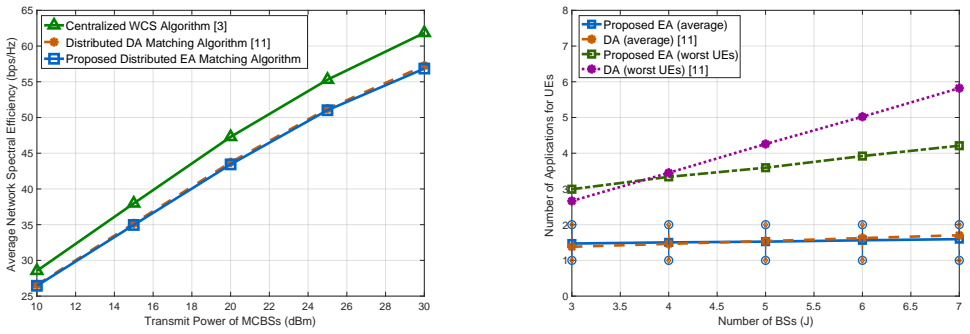
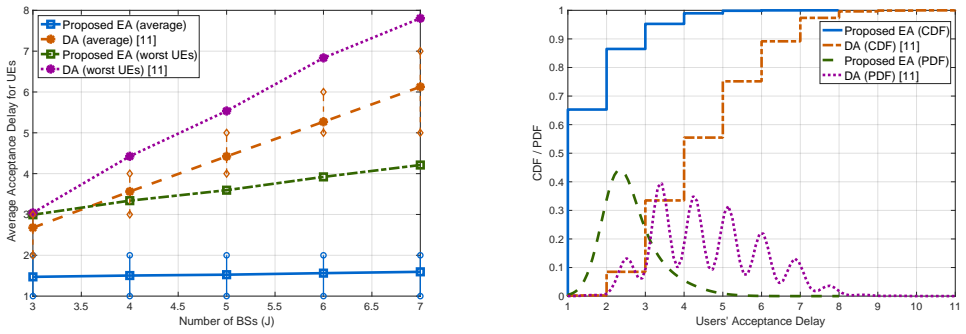
An early acceptance matching algorithm achieves near-optimal user association in mmWave 5G HetNets faster and with lower power than deferred acceptance.
A machine-rendered reading of the paper's core claim, the machinery that carries it, and where it could break.
Core claim
The proposed early acceptance (EA) matching algorithm for user association in mmWave-enabled cellular HetNets reaches a near-optimal solution when compared with centralized user association, and leads to a more power-efficient and much faster user association process when compared to the distributed deferred acceptance (DA) algorithm.
What carries the argument
The early acceptance matching game, in which users and base stations accept proposals immediately rather than deferring decisions until the algorithm terminates.
If this is right
- Distributed user association becomes feasible with performance close to centralized optimization in fast-varying mmWave channels.
- Power consumed by the association process itself drops relative to deferred acceptance.
- Association completes in substantially less time, reducing disruption from channel fluctuations.
- The algorithm supplies a practical distributed method for 5G HetNets that trades minimal optimality loss for large gains in speed and efficiency.
Where Pith is reading between the lines
- The same early-acceptance logic could apply to user association in other rapidly changing wireless settings such as vehicular networks.
- Pairing the algorithm with online preference updates based on real-time signal measurements would likely preserve the speed advantage.
- Extending the preference functions to incorporate latency or reliability targets would allow direct optimization for different 5G service classes.
Load-bearing premise
The numerical simulations accurately represent real-world mmWave HetNet conditions including channel variations and power consumption models, with matching preferences modeled correctly.
What would settle it
Running the EA algorithm on measured mmWave channel traces from a live HetNet testbed and comparing measured association completion time, total power draw during association, and final network throughput against both a centralized solver and the DA algorithm.
Figures
read the original abstract
In this paper we examine the use of matching theory for user association in millimeter wave (mmWave)-enabled cellular heterogeneous networks (HetNets). In a mmWave system, the channel variations can be fast and unpredictable, rendering centralized user association potentially inefficient. We propose an efficient distributed matching algorithm, called early acceptance (EA), tailored for user association in 5G HetNets. The effectiveness of the proposed algorithm is assessed by comparing its performance with the well-known deferred acceptance (DA) matching algorithm, in which user association is delayed until the algorithm finishes. Numerical results show that the proposed EA matching algorithm reaches a near-optimal solution when compared with a centralized user association, and leads to a more power-efficient and much faster user association process when compared to the distributed DA algorithm.
Editorial analysis
A structured set of objections, weighed in public.
Referee Report
Summary. The paper proposes an early acceptance (EA) distributed matching algorithm for user association in mmWave-enabled 5G HetNets. It claims that EA reaches a near-optimal solution relative to a centralized benchmark while being more power-efficient and substantially faster than the deferred acceptance (DA) algorithm, with these advantages demonstrated via numerical simulations.
Significance. If the simulation-based claims hold under realistic mmWave dynamics, the work would offer a practical distributed alternative to DA for user association, with potential gains in speed and power efficiency in fast-varying channels. The explicit comparisons to both a centralized optimum and the established DA algorithm provide a clear benchmark for assessing the proposal.
major comments (3)
- [Numerical Results] Numerical Results section: the paper provides no description of the number of Monte Carlo trials, confidence intervals, or error bars on the reported power-efficiency and runtime gains; without these, the statistical support for the central claim that EA is 'more power-efficient and much faster' cannot be assessed.
- [Algorithm] Algorithm section (EA definition): no stability guarantee, convergence proof, or bound on the optimality gap relative to the centralized solution is derived or referenced; the near-optimality claim therefore rests entirely on the specific simulation instances rather than on any general property of EA.
- [System Model] System Model section: the mmWave channel model and power-consumption model used to generate user and BS preference lists are not specified with sufficient detail (e.g., blockage probability, beamforming gain distributions, or circuit-power parameters) to allow independent verification that the simulated environment matches the 'fast and unpredictable' variations asserted in the abstract.
minor comments (2)
- [Notation] Notation for the preference lists and utility functions is introduced without an explicit table or equation reference, making it difficult to trace how the EA acceptance rule differs from DA.
- [Abstract] The abstract states that EA is 'tailored for user association in 5G HetNets' but does not cite prior matching-theory works on HetNets that motivate the specific early-acceptance modification.
Simulated Author's Rebuttal
We thank the referee for the constructive comments. Below we respond point by point to the major comments and indicate planned revisions.
read point-by-point responses
-
Referee: [Numerical Results] Numerical Results section: the paper provides no description of the number of Monte Carlo trials, confidence intervals, or error bars on the reported power-efficiency and runtime gains; without these, the statistical support for the central claim that EA is 'more power-efficient and much faster' cannot be assessed.
Authors: We agree that the statistical support should be strengthened. In the revised manuscript we will report the number of Monte Carlo trials performed and add error bars (or confidence intervals) to the relevant figures. revision: yes
-
Referee: [Algorithm] Algorithm section (EA definition): no stability guarantee, convergence proof, or bound on the optimality gap relative to the centralized solution is derived or referenced; the near-optimality claim therefore rests entirely on the specific simulation instances rather than on any general property of EA.
Authors: The EA algorithm is presented as a low-complexity heuristic motivated by the fast channel variations in mmWave HetNets. No stability or optimality-gap proofs are derived in the manuscript; the near-optimality claim is supported solely by the simulation results. We will add a clarifying sentence in the Algorithm section to make this explicit, but we do not intend to add theoretical analysis as part of the current contribution. revision: partial
-
Referee: [System Model] System Model section: the mmWave channel model and power-consumption model used to generate user and BS preference lists are not specified with sufficient detail (e.g., blockage probability, beamforming gain distributions, or circuit-power parameters) to allow independent verification that the simulated environment matches the 'fast and unpredictable' variations asserted in the abstract.
Authors: We will expand the System Model section with the requested parameters (blockage probability, beamforming gain distributions, and circuit-power values) to improve reproducibility. revision: yes
Circularity Check
No circularity; algorithm proposal and simulation comparisons are self-contained against external benchmarks.
full rationale
The paper proposes the EA matching algorithm for user association and evaluates it via numerical simulations against the established DA algorithm and a centralized benchmark. No derivation reduces to self-definition, fitted inputs renamed as predictions, or load-bearing self-citations. The central claims rest on direct performance comparisons in simulations, which are independent of the algorithm definition itself. No uniqueness theorems or ansatzes are smuggled via self-citation. This is the standard case of an algorithmic contribution validated externally.
Axiom & Free-Parameter Ledger
Lean theorems connected to this paper
-
IndisputableMonolith/Foundation/RealityFromDistinction.leanreality_from_one_distinction unclear?
unclearRelation between the paper passage and the cited Recognition theorem.
We propose an efficient distributed matching algorithm, called early acceptance (EA), tailored for user association in 5G HetNets... Numerical results show that the proposed EA matching algorithm reaches a near-optimal solution when compared with a centralized user association
-
IndisputableMonolith/Cost/FunctionalEquation.leanwashburn_uniqueness_aczel unclear?
unclearRelation between the paper passage and the cited Recognition theorem.
The well-known and widely-used deferred acceptance (DA) game is introduced by Gale and Shapley
What do these tags mean?
- matches
- The paper's claim is directly supported by a theorem in the formal canon.
- supports
- The theorem supports part of the paper's argument, but the paper may add assumptions or extra steps.
- extends
- The paper goes beyond the formal theorem; the theorem is a base layer rather than the whole result.
- uses
- The paper appears to rely on the theorem as machinery.
- contradicts
- The paper's claim conflicts with a theorem or certificate in the canon.
- unclear
- Pith found a possible connection, but the passage is too broad, indirect, or ambiguous to say the theorem truly supports the claim.
Reference graph
Works this paper leans on
-
[1]
User association for load balancing in hetero- geneous cellular networks,
Q. Ye et al., “User association for load balancing in hetero- geneous cellular networks,”IEEE Trans. Wireless Commun., vol. 12, no. 6, pp. 2706–2716, 2013
work page 2013
-
[2]
Optimal user-cell association for massive MIMO wireless networks,
D. Bethanabhotla et al., “Optimal user-cell association for massive MIMO wireless networks,”IEEE Trans. Wireless Com- mun., vol. 15, no. 3, pp. 1835–1850, 2016
work page 2016
-
[3]
Load balancing user association in millimeter wave mimo networks,
A. Alizadeh and M. Vu, “Load balancing user association in millimeter wave mimo networks,”Accepted for publication in IEEE Trans. Wireless Commun., 2019
work page 2019
-
[4]
M. Zalghout et al., “A greedy heuristic algorithm for context- aware user association and resource allocation in heteroge- neous wireless networks,” in Proc. IEEE 86th Veh. Technol. Conf. (VTC-Fall), Sep. 2017, pp. 1–7
work page 2017
-
[5]
Matching theory for priority-based cell association in the downlink of wireless small cell networks,
O. Semiari et al., “Matching theory for priority-based cell association in the downlink of wireless small cell networks,” in Proc. IEEE ICASSP, 2014, pp. 444–448
work page 2014
-
[6]
A college admissions game for uplink user association in wireless small cell networks,
W. Saad et al., “A college admissions game for uplink user association in wireless small cell networks,” in Proc. IEEE INFOCOM, 2014, pp. 1096–1104
work page 2014
-
[7]
Capacityofmulti-antennagaussianchannels,
E.Telatar,“Capacityofmulti-antennagaussianchannels,” Eur. Trans. Telecommun., vol. 10, no. 6, pp. 585–595, 1999
work page 1999
-
[8]
WINNER: Spatial channel model for multiple input multiple output (MIMO) simulations,
3GPP, “WINNER: Spatial channel model for multiple input multiple output (MIMO) simulations,” 3rd Generation Partner- ship Project (3GPP), Technical Report 25.996, Sep. 2003
work page 2003
-
[9]
3D mmWave channel model proposal,
T. A. Thomas et al., “3D mmWave channel model proposal,” in Proc. IEEE 80th Veh. Technol. Conf. (VTC Fall), 2014, pp. 1–6
work page 2014
-
[10]
Prob- abilistic omnidirectional path loss models for millimeter-wave outdoor communications,
M. K. Samimi, T. S. Rappaport, and G. R. MacCartney, “Prob- abilistic omnidirectional path loss models for millimeter-wave outdoor communications,”IEEE Wireless Commun. Lett., vol. 4, no. 4, pp. 357–360, 2015
work page 2015
-
[11]
College admissions and the stability of marriage,
D. Gale and L. S. Shapley, “College admissions and the stability of marriage,” The American Mathematical Monthly, vol. 69, no. 1, pp. 9–15, 1962
work page 1962
-
[12]
A. E. Roth and M. Sotomayor, “Two-sided matching,”Handbook Game Theory Econ. Appl., vol. 1, pp. 485–541, 1992
work page 1992
discussion (0)
Sign in with ORCID, Apple, or X to comment. Anyone can read and Pith papers without signing in.