Influence of in-medium mass width on Hanbury Brown-Twiss correlation strength
Pith reviewed 2026-05-24 18:18 UTC · model grok-4.3
The pith
In-medium mass width reduces Hanbury Brown-Twiss correlation strength for identical bosons.
A machine-rendered reading of the paper's core claim, the machinery that carries it, and where it could break.
Core claim
The strength of the Hanbury Brown-Twiss correlation decreases with in-medium mass width of identical bosons. This influence is more significant for the boson with heavier mass and decreases with increasing particle momentum.
What carries the argument
The in-medium mass width, introduced as an independent parameter that directly alters the two-particle correlation function for identical bosons.
If this is right
- The HBT correlation strength decreases as in-medium mass width increases.
- The reduction in strength is larger for bosons with heavier mass.
- The effect of the mass width on correlation strength becomes smaller at higher particle momenta.
Where Pith is reading between the lines
- Experimental extractions of source sizes from HBT data may require corrections for medium mass width to avoid systematic bias.
- The result suggests a possible link between mass modification and other in-medium effects on particle emission in dense nuclear matter.
- Varying the assumed mass width in transport models and comparing predicted correlations to data at different beam energies could provide a test.
Load-bearing premise
The in-medium mass width acts as an independent parameter that directly modifies the two-particle correlation function without other medium-induced changes dominating the result.
What would settle it
An experimental result in which HBT correlation strength remains unchanged or increases with larger in-medium mass width, or shows no dependence on boson mass, would falsify the central claim.
Figures
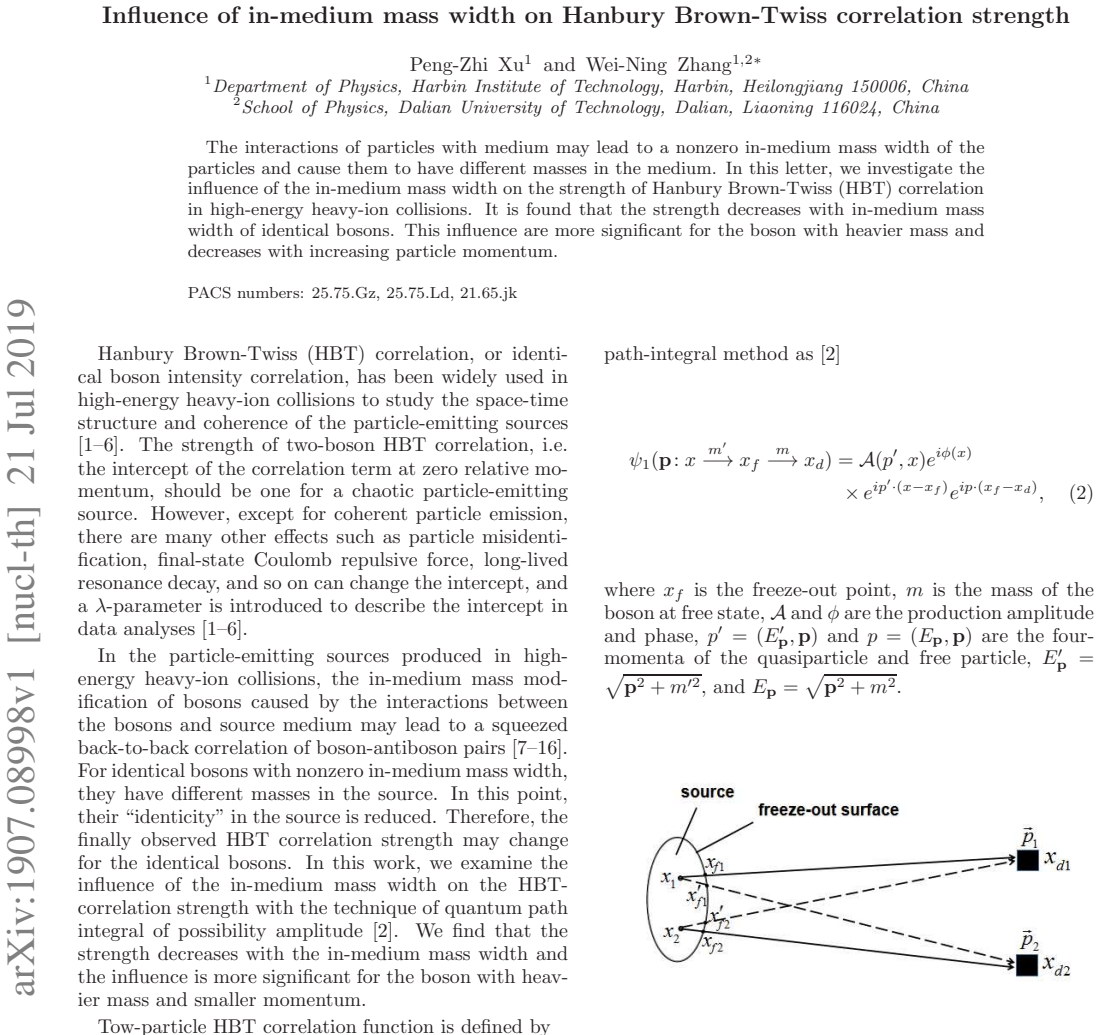
read the original abstract
The interactions of particles with medium may lead to a nonzero in-medium mass width of the particles and cause them to have different masses in the medium. In this letter, we investigate the influence of the in-medium mass width on the strength of Hanbury Brown-Twiss (HBT) correlation in high-energy heavy-ion collisions. It is found that the strength decreases with in-medium mass width of identical bosons. This influence are more significant for the boson with heavier mass and decreases with increasing particle momentum.
Editorial analysis
A structured set of objections, weighed in public.
Referee Report
Summary. The manuscript investigates the effect of a nonzero in-medium mass width on Hanbury Brown-Twiss (HBT) correlation strength for identical bosons produced in high-energy heavy-ion collisions. The central claim is that the correlation strength decreases with increasing in-medium mass width; the decrease is reported to be more pronounced for heavier bosons and to weaken with rising particle momentum.
Significance. If the reported trend is robust under a self-consistent treatment of medium effects, the result would be relevant for interpreting HBT radii extracted from heavy-ion data, as mass broadening is a generic medium-induced feature. The work supplies no machine-checked derivations, reproducible code, or falsifiable predictions that could be directly verified from the text.
major comments (2)
- The central claim requires that the in-medium mass width enters the two-particle correlation function as an independent modifier while the single-particle source, phase-space density, and wave-function overlap remain fixed. No section demonstrates that this isolation is consistent with other medium-induced changes (altered dispersion relations, flow, or interaction potentials) that would normally accompany mass broadening; the reported monotonic decrease may therefore be an artifact of the chosen parameterization rather than a general prediction.
- No explicit formula for the correlation function C(q), the model for the mass width, or any numerical results with error estimates appear in the provided text. Without these, the quantitative statements (decrease with width, mass dependence, momentum dependence) cannot be checked against the derivation or data.
Simulated Author's Rebuttal
We thank the referee for the careful reading of our manuscript and the constructive comments. We address each major comment below and indicate how we will revise the manuscript.
read point-by-point responses
-
Referee: The central claim requires that the in-medium mass width enters the two-particle correlation function as an independent modifier while the single-particle source, phase-space density, and wave-function overlap remain fixed. No section demonstrates that this isolation is consistent with other medium-induced changes (altered dispersion relations, flow, or interaction potentials) that would normally accompany mass broadening; the reported monotonic decrease may therefore be an artifact of the chosen parameterization rather than a general prediction.
Authors: Our calculation deliberately isolates the mass-width effect by holding the single-particle source and other quantities fixed; this is stated as an approximation in the manuscript to identify the specific role of the width. We agree that a fully self-consistent treatment would include additional medium modifications. In the revision we will add an explicit paragraph discussing the limitations of the parameterization and the conditions under which the reported trend is expected to hold. revision: partial
-
Referee: No explicit formula for the correlation function C(q), the model for the mass width, or any numerical results with error estimates appear in the provided text. Without these, the quantitative statements (decrease with width, mass dependence, momentum dependence) cannot be checked against the derivation or data.
Authors: Because the manuscript is a short letter, the explicit form of C(q) and the width parameterization were omitted. We will insert the relevant formulas, the functional form used for the mass width, and representative numerical results (with statistical uncertainties where applicable) in the revised version so that the quantitative claims can be verified directly from the text. revision: yes
Circularity Check
No significant circularity detected; result is a direct model computation.
full rationale
The paper conducts a parametric investigation in which an in-medium mass width is introduced as an explicit input to the two-particle correlation function for identical bosons. The reported decrease in HBT strength with increasing width (stronger for heavier mass, weaker at higher momentum) follows from evaluating the model correlation function under that variation. No quoted equations reduce the output to a redefinition of the input, no fitted subset is relabeled as a prediction, and no self-citation chain is invoked to justify a uniqueness theorem or ansatz. The calculation is therefore self-contained as a standard sensitivity study rather than a circular derivation.
Axiom & Free-Parameter Ledger
free parameters (1)
- in-medium mass width
axioms (1)
- domain assumption Interactions of particles with medium lead to nonzero in-medium mass width and different masses in the medium.
Lean theorems connected to this paper
-
IndisputableMonolith/Cost/FunctionalEquation.leanwashburn_uniqueness_aczel unclear?
unclearRelation between the paper passage and the cited Recognition theorem.
the strength decreases with in-medium mass width of identical bosons... Breit-Wigner form Γ/2π / ((m'-m-Δm')² + Γ²/4)
-
IndisputableMonolith/Foundation/AbsoluteFloorClosure.leanabsolute_floor_iff_bare_distinguishability unclear?
unclearRelation between the paper passage and the cited Recognition theorem.
I(p1,p2) = ∫ dm1' dm2' D(m1')D(m2') exp(-(E'p1-E'p2)²τ²)
What do these tags mean?
- matches
- The paper's claim is directly supported by a theorem in the formal canon.
- supports
- The theorem supports part of the paper's argument, but the paper may add assumptions or extra steps.
- extends
- The paper goes beyond the formal theorem; the theorem is a base layer rather than the whole result.
- uses
- The paper appears to rely on the theorem as machinery.
- contradicts
- The paper's claim conflicts with a theorem or certificate in the canon.
- unclear
- Pith found a possible connection, but the passage is too broad, indirect, or ambiguous to say the theorem truly supports the claim.
Reference graph
Works this paper leans on
-
[1]
1 2! ⏐ ⏐ ⏐ ⏐ ∑ x1,x2 ψ2(p1p2 : x1x2 m′ 1m′ 2 − → xf 1xf 2 mm − →xd1xd2) ⏐ ⏐ ⏐ ⏐ 2 = P1(p1)P1(p2) + ∫ dm′ 1dm′ 2D(m′ 1)D(m′ 2)dx1dx2 ρ(x1)ρ(x2)A(p′ 1, x1)A(p′ 2, x1)A(p′ 1, x2)A(p′ 2, x2) ×Re [ ei(p′ 1− p′ 2)·(x1− x2)ei(p′ 1− p1)·(x′ f 2− xf 1)ei(p′ 2− p2)·(x′ f 1− xf 2) ] . (5) In above derivations, the terms that contain production phase φ cancel out bec...
-
[2]
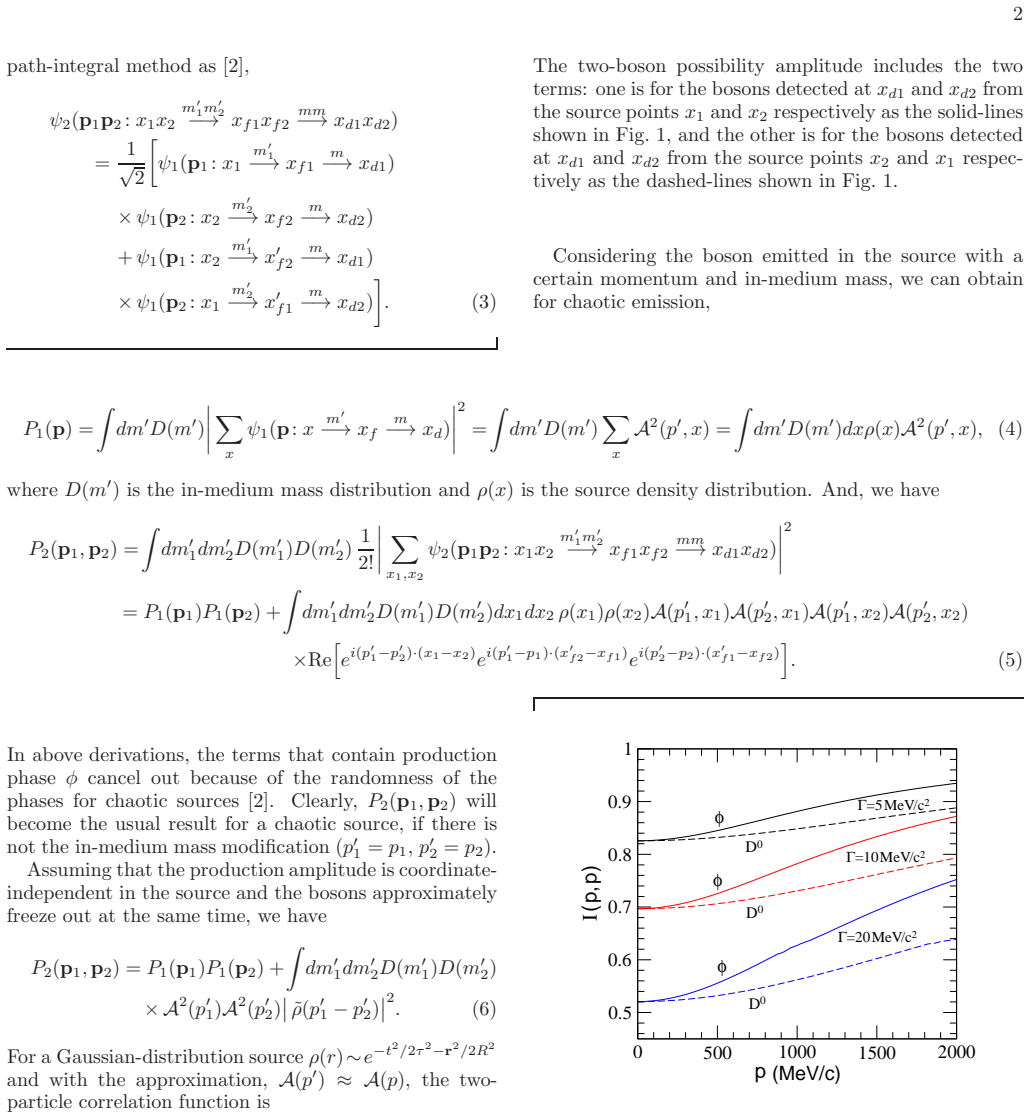
e− (E′ p1 − E′ p2 )2τ 2 . (8) The strength of HBT correlation, I(p, p), is related to the in-medium mass distribution of the bosons. We plot in Fig. 2 the strengths as a function of particle mo- mentum for φ and D0 mesons. Here, we take the source lifetime τ = 10 fm/ c, and the mass distribution is taken 0 500 1000 1500 2000 p (MeV/c) 0.5 0.6 0.7 0.8 0.9 ...
work page 2000
-
[3]
M. Gyulassy, S. K. Kauffmann, and Lance W. Wilson, Phys. Rev. C 20, 2267 (1979)
work page 1979
-
[4]
C. Y. Wong, Introduction to High-Energy Heavy-Ion Col- lisions (World Scientific, Singapore, 1994), Chap. 17
work page 1994
-
[5]
U. A. Wienemann and U. Heinz, Phys. Rep. 319, 145 (1999)
work page 1999
-
[6]
R. M. Weiner, Phys. Rep. 327, 249 (2000)
work page 2000
-
[7]
Particle Interferometry from 40 MeV to 40 TeV
T. Cs¨ org˝ o, Heavy Ion Physics 15 (2002) 1; arXiv:hep-ph/0001233
work page internal anchor Pith review Pith/arXiv arXiv 2002
-
[8]
M. A. Lisa, S. Pratt, R. Soltz, and U. Wiedemann, Annu. Rev. Nucl. Part. Sci. 55, 357 (2005)
work page 2005
-
[9]
M. Asakawa and T. Cs¨ org˝ o, Heavy Ion Physics 4, 233 (1996); hep-ph/9612331
-
[10]
M. Asakawa, T. Cs¨ org˝ o, and M. Gyulassy, Phys. Rev. Lett. 83, 4013 (1999)
work page 1999
-
[11]
S. S. Padula, G. Krein, T. Cs¨ org˝ o, Y. Hama, and P. K. Panda, Phys. Rev. C 73, 044906 (2006)
work page 2006
-
[12]
D. M. Dudek and S. S. Padula, Phys. Rev. C 82, 034905 (2010)
work page 2010
- [13]
- [14]
- [15]
-
[16]
A. G. Yang, Y. Zhang, L. Cheng, H. Sun, and W. N. Zhang, Chin. Phys. Lett. C 35, 052501 (2018)
work page 2018
-
[17]
P. Z. Xu, W. N. Zhang, and Y. Zhang, Phys. Rev. C 99, 011902(R) (2019)
work page 2019
-
[18]
P. Z. Xu and W. N. Zhang, arXiv:1904.04974
work page internal anchor Pith review Pith/arXiv arXiv 1904
-
[19]
S. V. Afanasiev et al. , (NA49 Collaboration), Phys. Lett. B 491, 59 (2000)
work page 2000
- [20]
-
[21]
B. Alessandro et al. (NA50 Collaboration), Phys. Lett. B 555, 147 (2003)
work page 2003
-
[22]
S. S. Adler et al. (PHENIX Collaboration), Phys. Rev. C 72, 014903 (2005)
work page 2005
-
[23]
S. Afanasiev et al. (PHENIX Collaboration), Phys. Rev. Lett. 99, 052301 (2007)
work page 2007
- [24]
-
[25]
B. I. Abelev et al. (STAR Collaboration), Phys. Rev. C 79, 064903 (2009)
work page 2009
-
[26]
B. I. Abelev et al. (STAR Collaboration), Phys. Lett. B 673, 183 (2009)
work page 2009
- [27]
- [28]
-
[29]
S. Acharya et al. (ALICE Collaboration), Eur. Phys. J. C 78, 559 (2018)
work page 2018
-
[30]
B. Abelev et al. (ALICE Collaboration), Phys. Rev. Lett. 111, 102301 (2013)
work page 2013
- [31]
- [32]
- [33]
-
[34]
S. Acharya et al. (ALICE Collaboration), J. High Energy Phys. 10 (2018) 174
work page 2018
-
[35]
A. M. Sirunyan et al. (CMS Collaboration), Phys. Lett. B 782, 474 (2018)
work page 2018
-
[36]
A. M. Sirunyan et al. (CMS Collaboration), Phys. Rev. Lett. 120, 202301 (2018)
work page 2018
- [37]
discussion (0)
Sign in with ORCID, Apple, or X to comment. Anyone can read and Pith papers without signing in.