Generalised single particle models for high-rate operation of graded lithium-ion electrodes: systematic derivation and validation
Pith reviewed 2026-05-25 15:13 UTC · model grok-4.3
The pith
Generalized single particle models with electrolyte correction accurately predict high-rate behavior in graded lithium-ion electrodes.
A machine-rendered reading of the paper's core claim, the machinery that carries it, and where it could break.
Core claim
A formal asymptotic derivation yields the single particle model from the porous electrode theory model for uniform spherical particles. A correction term accounts for spatial electrolyte non-uniformities. This is extended to graded electrodes with multiple particle sizes or chemistries. The generalized corrected SPM compares favourably to the full PET model for NMC and graphite.
What carries the argument
The asymptotic expansion based on the ratio of thermal voltage to characteristic overpotential change during lithiation, together with an additive correction term for electrolyte concentration gradients.
If this is right
- The corrected SPM gives accurate voltage predictions at higher rates where standard SPM fails due to electrolyte effects.
- Generalized SPMs can model electrodes with mixed particle sizes without needing the full spatially resolved PET.
- For NMC and graphite, the generalized models match PET solutions closely.
- This allows efficient modeling of high-rate operation in complex electrode designs.
Where Pith is reading between the lines
- Such models could enable optimization of particle size distributions in electrode manufacturing for better rate performance.
- The approach might extend to other battery chemistries if the asymptotic assumptions hold.
- Incorporating the correction could improve real-time battery management systems that rely on SPMs.
Load-bearing premise
The characteristic change in overpotential during (de)lithiation is much larger than the thermal voltage, allowing the asymptotic separation.
What would settle it
If measurements of cell voltage during high-rate discharge of a graded NMC electrode show significant deviation from the generalized SPM predictions while matching the PET model, the derivation would be falsified.
Figures


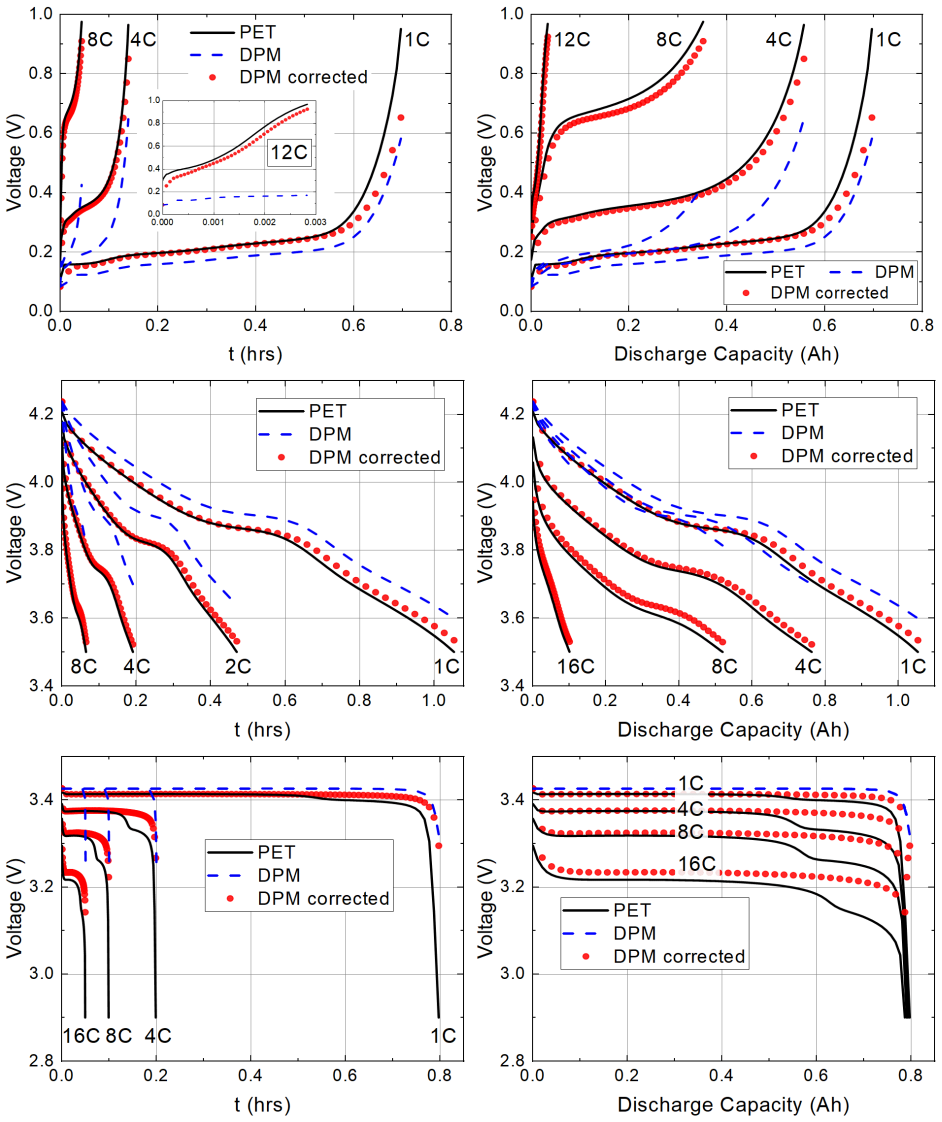

read the original abstract
A derivation of the single particle model (SPM) is made from a porous electrode theory model (or Newman model) of half-cell (dis)charge for an electrode composed of uniformly sized spherical electrode particles of a single chemistry. The derivation uses a formal asymptotic method based on the disparity between the size of the thermal voltage and that of the characteristic change in overpotential that occurs during (de)lithiation. Comparison is made between solutions to the SPM and to the porous electrode theory (PET) model for NMC, graphite and LFP. These are used to identify regimes where the SPM gives accurate predictions. For most chemistries, even at moderate (dis)charge rates, there are appreciable discrepancies between the PET model and the SPM which can be attributed to spatial non-uniformities in the electrolyte. This motivates us to calculate a correction term to the SPM. Once this has been incorporated into the model its accuracy is significantly improved. Generalised versions of the SPM, that can describe graded electrodes containing multiple electrode particle sizes (or chemistries), are also derived. The results of the generalised SPM, with the correction term, compare favourably to the full PET model where the active electrode material is either NMC or graphite.
Editorial analysis
A structured set of objections, weighed in public.
Referee Report
Summary. The paper derives the single particle model (SPM) from the porous electrode theory (PET) model for half-cell (dis)charge using a formal asymptotic expansion based on the small ratio of thermal voltage to the characteristic overpotential variation during (de)lithiation. It compares SPM and PET solutions for NMC, graphite and LFP, attributes discrepancies to electrolyte non-uniformities, introduces a correction term, and derives generalised SPMs for graded electrodes containing multiple particle sizes or chemistries. The generalised SPM plus correction is stated to compare favourably to the full PET model for NMC and graphite.
Significance. If the asymptotic expansion remains accurate in the claimed high-rate regimes and the correction improves predictions without fitted parameters, the work supplies a computationally efficient, systematically derived reduced-order model for graded electrodes. This would be valuable for rapid simulation and optimisation of advanced lithium-ion battery designs. The formal asymptotic approach and explicit generalisation to multi-particle/chemistry electrodes are strengths.
major comments (3)
- [Abstract] Abstract: the claim that the SPM with correction 'compares favourably' to PET for NMC and graphite is unsupported by any quantitative error metrics, RMS deviations, maximum errors, data-exclusion criteria or error bars. This is load-bearing for the central validation statement.
- [Derivation] Derivation (asymptotic reduction): the small parameter is the ratio of thermal voltage (~26 mV) to the scale of overpotential change during (de)lithiation, yet this ratio is never evaluated for the high C-rates or particle-size distributions used in the NMC and graphite comparisons. If the ratio is O(0.1) or larger, the neglected higher-order terms affect both the base SPM and the electrolyte correction.
- [Generalised SPM] Generalised SPM section: validation of the multi-particle/chemistry extension is asserted only for uniform NMC or graphite cases; it is unclear whether the graded-electrode predictions were tested against the full PET model or only against the uniform SPM.
minor comments (2)
- [Abstract] Abstract states comparisons were performed for NMC, graphite and LFP but favourable comparison with correction is reported only for NMC and graphite; the LFP outcome should be stated explicitly.
- Notation for the correction term and the small parameter should be introduced with a clear equation reference when first used.
Simulated Author's Rebuttal
We thank the referee for their careful reading of the manuscript and their constructive comments. We address each of the major comments below.
read point-by-point responses
-
Referee: [Abstract] Abstract: the claim that the SPM with correction 'compares favourably' to PET for NMC and graphite is unsupported by any quantitative error metrics, RMS deviations, maximum errors, data-exclusion criteria or error bars. This is load-bearing for the central validation statement.
Authors: We agree with the referee that quantitative error metrics are necessary to support the claim in the abstract. In the revised version of the manuscript, we will add RMS deviations, maximum errors, and any relevant error bars or data criteria for the comparisons between the corrected SPM and the PET model for NMC and graphite. revision: yes
-
Referee: [Derivation] Derivation (asymptotic reduction): the small parameter is the ratio of thermal voltage (~26 mV) to the scale of overpotential change during (de)lithiation, yet this ratio is never evaluated for the high C-rates or particle-size distributions used in the NMC and graphite comparisons. If the ratio is O(0.1) or larger, the neglected higher-order terms affect both the base SPM and the electrolyte correction.
Authors: The referee correctly identifies that the small parameter should be quantified for the specific conditions. We will include in the revised manuscript an explicit calculation of this ratio for the C-rates and materials used in the NMC and graphite comparisons to justify the asymptotic approximation. revision: yes
-
Referee: [Generalised SPM] Generalised SPM section: validation of the multi-particle/chemistry extension is asserted only for uniform NMC or graphite cases; it is unclear whether the graded-electrode predictions were tested against the full PET model or only against the uniform SPM.
Authors: We acknowledge the lack of clarity. The numerical validations presented are for uniform electrodes. The generalised SPM for graded electrodes is derived systematically from the same asymptotic approach, but direct comparisons to PET for graded (multi-particle) cases are not included in the current manuscript. In the revision, we will update the abstract and relevant sections to clarify this point and indicate that such validations are beyond the scope of the present work. revision: yes
Circularity Check
Asymptotic derivation from PET model is self-contained with no circularity
full rationale
The paper performs a formal asymptotic reduction of the established porous electrode theory (PET) model to obtain the single-particle model (SPM), using the ratio of thermal voltage to characteristic overpotential change as the small parameter. This is a standard mathematical expansion whose validity can be checked externally against the full PET equations; it does not rely on fitting parameters to data, self-citations for uniqueness, or any step that reduces to its own inputs by construction. Generalized SPMs for graded electrodes follow by the same expansion applied to a multi-particle PET formulation. Comparisons to PET solutions for NMC, graphite and LFP serve as external validation rather than tautological predictions. No load-bearing element in the derivation chain is equivalent to the input by definition.
Axiom & Free-Parameter Ledger
axioms (2)
- domain assumption Electrode particles are uniformly sized spheres of a single chemistry.
- domain assumption Disparity exists between thermal voltage and characteristic overpotential change during (de)lithiation.
Reference graph
Works this paper leans on
-
[1]
P. Bai, D. A. Cogswell, and M. Z. Bazant , Suppression of phase separation in LiFePO4 nanoparticles during battery discharge , Nano Letters, 11 (2011), pp. 4890– 4896
work page 2011
-
[2]
A. M. Bizeray, J.-H. Kim, S. R. Duncan, and D. A. Howey , Identifiability and parameter estimation of the single particle lithium-ion battery model, IEEE Transactions on Control Systems Technology, (2018), pp. 1–16
work page 2018
-
[3]
G. E. Blomgren, The development and future of lithium ion batteries , Journal of The Electrochemical Society, 164 (2017), pp. A5019–A5025
work page 2017
-
[4]
B. D. Bruggeman , Calculation of different physical constants of heterogeneous sub- stances. i. dielectric constants and conductivities of mixed bodies of isotropic substances, Annalen der Physik, 416 (1935), pp. 636–664
work page 1935
- [5]
-
[6]
F. Ciucci and W. Lai , Derivation of micro/macro lithium battery models from ho- mogenization, Transport in Porous Media, 88 (2011), pp. 249–270
work page 2011
-
[7]
D. A. Cogswell and M. Z. Bazant , Theory of coherent nucleation in phase- separating nanoparticles, Nano Letters, 13 (2013), pp. 3036–3041
work page 2013
- [8]
-
[9]
S. Dargaville and T. Farrell , A comparison of mathematical models for phase- change in high-rate LiFePO 4 cathodes, Electrochimica Acta, 111 (2013), pp. 474–490
work page 2013
- [10]
- [11]
- [12]
- [13]
-
[14]
T. R. Ferguson and M. Z. Bazant , Phase transformation dynamics in porous battery electrodes, Electrochimica Acta, 146 (2014), pp. 89–97
work page 2014
-
[15]
J. Foster, A. Gully, H. Liu, S. Krachkovskiy, Y. Wu, S. Schougaard, M. Jiang, G. Goward, G. Botton, and B. Protas , Homogenization study of the effects of cycling on the electronic conductivity of commercial lithium-ion battery cathodes, The Journal of Physical Chemistry C, 119 (2015), pp. 12199–12208
work page 2015
-
[16]
A. A. Franco, Multiscale modelling and numerical simulation of rechargeable lithium ion batteries: concepts, methods and challenges , RSC Advances, 3 (2013), pp. 13027– 13058
work page 2013
-
[17]
T. F. Fuller, M. Doyle, and J. Newman, Simulation and optimization of the dual lithium ion insertion cell , Journal of the Electrochemical Society, 141 (1994), pp. 1–10
work page 1994
- [18]
- [19]
-
[20]
Y. Li, F. El Gabaly, T. R. Ferguson, R. B. Smith, N. C. Bartelt, J. D. Sugar, K. R. Fenton, D. A. Cogswell, A. D. Kilcoyne, T. Tyliszczak, et al., Current-induced transition from particle-by-particle to concurrent intercalation in phase-separating battery electrodes, Nature Materials, 13 (2014), p. 1149
work page 2014
- [21]
-
[22]
S. J. Moura, F. B. Argomedo, R. Klein, A. Mirtabatabaei, and M. Krstic, Battery state estimation for a single particle model with electrolyte dynamics , IEEE Transactions on Control Systems Technology, 25 (2016), pp. 453–468. 29
work page 2016
-
[23]
I. R. Moyles, M. G. Hennessy, T. G. Myers, and B. R. Wetton , Asymp- totic reduction of a porous electrode model for lithium-ion batteries , arXiv preprint arXiv:1805.07093, (2018)
work page internal anchor Pith review Pith/arXiv arXiv 2018
-
[24]
Newman, Electrochemical Systems, vol
J. Newman, Electrochemical Systems, vol. 1, Prentice Hall, New Jersey, 2004
work page 2004
-
[25]
J. Newman and W. Tiedemann , Porous-electrode theory with battery applications , AIChE Journal, 21 (1975), pp. 25–41
work page 1975
- [26]
-
[27]
K. Persson, V. A. Sethuraman, L. J. Hardwick, Y. Hinuma, Y. S. Meng, A. Van Der Ven, V. Srinivasan, R. Kostecki, and G. Ceder, Lithium diffusion in graphitic carbon, The Journal of Physical Chemistry Letters, 1 (2010), pp. 1176–1180
work page 2010
-
[28]
G. L. Plett , High-performance battery-pack power estimation using a dynamic cell model, IEEE Transactions on Vehicular Technology, 53 (2004), pp. 1586–1593
work page 2004
-
[29]
S. K. Rahimian, S. Rayman, and R. E. White , Extension of physics-based single particle model for higher charge–discharge rates , Journal of Power Sources, 224 (2013), pp. 180–194
work page 2013
-
[30]
Ranom, Mathematical modelling of Lithium ion batteries , PhD thesis, University of Southampton, 2014
R. Ranom, Mathematical modelling of Lithium ion batteries , PhD thesis, University of Southampton, 2014
work page 2014
-
[31]
G. Richardson, G. Denuault, and C. Please , Multiscale modelling and analysis of lithium-ion battery charge and discharge , Journal of Engineering Mathematics, 72 (2012), pp. 41–72
work page 2012
-
[32]
M. Schmuck, Upscaling of solid-electrolyte composite intercalation cathodes for energy storage systems, Applied Mathematics Research eXpress, 2017 (2017), pp. 402–430
work page 2017
-
[33]
A. K. Sethurajan, J. M. Foster, G. Richardson, S. A. Krachkovskiy, J. D. Bazak, G. R. Goward, and B. Protas , Incorporating dendrite growth into con- tinuum models of electrolytes: Insights from nmr measurements and inverse modeling , Journal of The Electrochemical Society, 166 (2019), pp. A1591–A1602
work page 2019
-
[34]
V. Srinivasan and J. Newman, Design and Optimization of a Natural Graphite/Iron Phosphate Lithium-Ion Cell , Journal of The Electrochemical Society, 151 (2004), pp. A1530–A1538
work page 2004
-
[35]
K. E. Thomas, J. Newman, and R. M. Darling, Mathematical modeling of lithium batteries, in Advances in lithium-ion batteries, Springer, 2002, pp. 345–392
work page 2002
- [36]
-
[37]
Q. Wang, P. Ping, X. Zhao, G. Chu, J. Sun, and C. Chen , Thermal runaway caused fire and explosion of lithium ion battery , Journal of Power Sources, 208 (2012), pp. 210–224
work page 2012
-
[38]
Q. Wu, W. Lu, and J. Prakash , Characterization of a commercial size cylindrical Li-ion cell with a reference electrode, Journal of Power Sources, 88 (2000), pp. 237–242
work page 2000
-
[39]
J. Yi, U. S. Kim, C. B. Shin, T. Han, and S. Park , Three-dimensional thermal modeling of a lithium-ion battery considering the combined effects of the electrical and thermal contact resistances between current collecting tab and lead wire , Journal of the Electrochemical Society, 160 (2013), pp. A437–A443
work page 2013
-
[40]
F. yu KANG, J. MA, and B. hua LI , Effects of carbonaceous materials on the physical and electrochemical performance of a LiFePO4 cathode for lithium-ion batteries, New Carbon Materials, 26 (2011), pp. 161–170
work page 2011
-
[41]
G. Zubi, R. Dufo-Lopez, M. Carvalho, and G. Pasaoglu , The lithium-ion battery: State of the art and future perspectives , Renewable and Sustainable Energy Reviews, 89 (2018), pp. 292–308. A The Green’s function for the single particle problem Here we write down the problem for the Green’s function G(r, x, t; τ) for the problem (83)- (84) that is used to ...
work page 2018
discussion (0)
Sign in with ORCID, Apple, or X to comment. Anyone can read and Pith papers without signing in.