Asymmetry for tensor t_(2j) and vector t_(1i) polarizations with taking into account the deuteron wave function in coordinate space
Pith reviewed 2026-05-24 17:04 UTC · model grok-4.3
The pith
Analytic deuteron wave functions in coordinate space from multiple NN potentials are used to compute the full set of tensor t_{2j} and vector t_{1i} polarization asymmetries.
A machine-rendered reading of the paper's core claim, the machinery that carries it, and where it could break.
Core claim
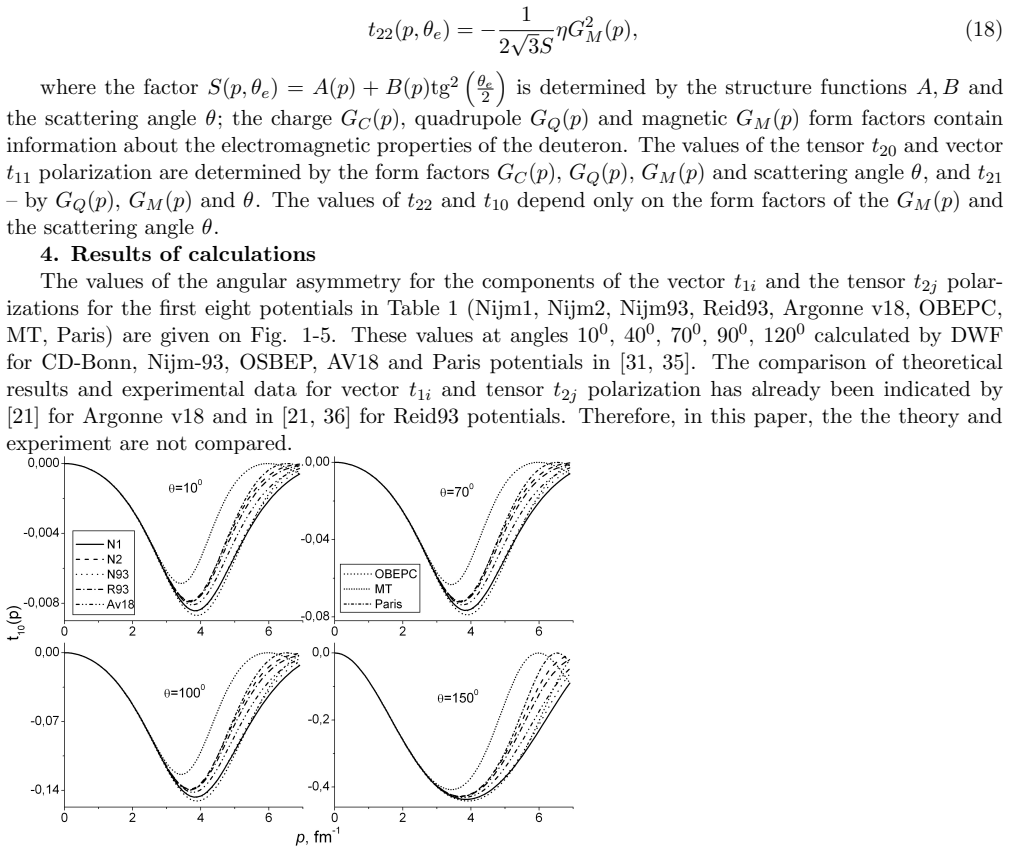
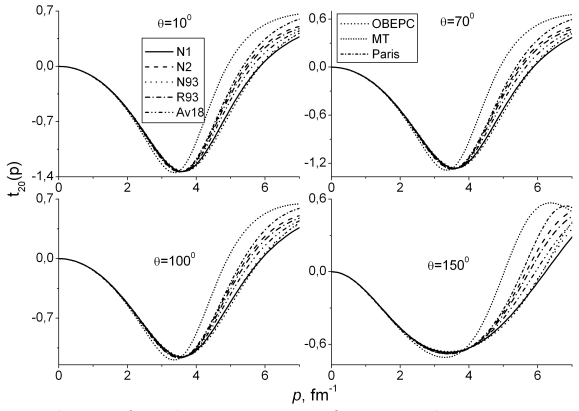
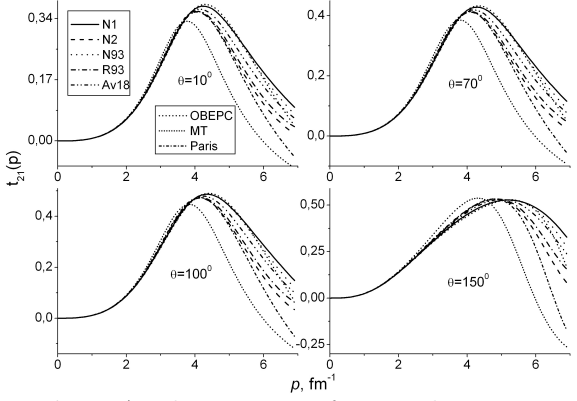
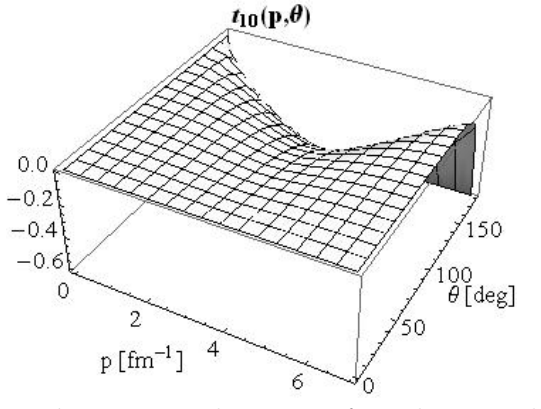
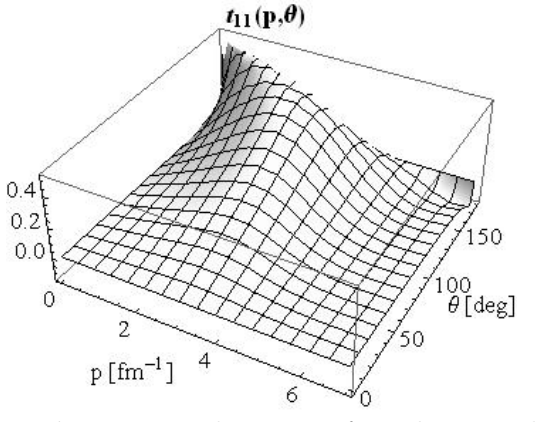
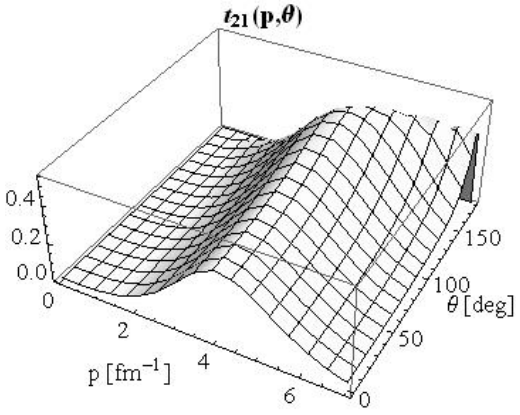
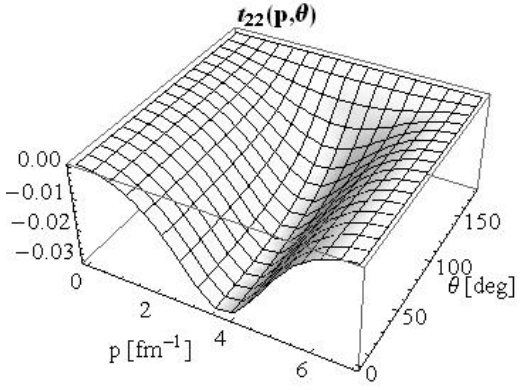
Analytic forms of the deuteron wave function in coordinate space derived from phenomenological nucleon-nucleon potentials (Nijm1, Nijm2, Nijm93, Reid93, Argonne v18, OBEPC, MT, Paris) are inserted into expressions for polarization asymmetries to yield numerical values of t_{ij} over momenta 0-7 fm^{-1} and angles 1-180 degrees, with explicit comparison of vector and tensor components and 3D plots for the Reid93 case.
What carries the argument
The analytic deuteron wave function in coordinate space generated by each NN potential, which is substituted into the polarization asymmetry formulas to obtain the full set of t_{2j} and t_{1i} values.
If this is right
- The computed asymmetries exhibit distinct angular and momentum dependence that varies with polarization type.
- Different potentials produce comparable but non-identical asymmetry values that can be contrasted directly.
- Three-dimensional representations of vector and tensor polarizations versus momentum and angle are available for the Reid93 wave function.
- The asymmetry values serve as input for calculating cross sections and other observables in deuteron-involved reactions.
Where Pith is reading between the lines
- The coordinate-space results could be compared directly with momentum-space calculations of the same asymmetries to quantify method differences.
- The spread across the eight potentials supplies a practical estimate of model uncertainty in deuteron polarization observables.
- The tabulated or plotted asymmetries could be folded into models of deuteron breakup or elastic scattering to predict observable effects.
Load-bearing premise
The deuteron wave functions produced by the listed phenomenological nucleon-nucleon potentials remain sufficiently accurate representations of the deuteron for asymmetry calculations over the entire momentum interval 0-7 fm^{-1}.
What would settle it
An experimental measurement of any t_{1i} or t_{2j} asymmetry at a chosen momentum between 0 and 7 fm^{-1} and angle that lies outside the range spanned by the calculations from all eight potentials would falsify the reported numerical results.
Figures
read the original abstract
The analytic forms of deuteron wave function in coordinate space were applied for theoretical calculations of full set asymmetries of tensor $t_{2j}$ and vector $t_{1i}$ polarizations. Nucleon-nucleon realistic phenomenological potentials of Nijmegen group (Nijm1, Nijm2, Nijm93, Reid93) and Argonne group (Argonne v18) as well as other widely used and popular potentials (OBEPC, MT, Paris) are used for numerical calculations. The angular asymmetry is calculated in the range of momentums 0-7 fm$^{ - 1}$. The values of the asymmetry $t_{ij,}$ by polarization type and with each other, are analysed. This is the angular-momentum dependence of values vector $t_{1i} (p,\theta_e )$ and tensor $t_{2i} (p,\theta_e )$ polarizations in 3D format at momentums 0-7 fm$^{-1}$ and scattering angles 1-180 degrees were calculated and compared for Reid93 potential. The perspectives of further application of the obtained results for calculating the values of the cross-sections, asymmetries and other characteristics of processes with the participation of a deuteron are discussed.
Editorial analysis
A structured set of objections, weighed in public.
Referee Report
Summary. The paper claims to compute the full set of vector t_{1i} and tensor t_{2j} polarization asymmetries for the deuteron by inserting analytic coordinate-space wave functions (u(r), w(r)) obtained from eight phenomenological NN potentials (Nijm1, Nijm2, Nijm93, Reid93, Argonne v18, OBEPC, MT, Paris) into the relevant expressions, presenting results over p = 0–7 fm^{-1} and θ = 1°–180°, including 3D plots for the Reid93 case, and discussing possible applications to cross sections and other deuteron observables.
Significance. If the numerical values prove reproducible, the work supplies a systematic comparison of polarization asymmetries across a wide momentum range and multiple standard potentials, which could serve as reference data for planning or interpreting deuteron polarization experiments. The use of several well-known potentials is a positive feature that allows direct assessment of model dependence.
major comments (2)
- [Abstract] Abstract and main text: no description is given of the numerical quadrature methods, radial grid, cutoff, or convergence tests used to evaluate the momentum-space integrals that define the asymmetries from the coordinate-space wave functions. Without these details the reported t_{1i}(p,θ) and t_{2j}(p,θ) values cannot be independently verified.
- The central numerical results at p ≳ 4–5 fm^{-1} rest on the short-range behavior of the chosen phenomenological wave functions, yet the manuscript provides no cross-check against high-momentum observables, chiral-EFT wave functions, or explicit short-range correlation corrections. This directly affects the reliability of the upper end of the reported momentum range.
minor comments (2)
- [Abstract] The abstract states that 'analytic forms' were used but does not list the explicit functional forms or cite the original references where the coordinate-space solutions for each potential are tabulated.
- Figure captions for the 3D plots should specify the exact definition of the plotted quantity (e.g., whether t_{2j} denotes a particular component or a combination) and the color scale.
Simulated Author's Rebuttal
We thank the referee for the careful reading of our manuscript and the positive assessment of its potential utility as reference data. We address each major comment below.
read point-by-point responses
-
Referee: [Abstract] Abstract and main text: no description is given of the numerical quadrature methods, radial grid, cutoff, or convergence tests used to evaluate the momentum-space integrals that define the asymmetries from the coordinate-space wave functions. Without these details the reported t_{1i}(p,θ) and t_{2j}(p,θ) values cannot be independently verified.
Authors: We agree that the absence of these technical details hinders independent verification. In the revised version we will add a new subsection (likely in Sec. II or an appendix) that specifies the quadrature algorithm (Gauss-Legendre with adaptive subdivision), the radial grid (uniform spacing Δr = 0.01 fm up to R_max = 20 fm with exponential tail matching), the momentum-space cutoff, and the convergence tests performed (variation of grid parameters until asymmetries stabilize to 0.1 %). revision: yes
-
Referee: The central numerical results at p ≳ 4–5 fm^{-1} rest on the short-range behavior of the chosen phenomenological wave functions, yet the manuscript provides no cross-check against high-momentum observables, chiral-EFT wave functions, or explicit short-range correlation corrections. This directly affects the reliability of the upper end of the reported momentum range.
Authors: The referee correctly identifies a genuine limitation: phenomenological potentials are constrained primarily by low-energy data, so their short-range behavior at p > 4 fm^{-1} carries model dependence. Our study deliberately restricts itself to a systematic comparison among eight established phenomenological models; performing new calculations with chiral-EFT wave functions or explicit SRC operators lies outside the present scope. We will insert a concise paragraph in the conclusions acknowledging this caveat and its implications for the high-momentum regime while retaining the comparative value of the existing results. revision: partial
Circularity Check
No circularity; direct numerical evaluation from independent potentials
full rationale
The paper inserts pre-existing deuteron wave functions u(r) and w(r) obtained from standard phenomenological NN potentials (Nijm1, Nijm2, Reid93, Argonne v18, Paris, etc.) into the expressions for tensor and vector polarization asymmetries and performs numerical integration over the stated momentum and angle ranges. These potentials are external inputs constrained by NN phase shifts and static deuteron properties, not by the target asymmetries t_{1i} or t_{2j}. No equation in the derivation defines an output quantity in terms of itself, renames a fitted parameter as a prediction, or reduces the central result to a self-citation chain. The work is therefore a straightforward computational application whose validity rests on the accuracy of the input wave functions rather than on any definitional loop.
Axiom & Free-Parameter Ledger
axioms (1)
- domain assumption Deuteron wave functions generated by the Nijmegen, Argonne, and other listed phenomenological potentials are accurate representations of the physical deuteron for polarization calculations up to 7 fm^{-1}.
Reference graph
Works this paper leans on
-
[1]
V. I. Zhaba, Mod. Phys. Lett. A 33, 1850160 (2018)
work page 2018
-
[3]
G. I. Gakh et al., J. Exp. Theor. Phys. 115, 212 (2012)
work page 2012
-
[4]
J. J. Ethier et al., Phys. Rev. C 89, 065203 (2014)
work page 2014
-
[5]
D. M. Nikolenko et al., Phys. Atom. Nucl. 73, 1322 (2010)
work page 2010
-
[6]
E. M. Darwish et al., Braz. J. Phys. 48, 168 (2018)
work page 2018
-
[7]
A. A. Temerbayev and Yu. N. Uzikov, Phys. Atom. Nucl. 78, 35 (2015)
work page 2015
- [8]
-
[9]
B. v. Przewoski al., Phys. Rev. C 74, 064003 (2006)
work page 2006
- [10]
-
[11]
G. I. Gakh et al., Phys. Rev. C 90, 064901 (2014)
work page 2014
-
[12]
V. P. Ladygin et al., Phys. Atom. Nucl. 69, 852 (2006)
work page 2006
-
[13]
L. S. Azhgirey et al., Phys. Atom. Nucl. 68, 991 (2005)
work page 2005
-
[14]
V. I. Zhaba. Deuteron: properties and analytical forms of wave function in coordinate space, arXiv:nucl-th/1706.08306
work page internal anchor Pith review Pith/arXiv arXiv
- [15]
- [16]
- [17]
- [18]
-
[19]
A. F. Krutov and V. E. Troitsky, Phys. Rev. C 76, 017001 (2007)
work page 2007
-
[20]
V. I. Zhaba, Nucl. Phys. Atom. Energy 17, 22 (2016)
work page 2016
-
[21]
V. I. Zhaba, Mod. Phys. Lett. A 31, 1650139 (2016)
work page 2016
-
[22]
M. N. Platonova and V. I. Kukulin, Phys. Atom. Nucl. 73, 86 (2010)
work page 2010
-
[23]
V. M. Krasnopol’sky et al., Phys. Lett. B 165, 7 (1985)
work page 1985
-
[24]
V. I. Zhaba, J. Phys. Stud. 20, 3101 (2016)
work page 2016
- [25]
- [26]
-
[27]
D. K. Hasell et al., Annu. Rev. Nucl. Part. Sci. 61, 409 (2011)
work page 2011
- [28]
-
[29]
R. G. Arnold, C.E. Carlson and F. Gross, Phys. Rev. C. 21, 1426 (1980)
work page 1980
-
[30]
T. W. Donnelly and A. S. Raskin, Ann. Phys. (N. Y.) 169, 247 (1986)
work page 1986
-
[31]
E. M. Darwish, M. Y. Hussein and B. Abu Sal, Appl. Math. & Inf. Sci. 3, 309 (2009)
work page 2009
-
[32]
E. M. Darwish and M. Y. Hussein, J. Kor. Phys. Soc. 52, 226 (2008)
work page 2008
-
[33]
R. G. Arnold, C. E. Carlson and F. Gross, Phys. Rev. C. 23, 363 (1981)
work page 1981
- [34]
-
[35]
E. M. Darwish, A. Abd El-Daiem and M. M. Abd El-Wahab, Phys. Part. Nucl. Lett. 14, 822 (2017)
work page 2017
-
[36]
V. I. Zhaba, J. Phys. Stud. 21, 4101 (2017)
work page 2017
-
[37]
V. I. Zhaba, Intern. Journ. Adv. Res. Phys. Scie. 5, 5 (2018)
work page 2018
-
[38]
V. I. Zhaba, Uzhhorod Univ. Scien. Herald. Ser. Phys. 42, 191 (2017). 10
work page 2017
discussion (0)
Sign in with ORCID, Apple, or X to comment. Anyone can read and Pith papers without signing in.