REVIEW 2 major objections 2 minor 47 references
Commercial Technologies for Advanced Light Control in Smart Building Energy Management Systems: A Comparative Study
T0 review · 2 major / 2 minor · reviewed 2026-05-24 · grok-4.3
Pith's one-line read Smart lighting technologies deliver payback in a few years with emission reductions, but results depend on location, energy prices and occupancy.
desk verdict Simulation study applies commercial lighting features to EnergyPlus models in Algiers and Stuttgart, showing location-sensitive paybacks, but without validation against local metered data. read the letter →
The pith
A machine-rendered reading of the paper's core claim, the machinery that carries it, and where it could break.
The reading
What carries the argument
EnergyPlus simulations of scenarios built from commercial ICT-based light control features including dimming, daylight harvesting, scheduling, and motion detection.
What would settle it
Field measurements of actual energy consumption, costs, and emissions in occupied homes in Algiers and Stuttgart equipped with the studied commercial lighting systems, compared against the simulation outputs.
Extended reading notes
Core claim
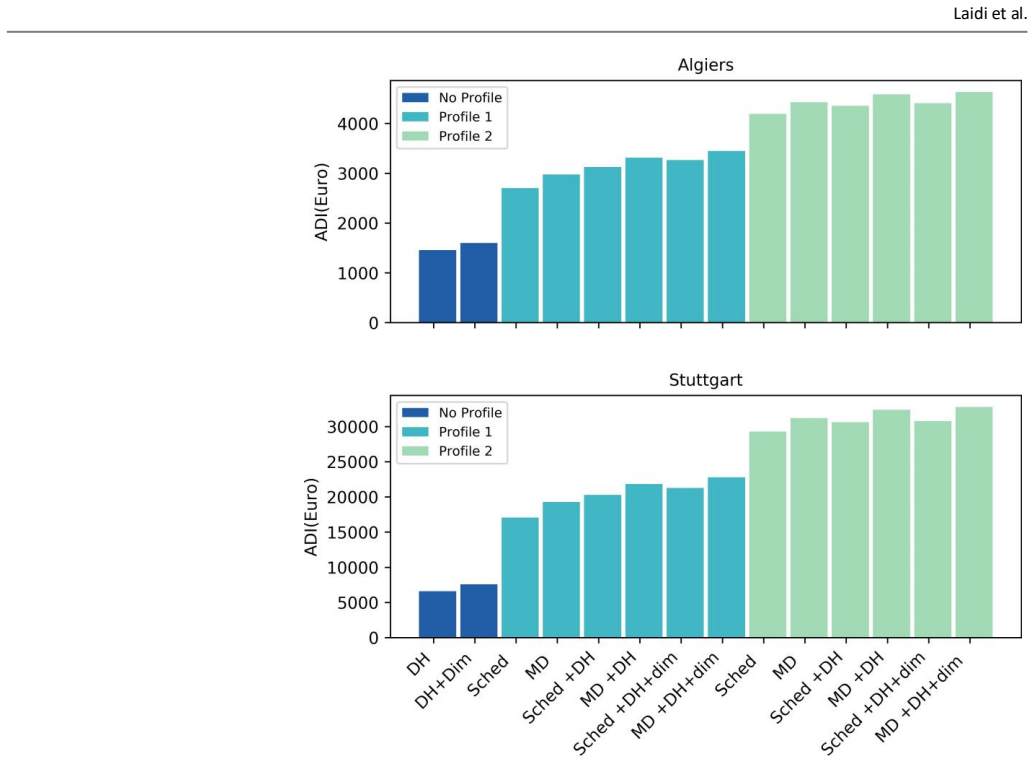
Adopting smart lighting technologies has a payback period of a few years, with positive economic and societal impacts as well as considerable reductions in gas emissions. This contribution is highly sensitive to geographical location, energy prices, and the occupancy profile.
Load-bearing premise
The generated simulation scenarios based on state-of-the-art commercial solutions accurately reflect the performance of real-world smart lighting systems in the two regions.
Editorial extensions
If this is right
- Smart lighting yields payback within a few years through reduced energy bills.
- Use of these systems produces measurable cuts in gas emissions.
- Benefits are larger or smaller depending on local energy prices.
- Occupancy patterns strongly influence the scale of savings achieved.
Reading between the lines
- Policies encouraging smart lighting adoption would need region-specific adjustments rather than uniform incentives.
- Future work could test whether adding predictive occupancy models improves the accuracy of the simulated savings.
- The approach could extend to other building systems such as heating if similar feature-extraction methods are applied.
Editorial analysis
A structured set of objections, weighed in public.
Referee Report
Summary. The paper extracts energy-related features (dimming, daylight harvesting, scheduling, motion detection) from commercial smart-lighting solutions and evaluates their impacts via EnergyPlus simulations for residential buildings in Algiers and Stuttgart. It reports that adoption yields payback periods of a few years together with positive economic, societal, and environmental effects (reduced gas emissions), while noting strong sensitivity to location, energy prices, and occupancy profiles.
Significance. If the simulation results hold, the work supplies a comparative, feature-level assessment of commercial lighting controls across two regulatory and climatic contexts, underscoring the need to tailor smart-building strategies to local conditions. The explicit linkage of individual ICT features to quantified savings and payback is a useful contribution to building-energy-management literature.
major comments (2)
- [Abstract and §3] Abstract and §3 (Simulation Methodology): the central payback-period and emission-reduction claims rest entirely on EnergyPlus outputs, yet no calibration against metered data from Algiers or Stuttgart buildings, no validation of the daylight or occupancy models for the two climates, and no error bars or Monte-Carlo sensitivity runs are described; without these the reported “few years” payback and the sensitivity conclusions cannot be considered robust.
- [§4] §4 (Results): the statement that benefits are “highly sensitive to … the occupancy profile” is load-bearing for the policy takeaway, but the paper does not specify how the occupancy schedules were derived, whether they were varied parametrically, or how HVAC–lighting interactions were modeled; this omission directly affects the reliability of the cross-region comparison.
minor comments (2)
- [Abstract] Abstract contains hyphenation artifacts (“light-ing”, “commercial-ized”); these should be corrected.
- [§2–§3] Ensure that every simulation scenario is explicitly mapped to the commercial product features listed in §2 so that readers can reproduce the feature-to-scenario correspondence.
Simulated Author's Rebuttal
We thank the referee for the constructive feedback. We address each major comment below with clarifications on our simulation methodology and indicate planned revisions where appropriate.
read point-by-point responses
-
Referee: [Abstract and §3] Abstract and §3 (Simulation Methodology): the central payback-period and emission-reduction claims rest entirely on EnergyPlus outputs, yet no calibration against metered data from Algiers or Stuttgart buildings, no validation of the daylight or occupancy models for the two climates, and no error bars or Monte-Carlo sensitivity runs are described; without these the reported “few years” payback and the sensitivity conclusions cannot be considered robust.
Authors: Our study is a comparative simulation analysis using EnergyPlus, whose core models for building physics, daylighting, and occupancy have been validated by the U.S. Department of Energy across multiple climates. We employed the tool's standard residential occupancy and daylight models adjusted for the Algiers and Stuttgart climate zones. No metered data from local buildings was available for site-specific calibration, which is a common constraint in such studies and limits claims to relative feature impacts rather than absolute predictions. We agree that additional robustness measures are warranted and will add error bars from repeated runs plus a sensitivity analysis subsection in the revision; however, a full Monte-Carlo study was not performed originally due to computational limits. revision: partial
-
Referee: [§4] §4 (Results): the statement that benefits are “highly sensitive to … the occupancy profile” is load-bearing for the policy takeaway, but the paper does not specify how the occupancy schedules were derived, whether they were varied parametrically, or how HVAC–lighting interactions were modeled; this omission directly affects the reliability of the cross-region comparison.
Authors: Occupancy schedules were taken from EnergyPlus default residential profiles and adapted for each location using typical daily patterns (e.g., cultural differences in evening occupancy between Algiers and Stuttgart). We parametrically varied these by weekday/weekend and household size to demonstrate sensitivity. EnergyPlus inherently couples lighting heat gains to HVAC loads through its zone energy balance. We will revise §4 to document the exact schedule parameters, the parametric variations performed, and the interaction modeling approach, including a supporting table for the two locations. revision: yes
- Calibration against metered data from Algiers or Stuttgart buildings (no such data available to the authors)
Circularity Check
No significant circularity; results from external simulation on extracted commercial features
full rationale
The paper extracts energy-related features from state-of-the-art commercial lighting solutions, then feeds them into the independent EnergyPlus simulator to generate scenarios for dimming, daylight harvesting, scheduling, and motion detection. Payback periods, emission reductions, and sensitivity to location/prices/occupancy are outputs of that simulation run, not definitions or re-statements of the input features. No self-citations are load-bearing, no parameters are fitted then re-predicted, and no uniqueness theorems or ansatzes are smuggled in. The derivation chain is therefore self-contained against external benchmarks (commercial product data + EnergyPlus engine).
Assumptions & free parameters
free parameters (2)
- occupancy profile
- energy prices
assumptions (1)
- domain assumption EnergyPlus simulation tool provides accurate fine-grained evaluation of building energy use
Cite this review
Pith. "Pith review of Commercial Technologies for Advanced Light Control in Smart Building Energy Management Systems: A Comparative Study." pith.science (2026). https://pith.science/paper/NAX3MRKU
@misc{pith2026190710429,
  author       = {Pith},
  title        = {Pith review of: Commercial Technologies for Advanced Light Control in Smart Building Energy Management Systems: A Comparative Study},
  year         = {2026},
  howpublished = {\url{https://pith.science/paper/NAX3MRKU}},
  note         = {Machine review of arXiv:1907.10429}
}
read the original abstract
This work investigates the economic, social, and environmental impact of adopting different smart lighting architectures for home automation in two geographical and regulatory regions: Algiers, Algeria, and Stuttgart, Germany. Lighting consumes a considerable amount of energy, and devices for smart light-ing solutions are among the most purchased smart home devices. As commercial-ized solutions come with variant features, we empirically evaluate through this study the impact of each one of the energy-related features and provide insights on those that have higher energy saving contribution. The study started by investigating the state-of-the-art of commercialized ICT-based light control solutions, which allowed the extraction of the energy-related features. Based on the outcomes of this study, we generated simulation scenarios and selected evaluations metrics to evaluate the impact of dimming, daylight harvesting, scheduling, and motion detection. The simulation study has been conducted using \textit{EnergyPlus} simulation tool, which enables fine-grained realistic evaluation. The results show that adopting smart lighting technologies have a payback period of few years, and that the use of these technologies has positive economic and societal impacts, as well as on the environment by considerably reducing gas emissions. However, this positive contribution is highly sensitive to the geographical location, energy prices, and the occupancy profile.
Figures


Figures from the paper (3 more)


Reference graph
Works this paper leans on
-
[1]
A. Sanguinetti, B. Karlin, R. Ford, K. Salmon, K. Dombrovski, What’s energy man- agement got to do with it? exploring the role of energy management in the smart home adoption process, Energy Efficiency 11 (2018) 1897–1911
work page 2018
-
[2]
[Online; accessed Jan-30-2019]
Global technology research firm on world, internet connected wireless lights by 2020., https://onworld.com/news/ 100-Million-Internet-Connected-LED-Lights-by-2020.html, 2019. [Online; accessed Jan-30-2019]
work page 2020
-
[3]
I. Chew, D. Karunatilaka, C. P. Tan, V. Kalavally, Smart lighting: The way forward? reviewing the past to shape the future, Energy and Buildings 149 (2017) 180 – 191
work page 2017
-
[4]
C. de Bakker, M. Aries, H. Kort, A. Rosemann, Occupancy-based lighting control in open-plan office spaces: A state-ofthe-art review, Building and Environment 112 (2017) 308 – 321
work page 2017
- [5]
-
[6]
A. Ouadjaout, N. Lasla, D. Djenouri, C. Zizoua, On the effect of sensing-holes in pir-based occupancy detection systems, in: SENSORNETS 2016 - Proceedings of the 5th International Confererence on Sensor Networks, Rome, Italy, February 19-21, 2016., pp. Laidi et al. DOI: 10.4236/***.2019.***** 21 Energy and Power Engineering 175–180
work page 2016
-
[7]
N. Lasla, M. Doudou, D. Djenouri, A. Ouadjaout, C. Zizoua, Wireless energy effi- cient occupancy-monitoring system for smart buildings.Pervasive and Mobile Computing (Elsevier Pub) , accepted, June 2019, DOI: doi.org/10.1016/j.pmcj.2019.101037
-
[8]
R. Ford, M. Pritoni, A. Sanguinetti, B. Karlin, Categories and functionality of smart home technology for energy management, Building and environment 123 (2017) 543– 554
work page 2017
Show all 47 references
-
[9]
Pritoni, R
M. Pritoni, R. Ford, B. Karlin, A. Sanguinetti, Home energy management (hem) da- tabase: A list with coded attributes of 308 devices commercially available in the us, Data in Brief 16 (2018) 71 – 74
2018
-
[10]
R. Ford, B. Karlin, A. Sanguinetti, A. Nersesyan, M. Pritoni, Assessing players, products, and perceptions of home energy management, Pacific Gas and Electric, San Francisco, CA, Emerging Technology Report ET15PGE8851, retrieved Nov (2016)
2016
-
[11]
King, Energy impacts of smart home technologies, Report A1801 2018 (2018)
J. King, Energy impacts of smart home technologies, Report A1801 2018 (2018)
2018
-
[12]
Paetz, E
A.-G. Paetz, E. Du¨tschke, W. Fichtner, Smart homes as a means to sustainable en- ergy consumption: A study of consumer perceptions, Journal of Consumer Policy 35 (2012) 23–41
2012
-
[13]
Ganandran, T
G. Ganandran, T. Mahlia, H. C. Ong, B. Rismanchi, W. Chong, Cost-benefit analysis and emission reduction of energy efficient lighting at the universiti tenaga nasional, The Scientific World Journal 2014 (2014)
2014
-
[14]
Nagar, S
S. Nagar, S. Aneja, H. Khadilkar, S. Dechu, Z. Charbiwala, A framework for evalu- ating the costs and benefits of instrumentation in smart home systems, in: Proceedings of the 2015 ACM Sixth International Conference on Future Energy Systems, e-Energy ’15, ACM, New York, NY, US...
2015
-
[15]
Nagar, S
S. Nagar, S. Aneja, H. Khadilkar, S. Dechu, Z. Charbiwala, Smome: A framework for evaluating the costs and benefits of instrumentation in smart home systems, in: 2016 IEEE International Conference on Smart Grid Communications (SmartGridComm), pp. 134–139
2016
-
[16]
[Online; accessed Jan-30-2019]
If This Then That, https://ifttt.com/, 2019. [Online; accessed Jan-30-2019]
2019
-
[17]
Gislason, Zigbee Wireless Networking, Elsevier Science, 2008
D. Gislason, Zigbee Wireless Networking, Elsevier Science, 2008
2008
-
[18]
[Online; accessed Jan-30-2019]
Philips Hue LEDs, https://www2.meethue.com/en-us, 2019. [Online; accessed Jan-30-2019]
2019
-
[19]
[Online; accessed Jan-30-2019]
Osram Lightify LEDs, https://www.osram.com/cb/lightify/index.jsp, 2019. [Online; accessed Jan-30-2019]
2019
-
[20]
Belkin WeMo LEDs, https://www.belkin.com/us/support-article?articleNum=116177,
-
[22]
[Online; accessed Jan-30-2019]
Lifx A19 LED, https://www.lifx.com/products/lifx-e26, 2019. [Online; accessed Jan-30-2019]
2019
-
[23]
[Online; accessed Jan-30-2019]
GE LEDS, https://www.cbyge.com/, 2019. [Online; accessed Jan-30-2019]
2019
-
[24]
[Online; Laidi et al
Wink Relay, https://www.wink.com/help/products/wink-relay-touchscreen-controller/, 2019. [Online; Laidi et al. DOI: 10.4236/***.2019.***** 22 Energy and Power Engineering accessed Jan-30-2019]
2019
-
[25]
[Online; ac- cessed Jan-30-2019]
Belkin WeMo switch, https://www.belkin.com/us/p/P-F7C030/, 2019. [Online; ac- cessed Jan-30-2019]
2019
-
[26]
[Online; ac- cessed Jan-30-2019]
GE wall-in smart switch, https://www.smartthings.com/products/ge-in-wall-smart-switch-zigbee, 2019. [Online; ac- cessed Jan-30-2019]
2019
-
[27]
[Online; accessed Jan-30-2019]
Lutron, http://www.lutron.com/en-US/Pages/default.aspx, 2019. [Online; accessed Jan-30-2019]
2019
-
[28]
[Online; ac- cessed Jan-30-2019]
google home, https://store.google.com/gb/product/google_home, 2019. [Online; ac- cessed Jan-30-2019]
2019
-
[29]
[Online; accessed Jan-30-2019]
Amazon alexa, https://www.amazon.com/Amazon-Echo-And-Alexa-Devices/b?ie=UTF8&node=981804 7011, 2019. [Online; accessed Jan-30-2019]
2019
-
[30]
[Online; accessed Jan-30-2019]
Roost Water Leak and Freeze Detector, http://www.getroost.com/product-waterdetector.html, 2019. [Online; accessed Jan-30-2019]
2019
-
[31]
[Online; accessed Jan-30-2019]
Honeywell Water Leak and Freeze Detector, https://www.honeywellhome.com/en/products/water-alarms/ lyr- ic-wi-fi-water-leak-and-freeze-detector, 2019. [Online; accessed Jan-30-2019]
2019
-
[32]
[Online; ac- cessed Jan-30-2019]
Ecobee Room Sensors, https://www.ecobee.com/room-sensors/, 2019. [Online; ac- cessed Jan-30-2019]
2019
-
[33]
[Online; accessed Jan-30-2019]
WS-1002 WiFI Smart Weather Station, https://www.ambientweather.com/amws1000wifi.html, 2019. [Online; accessed Jan-30-2019]
2019
-
[34]
[Online; accessed Jan-30-2019]
Ring motion-detector, https://shop.ring.com/products/alarm-motion-detector, 2019. [Online; accessed Jan-30-2019]
2019
-
[35]
[Online; accessed Jan-30-2019]
samsung-smartthings-motion-sensor, https://www.samsung.com/us/smart-home/smartthings/sensors/samsung-smartthings- motion-sensor-2018-gp-u999sjvlbaa/, 2019. [Online; accessed Jan-30-2019]
2018
-
[36]
[Online; accessed Jan-30-2019]
Everspring MOTION SENSOR, http://www.everspring.com/portfolio-item/sp817-motion-detector/, 2019. [Online; accessed Jan-30-2019]
2019
-
[37]
Ecolink MOTION SENSOR, https://discoverecolink.com/product/pirzwave25-eco/,
-
[38]
[Online; accessed Jan-30-2019]
2019
-
[39]
[Online; accessed Jan-30-2019]
Philips Hue motion sensor, https://www2.meethue.com/en-us/p/hue-motion-sensor/046677473389, 2019. [Online; accessed Jan-30-2019]
2019
-
[40]
energiedaten
Bmwi - bundesministerium fr wirtschaft und energie. energiedaten. gesamtausgabe., https://www.bmwi.de/Redaktion/DE/ Downloads/Energiedaten/energiedaten-gesamt-pdf-grafiken.pdf?__blob=publicationFile &v=14, 2019. [Online; accessed Jan-30-2019]. Laidi et al. DOI: 10.4236/***.201...
2019
-
[41]
electricity tarification in algeria., http://www.sda.dz/Fr/?page=article&id=173, 2019
Sonelgaz distribution alger. electricity tarification in algeria., http://www.sda.dz/Fr/?page=article&id=173, 2019. [On- line; accessed Jan-30-2019]
2019
-
[42]
Boardman, D
A. Boardman, D. Greenberg, A. Vining, D. Weimer, Cost-Benefit Analysis: Con- cepts and Practice, Cambridge University Press, 2018
2018
-
[43]
Uba - umweltbundesamt. spezifische emissionsfaktoren fr den deutschen strommix., https://www.umweltbundesamt.de/themen/luft/emissionen-von-luftschadstoffen/spezifisc he-emissionsfaktoren-fuer-den-deutschen, 2019. [Online; accessed Jan-30-2019]
2019
-
[44]
[Online; accessed Jan-30-2019]
Designbuilder, https://www.designbuilder.co.uk/software/product-overview, 2019. [Online; accessed Jan-30-2019]
2019
-
[45]
[Online; accessed Jan-30-2019]
Energyplus, https://www.energyplus.net/, 2019. [Online; accessed Jan-30-2019]
2019
-
[46]
P. H. Shaikh, N. B. M. Nor, P. Nallagownden, I. Elamvazuthi, T. Ibrahim, A review on optimized control systems for building energy and comfort management of smart sus- tainable buildings, Renewable and Sustainable Energy Reviews 34 (2014) 409–429
2014
-
[47]
[Online; ac- cessed Jan-30-2019]
List of cities by sunshine, https://en.wikipedia.org/wiki/List_of_cities_by_sunshine_duration, 2019. [Online; ac- cessed Jan-30-2019]
2019
-
[48]
Djenouri, R
D. Djenouri, R. Laidi, Y. Djenouri, I. Balasingham, Machine learning for smart building applications: Review and taxonomy, ACM Comput. Surv. 52 (2019) 24:1– 24:36
2019
Reviewed May 24, 2026 · model on record in the stance chip above.
Discussion (0). Sign in to comment.