Dark Sectors from the Hidden Photon Perspective
Pith reviewed 2026-05-24 16:37 UTC · model grok-4.3
The pith
A gauged U(1) symmetry on muons and taus lets one hidden photon explain both the muon g-2 excess and the dark matter relic density.
A machine-rendered reading of the paper's core claim, the machinery that carries it, and where it could break.
Core claim
When Standard Model leptons carry charges under the same new U(1) that governs the dark sector, the resulting hidden photon mediates both the (g-2)μ correction and the annihilation processes that set the dark matter relic density, allowing a simultaneous fit without additional mediators.
What carries the argument
Kinetically mixed hidden photon from a gauged U(1)_{Lμ−Lτ} that assigns charges to both Standard Model leptons and dark sector particles.
If this is right
- The model carves out specific ranges of hidden photon mass and kinetic mixing parameter that satisfy both anomalies at once.
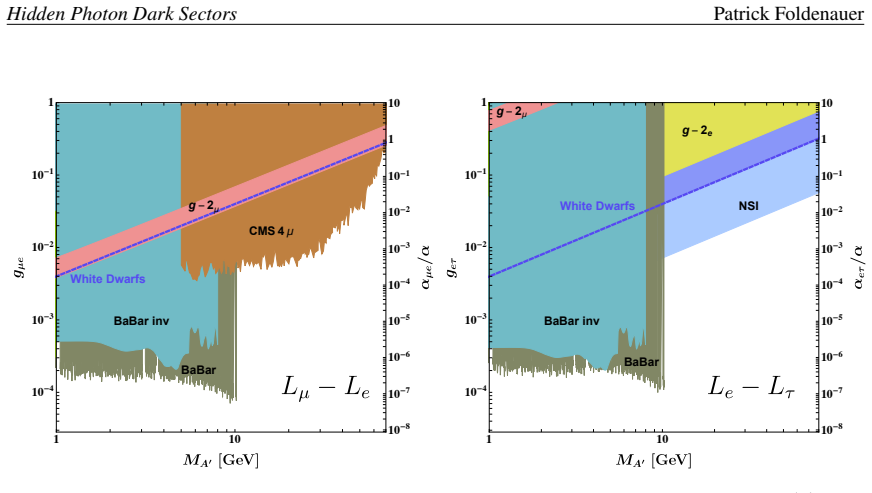
- Four-lepton final states become a primary search channel because the hidden photon can be produced and decay back to muons or taus.
- Dilepton events accompanied by missing energy arise when the hidden photon decays into invisible dark sector states.
- Existing flavor and electroweak constraints already limit the allowed charge assignments and mixing strength.
Where Pith is reading between the lines
- The same symmetry pattern could be applied to other lepton-flavor differences to address additional anomalies while preserving the dark matter connection.
- Direct production of the hidden photon at a future muon collider would provide a clean test independent of the relic density calculation.
- If the scenario holds, dark matter would couple preferentially to second- and third-generation leptons rather than to quarks or electrons.
Load-bearing premise
Dark sector particles can receive charges under the same U(1) symmetry that acts on muons and taus without creating conflicts with precision electroweak or flavor data.
What would settle it
A collider search or precision measurement that excludes the parameter region where the hidden photon mass and coupling simultaneously reproduce both the (g-2)μ excess and the observed dark matter density would rule out the simultaneous explanation.
Figures




read the original abstract
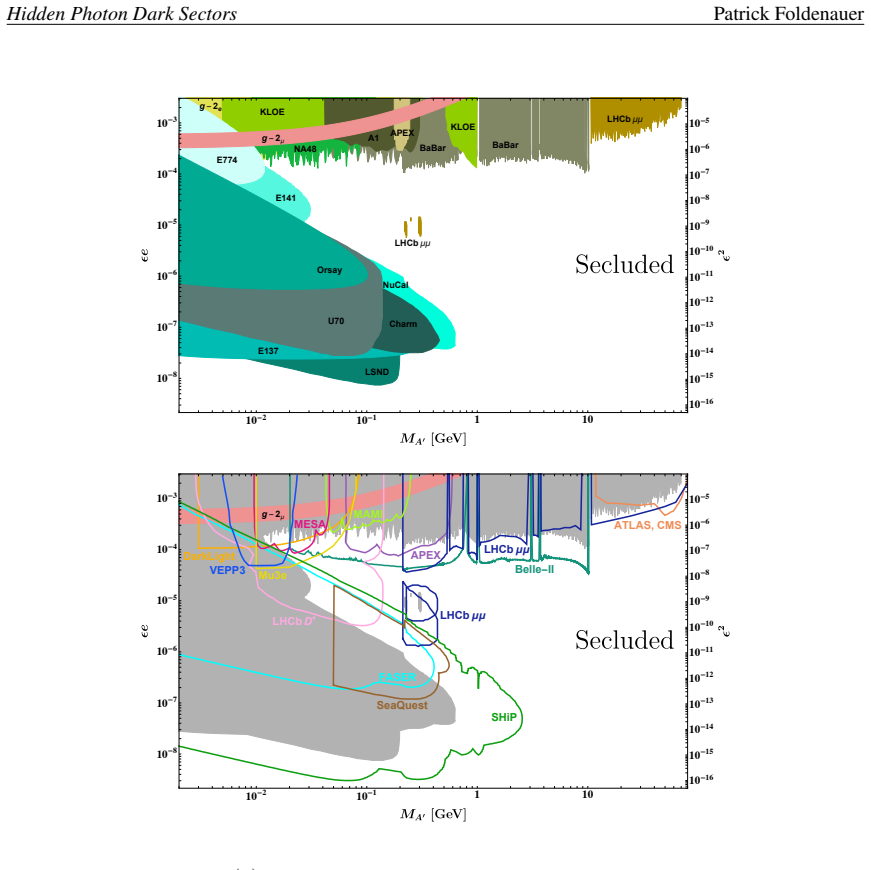
The non-observation of dark matter (DM) by direct detection experiments suggests that any new interaction of DM with the Standard Model (SM) should be very weak. One of the simplest scenarios to achieve this is a dark sector that is charged under a new $U(1)_X$ symmetry, which is kinetically mixed with the SM hypercharge $U(1)_Y$. We briefly review the status of such a minimal setup and analyze in a second step how the picture is altered if also SM fields are charged under the new symmetry. We exemplify this for the case of a gauged $U(1)_{L_\mu-L_\tau}$ and show that this allows for a simultaneous explanation of the $(g-2)_\mu$ excess and the DM relic abundance $\Omega_{DM}$. Furthermore, we discuss the potential of four-lepton and two-lepton plus missing energy signatures to test such scenarios.
Editorial analysis
A structured set of objections, weighed in public.
Referee Report
Summary. The paper reviews minimal dark sector models with a hidden photon A' arising from U(1)_X kinetically mixed with hypercharge, then considers the case where SM fields (specifically muons and taus) are also charged under U(1)_{Lμ−Lτ}. It claims that assigning charges to dark sector particles under the same U(1) permits a simultaneous explanation of the muon (g−2) excess via Z' loops and the observed DM relic density Ω_DM via annihilation channels, while outlining four-lepton and dilepton+MET signatures for testing.
Significance. If the viable parameter space survives all constraints, the work supplies a concrete, testable example of how non-universal gauging unifies two independent anomalies without additional fields beyond the minimal hidden-photon setup. The explicit discussion of collider signatures is a strength.
major comments (2)
- [gauged U(1)_{Lμ−Lτ} section] Gauged U(1)_{Lμ−Lτ} section: the central claim that charge assignments Q_DM exist such that both Δa_μ and Ω_DM are matched while avoiding conflicts with precision data is load-bearing. The manuscript must explicitly tabulate or plot the allowed (m_{A'}, g_X, Q_DM) region after imposing CCFR trident, BaBar four-lepton, and τ-decay bounds; without this, it is unclear whether the simultaneous fit survives or is excluded by the same Z'–lepton couplings fixed by the (g−2) requirement.
- [gauged U(1)_{Lμ−Lτ} section] The relic-density calculation (likely in the gauged-case subsection) fixes the DM–Z' coupling once Q_DM is chosen; the paper should show the resulting lower bound on the coupling and demonstrate that it does not push the model into the region already excluded by the same precision observables used to constrain the (g−2) window.
minor comments (2)
- Notation for the kinetic mixing parameter ε and the dark photon mass m_{A'} should be standardized across equations and figures to avoid reader confusion.
- The abstract states the simultaneous explanation is possible; the main text should include a short summary table of benchmark points that satisfy both anomalies and all listed constraints.
Simulated Author's Rebuttal
We thank the referee for the careful reading of our manuscript and the constructive comments. We address each major point below and will revise the manuscript accordingly to strengthen the presentation of the gauged U(1)_{Lμ−Lτ} case.
read point-by-point responses
-
Referee: [gauged U(1)_{Lμ−Lτ} section] Gauged U(1)_{Lμ−Lτ} section: the central claim that charge assignments Q_DM exist such that both Δa_μ and Ω_DM are matched while avoiding conflicts with precision data is load-bearing. The manuscript must explicitly tabulate or plot the allowed (m_{A'}, g_X, Q_DM) region after imposing CCFR trident, BaBar four-lepton, and τ-decay bounds; without this, it is unclear whether the simultaneous fit survives or is excluded by the same Z'–lepton couplings fixed by the (g−2) requirement.
Authors: We agree that an explicit visualization of the viable parameter space is required to make the central claim fully transparent. In the revised manuscript we will add a dedicated figure (or table) displaying the allowed (m_{A'}, g_X, Q_DM) region after all listed constraints (CCFR trident, BaBar four-lepton, τ-decay) have been imposed, together with the contours that simultaneously satisfy the (g−2)_μ excess and the observed relic density. revision: yes
-
Referee: [gauged U(1)_{Lμ−Lτ} section] The relic-density calculation (likely in the gauged-case subsection) fixes the DM–Z' coupling once Q_DM is chosen; the paper should show the resulting lower bound on the coupling and demonstrate that it does not push the model into the region already excluded by the same precision observables used to constrain the (g−2) window.
Authors: We will incorporate the requested lower bound on the DM–Z' coupling that follows from the relic-density requirement and overlay it on the same parameter-space plot described above. This will explicitly demonstrate that the relic-density lower bound does not exclude the region compatible with (g−2)_μ once all precision constraints are applied. revision: yes
Circularity Check
No significant circularity; simultaneous explanation is a parameter-space overlap result, not a definitional reduction.
full rationale
The paper reviews kinetic mixing scenarios and then assigns charges under gauged U(1)_{Lμ−Lτ} to both SM leptons and dark-sector fields. It computes the Z' contribution to Δa_μ via standard one-loop formulas and the DM relic density via standard Boltzmann-equation annihilation channels, then identifies overlapping (m_Z', g_X) regions consistent with both observables. No equation reduces the target quantities to each other by construction, no self-citation supplies a uniqueness theorem that forces the result, and no fitted parameter is relabeled as an independent prediction. The central claim is therefore an existence statement about viable parameter space rather than a closed derivation.
Axiom & Free-Parameter Ledger
free parameters (3)
- kinetic mixing parameter ε
- dark photon mass m_{A'}
- dark matter mass and coupling
axioms (2)
- domain assumption Existence of a new U(1)_X gauge symmetry that is kinetically mixed with hypercharge.
- domain assumption Standard Model fields can be consistently charged under the new U(1) without violating gauge anomaly cancellation.
invented entities (2)
-
hidden photon A'
no independent evidence
-
dark sector particles charged under U(1)_X
no independent evidence
Lean theorems connected to this paper
-
IndisputableMonolith/Foundation/RealityFromDistinction.leanreality_from_one_distinction unclear?
unclearRelation between the paper passage and the cited Recognition theorem.
gauged U(1)_{Lμ−Lτ} ... simultaneous explanation of the (g−2)μ excess and the DM relic abundance ΩDM
-
IndisputableMonolith/Cost/FunctionalEquation.leanwashburn_uniqueness_aczel unclear?
unclearRelation between the paper passage and the cited Recognition theorem.
kinetic mixing term L = −εY/2 Bμν Xμν
What do these tags mean?
- matches
- The paper's claim is directly supported by a theorem in the formal canon.
- supports
- The theorem supports part of the paper's argument, but the paper may add assumptions or extra steps.
- extends
- The paper goes beyond the formal theorem; the theorem is a base layer rather than the whole result.
- uses
- The paper appears to rely on the theorem as machinery.
- contradicts
- The paper's claim conflicts with a theorem or certificate in the canon.
- unclear
- Pith found a possible connection, but the passage is too broad, indirect, or ambiguous to say the theorem truly supports the claim.
Reference graph
Works this paper leans on
- [1]
-
[2]
Let there be Light Dark Matter: The gauged $U(1)_{L_\mu-L_\tau}$ case
P. Foldenauer, Light dark matter in a gauged U(1)Lµ−Lτ model, Phys. Rev. D99 (2019) 035007, [1808.03647]
work page internal anchor Pith review Pith/arXiv arXiv 2019
-
[3]
Foldenauer, Phenomenology of Extra Abelian Gauge Symmetries
P. Foldenauer, Phenomenology of Extra Abelian Gauge Symmetries. PhD thesis, Heidelberg U., 2019. 10.11588/heidok.00026777
-
[4]
New Measurement of the Electron Magnetic Moment and the Fine Structure Constant
D. Hanneke, S. Fogwell and G. Gabrielse, New Measurement of the Electron Magnetic Moment and the Fine Structure Constant, Phys. Rev. Lett. 100 (2008) 120801, [0801.1134]
work page internal anchor Pith review Pith/arXiv arXiv 2008
-
[5]
Planck 2018 results. VI. Cosmological parameters
P LANCK collaboration, N. Aghanim et al., Planck 2018 results. VI. Cosmological parameters, 1807.06209
work page internal anchor Pith review Pith/arXiv arXiv 2018
-
[6]
L. B. Okun, LIMITS OF ELECTRODYNAMICS: PARAPHOTONS?, Sov. Phys. JETP 56 (1982) 502
work page 1982
-
[7]
Holdom, Two U(1)’s and Epsilon Charge Shifts, Phys
B. Holdom, Two U(1)’s and Epsilon Charge Shifts, Phys. Lett. 166B (1986) 196–198
work page 1986
-
[8]
N. Arkani-Hamed, D. P. Finkbeiner, T. R. Slatyer and N. Weiner, A Theory of Dark Matter, Phys. Rev. D79 (2009) 015014, [0810.0713]
work page internal anchor Pith review Pith/arXiv arXiv 2009
-
[9]
LHC Signals for a SuperUnified Theory of Dark Matter
N. Arkani-Hamed and N. Weiner, LHC Signals for a SuperUnified Theory of Dark Matter, JHEP 12 (2008) 104, [0810.0714]
work page internal anchor Pith review Pith/arXiv arXiv 2008
-
[10]
A Natural Supersymmetric Model with MeV Dark Matter
D. Hooper and K. M. Zurek, A Natural Supersymmetric Model with MeV Dark Matter, Phys. Rev. D77 (2008) 087302, [0801.3686]
work page internal anchor Pith review Pith/arXiv arXiv 2008
-
[11]
Non-Abelian Dark Sectors and Their Collider Signatures
M. Baumgart, C. Cheung, J. T. Ruderman, L.-T. Wang and I. Yavin, Non-Abelian Dark Sectors and Their Collider Signatures, JHEP 04 (2009) 014, [0901.0283]. 9 Hidden Photon Dark Sectors Patrick Foldenauer
work page internal anchor Pith review Pith/arXiv arXiv 2009
-
[12]
Kinetic Mixing as the Origin of Light Dark Scales
C. Cheung, J. T. Ruderman, L.-T. Wang and I. Yavin, Kinetic Mixing as the Origin of Light Dark Scales, Phys. Rev. D80 (2009) 035008, [0902.3246]
work page internal anchor Pith review Pith/arXiv arXiv 2009
-
[13]
A. Katz and R. Sundrum, Breaking the Dark Force, JHEP 06 (2009) 003, [0902.3271]
work page internal anchor Pith review Pith/arXiv arXiv 2009
-
[14]
D. E. Morrissey, D. Poland and K. M. Zurek, Abelian Hidden Sectors at a GeV, JHEP 07 (2009) 050, [0904.2567]
work page internal anchor Pith review Pith/arXiv arXiv 2009
-
[15]
Probing a Secluded U(1) at B-factories
B. Batell, M. Pospelov and A. Ritz, Probing a Secluded U(1) at B-factories, Phys. Rev. D79 (2009) 115008, [0903.0363]
work page internal anchor Pith review Pith/arXiv arXiv 2009
-
[16]
Probing Dark Forces and Light Hidden Sectors at Low-Energy e+e- Colliders
R. Essig, P. Schuster and N. Toro, Probing Dark Forces and Light Hidden Sectors at Low-Energy e+e- Colliders, Phys. Rev. D80 (2009) 015003, [0903.3941]
work page internal anchor Pith review Pith/arXiv arXiv 2009
-
[17]
Searching for the light dark gauge boson in GeV-scale experiments
M. Reece and L.-T. Wang, Searching for the light dark gauge boson in GeV-scale experiments, JHEP 07 (2009) 051, [0904.1743]
work page internal anchor Pith review Pith/arXiv arXiv 2009
-
[18]
J. D. Bjorken, R. Essig, P. Schuster and N. Toro, New Fixed-Target Experiments to Search for Dark Gauge Forces, Phys. Rev. D80 (2009) 075018, [0906.0580]
work page internal anchor Pith review Pith/arXiv arXiv 2009
-
[19]
M UON G -2 collaboration, G. W. Bennett et al., Final Report of the Muon E821 Anomalous Magnetic Moment Measurement at BNL, Phys. Rev. D73 (2006) 072003, [hep-ex/0602035]
work page internal anchor Pith review Pith/arXiv arXiv 2006
-
[20]
CMS collaboration, A. M. Sirunyan et al., Search for an Lµ− Lτ gauge boson using Z→ 4µ events in proton-proton collisions at√s = 13 TeV, Phys. Lett. B792 (2019) 345–368, [1808.03684]
work page internal anchor Pith review Pith/arXiv arXiv 2019
-
[21]
R. H. Parker, C. Yu, W. Zhong, B. Estey and H. Müller, Measurement of the fine-structure constant as a test of the Standard Model, Science 360 (2018) 191, [1812.04130]
work page internal anchor Pith review Pith/arXiv arXiv 2018
-
[22]
Non-Standard Neutrino Interactions and Neutral Gauge Bosons
J. Heeck, M. Lindner, W. Rodejohann and S. V ogl,Non-Standard Neutrino Interactions and Neutral Gauge Bosons, SciPost Phys. 6 (2019) 038, [1812.04067]. 10
work page internal anchor Pith review Pith/arXiv arXiv 2019
discussion (0)
Sign in with ORCID, Apple, or X to comment. Anyone can read and Pith papers without signing in.