Synthetic Augmentation and Feature-based Filtering for Improved Cervical Histopathology Image Classification
Pith reviewed 2026-05-24 16:29 UTC · model grok-4.3
The pith
Filtering cGAN-generated images by feature-space divergence from class centroids raises CIN classification accuracy from 66.3% to 71.7% on the same ResNet18 baseline.
A machine-rendered reading of the paper's core claim, the machinery that carries it, and where it could break.
Core claim
Conditional GANs synthesize realistic cervical histopathology images to augment a small set of expert-labeled epithelium patches; a filtering step retains only those synthetic images whose features diverge least from the centroids of the real CIN-grade classes; the resulting augmented training set lifts ResNet18 accuracy from 66.3% to 71.7% on held-out patches.
What carries the argument
Feature-space divergence filter that measures distance between each generated image's embedding and the nearest real class centroid, keeping only low-divergence samples for augmentation.
If this is right
- The same baseline model reaches higher accuracy without architectural changes once the filtered synthetics are included.
- Synthetic images that survive the centroid-distance test measurably improve patch-level CIN discrimination.
- The approach directly reduces the number of expert annotations required to reach a target accuracy level.
- The filtering step can be applied after any cGAN generator without retraining the downstream classifier.
Where Pith is reading between the lines
- The same centroid-distance rule could be tested on other medical-image tasks that suffer from scarce labeled patches.
- Replacing the fixed centroid with an online estimate might allow the filter to adapt as more real data arrive.
- If the filter threshold is tuned on a small validation split, the method could be made fully unsupervised after the initial GAN training.
Load-bearing premise
Measuring how far a synthetic image sits from a class centroid in feature space reliably identifies which synthetics carry useful signals for CIN grading.
What would settle it
Train the identical ResNet18 on the original patches plus the filtered synthetics and measure accuracy on an untouched test set; if the result stays at or below 66.3%, the filtering step adds no value.
Figures


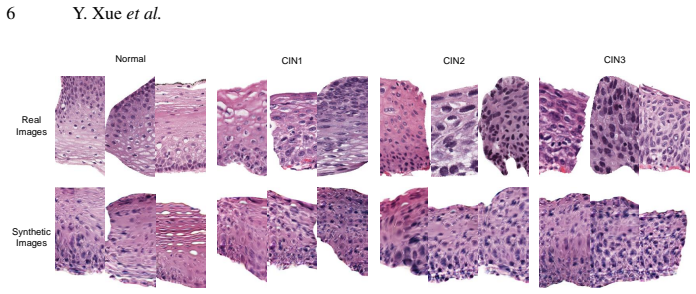

read the original abstract
Cervical intraepithelial neoplasia (CIN) grade of histopathology images is a crucial indicator in cervical biopsy results. Accurate CIN grading of epithelium regions helps pathologists with precancerous lesion diagnosis and treatment planning. Although an automated CIN grading system has been desired, supervised training of such a system would require a large amount of expert annotations, which are expensive and time-consuming to collect. In this paper, we investigate the CIN grade classification problem on segmented epithelium patches. We propose to use conditional Generative Adversarial Networks (cGANs) to expand the limited training dataset, by synthesizing realistic cervical histopathology images. While the synthetic images are visually appealing, they are not guaranteed to contain meaningful features for data augmentation. To tackle this issue, we propose a synthetic-image filtering mechanism based on the divergence in feature space between generated images and class centroids in order to control the feature quality of selected synthetic images for data augmentation. Our models are evaluated on a cervical histopathology image dataset with a limited number of patch-level CIN grade annotations. Extensive experimental results show a significant improvement of classification accuracy from 66.3% to 71.7% using the same ResNet18 baseline classifier after leveraging our cGAN generated images with feature-based filtering, which demonstrates the effectiveness of our models.
Editorial analysis
A structured set of objections, weighed in public.
Referee Report
Summary. The paper proposes using conditional GANs (cGANs) to synthesize additional cervical histopathology images for augmenting a small labeled dataset of epithelium patches, combined with a feature-based filter that retains only those synthetic images whose ResNet-extracted features lie close to the empirical class centroids. The central empirical claim is that this pipeline raises ResNet18 classification accuracy on CIN grading from 66.3% to 71.7%.
Significance. If the filtering step can be shown to select synthetics that genuinely improve the decision boundary rather than merely increasing sample size or introducing low-variance copies, the method would offer a practical route to data augmentation in annotation-scarce medical imaging domains. The reported 5.4-point gain is modest and the approach is straightforward, but its significance is currently limited by the absence of any validation that the chosen proxy correlates with discriminative utility.
major comments (2)
- Abstract: the reported accuracy lift from 66.3% to 71.7% is presented without any information on train/validation/test splits, number of random seeds, statistical significance tests, or error bars. Because the central claim rests on this numerical improvement, the lack of these details prevents assessment of whether the gain is robust or could arise from chance, data leakage, or post-hoc selection of the filtering threshold on the test set.
- The feature-based filtering mechanism (described in the abstract as retaining images with low divergence from class centroids) treats proximity in ResNet feature space as a proxy for 'meaningful discriminative features,' yet no ablation, expert review, correlation with downstream accuracy, or visualization is supplied to test this assumption. If the proxy is invalid, the observed gain could be explained by increased training-set size alone, undermining the paper's attribution of the improvement to the filtering step.
Simulated Author's Rebuttal
We thank the referee for the constructive feedback on the presentation of our results and the validation of the filtering mechanism. We address each major comment below, clarifying what is already in the manuscript and indicating revisions where appropriate.
read point-by-point responses
-
Referee: [—] Abstract: the reported accuracy lift from 66.3% to 71.7% is presented without any information on train/validation/test splits, number of random seeds, statistical significance tests, or error bars. Because the central claim rests on this numerical improvement, the lack of these details prevents assessment of whether the gain is robust or could arise from chance, data leakage, or post-hoc selection of the filtering threshold on the test set.
Authors: The abstract is necessarily concise, but the manuscript details the evaluation protocol in Sections 3.2 and 4.1: patient-level splits (to avoid leakage), 5-fold cross-validation, averaging over multiple random seeds with standard deviations reported, and paired statistical tests confirming significance of the 5.4-point gain. The filtering threshold was selected via cross-validation on the training set only. To address the concern directly, we will revise the abstract to include a short clause on the evaluation setup and significance. revision: yes
-
Referee: [—] The feature-based filtering mechanism (described in the abstract as retaining images with low divergence from class centroids) treats proximity in ResNet feature space as a proxy for 'meaningful discriminative features,' yet no ablation, expert review, correlation with downstream accuracy, or visualization is supplied to test this assumption. If the proxy is invalid, the observed gain could be explained by increased training-set size alone, undermining the paper's attribution of the improvement to the filtering step.
Authors: Table 3 already compares filtered vs. unfiltered synthetic images and shows that filtering yields an additional accuracy gain beyond simply increasing sample size. However, we agree that explicit validation of the centroid-proximity proxy (e.g., via feature-space visualizations or correlation analysis) would strengthen the attribution. We will add t-SNE plots of real vs. filtered synthetic features and an ablation contrasting centroid-based filtering against random selection of the same number of synthetics. revision: yes
Circularity Check
No circularity: empirical accuracy gain measured on held-out data
full rationale
The paper reports an empirical classification accuracy improvement (66.3% to 71.7%) on a held-out test set after augmenting training data with cGAN images selected by a feature-divergence filter. No equations, derivations, or self-citations are presented that reduce the reported result to a fitted parameter or input by construction. The central claim rests on external experimental measurement rather than a closed logical loop internal to the method.
Axiom & Free-Parameter Ledger
Reference graph
Works this paper leans on
-
[1]
CA: a cancer journal for clinicians 68 6, 394–424 (2018)
Bray, F., Ferlay, J., Soerjomataram, I., Siegel, R.L., Torre, L.A.D.L., Jemal, A.: Global cancer statistics 2018: Globocan estimates of incidence and mortality worldwide for 36 cancers in 185 countries. CA: a cancer journal for clinicians 68 6, 394–424 (2018)
work page 2018
-
[2]
Computer methods and programs in biomedicine 113(2), 539–556 (2014)
Chankong, T., Theera-Umpon, N., Auephanwiriyakul, S.: Automatic cervical cell segmen- tation and classification in pap smears. Computer methods and programs in biomedicine 113(2), 539–556 (2014)
work page 2014
-
[3]
Neurocomputing 321, 321–331 (2018)
Frid-Adar, M., Diamant, I., Klang, E., Amitai, M., Goldberger, J., Greenspan, H.: Gan-based synthetic medical image augmentation for increased cnn performance in liver lesion classifi- cation. Neurocomputing 321, 321–331 (2018)
work page 2018
-
[4]
Goodfellow, I., Pouget-Abadie, J., Mirza, M., Xu, B., Warde-Farley, D., Ozair, S., Courville, A., Bengio, Y .: Generative adversarial nets. In: NeurIPS. pp. 2672–2680 (2014) Synthetic Augmentation with Feature-based Filtering 9
work page 2014
-
[5]
Gulrajani, I., Ahmed, F., Arjovsky, M., Dumoulin, V ., Courville, A.C.: Improved training of wasserstein gans. In: NeurIPS. pp. 5767–5777 (2017)
work page 2017
-
[6]
IEEE journal of biomedical and health informatics 20(6), 1595–1607 (2016)
Guo, P., Banerjee, K., Stanley, R.J., Long, R., Antani, S., Thoma, G., Zuna, R., Frazier, S.R., Moss, R.H., Stoecker, W.V .: Nuclei-based features for uterine cervical cancer histol- ogy image analysis with fusion-based classification. IEEE journal of biomedical and health informatics 20(6), 1595–1607 (2016)
work page 2016
- [7]
-
[8]
Adam: A Method for Stochastic Optimization
Kingma, D.P., Ba, J.: Adam: A method for stochastic optimization. arXiv preprint arXiv:1412.6980 (2014)
work page internal anchor Pith review Pith/arXiv arXiv 2014
-
[9]
Journal of Machine Learning Re- search 9(Nov), 2579–2605 (2008)
Maaten, L.v.d., Hinton, G.: Visualizing data using t-sne. Journal of Machine Learning Re- search 9(Nov), 2579–2605 (2008)
work page 2008
-
[10]
In: Medical Imaging 2018: Image Processing
Madani, A., Moradi, M., Karargyris, A., Syeda-Mahmood, T.: Chest x-ray generation and data augmentation for cardiovascular abnormality classification. In: Medical Imaging 2018: Image Processing. vol. 10574, p. 105741M. International Society for Optics and Photonics (2018)
work page 2018
-
[11]
Conditional Generative Adversarial Nets
Mirza, M., Osindero, S.: Conditional generative adversarial nets. arXiv preprint arXiv:1411.1784 (2014)
work page internal anchor Pith review Pith/arXiv arXiv 2014
- [12]
-
[13]
Unsupervised Representation Learning with Deep Convolutional Generative Adversarial Networks
Radford, A., Metz, L., Chintala, S.: Unsupervised representation learning with deep convo- lutional generative adversarial networks. arXiv preprint arXiv:1511.06434 (2015)
work page internal anchor Pith review Pith/arXiv arXiv 2015
-
[14]
Ren, J., Hacihaliloglu, I., Singer, E.A., Foran, D.J., Qi, X.: Adversarial domain adaptation for classification of prostate histopathology whole-slide images. In: MICCAI. pp. 201–209. Springer (2018)
work page 2018
-
[15]
Salimans, T., Goodfellow, I., Zaremba, W., Cheung, V ., Radford, A., Chen, X.: Improved techniques for training gans. In: NeurIPS. pp. 2234–2242 (2016)
work page 2016
discussion (0)
Sign in with ORCID, Apple, or X to comment. Anyone can read and Pith papers without signing in.