Vector 0π pulse in anisotropic media
Pith reviewed 2026-05-24 16:27 UTC · model grok-4.3
The pith
Second derivatives in the SIT equations for anisotropic media produce vector 0π pulses that act as basic solutions alongside scalar 2π pulses.
A machine-rendered reading of the paper's core claim, the machinery that carries it, and where it could break.
Core claim
The system of equations of self-induced transparency (SIT) for extraordinary wave in uniaxial anisotropic media by means of generalized reduction perturbation method are transformed to the coupled nonlinear Schrödinger equations. It is shown that in the theory of SIT the second derivatives have significant role and leads to the formation of a vector 0π pulse oscillating with the sum and difference of the frequencies. It is shown that along with scalar 2π pulse, the vector 0π pulse is also the basic pulse of SIT and the scalar 0π pulse of SIT is only an approximation which can be considered in some special cases. The conditions of the existence of the nonlinear extraordinary wave depends on a
What carries the argument
Coupled nonlinear Schrödinger equations derived from the SIT equations for extraordinary waves via the generalized reduction perturbation method, which retain second derivatives and thereby generate the vector 0π pulse.
If this is right
- The vector 0π pulse oscillates with the sum and difference of the frequencies.
- Existence of the nonlinear extraordinary wave depends on the direction of propagation.
- Explicit analytical expressions for the profile and parameters of the vector 0π pulse can be obtained.
- The scalar 0π pulse of SIT is valid only as an approximation in special cases.
Where Pith is reading between the lines
- Neglecting second derivatives recovers the usual scalar approximation for 0π pulses.
- The same mechanism may appear in other anisotropic or birefringent media when second-order terms are retained.
- Measurements of frequency mixing at sum and difference components could test the vector-pulse prediction in ruby or similar crystals.
Load-bearing premise
The generalized reduction perturbation method applied to the SIT equations for extraordinary waves in uniaxial anisotropic media accurately captures the significant role of second derivatives leading to the vector 0π pulse formation.
What would settle it
An experiment propagating an extraordinary wave through a uniaxial anisotropic crystal under SIT conditions that either detects or fails to detect a pulse component oscillating at the sum and difference frequencies with the predicted profile.
Figures
read the original abstract
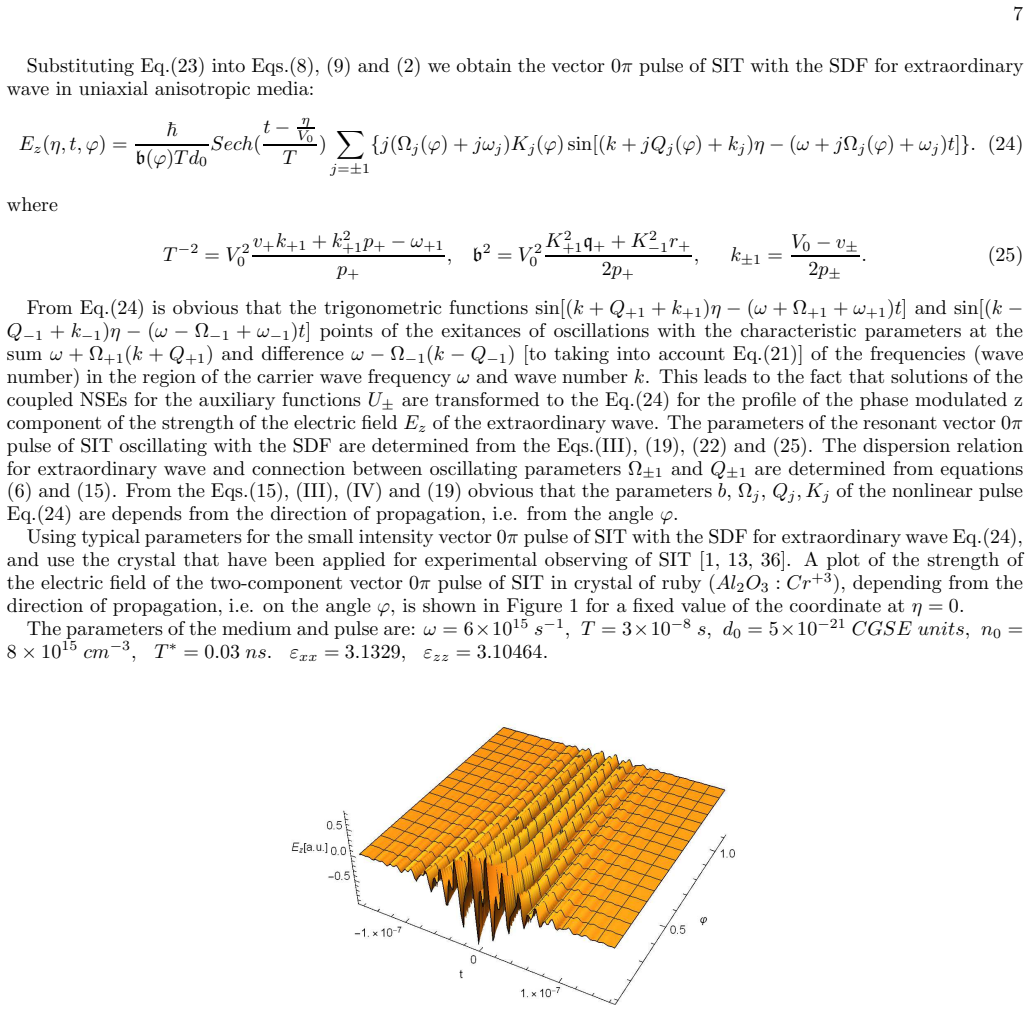
The system of equations of self-induced transparency (SIT) for extraordinary wave in uniaxial anisotropic media by means of generalized reduction perturbation method are transformed to the coupled nonlinear Schr\"odinger equations. It is shown that in the theory of SIT the second derivatives have significant role and leads to the formation of a vector $0\pi$ pulse oscillating with the sum and difference of the frequencies. An explicit analytical expressions for the profile and parameters of the nonlinear wave are obtained. It is shown that along with scalar $2\pi$ pulse, the vector $0\pi$ pulse is also the basic pulse of SIT and the scalar $0\pi$ pulse of SIT is only an approximation which can be considered in some special cases. The conditions of the existence of the nonlinear extraordinary wave depends on the direction of propagation. The profile of the vector $0\pi$ pulse in anisotropic crystal of ruby is presented with characteristic parameters which usually met in experiments.
Editorial analysis
A structured set of objections, weighed in public.
Referee Report
Summary. The manuscript applies the generalized reduction perturbation method to the SIT equations for extraordinary waves in uniaxial anisotropic media, transforming them into coupled nonlinear Schrödinger equations. It asserts that second derivatives play a significant role, producing a vector 0π pulse oscillating at sum and difference frequencies as a basic solution of SIT alongside the scalar 2π pulse; the scalar 0π pulse is presented as an approximation valid only in special cases. Explicit analytical expressions for the nonlinear wave profile and parameters are claimed, with existence conditions depending on propagation direction, and a numerical profile example is given for a ruby crystal using typical experimental parameters.
Significance. If the central derivation holds without hidden approximations, the result would be significant for nonlinear optics by extending SIT theory to anisotropic media and identifying the vector 0π pulse as fundamental rather than approximate. Credit is due for attempting an analytical treatment of the anisotropic case and for providing an explicit profile example tied to ruby parameters.
major comments (2)
- [Method and derivation of coupled NLS] The generalized reduction perturbation method is used to retain second-derivative terms at leading order in the reduction from SIT equations to coupled NLS (see the transformation steps leading to the vector 0π solution). Standard envelope approximations order these terms as O(ε) corrections under the slow-varying assumption; no explicit verification of the perturbation ordering is provided against the original SIT system or the isotropic limit for the ruby parameters and directions cited, which is load-bearing for the claim that second derivatives generate a new basic pulse.
- [Analytical expressions and results] The abstract and results section assert that explicit analytical expressions for the vector 0π pulse profile and parameters are obtained and that this pulse is a basic solution of SIT. However, the manuscript provides no full step-by-step derivation, error bounds, or direct substitution check back into the original SIT equations to confirm the solution satisfies the unapproximated system, undermining support for the claim that the scalar 0π pulse is only an approximation.
minor comments (2)
- [Figures] Figure 1 (ruby profile) would benefit from explicit labeling of the sum and difference frequency components and a comparison plot against the scalar 2π case.
- [Notation] Notation for the extraordinary wave components and the perturbation parameter should be defined at first use with a clear table of symbols.
Simulated Author's Rebuttal
We thank the referee for the careful reading and constructive comments on our manuscript. We address the two major comments below and will incorporate clarifications and verifications in a revised version.
read point-by-point responses
-
Referee: [Method and derivation of coupled NLS] The generalized reduction perturbation method is used to retain second-derivative terms at leading order in the reduction from SIT equations to coupled NLS (see the transformation steps leading to the vector 0π solution). Standard envelope approximations order these terms as O(ε) corrections under the slow-varying assumption; no explicit verification of the perturbation ordering is provided against the original SIT system or the isotropic limit for the ruby parameters and directions cited, which is load-bearing for the claim that second derivatives generate a new basic pulse.
Authors: The generalized reduction perturbation method is formulated precisely to retain second-derivative contributions at leading order when anisotropy prevents uniform application of the standard slow-envelope ordering. This is the central distinction from isotropic SIT. We acknowledge that an explicit ordering verification (including ε estimates for the ruby parameters and directions) and a direct comparison to the isotropic limit would strengthen the presentation. These will be added to the revised manuscript. revision: yes
-
Referee: [Analytical expressions and results] The abstract and results section assert that explicit analytical expressions for the vector 0π pulse profile and parameters are obtained and that this pulse is a basic solution of SIT. However, the manuscript provides no full step-by-step derivation, error bounds, or direct substitution check back into the original SIT equations to confirm the solution satisfies the unapproximated system, undermining support for the claim that the scalar 0π pulse is only an approximation.
Authors: The analytical expressions follow directly from applying the generalized RPM to the SIT system for extraordinary waves, yielding the coupled NLS whose vector soliton is the claimed 0π pulse. While the final profile and parameter expressions are given, we agree that a concise outline of the intermediate steps, error bounds on the approximation, and a substitution verification into the original SIT equations would better substantiate that the scalar 0π form is recovered only in special limits. These elements will be included in the revision. revision: yes
Circularity Check
Derivation of vector 0π pulse via generalized reduction perturbation method is self-contained
full rationale
The paper applies the generalized reduction perturbation method to the SIT equations for extraordinary waves, transforming them into coupled NLS equations and obtaining explicit analytical expressions for the vector 0π pulse profile and parameters. No quoted steps reduce the central claim (vector 0π as basic solution alongside scalar 2π) to a self-definition, a fitted input renamed as prediction, or a load-bearing self-citation chain. The result is presented as following from the transformed equations with the stated role of second derivatives; the derivation chain remains independent of the target claim and does not require external verification of uniqueness theorems or ansatzes from the same authors to hold.
Axiom & Free-Parameter Ledger
axioms (1)
- domain assumption SIT equations for extraordinary wave in uniaxial anisotropic media can be transformed via generalized reduction perturbation method to coupled nonlinear Schrödinger equations where second derivatives play a significant role.
Lean theorems connected to this paper
-
IndisputableMonolith/Cost/FunctionalEquation.leanwashburn_uniqueness_aczel unclear?
unclearRelation between the paper passage and the cited Recognition theorem.
the system of equations of self-induced transparency (SIT) for extraordinary wave in uniaxial anisotropic media by means of generalized reduction perturbation method are transformed to the coupled nonlinear Schrödinger equations
What do these tags mean?
- matches
- The paper's claim is directly supported by a theorem in the formal canon.
- supports
- The theorem supports part of the paper's argument, but the paper may add assumptions or extra steps.
- extends
- The paper goes beyond the formal theorem; the theorem is a base layer rather than the whole result.
- uses
- The paper appears to rely on the theorem as machinery.
- contradicts
- The paper's claim conflicts with a theorem or certificate in the canon.
- unclear
- Pith found a possible connection, but the passage is too broad, indirect, or ambiguous to say the theorem truly supports the claim.
Reference graph
Works this paper leans on
-
[1]
S. L. McCall and E. L. Hahn, Phys. Rev. 183, 457 (1969)
work page 1969
-
[2]
L. Allen and J. Eberly, Optical resonance and two level atoms , (Dover, 1975)
work page 1975
-
[3]
A. I. Maimistov, A. M. Basharov, S. O. Elyutin and Y. M. Skl yarov, Phys. Rep. 191, 1 (1990)
work page 1990
-
[4]
G. T. Adamashvili, C. Weber, A. Knorr and N. T. Adamashvil i, Phys. Rev. A. 75, 063808 (2007)
work page 2007
-
[5]
G. Panzarini, U. Hohenester and E. Molinari, Phys. Rev. B . 65, 165322 (2002)
work page 2002
-
[6]
G. T. Adamashvili and D. J. Kaup, Phys. Phys. A. 99, 013832 (2019)
work page 2019
-
[7]
M. D. Crisp, Phys. Rev. A. 2, 2172 (1970)
work page 1970
-
[8]
J. E. Rothenberg, D. Grischkowsky and A. C. Balant, Phys. Rev. Lett. 53, 552 (1984)
work page 1984
-
[9]
R. M. Arkhipov, M. V. Arkhipov, I. Babushkin and N. N. Rosa nov , Optics lett. 41, 737 (2016)
work page 2016
-
[10]
J. D. Harvey, J. M. Dudley, P. F. Curley, C. Spielmann and F. Krausz , Optics lett. 19, 972 (1994)
work page 1994
-
[11]
M. V. Arkhipov, A. A. Shimko, R. M. Arkhipov, I. Babushki n, A. A. Kalinichev, A. Demircan, U. Morgner and N. N. Rosanov , Laser Phys.lett. 15, 075003 (2018)
work page 2018
-
[12]
G. L. Lamb, Jr., Rev. Mod. Phys. 43, 99 (1971)
work page 1971
-
[13]
I. A. Poluektov, Y. M. Popov and V. S. Roitberg, Usp. Fiz. Nauk. 114, 97 (1974)
work page 1974
-
[14]
A. C. Newell, Solitons in Mathematics and Physics , (Society for Industrial and Applied Mathematics, 1985)
work page 1985
-
[15]
R. K. Dodd, J. C. Eilbeck, J. D. Gibbon and H. C. Morris, So litons and Nonlinear wave Equations, Academic Press. Inc. (1982)
work page 1982
- [16]
-
[17]
S. P. Novikov, S. V. Manakov, L. P. Pitaevski and V. E. Zak harov, Theory of Solitons: The Inverse Scattering Method, Academy of Science of the USSR, Moscow, USSR. (1984)
work page 1984
-
[18]
D. J. Kaup, Phys. Rev. A. 16, 704 (1977)
work page 1977
-
[19]
G. T. Adamashvili, D. J. Kaup, A. Knorr and C. Weber , Phys . Pev. A. 78, 013840 (2008)
work page 2008
-
[20]
G. T. Adamashvili, Results in Physics, 1, 26 (2011)
work page 2011
-
[21]
G. T. Adamashvili, Optics and spectroscopy, 113, 1 (2012)
work page 2012
-
[22]
G. T. Adamashvili, Physica B. 407, 3413 (2012)
work page 2012
-
[23]
G. T. Adamashvili, The Eur. Phys. J. D. 66, 101 (2012)
work page 2012
-
[24]
G. T. Adamashvili, D. J. Kaup and A. Knorr , Phys. Pev. A. 90, 053835 (2014)
work page 2014
-
[25]
G. T. Adamashvili, Phys. Rev. E. 69, 026608 (2004)
work page 2004
-
[26]
G. T. Adamashvili and D. J. Kaup, Phys. Rev. E. 73, 066616 (2006)
work page 2006
- [27]
-
[28]
Y. S. Kivshar and G. P. Agrawal, Optical solitons. From Fibers to Photonic Crystals (Academic Press, 2003)
work page 2003
-
[29]
Z. Chen, M. Segev and D. Christodoulides, Reports on Pro gress in Physics, 75, 086401 (2012)
work page 2012
-
[30]
G. T. Adamashvili, Phys. Lett. A. 379, 218 (2015)
work page 2015
-
[31]
A. A. Kaminskii, Lasernie Kristali , (Nauka, Moscow, 1975)
work page 1975
- [32]
-
[33]
A. K. Geim and K. S. Novoselov, Nat. Mater. 6, 183 (2007)
work page 2007
-
[34]
G. T. Adamashvili, Tech. Phys. Lett. 44, 351 (2018)
work page 2018
-
[35]
L. D. Landau and E. M. Lifshitz, Electrodynamics of continuous Media , (Pergamon press Ltd. New York , 1984)
work page 1984
-
[36]
J. C. Diels and E. L. Hahn, Phys. Rev. A 10, 2501 (1974)
work page 1974
-
[37]
V. M. Agranovich, G. T. Adamashvili and V. I. Rupasov, Zh . Eksp. Teor. Fiz. 80, 1741 (1981)
work page 1981
-
[38]
S. V. Sazonov and N. V. Ustinov, Kvantovaya Electronika , 35, 701 (2005)
work page 2005
-
[39]
A. I. Maimistov and A. M. Basharov, Nonlinear optical wa ves, Kluwer Academic publishers, (1999)
work page 1999
-
[40]
G. T. Adamashvili and A. Knorr, Optics Lett., 31, 74 (2006)
work page 2006
-
[41]
G. T. Adamashvili and D. J. Kaup, Phys. Rev. E, 70, 066616 (2004)
work page 2004
-
[42]
S. V. Manakov, Sov.Phys. JETP. 38, 248 (1974)
work page 1974
discussion (0)
Sign in with ORCID, Apple, or X to comment. Anyone can read and Pith papers without signing in.