REVIEW 2 major objections 2 minor 16 references
Experimentation on the motion of an obstacle avoiding robot
T0 review · 2 major / 2 minor · reviewed 2026-05-24 · grok-4.3
Pith's one-line read A Lego Mindstorms EV3 robot programmed with hill climbing navigates out of adjustable wooden mazes using sensor inputs.
desk verdict Basic EV3 hill-climbing maze robot description with no results reported and local maxima issue unaddressed. read the letter →
The pith
A machine-rendered reading of the paper's core claim, the machinery that carries it, and where it could break.
The reading
What carries the argument
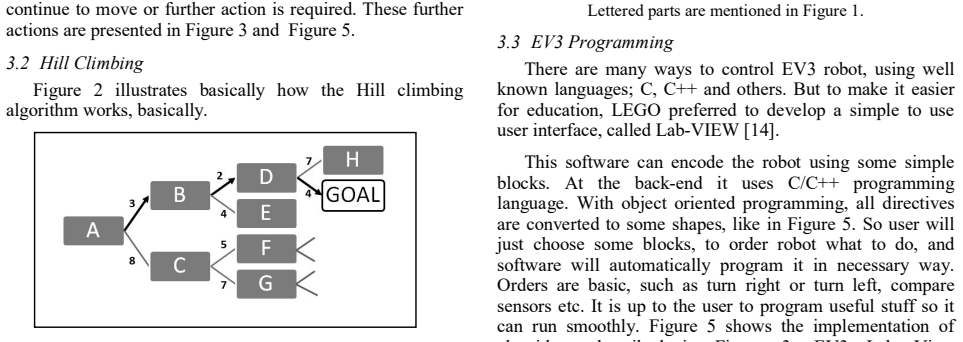
Hill climbing algorithm, which makes decisions at every node to find the shortest possible solution by searching the produced tree.
What would settle it
Run the robot in a maze containing a local maximum dead-end and observe whether it loops indefinitely without exiting.
Extended reading notes
Core claim
The programmed EV3 robot traverses the maze by using sensors and applies the hill climbing algorithm to search the produced tree and select the best possibilities at every node, allowing it to find a way out of the adjustable wooden maze.
Load-bearing premise
The hill climbing algorithm is suitable for real-time maze navigation on this hardware without getting trapped in local maxima.
Editorial extensions
If this is right
- The robot can operate in high-risk applications such as nuclear sites, space exploration, or demining.
- Adjustable maze designs confirm the system handles different layouts.
- Native LabView programming supports quick sensor interaction and reconstruction of the robot.
Reading between the lines
- The approach may fail in mazes where hill climbing encounters local maxima, requiring additional mechanisms to escape.
- Testing against other search algorithms on the same hardware would clarify relative performance.
- The quick reconstruction capability of the EV3 platform allows systematic variation of sensor placement to measure effects on navigation success.
Editorial analysis
A structured set of objections, weighed in public.
Referee Report
Summary. The manuscript describes an implementation of the hill-climbing algorithm on an EV3 Lego Mindstorms robot equipped with sensors. The robot is intended to traverse and exit an adjustable wooden maze by evaluating possibilities at each state; the abstract states that hill climbing is among the most suitable methods for this decision-making task and that the setup succeeds for any maze design.
Significance. If supported by data, the work would illustrate a low-cost, sensor-driven application of a basic AI search algorithm to obstacle avoidance on accessible hardware. The choice of Lego EV3 and LabView could aid reproducibility for educational robotics experiments.
major comments (2)
- [Abstract] Abstract: the central claim that the robot 'will calculate the best possibilities to find way out of maze' and succeed on 'any design' is unsupported; the manuscript reports no quantitative results, success rates, path lengths, failure cases, or experimental trials.
- [Abstract] Abstract: the assertion that hill climbing is 'one of most suitable searching methods' for real-time maze navigation does not address the algorithm's known termination at local maxima; no escape mechanisms, backtracking, or state-representation details are described that would prevent trapping in dead-end configurations.
minor comments (2)
- The state representation derived from the sensors and the precise form of the hill-climbing heuristic are not specified, making the implementation difficult to replicate or evaluate.
- No pseudocode, flow diagram, or LabView block details are provided for the decision loop.
Simulated Author's Rebuttal
We thank the referee for their comments, which highlight important issues with the presentation of our work. We respond to each major comment below.
read point-by-point responses
-
Referee: [Abstract] Abstract: the central claim that the robot 'will calculate the best possibilities to find way out of maze' and succeed on 'any design' is unsupported; the manuscript reports no quantitative results, success rates, path lengths, failure cases, or experimental trials.
Authors: We agree that the abstract contains claims not backed by quantitative data. The manuscript describes the implementation and provides a qualitative account of the robot's performance in the maze. We will revise the abstract to remove the assertion of success for 'any design' and to better reflect the scope of the reported work as an experimental demonstration rather than a comprehensive evaluation. revision: yes
-
Referee: [Abstract] Abstract: the assertion that hill climbing is 'one of most suitable searching methods' for real-time maze navigation does not address the algorithm's known termination at local maxima; no escape mechanisms, backtracking, or state-representation details are described that would prevent trapping in dead-end configurations.
Authors: This is a valid criticism. The paper implements the basic hill-climbing algorithm without mechanisms to escape local maxima. We will revise the abstract to qualify the statement, noting that hill-climbing was selected for its simplicity in this context, and we will add discussion of its limitations regarding local maxima in the manuscript. revision: yes
Circularity Check
No derivation chain or equations; purely experimental implementation description
full rationale
The manuscript contains no mathematical derivations, equations, fitted parameters, predictions, or self-citations. It is an implementation report describing the choice of hill-climbing on EV3 hardware for maze traversal, with no load-bearing steps that reduce to inputs by construction. The central claim is an empirical assertion about robot behavior rather than a derived result, making circularity analysis inapplicable.
Assumptions & free parameters
Cite this review
Pith. "Pith review of Experimentation on the motion of an obstacle avoiding robot." pith.science (2026). https://pith.science/paper/KDUBQVS4
@misc{pith2026190711021,
  author       = {Pith},
  title        = {Pith review of: Experimentation on the motion of an obstacle avoiding robot},
  year         = {2026},
  howpublished = {\url{https://pith.science/paper/KDUBQVS4}},
  note         = {Machine review of arXiv:1907.11021}
}
read the original abstract
An intelligent robot can be used for applications where a human is at significant risk (like nuclear, space, military), the economics or menial nature of the application result in inefficient use of human workers (service industry, agriculture), for humanitarian uses where there is great risk (demining an area of land mines, urban search and rescue). This paper implements an experiment on one of important fields of AI Searching Algorithms, to find shortest possible solution by searching the produced tree. We will concentrate on Hill climbing algorithm, which is one of simplest searching algorithms in AI. This algorithm is one of most suitable searching methods to help expert system to make decision at every state, at every node. The experimental robot will traverse the maze by using sensors plugged on it. The robot used is E.V.3 Lego Mind storms, with native software for programming LabView. The reason we chose this robot is that it interacts quickly with sensors and can be reconstructed in many ways. This programmed robot will calculate the best possibilities to find way out of maze. The maze is made of wood, and it is adjustable, as robot should be able to leave the maze in any design.
Figures


Figures from the paper (4 more)


Lean theorems connected to this paper
-
IndisputableMonolith/Cost/FunctionalEquation.leanwashburn_uniqueness_aczel unclear?
unclearRelation between the paper passage and the cited Recognition theorem.
This programmed robot will calculate the best possibilities to find way out of maze... Hill climbing algorithm... longer distance from wall is an optimal choice.
-
IndisputableMonolith/Foundation/DimensionForcing.leanalexander_duality_circle_linking unclear?
unclearRelation between the paper passage and the cited Recognition theorem.
The maze is made of wood, and it is adjustable... robot should be able to leave the maze in any design.
What do these tags mean?
- matches
- The paper's claim is directly supported by a theorem in the formal canon.
- supports
- The theorem supports part of the paper's argument, but the paper may add assumptions or extra steps.
- extends
- The paper goes beyond the formal theorem; the theorem is a base layer rather than the whole result.
- uses
- The paper appears to rely on the theorem as machinery.
- contradicts
- The paper's claim conflicts with a theorem or certificate in the canon.
- unclear
- Pith found a possible connection, but the passage is too broad, indirect, or ambiguous to say the theorem truly supports the claim.
Reference graph
Works this paper leans on
-
[1]
Francis X. Govers. Artificial Intelligence for Robotics. Packt Publish, Chapter 1. 2018
work page 2018
-
[2]
Worrall, K. J. Guidance and search algorithms for mobile robots: application and analysis within the context of urban search and rescue. University of Glasgow, PhD thesis. 2008
work page 2008
-
[3]
van Putten, B. J. S . Design of a maze solving robot using Lego MINDSTORMS. (DCT rapporten; Vol.2006.057). Eindhoven: Technische Universiteit Eindhoven. 2006
work page 2006
-
[4]
P. Kevan. A Lego Mindstorms Maze Solving Robot. University of Leeds, Master Thesis. 2003
work page 2003
-
[5]
Pantech Solution. Obstacle avoidance robot. https://www.pantechsolutions.net/robotics-projects/obstacle- avoidance-robot (visited on 06/05/2019)
work page 2019
-
[6]
Robin M. Introduction to AI Robotics. MIT Press. ISBN: 9780262038485. 2000
work page 2000
-
[7]
Renata B. & Robertas D. Teaching of Computer Science Topics Using Meta-Programming-Based GLOs and LEGO. Informatics in Education, vol. Vol. 12, no. No. 1, pp. 125–
-
[8]
A.M. Cook, K. Adams, J. Volden & N. Harbottle. Using Lego Robots to Estimate Cognitive Ability in Children who have Severe Physical Disabilities. Disabil Rehabil Assist Technol. 2011;6(4):338-46. 2011
work page 2011
Show all 16 references
-
[9]
& Hussein B
Haissam E. & Hussein B. A simulated motion planning algorithm in 2D and 3D environment using Hill Climbing. International Journal of Artificial Intelligence & Applications (IJAIA), Vol. 5, p. 1. 2014
2014
-
[10]
& Asaju L
Mohammed A. & Asaju L. ß-Hill Climbing algorithm for sudoku game. 2nd Proceedings of Palestinian International Conference on Information and Communication Technology. 2017
2017
-
[11]
Artificial Intelligence Illuminated
Ben C. Artificial Intelligence Illuminated. Jones and Barlett Publishers. 2004
2004
-
[12]
& Nayak T
Dash T., Mishra G. & Nayak T. A Novel Approach for Intelligent Robot Path Planning. Proceedings of National Conference in AIRES-, Andhra University , p. 388. 2012
2012
-
[13]
A path planning algorithm of mobile robot in known 3D environment
Liang J. A path planning algorithm of mobile robot in known 3D environment. Procedia Engineering. Jan 1;15:157-62. 2011
2011
-
[14]
& Evelyn L
Joe O. & Evelyn L. LEGO Mindstorms EV3 Programming Basics. Washington State Library, Library Development Team, 2016
2016
-
[15]
User Guide (Official release)
Lego. User Guide (Official release). ENGB Version 1.3.2. www.legoeducation.com/mindstorms (Last visited: 27/05/2019)
2019
-
[16]
Introduction to Programming EV3
Carnegie Mellon’s Robotics Academy. Introduction to Programming EV3. Carnegie Mellon’s University. https://www.cmu.edu/roboticsacademy/PDFs/Curriculum/Int ro-to-EV3/EV3-teachers-guideWEB.pdf. 2014. (Last visited: 27/05/2019)
2014
Reviewed May 24, 2026 · model on record in the stance chip above.
Discussion (0). Sign in to comment.