Deep Ranking Based Cost-sensitive Multi-label Learning for Distant Supervision Relation Extraction
Pith reviewed 2026-05-24 16:36 UTC · model grok-4.3
The pith
A ranking-based multi-label framework with CNNs learns latent ties between relation classes and applies cost-sensitive rescaling to handle label imbalance in distant supervision relation extraction.
A machine-rendered reading of the paper's core claim, the machinery that carries it, and where it could break.
Core claim
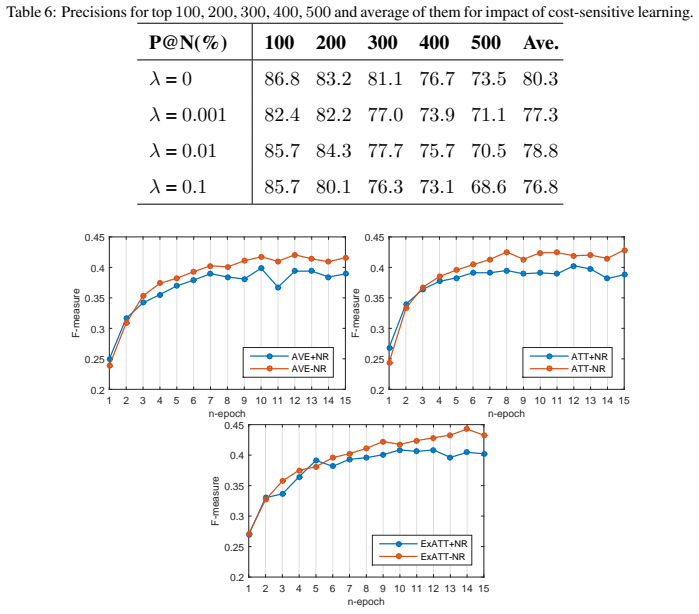
To exploit class ties between relations to improve relation extraction, we propose a general ranking based multi-label learning framework combined with convolutional neural networks, in which ranking based loss functions with regularization technique are introduced to learn the latent connections between relations. Furthermore, to deal with the problem of class imbalance in distant supervision relation extraction, we further adopt cost-sensitive learning to rescale the costs from the positive and negative labels.
What carries the argument
Ranking-based loss functions with regularization inside a convolutional neural network multi-label learner, used to capture latent class ties among relations, together with cost-sensitive rescaling of positive versus negative label costs.
If this is right
- The model learns latent connections between relation classes by optimizing ranking losses rather than independent binary decisions.
- Cost-sensitive rescaling reduces the impact of the severe positive-negative imbalance typical in distant supervision data.
- Experiments on a standard benchmark dataset demonstrate improved performance when both the ranking component and the cost adjustment are active.
- The framework is presented as general, so the same ranking-plus-cost structure can be attached to other base neural extractors.
Where Pith is reading between the lines
- The same ranking-loss structure could be tested on other multi-label sequence labeling tasks that exhibit label co-occurrence patterns.
- If class ties prove stable across different knowledge bases, the learned ranking parameters might transfer without full retraining.
- An extension could replace the CNN encoder with a transformer and measure whether the ranking component still adds value once contextual representations improve.
Load-bearing premise
Latent connections between relation classes exist in a form that ranking losses can usefully exploit to raise extraction accuracy.
What would settle it
An ablation that removes the ranking-loss and regularization terms, retrains on the same dataset, and shows no drop in extraction metrics would indicate that the class ties are not being exploited as claimed.
Figures


read the original abstract
Knowledge base provides a potential way to improve the intelligence of information retrieval (IR) systems, for that knowledge base has numerous relations between entities which can help the IR systems to conduct inference from one entity to another entity. Relation extraction is one of the fundamental techniques to construct a knowledge base. Distant supervision is a semi-supervised learning method for relation extraction which learns with labeled and unlabeled data. However, this approach suffers the problem of relation overlapping in which one entity tuple may have multiple relation facts. We believe that relation types can have latent connections, which we call class ties, and can be exploited to enhance relation extraction. However, this property between relation classes has not been fully explored before. In this paper, to exploit class ties between relations to improve relation extraction, we propose a general ranking based multi-label learning framework combined with convolutional neural networks, in which ranking based loss functions with regularization technique are introduced to learn the latent connections between relations. Furthermore, to deal with the problem of class imbalance in distant supervision relation extraction, we further adopt cost-sensitive learning to rescale the costs from the positive and negative labels. Extensive experiments on a widely used dataset show the effectiveness of our model to exploit class ties and to relieve class imbalance problem.
Editorial analysis
A structured set of objections, weighed in public.
Referee Report
Summary. The paper proposes a ranking-based multi-label learning framework integrated with CNNs for distant supervision relation extraction. It introduces ranking loss functions with regularization to capture latent connections (class ties) between relation types and adopts cost-sensitive rescaling to mitigate class imbalance. Experiments on a standard dataset are reported to demonstrate effectiveness in exploiting class ties and relieving imbalance.
Significance. If the empirical gains hold under rigorous controls, the work provides a concrete mechanism for modeling inter-relation dependencies via ranking objectives in a multi-label RE setting, which remains underexplored. The explicit combination of ranking regularization and cost-sensitive learning offers a reusable template for noisy, overlapping-label extraction tasks.
major comments (2)
- [§3] §3 (Method), ranking loss formulation: the claim that the regularization term learns latent class ties is central to the contribution, yet no analysis (e.g., inspection of learned relation embeddings or correlation matrices before/after training) is provided to show that the improvement stems from tie exploitation rather than generic ranking optimization; an ablation removing the regularization term is required to support this.
- [§4] §4 (Experiments), baseline and ablation tables: without an ablation that isolates the cost-sensitive rescaling from the ranking component, it is impossible to attribute performance gains to the two stated innovations; the current comparisons do not establish that the framework outperforms prior multi-label or cost-sensitive RE methods on the same dataset splits.
minor comments (2)
- [§3.2] Notation for the multi-label ranking loss should be introduced with explicit definitions of positive/negative sets and the margin parameter before its first use in equations.
- [Figures] Figure captions should state the exact dataset split (e.g., NYT train/test sizes) and the evaluation metric (P@N or AUC) used in each plot.
Simulated Author's Rebuttal
We thank the referee for the constructive comments and the recommendation for minor revision. We address the two major comments point by point below and will revise the manuscript accordingly.
read point-by-point responses
-
Referee: [§3] §3 (Method), ranking loss formulation: the claim that the regularization term learns latent class ties is central to the contribution, yet no analysis (e.g., inspection of learned relation embeddings or correlation matrices before/after training) is provided to show that the improvement stems from tie exploitation rather than generic ranking optimization; an ablation removing the regularization term is required to support this.
Authors: We agree that an ablation isolating the regularization term would strengthen the central claim. In the revised version we will add an ablation that removes the regularization term while retaining the base ranking loss, allowing direct attribution of gains to the class-tie modeling component. Space permitting, we will also include a short qualitative inspection of the learned relation embeddings. revision: yes
-
Referee: [§4] §4 (Experiments), baseline and ablation tables: without an ablation that isolates the cost-sensitive rescaling from the ranking component, it is impossible to attribute performance gains to the two stated innovations; the current comparisons do not establish that the framework outperforms prior multi-label or cost-sensitive RE methods on the same dataset splits.
Authors: We concur that separate ablations are needed to attribute gains to each innovation. We will add an ablation that disables cost-sensitive rescaling while keeping the ranking loss and regularization fixed. Our experiments already follow the standard NYT dataset splits used by prior work; we will expand the baseline tables to include additional published multi-label and cost-sensitive RE methods for direct comparison on those splits. revision: yes
Circularity Check
No significant circularity in derivation chain
full rationale
The paper proposes a ranking-based multi-label CNN framework with regularization to learn latent class ties between relations plus cost-sensitive rescaling for imbalance. No equations, derivations, or self-citations are visible that reduce the claimed improvements or the exploitation of class ties to fitted parameters, renamed inputs, or prior self-work by construction. The central premise is an empirical modeling choice tested on standard datasets rather than a tautological reduction; the derivation remains self-contained.
Axiom & Free-Parameter Ledger
Reference graph
Works this paper leans on
- [1]
-
[2]
K. D. Bollacker, C. Evans, P. Paritosh, T. Sturge, J. Taylor, Freebase: a collabora- tively created graph database for structuring human knowledge, in: Proceedings of KDD, 2008, pp. 1247–1250
work page 2008
-
[3]
R. Hoffmann, C. Zhang, X. Ling, L. Zettlemoyer, D. S. Weld, Knowledge-based weak supervision for information extraction of overlapping relations, in: Pro- ceedings of ACL-HLT, 2011
work page 2011
-
[4]
M. Surdeanu, J. Tibshirani, R. Nallapati, C. D. Manning, Multi-instance multi- label learning for relation extraction, in: Proceedings of EMNLP, 2012
work page 2012
-
[5]
J. F ¨urnkranz, E. H ¨ullermeier, E. L. Menc´ıa, K. Brinker, Multilabel classification via calibrated label ranking, Machine learning 73 (2) (2008) 133–153
work page 2008
-
[6]
M.-L. Zhang, Z.-H. Zhou, Multilabel neural networks with applications to func- tional genomics and text categorization, IEEE transactions on Knowledge and Data Engineering 18 (10) (2006) 1338–1351. 26
work page 2006
-
[7]
Z.-H. Zhou, M.-L. Zhang, S.-J. Huang, Y .-F. Li, Multi-instance multi-label learn- ing, Artificial Intelligence 176 (1) (2012) 2291–2320
work page 2012
-
[8]
T. Evgeniou, C. A. Micchelli, M. Pontil, Learning multiple tasks with kernel methods, Journal of Machine Learning Research 6 (Apr) (2005) 615–637
work page 2005
-
[9]
N. Japkowicz, S. Stephen, The class imbalance problem: A systematic study, Intelligent data analysis 6 (5) (2002) 429–449
work page 2002
- [10]
-
[11]
Y . Lin, S. Shen, Z. Liu, H. Luan, M. Sun, Neural relation extraction with selective attention over instances, in: Proceedings of ACL, 2016
work page 2016
- [12]
-
[13]
C. N. d. Santos, B. Xiang, B. Zhou, Classifying relations by ranking with convo- lutional neural networks, in: Proceeding of ACL, 2015
work page 2015
- [14]
-
[15]
X. Han, L. Sun, Global distant supervision for relation extraction, in: Proceedings of AAAI, 2016
work page 2016
-
[16]
D. Zeng, K. Liu, S. Lai, G. Zhou, J. Zhao, et al., Relation classification via con- volutional deep neural network., in: Proceeding of COLING, 2014
work page 2014
-
[17]
M. G. Yu Mo, M. Dredze, Factor-based compositional embedding models, in: NIPS Workshop on Learning Semantics, 2014
work page 2014
-
[18]
H. Ye, Z. Yan, Z. Luo, W. Chao, Dependency-tree based convolutional neural networks for aspect term extraction, in: Advances in Knowledge Discovery and Data Mining - 21st Pacific-Asia Conference, PAKDD 2017, Jeju, South Korea, May 23-26, 2017, Proceedings, Part II, 2017. 27
work page 2017
-
[19]
H. Ye, L. Wang, Semi-supervised learning for neural keyphrase generation, in: Proceedings of Empirical Methods in Natural Language Processing, 2018
work page 2018
-
[20]
H. Ye, X. Jiang, Z. Luo, W. Chao, Interpretable charge predictions for crim- inal cases: Learning to generate court views from fact descriptions, CoRR abs/1802.08504
work page internal anchor Pith review Pith/arXiv arXiv
- [21]
-
[22]
D. Zeng, K. Liu, Y . Chen, J. Zhao, Distant supervision for relation extraction via piecewise convolutional neural networks, in: Proceedings of EMNLP, 2015
work page 2015
- [23]
-
[24]
Neural Machine Translation by Jointly Learning to Align and Translate
D. Bahdanau, K. Cho, Y . Bengio, Neural machine translation by jointly learning to align and translate, arXiv preprint arXiv:1409.0473
work page internal anchor Pith review Pith/arXiv arXiv
-
[25]
Y . Lin, Z. Liu, M. Sun, Neural relation extraction with multi-lingual attention, in: Proceedings of Association for Computational Linguistics, 2017
work page 2017
-
[26]
W. Zeng, Y . Lin, Z. Liu, M. Sun, Incorporating relation paths in neural relation extraction, arXiv preprint arXiv:1609.07479
work page internal anchor Pith review Pith/arXiv arXiv
-
[27]
G. Ji, K. Liu, S. He, J. Zhao, Distant supervision for relation extraction with sentence-level attention and entity descriptions., in: AAAI, 2017, pp. 3060–3066
work page 2017
-
[28]
L. Chen, Y . Feng, S. Huang, B. Luo, D. Zhao, Encoding implicit relation require- ments for relation extraction: A joint inference approach, Artificial Intelligence 265 (2018) 45–66
work page 2018
-
[29]
H. Ye, W. Li, L. Wang, Jointly learning semantic parser and natural language generator via dual information maximization, CoRR abs/1906.00575. 28
work page internal anchor Pith review Pith/arXiv arXiv 1906
-
[30]
B. Luo, Y . Feng, Z. Wang, Z. Zhu, S. Huang, R. Yan, D. Zhao, Learning with noise: Enhance distantly supervised relation extraction with dynamic transition matrix, in: Proceedings of Association for Computational Linguistics, 2017
work page 2017
-
[31]
P. Qin, W. Xu, W. Y . Wang, Dsgan: Generative adversarial training for distant supervision relation extraction, arXiv preprint arXiv:1805.09929
work page internal anchor Pith review Pith/arXiv arXiv
-
[32]
X. Han, Z. Liu, M. Sun, Denoising distant supervision for relation extraction via instance-level adversarial training, arXiv preprint arXiv:1805.10959
work page internal anchor Pith review Pith/arXiv arXiv
-
[33]
I. Goodfellow, J. Pouget-Abadie, M. Mirza, B. Xu, D. Warde-Farley, S. Ozair, A. Courville, Y . Bengio, Generative adversarial nets, in: Advances in neural in- formation processing systems, 2014
work page 2014
-
[34]
J. Feng, M. Huang, L. Zhao, Y . Yang, X. Zhu, Reinforcement learning for relation classification from noisy data, in: Proceedings of the Thirty-Second AAAI Con- ference on Artificial Intelligence, (AAAI-18), the 30th innovative Applications of Artificial Intelligence (IAAI-18), and the 8th AAAI Symposium on Educational Advances in Artificial Intelligence (EAA...
work page 2018
-
[35]
P. Qin, W. Xu, W. Y . Wang, Robust distant supervision relation extraction via deep reinforcement learning, in: Proceedings of the 56th Annual Meeting of the As- sociation for Computational Linguistics, ACL 2018, Melbourne, Australia, July 15-20, 2018, V olume 1: Long Papers, 2018
work page 2018
-
[36]
T. Liu, K. Wang, B. Chang, Z. Sui, A soft-label method for noise-tolerant distantly supervised relation extraction, in: Proceedings of Empirical Methods in Natural Language Processing, 2017
work page 2017
-
[37]
T. Liu, X. Zhang, W. Zhou, W. Jia, Neural relation extraction via inner-sentence noise reduction and transfer learning, in: Proceedings of Empirical Methods in Natural Language Processing, 2018
work page 2018
-
[38]
T.-Y . Liu, Learning to rank for information retrieval, Foundations and Trends in Information Retrieval 3 (3) (2009) 225–331. 29
work page 2009
-
[39]
F. Zhao, Y . Huang, L. Wang, T. Tan, Deep semantic ranking based hashing for multi-label image retrieval, in: Proceedings of CVPR, 2015
work page 2015
-
[40]
A. Severyn, A. Moschitti, Learning to rank short text pairs with convolutional deep neural networks, in: Proceedings of the 38th International ACM SIGIR Con- ference on Research and Development in Information Retrieval, ACM, 2015, pp. 373–382
work page 2015
-
[41]
W. Shen, X. Wang, Y . Wang, X. Bai, Z. Zhang, Deepcontour: A deep convo- lutional feature learned by positive-sharing loss for contour detection, in: Pro- ceedings of the IEEE Conference on Computer Vision and Pattern Recognition, 2015
work page 2015
-
[42]
S. H. Khan, M. Bennamoun, F. Sohel, R. Togneri, Cost sensitive learning of deep feature representations from imbalanced data, arXiv preprint arXiv:1508.03422
work page internal anchor Pith review Pith/arXiv arXiv
- [43]
-
[44]
H. He, E. A. Garcia, Learning from imbalanced data, IEEE Trans. Knowl. Data Eng. 21 (9) (2009) 1263–1284
work page 2009
-
[45]
H. Ye, W. Chao, Z. Luo, Z. Li, Jointly extracting relations with class ties via effec- tive deep ranking, in: Proceedings of Association for Computational Linguistics, 2017
work page 2017
-
[46]
L. Wang, Z. Cao, G. de Melo, Z. Liu, Relation classification via multi-level atten- tion cnns, in: Proceedings of ACL, V olume 1: Long Papers, 2016
work page 2016
- [47]
-
[48]
M.-L. Zhang, Z.-H. Zhou, A review on multi-label learning algorithms, IEEE transactions on knowledge and data engineering 26 (8) (2014) 1819–1837. 30
work page 2014
discussion (0)
Sign in with ORCID, Apple, or X to comment. Anyone can read and Pith papers without signing in.