REVIEW 25 references
Probing sterile neutrino in $B$ ($D$) meson decays at Belle II (BESIII)
T0 review · reviewed 2026-08-14 · deepseek-v4-flash
Pith's one-line read A missing-mass search in semileptonic B decays at Belle II could constrain or discover GeV-scale sterile neutrinos, with sensitivity comparable to or better than upgraded LHCb for masses below 2 GeV.
The pith
A machine-rendered reading of the paper's core claim, the machinery that carries it, and where it could break.
The reading
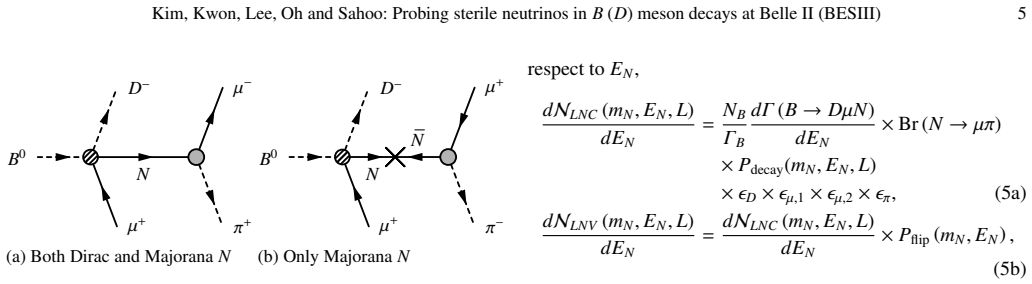
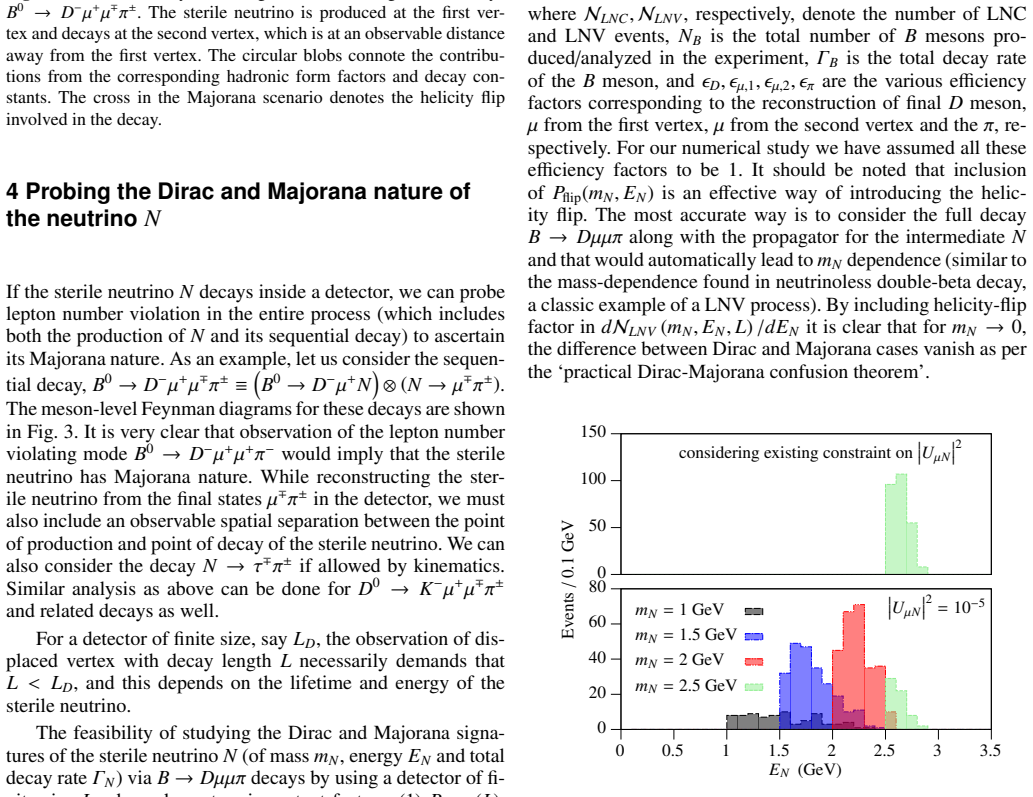
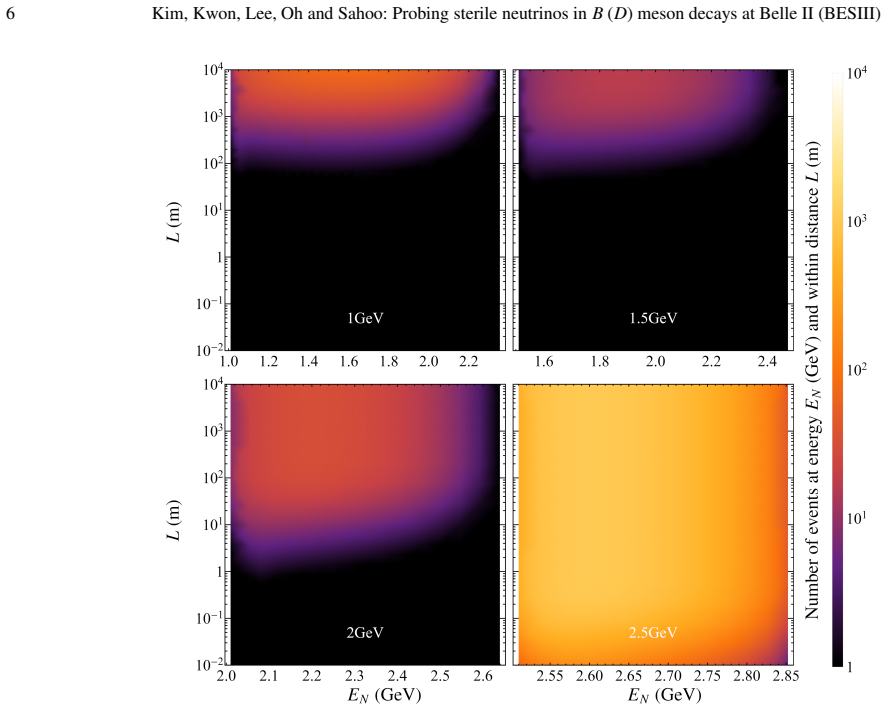
Belle II produces billions of B mesons, but only a small fraction can be fully reconstructed with the hadronic tagging method used here. The paper estimates that even with only 4.8×10^8 fully reconstructed B decays, the search could match the sensitivity of a much larger LHCb dataset for sterile neutrinos below about 2 GeV in mass. This is because the proposed mode does not require the heavy neutrino to decay inside the detector, avoiding several suppression factors. The paper also studies the more challenging case where N does decay inside the detector, which could reveal whether the neutrino is its own antiparticle, a Majorana fermion. Here a helicity flip suppression reduces the expected events, especially for light neutrinos.
Overall, the paper provides a concrete, quantitative case for adding this search to the Belle II program. The main caveats are the optimistic assumptions of perfect reconstruction efficiency in the signal and a simplified treatment of backgrounds.
Extended reading notes
Core claim
The central claim is that a missing-mass search in B→DμN decays at Belle II, using hadronically tagged events, can constrain |U_μN|^2 to a level comparable to upgraded LHCb and better below m_N < 2 GeV, and that the sequential decay of N, including helicity flip, can be used to distinguish Dirac from Majorana neutrinos. As stated in the abstract: "Our constraint on |U_μN|^2 that can be achieved from the full Belle II data is comparable with what can be obtained from the much larger data set of the upgraded LHCb." If correct, the paper demonstrates that a comparatively small sample of 4.8×10^8 fully reconstructed B decays yields a competitive sterile-neutrino probe.
Load-bearing premise
The projected limits are directly proportional to the assumed unit reconstruction efficiencies ε_D=ε_μ=1 stated in Section 3. This is load-bearing because Eq. (3) scales the extracted |U|^2 linearly with these efficiencies; if the true efficiencies are 50%, all quoted limits worsen by a factor of two, and the claim of parity with LHCb at m_N<2 GeV could fail, especially since the 50-event threshold is also optimistic.
Signed reviews
Editorial analysis
A structured set of objections, weighed in public.
Assumptions & free parameters
free parameters (5)
- Signal-side reconstruction efficiencies ε_D, ε_μ =
assumed = 1
- Tau reconstruction efficiency ε_τ =
0.001
- Observation threshold N_obs =
50 events
- Detector fiducial length L_D =
1 m
- Soft pion/photon energy cuts =
E_π < 0.2 GeV, E_γ < 0.1 GeV
assumptions (5)
- domain assumption Sterile neutrino N mixes with active neutrinos via |U_ℓN|^2 and has no other interactions
- domain assumption Canonical branching ratio Br(B→DℓN) is taken from Ref [19]
- domain assumption N total decay width Γ_N from Eqs. (30-32) of Ref [19]
- domain assumption Hadronic tagging efficiency from Belle II physics book [22]
- ad hoc to paper Helicity flip factor P_flip approximates the full spin treatment of LNV N decay
Cite this review
Pith. "Pith review of Probing sterile neutrino in $B$ ($D$) meson decays at Belle II (BESIII)." pith.science (2026). https://pith.science/paper/NLQXE6QE
@misc{pith2026190800376,
  author       = {Pith},
  title        = {Pith review of: Probing sterile neutrino in $B$ ($D$) meson decays at Belle II (BESIII)},
  year         = {2026},
  howpublished = {\url{https://pith.science/paper/NLQXE6QE}},
  note         = {Machine review of arXiv:1908.00376}
}
abstract
We present, how a systematic study of $B \to D\ell N$ ($D \to K \ell N$) decays with $\ell=\mu,\tau$, at Belle II (BESIII) can provide unambiguous signature of a heavy neutrino $N$ and/or constrain its mixing with active neutrinos $\nu_\ell$, which is parameterized by $|U_{\ell N}|^2$. Our constraint on $|U_{\mu N}|^2$ that can be achieved from the full Belle II data is comparable with what can be obtained from the much larger data set of the upgraded LHCb. Additionally, our method offers better constraint on $|U_{\mu N}|^2$ for mass of sterile neutrino $m_N < 2$ GeV. We can also probe the Dirac and Majorana nature of $N$ by observing the sequential decay of $N$, including suppression from observation of a displaced vertex as well as helicity flip, for Majorana $N$.
Figures


Figures from the paper (3 more)

Reference graph
Works this paper leans on
-
[1]
The Family Group in Grand Unified Theories,
P. Minkowski, Phys. Lett. B 67, 421 (1977); M. Gell-Mann, P. Ra- mond and R. Slansky, in Sanibel Conference, “The Family Group in Grand Unified Theories,” Feb. 1979, CALT-68-709, reprinted in hep-ph /9809459; “Complex Spinors and Unified Theories,” Print 80-0576, published in: D. Freedman et al. (Eds.), “Super- gravity”, North-Holland, Amsterdam, 1979; T. Y...
work page 1977
-
[2]
D. Wyler and L. Wolfenstein, Nucl. Phys. B 218, 205 (1983); E. Witten, Nucl. Phys. B 258, 75 (1985); R. N. Mohapatra and J. W. F. Valle, Phys. Rev. D 34, 1642 (1986); A. Pilaftsis and T. E. J. Underwood, Phys. Rev. D 72, 113001 (2005); M. Malin- sky, J. C. Romao and J. W. F. Valle, Phys. Rev. Lett. 95, 161801 (2005); P. S. B. Dev and R. N. Mohapatra, Phys...
work page 1983
-
[3]
W. Buchmüller and C. Greub, Nucl. Phys. B 363, 345 (1991); T. Appelquist and R. Shrock, Phys. Lett. B 548, 204 (2002); T. Appelquist and R. Shrock, Phys. Rev. Lett.90, 201801 (2003); T. Appelquist, M. Piai and R. Shrock, Phys. Rev. D 69, 015002 (2004); J. Kersten and A. Y . Smirnov, Phys. Rev. D 76, 073005 (2007); F. del Aguila, J. A. Aguilar-Saavedra, J....
work page 1991
-
[4]
Dodelson and L
S. Dodelson and L. M. Widrow, Phys. Rev. Lett. 72, 17 (1994)
1994
- [5]
-
[6]
F. F. Deppisch, P. S. Bhupal Dev and A. Pilaftsis, New J. Phys. 17, no. 7, 075019 (2015)
work page 2015
-
[7]
G.Cveti ˇc and C. S. Kim, Phys. Rev. D100, no. 1, 015014 (2019)
work page 2019
-
[8]
W. H. Furry, Phys. Rev. 56, 1184 (1939); for early reviews see, Primakoff and Rosen, Rep. Prog. Phys.22, 121 (1959); Ann. Rev. Nucl. Part. Sci. 31, 145 (1981); M. Doi, T. Kotani and E. Taka- sugi, Prog. Theor. Phys. Suppl. 83, 1 (1985); for recent reviews see S. R. Elliott and J. Engel, J. Physics. G 30 R183 (2004); W. Rodejohann, Int. J. Mod. Phys. E 20, ...
work page 1939
Show all 25 references
-
[9]
W. -Y . Keung and G. Senjanovi ´c, Phys. Rev. Lett. 50, 1427 (1983); V . Tello, M. Nemevšek, F. Nesti, G. Senjanovi ´c and F. Vissani, Phys. Rev. Lett. 106, 151801 (2011); M. Nemevšek, F. Nesti, G. Senjanovi ´c and V . Tello, arXiv:1112.3061 [hep- ph]; S. Kovalenko, Z. Lu and ...
1983 arXiv
-
[10]
Buchmüller and C
W. Buchmüller and C. Greub, Nucl. Phys. B 363, 345 (1991); M. Kohda, H. Sugiyama and K. Tsumura, Phys. Lett. B718, 1436 (2013)
1991
-
[11]
J. C. Helo, M. Hirsch and S. Kovalenko, Phys. Rev. D 89, 073005 (2014) Erratum: [Phys. Rev. D 93, no. 9, 099902 (2016)]
2014
-
[12]
C. O. Dib and C. S. Kim, Phys. Rev. D 92, no. 9, 093009 (2015); C. O. Dib, C. S. Kim, K. Wang and J. Zhang, Phys. Rev. D94, no. 1, 013005 (2016); C. O. Dib, C. S. Kim and K. Wang, Phys. Rev. D 95, no. 11, 115020 (2017); C. O. Dib, C. S. Kim and K. Wang, Chin. Phys. C 41, no. 1...
2015
-
[13]
Gribanov, S
V . Gribanov, S. Kovalenko and I. Schmidt, Nucl. Phys. B 607, 355 (2001); G. Cveti ˇc, C. Dib, C. S. Kim and J. D. Kim, Phys. Rev. D 66, 034008 (2002) Erratum: [Phys. Rev. D 68, 059901 (2003)]; J. C. Helo, S. Kovalenko and I. Schmidt, Phys. Rev. D 84, 053008 (2011); J. Zamora-...
2001
-
[14]
L. S. Littenberg and R. E. Shrock, Phys. Rev. Lett.68, 443 (1992); Phys. Lett. B 491, 285 (2000); C. Dib, V . Gribanov, S. Kovalenko and I. Schmidt, Phys. Lett. B493, 82 (2000); A. Ali, A. V . Borisov and N. B. Zamorin, Eur. Phys. J. C 21, 123 (2001); M. A. Ivanov and S. G. Ko...
1992
-
[15]
J. C. Helo, S. Kovalenko and I. Schmidt, Nucl. Phys. B 853, 80 (2011)
2011
-
[16]
A. Atre, T. Han, S. Pascoli and B. Zhang, JHEP0905, 030 (2009)
2009
-
[17]
Cveti ˇc, C
G. Cveti ˇc, C. Dib, S. K. Kang and C. S. Kim, Phys. Rev. D 82, 053010 (2010); G. Cveti ˇc, C. Dib and C. S. Kim, JHEP 1206, 149 (2012) [arXiv:1203.0573 [hep-ph]]; G. Cvetiˇc, C. S. Kim and J. Zamora-Saá, J. Phys. G 41, 075004 (2014); G. Cveti ˇc, C. Dib, C. S. Kim and J. Zamo...
2010 arXiv
-
[18]
Mandal and N
S. Mandal and N. Sinha, Phys. Rev. D 94, no. 3, 033001 (2016)
2016
-
[19]
G.Cveti ˇc and C. S. Kim, Phys. Rev. D 94, no. 5, 053001 (2016) Erratum: [Phys. Rev. D 95, no. 3, 039901 (2017)]
2016
-
[20]
Halzen, C
G.Cveti ˇc, F. Halzen, C. S. Kim and S. Oh, Chin. Phys. C 41, no. 11, 113102 (2017)
2017
-
[21]
R. E. Shrock, Phys. Lett. 96B, 159 (1980); R. E. Shrock, Phys. Rev. D 24, 1232 (1981); L. Lello and D. Boyanovsky, Phys. Rev. D 87, 073017 (2013); G. Azuelos et al. , Phys. Rev. Lett. 56, 2241 (1986); N. De Leener- Rosier et al., Phys. Rev. D 43, 3611 (1991); D. I. Britton et ...
1980
-
[22]
Kou et al
E. Kou et al. [Belle-II Collaboration], PTEP 2019, no.12, 123C01 (2019)
2019
-
[23]
Huschle et al
M. Huschle et al. [Belle Collaboration], Phys. Rev. D 92, no. 7, 072014 (2015)
2015
-
[24]
Tanabashi et al
M. Tanabashi et al. [Particle Data Group], Phys. Rev. D98, no. 3, 030001 (2018)
2018
-
[25]
Liventsev et al
D. Liventsev et al. [Belle], Phys. Rev. D87, no.7, 071102 (2013); R. Aaij et al. [LHCb], Phys. Rev. Lett.112, no.13, 131802 (2014)
2013
Reviewed August 14, 2026 · model on record in the stance chip above.
Discussion (0). Continue with ORCID to comment.