REVIEW 4 major objections 3 minor 175 references
IAEA Photonuclear Data Library 2019
T0 review · 4 major / 3 minor · reviewed 2026-08-14 · deepseek-v4-flash
Pith's one-line read The updated Photonuclear Data Library covers 220 nuclides to 200 MeV and uses model-based Fi corrections to fix partial photoneutron cross sections.
desk verdict A genuinely useful updated photonuclear library, but the Fi-correction method injects unquantified model dependence into the partial cross sections, and the lack of uncertainty bars is the main thing holding it back. read the letter →
The pith
A machine-rendered reading of the paper's core claim, the machinery that carries it, and where it could break.
The reading
What carries the argument
The central object is the Fi correction factor, defined as the share of the neutron-yield cross section carried by the $i$-neutron partial channel; it is used in Eq. (38) to convert an experimental neutron yield into evaluated partial channels, imposing the physical inequalities that many raw data violate. The second load-bearing element is the direct neutron-multiplicity sorting technique with a flat-efficiency detector, which provides experimental partial cross sections that avoid the ring-ratio unfolding assumptions of older detectors. Third, statistical Hauser-Feshbach decay codes with giant-dipole-resonance and quasi-deuteron photo-absorption provide the overall model framework, and an inter-comparison across several codes was used to gauge how much the theoretical Fi values depend on model choices.
What would settle it
Take a nucleus in the new library whose partial cross sections rest on Fi-corrected older data, such as 133Cs or 94Zr, measure (γ,1n), (γ,2n), and (γ,3n) with direct neutron-multiplicity sorting across 10–40 MeV using a flat-efficiency detector, and compare channel by channel; if the direct sorting tracks the uncorrected raw data rather than the Fi-corrected curve, the model branching ratios are falsified for that nucleus.
Extended reading notes
Core claim
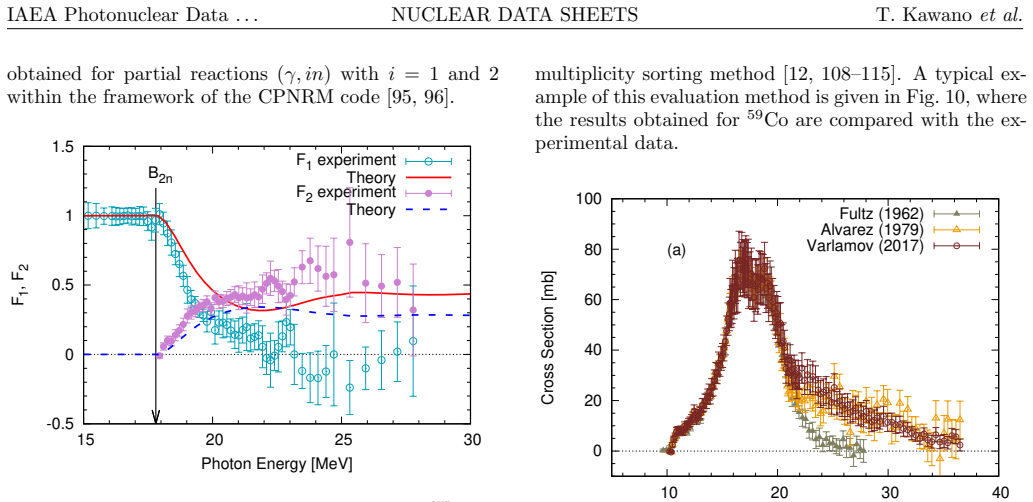
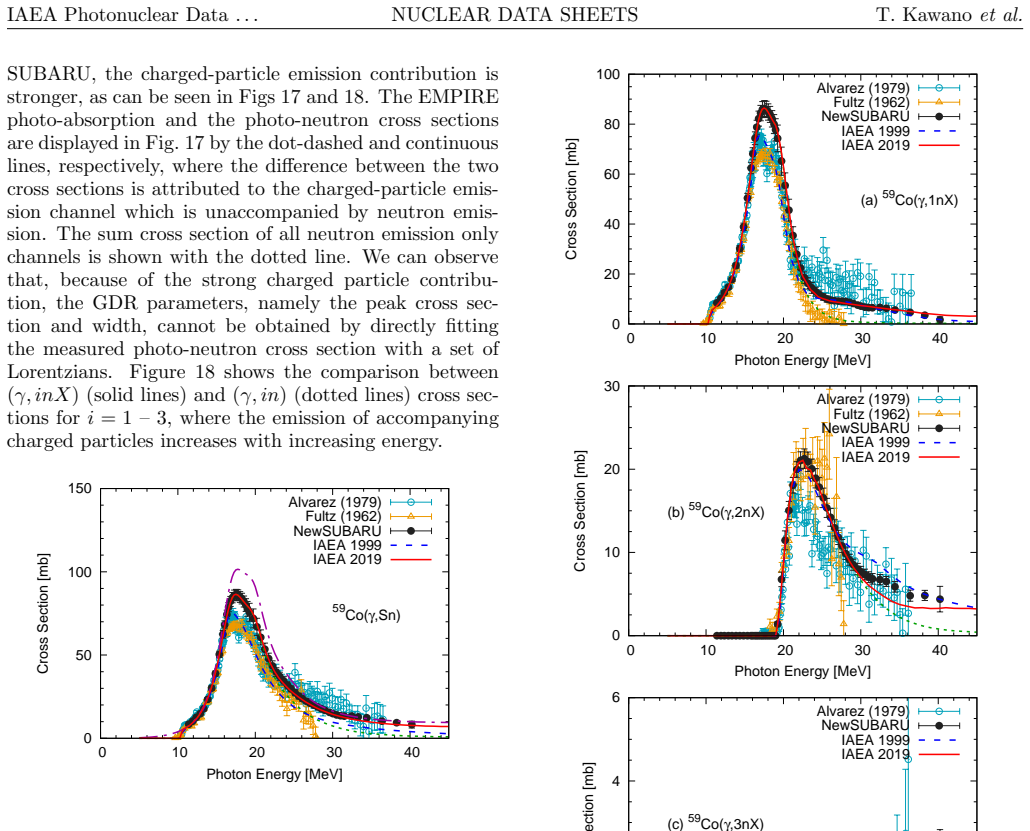
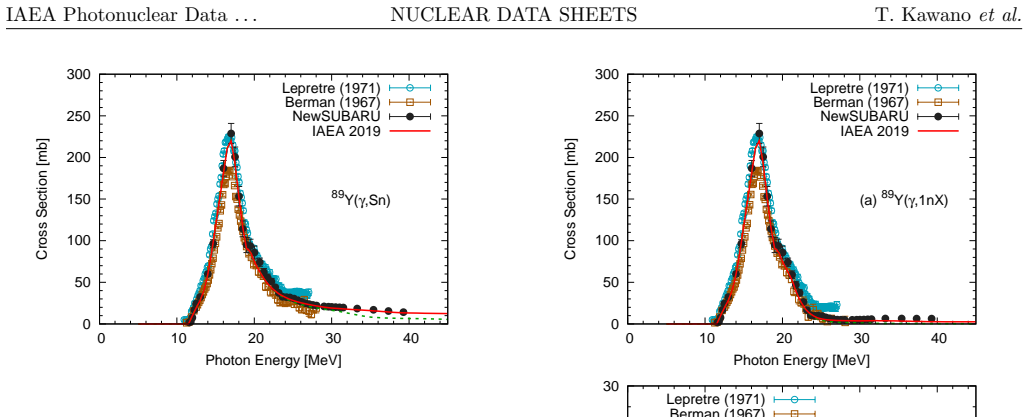
The new library provides evaluated photo-absorption, photoneutron, and charged-particle emission data for 220 isotopes up to 200 MeV, grounded in a consistency test: each experimental partial photoneutron cross section $\sigma(\gamma,inX)$ is compared with the ratio $F_i = \sigma(\gamma,inX)/\sigma(\gamma,xn)$, which by definition cannot exceed $1$, $1/2$, or $1/3$ for $i=1,2,3$. Many existing experimental data sets violate these bounds, a signature of neutron mis-counting in the multiplicity-sorting method. The paper therefore evaluates partial cross sections by multiplying the experimental neutron yield $\sigma(\gamma,xn)$ by theoretical $F_i$ values from a combined photonuclear reaction model, giving $\sigma_{\rm eval}(\gamma,in)=F_i^{\rm th}\,\sigma_{\rm exp}(\gamma,xn)$, a construction that automatically satisfies the bounds. Comparisons for a selection of nuclei show the corrected partial cross sections agree with activation measurements and with new laser Compton-scattering data, and the paper recommends against simply normalizing the discrepant older data.
Load-bearing premise
The entire Fi correction rests on the assumption that the theoretical branching ratios from the model code are accurate enough that multiplying an experimental neutron yield by them yields true partial cross sections; if those ratios are biased, the bias is baked into evaluations that then tune the model to reproduce its own shape.
Editorial extensions
If this is right
- The library extends evaluated photonuclear data to 200 MeV, so transport simulations for accelerator shielding, transmutation, and related applications can use a single consistent data set.
- For roughly 40 nuclei where older quasi-monoenergetic beam data disagreed in the partial channels, the Fi correction gives a principled way to supersede or select among the data without invoking a global normalization factor.
- The new flat-efficiency detector measurements provide an independent experimental anchor for partial cross sections, and the same technique can be deployed on other isotopes to test further evaluations.
- The accompanying atlas of giant-dipole-resonance parameters and the photon strength function database give modelers a consistent input set for future evaluations of nuclei not in the library.
Reading between the lines
- If the model Fi ratios are close to correct, the same correction could be extended to every nuclide with a measured neutron yield but no reliable multiplicity sorting, substantially enlarging the practical coverage of the library.
- A sharper prospective test than the paper's own activation checks would be to apply direct neutron-multiplicity sorting to a nucleus currently evaluated only from Fi-corrected older data, such as 133Cs or 94Zr; agreement would transfer the method's credibility to the rest of the library.
- The code comparison shows that Fi varies with energy and with model choice, which suggests the library would benefit from assigning an energy-dependent uncertainty band to each corrected partial cross section rather than a single global uncertainty.
- Because evaluations that tune model parameters to Fi-corrected data inherit the method's assumptions, the library's predictive power for medical isotope production depends on how well the model's branching ratios generalize to isotopes with no experimental anchor.
Signed reviews
Editorial analysis
A structured set of objections, weighed in public.
Referee Report
Summary. This paper reports the completion of the new IAEA Photonuclear Data Library 2019, which contains evaluated photo-induced reaction cross sections for 220 nuclides up to incident photon energies of 200 MeV. The authors describe the experimental data landscape, propose an evaluation methodology based on the theoretical branching-ratio factors Fi (Eq. 7) to correct problematic partial photoneutron cross sections, present the nuclear models and codes used (EMPIRE, TALYS, CCONE, MEND-G, GLUNF, CPNRM), summarize new evaluations at KAERI, IFIN-HH, JAEA, and CIAE, and provide an updated Atlas of GDR parameters. The library is released in ENDF-6 format and supersedes the 1999 IAEA library, which contained 164 nuclides.
Significance. If the library is accepted as reliable, it will be an important resource for shielding, reactor and fusion applications, medical isotope production, and astrophysics. The paper's concrete strengths are the compilation and critical assessment of a large body of experimental data, the development of the direct neutron-multiplicity sorting technique at NewSUBARU, the six-code intercomparison of model predictions, and the provision of a new GDR parameter atlas. However, the central claim of improved reliability for the partial photoneutron cross sections is weakened by the unquantified model dependence of the Fi correction and the absence of uncertainty information in the released files; these issues affect the main deliverable and need to be addressed.
major comments (4)
- [Sec. IV.B.2 and Eq. (38)] The paper acknowledges that Fi values from the six codes differ substantially (CPNRM F1 and F2 increase above 30 MeV while the other codes do not) and that 'the uncertainties in Fi due to different codes and model parameters need to be considered.' Yet the library releases no uncertainty information for the evaluated partial cross sections, and the KAERI TALYS tuning (Sec. V.B) uses the Fi-corrected data as evaluation targets without propagating these Fi uncertainties. Since TALYS and CPNRM are both Hauser-Feshbach statistical codes, agreement between the tuned TALYS calculation and the Fi-corrected targets is not an independent validation; a common bias in the theoretical branching ratios would be invisible. To support the central reliability claim, the authors should either propagate Fi uncertainties into the evaluated files or clearly mark the partial cross sections as model-dependent estimates, and should extend the activation-based validation (currently only 181Ta, 209Bi, and 197Au) to more nuclides.
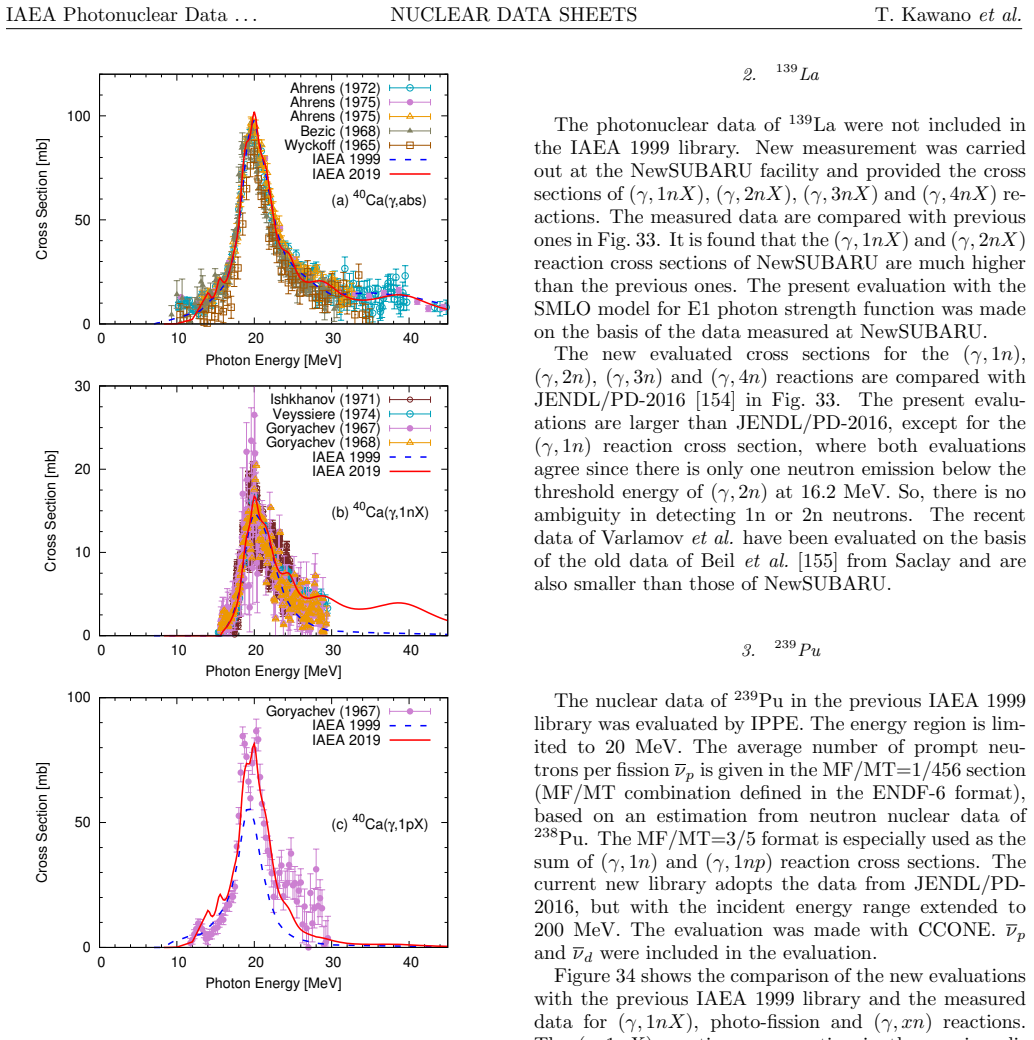
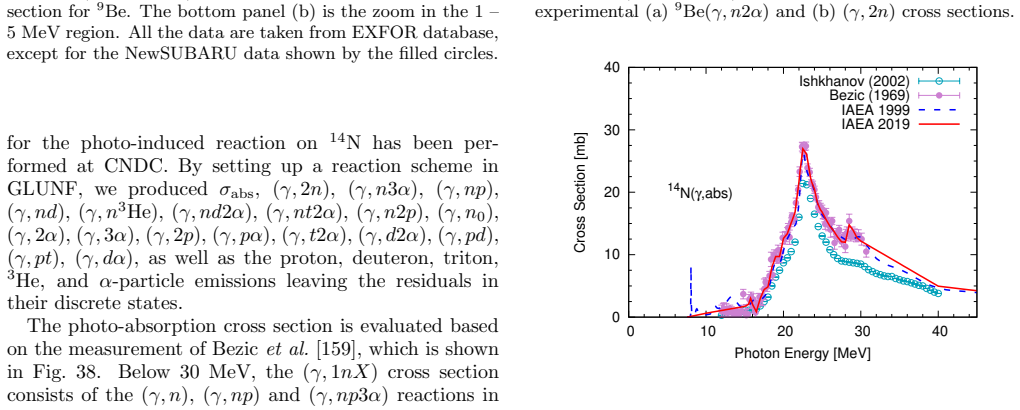
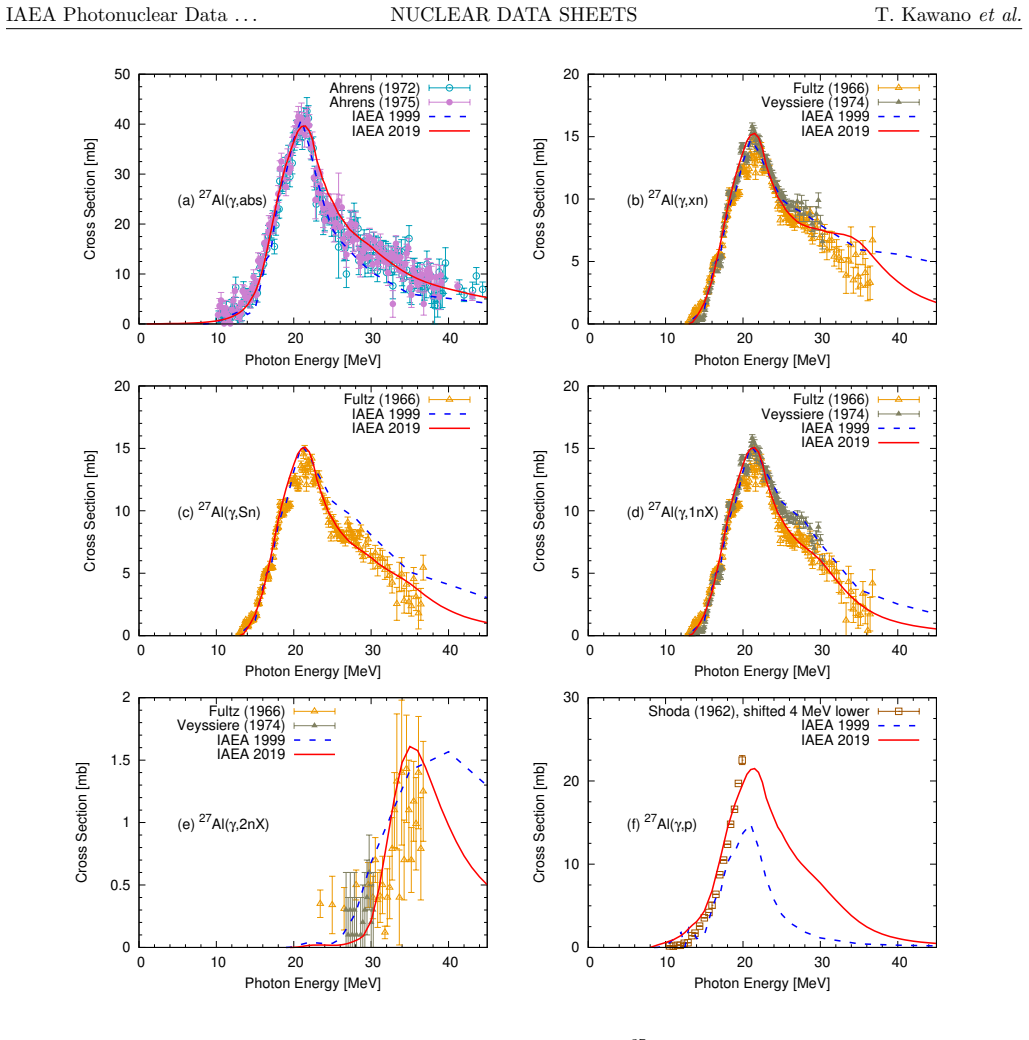
- [Sec. V.E.4 and Sec. V.E.2] The 27Al(γ,p) data of Shoda et al. are shifted to lower energies by 4 MeV to match the reaction threshold, and the 14N data of Komar et al. are multiplied by 2.57 based on branching-ratio estimates from a single reference. These are large, ad hoc adjustments that directly shape the evaluated targets. No uncertainty or sensitivity analysis is given for these adjustments, and the figures do not show the unshifted/unscaled data for comparison. The authors should justify these adjustments quantitatively and demonstrate that the final evaluations are robust to the exact choice of shift and rescaling.
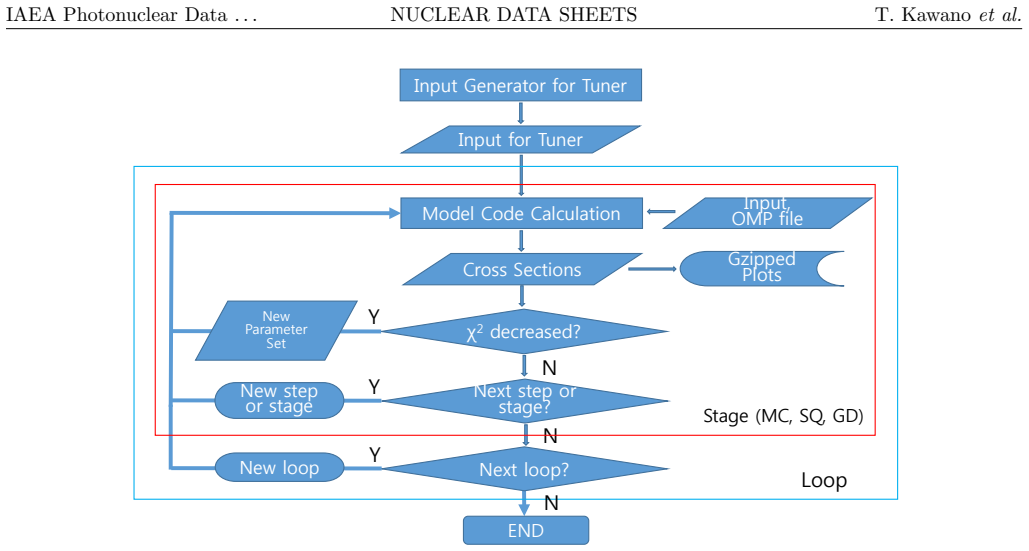
- [Sec. V.B] The automated TALYS tuning adjusts about 19 optical-model parameters, roughly 35 level-density parameters, GDR parameters, and pre-equilibrium parameters, with deviations from defaults up to 50%. Such large adjustments risk overfitting and parameter compensation. The paper does not provide a goodness-of-fit measure, parameter sensitivities, or covariance estimates, so it is difficult to assess the reliability of the resulting cross sections in energy regions without experimental data. The authors should provide a summary of typical fitted parameter deviations and at least one representative covariance or sensitivity analysis.
- [Sec. VI] Section VI states that a unique set of evaluations was selected based mainly on how well each evaluation reproduces the recommended experimental data, but no quantitative criteria are given and no overall statistical comparison (e.g., distributions of deviations between evaluated and experimental files) is presented for the 220 nuclides. The claim that the library is improved would be much better supported by a global benchmark table or a summary of validation metrics across all nuclides.
minor comments (3)
- [General] There are several typographical errors that should be corrected: 'he new 2019 IAEA Photonuclear Data Library' in Sec. VII (missing 'T'), 'diffculty' in Sec. VI, 'fort the production' in Sec. I, and 'photoncouting' in the title of Ref. [30].
- [Sec. V.E.2] The sentence 'In Table I of Ref. [160], a relative yield of the (γ,np) reaction is reported to be 35%, while there are two channels given, 16% of (γ,n) and 11% of (γ,3αpn), which produce one neutron' is hard to parse; the branching-ratio accounting should be rewritten for clarity.
- [Appendix B] The GDR Atlas tables in Appendix B would benefit from a brief explanation of the fitting procedure and the uncertainty ranges, since the reference abbreviations are not expanded and the table notes are minimal.
Circularity Check
The Fi-corrected partial cross sections are defined as CPNRM branching ratios times experimental yields, and KAERI then tunes TALYS to those same model-corrected targets, so the library's Fi-based route inherits an unquantified model bias.
-
self definitional
[Section V.A, Eq. (38)]
"The evaluated partial photo-neutron reaction cross section σeval(γ,in) is obtained by multiplying the experimental photo-neutron yield cross section σexp(γ,xn) given in Eq. (2) by the theoretical Fth_i functions computed with the CPNRM code for neutron multiplicity i = 1, 2, 3, ... σeval(γ,in) = Fth_i σexp(γ,xn) = σth(γ,in)/σth(γ,xn) σexp(γ,xn) . (38)"
By construction, the 'evaluated' partial cross sections are exactly the experimental neutron yield partitioned by CPNRM's theoretical branching ratios. Since Σ_i σ_th(γ,in) = σ_th(γ,xn), the evaluated partials sum to the experimental yield by definition; the model ratio is the input and the result is the product. Any claim that these partial cross sections are measured or independently established reduces to the unverified reliability of the CPNRM ratio, which Eq. (38) itself does not test.
-
fitted input called prediction
[Section V.B (Data Evaluation at KAERI)]
"The Fi-corrected data and the new measurements produced under this CRP, if any, were used preferentially over other data. ... the model parameters were adjusted ... to reproduce the experimental data or the Fi-corrected data."
KAERI's TALYS parameters are tuned to the Fi-corrected partial cross sections, and those tuned outputs are then released as evaluated files. The agreement between the TALYS curve and the Fi-corrected targets is therefore a fit, not an independent check. Because TALYS and CPNRM are both Hauser-Feshbach statistical models, a common bias in CPNRM's branching ratios is invisible in this loop: the model is being fitted to its own shape, and the released files carry no uncertainty bars from the target construction.
1 more flagged steps
-
other
[Section IV.B.2 (code inter-comparison)]
"The conclusion is that if the theoretical Fis are used to correct problematic or inconsistent experimental data, as proposed in Sec. V A, then the uncertainties in Fi due to different codes and model parameters need to be considered. Moreover, since these uncertainties are shown to vary with energy, the introduction of an overall constant uncertainty may not be adequate."
This is the paper's own acknowledgment of the load-bearing model dependence: the Fi values that define the evaluation targets are code- and parameter-dependent, with CPNRM's F1 and F2 rising above 30 MeV where other codes do not. That uncertainty is stated as needing consideration but is never quantified or propagated into the library. Consequently, the reliability claim for the Fi-corrected route rests on an acknowledged but unquantified input, and the subsequent tuning to those targets cannot resolve the ambiguity.
full rationale
The circularity is partial rather than total. The new NewSUBARU direct neutron-multiplicity measurements for seven isotopes and the activation checks for 181Ta, 209Bi, and 197Au provide genuinely independent anchors, and many nuclides in the library were evaluated by JAEA, CIAE, or IFIN-HH without passing through Eq. (38). However, for the substantial Fi-corrected route, the evaluated partial photoneutron cross sections are defined as CPNRM branching ratios times experimental yields, and the KAERI evaluations then fit another Hauser-Feshbach code to those same model-corrected targets. The paper's own code inter-comparison shows substantial Fi scatter among codes and states that these uncertainties need to be considered, yet they are not propagated. Thus the central claim of improved, reliable partial photoneutron cross sections is, for this route, a model-shape assumption rather than an independent derivation, warranting a score of 6 rather than a lower non-circular finding.
Assumptions & free parameters
free parameters (6)
- GDR peak energy, width, peak cross section (E_R, Gamma_R, sigma_R) per nuclide =
e.g., 208Pb: E_R=13.37 MeV, Gamma_R=3.93 MeV, sigma_R=645.49 mb (SLO table)
- Level density parameters at KAERI =
about 35 parameters per nuclide, adjusted up to 50%
- Pre-equilibrium exciton model parameters C1, C2, C3 and R-scaling factors =
not given numerically
- Levinger constant L =
6.5
- Data re-scaling factor for 14N Komar data =
2.57
- Energy shift for 27Al Shoda data =
-4 MeV
assumptions (6)
- domain assumption Compound nucleus independence (Bohr hypothesis): decay of the compound nucleus is independent of how it was formed.
- standard math Hauser-Feshbach statistical model for compound nucleus decay, with width fluctuation correction neglected for photonuclear channels.
- domain assumption Photoabsorption is the sum of Giant Dipole Resonance and quasi-deuteron contributions, sigma_abs = sigma_GDR + sigma_QD.
- domain assumption The E1 gamma strength function follows Lorentzian lineshapes (SLO, SMLO, GLO variants) with parameters fitted to data.
- domain assumption Kalbach systematics for angular distributions of emitted particles, transferred from neutron-induced reactions to photonuclear.
- domain assumption Global optical potentials (Koning-Delaroche for nucleons, plus others for complex particles) give correct transmission coefficients.
Cite this review
Pith. "Pith review of IAEA Photonuclear Data Library 2019." pith.science (2026). https://pith.science/paper/PDAPSSB7
@misc{pith2026190800471,
  author       = {Pith},
  title        = {Pith review of: IAEA Photonuclear Data Library 2019},
  year         = {2026},
  howpublished = {\url{https://pith.science/paper/PDAPSSB7}},
  note         = {Machine review of arXiv:1908.00471}
}
read the original abstract
Photo-induced reaction cross section data are of importance for a variety of current or emerging applications, such as radiation shielding design and radiation transport analyses, calculations of absorbed dose in the human body during radiotherapy, physics and technology of fission reactors (influence of photo-reactions on neutron balance) and fusion reactors (plasma diagnostics and shielding), activation analyses, safeguards and inspection technologies, nuclear waste transmutation, medical isotope production and astrophysical applications. Since the release of the IAEA Photonuclear Data Library in 1999 however, new experimental data as well as new methods to assess the reliability of experimental cross sections have become available. Theoretical models and input parameters used to evaluate photo-induced reactions have improved significantly over the years. In addition, new measurements of partial photoneutron cross sections using mono-energetic photon beams and advanced neutron detection systems have been performed allowing for the validation of the evaluations and assessments of the experimental data. Furthermore, technological advances have led to the construction of new and more powerful gamma-beam facilities, therefore new data needs are emerging. We report our coordinated efforts to address these data needs and present the results of the new evaluations of more than 200 nuclides included in the new updated IAEA Photonuclear Data Library, where the photon energy goes up to 200 MeV. We discuss the new assessment method and make recommendations to the user community in cases where the experimental data are discrepant and the assessments disagree. In addition, in the absence of experimental data, we present model predictions for photo-induced reaction cross section on nuclides of potential interest to medical radioisotope production.
Figures

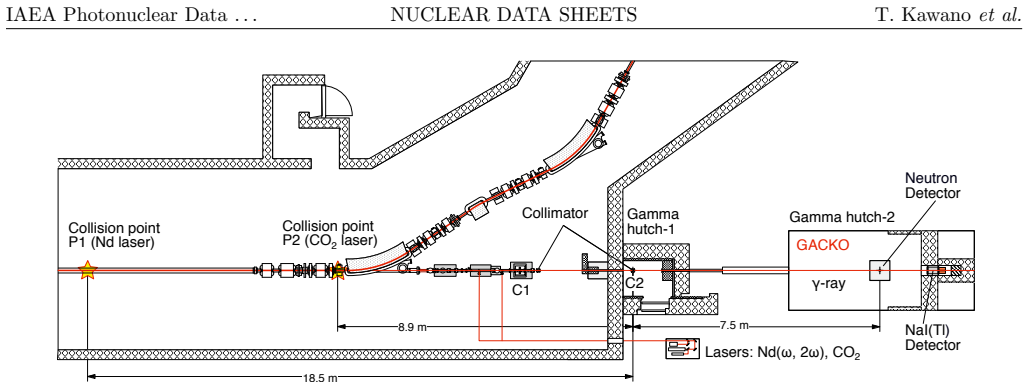

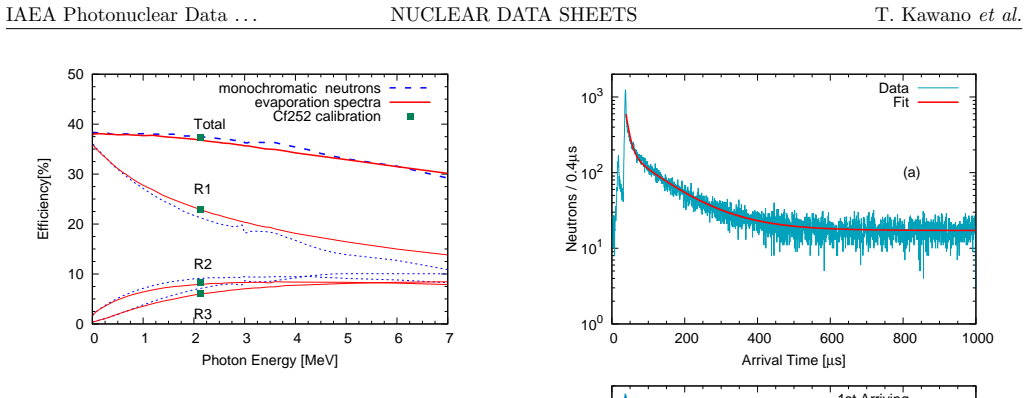
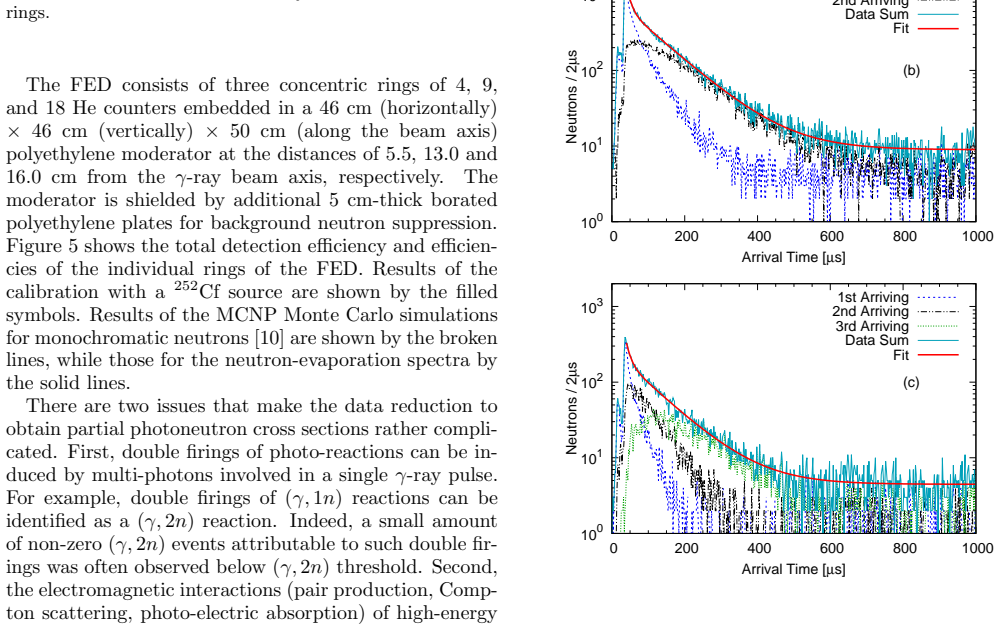
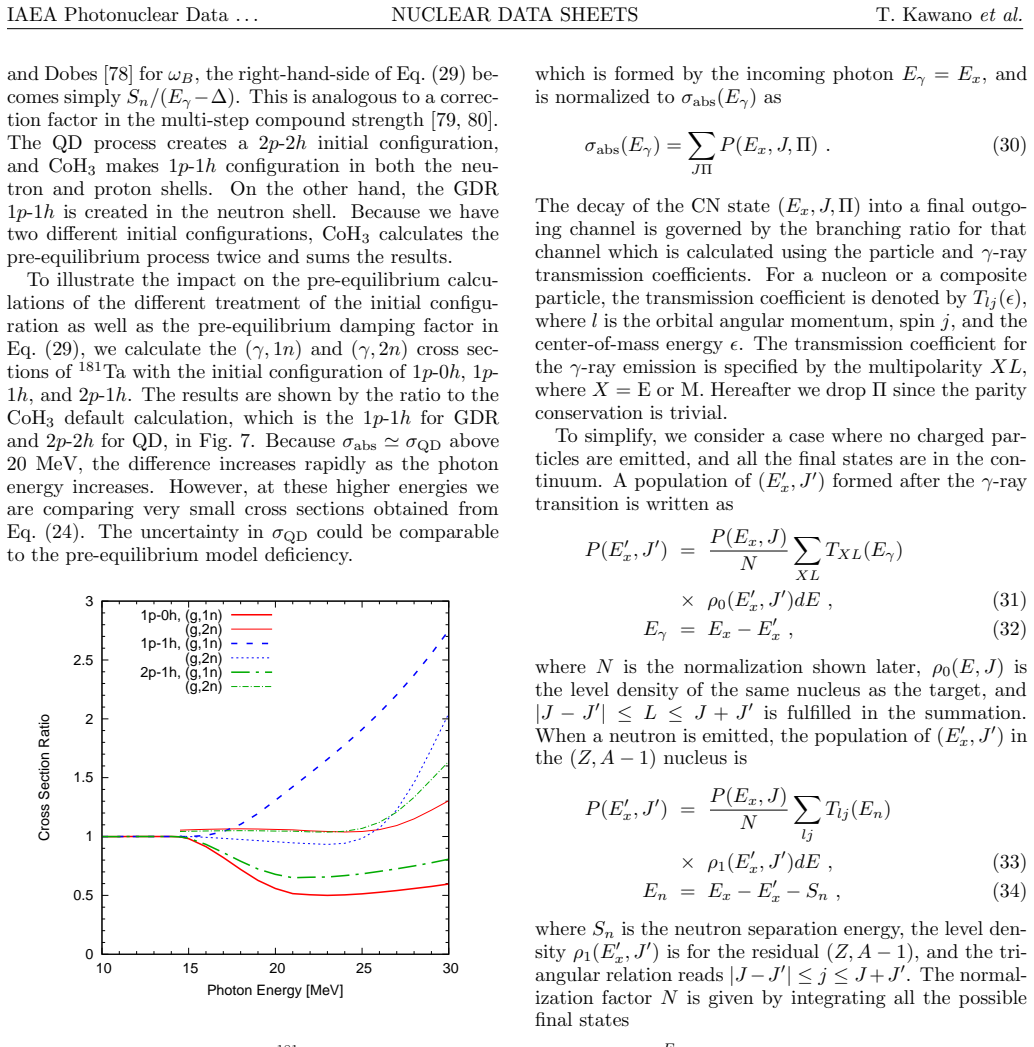
Figures from the paper (40 more)















Reference graph
Works this paper leans on
-
[1]
The evaluation in the previous IAEA 1999 library [3] was performed with the GLUNF code at CNDC
9Be 9Be is a natural stable isotope of beryllium with the abundance of 100%. The evaluation in the previous IAEA 1999 library [3] was performed with the GLUNF code at CNDC. In the GLUNF reaction scheme used in our present evaluation, the photo-absorption cross section σabs is split into the reaction channels of (γ, 2n), (γ, 2nα), (γ,np ), (γ,n 2α), (γ,nd ...
1999
-
[2]
A new evaluation 34 IAEA Photonuclear Data
14N 14N is a natural stable isotope of nitrogen, which has the largest abundance of 99.64%. A new evaluation 34 IAEA Photonuclear Data ... NUCLEAR DATA SHEETS T. Kawano et al. 0 2 4 6 0 10 20 30 40 (a) 9Be(γ ,abs) Cross Section [mb] Photon Energy [MeV] NewSUBARU IAEA 1999 IAEA 2019 0 0.5 1 1.5 2 0 1 2 3 4 5 (b) 9Be(γ ,abs) Cross Section [mb] Photon Energy...
1978
-
[3]
16O 16O is a natural stable isotope for oxygen with the abundance of 99.76%. We produced evaluated σabs and all of the exclusive cross sections for the ( γ, 2n), (γ,nα ), ( γ,n 3α), ( γ,np ), ( γ,n 2α), ( γ,nd ), ( γ,n 3He), (γ, 2np), ( γ,n 0) – ( γ,n 6), ( γ, 3α), ( γ, 2p), ( γ,pα ), (γ,t 2α), (γ,d 2α), (γ,pd ), (γ,pt ), and (γ,dα ) reactions, as well as...
1999
-
[4]
The photo-absorption cross section is evaluated based on the experimental data of Ahrens et al
27Al A new evaluation for 27Al based on the MEND-G code calculation was adopted in the new photonuclear data library. The photo-absorption cross section is evaluated based on the experimental data of Ahrens et al. [151, 161], and the PSF calculation using the SMLO model. The evaluated photo-absorption cross section, shown in 0 10 20 30 40 50 0 10 20 30 40...
2002
-
[5]
The new library in- cludes an updated evaluation of 50Cr whose abundance 36 IAEA Photonuclear Data
50Cr There are four natural stable isotopes for chromium, and all of them were evaluated by CIAE in the former IAEA Photonuclear data library. The new library in- cludes an updated evaluation of 50Cr whose abundance 36 IAEA Photonuclear Data ... NUCLEAR DATA SHEETS T. Kawano et al. 0 10 20 30 40 50 0 10 20 30 40 (a) 27Al(γ ,abs) Cross Section [mb] Photon ...
1972
-
[6]
The new evaluation was performed with the MEND-G code
90Zr The natural zirconium includes five stable isotopes, and CIAE evaluated 90Zr that has the largest abun- dance of 51.45%. The new evaluation was performed with the MEND-G code. The experimental data of Berman et al. [33] and Leprˆ etre et al. [128] are reported for 37 IAEA Photonuclear Data ... NUCLEAR DATA SHEETS T. Kawano et al. 0 10 20 30 40 0 10 20...
1973
-
[7]
Updating the Photonuclear Data Library and Generating a Reference Database for Photon Strength Functions
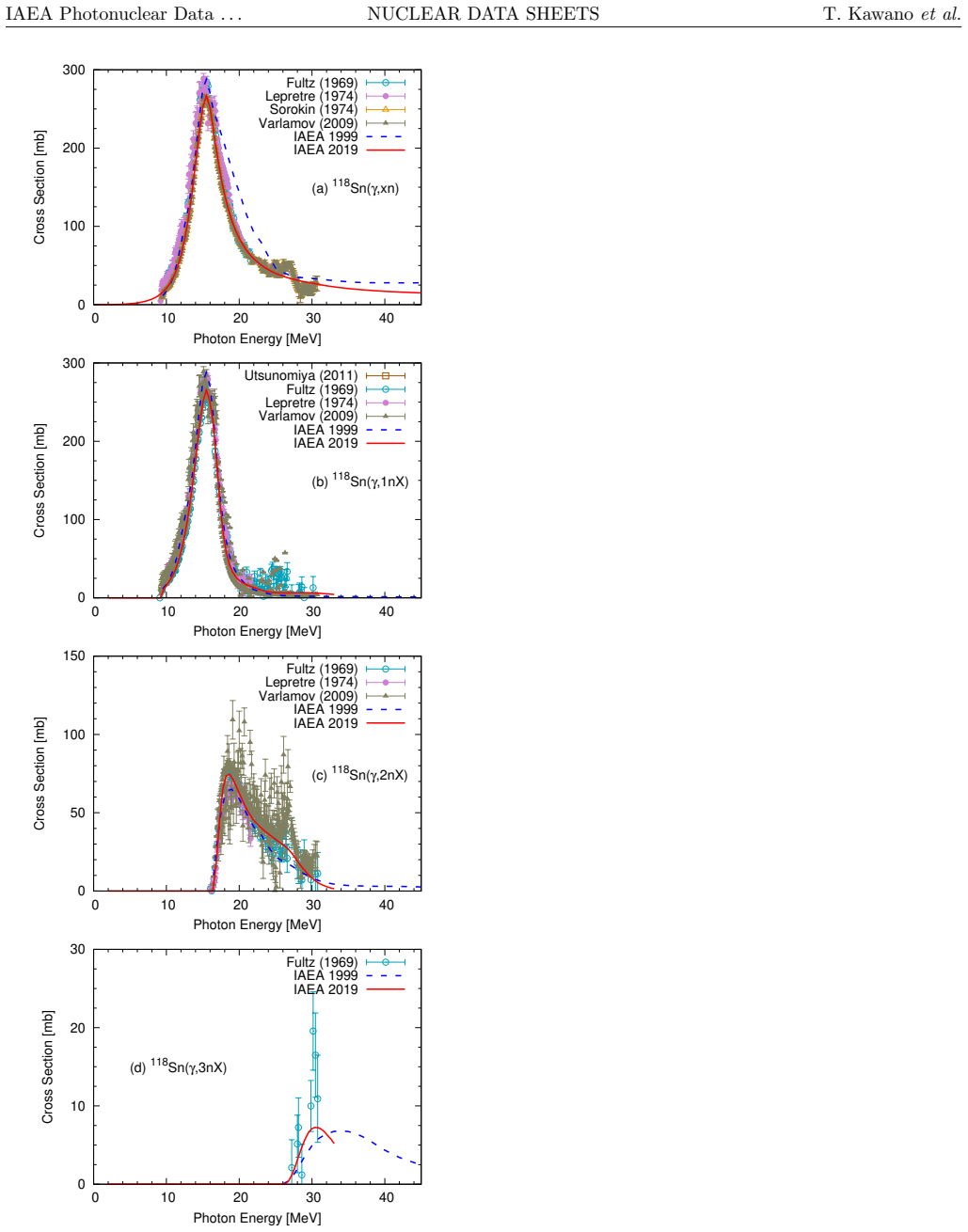
118Sn There are 10 stable isotopes in natural tin. The IAEA photonuclear data library adopted 120Sn from JENDL/PD-2016 [154], which has the largest abundance of 32.6%. CIAE undertook the evaluation of 118Sn, whose abundance is the second largest of 24.22%. The exper- imental data of Fultz et al. [164] and Leprˆ etre [123] re- ported in 1960–1970s provide ...
1967
-
[8]
Giant dipole resonance parameters of ground-state photoabsorption: Experimental values with uncertainties,
V. A. Plujko, O. M. Gorbachenko, R. Capote, and P. Dimitriou, “Giant dipole resonance parameters of ground-state photoabsorption: Experimental values with uncertainties,” At. Data Nucl. Data Tables 123–124, 1 (2018)
2018
Show all 175 references
-
[9]
Atlas of photoneutron cross sections ob- tained with monoenergetic photons,
B. L. Berman, “Atlas of photoneutron cross sections ob- tained with monoenergetic photons,” At. Data Nucl. Data Tables 15, 319 (1975)
1975
-
[10]
Atlas of photoneutron cross sections obtained with monoenergetic photons,
S. S. Dietrich and B. L. Berman, “Atlas of photoneutron cross sections obtained with monoenergetic photons,” At. Data Nucl. Data Tables 38, 199 (1988)
1988
-
[11]
Handbook on photonuclear data for applications. cross- sections and spectra, final report of a co-ordinated re- search project 1996–1999,
“Handbook on photonuclear data for applications. cross- sections and spectra, final report of a co-ordinated re- search project 1996–1999,” Tech. Rep. IAEA-TECDOC- 1178, International Atomic Energy Agency (2000)
2000
-
[12]
Production of medical ra- dioisotopes with high specific activity in photonuclear reactions with γ-beams of high intensity and large bril- liance,
D. Habs and U. K¨ oster, “Production of medical ra- dioisotopes with high specific activity in photonuclear reactions with γ-beams of high intensity and large bril- liance,” Appl. Phys. B 103, 501 (2011)
2011
-
[13]
Nuclear data for medical applications — recent developments and future require- ments,
A. L. Nichols and R. Capote, “Nuclear data for medical applications — recent developments and future require- ments,” Nucl. Data Sheets 120, 239 (2014)
2014
-
[14]
Sum- mary report of the technical meeting on intermediate- term nuclear data needs for medical applications: Cross sections and decay data,
A. L. Nichols, S. M. Qaim, and R. Capote Noy, “Sum- mary report of the technical meeting on intermediate- term nuclear data needs for medical applications: Cross sections and decay data,” Tech. Rep. INDC(NDS)-0596, International Atomic Energy Agency (2011)
2011
-
[15]
Sum- mary report of third research coordination meeting on nuclear data for charged-particle monitor reactions and medical isotope production,
A. L. Nichols, F. M. Nortier, and R. Capote Noy, “Sum- mary report of third research coordination meeting on nuclear data for charged-particle monitor reactions and medical isotope production,” Tech. Rep. INDC(NDS)- 0717, International Atomic Energy Agency (2016)
2016
-
[16]
The analysis of photonuclear yield curves,
E. Bramanis, T. K. Deague, R. Hicks, R. S. Hughes, E. G. Muirhead, R. H. Sambell, and R. J. J. Stew- art, “The analysis of photonuclear yield curves,” Nucl. Inst. Meth . 100, 59 (1972). 41 IAEA Photonuclear Data ... NUCLEAR DATA SHEETS T. Kawano et al
1972
-
[17]
Towards a more complete and accurate experimental nuclear reac- tion data library (EXFOR): International collaboration between nuclear reaction data centres (NRDC),
N. Otuka, E. Dupont, V. Semkova, et al. , “Towards a more complete and accurate experimental nuclear reac- tion data library (EXFOR): International collaboration between nuclear reaction data centres (NRDC),” Nucl. Data Sheets 120, 272 (2014)
2014
-
[18]
Direct neutron-multiplicity sorting with a flat- efficiency detector,
H. Utsunomiya, I. Gheorghe, D. M. Filipescu, et al. , “Direct neutron-multiplicity sorting with a flat- efficiency detector,” Nucl. Inst. Meth. A 871, 135 (2017)
2017
-
[19]
Ref- erence database for photon strength functions,
S. Goriely, P. Dimitriou, M. Wiedeking, et al. , “Ref- erence database for photon strength functions,” Eur. Phys. J. A (2019) [submitted to EPJA]
2019
-
[20]
New data for 197Au(γ,nx ) and 197Au(γ, 2nx) reaction cross sections,
V. V. Varlamov, B. S. Ishkhanov, V. N. Orlin, and S. Y. Troshchiev, “New data for 197Au(γ,nx ) and 197Au(γ, 2nx) reaction cross sections,” Bull. Rus. Acad. Sci . 74 (2010)
2010
-
[21]
O. V. Bogdankevich and F. A. Nikolaev, Methods in Bremsstrahlung Research. New York, USA: Academic Press (1966)
1966
-
[22]
Experimental determination of the proton escape width in the giant dipole resonance of 89Y,
E. Van Camp, R. Van de Vyver, E. Kerkhove, D. Ryck- bosch, H. Ferdinande, P. Van Otten, and P. Berkvens, “Experimental determination of the proton escape width in the giant dipole resonance of 89Y,” Phys. Rev. C 24, 2499 (1981)
1981
-
[23]
Analysis of photonuclear cross sections,
A. S. Penfold and J. E. Leiss, “Analysis of photonuclear cross sections,” Phys. Rev . 114, 1332 (1959)
1959
-
[24]
L. S. Cardman, Photon tagging, present practice and future prospects. Univ. of Illinois at Urbana-Champaign Dept. of Physics Report R/83/12/168 (1983)
1983
-
[25]
About the determination of photonu- clear reaction cross-sections,
A. N. Tikhonov, V. G. Shevchenko, V. Galkin, B. I. Goryachev, P. N. Zaikin, B. Ishkhanov, and I. M. Kapitonov, “About the determination of photonu- clear reaction cross-sections,” Vestnik Moskovskogo Univ. Fiz. Astron . 2, 208 (1970)
1970
-
[26]
Least structure solution of photonuclear yield functions,
B. C. Cook, “Least structure solution of photonuclear yield functions,” Nucl. Inst. Meth . 24, 256 (1963)
1963
-
[27]
Photoneutron cross section of oxygen,
K. N. Geller and E. G. Muirhead, “Photoneutron cross section of oxygen,” Phys. Rev. Lett . 11, 371 (1963)
1963
-
[28]
The use of mathematical-statistics methods in the solution of incorrectly posed problems,
V. F. Turchin, V. P. Kozlov, and M. S. Malkevich, “The use of mathematical-statistics methods in the solution of incorrectly posed problems,” Sov. Phys. Uspekhi 13, 681 (1971)
1971
-
[29]
A method of producing a narrow spectrum of high-energy photons,
A. Tzara, “A method of producing a narrow spectrum of high-energy photons,” Comptes Rendus Acad. Sci . 56 (1957)
1957
-
[30]
Measurements of the giant dipole resonance with monoenergetic photons,
B. L. Berman and S. C. Fultz, “Measurements of the giant dipole resonance with monoenergetic photons,” Rev. Mod. Phys . 47, 713 (1975)
1975
-
[31]
Photoneutron cross-section measurements on gold using nearly monochromatic photons,
S. C. Fultz, R. L. Bramblett, J. T. Caldwell, and N. A. Kerr, “Photoneutron cross-section measurements on gold using nearly monochromatic photons,” Phys. Rev. 127, 1273 (1962)
1962
-
[32]
Photon-flux determination by the poisson-fitting tech- nique with quenching corrections,
H. Utsunomiya, T. Watanabe, T. Ari-izumi, et al. , “Photon-flux determination by the poisson-fitting tech- nique with quenching corrections,” Nucl. Inst. Meth. A 896, 103 (2018)
2018
-
[33]
Generation and application of laser- compton gamma-ray at ETL,
H. Ohgaki, H. Toyokawa, K. Kudo, N. Takeda, and T. Yamazaki, “Generation and application of laser- compton gamma-ray at ETL,” Nucl. Inst. Meth. A 455, 54 (2000)
2000
-
[34]
Several- MeV γ-ray generation at NewSUBARU by laser comp- ton backscattering,
S. Amano, K. Horikawa, K. Ishihara, S. Miyamoto, T. Hayakawa, T. Shizuma, and T. Mochizuki, “Several- MeV γ-ray generation at NewSUBARU by laser comp- ton backscattering,” Nucl. Inst. Meth. A 602, 337 (2009)
2009
-
[35]
Measurements for the energy and flux of laser compton scattering γ-ray photons gener- ated in an electron storage ring: NewSUBARU,
K. Horikawa, S. Miyamoto, S. Amano, and T. Mochizuki, “Measurements for the energy and flux of laser compton scattering γ-ray photons gener- ated in an electron storage ring: NewSUBARU,” Nucl. Inst. Meth. A 618, 209 (2010)
2010
-
[36]
The γ-ray beam-line at NewSUBARU,
H. Utsunomiya, S. Hashimoto, and S. Miyamoto, “The γ-ray beam-line at NewSUBARU,” Nucl. Phys. News 25, 25 (2015)
2015
-
[37]
En- ergy calibration of the NewSUBARU storage ring for laser Compton-scattering gamma rays and applica- tions,
H. Utsunomiya, T. Shima, K. Takahisa, et al. , “En- ergy calibration of the NewSUBARU storage ring for laser Compton-scattering gamma rays and applica- tions,” IEEE Trans. on Nucl. Sci . 61, 1252 (2014)
2014
-
[38]
Photon couting method for high flux pulsed laser-compton backscattered photons based on poisson model,
T. Kii, T. Baba, Y. Nagai, H. Ohgaki, T. Shima, and H. Toyokawa, “Photon couting method for high flux pulsed laser-compton backscattered photons based on poisson model,” 12th Symp. on Accel. Sci. Tech- nol. W ako, Jpn. 27 - 29 Oct 1999 , 484
1999
-
[39]
Determination of the number of pulsed laser-compton scattering photons,
T. Kondo, H. Utsunomiya, H. Akimune, T. Yama- gata, A. Okamoto, H. Harada, F. Kitatani, T. Shima, K. Horikawa, and S. Miyamoto, “Determination of the number of pulsed laser-compton scattering photons,” Nucl. Inst. Meth. A 659, 462 (2011)
2011
-
[40]
Pho- toneutron cross section measurements on the N = 82 nuclei 139La and 141Pr: Implications for p-process nu- cleosynthesis,
H. Utsunomiya, A. Makinaga, S. Goko, et al. , “Pho- toneutron cross section measurements on the N = 82 nuclei 139La and 141Pr: Implications for p-process nu- cleosynthesis,” Phys. Rev. C 74, 025806 (2006)
2006
-
[41]
Photoneutron cross sections for Zr90, Zr91, Zr92, Zr94, and Y89,
B. L. Berman, J. T. Caldwell, R. R. Harvey, M. A. Kelly, R. L. Bramblett, and S. C. Fultz, “Photoneutron cross sections for Zr90, Zr91, Zr92, Zr94, and Y89,” Phys. Rev. 162, 1098 (1967)
1967
-
[42]
Comment on pho- toneutron cross sections,
E. Wolynec, A. R. V. Martinez, P. Gouffon, Y. Miyao, V. A. Serr˜ ao, and M. N. Martins, “Comment on pho- toneutron cross sections,” Phys. Rev. C 29, 1137 (1984)
1984
-
[43]
Discrepancies between Saclay and Livermore photoneutron cross sections,
E. Wolynec and M. N. Martins, “Discrepancies between Saclay and Livermore photoneutron cross sections,” Re- vista Brasileira de Fisica 17, 56 (1987)
1987
-
[44]
Study of consis- tency between (γ,xn), [(γ,n) + (γ,np)] and (γ,2n) reac- tion cross sections using data systematics,
V. V. Varlamov and B. S. Ishkhanov, “Study of consis- tency between (γ,xn), [(γ,n) + (γ,np)] and (γ,2n) reac- tion cross sections using data systematics,” Tech. Rep. INDC(CCP)-433, International Atomic Energy Agency (2002)
2002
-
[45]
Photodisintegration of cadmium isotopes,
S. S. Belyshev, B. S. Ishkhanov, A. A. Kuznetsov, V. N. Orlin, K. A. Stopani, V. V. Khankin, and N. V. Shvedunov, “Photodisintegration of cadmium isotopes,” Phys. Atom. Nucl . 77, 809 (2014)
2014
-
[46]
Multinucleon photonuclear reactions on 209Bi: Experi- ment and evaluation,
S. S. Belyshev, D. M. Filipescu, I. Gheoghe, et al. , “Multinucleon photonuclear reactions on 209Bi: Experi- ment and evaluation,” Eur. Phys. J. A 51, 67 (2015)
2015
-
[47]
Measurement of flux-weighted average cross sections for 197Au(γ,xn) reactions and isomeric yield ra- tios of 196m,gAu with bremsstrahlung,
H. Naik, G. Kim, K. Kim, M. Zaman, A. Goswami, M. W. Lee, S.-C. Yang, Y.-O. Lee, S.-G. Shin, and M.- H. Cho, “Measurement of flux-weighted average cross sections for 197Au(γ,xn) reactions and isomeric yield ra- tios of 196m,gAu with bremsstrahlung,” Nucl. Phys. A 948, 28 (2016)
2016
-
[48]
IAEA bibliographical series, photonu- clear reactions,
V. I. Antonescu, “IAEA bibliographical series, photonu- clear reactions,” Tech. Rep. 10, International Atomic Energy Agency, Vienna, Austria (1964)
1964
-
[49]
Photoneu- tron cross sections for Au revisited: Measurements with laser compton scattering γ-rays and data reduction by a least-squares method,
O. Itoh, H. Utsunomiya, H. Akimune, et al., “Photoneu- tron cross sections for Au revisited: Measurements with laser compton scattering γ-rays and data reduction by a least-squares method,” J. Nucl. Sci. Technol . 48, 834 (2011)
2011
-
[50]
Cross section measurements of the 181Ta(γ,n )180Ta reaction near neutron threshold and the p-process nucleosynthe- sis,
H. Utsunomiya, H. Akimune, S. Goko, et al. , “Cross section measurements of the 181Ta(γ,n )180Ta reaction near neutron threshold and the p-process nucleosynthe- sis,” Phys. Rev. C 67, 015807 (2003)
2003
-
[51]
Pho- toneutron cross sections for 96Zr: A systematic exper- imental study of photoneutron and radiative neutron capture cross sections for zirconium isotopes,
H. Utsunomiya, S. Goriely, H. Akimune, et al. , “Pho- toneutron cross sections for 96Zr: A systematic exper- imental study of photoneutron and radiative neutron capture cross sections for zirconium isotopes,” Phys. Rev. C 81, 035801 (2010)
2010
-
[52]
Total and partial photoneutron cross sections for Pb isotopes,
T. Kondo, H. Utsunomiya, S. Goriely, et al. , “Total and partial photoneutron cross sections for Pb isotopes,” Phys. Rev. C 86, 014316 (2012)
2012
-
[53]
Photoneu- tron cross sections for Mo isotopes: A step toward a uni- fied understanding of (γ,n ) and (n,γ ) reactions,
H. Utsunomiya, S. Goriely, T. Kondo, et al., “Photoneu- tron cross sections for Mo isotopes: A step toward a uni- fied understanding of (γ,n ) and (n,γ ) reactions,” Phys. Rev. C 88, 015805 (2013)
2013
-
[54]
Veri- fication of detailed balance forγ absorption and emission in Dy isotopes,
T. Renstrøm, H. Utsunomiya, H. T. Nyhus, et al., “Veri- fication of detailed balance forγ absorption and emission in Dy isotopes,” Phys. Rev. C 98, 054310 (2018)
2018
-
[55]
Photoneutron cross-section measurements in the 209Bi(γ,xn ) reaction with a new method of direct neutron-multiplicity sorting,
I. Gheorghe, H. Utsunomiya, S. Katayama, et al. , “Photoneutron cross-section measurements in the 209Bi(γ,xn ) reaction with a new method of direct neutron-multiplicity sorting,” Phys. Rev. C 96, 044604 (2017)
2017
-
[56]
Compilation of giant electric dipole resonances built on excited states,
A. Schiller and M. Thoennessen, “Compilation of giant electric dipole resonances built on excited states,” At. Data Nucl. Data Tables 93, 549 (2007)
2007
-
[57]
E. G. Fuller and H. Gerstenberg, Photonuclear data - abstract sheets 1955 - 1982. Report of the US National 42 IAEA Photonuclear Data ... NUCLEAR DATA SHEETS T. Kawano et al. Bureau of Standards, NBSIR 83 - 2742 , I - XV . Na- tional Institute of Standards and Technology, Gait...
1983
-
[58]
V. V. Varlamov, V. V. Sapunenko, and M. E. Stepanov, Photonuclear data index 1976–1995. Moscow State Uni- versity (1996)
1996
-
[59]
Bibliographic index to photonuclear reaction data (1955 – 1992),
T. Asami and T. Nakagawa, “Bibliographic index to photonuclear reaction data (1955 – 1992),” Tech. Rep. JAERI-M-93-195, INDC(JPN)-167L, Japan Atomic En- ergy Research Institute, Ibaraki-ken, Japan (1993)
1993
-
[60]
CDFE online services,
V. V. Varlamov, “CDFE online services,” http://cdfe.sinp.msu.ru/services/pnisearch.html
-
[61]
Handbook on nuclear activation data,
“Handbook on nuclear activation data,” Tech. Rep. Technical Report Series No.273, International Atomic Energy Agency (1987)
1987
-
[62]
Plots of the ex- perimental and evaluated photonuclear cross-sections,
A. I. Blokhon and S. M. Nasyrova, “Plots of the ex- perimental and evaluated photonuclear cross-sections,” Tech. Rep. INDC(CCP)-337, International Atomic En- ergy Agency (1991)
1991
-
[63]
Atlas of giant dipole resonances, parameters and graphs of photonuclear reaction cross sections,
A. V. Varlamov, V. V. Varlamov, D. S. Rudenko, and M. E. Stepanov, “Atlas of giant dipole resonances, parameters and graphs of photonuclear reaction cross sections,” Tech. Rep. INDC(NDS)-394, International Atomic Energy Agency (1999)
1999
-
[64]
Dipole radiative strength functions from resonance neutron capture,
C. M. McCullagh, M. L. Stelts, and R. E. Chrien, “Dipole radiative strength functions from resonance neutron capture,” Phys. Rev. C 23, 1394 (1981)
1981
-
[65]
Gi- ant dipole resonance parameters with uncertainties from photonuclear cross sections,
V. A. Plujko, R. Capote, and O. M. Gorbachenko, “Gi- ant dipole resonance parameters with uncertainties from photonuclear cross sections,” At. Data Nucl. Data Tables 97, 567 (2011)
2011
-
[66]
RIPL — reference input parameter library for calculation of nuclear reactions and nuclear data evaluations,
R. Capote, M. Herman, P. Obloˇ zinsk´ y,et al. , “RIPL — reference input parameter library for calculation of nuclear reactions and nuclear data evaluations,” Nucl. Data Sheets 110, 3107 (2009)
2009
-
[67]
EXFOR systems manual nuclear reaction data exchange format,
V. McLane, “EXFOR systems manual nuclear reaction data exchange format,” Tech. Rep. BNL-NCS-63330- 00/04-REV;KB0401040, Brookhaven National Labora- tory (2000)
2000
-
[68]
International network of nuclear reaction data centres,
N. Otsuka and S. Dunaeva, “International network of nuclear reaction data centres,” Tech. Rep. INDC(NDS)- 401, International Atomic Energy Agency (2010)
2010
-
[69]
The experimen- tal nuclear reaction data (EXFOR): Extended com- puter database and Web retrieval system,
V. V. Zerkin and B. Pritychenko, “The experimen- tal nuclear reaction data (EXFOR): Extended com- puter database and Web retrieval system,” Nucl. Inst. Meth. A 888, 31 (2018)
2018
-
[70]
The high energy nuclear photoeffect,
J. S. Levinger, “The high energy nuclear photoeffect,” Phys. Rev . 84, 43 (1951)
1951
-
[71]
Modified quasi-deutron model,
J. S. Levinger, “Modified quasi-deutron model,” Phys. Lett. B 82, 181 (1979)
1979
-
[72]
EMPIRE: Nuclear reaction model code system for data evalua- tion,
M. Herman, R. Capote, B. V. Carlson, P. Obloˇ zinsk´ y, M. Sin, A. Trkov, H. Wienke, and V. Zerkin, “EMPIRE: Nuclear reaction model code system for data evalua- tion,” Nucl. Data Sheets 108, 2655 (2007)
2007
-
[73]
Test of gamma-ray strength functions in nuclear reaction model calculations,
J. Kopecky and M. Uhl, “Test of gamma-ray strength functions in nuclear reaction model calculations,” Phys. Rev. C 41, 1941 (1990)
1990
-
[74]
Radiative strength in the compound nucleus 157Gd,
J. Kopecky, M. Uhl, and R. E. Chrien, “Radiative strength in the compound nucleus 157Gd,” Phys. Rev. C 47, 312 (1993)
1993
-
[75]
Finite amplitude method for the solution of the random-phase approximation,
T. Nakatsukasa, T. Inakura, and K. Yabana, “Finite amplitude method for the solution of the random-phase approximation,” Phys. Rev. C 76, 024318 (2007)
2007
-
[76]
Mean field based calculations with the Gogny force: Some theoretical tools to explore the nuclear structure,
S. P´ eru and M. Martini, “Mean field based calculations with the Gogny force: Some theoretical tools to explore the nuclear structure,” The Eur. Phys. J. A 50, 88 (2014)
2014
-
[77]
Renewed database of GDR parameters for atomic nuclei,
V. A. Plujko, O. M. Gorbachenko, V. M. Bondar, and R. Capote, “Renewed database of GDR parameters for atomic nuclei,” J. Korean Phys. Soc . 59, 1514 (2011)
2011
-
[78]
Pauli-blocking in the quasideuteron model of photoabsorption,
M. B. Chadwick, P. Obloˇ zinsk´ y, P. E. Hodgson, and G. Reffo, “Pauli-blocking in the quasideuteron model of photoabsorption,” Phys. Rev. C 44, 814 (1991)
1991
-
[79]
The statisti- cal theory of multi-step compound and direct reactions,
H. Feshbach, A. Kerman, and S. Koonin, “The statisti- cal theory of multi-step compound and direct reactions,” Annals Phys . 125, 429 (1980)
1980
-
[80]
Microscopic calculation of the multistep compound process,
T. Kawano, “Microscopic calculation of the multistep compound process,” Phys. Rev. C 59, 865 (1999)
1999
-
[81]
EMPIRE-3.2 Malta, modular system for nuclear reaction calculations and nuclear data evaluation user’s manual,
M. Herman, R. Capote, M. Sin, et al. , “EMPIRE-3.2 Malta, modular system for nuclear reaction calculations and nuclear data evaluation user’s manual,” Tech. Rep. INDC(NDS)-0603, International Atomic Energy Agency (2013)
2013
-
[82]
TALYS-1.0,
A. J. Koning, S. Hilaire, and M. C. Duijvestijn, “TALYS-1.0,” EPJ Web Conf ., 211 (2008). Proc. Int. Conf. on Nuclear Data for Science and Technology, 22 – 27 Apr., 2007, Nice, France, (Eds.) O. Bersillon, F. Gunsing, E. Bauge, R. Jacqmin, and S. Leray
2008
-
[83]
The CCONE code system and its appli- cation to nuclear data evaluation for fission and other reactions,
O. Iwamoto, N. Iwamoto, S. Kunieda, F. Minato, and K. Shibata, “The CCONE code system and its appli- cation to nuclear data evaluation for fission and other reactions,” Nucl. Data Sheets 131, 259 (2016)
2016
-
[84]
CoH 3: The coupled-channels and hauser- feshbach code,
T. Kawano, “CoH 3: The coupled-channels and hauser- feshbach code,” (2019). CNR2018: International Work- shop on Compound Nucleus and Related Topics, LBNL, Berkeley, CA, USA, September 24 – 28, 2018, (Ed.) J. Escher
2019
-
[85]
Particle-hole state density in the uni- form spacing model,
F. C. Williams, “Particle-hole state density in the uni- form spacing model,” Nucl. Phys. A 166, 231 (1971)
1971
-
[86]
The finite depth of the nuclear potential well in the exciton model of preequilibrium decay,
E. Bˇ et´ ak and J. Dobeˇ s, “The finite depth of the nuclear potential well in the exciton model of preequilibrium decay,” Z. f ¨ur Physik A 279, 319 (1976)
1976
-
[87]
Feshbach-Kerman- Koonin analysis of 93Nb reactions: P→Q transitions and reduced importance of multistep compound emission,
M. B. Chadwick and P. G. Young, “Feshbach-Kerman- Koonin analysis of 93Nb reactions: P→Q transitions and reduced importance of multistep compound emission,” Phys. Rev. C 47, 2255 (1993)
1993
-
[88]
On the validity of the intranuclear-cascade and evaporation model for high energy proton induced reactions,
N. Kishida and H. Kadotani, “On the validity of the intranuclear-cascade and evaporation model for high energy proton induced reactions,” Proc. Int. Conf. Nucl. Data for Sci. Technol ., 1209 (1989). Mito, Japan, May 30 – June 3, 1988, (Ed.) S. Igarasi (Saikon Publishing Co. Lt...
1989
-
[89]
The inelastic scattering of neutrons,
W. Hauser and H. Feshbach, “The inelastic scattering of neutrons,” Phys. Rev . 87, 366 (1952)
1952
-
[90]
Photonuclear angular distribution systematics in the quasideuteron regime,
M. B. Chadwick, P. G. Young, and S. Chiba, “Photonuclear angular distribution systematics in the quasideuteron regime,” J. Nucl. Sci. Technol . 32, 1154 (1995)
1995
-
[91]
Systematics of continuum angular distri- butions: Extensions to higher energies,
C. Kalbach, “Systematics of continuum angular distri- butions: Extensions to higher energies,” Phys. Rev. C 37, 2350 (1988)
1988
-
[92]
Local and global nucleon optical models from 1 keV to 200 MeV,
A. J. Koning and J.-P. Delaroche, “Local and global nucleon optical models from 1 keV to 200 MeV,” Nucl. Phys. A 713, 231 (2003)
2003
-
[93]
GNASH, a pre- equilibrium, statistical nuclear-model code for calcula- tion of cross sections and emission spectra,
P. G. Young and E. D. Arthur, “GNASH, a pre- equilibrium, statistical nuclear-model code for calcula- tion of cross sections and emission spectra,” Tech. Rep. LA-6947, Los Alamos National Laboratory (1977)
1977
-
[94]
Com- prehensive nuclear model calculations: Introduction to the theory and use of the GNASH code,
P. G. Young, E. D. Arthur, and M. B. Chadwick, “Com- prehensive nuclear model calculations: Introduction to the theory and use of the GNASH code,” Tech. Rep. 43 IAEA Photonuclear Data ... NUCLEAR DATA SHEETS T. Kawano et al. LA-12343-MS, Los Alamos National Laboratory (1992)
1992
-
[95]
ALICE-F calculation of nuclear data up to 1 GeV,
T. Fukahori, “ALICE-F calculation of nuclear data up to 1 GeV,” JAERI-M 92-039, 114 (1992)
1992
-
[96]
Preequilibrium model of photonucleon reactions that is based on Fermi gas densities,
B. S. Ishkhanov and V. N. Orlin, “Preequilibrium model of photonucleon reactions that is based on Fermi gas densities,” Phys. Atom. Nucl ., 493 (2008)
2008
-
[97]
Illustration on photonuclear data calculation with GUNF code,
Z. Zhang, “Illustration on photonuclear data calculation with GUNF code,” Comm. Nucl. Data Prog. 19, 33 (1998)
1998
-
[98]
Illustration on photonuclear data calc. with GLUNF code,
Z. Zhang,, “Illustration on photonuclear data calc. with GLUNF code,” Comm. Nucl. Data Prog. 22, (1999)
1999
-
[99]
The XGFISS code for analysis of pho- tonuclear cross-sections for actinide nuclei,
A. Blokhin, “The XGFISS code for analysis of pho- tonuclear cross-sections for actinide nuclei,” Yadernye Konstanty 2 (1999)
1999
-
[100]
Inter-comparison of Hauser-Feshbach model codes toward better actinide evaluations,
R. Capote, S. Hilaire, O. Iwamoto, T. Kawano, and M. Sin, “Inter-comparison of Hauser-Feshbach model codes toward better actinide evaluations,” EPJ Web Conf. 146, 12034 (2017). ND 2016: International Con- ference on Nuclear Data for Science and Technology, Bruges, Belgium, Sep...
2017
-
[101]
Random-matrix approach to the statistical compound nuclear reaction at low energies using the Monte Carlo technique,
T. Kawano, P. Talou, and H. A. Weidenm¨ uller, “Random-matrix approach to the statistical compound nuclear reaction at low energies using the Monte Carlo technique,” Phys. Rev. C 92, 044617 (2015)
2015
-
[102]
MEND-A code for calculating nuclear data of medium-heavy nuclei below 250 MeV,
C.-H. Cai, “MEND-A code for calculating nuclear data of medium-heavy nuclei below 250 MeV,” Nucl. Phys. Rev. 28, 354 (2011)
2011
-
[103]
Semimicroscopic de- scription of the giant dipole resonance,
B. S. Ishkhanov and V. N. Orlin, “Semimicroscopic de- scription of the giant dipole resonance,” Phys. Part. Nucl. 38, 232 (2007)
2007
-
[104]
Nucleon-nucleus optical-model parameters, A > 40, E < 50 MeV,
F. D. Becchetti and G. W. Greenlees, “Nucleon-nucleus optical-model parameters, A > 40, E < 50 MeV,” Phys. Rev . 182, 1190 (1969)
1969
-
[105]
High energy scattering of deuterons by complex nuclei,
S. Watanabe, “High energy scattering of deuterons by complex nuclei,” Nucl. Phys . 8, 484 (1958)
1958
-
[106]
Global optical potentials for emitted alpha particles,
V. Avrigeanu, P. E. Hodgson, and M. Avrigeanu, “Global optical potentials for emitted alpha particles,” Phys. Rev. C 49, 2136 (1994)
1994
-
[107]
Complementary optical-potential analysis of α-particle elastic scattering and induced reactions at low energies,
M. Avrigeanu, A. C. Obreja, F. L. Roman, V. Avrigeanu, and W. von Oertzen, “Complementary optical-potential analysis of α-particle elastic scattering and induced reactions at low energies,”At. Data Nucl. Data Tables 95, 501 (2009)
2009
-
[108]
α-particle nuclear sur- face absorption below the Coulomb barrier in heavy nu- clei,
M. Avrigeanu and V. Avrigeanu, “α-particle nuclear sur- face absorption below the Coulomb barrier in heavy nu- clei,” Phys. Rev. C 82, 014606 (2010)
2010
-
[109]
Fur- ther explorations of the α-particle optical model poten- tial at low energies for the mass range A≈ 45–209,
V. Avrigeanu, M. Avrigeanu, and C. Mˇ anˇ ailescu, “Fur- ther explorations of the α-particle optical model poten- tial at low energies for the mass range A≈ 45–209,” Phys. Rev. C 90, 044612 (2014)
2014
-
[110]
Global deuteron optical model po- tential for the energy range up to 183 MeV,
H. An and C. Cai, “Global deuteron optical model po- tential for the energy range up to 183 MeV,”Phys. Rev. C 73, 054605 (2006)
2006
-
[111]
Elastic deuteron scattering and optical model parameters at energies up to 100 MeV,
J. Bojowald, H. Machner, H. Nann, W. Oelert, M. Rogge, and P. Turek, “Elastic deuteron scattering and optical model parameters at energies up to 100 MeV,” Phys. Rev. C 38, 1153 (1988)
1988
-
[112]
New data on cross sections for par- tial and total photoneutron reactions on the isotopes 91,94Zr,
V. V. Varlamov, M. A. Makarov, N. N. Peskov, and M. E. Stepanov, “New data on cross sections for par- tial and total photoneutron reactions on the isotopes 91,94Zr,” Phys. Atom. Nucl . 78, 634 (2015)
2015
-
[113]
Standard optical model parameters,
F. D. Becchetti and G. W. Greenlees, “Standard optical model parameters,” Tech. Rep., University of Minnesota (1969)
1969
-
[114]
Deuteron global optical model potential for energies up to 200 MeV,
Y. Han, Y. Shi, and Q. Shen, “Deuteron global optical model potential for energies up to 200 MeV,” Phys. Rev. C 74, 044615 (2006)
2006
-
[115]
Helium-3 global opti- cal model potential with energies below 250 MeV,
Y. Xu, H. Guo, and Y. Han, “Helium-3 global opti- cal model potential with energies below 250 MeV,” Sci. China Phys. Mech. Astron . 54, 2005 (2011)
2011
-
[116]
New data on ( γ,n ), (γ, 2n), and ( γ, 3n) partial photoneutron reactions,
V. V. Varlamov, B. S. Ishkhanov, V. N. Orlin, N. N. Peskov, and M. E. Stepanov, “New data on ( γ,n ), (γ, 2n), and ( γ, 3n) partial photoneutron reactions,” Phys. Atom. Nucl . 76, 1403 (2013)
2013
-
[117]
New approach to analyzing and evaluating cross sections for partial photoneutron reactions,
V. V. Varlamov, B. S. Ishkhanov, and V. N. Orlin, “New approach to analyzing and evaluating cross sections for partial photoneutron reactions,” Phys. Atom. Nucl . 75, 1339 (2012)
2012
-
[118]
A new approach for analysis and evaluation of partial photoneutron reaction cross sections,
V. V. Varlamov, B. S. Ishkhanov, V. N. Orlin, and K. A. Stopani, “A new approach for analysis and evaluation of partial photoneutron reaction cross sections,” Eur. Phys. J. A 50, 114 (2014)
2014
-
[119]
To- tal and partial photoneutron reactions cross sections - new analysis and evaluation,
B. S. Ishkhanov, V. N. Orlin, and V. V. Varlamov, “To- tal and partial photoneutron reactions cross sections - new analysis and evaluation,” EPJ Web Conf . 38, 12003 (2012)
2012
-
[120]
The reliability of photoneutron cross sec- tions for 90,91,92,94Zr,
V. V. Varlamov, A. I. Davydov, B. S. Ishkhanov, and V. N. Orlin, “The reliability of photoneutron cross sec- tions for 90,91,92,94Zr,” Eur. Phys. J. A 54, 74 (2018)
2018
-
[121]
Photodisintegration of the isotopes 186,188,189,190,192Os: Similarities and distinctions,
V. Varlamov, M. Makarov, N. Peskov, and M. Stepanov, “Photodisintegration of the isotopes 186,188,189,190,192Os: Similarities and distinctions,” Phys. Atom. Nucl . 78, 746 (2015)
2015
-
[122]
Reliability of the data on the cross sections of the partial photoneutron reaction for 63,65Cu and 80Se nuclei,
V. V. Varlamov, A. I. Davydov, M. A. Makarov, V. N. Orlin, and N. N. Peskov, “Reliability of the data on the cross sections of the partial photoneutron reaction for 63,65Cu and 80Se nuclei,” Bull. Rus. Acad. Sci . 80, 317 (2016)
2016
-
[123]
Data on photoneutron reactions from various experiments for 133Cs, 138Ba and 209Bi nuclei,
V. V. Varlamov, B. S. Ishkhanov, V. N. Orlin, and N. N. Peskov, “Data on photoneutron reactions from various experiments for 133Cs, 138Ba and 209Bi nuclei,” Phys. Atom. Nucl. 79, 501 (2016)
2016
-
[124]
Photoneutron cross sections for natural Cu, Cu63, and Cu 65,
S. C. Fultz, R. L. Bramblett, J. T. Caldwell, and R. R. Harvey, “Photoneutron cross sections for natural Cu, Cu63, and Cu 65,” Phys. Rev . 133, B1149 (1964)
1964
-
[125]
Photoneutron cross sections for 59Co : Systematic uncertainties of data from various experiments,
V. V. Varlamov, A. I. Davydov, and B. S. Ishkhanov, “Photoneutron cross sections for 59Co : Systematic uncertainties of data from various experiments,” Eur. Phys. J. A 53, 180 (2017)
2017
-
[126]
Photoneutron cross sections for V 51 and Co59,
S. C. Fultz, R. L. Bramblett, J. T. Caldwell, N. E. Hansen, and C. P. Jupiter, “Photoneutron cross sections for V 51 and Co59,” Phys. Rev . 128, 2345 (1962)
1962
-
[127]
Photoneutron cross sections for 55Mn and 59Co,
R. A. Alvarez, B. L. Berman, D. D. Faul, F. H. Lewis, and P. Meyer, “Photoneutron cross sections for 55Mn and 59Co,” Phys. Rev. C 20, 128 (1979)
1979
-
[128]
The giant dipole states in theA = 90 mass region,
A. Leprˆ etre, H. Beil, R. Berg` ere, P. Carlos, A. Veyssi` ere, and M. Sugawara, “The giant dipole states in theA = 90 mass region,” Nucl. Phys. A 175, 609 (1971)
1971
-
[129]
Pho- todisintegration of tantalum,
B. S. Ishkhanov, V. N. Orlin, and S. Y. Troschiev, “Pho- todisintegration of tantalum,” Phys. Atom. Nucl . 75, 253 (2012)
2012
-
[130]
Experi- mental and evaluated photoneutron cross sections for 44 IAEA Photonuclear Data ... NUCLEAR DATA SHEETS T. Kawano et al. 197Au,
V. Varlamov, B. Ishkhanov, and V. Orlin, “Experi- mental and evaluated photoneutron cross sections for 44 IAEA Photonuclear Data ... NUCLEAR DATA SHEETS T. Kawano et al. 197Au,” Phys. Rev. C 96, 044606 (2017)
2017
-
[131]
A study of the giant dipole resonance of vibrational nuclei in the 103≤ A≤ 133 mass region,
A. Leprˆ etre, H. Beil, R. Berg` ere, P. Carlos, A. De Miniac, A. Veyssi` ere, and K. Kernbach, “A study of the giant dipole resonance of vibrational nuclei in the 103≤ A≤ 133 mass region,” Nucl. Phys. A 219, 39 (1974)
1974
-
[132]
Photoneutron cross sections for As 75, Ag 107, and Cs 133,
B. L. Berman, R. L. Bramblett, J. T. Caldwell, H. S. Davis, M. A. Kelly, and S. C. Fultz, “Photoneutron cross sections for As 75, Ag 107, and Cs 133,” Phys. Rev . 177, 1745 (1969)
1969
-
[133]
Photoneutron cross sections for Ba138 and N14,
B. L. Berman, S. C. Fultz, J. T. Caldwell, M. A. Kelly, and S. S. Dietrich, “Photoneutron cross sections for Ba138 and N14,” Phys. Rev. C 2, 2318 (1970)
1970
-
[134]
A study of the giant dipole resonance in doubly even tellurium and cerium isotopes,
A. Leprˆ etre, H. Beil, R. Berg` ere, P. Carlos, J. Fagot, A. De Miniac, A. Veyssi` ere, and H. Miyase, “A study of the giant dipole resonance in doubly even tellurium and cerium isotopes,” Nucl. Phys. A 258, 350 (1976)
1976
-
[135]
Pho- toneutrons from Li 6 and Co59,
E. B. Bazhanov, A. P. Komar, and A. V. Kulikov, “Pho- toneutrons from Li 6 and Co59,” Sov. Phys. JETP 19, 1014 (1964)
1964
-
[136]
JENDL photonuclear data file,
N. Kishida, T. Murata, T. Asami, K. Kosako, K. Maki, H. Harada, Y. Lee, J. Chang, S. Chiba, and T. Fukahori, “JENDL photonuclear data file,” 769, 199 (2004). Pro- ceedings of International Conference on Nuclear Data for Science and Technology, Santa Fe, New Mexico, USA, Sep. 26...
2004
-
[137]
The photodisintegration of manganese and rhodium,
R. W. Parsons, “The photodisintegration of manganese and rhodium,” Can. J. Phys . 37, 1344 (1959)
1959
-
[138]
Splitting of the giant dipole resonance in medium-heavy nuclei,
O. V. Bogdankevich, B. I. Goryachev, and V. A. Za- pevalov, “Splitting of the giant dipole resonance in medium-heavy nuclei,” J. Exp. Theor. Phys . 15, 1044 (1962)
1962
-
[139]
Photoneutron cross sections of Tb 159 and O16,
R. L. Bramblett, J. T. Caldwell, R. R. Harvey, and S. C. Fultz, “Photoneutron cross sections of Tb 159 and O16,” Phys. Rev . 133, B869 (1964)
1964
-
[140]
Photoneutron cross sections of La, Tb, Ho and Ta,
R. Berg` ere, H. Beil, and A. Veyssi` ere, “Photoneutron cross sections of La, Tb, Ho and Ta,” Nucl. Phys. A 121, 463 (1968)
1968
-
[141]
Giant resonance in strongly deformed nuclei Tb-159, Ho-165, Er-166, and Hf-178,
B. I. Goryachev, Y. V. Kuznetsov, V. N. Orlin, N. A. Pozhidaeva, and V. G. Shevchenko, “Giant resonance in strongly deformed nuclei Tb-159, Ho-165, Er-166, and Hf-178,” Yad. Fiz. 23, 1145 (1976)
1976
-
[142]
Giant resonance in deformed nuclei: Photoneutron cross sections for Eu 153, Gd160, Ho165, and W186,
B. L. Berman, M. A. Kelly, R. L. Bramblett, J. T. Cald- well, H. S. Davis, and S. C. Fultz, “Giant resonance in deformed nuclei: Photoneutron cross sections for Eu 153, Gd160, Ho165, and W186,” Phys. Rev. 185, 1576 (1969)
1969
-
[143]
To- tal nuclear photoabsorption cross sections in the region 150<A< 190,
G. M. Gurevich, L. E. Lazareva, V. M. Mazur, S. Y. Merkulov, G. V. Solodukhov, and V. A. Tyutin, “To- tal nuclear photoabsorption cross sections in the region 150<A< 190,” Nucl. Phys. A 351, 257 (1981)
1981
-
[144]
Renewal of JENDL photonuclear data file 2004 (I) elements of atomic number below 20,
T. Murata, K. Kosaka, and T. Fukahori, “Renewal of JENDL photonuclear data file 2004 (I) elements of atomic number below 20,” JAEA-Conf 2011-002, 235 (2011)
2011
-
[145]
Photoneutron cross sections of Ta 181 and Ho165,
R. L. Bramblett, J. T. Caldwell, G. F. Auchampaugh, and S. C. Fultz, “Photoneutron cross sections of Ta 181 and Ho165,” Phys. Rev . 129, 2723 (1963)
1963
-
[146]
Summary report of the 1st research co-ordination meeting on compilation and evaluation of photonuclear data for applications,
P. Obloˇ zinsk´ y, “Summary report of the 1st research co-ordination meeting on compilation and evaluation of photonuclear data for applications,” Tech. Rep. INDC(NDS)-364, IAEA Nuclear Data Section Vienna, Austria (1996)
1996
-
[147]
S. N. Belyaev and V. P. Sinichkin, Precision photonu- clear experiment for investigation of 181Ta GDR inter- mediate structure. Workshop on Beam Dynamics and Optimiz, Saratov 2001, p.81, Russia (2001)
2001
-
[148]
Splitting of the giant resonance for deformed nuclei,
E. G. Fuller and M. S. Weiss, “Splitting of the giant resonance for deformed nuclei,” Phys. Rev . 112, 560 (1958)
1958
-
[149]
Photoneutron reactions on Al, S, Ta, and Bi,
G. P. Antropov, I. E. Mitrofanov, and B. S. Russkikh, “Photoneutron reactions on Al, S, Ta, and Bi,” Izv. Rossiiskoi Akademii Nauk, Ser.Fiz . 31, 336 (1967)
1967
-
[150]
Width of giant resonance in the absorp- tion for the cross sections of gamma-rays by nuclei in the region 150 < A <200,
G. M. Gurevich, L. E. Lazareva, V. M. Mazur, and G. V. Solodukhov, “Width of giant resonance in the absorp- tion for the cross sections of gamma-rays by nuclei in the region 150 < A <200,” Zhurnal Eksper. i Teoret. Fiz., Pisma v Redakt . 23, 411 (1976)
1976
-
[151]
Partial pho- toneutron cross sections for the isomeric state 180Tam,
S. Goko, H. Utsunomiya, S. Goriely, et al., “Partial pho- toneutron cross sections for the isomeric state 180Tam,” Phys. Rev. Lett . 96, 192501 (2006)
2006
-
[152]
A study of the photoneutron contri- bution to the giant dipole resonance of s-d shell nuclei,
A. Veyssi` ere, H. Beil, R. Berg´ ere, P. Carlos, A. Leprˆ etre, and A. De Miniac, “A study of the photoneutron contri- bution to the giant dipole resonance of s-d shell nuclei,” Nucl. Phys. A 227, 513 (1974)
1974
-
[153]
Handbook for calculations of nuclear reaction data, RIPL-2 reference input parameter library-2,
“Handbook for calculations of nuclear reaction data, RIPL-2 reference input parameter library-2,” Tech. Rep. IAEA-TECDOC-1506, International Atomic En- ergy Agency (2006)
2006
-
[154]
A composite nuclear-level density formula with shell corrections,
A. Gilbert and A. G. W. Cameron, “A composite nuclear-level density formula with shell corrections,” Can. J. Phys . 43, 1446 (1965)
1965
-
[155]
Fermi-gas model parametrization of nuclear level density,
A. Mengoni and Y. Nakajima, “Fermi-gas model parametrization of nuclear level density,” J. Nucl. Sci. Technol. 31, 151 (1994)
1994
-
[156]
Photofission and photoneutron cross sections and photofission neutron multiplicities for 233U, 234U, 237Np, and 239Pu,
B. L. Berman, J. T. Caldwell, E. J. Dowdy, S. S. Diet- rich, P. Meyer, and R. A. Alvarez, “Photofission and photoneutron cross sections and photofission neutron multiplicities for 233U, 234U, 237Np, and 239Pu,” Phys. Rev. C 34, 2201 (1986)
1986
-
[157]
Experimental determination of photofission neutron multiplicities for 235U, 236U, 238U, and 232Th using monoenergetic photons,
J. T. Caldwell, E. J. Dowdy, R. A. Alvarez, B. L. Berman, and P. Meyer, “Experimental determination of photofission neutron multiplicities for 235U, 236U, 238U, and 232Th using monoenergetic photons,” Nucl. Sci. Eng. 73, 153 (1980)
1980
-
[158]
Neutron multiplicity in the fission of238U and 235U with neutrons up to 200 MeV,
T. Ethvignot, M. Devlin, H. Duarte, T. Granier, R. C. Haight, B. Morillon, R. O. Nelson, J. M. O’Donnell, and D. Rochman, “Neutron multiplicity in the fission of238U and 235U with neutrons up to 200 MeV,” Phys. Rev. Lett. 94, 052701 (2005)
2005
-
[159]
Total nu- clear photon absorption cross sections for some light el- ements,
J. Ahrens, H. Borchert, K. Czock, et al. , “Total nu- clear photon absorption cross sections for some light el- ements,” Nucl. Phys. A 251, 479 (1975)
1975
-
[160]
Photo- disintegration of nitrogen,
A. P. Komar, Y. Krzhemenek, and I. P. Yavor, “Photo- disintegration of nitrogen,” Nucl. Phys. 34, 551 (1962)
1962
-
[161]
Stucture of the gross section the reaction Ca 40(γ,p ),
B. I. Goryachev, B. S. Ishkhanov, I. M. Kapitonov, I. M. Piskarev, V. G. Shevchenko, and O. P. Shevchenko, “Stucture of the gross section the reaction Ca 40(γ,p ),” JETP Lett . 5 (1967)
1967
-
[162]
Photonuclear data file,
N. Iwamoto, K. Kosako, and T. Murata, “Photonuclear data file,” JAEA-Conf 2016-004 , 53 (2016)
2016
-
[163]
Giant dipole resonance in N = 82 nu- clei,
H. Beil, R. Bergere, P. Carlos, A. Lepretre, A. Veyssiere, and A. Parlag, “Giant dipole resonance in N = 82 nu- clei,” Nucl. Phys. A 172, 426 (1971)
1971
-
[164]
New integral formula for obtain- ing analytical Legendre expansion coefficients and its applications to light-nucleus reactions,
X. Sun and J. Zhang, “New integral formula for obtain- ing analytical Legendre expansion coefficients and its applications to light-nucleus reactions,” Phys. Rev. C 45 IAEA Photonuclear Data ... NUCLEAR DATA SHEETS T. Kawano et al. 92, 061601 (2015)
2015
-
[165]
Statistical theory of light-nucleus reactions and application to the 9Be(p,xn ) reaction,
X. Sun and J. Zhang, “Statistical theory of light-nucleus reactions and application to the 9Be(p,xn ) reaction,” Phys. Rev. C 93, 014609 (2016)
2016
-
[166]
Alpha particles from the photodisintegration of 9Be in the pho- ton energy region 18 to 26 MeV,
A. Buchnea, R. G. Johnson, and K. G. McNeill, “Alpha particles from the photodisintegration of 9Be in the pho- ton energy region 18 to 26 MeV,” Can. J. Phys . 56, 47 (1978)
1978
-
[167]
Total photonuclear cross sections for 12C, 14N, 16O and 19F in the region of the giant resonance,
N. Bezi´ c, D. Brajnik, D. Jamnik, and G. Kernel, “Total photonuclear cross sections for 12C, 14N, 16O and 19F in the region of the giant resonance,” Nucl. Phys. A 128, 426 (1969)
1969
-
[169]
Total cross sections for the nuclear pho- toeffect,
J. Ahrens, H. Borchert, H. B. Eppler, H. Gimm, H. Gun- drum, P. Riehn, G. Sita Ram, A. Zieger, M. Kr¨ oning, and B. Ziegler, “Total cross sections for the nuclear pho- toeffect,” Proc. Int. Conf. Nucl. Struct. Studies, Sendai, Jpn . (1972)
1972
-
[170]
Photoneutron cross sections for C12 and Al27,
S. C. Fultz, J. T. Caldwell, B. L. Berman, R. L. Bram- blett, and R. R. Harvey, “Photoneutron cross sections for C12 and Al27,” Phys. Rev . 143, 790 (1966)
1966
-
[171]
Photoproton cross sections for Mg, Al, Si and S,
K. Shoda, K. Abe, T. Ishizuka, N. Kawamura, and M. Kimura, “Photoproton cross sections for Mg, Al, Si and S,” J. Phys. Soc. Jpn . 17, 735 (1962)
1962
-
[172]
Photoneutron cross sections for Sn116, Sn 117, Sn 118, Sn 119, Sn 120, Sn 124, and indium,
S. C. Fultz, B. L. Berman, J. T. Caldwell, R. L. Bram- blett, and M. A. Kelly, “Photoneutron cross sections for Sn116, Sn 117, Sn 118, Sn 119, Sn 120, Sn 124, and indium,” Phys. Rev . 186, 1255 (1969)
1969
-
[173]
Pho- toneutron cross sections for 118–124Sn and the γ-ray strength function method,
H. Utsunomiya, S. Goriely, M. Kamata, et al. , “Pho- toneutron cross sections for 118–124Sn and the γ-ray strength function method,” Phys. Rev. C 84, 055805 (2011)
2011
-
[174]
Formation and application of evaluated photoneutron data library BOFOD,
A. I. Blokhin, N. N. Buleeva, S. M. Nasyrova, O. A. Pakhomova, S. V. Zabrodskaya, and A. M. Tsibulya, “Formation and application of evaluated photoneutron data library BOFOD,” Yadernye Konstanty 3, 3 (1992)
1992
-
[175]
CENDL-3 - chinese evaluated nuclear data library, version 3,
Y. Zhuang, T. Liu, J. Zhang, and P. Liu, “CENDL-3 - chinese evaluated nuclear data library, version 3,” J. Nucl. Sci. Technol . 39, 37 (2002). 46 IAEA Photonuclear Data ... NUCLEAR DATA SHEETS T. Kawano et al. Appendix A: Contents of IAEA 1999 and 2019 Photonuclear Data Librar...
2002
-
[2018]
In this case, after considering all the available data, we decided to adopt Berman’s data for our evaluation
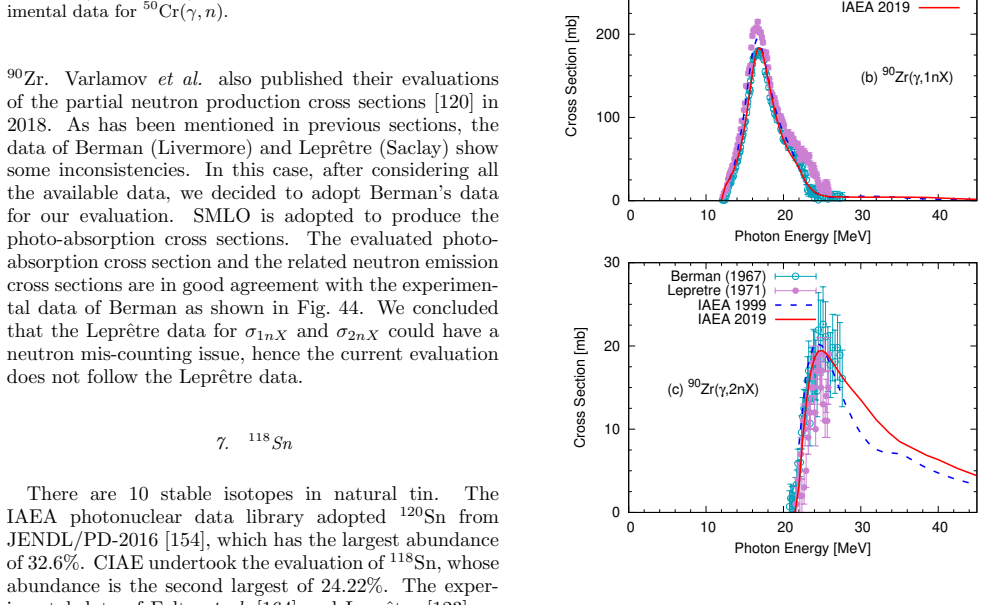
As has been mentioned in previous sections, the data of Berman (Livermore) and Leprˆ etre (Saclay) show some inconsistencies. In this case, after considering all the available data, we decided to adopt Berman’s data for our evaluation. SMLO is adopted to produce the photo-abso...
Reviewed August 14, 2026 · model on record in the stance chip above.
Discussion (0). Continue with ORCID to comment.