REVIEW 3 major objections 5 minor 66 references
Electrothermal Transistor Effect and Cyclic Electronic Currents in Multithermal Charge Transfer Networks
T0 review · 3 major / 5 minor · reviewed 2026-08-14 · deepseek-v4-flash
Pith's one-line read Temperature differences alone can drive cyclic electron currents and amplify heat flow in donor–acceptor networks.
desk verdict A clean network generalization of bithermal Marcus theory that predicts steady-state cyclic currents and an electrothermal transistor effect; worth a serious referee, but fix the steady-state slip and provide the derivations. read the letter →
The pith
A machine-rendered reading of the paper's core claim, the machinery that carries it, and where it could break.
The reading
What carries the argument
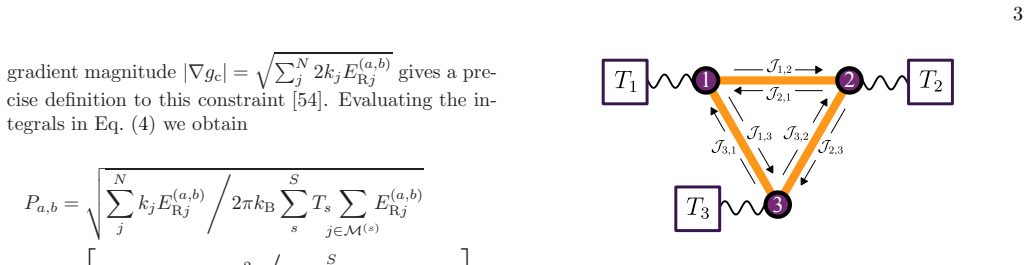
The load-bearing object is a multithermal Marcus rate: the usual Marcus electron-transfer rate generalized so that each site's vibrational modes are equilibrated with an independent bath at that site's own temperature $T_s$, giving a rate (Eq. 5) whose exponent involves a temperature-weighted sum of reorganization energies. Each hop also carries a well-defined heat exchange with each bath, $\langle Q_s^{(a,b)}\rangle$ (Eq. 11), which contains a term proportional to $T_q - T_s$ that transfers heat between baths. Combining these into the network master equation (Eq. 6) and the site heat currents (Eq. 12) yields the steady-state occupation probabilities, the cyclic bond currents, and the transistor amplification factor $\alpha_s$. The adjacency matrix of the network enters through which sites can exchange electrons, so the same machinery applies to ring, linear, and complete topologies.
What would settle it
Measure the heat current $\dot{Q}_1$ and the cyclic electronic current $J_c$ in a three-site molecular ring with independent local temperatures $T_1=T_2$, sweeping $T_3$. The theory predicts that $J_c$ changes sign at some $T_3$ and that $\alpha_1=\partial \dot{Q}_1/\partial \dot{Q}_3$ exceeds one near the point where $\partial \dot{Q}_3/\partial T_3$ passes through zero. If instead $\dot{Q}_1$ follows a smooth monotone curve, $J_c$ never changes sign, and $|\alpha_1|\le 1$ throughout, the electrothermal mechanism is not the dominant transport channel.
Extended reading notes
Core claim
The central claim is that Marcus-type electron hopping between donor and acceptor sites at different local temperatures produces coupled heat and charge currents whose behavior is qualitatively new. In a three-site ring with sites 1 and 2 at the same temperature, varying the temperature $T_3$ of the third site reverses the sign and changes the magnitude of the steady-state cyclic electronic current $J_c$, and it makes the heat-current amplification factor $\alpha_s = \partial \dot{Q}_s/\partial \dot{Q}_3$ exceed one near the point where $\partial \dot{Q}_3/\partial T_3$ vanishes. The paper also shows that heat currents between baths can remain nonzero even when the net electronic currents vanish, a transport channel that is not a standard thermoelectric effect. These effects disappear in the uniform-temperature limit, where detailed balance and all fluxes are restored.
Load-bearing premise
The prediction depends on the assumption that all heat transport between sites is carried by the hopping electrons themselves, while direct vibrational (phononic) heat conduction between sites is ignored; if phononic conduction is comparable to or larger than the electrothermal contribution, the predicted cyclic currents and amplification would be masked.
Editorial extensions
If this is right
- In any loop of three or more unequally heated sites with different site energies, a steady circulating electronic current flows; its direction can be flipped by changing one site's temperature.
- A thermal transistor effect appears: for a three-site ring, $|\alpha_s|>1$ can be achieved by tuning $T_3$, so heat current between two sites responds more strongly than the heat current pumped into the control site.
- Steady-state heat flow between baths does not require a net electron flux; the system can pump heat while charge currents cancel.
- The master-equation formulation works for arbitrary network topologies, so the same theory can be used to search for optimal temperature patterns that maximize or suppress multithermal currents.
Reading between the lines
- If confirmed, the temperature-controlled cyclic current offers a way to build a current circulator or switch that operates with no voltage bias, using only a local temperature gradient.
- Because the mechanism routes heat through electron hops, materials with weak phononic heat conduction, or isotopically engineered lattices that suppress phonons, should show the transistor effect most clearly; strong phonon conduction would mask it.
- The same multithermal Marcus rate could be applied to natural or artificial light-harvesting assemblies where local photoinduced heating creates temperature differences, predicting cyclic charge motion that steady-state thermoelectric theory would miss.
Editorial analysis
A structured set of objections, weighed in public.
Referee Report
Summary. The manuscript develops a Marcus-type hopping theory for electron transfer in networks of donor-acceptor sites, each in contact with an independent heat bath at a local temperature T_s. The authors derive a multithermal transition-state rate expression (Eq. 5) and a per-transition heat exchange with each site bath (Eqs. 10–11), and combine these with a master equation (Eq. 6) to compute steady-state electronic and heat currents. For a three-site ring, they show that the temperature T_3 controls the cyclic electronic current J_c and the electrothermal amplification factor α_s, with |α_s|>1 achievable. The central claim is that temperature gradients produce transport phenomena—cyclic currents and a thermal transistor effect—absent in thermally homogeneous systems and not describable by standard thermoelectric relations.
Significance. If the results hold, this provides a general framework for coupled charge and heat transport in molecular hopping networks, extending the authors' earlier two-site bithermal Marcus theory to arbitrary network topologies. The derivation is analytic and does not rely on fitting; the uniform-temperature limit correctly recovers the Marcus rate, and the two-site limit passes an entropy-production check in the stress-test re-derivation. The paper makes falsifiable predictions about the T_3-dependence of J_c and α_s. The main stated limitation—neglect of phononic heat conduction—is explicitly acknowledged and delimits applicability rather than invalidating the internal consistency of the model. The clean analytic structure and clear graphical predictions are notable strengths.
major comments (3)
- [After Eq. (6)] The sentence 'At steady-state dPa/dt = 0 ∀ a, which implies that the net electronic flux between sites vanishes' is incorrect: stationarity of the site occupations only implies that the net flux into each site is zero, not that the net current on each bond is zero. On a ring, a divergence-free cyclic current satisfies dPa/dt=0. Since the paper's central result (the R3 section, Fig. 3) is precisely a nonzero steady-state bond current Jc, this statement contradicts the later analysis and must be corrected, e.g., to 'the net flux into each site vanishes' or 'the occupation probabilities are stationary.'
- [Eqs. (5), (10)–(11), and Ref. 48] The central rate and heat expressions are presented as results of integrals in Eqs. (4) and (8), but the derivations are relegated to a Supplemental Material that is not available in the manuscript (Ref. 48). Since all subsequent predictions—network currents (Eq. 6), heat currents (Eq. 12), and the transistor effect—rest on these expressions, the derivation should be provided in the main text or in an attached supplement. I verified by direct re-derivation that Eq. (5) follows from Eq. (4) under the stated Gaussian integrals and that Eq. (10) sums to the energy balance E_ab; however, the submitted manuscript itself is incomplete as a stand-alone paper.
- [Thermal transistor section, definition of α_s] The amplification factor is defined as α_s = ∂Q_s/∂Q_3 with s ∈ {1,2}, but Q_3 is a derived quantity that depends on T_3 and all other parameters. The partial derivative is ambiguous unless the independent variables are specified. The prudent definition is α_s = (∂Q_s/∂T_3)/(∂Q_3/∂T_3) with T_1, T_2, and site parameters held fixed; this is presumably what is plotted in Fig. 4(a), but the text should state it explicitly. This point matters because the transistor claim rests on the magnitude of α_s.
minor comments (5)
- [Introduction, paragraph after Ref. 19] There is a typo in 'electron hopping was shown to to be accompanied by heat transfer'; 'to' appears twice.
- [Abstract and Limitations paragraph] The abstract states the phenomena are 'absent in thermally homogeneous systems' without noting the scope condition stated at the end of the paper, namely that the theory applies when electronic heat transport dominates phononic heat conduction. Please add this qualifier in the abstract or opening paragraph.
- [Page 1, 'Cite as' line] The 'Cite as: G. T. Craven and A. Nitzan, Phys. Rev. Lett. 118, 207201 (2017)' line appears to reference a different paper and may be a leftover from a previous submission; it should be removed or corrected.
- [Eqs. (10)–(11)] The notation T_j = T_s if j ∈ M(s) is introduced in Eq. (10), but Eq. (11) uses T_q without defining q as a site index; please define all symbols in one place and ensure consistent use of subscripts.
- [End of page 3] The phrase 'even as the occupation probabilities approach electronic quasi-equilibrium where the net electronic currents are zero, the net flow of heat does not vanish' would benefit from a brief explanation of why this is not a standard thermoelectric effect, given that the heat current is expressed through the same Marcus rates.
Circularity Check
No significant circularity: the network predictions follow from explicitly derived multithermal Marcus rates and heat-transfer expressions, not from fitted inputs or load-bearing self-citation.
full rationale
The paper's derivation is self-contained. The central quantities—cyclic electronic flux Jc and the transistor amplification factor α_s—are computed from the multithermal transition rate and per-transition heat exchange, both derived in the manuscript. The rate follows from transition-state theory: Eq. (4) defines the multithermal TS probability, and the text states 'Evaluating the integrals in Eq. (4) we obtain Eq. (5)', i.e., the Gaussian rate expression is obtained by direct integration, not assumed. Similarly, the heat per transition is derived from the energy surfaces via Eq. (8), yielding Eq. (10), and the heat current is then constructed from these ingredients in Eq. (12). No parameter is fitted to reproduce the predicted cyclic currents or transistor effect; the figures are numerical evaluations of the derived formulas with stated reduced units. The paper does cite the authors' earlier bithermal work (Refs. 19 and 55) and adopts its formalism, but the needed expressions are re-derived here in a generalized network form, so the central claim does not reduce to an unverified self-citation. The acknowledged disregard of phononic heat conduction is a stated scope limitation, not a circular step. The sentence after Eq. (6) claiming that steady state implies vanishing net electronic flux is internally inconsistent with the later cyclic-current analysis, but it is a wording slip rather than a circular dependence of the predictions on their inputs.
Assumptions & free parameters
free parameters (4)
- Site energies E(0)_a for illustration =
E1 = -4, E2 = 0, E3 varied (reduced units)
- Local temperatures T_s for illustration =
T1 = 3/2 or 3/4, T2 = 3/2, T3 varied
- Reorganization energies ERj =
ERj = 1/2 for modes involved in each transition (reduced units)
- Electronic coupling Hab =
0.01 eV in nonadiabatic limit
assumptions (5)
- domain assumption Each site s is in contact with an independent thermal bath at a local temperature Ts
- domain assumption Vibrational heat transfer between sites is disregarded
- domain assumption Electron transfer is dominated by Marcus-type hopping in the strong electron-phonon coupling limit
- domain assumption Harmonic modes with reorganization energies E_Rj and energy surfaces of the form Eq. (1)
- standard math Transition state hypersurface defined by energy conservation Ea = Eb, with Boltzmann distributions at local temperatures on each side
Cite this review
Pith. "Pith review of Electrothermal Transistor Effect and Cyclic Electronic Currents in Multithermal Charge Transfer Networks." pith.science (2026). https://pith.science/paper/SLGMQNDD
@misc{pith2026190800499,
  author       = {Pith},
  title        = {Pith review of: Electrothermal Transistor Effect and Cyclic Electronic Currents in Multithermal Charge Transfer Networks},
  year         = {2026},
  howpublished = {\url{https://pith.science/paper/SLGMQNDD}},
  note         = {Machine review of arXiv:1908.00499}
}
read the original abstract
A theory is developed to describe the coupled transport of energy and charge in networks of electron donor-acceptor sites which are seated in a thermally heterogeneous environment, where the transfer kinetics are dominated by Marcus-type hopping rates. It is found that the coupling of heat and charge transfer in such systems gives rise to exotic transport phenomena which are absent in thermally homogeneous systems and cannot be described by standard thermoelectric relations. Specifically, the directionality and extent of thermal transistor amplification and cyclical electronic currents in a given network can be controlled by tuning the underlying temperature gradient in the system. The application of these findings toward optimal control of multithermal currents is illustrated on a paradigmatic nanostructure.
Figures


Reference graph
Works this paper leans on
-
[1]
can represent more general situations where the modes localized about site s respond to the electronic occupation on a different site. A transition be- tween states a and b is associated with a reorganization energy (assumed temperature independent) in the jth mode, E(a,b) Rj , and a total reorganization energy, E(a,b) R , which are given by: E(a,b) Rj = 1...
-
[2]
We emphasize this simple system because of its experimental realizability and its general applications in molecular electronics and devices [33, 57, 58], but note that other more complex networks can also be analyzed using the developed theory [59]. In a multithermal R3 network, the direction and magnitude of the cyclic flux Jc = J1,2 −J 2,1 = J2,3 −J 3,2 ...
-
[3]
and (5) recovers the Marcus rate [13–16]. With the multidimensional-multithermal transition rate ka,b now derived, the kinetic equations for the oc- cupation probability P of each state can be constructed. For a reaction network (see Fig. 1) with adjacency matrix A these equations take the form dPa dt = ∑ b Abakb,aPb(t) − Aabka,bPa(t), (6) for each state ...
-
[4]
In the uniform temperature limit, combining Eqs
we obtain Pa,b = /radicaltp /radicalvertex /radicalvertex √ N∑ j kjE(a,b) Rj / 2πk B S∑ s Ts ∑ j∈M(s) E(a,b) Rj × exp − ( Eba + E(a,b) R ) 2 / 4kB S∑ s Ts ∑ j∈M(s) E(a,b) Rj , (5) which expresses the probability density on the reac- tion path in terms of the temperature of each bath, and the reorganization energy and reaction free energy Eba = −Eab...
-
[5]
Y. Wang, J. Zhou, and R. Yang, J. Phys. Chem. C 115, 24418 (2011), doi:10.1021/jp208490q
-
[6]
Galperin, M
M. Galperin, M. A. Ratner, and A. Nitzan, J. Phys.: Condens. Matter 19, 103201 (2007)
2007
-
[7]
Y. Dubi and M. Di Ventra, Rev. Mod. Phys. 83, 131 (2011), doi:10.1103/RevModPhys.83.131
-
[8]
Walczak, Physica B 392, 173 (2007), ISSN 0921-4526, doi:10.1016/j.physb.2006.11.013
K. Walczak, Physica B 392, 173 (2007), ISSN 0921-4526, doi:10.1016/j.physb.2006.11.013
Show all 66 references
-
[9]
Galperin, A
M. Galperin, A. Nitzan, and M. A. Ratner, Mol. Phys. 106, 397 (2008), doi:10.1080/00268970701837784
2008 doi
-
[10]
C. A. Perroni, D. Ninno, and V. Cataudella, New J. Phys. 17, 083050 (2015), http://iopscience.iop.org/article/10.1088/1367- 2630/17/8/083050
2015 doi
-
[11]
Ren, J.-X
J. Ren, J.-X. Zhu, J. E. Gubernatis, C. Wang, and B. Li, Phys. Rev. B 85, 155443 (2012), doi:10.1103/PhysRevB.85.155443
2012 doi
-
[12]
M. B. Tagani and H. R. Soleimani, J. Appl. Phys. 112, 103719 (2012), doi:10.1063/1.4767376
2012 doi
-
[13]
M. B. Tagani and H. R. Soleimani, Physica B 413, 86 (2013), doi:10.1016/j.physb.2013.01.007
2013 doi
-
[14]
C. A. Perroni, D. Ninno, and V. Cataudella, Phys. Rev. B 90, 125421 (2014), doi:10.1103/PhysRevB.90.125421
2014 doi
-
[15]
Nitzan, Chemical Dynamics in Condensed Phases: Relaxation, Transfer, and Reactions in Condensed Molec- ular Systems (Oxford University Press, 2006)
A. Nitzan, Chemical Dynamics in Condensed Phases: Relaxation, Transfer, and Reactions in Condensed Molec- ular Systems (Oxford University Press, 2006)
2006
-
[16]
T. Koch, J. Loos, and H. Fehske, Phys. Rev. B 89, 155133 (2014), doi:10.1103/PhysRevB.89.155133
2014 doi
-
[17]
N. A. Zimbovskaya, J. Phys.: Condens. Mat- ter 28, 183002 (2016), http://stacks.iop.org/0953- 8984/28/i=18/a=183002
2016
-
[18]
R. A. Marcus, J. Chem. Phys. 24, 966 (1956), doi:10.1063/1.1742723
1956 doi
-
[19]
R. A. Marcus, Annu. Rev. Phys. Chem. 15, 155 (1964), doi:10.1146/annurev.pc.15.100164.001103
1964
-
[20]
C. W. Chang, D. Okawa, A. Majumdar, and A. Zettl, Science 314, 1121 (2006), doi:10.1126/science.1132898
2006 doi
- [21]
-
[22]
Zhang, A
J. Zhang, A. M. Kuznetsov, I. G. Medvedev, Q. Chi, T. Albrecht, P. S. Jensen, and J. Ulstrup, Chem. Rev. 108, 2737 (2008), doi:10.1021/cr068073+
2008 doi
-
[23]
Migliore and A
A. Migliore and A. Nitzan, J. Am. Chem. Soc. 135, 9420 (2013), doi:10.1021/ja401336u
2013 doi
-
[24]
G. T. Craven and A. Nitzan, Proc. Natl. Acad. Sci. 113, 9421 (2016), doi:10.1073/pnas.1609141113
2016 doi
-
[25]
Y. Kim, W. Jeong, K. Kim, W. Lee, and P. Reddy, Nature Nanotech. 9, 881 (2014), doi:10.1038/nnano.2014.209
2014 doi
-
[26]
Sadat, A
S. Sadat, A. Tan, Y. J. Chua, and P. Reddy, Nano Lett. 10, 2613 (2010), doi:10.1021/nl101354e
2010 doi
-
[27]
J. A. Malen, S. K. Yee, A. Majumdar, and R. A. Segalman, Chem. Phys. Lett. 491, 109 (2010), doi:10.1016/j.cplett.2010.03.028
2010 doi
-
[28]
A. Tan, J. Balachandran, S. Sadat, V. Gavini, B. D. Dunietz, S.-Y. Jang, and P. Reddy, J. Am. Chem. Soc. 133, 8838 (2011), doi:10.1021/ja202178k
2011 doi
-
[29]
W. Lee, K. Kim, W. Jeong, L. A. Zotti, F. Pauly, J. C. Cuevas, and P. Reddy, Nature 498, 209 (2013), doi:10.1038/nature12183
2013 doi
-
[30]
Einax and A
M. Einax and A. Nitzan, J. Chem. Phys. 145, 014108 (2016), doi:10.1063/1.4955160
2016 doi
-
[31]
A. V. Popov and R. Hernandez, J. Chem. Phys. 126, 244506 (2007), doi:10.1063/1.2743032
2007 doi
- [32]
-
[33]
G. T. Craven and R. Hernandez, Phys. Rev. Lett. 115, 148301 (2015), doi:10.1103/PhysRevLett.115.148301
2015 doi
-
[34]
Q. Li, I. Duchemin, S. Xiong, G. C. Solomon, and D. Donadio, J. Phys. Chem. C 119, 24636 (2015), doi:10.1021/acs.jpcc.5b07429
2015 doi
-
[35]
has significantly increased our understanding of the flow of charge, energy, and information in diverse types of systems [36–45] and the present study makes it possi- ble to consider electron and heat transport within such a framework and to study the consequence of their inter-...
-
[36]
B. Li, L. Wang, and G. Casati, Appl. Phys. Lett. 88, 143501 (2006), doi:10.1063/1.2191730
2006 doi
-
[37]
Ben-Abdallah and S.-A
P. Ben-Abdallah and S.-A. Biehs, Phys. Rev. Lett. 112, 044301 (2014), doi:10.1103/PhysRevLett.112.044301
2014 doi
-
[38]
Joulain, J
K. Joulain, J. Drevillon, Y. Ezzahri, and J. Ordonez- Miranda, Phys. Rev. Lett. 116, 200601 (2016), doi:10.1103/PhysRevLett.116.200601
2016 doi
-
[39]
D. V. Matyushov, Proc. Natl. Acad. Sci. 113, 9401 (2016), doi:10.1073/pnas.1610542113
2016 doi
-
[40]
Schnakenberg, Rev
J. Schnakenberg, Rev. Mod. Phys. 48, 571 (1976), doi:10.1103/RevModPhys.48.571. 6
1976 doi
-
[41]
S. H. Strogatz, Nature 410, 268 (2001), doi:10.1038/35065725
2001 doi
-
[42]
Albert and A.-L
R. Albert and A.-L. Barab´ asi, Rev. Mod. Phys. 74, 47 (2002), doi:10.1103/RevModPhys.74.47
2002 doi
-
[43]
Estrada and N
E. Estrada and N. Hatano, Chem. Phys. Lett. 439, 247 (2007), doi:10.1016/j.cplett.2007.03.098
2007 doi
-
[44]
J. Gao, S. V. Buldyrev, S. Havlin, and H. E. Stanley, Phys. Rev. Lett. 107, 195701 (2011), doi:10.1103/PhysRevLett.107.195701
2011 doi
-
[45]
G. C. Solomon, C. Herrmann, T. Hansen, V. Mu- jica, and M. A. Ratner, Nature Chem. 2, 223 (2010), doi:10/1038/nchem.546
2010
-
[46]
D. Rai, O. Hod, and A. Nitzan, J. Phys. Chem. Lett. 2, 2118 (2011), doi:10.1021/jz200862r
2011 doi
-
[47]
D. Rai, O. Hod, and A. Nitzan, Phys. Rev. B 85, 155440 (2012), doi:10.1103/PhysRevB.85.155440
2012 doi
-
[48]
B. M. Savoie, K. L. Kohlstedt, N. E. Jackson, L. X. Chen, M. Olvera de la Cruz, G. C. Schatz, T. J. Marks, and M. A. Ratner, Proc. Natl. Acad. Sci. 111, 10055 (2014), doi:10.1073/pnas.1409514111
2014 doi
-
[49]
Einax and A
M. Einax and A. Nitzan, J. Phys. Chem. C 118, 27226 (2014), doi:10.1021/jp5084373
2014 doi
-
[50]
Hansen and G
T. Hansen and G. C. Solomon, J. Phys. Chem. C 120, 6295 (2016), doi:10.1021/acs.jpcc.5b11211
2016 doi
-
[51]
Hammes-Schiffer and J
S. Hammes-Schiffer and J. C. Tully, J. Chem. Phys. 103, 8528 (1995), doi:10.1063/1.470162
1995 doi
-
[52]
G. H. J´ ohannesson and H. J´ onsson, J. Chem. Phys.115, 9644 (2001), doi:10.1063/1.1415499
2001 doi
-
[53]
See the Supplemental Material for detailed derivations of each component in the rate and heat transfer expressions
-
[54]
For experimental setups in which sites of appreciably dif- ferent temperatures are relatively far from each other, implying relatively weak electronic coupling, the nonadi- abatic limit will be the most pertinent
-
[55]
D. L. Thompson, Modern Methods for Multidimensional Dynamics Computations in Chemistry (World Scientific, 1998)
1998
-
[56]
A. O. Lykhin, D. S. Kaliakin, G. E. dePolo, A. A. Kuzubov, and S. A. Varganov, Int. J. Quantum Chem. 116, 750 (2016), doi:10.1002/qua.25124
2016 doi
-
[57]
A. J. Marks and D. L. Thompson, J. Chem. Phys. 96, 1911 (1992), doi:10.1063/1.462092
1992 doi
-
[58]
In the nonadiabatic limit a coupling constant between diabatic surfaces: Ha,b = 0 .01 eV has been used in all calculations
-
[59]
Hartmann, J
C. Hartmann, J. C. Latorre, and G. Ciccotti, Eur. Phys. J. Spec. Top. 200, 73 (2011), doi:10.1140/epjst/e2011- 01519-7
2011 doi
-
[60]
G. T. Craven and A. Nitzan, J. Chem. Phys. 146, 092305 (2017), doi:10.1063/1.4971293
2017 doi
-
[61]
Using these units, a reduced temperature of kBT /ǫ ≈ 1.3 corresponds to T = 300 K
Characteristic units are: ǫ = 0 .02 eV for energy, τ = 0.5 ps for time, and σ = 1 nm for length. Using these units, a reduced temperature of kBT /ǫ ≈ 1.3 corresponds to T = 300 K
-
[62]
N. Li, J. Ren, L. Wang, G. Zhang, P. H¨ anggi, and B. Li, Rev. Mod. Phys. 84, 1045 (2012), doi:10.1103/RevModPhys.84.1045
2012 doi
-
[63]
A. E. Allahverdyan, S. G. Babajanyan, N. H. Mar- tirosyan, and A. V. Melkikh, Phys. Rev. Lett. 117, 030601 (2016), doi:10.1103/PhysRevLett.117.030601
2016 doi
-
[64]
Analysis of electric and heat currents for other multither- mal networks is given in the Supplemental Material
-
[65]
C. Jia, A. Migliore, N. Xin, S. Huang, J. Wang, Q. Yang, S. Wang, H. Chen, D. Wang, B. Feng, et al., Science 352, 1443 (2016), doi:10.1126/science.aaf6298
2016 doi
-
[66]
A. G. Gagorik, B. Savoie, N. Jackson, A. Agrawal, A. Choudhary, M. A. Ratner, G. C. Schatz, and K. L. Kohlstedt, J. Phys. Chem. Lett. 8, 415 (2017), doi:10.1021/acs.jpclett.6b02921
2017 doi
Reviewed August 14, 2026 · model on record in the stance chip above.
Discussion (0). Continue with ORCID to comment.