REVIEW 1 major objections 5 minor 80 references
Electron transfer at thermally heterogeneous molecule-metal interfaces
T0 review · 1 major / 5 minor · reviewed 2026-08-14 · deepseek-v4-flash
Pith's one-line read A bithermal Marcus formalism for molecule-metal electron transfer predicts that interfacial heat conduction has an electronic component that survives at zero net electronic current.
desk verdict Extends the authors' bithermal Marcus formalism to molecule-metal interfaces with a clean derivation of thermoelectric and heat-current effects; main caveat is the strong-coupling assumption and the model's idealized junction. read the letter →
The pith
A machine-rendered reading of the paper's core claim, the machinery that carries it, and where it could break.
The reading
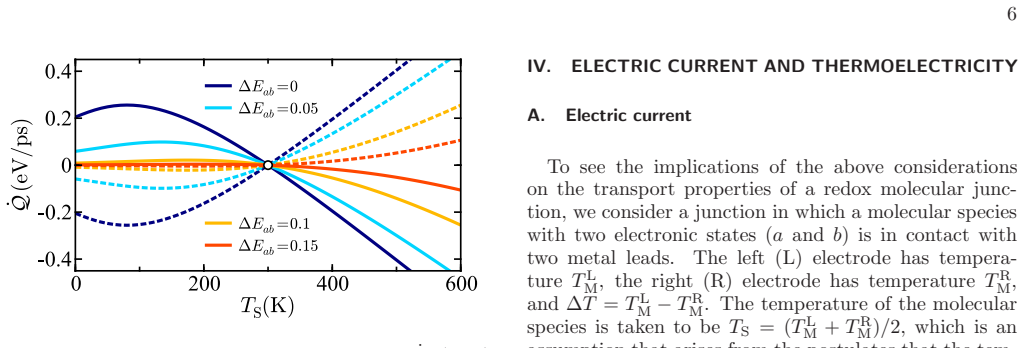
The derived rates depend on each temperature separately, not just on the difference between them. When the temperatures differ, every electron hop also moves a small amount of heat: the heat carried by the hop equals the energy difference between the molecular level and the metal's chemical potential. A central result is that heat can flow even when the net electric current is zero, because the forward and backward electron hops balance in number while carrying unequal amounts of heat. The paper also computes the voltage needed to stop the thermally driven current and the Seebeck coefficient for a model two-electrode junction.
The theory relies on the assumption that the molecular nuclear environment stays thermally equilibrated at its own temperature during the electron transfer, which holds when nuclear motion is fast compared to hopping. The authors note that the opposite limit requires a separate nonequilibrium treatment. If the assumptions hold, the framework offers a practical model for thermoelectric effects in the hopping conduction regime of molecular electronics.
Extended reading notes
Core claim
Electron transfer between a molecular species and a metal electrode, each at a different local temperature, is associated with interfacial heat transfer, and the electron exchange contributes to interfacial heat conduction even when the net electronic current vanishes. This is stated in the abstract and derived in Sections II and III, with the heat current given by Eq. (21) and the steady-state flux relations in Eq. (A14).
Load-bearing premise
The molecular nuclear environment remains in internal thermal equilibrium at temperature TS while exchanging electrons with a metal at a different temperature TM. This nonadiabatic, strong-coupling limit is stated in Sec. II: 'relaxation of the nuclear environment to a transient distorted state induced by electron localization occurs on a faster timescale than the electronic transition rate.' It is this assumption that justifies the Boltzmann factor exp[-betaS E_m^double-dagger(x)] in Eqs. (8) and (9) and the heat current expressions in Eqs. (18)-(21). If nuclear relaxation is not fast, the bithermal rate expressions are not valid; the authors flag this weak-coupling case as future work in Sec. V.
Signed reviews
Editorial analysis
A structured set of objections, weighed in public.
Referee Report
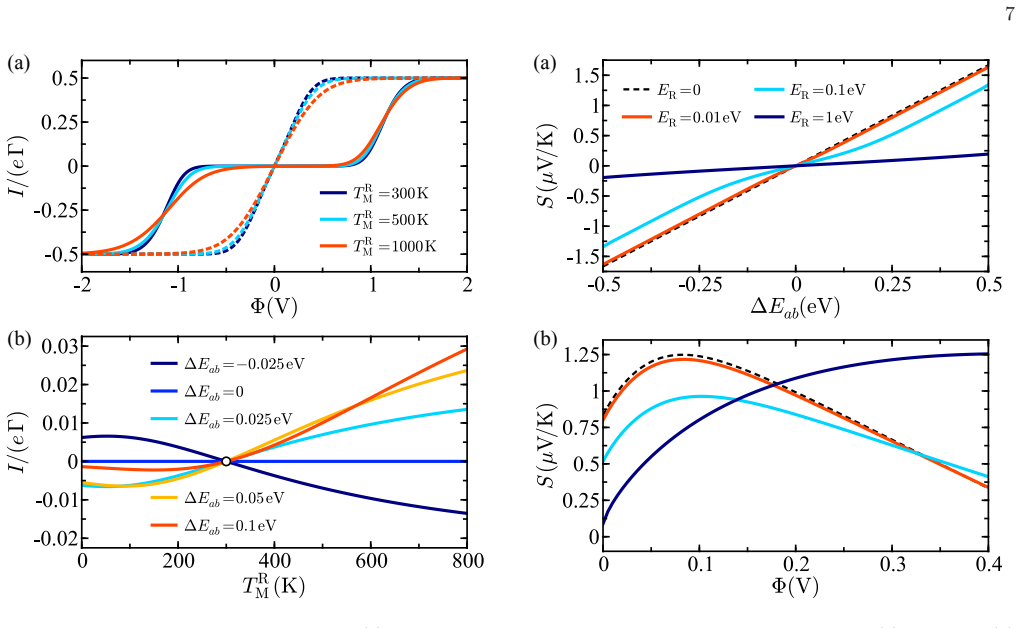
Summary. The manuscript presents a theoretical analysis of electron transfer between a redox molecule and a metal electrode when the metal and the molecular nuclear environment are held at different temperatures. The authors derive bithermal Marcus rate expressions for molecule-to-metal and metal-to-molecule transfer (Eqs. (8) and (9)), which reduce to the standard Marcus-Hush-Chidsey rates in the unithermal limit. They then derive the interfacial heat current carried by electron exchange (Eq. (21)) and show that it remains finite even when the net electronic current vanishes at steady state. The theory is extended to a two-electrode molecular junction with a linear temperature profile, yielding expressions for the electric current and Seebeck coefficient (Eqs. (24)-(27)). The paper's main physical claim is that electron exchange across a molecule-metal interface contributes to interfacial heat conduction and thermoelectric response in the hopping-transport regime.
Significance. The paper is a significant extension of the authors' earlier bithermal electron-transfer formalism to metal electrodes, providing a concrete, self-contained framework for modelling redox molecular junctions under thermal gradients. Its unithermal limit correctly recovers well-established rate theory, and the heat-current expressions are validated by energy-conservation checks. The predicted heat transport in the absence of net charge current at a single interface is a falsifiable and physically interesting effect. The two-electrode analysis gives a well-defined Seebeck coefficient that reduces to the known elastic-transport result in the appropriate limit, and the paper identifies signatures, such as the TM-induced rate turnover in Fig. 1(c), that could be tested experimentally.
major comments (1)
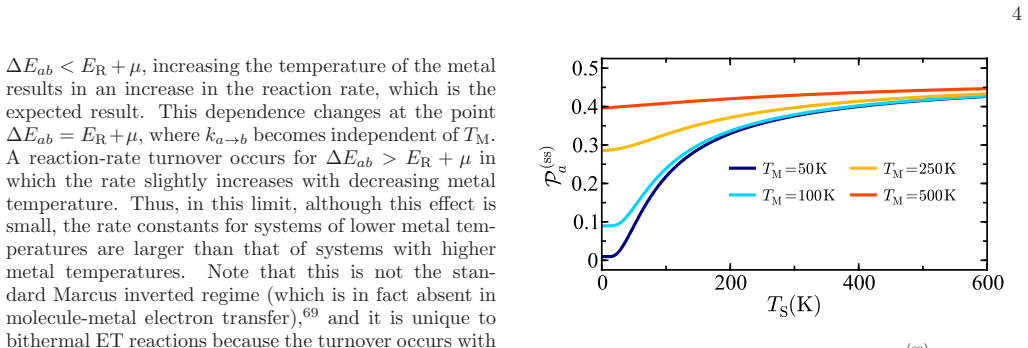
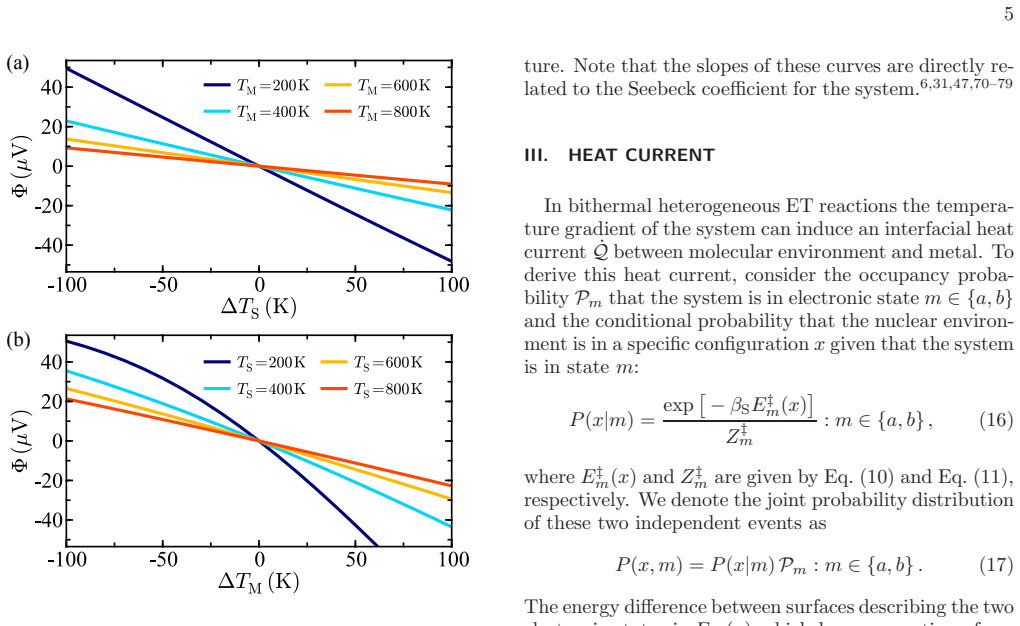
- [§II.B (Fig. 3)] The zero-current condition used to compute the electrode potential Φ is not specified. In the two-state kinetic equations (13), the steady-state populations (15) always satisfy ka→b P_a^ss = kb→a P_b^ss, so the net electronic current between the molecule and a single metal electrode vanishes for any value of Φ. The curves in Fig. 3 are therefore not determined by the condition I = 0 unless an additional constraint is imposed (for example, fixed P_a/P_b, as in an electrochemical standard-state convention, or a specific reference-electrode configuration). Please state the definition of I and the protocol used to calculate Φ explicitly.
minor comments (5)
- [Header] The manuscript contains typographical artifacts in the header, such as "me-tal" and "Phil adelphia"; these are likely PDF-extraction artifacts and should be cleaned up.
- [Appendix A] The constant T is used in Eqs. (A1)-(A4) but is not defined before Eq. (A1); please define it explicitly when it is first introduced.
- [Appendix A] The notation ∆Eba is used in Eqs. (A2), (A3), (A8), and (A9) without being defined; since ∆Eba = -∆Eab, please define it or use consistent notation.
- [Below Eq. (21)] The text says that the conservation relation Qdot_M + Qdot_S = 0 is "shown explicitly in Appendix A", but Appendix A reports only numerical verification over a variety of parameter values (Eqs. (A6) and (A12)). Please adjust the wording to match the numerical check.
- [Sec. IV] The assumption TS = (T_L + T_R)/2 is introduced from a linear temperature profile without discussion of its validity; a brief comment on the limitations of this assumption would improve the presentation.
Assumptions & free parameters
free parameters (4)
- Reorganization energy ER =
0.1 eV (figures)
- Molecule-metal coupling Gamma =
100 ps^-1 (figures)
- Reaction free energy Delta Eab =
Varied per figure (e.g., 0.01 eV to -0.5 eV)
- Molecular temperature assignment TS =
TS = (T_L + T_R)/2
assumptions (6)
- domain assumption Marcus theory with two shifted parabolic free energy surfaces (Eqs. 4-5) describes heterogeneous electron transfer.
- domain assumption The molecular nuclear environment remains in internal thermal equilibrium at temperature TS throughout the ET process (Boltzmann weight in Eqs. 8-9).
- domain assumption The metal remains in equilibrium at temperature TM with a Fermi-Dirac occupation f(betaM, epsilon).
- standard math Energy conservation during ET is enforced by the delta-function constraint gc(x, epsilon) = 0 (Eq. 7).
- ad hoc to paper In the junction model, the temperature gradient is linear and the molecular site lies midway, TS = (T_L + T_R)/2.
- domain assumption Landau-Zener relation PLZ(epsilon) rho_M(epsilon) = T Gamma(epsilon) in the nonadiabatic limit.
Cite this review
Pith. "Pith review of Electron transfer at thermally heterogeneous molecule-metal interfaces." pith.science (2026). https://pith.science/paper/H2QHLFV3
@misc{pith2026190800501,
  author       = {Pith},
  title        = {Pith review of: Electron transfer at thermally heterogeneous molecule-metal interfaces},
  year         = {2026},
  howpublished = {\url{https://pith.science/paper/H2QHLFV3}},
  note         = {Machine review of arXiv:1908.00501}
}
read the original abstract
The rate of electron transfer between a molecular species and a metal, each at a different local temperature, is examined theoretically through implementation of a bithermal (characterized by two temperatures) Marcus formalism. Expressions for the rate constant and the electronic contribution to a heat transfer mechanism which is induced by the temperature gradient between molecule and metal are constructed. The system of coupled dynamical equations describing the electronic and thermal currents are derived and examined over diverse ranges of reaction geometries and temperature gradients. It is shown that electron transfer across the molecule-metal interface is associated with heat transfer and that the electron exchange between metal and molecule makes a distinct contribution to the interfacial heat conduction even when the net electronic current vanishes.
Figures

Figures from the paper (2 more)
Reference graph
Works this paper leans on
-
[1]
author A. Aviram and author M. A. Ratner , journal Chem. Phys. Lett. volume 29 , pages 277 ( year 1974 ), doi:10.1016/0009-2614(74)85031-1
-
[2]
author R. L. Carroll and author C. B. Gorman , journal Angew. Chem., Ind. Ed. volume 41 , pages 4378 ( year 2002 ), doi:10.1002/1521-3773(20021202)41:23<4378::AID-ANIE4378>3.0.CO;2-A
-
[3]
author A. Nitzan and author M. A. Ratner , journal Science volume 300 , pages 1384 ( year 2003 ), doi:10.1126/science.1081572
-
[4]
author V. Coropceanu , author J. Cornil , author D. A. da Silva Filho , author Y. Olivier , author R. Silbey , and author J.-L. Br \'e das , journal Chem. Rev. volume 107 , pages 926 ( year 2007 )
work page 2007
-
[5]
author M. Galperin , author M. A. Ratner , and author A. Nitzan , journal J. Phys.: Condens. Matter volume 19 , pages 103201 ( year 2007 a )
work page 2007
-
[6]
author Y. Dubi and author M. Di Ventra , journal Rev. Mod. Phys. volume 83 , pages 131 ( year 2011 ), doi:10.1103/RevModPhys.83.131
-
[7]
author M. Galperin , author A. Nitzan , and author M. A. Ratner , journal Phys. Rev. B volume 75 , pages 155312 ( year 2007 b ), doi:10.1103/PhysRevB.75.155312
-
[8]
author M. Galperin , author K. Saito , author A. V. Balatsky , and author A. Nitzan , journal Phys. Rev. B volume 80 , pages 115427 ( year 2009 ), doi:10.1103/PhysRevB.80.115427
Show all 80 references
-
[9]
Galperin and author A
author M. Galperin and author A. Nitzan , journal J. Phys. Chem. Lett. volume 2 , pages 2110 ( year 2011 a ), doi:10.1021/jz2008853
2011 doi
-
[10]
Galperin and author A
author M. Galperin and author A. Nitzan , journal Phys. Rev. B volume 84 , pages 195325 ( year 2011 b ), doi:10.1103/PhysRevB.84.195325
2011 doi
-
[11]
author A. P. Horsfield , author D. R. Bowler , author H. Ness , author C. G. S\'anchez , author T. N. Todorov , and author A. J. Fisher , journal Rep. Prog. Phys. volume 69 , pages 1195 ( year 2006 )
2006
-
[12]
D'Agosta and author M
author R. D'Agosta and author M. D. Ventra , journal J. Phys.: Condens. Matter volume 20 , pages 374102 ( year 2008 )
2008
-
[13]
Asai , journal Phys
author Y. Asai , journal Phys. Rev. B volume 84 , pages 085436 ( year 2011 ), doi:10.1103/PhysRevB.84.085436
2011 doi
-
[14]
Asai , journal Phys
author Y. Asai , journal Phys. Rev. B volume 91 , pages 161402 ( year 2015 ), doi:10.1103/PhysRevB.91.161402
2015 doi
-
[15]
Lake and author S
author R. Lake and author S. Datta , journal Phys. Rev. B volume 46 , pages 4757 ( year 1992 ), doi:10.1103/PhysRevB.46.4757
1992 doi
-
[16]
H\"artle and author M
author R. H\"artle and author M. Thoss , journal Phys. Rev. B volume 83 , pages 115414 ( year 2011 ), doi:10.1103/PhysRevB.83.115414
2011 doi
-
[17]
Lu , author H
author J.-T. Lu , author H. Zhou , author J.-W. Jiang , and author J.-S. Wang , journal AIP Adv. volume 5 , pages 053204 ( year 2015 ), doi:10.1063/1.4917017
2015 doi
-
[18]
author D. G. Cahill , author K. Goodson , and author A. Majumdar , journal J. Heat Transfer volume 124 , pages 223 ( year 2002 )
2002
-
[19]
author D. G. Cahill , author W. K. Ford , author K. E. Goodson , author G. D. Mahan , author A. Majumdar , author H. J. Maris , author R. Merlin , and author S. R. Phillpot , journal J. Appl. Phys. volume 93 , pages 793 ( year 2003 ), doi:10.1063/1.1524305
2003 doi
-
[20]
author D. M. Leitner , journal Annu. Rev. Phys. Chem. volume 59 , pages 233 ( year 2008 ), doi:10.1146/annurev.physchem.59.032607.093606
2008 arXiv
-
[21]
author D. M. Leitner , journal J. Phys. Chem. B volume 117 , pages 12820 ( year 2013 ), doi:10.1021/jp402012z
2013 doi
-
[22]
author D. M. Leitner , journal Adv. Phys. volume 64 , pages 445 ( year 2015 ), doi:10.1080/00018732.2015.1109817
2015
-
[23]
Li , author J
author N. Li , author J. Ren , author L. Wang , author G. Zhang , author P. H\"anggi , and author B. Li , journal Rev. Mod. Phys. volume 84 , pages 1045 ( year 2012 ), doi:10.1103/RevModPhys.84.1045
2012 doi
-
[24]
Dhar , journal Adv
author A. Dhar , journal Adv. Phys. volume 57 , pages 457 ( year 2008 ), doi:10.1080/00018730802538522
2008 doi
-
[25]
Luo and author G
author T. Luo and author G. Chen , journal Phys. Chem. Chem. Phys. volume 15 , pages 3389 ( year 2013 ), doi:10.1039/C2CP43771F
2013 doi
-
[26]
author N. I. Rubtsova , author L. N. Qasim , author A. A. Kurnosov , author A. L. Burin , and author I. V. Rubtsov , journal Acc. Chem. Res. volume 48 , pages 2547 ( year 2015 a ), doi:10.1021/acs.accounts.5b00299
2015 doi
-
[27]
author N. I. Rubtsova , author C. M. Nyby , author H. Zhang , author B. Zhang , author X. Zhou , author J. Jayawickramarajah , author A. L. Burin , and author I. V. Rubtsov , journal J. Chem. Phys. volume 142 , pages 212412 ( year 2015 b ), doi:10.1063/1.4916326
2015 doi
-
[28]
Chen , author M
author Y.-C. Chen , author M. Zwolak , and author M. Di Ventra , journal Nano Lett. volume 3 , pages 1691 ( year 2003 ), doi:10.1021/nl0348544
2003 doi
-
[29]
Pecchia , author G
author A. Pecchia , author G. Romano , and author A. Di Carlo , journal Phys. Rev. B volume 75 , pages 035401 ( year 2007 ), doi:10.1103/PhysRevB.75.035401
2007 doi
-
[30]
Yang , author X
author N. Yang , author X. Xu , author G. Zhang , and author B. Li , journal AIP Adv. volume 2 , pages 041410 ( year 2012 ), doi:10.1063/1.4773462
2012 doi
-
[31]
author N. A. Zimbovskaya , journal J. Phys.: Condens. Matter volume 28 , pages 183002 ( year 2016 ), http://stacks.iop.org/0953-8984/28/i=18/a=183002
2016
-
[32]
Li , author L
author B. Li , author L. Wang , and author G. Casati , journal Phys. Rev. Lett. volume 93 , pages 184301 ( year 2004 ), doi:10.1103/PhysRevLett.93.184301
2004 doi
-
[33]
Segal and author A
author D. Segal and author A. Nitzan , journal J. Chem. Phys. volume 122 , pages 194704 ( year 2005 ), doi:10.1063/1.1900063
2005 doi
-
[34]
author C. W. Chang , author D. Okawa , author A. Majumdar , and author A. Zettl , journal Science volume 314 , pages 1121 ( year 2006 ), doi:10.1126/science.1132898
2006 doi
-
[35]
Segal , journal Phys
author D. Segal , journal Phys. Rev. Lett. volume 100 , pages 105901 ( year 2008 ), doi:10.1103/PhysRevLett.100.105901
2008 doi
-
[36]
Wu and author D
author L.-A. Wu and author D. Segal , journal Phys. Rev. Lett. volume 102 , pages 095503 ( year 2009 ), doi:10.1103/PhysRevLett.102.095503
2009 doi
-
[37]
Zhong , author P
author W.-R. Zhong , author P. Yang , author B.-Q. Ai , author Z.-G. Shao , and author B. Hu , journal Phys. Rev. E volume 79 , pages 050103 ( year 2009 ), doi:10.1103/PhysRevE.79.050103
2009 doi
-
[38]
Ren and author J.-X
author J. Ren and author J.-X. Zhu , journal Phys. Rev. B volume 87 , pages 241412 ( year 2013 ), doi:10.1103/PhysRevB.87.241412
2013 doi
-
[39]
Ming , author H.-M
author Y. Ming , author H.-M. Li , and author Z.-J. Ding , journal Phys. Rev. E volume 93 , pages 032127 ( year 2016 ), doi:10.1103/PhysRevE.93.032127
2016 doi
-
[40]
Arrachea , author N
author L. Arrachea , author N. Bode , and author F. von Oppen , journal Phys. Rev. B volume 90 , pages 125450 ( year 2014 ), doi:10.1103/PhysRevB.90.125450
2014 doi
-
[41]
Li , author I
author Q. Li , author I. Duchemin , author S. Xiong , author G. C. Solomon , and author D. Donadio , journal J. Phys. Chem. C volume 119 , pages 24636 ( year 2015 ), doi:10.1021/acs.jpcc.5b07429
2015 doi
-
[42]
Delor , author P
author M. Delor , author P. A. Scattergood , author I. V. Sazanovich , author A. W. Parker , author G. M. Greetham , author A. J. H. M. Meijer , author M. Towrie , and author J. A. Weinstein , journal Science volume 346 , pages 1492 ( year 2014 ), doi:10.1126/science.1259995
2014 doi
-
[43]
Vl c ek Jr
author A. Vl c ek Jr. , author H. Kvapilov\' a , author M. Towrie , and author S. Z\' a li s , journal Acc. Chem. Res. volume 48 , pages 868 ( year 2015 ), doi:10.1021/ar5004048
2015 doi
-
[44]
author A. A. Bakulin , author R. Lovrincic , author X. Yu , author O. Selig , author H. J. Bakker , author Y. L. Rezus , author P. K. Nayak , author A. Fonari , author V. Coropceanu , author J.-L. Br \'e das , et al. , journal Nat. Commun. volume 6 , pages 7880 ( year 2015 ), ...
2015 doi
-
[45]
Ren , author J.-X
author J. Ren , author J.-X. Zhu , author J. E. Gubernatis , author C. Wang , and author B. Li , journal Phys. Rev. B volume 85 , pages 155443 ( year 2012 ), doi:10.1103/PhysRevB.85.155443
2012 doi
-
[46]
Walczak , journal Physica B volume 392 , pages 173 ( year 2007 ), ISSN issn 0921-4526 , doi:10.1016/j.physb.2006.11.013
author K. Walczak , journal Physica B volume 392 , pages 173 ( year 2007 ), ISSN issn 0921-4526 , doi:10.1016/j.physb.2006.11.013
2007 doi
-
[47]
Koch , author J
author T. Koch , author J. Loos , and author H. Fehske , journal Phys. Rev. B volume 89 , pages 155133 ( year 2014 ), doi:10.1103/PhysRevB.89.155133
2014 doi
-
[48]
author C. A. Perroni , author D. Ninno , and author V. Cataudella , journal Phys. Rev. B volume 90 , pages 125421 ( year 2014 ), doi:10.1103/PhysRevB.90.125421
2014 doi
-
[49]
author N. A. Zimbovskaya , journal J. Phys.: Condens. Matter volume 26 , pages 275303 ( year 2014 )
2014
-
[50]
Migliore and author A
author A. Migliore and author A. Nitzan , journal J. Am. Chem. Soc. volume 135 , pages 9420 ( year 2013 ), doi:10.1021/ja401336u
2013 doi
-
[51]
author R. A. Marcus , journal J. Chem. Phys. volume 24 , pages 966 ( year 1956 ), doi:10.1063/1.1742723
1956 doi
-
[52]
author R. A. Marcus , journal Annu. Rev. Phys. Chem. volume 15 , pages 155 ( year 1964 ), doi:10.1146/annurev.pc.15.100164.001103
1964
-
[53]
author R. A. Marcus and author N. Sutin , journal Biochim. Biophys. Acta volume 811 , pages 265 ( year 1985 ), doi:10.1016/0304-4173(85)90014-X
1985 doi
-
[54]
author R. A. Marcus , journal Rev. Mod. Phys. volume 65 , pages 599 ( year 1993 ), doi:10.1103/RevModPhys.65.599
1993 doi
-
[55]
Peters , journal J
author B. Peters , journal J. Phys. Chem. B volume 119 , pages 6349 ( year 2015 ), doi:10.1021/acs.jpcb.5b02547
2015 doi
-
[56]
author G. T. Craven and author A. Nitzan , journal Proc. Natl. Acad. Sci. volume 113 , pages 9421 ( year 2016 ), doi:10.1073/pnas.1609141113
2016 doi
-
[57]
author G. T. Craven and author A. Nitzan , journal Phys. Rev. Lett. volume 118 , pages 207201 ( year 2017 ), doi:10.1103/PhysRevLett.118.207201
2017 doi
-
[58]
Nitzan , title Chemical Dynamics in Condensed Phases: Relaxation, Transfer, and Reactions in Condensed Molecular Systems ( publisher Oxford University Press , year 2006 )
author A. Nitzan , title Chemical Dynamics in Condensed Phases: Relaxation, Transfer, and Reactions in Condensed Molecular Systems ( publisher Oxford University Press , year 2006 )
2006
-
[59]
author R. A. Marcus , journal J. Chem. Phys. volume 43 , pages 679 ( year 1965 ), doi:10.1063/1.1696792
1965 doi
-
[60]
St \"a hler , author M
author J. St \"a hler , author M. Meyer , author X. Y. Zhu , author U. Bovensiepen , and author M. Wolf , journal New J. Phys. volume 9 , pages 394 ( year 2007 ), doi:10.1088/1367-2630/9/10/394
2007 doi
-
[61]
Zeng , author R
author Y. Zeng , author R. B. Smith , author P. Bai , and author M. Z. Bazant , journal J. Electroanal. Chem. volume 735 , pages 77 ( year 2014 ), ISSN issn 1572-6657 , doi:10.1016/j.jelechem.2014.09.038
2014 doi
-
[62]
Zanetti-Polzi and author S
author L. Zanetti-Polzi and author S. Corni , journal Phys. Chem. Chem. Phys. volume 18 , pages 10538 ( year 2016 ), doi:10.1039/C6CP00044D
2016 doi
-
[63]
author J. T. Hupp and author M. J. Weaver , journal J. Phys. Chem. volume 88 , pages 6128 ( year 1984 ), doi:10.1021/j150669a015
1984 doi
-
[64]
Laborda , author M
author E. Laborda , author M. C. Henstridge , and author R. G. Compton , journal J. Electroanal. Chem. volume 667 , pages 48 ( year 2012 ), ISSN issn 1572-6657 , doi:10.1016/j.jelechem.2011.12.011
2012 doi
-
[65]
Laborda , author M
author E. Laborda , author M. C. Henstridge , author C. Batchelor-McAuley , and author R. G. Compton , journal Chem. Soc. Rev. volume 42 , pages 4894 ( year 2013 ), doi:10.1039/C3CS35487C
2013 doi
-
[66]
Hush , journal Electrochim
author N. Hush , journal Electrochim. Acta volume 13 , pages 1005 ( year 1968 ), doi:10.1016/0013-4686(68)80032-5
1968 doi
-
[67]
author C. E. D. Chidsey , journal Science volume 251 , pages 919 ( year 1991 ), doi:10.1126/science.251.4996.919
1991 doi
-
[68]
Migliore and author A
author A. Migliore and author A. Nitzan , journal ACS Nano volume 5 , pages 6669 ( year 2011 ), doi:10.1021/nn202206e
2011 doi
-
[69]
Migliore , author P
author A. Migliore , author P. Schiff , and author A. Nitzan , journal Phys. Chem. Chem. Phys. volume 14 , pages 13746 ( year 2012 ), doi:10.1039/C2CP41442B
2012 doi
-
[70]
Reddy , author S.-Y
author P. Reddy , author S.-Y. Jang , author R. A. Segalman , and author A. Majumdar , journal Science volume 315 , pages 1568 ( year 2007 ), doi:10.1126/science.1137149
2007 doi
-
[71]
Galperin , author A
author M. Galperin , author A. Nitzan , and author M. A. Ratner , journal Mol. Phys. volume 106 , pages 397 ( year 2008 ), doi:10.1080/00268970701837784
2008 doi
-
[72]
Ke , author W
author S.-H. Ke , author W. Yang , author S. Curtarolo , and author H. U. Baranger , journal Nano Lett. volume 9 , pages 1011 ( year 2009 ), doi:10.1021/nl8031229
2009 doi
-
[73]
Liu and author Y.-C
author Y.-S. Liu and author Y.-C. Chen , journal Phys. Rev. B volume 79 , pages 193101 ( year 2009 ), doi:10.1103/PhysRevB.79.193101
2009 doi
-
[74]
Sadat , author A
author S. Sadat , author A. Tan , author Y. J. Chua , and author P. Reddy , journal Nano Lett. volume 10 , pages 2613 ( year 2010 ), doi:10.1021/nl101354e
2010 doi
-
[75]
Tan , author J
author A. Tan , author J. Balachandran , author S. Sadat , author V. Gavini , author B. D. Dunietz , author S.-Y. Jang , and author P. Reddy , journal J. Am. Chem. Soc. volume 133 , pages 8838 ( year 2011 ), doi:10.1021/ja202178k
2011 doi
-
[76]
Kim , author W
author Y. Kim , author W. Jeong , author K. Kim , author W. Lee , and author P. Reddy , journal Nature Nanotech. volume 9 , pages 881 ( year 2014 ), doi:10.1038/nnano.2014.209
2014 doi
-
[77]
Lee , author S
author E.-S. Lee , author S. Cho , author H.-K. Lyeo , and author Y.-H. Kim , journal Phys. Rev. Lett. volume 112 , pages 136601 ( year 2014 ), doi:10.1103/PhysRevLett.112.136601
2014 doi
-
[78]
Koch , author F
author J. Koch , author F. von Oppen , author Y. Oreg , and author E. Sela , journal Phys. Rev. B volume 70 , pages 195107 ( year 2004 ), doi:10.1103/PhysRevB.70.195107
2004 doi
-
[79]
Simine , author W
author L. Simine , author W. J. Chen , and author D. Segal , journal J. Phys. Chem. C volume 119 , pages 12097 ( year 2015 ), doi:10.1021/jp512648f
2015 doi
-
[80]
We will expand on this issue in a future paper
note It is important to note that these results depend on the protocol used to define T and . We will expand on this issue in a future paper
Reviewed August 14, 2026 · model on record in the stance chip above.
Discussion (0). Continue with ORCID to comment.