REVIEW 2 major objections 6 minor 63 references
How to make a giant bubble
T0 review · 2 major / 6 minor · reviewed 2026-08-14 · deepseek-v4-flash
Pith's one-line read The reason some soap solutions make giant bubbles is the fluid's resistance to stretching, not its shear viscosity.
desk verdict Useful experimental study with a genuinely interesting polydispersity effect, but the central 'extensional rheology is most important' claim relies on a thread-rupture proxy that is not independently validated. read the letter →
The pith
A machine-rendered reading of the paper's core claim, the machinery that carries it, and where it could break.
The reading
What carries the argument
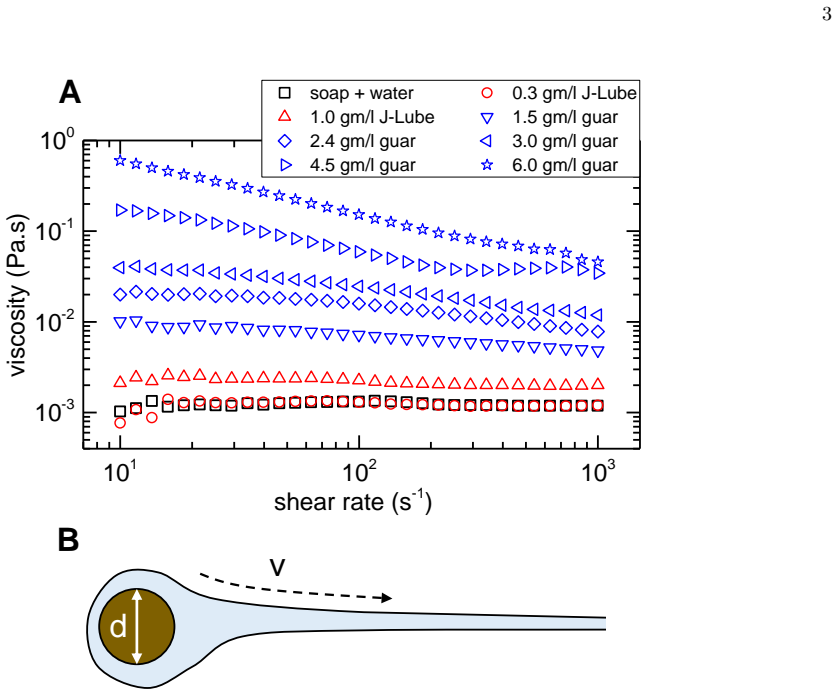
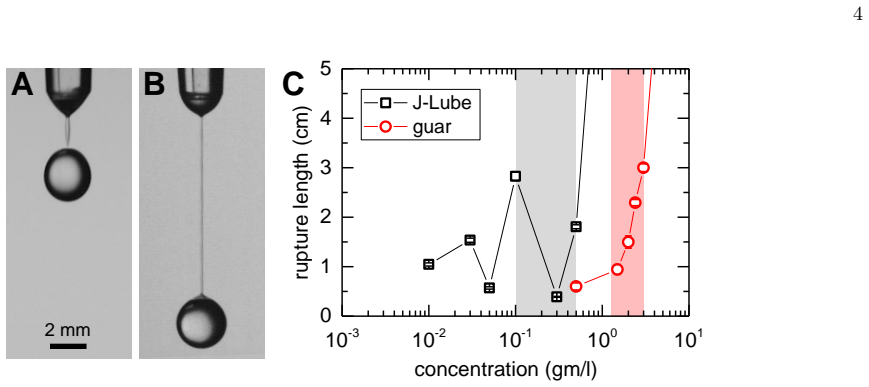
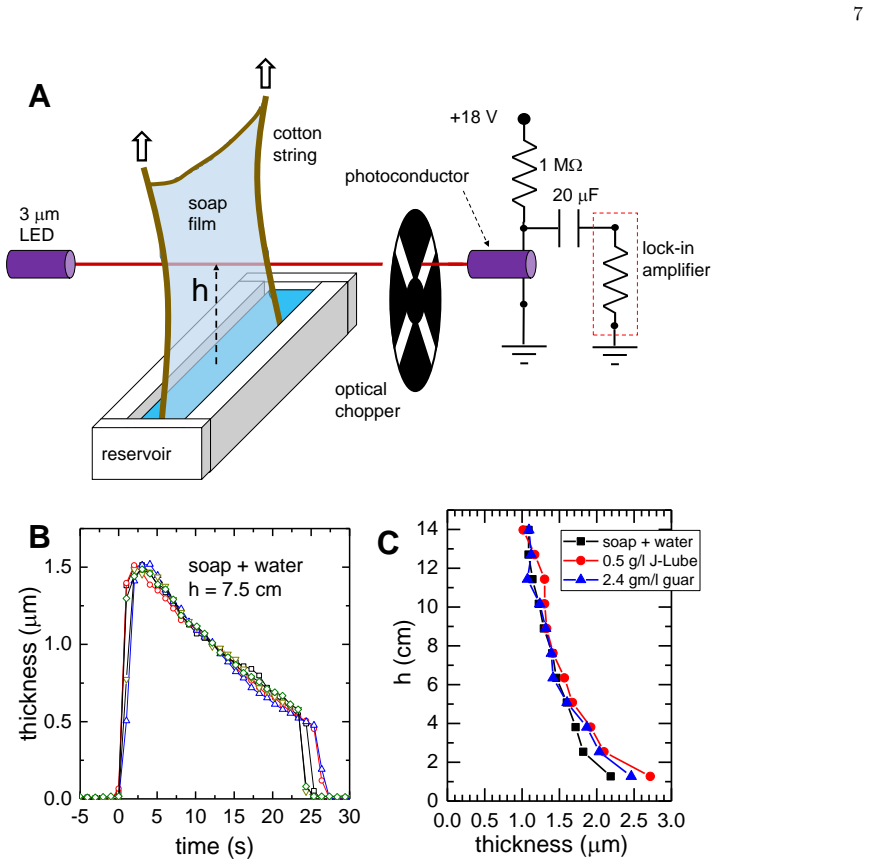
The central object is the viscoelastic thread that a falling drop leaves behind; its rupture length, captured at 2000 frames per second, serves as a proxy for the extensional rheology of the solution under rapid stretching. That proxy is meant to mimic the continuous pulling of a soap film from a rope, where the flow away from the rope is mostly extensional. The supporting machinery is infrared absorption at 3 micrometers, whose exponential extinction maps film thickness versus height over time and yields film lifetime and drainage behavior.
What would settle it
In a controlled setup, pull soap films at fixed speed from a thin frame and measure the maximum film area achievable for each polymer solution, then plot it against the thread rupture length from the dripping-drop test. If the two orderings disagree, with short-thread solutions forming large films or long-thread solutions failing, the rupture-length proxy does not capture the extensional rheology that controls film creation.
Extended reading notes
Core claim
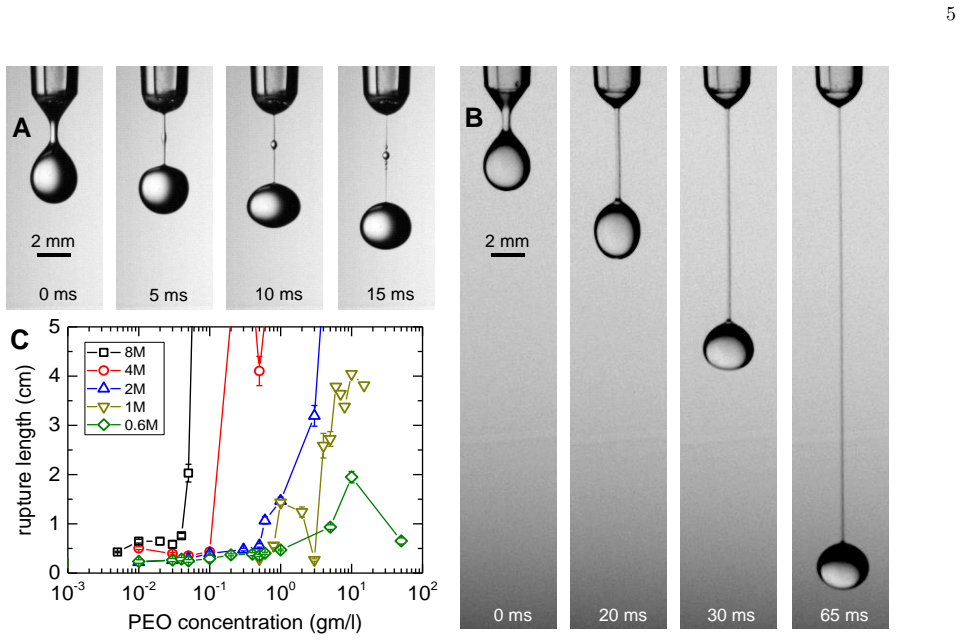
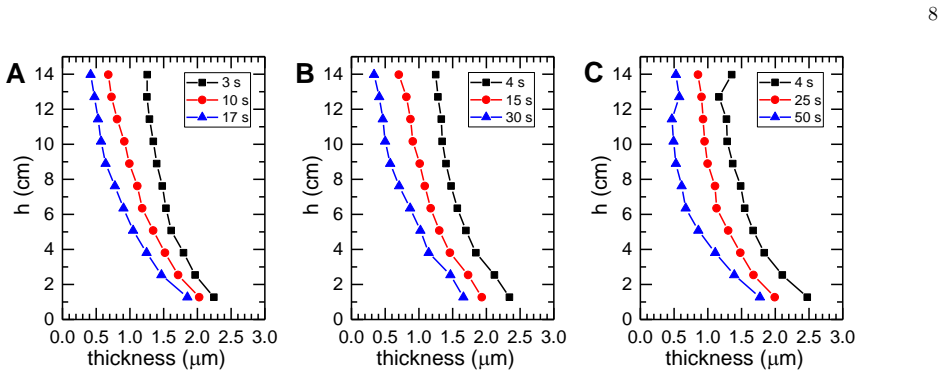
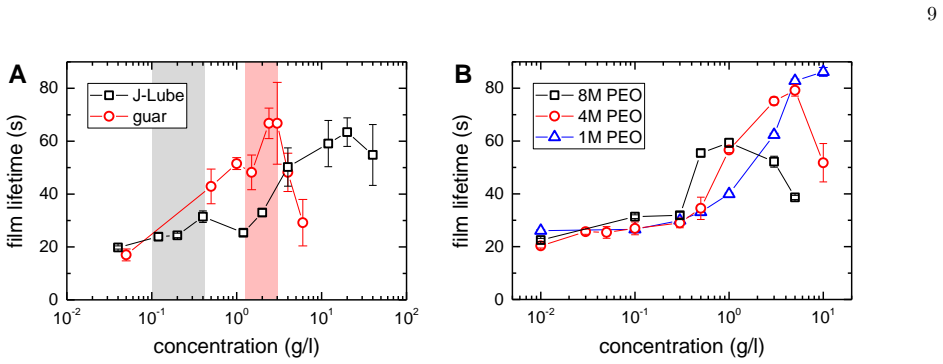
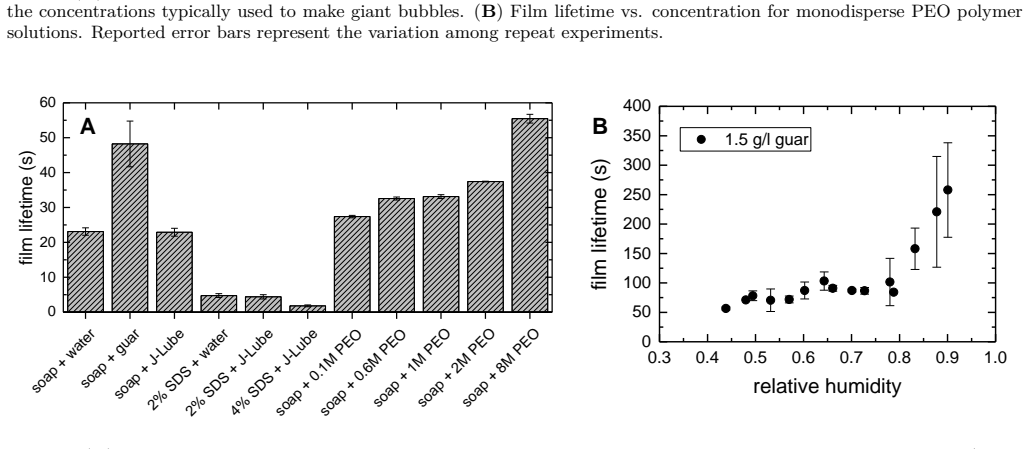
This paper establishes that the creation of giant soap films is controlled by the extensional rheology of the polymer solution rather than by its shear viscosity, surface tension, or film lifetime. In a falling-drop experiment, solutions with higher molecular weight polymers or polydisperse mixtures produce threads that stretch several centimeters before rupturing, whereas plain soap water ruptures almost immediately; the same hierarchy tracks the concentrations at which giant-bubble recipes work. At the same time, measurements of film thickness by infrared absorption show that the initial film thickness depends mainly on the detergent, while polymers matter later: they lengthen film lifetime at high molecular weight and concentration by slowing drainage and evaporation, with relative humidity above roughly 75 percent sharply extending lifetime. The authors conclude that 'the extensional rheology of these dilute, polymer solutions is the most important factor in creating the films.'
Load-bearing premise
Everything rests on treating the length of the liquid thread stretched by a falling drop as a faithful model of how the fluid behaves when a soap film is pulled continuously from a rope; if that transfer fails, the claim that extensional rheology is the most important factor is not directly supported.
Editorial extensions
If this is right
- Bubble-solution recipes should be judged by how far the liquid thread stretches before breaking, not by how thick or viscous the liquid feels.
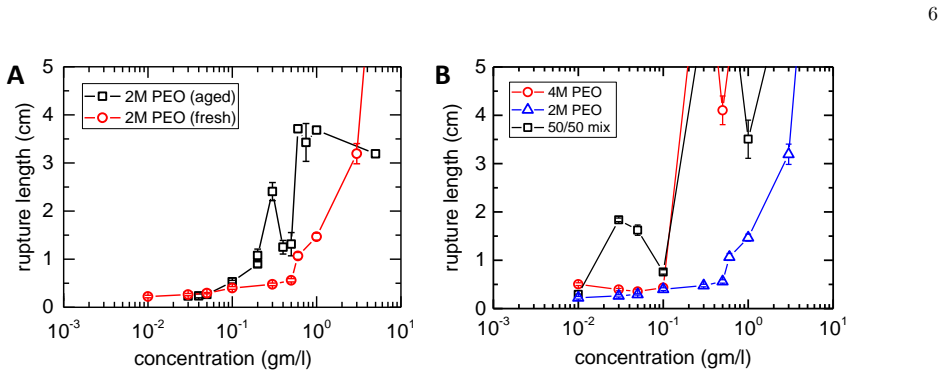
- Polydisperse polymer sources, whether guar, aged PEO, or deliberate blends, deliver the needed extensional strength at lower total polymer concentration than monodisperse samples.
- Film formation and film survival are decoupled: a solution can stretch into a huge film yet pop quickly, while another can last long but never form a large bubble.
- Adding polymer to increase film lifetime helps only up to a point; high concentrations that give long lifetimes can inhibit the initial creation of the film.
- Humidity strongly controls lifetime, so the same solution that fails on a dry day can make long-lived films when relative humidity exceeds roughly 75 percent.
Reading between the lines
- Inference: Because thread rupture length is cheap to measure, it could serve as a practical screening test for giant-bubble recipes, but this is a use the paper does not itself propose.
- Inference: The cooperative polydispersity effect likely generalizes to other processes where dilute polymer solutions are stretched into filaments, such as spray coating or fiber spinning; the paper's mechanism, clustering of long chains aided by shorter-chain depletants, would predict that deliberate bidisperse blends outperform either single molecular weight.
- Inference: A direct test separating bulk extensional rheology from surface effects would be interfacial rheometry on PEO-laden soap films; the paper suspects surface viscoelasticity is minor but does not measure it, so that measurement could either confirm or overturn the bulk-rheology interpretation.
- Inference: If the clustering mechanism is correct, a systematic bidisperse matrix varying long-chain and short-chain concentrations independently should show a peak in extensional resistance at a specific mixing ratio, a prediction that can be checked with the same dripping-drop apparatus.
Signed reviews
Editorial analysis
A structured set of objections, weighed in public.
Referee Report
Summary. The paper investigates the physics of making giant soap bubbles with polymer additives such as guar gum and polyethylene oxide (PEO). The authors characterize the shear rheology of model solutions, use high-speed imaging of dripping drops to measure viscoelastic thread rupture length as an empirical proxy for extensional rheology, and use infrared absorption to measure thickness profiles and lifetimes of vertical soap films. They report that (i) extensional rheology is the most important factor in creating giant-bubble films, (ii) polydisperse or aged PEO mixtures produce longer threads at lower total concentration than monodisperse samples, and (iii) polymer additives increase film lifetime mainly at high concentrations, while initial film thickness is controlled by the detergent. The paper concludes that an optimal recipe combines robust extensional response with long film lifetimes.
Significance. If the central claims hold, the paper offers a useful practical rule for formulating giant-bubble solutions and identifies a surprising cooperative effect of polydisperse polymer mixtures that warrants further study. Strengths of the study include the use of multiple independent observables (shear viscosity, thread rupture length, film thickness, film lifetime), the external anchoring of concentrations against the commonly cited overlap concentration c* from literature values, and the absence of fitted free parameters in the main comparisons. The data are internally consistent and the paper is clearly written. However, the headline claim about extensional rheology rests on an unvalidated proxy, and the polydispersity claim is explicitly labeled a hypothesis in parts of the text while being stated more strongly in the abstract. These gaps are correctable and should be addressed before the paper can be accepted.
major comments (2)
- [Section III, Figs. 2-3] The central inference that 'the extensional rheology of these dilute, polymer solutions is the most important factor in creating the films' (Section V) rests entirely on the thread rupture length measured in a dripping drop. The authors state that this quantity is 'more analogous to the continuous pulling of a soap film,' but no evidence is provided that the ranking of solutions by dripping-thread rupture length transfers to the film-pulling geometry. In pinch-off, the extension rate is set by the capillary-viscous timescale and varies in time, whereas a giant-bubble film is pulled from a reservoir at U ~ 1 m/s with kinematics controlled by the film thickness gradient and wand speed; the rupture length also depends on bead formation and initial drop conditions. Since no independent extensional rheometry (e.g., CaBER or FiSER) or a controlled film-pulling experiment is included, the manuscript currently does not directly establish that extensional rheology is the dominant factor. A direct validation of the proxy, or a more cautious claim, is needed.
- [Section III, Fig. 4 and Section V] The claim that polydispersity 'leads to better performance at lower concentrations' is inferred from longer thread rupture lengths for aged 2M PEO and a 50/50 2M/4M mixture. No film-formation or film-stability measurement confirms that these polydisperse solutions actually improve performance in the bubble geometry; in fact, Figure 7A shows that the polydisperse J-Lube solutions have shorter film lifetimes than guar at the concentrations typically used for giant bubbles. The authors themselves describe the cooperative mechanism as a hypothesis ('we hypothesize that some degree of clustering...') and call for dedicated extensional rheology experiments. The abstract and conclusion currently overstate the strength of this finding; the paper should either present the polydispersity benefit as a hypothesis or support it with direct bubble-forming measurements.
minor comments (6)
- [Figure 5 caption] The second subplot label should be (C), not (B); the caption currently lists two (B) entries.
- [Section IV, near Fig. 6] The reference to 'Fig. 6D' is incorrect; Figure 6 has only panels A-C.
- [Section V] 'hydrophillic' should be 'hydrophilic'.
- [Reference [13]] Reference [13] is incomplete; it gives a book title and edition but no authors or publisher.
- [Table I] The statement 'Mv = Mw' assumes negligible polydispersity, but the authors note that the polydispersity index was not available; the assumption should be stated explicitly in the text.
- [Section IV, film lifetime] The sentence 'This may be expected since the film can pop due to an instability that forms anywhere in the film' is vague; specifying the likely instability would help.
Circularity Check
No significant circularity: the central claims rest on direct measurements and external benchmarks; the dripping-thread proxy is an inference about representativeness, not a definitional or self-citation-based reduction.
full rationale
The derivation chain is self-contained against external data and does not reduce to its own inputs. The extensional characterization is a direct measurement (thread rupture length in dripping drops), not a fitted parameter or a quantity defined by the target claim. Molecular parameters (Rg and c*) are obtained from literature scaling formulas and tabulated separately, and the recommended concentrations for giant bubbles come from the Soap Bubble Wiki, an external benchmark. Film thickness and lifetime conclusions come from independent IR absorption experiments. The statement that extensional rheology is the most important factor in creating the films is supported by the correlation between rupture-length behavior and the externally supplied concentration ranges, together with the physical argument that flow away from the rope is extensional; this is an empirical inference rather than a tautology. The only self-citations are methodological (ref. [18] for drop-shape analysis; ref. [28] for pinch-off phenomenology) and are not load-bearing. The paper explicitly flags the polydispersity mechanism as a hypothesis in Section V ('One main finding of this work that requires further investigation...', 'Dedicated extensional rheology experiments and molecular dynamics simulations may help to shed light...') and notes in Section III that the oscillations in Fig. 2C are 'likely specific to our dripping experiment.' These are limitation statements about proxy transferability and mechanism uncertainty; they lower confidence in the inference, but they are not circular reasoning. No equation, fitted value, or self-citation chain makes a prediction equivalent to its input by construction.
Assumptions & free parameters
assumptions (5)
- domain assumption Thread rupture length in dripping drops is a faithful proxy for extensional rheology during soap film pulling.
- domain assumption Surface viscoelastic effects are minor relative to bulk extensional rheology for film formation.
- domain assumption Monodisperse PEO samples have Mv = Mw, meaning negligible polydispersity.
- domain assumption The radius of gyration scaling Rg = 0.02 M^0.58 nm and the overlap concentration formula from references [35-37] apply to these PEO solutions.
- domain assumption The Beer-Lambert relation in Eq. (2) gives film thickness, with reflection effects negligible.
Cite this review
Pith. "Pith review of How to make a giant bubble." pith.science (2026). https://pith.science/paper/IE3EOVSA
@misc{pith2026190800537,
  author       = {Pith},
  title        = {Pith review of: How to make a giant bubble},
  year         = {2026},
  howpublished = {\url{https://pith.science/paper/IE3EOVSA}},
  note         = {Machine review of arXiv:1908.00537}
}
abstract
Using mixtures of soap, water, and long chain polymers, free-floating soap bubbles can be formed with volumes approaching 100 m$^3$. Here we investigate how such thin films are created and maintained over time. We show how the extensional rheology is the most important factor in creating the bubble, and how polydispersity in molecular weight of the solvated polymers leads to better performance at lower concentrations. Additionally, using IR absorption, we measure soap film thickness profiles and film lifetimes. Although the initial thickness mostly depends on the choice of detergent, polymers can dramatically increase film lifetime at high molecular weights and high concentrations, although such high concentrations can inhibit the initial film formation. Thus, the ideal concentration of polymer additives for making giant bubbles requires a robust viscoelastic rheology during extension, and is aided by long film lifetimes during gravitational drainage and evaporation.
Figures
Figures from the paper (5 more)
Reference graph
Works this paper leans on
-
[1]
GuinnessWorldRecords, https://www.guinnessworldrecords.com/world-records/largest-free-floating-soap-bubble , [Accessed: 29-June-2019]
work page 2019
-
[2]
R. E. Goldstein, H. K. Moffatt, A. I. Pesci, and R. L. Ricca, Soap-film m´’obius strip changes topology with a twist singularity, Proc. Nat. Acad. Sci.107, 21979 (2010)
work page 2010
-
[3]
Rivera, P
M. Rivera, P. Vorobieff, and R. E. Ecke, Turbulence in flowing soap films: Velocity, vorticity, and thickness fields, Phys. Rev. Lett. 81, 1417 (1998)
1998
-
[4]
L. Ristroph and J. Zhang, Anomalous hydrodynamic drafting of interacting flapping flags, Phys. Rev. Lett.101, 194502 (2008)
work page 2008
- [5]
-
[6]
S. Poulain, E. Villermaux, and L. Bourouiba, Ageing and burst of surface bubbles, J. Fluid. Mech.851, 636 (2018)
work page 2018
-
[7]
Isenberg, Soap films and bubbles, Phys
C. Isenberg, Soap films and bubbles, Phys. Educ.16, 218 (1981)
work page 1981
-
[8]
R´’amme, Reflected laser light from a soap bubble - a demonstration experiment, Phys
G. R´’amme, Reflected laser light from a soap bubble - a demonstration experiment, Phys. Educ.27, 282 (1992)
work page 1992
Show all 63 references
-
[9]
R´’amme, Surface tension from deflating a soap bubble, Phys
G. R´’amme, Surface tension from deflating a soap bubble, Phys. Educ.32, 191 (1997)
1997
-
[10]
Schilling and M
K. Schilling and M. Zessner, Foam in the aquatic environment, Water Res.45, 4355 (2011)
2011
-
[11]
html, [Accessed: 11-July-2019]
Toxic foam floods the streets of Bangalore,https://www.cnn.com/2017/05/31/asia/india-toxic-foam-lake/index. html, [Accessed: 11-July-2019]
2017
-
[12]
Soap Bubble Wiki,https://soapbubble.fandom.com, [Accessed: 29-June-2019]
2019
-
[13]
(CRC Press, 2011)
Physics of Continuous Matter, 2nd ed. (CRC Press, 2011)
2011
-
[14]
P. G. de Gennes, “young” soap films, Langmuir17, 2416 (2001)
2001
-
[15]
(Springer, 2004)
Capillarity and Wetting Phenomena: Drops, Bubbles, Pearls, Waves, 1st ed. (Springer, 2004)
2004
-
[16]
Cohen, B
C. Cohen, B. D. Texier, E. Reyssat, J. H. Snoeijer, D. Quéré, and C. Clanet, On the shape of giant soap bubbles, Proc. Natl. Acad. Sci USA114, 2515 (2017)
2017
-
[17]
Mudgil, S
D. Mudgil, S. Barak, and B. S. Khatkar, Guar gum: processing, properties and food applications–a review, J. Food Sci. Technol. 51, 409 (2014)
2014
-
[18]
J. C. Burton, F. M. Huisman, P. Alison, D. Rogerson, and P. Taborek, Experimental and numerical investigation of the equilibrium geometry of liquid lenses, Langmuir26, 15316 (2010)
2010
-
[19]
E. A. van Nierop, B. Scheid, and H. A. Stone, On the thickness of soap films: an alternative to frankel’s law, J. Fluid Mech. 602, 119 (2008)
2008
-
[20]
B. H. Zimm, Dynamics of polymer molecules in dilute solution: Viscoelasticity, flow birefringence and dielectric loss, J. Chem. Phys. 24, 269 (1956)
1956
-
[21]
Wagner, Y
C. Wagner, Y. Amarouchene, D. Bonn, and J. Eggers, Droplet detachment and satellite bead formation in viscoelastic fluids, Phys. Rev. Lett.95, 164504 (2005)
2005
-
[22]
Clasen, J
C. Clasen, J. P. Plog, W.-M. Kulicke, M. Owens, C. Macosko, L. E. Scriven, M. Verani, and G. H. McKinley, How dilute are dilute solutions in extensional flows?, J. Rheol.50, 849 (2006)
2006
-
[23]
Palangetic, N
L. Palangetic, N. K. Reddy, S. Srinivasan, R. E. Cohen, G. H. McKinley, and C. Clasen, Dispersity and spinnability: Why highly polydisperse polymer solutions are desirable for electrospinning, Polymer55, 4920 (2014)
2014
-
[24]
Del Giudice, S
F. Del Giudice, S. J. Haward, and A. Q. Shen, Relaxation time of dilute polymer solutions: A microfluidic approach, J. Rheol. 61, 327 (2017)
2017
-
[25]
G. H. McKinley and T. Sridhar, Filament-stretching rheometry of complex fluids, Ann. Rev. Fluid Mech.34, 375 (2002)
2002
-
[26]
Dinic, L
J. Dinic, L. N. Jimenez, and V. Sharma, Pinch-off dynamics and dripping-onto-substrate (dos) rheometry of complex fluids, Lab Chip 17, 460 (2017)
2017
-
[27]
Dinic and V
J. Dinic and V. Sharma, Macromolecular relaxation, strain, and extensibility determine elastocapillary thinning and extensional viscosity of polymer solutions, Proc. Nat. Acad. Sci.116, 8766 (2019)
2019
-
[28]
J. C. Burton, J. E. Rutledge, and P. Taborek, Fluid pinch-off in superfluid and normal he4, Phys. Rev. E 75, 036311 (2007)
2007
-
[29]
P. P. Bhat, S. Appathurai, M. T. Harris, M. Pasquali, G. H. McKinley, and O. A. Basaran, Formation of beads-on-a-string structures during break-up of viscoelastic filaments, Nature Phys.6, 625 (2010)
2010
-
[30]
de Sainte Claire, Degradation of peo in the solid state: A theoretical kinetic model, Macromolecules42, 3469 (2009)
P. de Sainte Claire, Degradation of peo in the solid state: A theoretical kinetic model, Macromolecules42, 3469 (2009)
2009
-
[31]
Morlat and J.-L
S. Morlat and J.-L. Gardette, Phototransformation of water-soluble polymers. i: photo- and thermooxidation of poly(ethylene oxide) in solid state, Polymer42, 6071 (2001)
2001
-
[32]
Dupas, I
A. Dupas, I. Hénaut, J.-F. Argillier, and T. Aubry, Mechanical degradation onset of polyethylene oxide used as a hydrosol- uble model polymer for enhanced oil recovery, Oil & Gas Sci. Tech.67, 931 (2012)
2012
-
[33]
B. A. Buchholz, J. M. Zahn, M. Kenward, G. W. Slater, and A. E. Barron, Flow-induced chain scission as a physical route to narrowly distributed, high molar mass polymers, Polymer45, 1223 (2004)
2004
-
[34]
A. J. M´’uller, J. A. Odell, and S. Carrington, Degradation of semidilute polymer solutions in elongational flows, Polymer 33, 2598 (1992)
1992
-
[35]
Tabaka, N
R.Holyst, A.Bielejewska, J.Szymański, A.Wilk, A.Patkowski, J.Gapiński, A.Żywociński, T.Kalwarczyk, E.Kalwarczyk, M. Tabaka, N. Ziębacz, and S. A. Wieczorek, Scaling form of viscosity at all length-scales in poly(ethylene glycol) solutions studied by fluorescence correlation spe...
2009
-
[36]
Devan, , and J
K. Devan, , and J. C. Selser, Asymptotic behavior and long-range interactions in aqueous solutions of polyethylene oxide), Macromolecules 24, 5943 (1991)
1991
-
[37]
Ying and B
Q. Ying and B. Chu, Overlap concentration of macromolecules in solution, Macromolecules20, 362 (1987)
1987
-
[38]
M. M. Cross, Polymer rheology: Influence of molecular weight and polydispersity, J. Appl. Polym. Sci.13, 765 (1969)
1969
-
[39]
Kulicke, M
W.-M. Kulicke, M. Elasabee, C. D. Eisenbach, and M. Peuscher, Effect of molecular weight and molecular weight distri- bution on the rheological properties of aqueous poly(ethylene oxide) solution, Polymer Bulletin9, 190 (1983)
1983
-
[40]
P. K. Bhattacharjee, J. P. Oberhauser, G. H. McKinley, L. G. Leal, and T. Sridhar, Extensional rheometry of entangled solutions, Macromolecules 35, 10131 (2002)
2002
-
[41]
X. Ye, R. G. Larson, C. Pattamaprom, and T. Sridhar, Extensional properties of monodisperse and bidisperse polystyrene solutions, J. Rheol.47, 443 (2003)
2003
-
[42]
Ye and T
X. Ye and T. Sridhar, Effects of the polydispersity on rheological properties of entangled polystyrene solutions, Macro- molecules 38, 3442 (2005)
2005
-
[43]
(Pergamon Press, 1959)
Soap films: studies of their thinning, 1st ed. (Pergamon Press, 1959). 12
1959
-
[44]
Champougny, J
L. Champougny, J. Miguet, R. Henaff, F. Restagno, F. Foulogne, and E. Rio, Influence of evaporation on soap film rupture, Langmuir 34, 3221 (2018)
2018
-
[45]
Saulnier, L
L. Saulnier, L. Champougny, G. Bastien, F. Restagno, D. Langevin, and E. Rio, A study of generation and rupture of soap films, Soft Matter10, 2899 (2014)
2014
-
[46]
Naire, R
S. Naire, R. J. Braun, and S. A. Snow, An insoluble surfactant model for a vertical draining free film, J. Colloid. Int. Sci. 230, 91 (2000)
2000
-
[47]
S. Berg, E. A. Adelizzi, and S. M. Troian, Experimental study of entrainment and drainage flows in microscale soap films, Langmuir 21, 3867 (2005)
2005
-
[48]
L. W. Schwartz and R. V. Roy, Modeling draining flow in mobile and immobile soap films, J. Colloid Interface Sci.218, 309 (1999)
1999
-
[49]
Langevin, Influence of interfacial rheology on foam and emulsion properties, Adv
D. Langevin, Influence of interfacial rheology on foam and emulsion properties, Adv. Colloid Int. Sci.88, 209 (2000)
2000
-
[50]
Seiwert, B
J. Seiwert, B. Dollet, and I. Cantat, Theoretical study of the generation of soap films: role of interfacial visco-elasticity, J. Fluid Mech. 739, 124 (2014)
2014
-
[51]
A. A. Sonin, A. Bonfillon, and D. Langevin, Thinning of soap films: The role of surface viscoelasticity, J. Colloid. Int. Sci. 162, 323 (1994)
1994
-
[52]
Bruinsma, J
R. Bruinsma, J. di Meglio, D. Quéré, and S. Cohen-Addad, Stabilization of aqueous foam by hydrosoluble polymers. 1. sodium dodecyl sulfate-poly(ethylene oxide) system, Langmuir8, 324 (1992)
1992
-
[53]
E. A. Adelizzi and S. M. Troian, Interfacial slip in entrained soap films containing associating hydrosoluble polymer, Langmuir 20, 7482 (2004)
2004
-
[54]
Bruinsma, J
R. Bruinsma, J. di Meglio, D. Quéré, and S. Cohen-Addad, Formation of soap films from polymer solutions, Langmuir8, 3161 (1992)
1992
-
[55]
Cohen-Addad and J.-M
S. Cohen-Addad and J.-M. di Meglio, Stabilization of aqueous foam by hydrosoluble polymers. 2. role of polymer/surfactant interactions, Langmuir 10, 773 (1994)
1994
-
[56]
X. L. Wu, R. Levine, M. Rutgers, H. Kellay, and W. I. Goldburg, Infrared technique for measuring thickness of a flowing soap film, Rev. Sci. Instrum.72, 2467 (2001)
2001
-
[57]
Debrégeas, P.-G
G. Debrégeas, P.-G. de Gennes, and F. Brochard-Wyart, The life and death of “bare” viscous bubbles, Science279, 1704 (1998)
1998
-
[58]
M. S. Bhamla, C. Chai, M. A. Àlvarez Valenzuela, J. Tajuelo, and G. G. Fuller, Interfacial mechanisms for stability of surfactant-laden films, PLoS One12, e0175753 (2017)
2017
-
[59]
B. H. Cao and M. W. Kim, Molecular weight dependence of the surface tension of aqueous poly(ethylene oxide) solutions, Faraday Discuss.98, 245 (1994)
1994
-
[60]
Zhang and R
W. Zhang and R. G. Larson, Tension-induced nematic phase separation in bidisperse homopolymer melts, ACS Cent. Sci. 4, 1545 (2018)
2018
-
[61]
S. M. Clegg, P. A. Williams, P. Warren, and I. D. Robb, Phase behavior of polymers with concentrated dispersions of surfactants, Langmuir 10, 3390 (1994)
1994
-
[62]
Helfand and G
E. Helfand and G. H. Fredreickson, Large fluctuations in polymer solutions under shear, Phys. Rev. Lett.62, 2468 (1989)
1989
-
[63]
S. T. Milner, Hydrodynamics of semidilute polymer solutions, Phys. Rev. Lett.66, 1477 (1991)
1991
Reviewed August 14, 2026 · model on record in the stance chip above.
Discussion (0). Continue with ORCID to comment.