REVIEW 3 major objections 6 minor 65 references
Quantum Isomer Search
T0 review · 3 major / 6 minor · reviewed 2026-08-14 · deepseek-v4-flash
Pith's one-line read Structural isomer search for alkanes can be encoded as a QUBO and solved on a quantum annealer, and the authors enumerate all alkane isomers up to nonane with sampling time that grows linearly in the carbon count.
desk verdict The QUBO core is clean and the isomer counts match known values, but the paper's completeness claim is not reproducible because the degree-sequence-to-graph reconstruction step is never described. read the letter →
The pith
A machine-rendered reading of the paper's core claim, the machinery that carries it, and where it could break.
The reading
What carries the argument
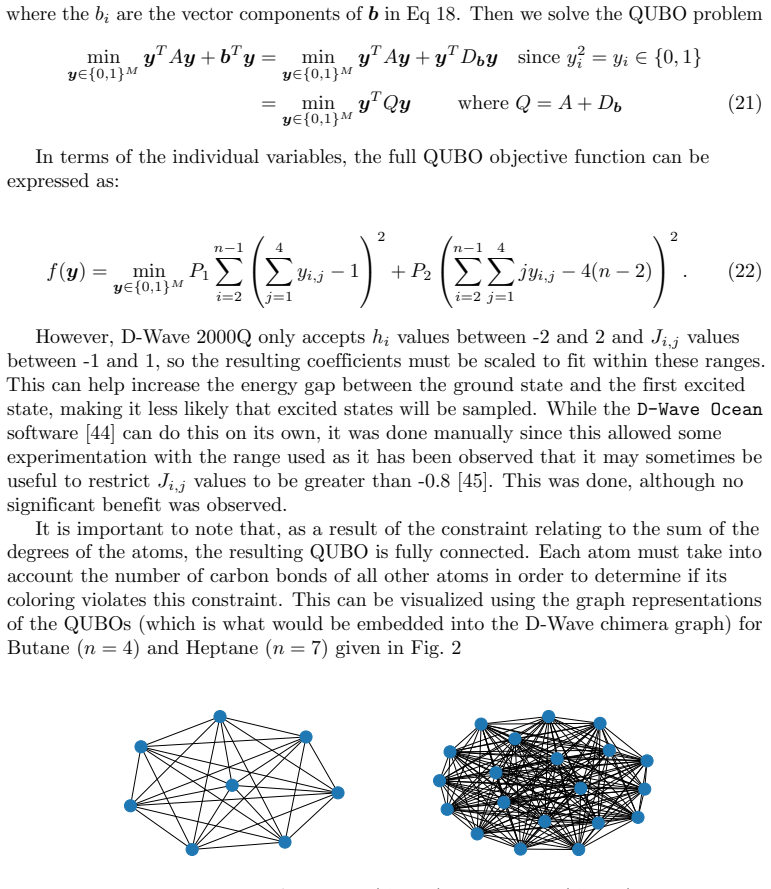
The load-bearing object is the QUBO Hamiltonian built from tree-degree constraints. For an n-carbon alkane there are 4(n−2) decision variables, the one-hot bits for interior carbons; endpoint carbons are fixed. The objective combines a per-carbon one-hot penalty (P1) with a global degree-sum penalty (P2), producing the matrix form Q = P2 $D_α^{2}$ + 2(P2 D_α U_α + P1 D_U) with linear term b = −(4(n−2)P2 α + P1 1_M) and constant c = 4(n−2)^2 P2 + (n−2) P1. Ground states of x^T Q x are exactly the valid degree sequences, but they are degenerate: many distinct valid solutions share the minimum energy, so the computational task shifts from "minimize once" to "sample every minimizer." Two additions carry the sampling: the perturbed Hamiltonian Q′ = Q + λ|ψ⟩⟨ψ|, where |ψ⟩ is the most-counted ground state of the previous batch, and reverse annealing, which starts from a known solution and explores its neighborhood before re-annealing.
What would settle it
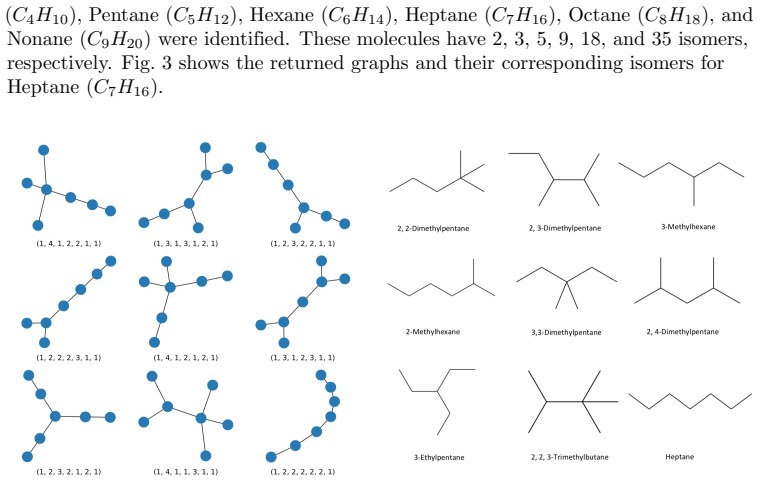
Run the published heptane QUBO to collect its ground-state degree sequences, then independently generate all unlabeled trees on seven vertices with maximum degree 4 and compare the resulting graph set to the paper's list of nine heptane isomers; any missing or duplicated graph would refute the enumeration claim. The same check can be done for octane and nonane against the known 18 and 35 isomer counts.
Extended reading notes
Core claim
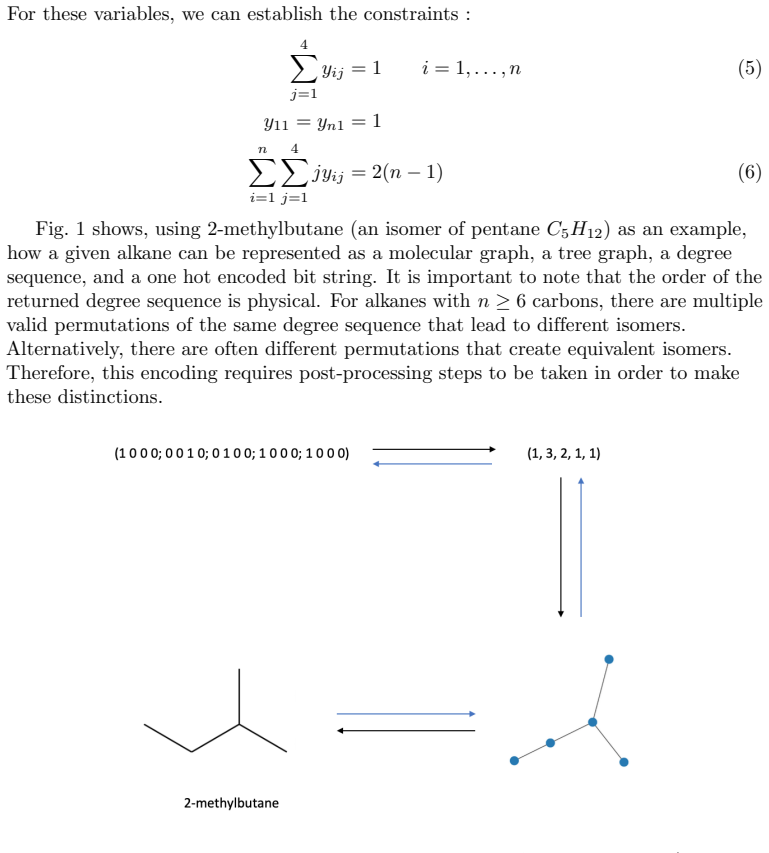
On its own terms, the paper's claim is that the structural isomer search for an alkane is equivalent to enumerating the ground states of a particular fully connected QUBO. Each carbon's valence (degree in the carbon skeleton) is one-hot encoded as four bits, the end carbons are pinned to degree 1, and the remaining constraints are: exactly one bit per carbon, each interior degree between 1 and 4, and the sum of all degrees equal to 2(n−1). The penalty-weighted objective combines these; because the sum constraint couples every variable pair, the QUBO is fully connected. The authors report that on the D-Wave 2000Q, sampling this QUBO and decoding the degenerate ground states produces every structural isomer of every alkane from C4H10 through C9H20 (2, 3, 5, 9, 18, and 35 isomers respectively). They additionally claim that 10,000-sample batches take time that grows by roughly 20 microseconds per added carbon, and that reverse annealing plus a perturbed Hamiltonian that penalizes the most frequent answer reduces the number of sample batches needed to see the full isomer set.
Load-bearing premise
The load-bearing premise is that the paper's unshown post-processing step reconstructs every non-isomorphic alkane graph from each returned degree sequence without missing or duplicating any isomer; if that reconstruction is incomplete, the claim of complete enumeration fails even though the QUBO ground states are correct.
Editorial extensions
If this is right
- Any quantum device that can minimize QUBO/Ising objectives — annealing or gate-based — can in principle run this isomer search, with the hard limits being qubit count, connectivity, and sampling quality rather than the formulation itself.
- The reported linear scaling of QPU sampling time with n, despite quadratic growth in QUBO parameters, means time-to-enumerate is dominated by the number of samples needed, so noise reduction or error correction directly translates into larger enumerable alkanes.
- The authors suggest that penalizing the most frequent ground state after each batch may help any degenerate search problem on an annealer where the goal is to enumerate all optimal solutions, not just find one.
- With 4(n−2) fully connected logical variables and current embedding limits, the method reaches roughly 18 carbons on 2000Q-class hardware; next-generation connectivity will extend that range without any change to the QUBO itself.
Reading between the lines
- Editorial: The completeness of the enumeration rests on an undescribed post-processing step that turns degree sequences into non-isomorphic graphs; until that step is specified, "all isomers found" should be read as conditional on it.
- Editorial: The same QUBO-plus-perturbation scheme could be extended to cycloalkanes by adding a cycle-count penalty, and to heteroatom-containing molecules by expanding the one-hot degree alphabet; the paper does not attempt either.
- Editorial: The linear sampling-time scaling is measured on current noisy hardware; a fair comparison against classical enumeration for larger n (say 12–18 carbons) would be the decisive next experiment, and the paper does not provide it.
Signed reviews
Editorial analysis
A structured set of objections, weighed in public.
Referee Report
Summary. The paper proposes a QUBO formulation for the structural isomer search of alkanes, encoding the carbon skeleton as a tree with one-hot degree variables and enforcing tree degree-sequence constraints (Eqs. 2-6). The resulting QUBO (Eqs. 20-22) is solved on the D-Wave 2000Q quantum annealer. The authors report successful enumeration of all structural isomers for alkanes with n = 4 to 9 carbon atoms, matching known counts (2, 3, 5, 9, 18, 35), and introduce a QUBO-perturbation method combined with reverse annealing to reduce the number of samples required to find all degenerate ground-state solutions. They also report that the time per 10,000 samples grows roughly linearly with n.
Significance. If the enumeration claim holds, the paper is a useful proof-of-principle that quantum annealing can address a class of combinatorial enumeration problems with degenerate solution sets. The QUBO construction is transparent and not circular: it is derived from standard tree degree-sequence constraints rather than fitted to the target isomer counts, and the reported counts agree with known values, providing indirect evidence of completeness. The perturbation plus reverse-annealing scheme is a plausible practical technique for broader degenerate-solution sampling. However, the paper's reproducibility is currently limited by the unspecified degree-sequence-to-graph reconstruction step and by missing experimental parameters, and the abstract's linear-scaling claim is not matched by the reported measurements.
major comments (3)
- [Implementation (decoding step)] The central claim that all structural isomers were enumerated depends on a post-processing step that is not described or cited. The Implementation section states that one-hot encoded results are 'decoded into the degree sequences and graphs in the method described previously, checked and filtered for redundancy,' but no such method appears earlier in the manuscript and no reference is provided. This matters because the paper itself notes in the QUBO Formulation section that for n ≥ 6 multiple non-isomorphic isomers can share the same degree sequence, and the Discussion reinforces that 'multiple permutations of a degree sequence lead to identical graphs.' A degree sequence does not uniquely determine an alkane tree, so the reconstruction and redundancy-removal procedure is load-bearing for the claim that the reported counts (2, 3, 5, 9, 18, 35) represent complete enumerations. The authors must specify this algorithm, cite a published method, or otherwise demonstrate that the reconstruction step is complete and free of duplicates.
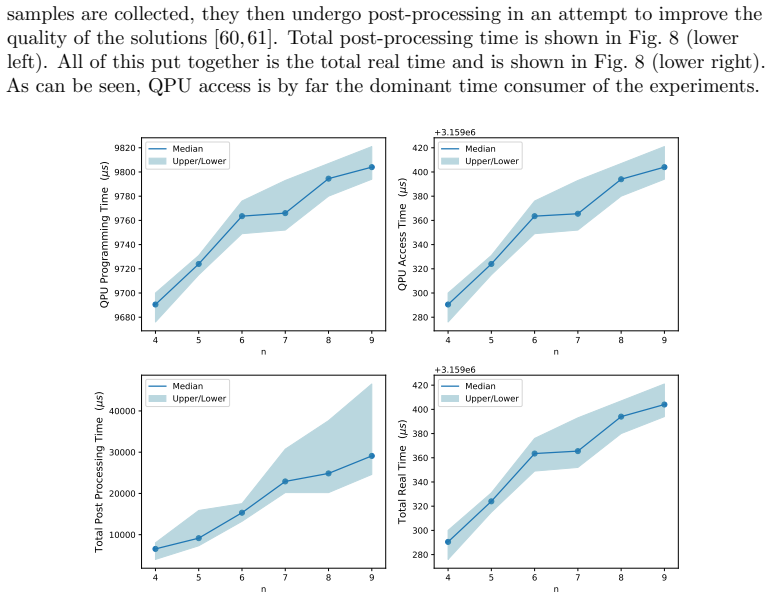
- [Abstract and Results (runtime scaling)] The abstract's statement that 'the sampling time needed to identify all solutions scales linearly with the number of carbon atoms' is not supported by the data presented. The linear scaling reported in Fig. 8 is for the time to generate a fixed batch of 10,000 samples, not for the time to identify all isomers. The paper also reports that larger alkanes require substantially more samples to find all isomers (e.g., Table 1 and the statement that larger alkanes 'often needed well over 50,000 samples'), and that the total time per 10,000 samples grows with n. The total sampling time to identify all solutions is the product of these two quantities, and the paper provides no evidence that this product scales linearly. This claim should be revised to refer to per-batch sampling time, or the total-time scaling should be measured and reported.
- [Methods (QUBO parameters)] The numerical values of the penalty constants P1 and P2, introduced in Eq. (7) and Eq. (8), are never stated in the manuscript. These constants determine the relative weights of the one-hot constraints and the total-degree constraint, and hence define the energy landscape that the annealer samples. The paper reports specific values for the perturbation strength λ and reverse-annealing settings (s* = 0.5, h = 85 µs) in the caption of Table 1, but omits P1 and P2 entirely. Without these values, the experiments as described are not reproducible. The authors should report the values used, or explain how they were set, and ideally provide a sensitivity analysis to show that the enumeration results do not depend critically on their choice.
minor comments (6)
- [Eq. (7) and Eq. (9)] There is an inconsistency in the constant term of the P1 penalty expansion: Eq. (7) shows '+ n' while the subsequent matrix form in Eq. (9) uses '+ (n-2)', which is the correct constant from summing the (n-2) one-hot constraints. Please correct Eq. (7).
- [Implementation] The phrase 'D-Wave 2000Q 5 chimera graph' appears to contain a typo; it should likely read 'D-Wave 2000Q's chimera graph.'
- [Introduction] The phrase 'In this vain' should be 'In this vein.'
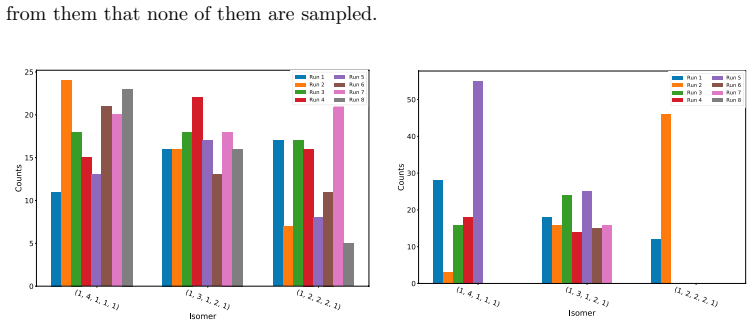
- [Figure 7 caption] The caption states 'Left: Not using QUBO perturbation, Right: Using QUBO perturbation,' but the main text says the opposite ('with (left) and without (right) perturbing the QUBO'). Please make the labels consistent.
- [Results (IBM Q)] The claim that the QUBO formulation is 'for general use on either annealing or gate-based quantum computers' is only supported by a small Qiskit simulator test on butane; the status of the gate-based implementation (e.g., QAOA or VQE) should be described more fully or explicitly labeled as preliminary.
- [Conclusion] The paper reports results only for n = 4 to 9, while the abstract claims 'all alkanes with fewer carbon atoms than Decane (C10H22).' The trivial cases n = 1-3 are not discussed; please clarify whether they are included or excluded, or state that they are trivial.
Circularity Check
No significant circularity: the QUBO is derived from explicit tree constraints, and the enumeration claim is checked against known isomer counts.
full rationale
The central construction is self-contained. Eqs. (2)-(6) state the tree constraints (endpoint degree 1, internal degrees 1-4, total degree 2(n-1)), and Eq. (22) is just the penalized sum of those constraints; no target isomer count enters the objective. The reported counts '2, 3, 5, 9, 18, and 35' are external checks, not fitted inputs. Penalty constants P1, P2, perturbation strength lambda, and reverse-annealing parameters are sampling heuristics, not fitted values of the result. The paper's linear-scaling claim is an empirical benchmark observation ('the time taken to generate 10,000 samples grows fairly linearly with n'), not a prediction derived from the QUBO, so it cannot be circular. The one load-bearing gap is the reconstruction of graphs from degree sequences in the Implementation section: the text says one-hot results 'are decoded into the degree sequences and graphs in the method described previously, checked and filtered for redundancy, and returned' but no such method is described or cited, and the paper itself notes that for alkanes with n >= 6 carbons 'there are multiple valid permutations of the same degree sequence that lead to different isomers' and later that 'there are multiple valid yet identical global minima.' This is a missing-support/reproducibility problem for the completeness claim, not a reduction of output to input: a degree-sequence constraint does not define the graph enumeration result by construction. There is also no reliance on a self-citation chain or imported uniqueness theorem; the only self-citations ([4,5]) are background examples of Ising applications. Accordingly, no circular step is established.
Assumptions & free parameters
free parameters (3)
- P1, P2 QUBO penalty constants =
not given
- lambda (QUBO perturbation strength) =
5e-5 in Fig. 7 caption; 5e-6 in Table 1 caption
- Reverse annealing settings s* and h =
s* = 0.5, h = 85 microseconds
assumptions (4)
- standard math Every positive integer sequence with sum 2n-2 and degrees at most n-1 is realizable as a tree
- domain assumption Alkane structural isomers correspond to unlabeled acyclic carbon graphs with carbon degrees between 1 and 4
- domain assumption Repeated sampling of a D-Wave annealer can eventually find all degenerate ground states of the embedded QUBO
- ad hoc to paper There exists an exact post-processing procedure that reconstructs all non-isomorphic isomer graphs from the QUBO degree sequences
Cite this review
Pith. "Pith review of Quantum Isomer Search." pith.science (2026). https://pith.science/paper/MHHDDSVT
@misc{pith2026190800542,
  author       = {Pith},
  title        = {Pith review of: Quantum Isomer Search},
  year         = {2026},
  howpublished = {\url{https://pith.science/paper/MHHDDSVT}},
  note         = {Machine review of arXiv:1908.00542}
}
read the original abstract
Isomer search or molecule enumeration refers to the problem of finding all the isomers for a given molecule. Many classical search methods have been developed in order to tackle this problem. However, the availability of quantum computing architectures has given us the opportunity to address this problem with new (quantum) techniques. This paper describes a quantum isomer search procedure for determining all the structural isomers of alkanes. We first formulate the structural isomer search problem as a quadratic unconstrained binary optimization (QUBO) problem. The QUBO formulation is for general use on either annealing or gate-based quantum computers. We use the D-Wave quantum annealer to enumerate all structural isomers of all alkanes with fewer carbon atoms (n < 10) than Decane (C10H22). The number of isomer solutions increases with the number of carbon atoms. We find that the sampling time needed to identify all solutions scales linearly with the number of carbon atoms in the alkane. We probe the problem further by employing reverse annealing as well as a perturbed QUBO Hamiltonian and find that the combination of these two methods significantly reduces the number of samples required to find all isomers.
Figures
Figures from the paper (6 more)


Reference graph
Works this paper leans on
-
[1]
Ising formulations of many NP problems
Lucas A. Ising formulations of many NP problems. Frontiers in Physics. 2014;2:5
work page 2014
-
[2]
Exact Ising model simulation on a quantum computer
Cervera-Lierta A. Exact Ising model simulation on a quantum computer. Quantum. 2018;2:114. doi:10.22331/q-2018-12-21-114
-
[3]
The Ising model: teaching an old problem new tricks
Bian Z, Chudak F, Macready W, Rose G. The Ising model: teaching an old problem new tricks. D-Wave Systems. 2010
work page 2010
-
[4]
Graph Partitioning Using Quantum Annealing on the D-Wave System
Ushijima-Mwesigwa H, Negre CFA, Mniszewski SM. Graph Partitioning Using Quantum Annealing on the D-Wave System. In: Proceedings of the Second International Workshop on Post Moores Era Supercomputing. PMES’17. New York, NY, USA: ACM; 2017. p. 22–29. Available from: http://doi.acm.org/10.1145/3149526.3149531
arXiv 2017
-
[5]
Detecting Multiple Communities Using Quantum Annealing on the D-Wave System
Negre CFA, Ushijima-Mwesigwa H, Mniszewski SM. Detecting Multiple Communities Using Quantum Annealing on the D-Wave System. arXiv preprint arXiv:190109756. 2019
work page 2019
-
[6]
Glossary of terms used in theoretical organic chemistry
Minkin VI. Glossary of terms used in theoretical organic chemistry. J Macromol Sci Part A Pure Appl Chem. 1999;71(10):1919–1981
work page 1999
-
[7]
Basic terminology of stereochemistry (IUPAC Recommendations 1996)
Moss GP. Basic terminology of stereochemistry (IUPAC Recommendations 1996). J Macromol Sci Part A Pure Appl Chem. 1996;68(12):2193–2222
work page 1996
-
[8]
Reading E, Munoz-Muriedas J, Roberts AD, Dear GJ, Robinson CV, Beaumont C. Elucidation of Drug Metabolite Structural Isomers Using Molecular Modeling Coupled with Ion Mobility Mass Spectrometry. Analytical Chemistry. 2016;88(4):2273–2280. doi:10.1021/acs.analchem.5b04068
Show all 65 references
-
[9]
Catalytic Hydroisomerization of Long-Chain Hydrocarbons for the Production of Fuels
M¨ aki-Arvela P, Kaka khel T, Azkaar M, Engblom S, Murzin D. Catalytic Hydroisomerization of Long-Chain Hydrocarbons for the Production of Fuels. Catalysts. 2018;8(534)
2018
-
[10]
Correct Molecular Reconstruction of Cracking Feeds: a Need for the Accurate Predictions of Ethylene Yields
Ranzi E, Pierucci S, Dente M, van Goethem M, van Meeuwen D, Wagner E. Correct Molecular Reconstruction of Cracking Feeds: a Need for the Accurate Predictions of Ethylene Yields. Chemical Engineering Transactions. 2015;43:871–876
2015
-
[11]
Enumerating Molecules
Faulon JL, Visco DP, Roe D. Enumerating Molecules. In: Reviews in Computational Chemistry. vol. 21. Hoboken, New Jersey: John Wiley & Sons Inc.; 2005. p. 209–275
2005
-
[12]
Topology of Molecules
Lederberg J. Topology of Molecules. In: The Mathematical sciences; a collection of essays. Cambridge, Mass.: M.I.T. Press; 1969. p. 37–51
1969
-
[13]
Applications of Artificial Intelligence for Organic Chemistry: The DENDRAL Project
Lindsay RK, Buchanan BG, Feigenbaum EA, Lederberg J. Applications of Artificial Intelligence for Organic Chemistry: The DENDRAL Project. New York: McGraw-Hill; 1980
1980
-
[14]
Applications of artificial intelligence for chemical inference
Lederberg J, Sutherland GL, Buchanan BG, Feigenbaum EA, Robertson AV, Duffield AM, et al. Applications of artificial intelligence for chemical inference. I. Number of possible organic compounds. Acyclic structures containing carbon, hydrogen, oxygen, and nitrogen. Journal of t...
1969 doi
-
[15]
Generation and enumeration of carbon skeletons
Hendrickson JB, Parks CA. Generation and enumeration of carbon skeletons. Journal of Chemical Information and Computer Sciences. 1991;31(1):101–107. doi:10.1021/ci00001a018
1991 doi
-
[16]
Exhaustive generation of organic isomers
Contreras ML, Valdivia R, Rozas R. Exhaustive generation of organic isomers. 1. Acyclic structures. Journal of Chemical Information and Computer Sciences. 1992;32(4):323–330. doi:10.1021/ci00008a011
1992 doi
-
[17]
AEGIS, a Structure Generation Program in Prolog
Luinge HJ. AEGIS, a Structure Generation Program in Prolog. MATCH. 1992;27:175
1992
-
[18]
Exhaustive generation of structural isomers for a given empirical formula - a new algorithm
Zhu SY, Zhang JP. Exhaustive generation of structural isomers for a given empirical formula - a new algorithm. Journal of Chemical Information and Computer Sciences. 1982;22(1):34–38. doi:10.1021/ci00033a007
1982 doi
-
[19]
Exhaustive Generation of Organic Isomers from Base 2 and Base 4 Numbers
Barone R, Barberis F, Chanon M. Exhaustive Generation of Organic Isomers from Base 2 and Base 4 Numbers. MATCH. 1995;32:19–25
1995
-
[20]
Structure Generator for Molecular Graphs
Kerber A, Laue R, Moser DA. Structure Generator for Molecular Graphs. Analytica Chimica Acta. 1990;235:2973
1990
-
[21]
Exhaustive Isomer Generation using the Genetic Algorithm
Le Bret C. Exhaustive Isomer Generation using the Genetic Algorithm. Match. 2000;41:79–97
2000
-
[22]
Applications of artificial intelligence for chemical inference–XX
E Carhart R, H Smith D. Applications of artificial intelligence for chemical inference–XX. Computers & Chemistry. 1977;1:79–84. doi:10.1016/0097-8485(77)80003-X
1977 doi
-
[23]
GENOA: A computer program for structure elucidation utilizing overlapping and alternative substructures
E Carhart R, H Smith D, A B Gray N, G Nourse J, Djerassi C. GENOA: A computer program for structure elucidation utilizing overlapping and alternative substructures. Journal of Organic Chemistry - J ORG CHEM. 1981;46. doi:10.1021/jo00321a037
1981 doi
-
[24]
Assemble 2.0: a structure generator
Badertscher M, Korytko AI, Schulz KP, Madison MS, Munk ME, Portmann P, et al. Assemble 2.0: a structure generator. Chemometrics and Intelligent laboratory Systems. 2000;51(1):73–79. doi:10.1016/S0169-7439(00)00056-3
-
[25]
Further development of structure generation in the automated structure elucidation system CHEMICS
Funatsu K, Miyabayashi N, Sasaki S. Further development of structure generation in the automated structure elucidation system CHEMICS. Journal of Chemical Information and Computer Sciences. 1988;28(1):18–28. doi:10.1021/ci00057a003
1988 doi
-
[26]
Elucidation by progressive intersection of ordered substructures from carbon-13 nuclear magnetic resonance
Carabedian M, Dagane I, Dubois JE. Elucidation by progressive intersection of ordered substructures from carbon-13 nuclear magnetic resonance. Analytical Chemistry. 1988;60(20):2186–2192. doi:10.1021/ac00171a005
1988 doi
-
[27]
Structure Generator GEN
Bohanec S, Zupan J. Structure Generator GEN. MATCH. 1992;27:49
1992
-
[28]
Application of a New Expert System for the Structure Elucidation of Natural Products from Their 1D and 2D NMR Data
Elyashberg ME, Blinov KA, Williams AJ, Martirosian ER, Molodtsov SG. Application of a New Expert System for the Structure Elucidation of Natural Products from Their 1D and 2D NMR Data. Journal of Natural Products. 2002;65(5):693–703. doi:10.1021/np0103315
2002 doi
-
[29]
Cocon: From NMR Correlation Data to Molecular Constitutions
Lindel T, Junker J, K¨ ock M. Cocon: From NMR Correlation Data to Molecular Constitutions. Molecular modeling annual. 1997;3(8):364–368. doi:10.1007/s008940050052
1997 doi
-
[30]
Fully Automated Structure ElucidationA Spectroscopist’s Dream Comes True
Will M, Fachinger W, Richert JR. Fully Automated Structure ElucidationA Spectroscopist’s Dream Comes True. Journal of Chemical Information and Computer Sciences. 1996;36(2):221–227. doi:10.1021/ci950092p. August 7, 2019 18/20
1996 doi
-
[31]
Computer Automated Structure Elucidation Expert System, Esesoc
Hu C, Xu L. Computer Automated Structure Elucidation Expert System, Esesoc. Fenxi Huaxue. 1992;20:643
1992
-
[32]
Expert System for Elucidation of Structures of Organic Compounds (Esesoc)- Algorithm on Stereoisomer Generation
Hao J, Xu L, Hu C. Expert System for Elucidation of Structures of Organic Compounds (Esesoc)- Algorithm on Stereoisomer Generation. vol. 43 of B: Chemistry. Science in China; 2000
2000
-
[33]
Stochastic Generator of Chemical Structure
Faulon JL. Stochastic Generator of Chemical Structure. 1. Application to the Structure Elucidation of Large Molecules. Journal of Chemical Information and Computer Sciences. 1994;34(5):1204–1218. doi:10.1021/ci00021a031
1994 doi
-
[34]
Stochastic Generator of Chemical Structure
Faulon JL. Stochastic Generator of Chemical Structure. 2. Using Simulated Annealing To Search the Space of Constitutional Isomers. Journal of Chemical Information and Computer Sciences. 1996;36(4):731–740. doi:10.1021/ci950179a
1996 doi
-
[35]
SENECA: A Platform-Independent, Distributed, and Parallel System for Computer-Assisted Structure Elucidation in Organic Chemistry
Steinbeck C. SENECA: A Platform-Independent, Distributed, and Parallel System for Computer-Assisted Structure Elucidation in Organic Chemistry. Journal of Chemical Information and Computer Sciences. 2001;41(6):1500–1507. doi:10.1021/ci000407n
2001 doi
-
[36]
Structure generation by reduction: a new strategy for computer-assisted structure elucidation
Christie BD, Munk ME. Structure generation by reduction: a new strategy for computer-assisted structure elucidation. Journal of Chemical Information and Computer Sciences. 1988;28(2):87–93. doi:10.1021/ci00058a009
1988 doi
-
[37]
The role of two-dimensional nuclear magnetic resonance spectroscopy in computer-enhanced structure elucidation
Christie BD, Munk ME. The role of two-dimensional nuclear magnetic resonance spectroscopy in computer-enhanced structure elucidation. Journal of the American Chemical Society. 1991;113(10):3750–3757. doi:10.1021/ja00010a018
1991 doi
-
[38]
Application of Expert System CISOC-SES to the Structure Elucidation of Complex Natural Products
Peng C, Yuan S, Zheng C, Hui Y, Wu H, Ma K, et al. Application of Expert System CISOC-SES to the Structure Elucidation of Complex Natural Products. Journal of Chemical Information and Computer Sciences. 1994;34(4):814–819. doi:10.1021/ci00020a014
1994 doi
-
[39]
X-PERT: a user-friendly expert system for molecular structure elucidation by spectral methods
Elyashberg ME, Martirosian ER, Karasev YZ, Thiele H, Somberg H. X-PERT: a user-friendly expert system for molecular structure elucidation by spectral methods. Analytica Chimica Acta. 1997;337:265–286
1997
-
[40]
The D-Wave 2000Q System
D-Wave. The D-Wave 2000Q System;. https://www.dwavesys.com/d-wave-two-system
-
[41]
Available from: https://docs.dwavesys.com/docs/latest/c_gs_4.html [cited 2019 July 11]
D-Wave QPU Architecture: Chimera; 2019. Available from: https://docs.dwavesys.com/docs/latest/c_gs_4.html [cited 2019 July 11]
2019
-
[42]
Quantum annealing for problems with ground-state degeneracy
Matsuda Y, Nishimori H, Katzgraber H. Quantum annealing for problems with ground-state degeneracy. Journal of Physics: Conference Series. 2009;143(012003)
2009
-
[43]
A Tutorial on Formulating QUBO Models
Glover FW, Kochenberger GA. A Tutorial on Formulating QUBO Models. CoRR. 2018;abs/1811.11538
2018 arXiv
-
[44]
Available from: https://ocean.dwavesys.com/ [cited 2019 July 11]
D-Wave’s Ocean Software; 2019. Available from: https://ocean.dwavesys.com/ [cited 2019 July 11]
2019
-
[45]
Solving a Problem on the QPU; 2019
D-Wave. Solving a Problem on the QPU; 2019. https://docs.dwavesys.com/docs/latest/c_handbook_6.html# overcoming-imprecisions-of-qubit-biases-and-coupling-strengths . August 7, 2019 19/20
2019
-
[46]
D-Wave Makes New Lower-Noise Quantum Processor Available in Leap
D-Wave. D-Wave Makes New Lower-Noise Quantum Processor Available in Leap
-
[47]
Los Alamos National Laboratory Upgrades to D-Wave 2000Q ™ Quantum Computer; 2019
D-Wave. Los Alamos National Laboratory Upgrades to D-Wave 2000Q ™ Quantum Computer; 2019. https://www.dwavesys.com/press-releases/ los-alamos-national-laboratory-upgrades-d-wave-2000q%E2%84% A2-quantum-computer
2019
-
[48]
Quantum annealing correction for random Ising problems
Pudenz KL, Albash T, Lidar DA. Quantum annealing correction for random Ising problems. Physical Review A. 2015;91(4):042302
2015
-
[49]
Quantum-Assisted Genetic Algorithm
King J, Mohseni M, Bernoudy W, Fr´ echette A, Sadeghi H, Isakov S, et al. Quantum-Assisted Genetic Algorithm. arXiv preprint arXiv:190700707. 2019
2019
-
[50]
Available from: https://qiskit.org/ [cited 2019 July 11]
Qiskit; 2019. Available from: https://qiskit.org/ [cited 2019 July 11]
2019
-
[51]
A variational eigenvalue solver on a photonic quantum processor
Peruzzo A, McClean J, Shadbolt P, Yung M, Zhou X, Love P, et al. A variational eigenvalue solver on a photonic quantum processor. Nature Communications. 2014;5(4213)
2014
-
[52]
A Quantum Approximate Optimization Algorithm
Farhi E, Goldstone J. A Quantum Approximate Optimization Algorithm. arXiv preprint arXiv:14114028. 2014
2014
-
[53]
Available from: https://www.research.ibm.com/ibm-q/technology/devices/ [cited 2019 July 11]
IBM Q systems; 2019. Available from: https://www.research.ibm.com/ibm-q/technology/devices/ [cited 2019 July 11]
2019
-
[54]
A Preview of Bristlecone, Google’s New Quantum Processor; 2018
Kelley J. A Preview of Bristlecone, Google’s New Quantum Processor; 2018
2018
-
[55]
Available from: https://www.numpy.org/ [cited 2019 July 11]
Numpy; 2019. Available from: https://www.numpy.org/ [cited 2019 July 11]
2019
-
[56]
Available from: https://www.sympy.org/en/index.html [cited 2019 July 11]
Sympy; 2018. Available from: https://www.sympy.org/en/index.html [cited 2019 July 11]
2018
-
[57]
Exploring Network Structure, Dynamics, and Function using NetworkX
Hagberg AA, Schult DA, Swart PJ. Exploring Network Structure, Dynamics, and Function using NetworkX. In: Proceedings of the 7th Python in Science Conference (SciPy 2008). SciPy 2008. ACM; 2008. p. 11–16
2008
-
[58]
Available from: https://matplotlib.org/ [cited 2019 July 11]
Matplotlib; 2019. Available from: https://matplotlib.org/ [cited 2019 July 11]
2019
-
[59]
Breakdown of QPU Access Time; 2019
D-Wave. Breakdown of QPU Access Time; 2019. https://docs.dwavesys.com/docs/latest/c_timing_2.html
2019
-
[60]
Types of Postprocessing; 2019
D-Wave. Types of Postprocessing; 2019. https://docs.dwavesys.com/docs/latest/c_post-processing_1.html
2019
-
[61]
Sampling Tests and Results; 2019
D-Wave. Sampling Tests and Results; 2019. https://docs.dwavesys.com/ docs/latest/c_post-processing_4.html#sampling-tests-and-results
2019
-
[62]
What is the Computational Value of Finite Range Tunneling? arXiv preprint arXiv:151202206
Denchev V, Boixo S, Isakov S, Ding N, Babbush R, Smelyanskiy V, et al. What is the Computational Value of Finite Range Tunneling? arXiv preprint arXiv:151202206. 2016
2016
-
[63]
Subspace-search variational quantum eigensolver for excited states
Nakanishi K, Mitarai K, Fujii K. Subspace-search variational quantum eigensolver for excited states. arXiv preprint arXiv:181009434. 2019
2019
-
[64]
Next-Generation Topology of D-Wave Quantum Processors
Boothby K, Bunyk P, Raymond J, Roy A. Next-Generation Topology of D-Wave Quantum Processors. D-Wave Technical Report Series. 2019;(14-1026A-C). August 7, 2019 20/20
2019
-
[2019]
https://www.dwavesys.com/press-releases/ d-wave-makes-new-lower-noise-quantum-processor-available-leap
Reviewed August 14, 2026 · model on record in the stance chip above.
Discussion (0). Continue with ORCID to comment.