REVIEW 2 major objections 5 minor 40 references
Ramifications of disorder on active particles in one dimension
T0 review · 2 major / 5 minor · reviewed 2026-08-14 · deepseek-v4-flash
Pith's one-line read This paper aims to establish that a run-and-tumble particle in a bounded random potential behaves at long times like an equilibrium particle in a random force field, spreading as $\langle x^2(t)\rangle \propto \ln^4 t$, and that many…
desk verdict A mostly careful paper with a genuinely nice Sinai-diffusion mapping for single RTPs, but the headline many-body strong-disorder clustering claim is a conjecture resting on a lattice-fermion analog that is not validated for interacting RTPs. read the letter →
The pith
A machine-rendered reading of the paper's core claim, the machinery that carries it, and where it could break.
The reading
What carries the argument
The object carrying the argument is the effective quasi-potential $U(x)\simeq \frac{1}{2}\ln\bigl[1-(\partial_x\tilde V)^2\bigr]+g\sum_{i=1}^{\lfloor x/\xi\rfloor}\eta_i$, built from the exact steady-state density (Eqs. 4-6), where $\tilde V=\mu V/v$, $g=\alpha/v$, and the $\eta_i$ are independent random increments contributed by each correlation-length cell of the potential. Because the increments are independent and identically distributed, $U$ looks like a random walk in space and grows as $\sqrt{L}$; this is the feature that both localizes the steady state and sets the exponential first-passage-time scale. For the many-particle strong-disorder result, the second piece of machinery is the mapping of hard-core interacting particles in such a landscape to non-overlapping particles on a lattice, where a cluster is a consecutive filled run and the cluster-size distribution follows from the statistics of the first time a random walk returns to the level that separates filled from empty sites.
What would settle it
Simulate many interacting run-and-tumble particles with hard-core or short-range repulsion in a strongly disordered random ratchet potential, at system sizes far beyond the crossover length $\ell^*$, and measure the mean cluster size as the system size doubles; if it does not grow as $\sqrt{L}$, or if the cluster-size distribution is not a power law, the central many-body claim fails. For the single-particle claim, measure the disorder-averaged mean-square displacement in the same landscape and check whether it approaches $\ln^4 t$ rather than any power of $t$.
Extended reading notes
Core claim
The central claim is a mapping: a run-and-tumble particle with constant speed and tumbling rate in a bounded random potential $V(x)$ has an exact steady state whose exponent is a sum of independent random contributions, so its effective quasi-potential is that of a random force. When the system is much larger than the correlation length of $V$, the effective potential grows as $\sqrt{L}$ by the central limit theorem, and the first-passage-time statistics match Sinai diffusion: $\ln\langle\tau\rangle\sim A\sqrt{L}$, hence $\langle x^2(t)\rangle\propto\ln^4 t$. Using this single-particle equivalence, the paper derives that in weak disorder the density structure factor diverges as $q^{-2}$ and real-space correlations decay linearly with $r/L$ with an amplitude linear in $L$; in strong disorder, non-interacting particles collapse around one minimum, while hard-core interacting particles, mapped to non-overlapping particles on a random-force lattice, have cluster sizes distributed as $P(\ell)\sim \ell^{-3/2}$, so the mean cluster size is $\langle\ell\rangle\sim\sqrt{L}$. The paper also shows that disorder in the speed or tumbling rate generically leaves ordinary diffusion, except for singular distributions that produce power-law anomalous exponents.
Load-bearing premise
The prediction that clusters grow as the square root of the system size rests on replacing the interacting active particles by non-overlapping particles on a random energy landscape; if this analogy misses the non-equilibrium dynamics of run-and-tumble motion, the predicted power-law clusters would not form.
Editorial extensions
If this is right
- A single active particle in a bounded random potential is strongly localized in its steady state, with the location of the maximum depending on the whole potential profile across the system, unlike a passive particle in a bounded potential.
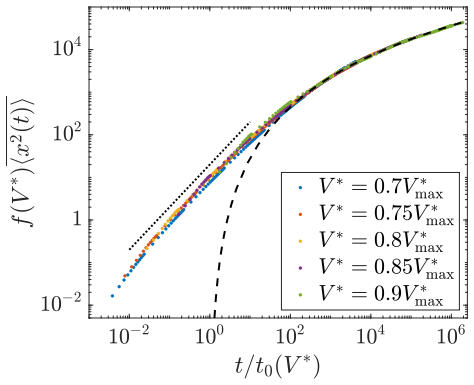
- The disorder-averaged mean-square displacement grows only as $\ln^4 t$ at long times, with a crossover from ordinary diffusion set by a length scale $\ell^*\simeq D^2/\sigma^2$.
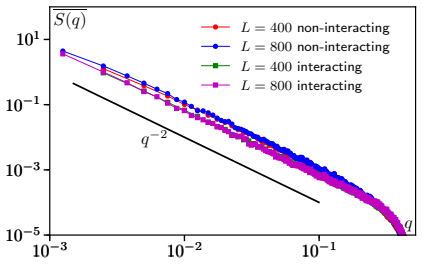
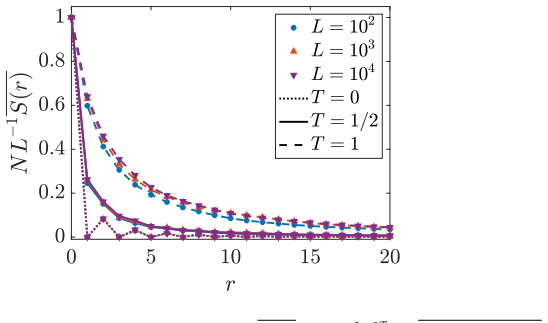
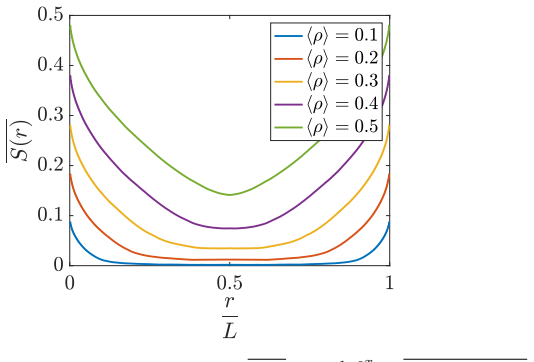
- At weak disorder, many-particle systems develop long-range density correlations: the structure factor diverges as $q^{-2}$ and the real-space correlation function decays linearly on the scale of the system size.
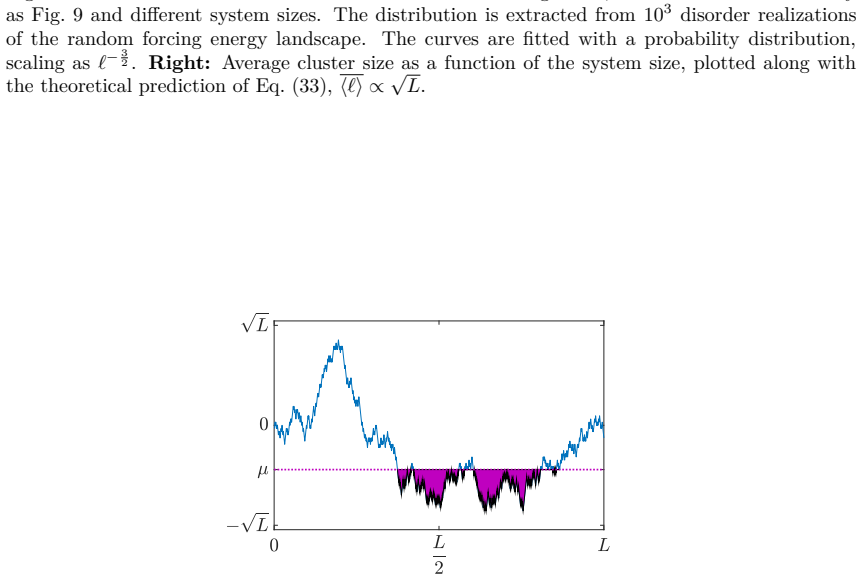
- At strong disorder, non-interacting particles all gather at one minimum, while interacting particles form clusters with a power-law size distribution and mean size $\sqrt{L}$, in contrast to the finite clusters found without disorder.
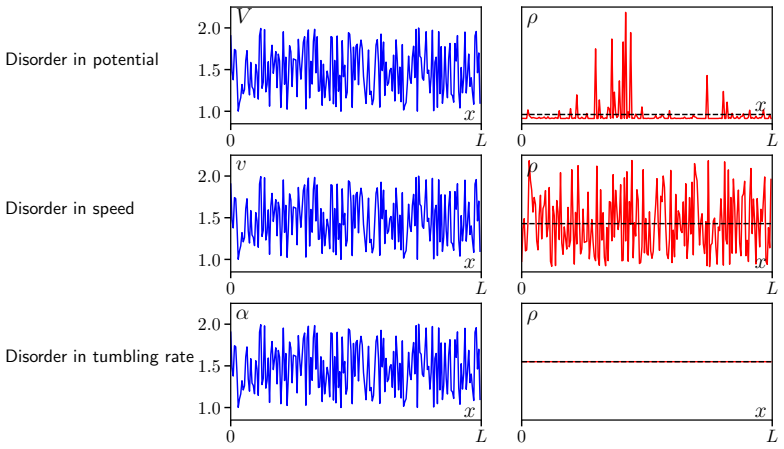
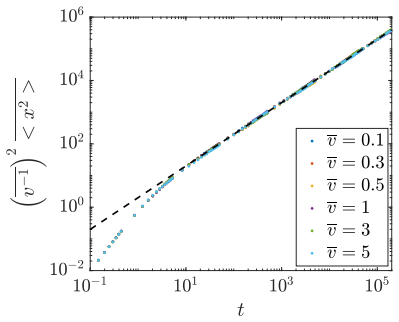
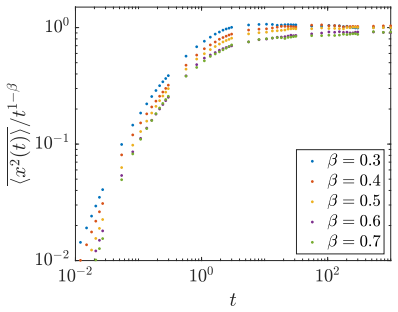
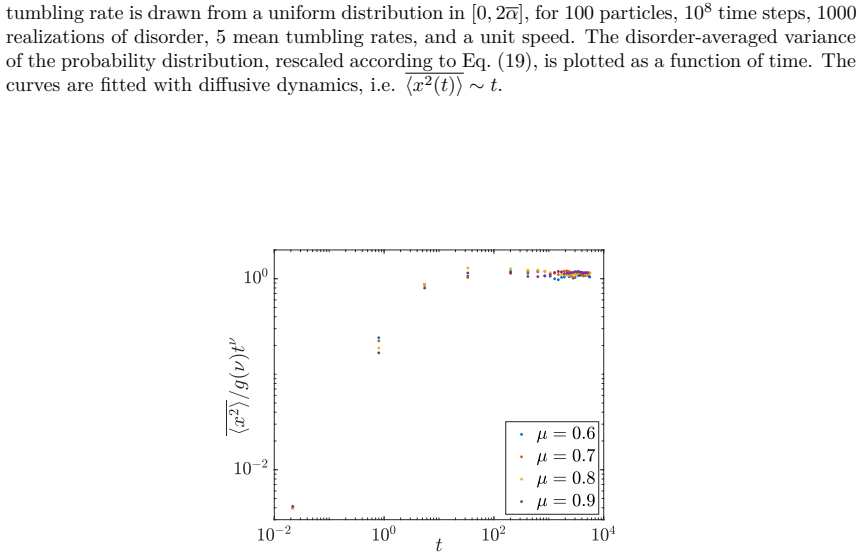
- Disorder in speed or tumbling rate generically gives diffusive spreading; anomalous exponents appear only when the speed distribution near zero behaves like $v^{-\beta}$ or the tumbling-rate tail behaves like $\alpha^{-(1+\mu)}$.
Reading between the lines
- The random-force equivalence is probably generic to any one-dimensional active dynamics that rectifies asymmetric potentials, not only run-and-tumble motion; the paper suggests this for Brownian-noise-assisted hopping and other active models, but does not prove it.
- In two dimensions the same effective random forces should create circulating currents and a slower-than-diffusive spread $\langle x^2\rangle\sim t/\ln t$; the paper flags this as an expectation, not a derived result.
- A direct numerical test of the strong-disorder many-body claim would simulate many interacting run-and-tumble particles in a strongly disordered ratchet potential at $L\gg\ell^*$ and check whether the cluster-size distribution and the $\sqrt{L}$ scaling survive outside the lattice mapping.
- If the clustering result holds, it gives a clean way to distinguish disorder-induced clustering from ordinary motility-induced phase separation: the mean cluster size has no finite thermodynamic limit and grows with system size, which could be probed by controlling speckle or ratchet-like landscapes experimentally.
Signed reviews
Editorial analysis
A structured set of objections, weighed in public.
Referee Report
Summary. The paper studies the effects of quenched disorder on run-and-tumble particles (RTPs) in one dimension. For a single particle, it derives the steady-state distribution (Eq. 3) and the mean first passage time to exit an interval for three types of disorder: a bounded external potential, a space-dependent speed, and a space-dependent tumbling rate. For disordered potential, the steady-state distribution is argued to be equivalent to that of a passive particle in a random force field, and the typical MFPT grows as exp(sqrt(L)), implying Sinai-type diffusion with mean-square displacement scaling as ln^4(t) (Eq. 13), verified numerically in Fig. 3. For speed and tumbling-rate disorder, normal diffusion is generally found, with anomalous exponents when the speed distribution vanishes as v^{-beta} or the tumbling-rate distribution has a diverging mean. For many particles in a disordered potential, the paper predicts, in the weak-disorder regime, a structure factor S(q) ~ q^{-2} (Eq. 29), and in the strong-disorder regime, a cluster-size distribution P(l) ~ l^{-3/2} with mean cluster size ~ sqrt(L) (Eqs. 32-33), the latter derived from a lattice model of non-interacting fermions in a random force landscape.
Significance. The single-particle analysis is a genuine contribution: the derivations are explicit and the Sinai-diffusion prediction for RTPs is non-trivial and is tested by direct simulation without fitting the exponent. The weak-disorder many-body result is also compared against RTP numerics. However, the strong-disorder many-body clustering claim, which is highlighted in the abstract, is supported only by a heuristic mapping to an equilibrium lattice fermion model and has no direct simulation of interacting RTPs; this is the main weakness. If the mapping can be substantiated, the paper would make a strong contribution; as it stands, the many-body part is more suggestive than established.
major comments (2)
- [Sec. 3.2, Eqs. (32)-(33), Figs. 10-11] The central many-body strong-disorder result, the power-law cluster-size distribution P(l) ~ l^{-3/2} and mean cluster size ~ sqrt(L), is derived entirely from a lattice model of non-interacting fermions in a random +/-1 force landscape. The paper states (Sec. 3.2) that direct RTP simulations are 'prohibitively slow' in this regime, and no test of the mapping against interacting RTP dynamics is provided. The single-particle equivalence established in Sec. 2.1.1 concerns the steady state of an isolated particle; it does not by itself imply that soft repulsive RTPs obey the same quasi-potential statistics once interactions are present. Because this is the headline claim of the abstract, please either add a direct numerical test of the cluster-size scaling for interacting RTPs in a numerically accessible parameter range, or provide a physically motivated argument (beyond the analogy) for why the fermion lattice model is the correct effective description.
- [Sec. 3.2, mapping to non-interacting fermions] The mapping to non-interacting fermions assumes (i) that the many-particle steady state is described by filling the single-particle quasi-potential U(x) of Eq. (6) up to a chemical potential and (ii) that finite-range repulsion can be replaced by hard-core exclusion on a lattice. For RTPs with soft pairwise repulsion, neither assumption is self-evident, since the system is out of equilibrium and U(x) was derived from the no-current condition for a single particle. Fig. 10 tests only the lattice fermion model, so the l^{-3/2} law and the sqrt(L) scaling are properties of that model, not of the RTP system. The authors should either relax the claim or provide evidence that the effective interaction among trapped RTPs in the strong-disorder regime is indeed hard-core and that the quasi-potential picture survives interactions.
minor comments (5)
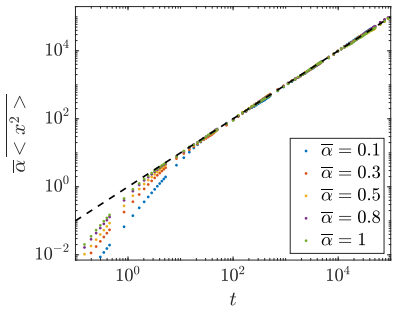
- [Fig. 3] The numerical verification of Eq. (13) would be more convincing with error bars or a statement of the number of disorder realizations used; the caption also appears to read '104 ratchets' where '10^4 ratchets' is intended.
- [Sec. 2.2.1, Eq. (12)] Please state explicitly what the constant A in Eq. (12) depends on (e.g., disorder strength and correlation length) and how its value is chosen in the rescaled axes of Fig. 3.
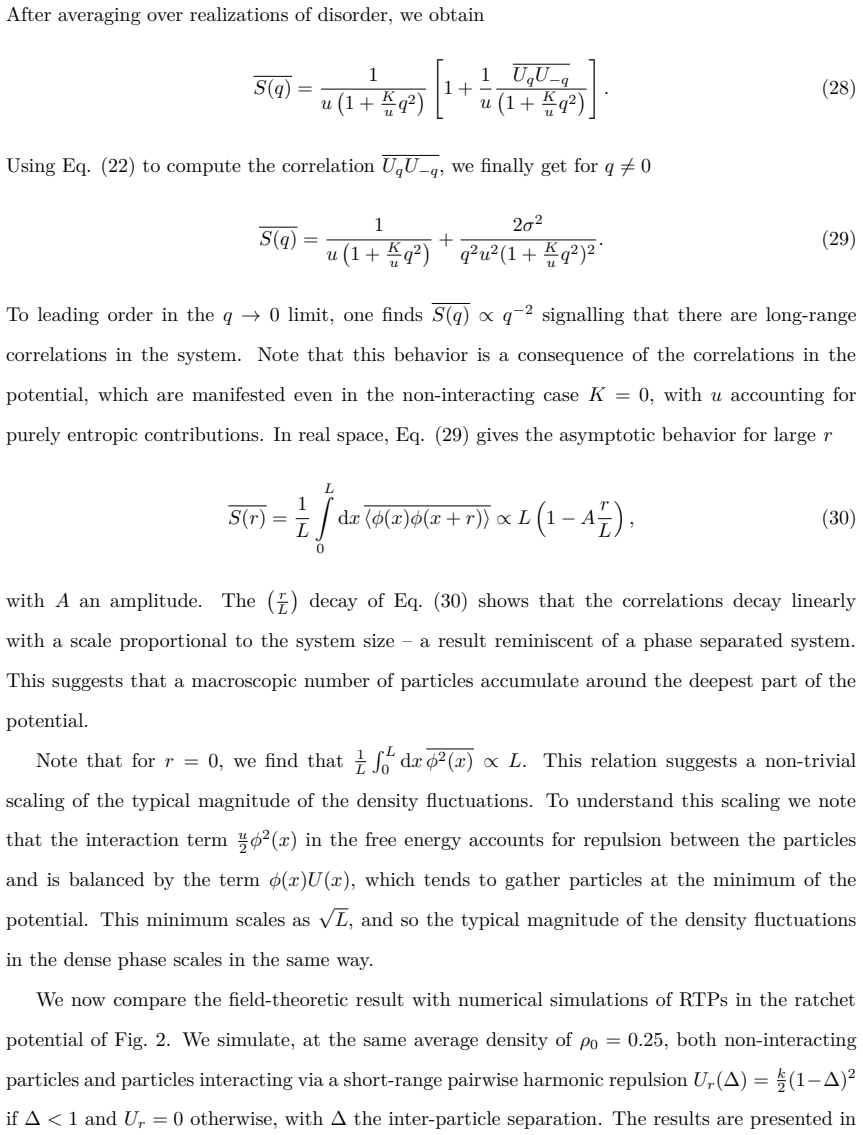
- [Sec. 3.1, Eq. (29)] The structure factor is evaluated for q != 0 in Eq. (29); please state the treatment of the q=0 mode in the Gaussian free energy (21), since the normalization of the total density is sensitive to this mode.
- [Sec. 4] The closing statement that any 1d active particle model generating ratchet currents 'should exhibit the same phenomenology' goes beyond the models analyzed; consider presenting this as a conjecture rather than a conclusion.
- [Various] There are minor typographical issues, e.g., 'dependance' in Sec. 2.2.1 and 'NSF5-BSF' in the acknowledgments, which should be corrected.
Circularity Check
No circular derivation found; the Sinai mapping and many-body predictions are independently derived and tested, with the strong-disorder lattice analogy flagged as a validation limitation rather than a circular input.
full rationale
The paper's single-particle results are derived from the Fokker-Planck equation (Eq. 1) with an explicit steady-state formula (Eq. 3) that is also supported by an independent external reference [17]; the disordered-potential mapping to a random-force landscape follows from a CLT approximation of the quasi-potential (Eqs. 5-6), not from an assumed equality. The Sinai-type MSD scaling (Eq. 13) is obtained from a self-contained MFPT computation in Appendix A and compared against direct RTP simulations in Fig. 3, with the ln^4 t law benchmarked to the external Sinai/Bouchaud literature. The weak-disorder many-body structure factor (Eq. 29) is solved exactly from the Gaussian free-energy ansatz and then tested against RTP numerics in Fig. 8, so the q^{-2} divergence is a falsifiable prediction rather than a fitted input. In the strong-disorder regime the paper explicitly states that direct RTP simulations are 'prohibitively slow' and therefore uses a lattice-fermion analog; the cluster-size power law (Eq. 32) is a derived first-return property verified on that analog (Fig. 10). This is an unvalidated analogy for interacting RTPs, a correctness or validation risk, but it is not circular because the cluster statistics are not assumed as an input and no exponent is fitted to the claimed RTP result. Self-citations occur (e.g., Refs. [5,9]), but the load-bearing steady-state and MFPT equations are either derived in the paper or carry an independent external citation, so no claim reduces to its own input.
Assumptions & free parameters
assumptions (6)
- domain assumption The run-and-tumble Fokker-Planck equations (1) correctly describe the dynamics with space-dependent speed v(x), tumbling rate α(x), and potential V(x).
- domain assumption The potential slope is bounded by the propulsion speed, v(x) > |μ ∂x V|, so the particle can cross all barriers.
- standard math The disorder has short-range correlations, so the integral of ∂x Ṽ over intervals of length ξ can be treated as a sum of i.i.d. random variables (Eq. 5).
- standard math The asymptotic MFPT is dominated by saddle-point evaluation of exponential terms involving the effective potential W(x), whose typical fluctuations grow as sqrt(L).
- ad hoc to paper The weak-disorder many-body structure factor is captured by a Gaussian free energy functional with interaction coefficients K and u (Eq. 21).
- ad hoc to paper In strong disorder, interacting RTPs on a random force landscape are represented by non-interacting Fermions filling energy levels up to a chemical potential.
Cite this review
Pith. "Pith review of Ramifications of disorder on active particles in one dimension." pith.science (2026). https://pith.science/paper/CQXVJ7E7
@misc{pith2026190800568,
  author       = {Pith},
  title        = {Pith review of: Ramifications of disorder on active particles in one dimension},
  year         = {2026},
  howpublished = {\url{https://pith.science/paper/CQXVJ7E7}},
  note         = {Machine review of arXiv:1908.00568}
}
read the original abstract
The effects of quenched disorder on a single and many active run-and-tumble particles is studied in one dimension. For a single particle, we consider both the steady-state distribution and the particle's dynamics subject to disorder in three parameters: a bounded external potential, the particle's speed, and its tumbling rate. We show that in the case of a disordered potential, the behavior is like an equilibrium particle diffusing on a random force landscape, implying a dynamics that is logarithmically slow in time. In the situations of disorder in the speed or tumbling rate, we find that the particle generically exhibits diffusive motion, although particular choices of the disorder may lead to anomalous diffusion. Based on the single-particle results, we find that in a system with many interacting particles, disorder in the potential leads to strong clustering. We characterize the clustering in two different regimes depending on the system size and show that the mean cluster size scales with the system size, in contrast to non-disordered systems.
Figures

Figures from the paper (10 more)

Reference graph
Works this paper leans on
-
[1]
Paul D Frymier, Roseanne M Ford, Howard C Berg, and Peter T Cummings. Three- dimensional tracking of motile bacteria near a solid planar surface.Proceedings of the National Academy of Sciences, 92(13):6195–6199, 1995
work page 1995
-
[2]
A wall of funnels concentrates swimming bacteria
Peter Galajda, Juan Keymer, Paul Chaikin, and Robert Austin. A wall of funnels concentrates swimming bacteria. Journal of bacteriology, 189(23):8704–8707, 2007
work page 2007
-
[3]
J Tailleur and ME Cates. Sedimentation, trapping, and rectification of dilute bacteria.EPL (Europhysics Letters), 86(6):60002, 2009
work page 2009
-
[4]
Y Baek, AP Solon, X Xu, N Nikola, and Y Kafri. Generic long-range interactions between passive bodies in an active fluid.Physical review letters, 120(5):058002, 2018
work page 2018
-
[5]
Pressure is not a state function for generic active fluids.Nature Physics, 11:673–678, 2015
AP Solon, Y Fily, A Baskaran, ME Cates, Y Kafri, M Kardar, and J Tailleur. Pressure is not a state function for generic active fluids.Nature Physics, 11:673–678, 2015
work page 2015
-
[6]
Active versus passive hard 25 disks against a membrane: mechanical pressure and instability
G Junot, G Briand, R Ledesma-Alonso, and O Dauchot. Active versus passive hard 25 disks against a membrane: mechanical pressure and instability. Physical Review Letters, 119(2):028002, 2017
work page 2017
-
[7]
Ydan Ben Dor, Yariv Kafri, and Julien Tailleur. Forces in dry active matter.arXiv preprint arXiv:1811.08829, 2018
work page Pith review arXiv 2018
-
[8]
Dynamics of self-propelled particles under strong con- finement.Soft Matter, 10(30):5609, 2014
Y Fily, A Baskaran, and MF Hagan. Dynamics of self-propelled particles under strong con- finement.Soft Matter, 10(30):5609, 2014
work page 2014
Show all 40 references
-
[9]
Active particles with soft and curved walls: Equation of state, ratchets, and instabilities.Physical Review Letters, 117:098001–5, 2016
N Nikola, A P Solon, Y Kafri, M Kardar, J Tailleur, and Vouturiez R. Active particles with soft and curved walls: Equation of state, ratchets, and instabilities.Physical Review Letters, 117:098001–5, 2016
2016
-
[10]
Substrate catalysis enhances single-enzyme diffusion.Journal of the American Chemical Society, 132(7):2110–2111, 2010
Hari S Muddana, Samudra Sengupta, Thomas E Mallouk, Ayusman Sen, and Peter J But- ler. Substrate catalysis enhances single-enzyme diffusion.Journal of the American Chemical Society, 132(7):2110–2111, 2010
2010
-
[11]
Optimal noise maximizes collective motion in heterogeneous media.Physical review letters, 110(23):238101, 2013
Oleksandr Chepizhko, Eduardo G Altmann, and Fernando Peruani. Optimal noise maximizes collective motion in heterogeneous media.Physical review letters, 110(23):238101, 2013
2013
-
[12]
Swarming in the dirt: Ordered flocks with quenched disorder
John Toner, Nicholas Guttenberg, and Yuhai Tu. Swarming in the dirt: Ordered flocks with quenched disorder. Physical review letters, 121(24):248002, 2018
2018
-
[13]
Hydrodynamic theory of flocking in the presence of quenched disorder.Physical Review E, 98(6):062604, 2018
John Toner, Nicholas Guttenberg, and Yuhai Tu. Hydrodynamic theory of flocking in the presence of quenched disorder.Physical Review E, 98(6):062604, 2018
2018
-
[14]
Polar flock in the presence of random quenched rotators
Rakesh Das, Manoranjan Kumar, and Shradha Mishra. Polar flock in the presence of random quenched rotators. Physical Review E, 98(6):060602, 2018
2018
-
[15]
Brownian motion in a speckle light field: tunable anomalous diffusion and selective optical manipulation.Scientific reports, 4:3936, 2014
Giorgio Volpe, Giovanni Volpe, and Sylvain Gigan. Brownian motion in a speckle light field: tunable anomalous diffusion and selective optical manipulation.Scientific reports, 4:3936, 2014
2014
-
[16]
Run-and-tumble particles in speckle fields
M Paoluzzi, R Di Leonardo, and L Angelani. Run-and-tumble particles in speckle fields. Journal of Physics: Condensed Matter, 26(37):375101, 2014. 26
2014
-
[17]
Activation rates for nonlinear stochastic flows driven by non-gaussian noise
C Van den Broeck and P Hänggi. Activation rates for nonlinear stochastic flows driven by non-gaussian noise. Physical Review A, 30(5):2730, 1984
1984
-
[18]
Limit behaviour of one-dimensional random walks in random envi- ronments
Yakov Grigor’evich Sinai. Limit behaviour of one-dimensional random walks in random envi- ronments. Teoriya Veroyatnostei i ee Primeneniya, 27(2):247–258, 1982
1982
-
[19]
Classical diffusion of a particle in a one-dimensional random force field.Annals of Physics, 201(2):285–341, 1990
J-Ph Bouchaud, A Comtet, A Georges, and P Le Doussal. Classical diffusion of a particle in a one-dimensional random force field.Annals of Physics, 201(2):285–341, 1990
1990
-
[20]
Dynamics of molecular motors and polymer translocation with sequence heterogeneity
Yariv Kafri, David K Lubensky, and David R Nelson. Dynamics of molecular motors and polymer translocation with sequence heterogeneity. Biophysical journal, 86(6):3373–3391, 2004
2004
-
[21]
Driven ratchets with disordered tracks
Thomas Harms and Reinhard Lipowsky. Driven ratchets with disordered tracks. Physical review letters, 79(15):2895, 1997
1997
-
[22]
Motility-induced phase separation.Annual Review of Condensed Matter Physics, 6(1):219–244, 2015
ME Cates and J Tailleur. Motility-induced phase separation.Annual Review of Condensed Matter Physics, 6(1):219–244, 2015
2015
-
[23]
Statistical mechanics of interacting run-and-tumble bacteria.Phys- ical review letters, 100(21):218103, 2008
J Tailleur and ME Cates. Statistical mechanics of interacting run-and-tumble bacteria.Phys- ical review letters, 100(21):218103, 2008
2008
-
[24]
Random walks in biology
HC Berg. Random walks in biology. Princeton University Press, 1993
1993
-
[25]
Theory of continuum random walks and application to chemotaxis.Physical Review E, 48(4):2553, 1993
MJ Schnitzer. Theory of continuum random walks and application to chemotaxis.Physical Review E, 48(4):2553, 1993
1993
-
[26]
Statistical mechanics of interacting run-and-tumble bacteria.Phys- ical Review Letters, 100(21):218103, 2008
J Tailleur and ME Cates. Statistical mechanics of interacting run-and-tumble bacteria.Phys- ical Review Letters, 100(21):218103, 2008
2008
-
[27]
Activated escape of a self-propelled particle from a metastable state
E Woillez, Y Zhao, Y Kafri, V Lecomte, and J Tailleur. Activated escape of a self-propelled particle from a metastable state
-
[28]
Handbook of stochastic methods for physics, chemistry and the natural sciences, volume 25
Crispin W Gardiner. Handbook of stochastic methods for physics, chemistry and the natural sciences, volume 25. 1986. 27
1986
-
[29]
Bacterial ratchet motors.Proceedings of the National Academy of Sciences, 107(21):9541–9545, 2010
R Di Leonardo, L Angelani, D Della Arciprete, G Ruocco, V Iebba, S Schippa, MP Conte, F Mecarini, F De Angelis, and E Di Fabrizio. Bacterial ratchet motors.Proceedings of the National Academy of Sciences, 107(21):9541–9545, 2010
2010
-
[30]
Swimming bacteria power mi- croscopic gears
A Sokolov, MM Apodaca, BA Grzybowski, and IS Aranson. Swimming bacteria power mi- croscopic gears. Proceedings of the National Academy of Sciences, 107(3):969–974, 2010
2010
-
[31]
Velocity and diffusion constant of a periodic one-dimensional hopping model
Bernard Derrida. Velocity and diffusion constant of a periodic one-dimensional hopping model. Journal of statistical physics, 31(3):433–450, 1983
1983
-
[32]
Random walkers in one-dimensional random environments: exact renormalization group analysis.Physical Review E, 59(5):4795, 1999
Pierre Le Doussal, Cécile Monthus, and Daniel S Fisher. Random walkers in one-dimensional random environments: exact renormalization group analysis.Physical Review E, 59(5):4795, 1999
1999
-
[33]
Dynamic density shaping of photokinetic e
Giacomo Frangipane, Dario Dell’Arciprete, Serena Petracchini, Claudio Maggi, Filippo Saglimbeni, Silvio Bianchi, Gaszton Vizsnyiczai, Maria Lina Bernardini, and Roberto Di Leonardo. Dynamic density shaping of photokinetic e. coli.Elife, 7:e36608, 2018
2018
-
[34]
Dynamics-dependent density distribution in active suspensions
Jochen Arlt, Vincent A Martinez, Angela Dawson, Teuta Pilizota, and Wilson CK Poon. Dynamics-dependent density distribution in active suspensions. Nature communications, 10(1):2321, 2019
2019
-
[35]
Excitation dynamics in random one-dimensional systems
S Alexander, J Bernasconi, WR Schneider, and R Orbach. Excitation dynamics in random one-dimensional systems. Reviews of Modern Physics, 53(2):175, 1981
1981
-
[36]
Near-extreme statis- tics of brownian motion.Physical review letters, 111(24):240601, 2013
Anthony Perret, Alain Comtet, Satya N Majumdar, and Gregory Schehr. Near-extreme statis- tics of brownian motion.Physical review letters, 111(24):240601, 2013
2013
-
[37]
On the gap and time interval between the first two maxima of long random walks.Journal of Statistical Mechanics: Theory and Experiment, 2014(9):P09013, 2014
Satya N Majumdar, Philippe Mounaix, and Gregory Schehr. On the gap and time interval between the first two maxima of long random walks.Journal of Statistical Mechanics: Theory and Experiment, 2014(9):P09013, 2014
2014
-
[38]
Diffusion, subdiffusion, and trapping of active particles in heterogeneous media.Physical review letters, 111(16):160604, 2013
Oleksandr Chepizhko and Fernando Peruani. Diffusion, subdiffusion, and trapping of active particles in heterogeneous media.Physical review letters, 111(16):160604, 2013. 28
2013
-
[39]
Steadystate, relaxationandfirst-passageproperties of a run-and-tumble particle in one-dimension.Journal of Statistical Mechanics: Theory and Experiment, 2018(4):043215, 2018
Kanaya Malakar, V Jemseena, Anupam Kundu, K Vijay Kumar, Sanjib Sabhapandit, Satya N Majumdar, SRedner, andAbhishekDhar. Steadystate, relaxationandfirst-passageproperties of a run-and-tumble particle in one-dimension.Journal of Statistical Mechanics: Theory and Experiment, 2018...
2018
-
[40]
In these non-dimensional units, we denote(−µ∂xV ) by ϕ(x)
For compactness, time can be rescaled using the inverse tumbling rate and length can be rescaled by the factorvα 2 . In these non-dimensional units, we denote(−µ∂xV ) by ϕ(x). Equations (A.1) can then be written in the dimensionless form ∂tP+ (x′,t ;x, 0) = (1 +ϕ(x))∂xP+ (x′,t...
Reviewed August 14, 2026 · model on record in the stance chip above.
Discussion (0). Continue with ORCID to comment.