REVIEW 3 major objections 3 minor 62 references
The Casimir pressure between metallic plates out of thermal equilibrium: Proposed test for the relaxation properties of free electrons
T0 review · 3 major / 3 minor · reviewed 2026-08-14 · deepseek-v4-flash
Pith's one-line read Heating one of two gold plates by just 10 K in a modified CANNEX experiment could distinguish the Drude and plasma descriptions of conduction electrons in the out-of-equilibrium Casimir pressure.
desk verdict A concrete, well-posed proposal for discriminating Drude from plasma in the out-of-equilibrium Casimir effect, with standard theory and credible but unproven sensitivity assumptions. read the letter →
The pith
A machine-rendered reading of the paper's core claim, the machinery that carries it, and where it could break.
The reading
What carries the argument
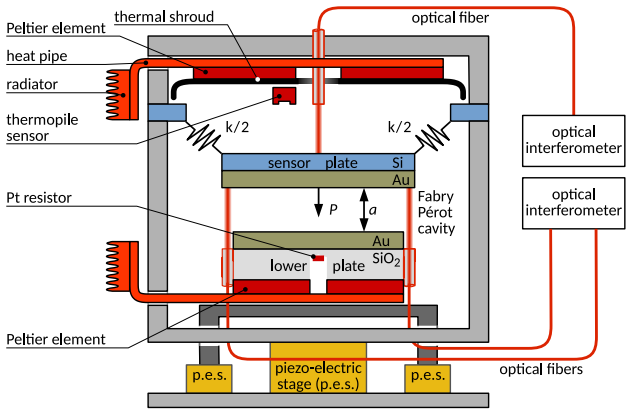
The load-bearing device is the three-term decomposition of the out-of-equilibrium Casimir pressure, Eq. (1): the mean of the equilibrium pressures at the two plate temperatures, $\frac{1}{2}[P_{\rm eq}(a,T_1)+P_{\rm eq}(a,T_2)]$; an antisymmetric term $\Delta P_{\rm neq}(a,T_1,T_2)$ that changes sign when the temperatures are interchanged; and a separation-independent radiation term $\frac{2\sigma}{3c}(T_1^4+T_2^4)$. For coatings thicker than the penetration depth of the relevant fluctuations, the antisymmetric term drops out, so the pressure and its gradient are governed by the mean equilibrium term plus the constant radiation pressure, making the predictions computable from the equilibrium Lifshitz formula with layered reflection coefficients. The second piece of machinery is the choice of how to extrapolate gold's optical data to zero frequency: the Drude model $\varepsilon_D(\omega)=1-\omega_p^2/[\omega(\omega+i\gamma)]$, which keeps the relaxation of conduction electrons, versus the lossless plasma model $\varepsilon_p(\omega)=1-\omega_p^2/\omega^2$; this choice enters the Matsubara reflection coefficients and produces the divergent predictions. The third is the CANNEX apparatus itself — a parallel-plate force sensor using interferometric detection of pressure and pressure-gradient — whose proposed thermal modification keeps the sensor stable to better than 1 mK by radiative shielding and Peltier control while the lower plate is heated up to 10 K above ambient.
What would settle it
Run the modified CANNEX configuration with the plates at $T_1=300$ K and $T_2=310$ K and compare the measured total pressure, differential pressure, and pressure gradient over 4–10 µm with the two model predictions: if the data do not clearly agree with one model and exclude the other at the quoted sensitivities, or if the predicted separation-independent offset of about 0.14 µPa is not resolved, the discrimination claim fails. A direct computation showing that the antisymmetric term $\Delta P_{\rm neq}$ in Eq. (7) is not negligible at the CANNEX plate thicknesses would equally invalidate the reduction to Eq. (20).
Extended reading notes
Core claim
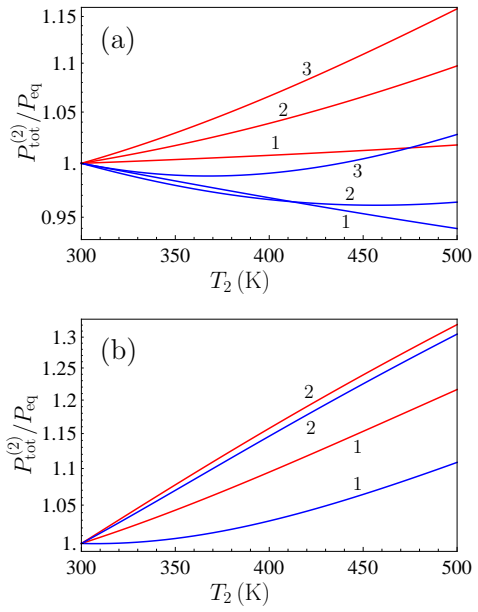
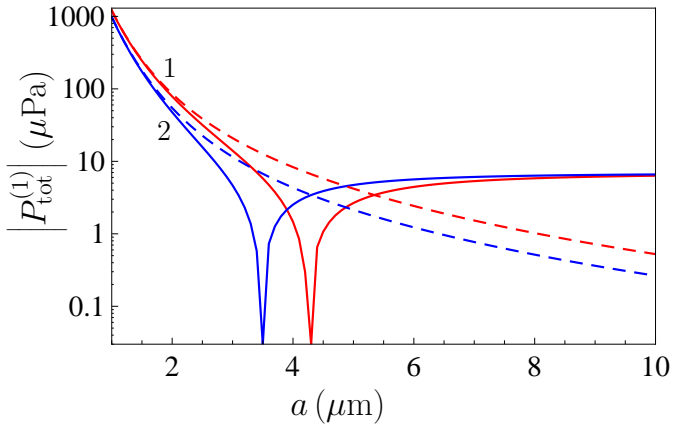
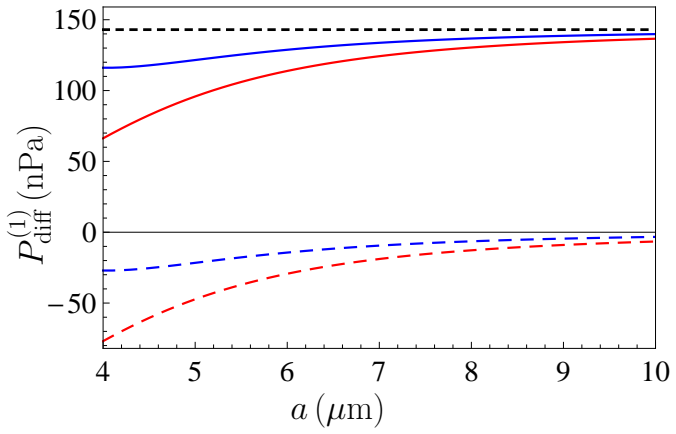
The central claim is that in a configuration of two parallel plates with the upper plate at ambient temperature $T_1$ and the lower plate at a different temperature $T_2$, with metallic coatings thick enough to shield the dielectric substrates, the nonequilibrium Casimir pressure on the upper plate takes the form $$P(a,T_1,T_2)=\tfrac{1}{2}\bigl[P_{\rm eq}(a,T_1)+P_{\rm eq}(a,T_2)\bigr] + \tfrac{2\$\sigma$}{3c}\left($T_2^{4}$ - $T_1^{4}$\right),$$ because the antisymmetric contribution $\Delta P_{\rm neq}$ vanishes to high accuracy for thick plates. The paper computes this pressure and its gradient for two gold plates using the standard Lifshitz formula, extrapolating the optical data of gold to zero frequency either with the Drude model (relaxation parameter $\hbar\gamma = 0.035$ eV) or with the lossless plasma model. The two extrapolations give markedly different predictions: the ratio of nonequilibrium to equilibrium pressure grows monotonically with $T_2$ under the plasma model but is nonmonotonic under the Drude model, and in the CANNEX geometry with $T_1=300$ K, $T_2=310$ K, the predicted pressure gradients differ by factors between $10^2$ and $2\times10^3$ times the experimental sensitivity, while the total pressures and the separation-independent offset of about $0.14\,\mu$Pa are also well above the noise floor. The paper claims that this allows a reliable discrimination between the two theoretical approaches, and a direct test of the separation-independent term, using the modified CANNEX setup over separations from 4 to 10 µm.
Load-bearing premise
The load-bearing premise is that the modified apparatus can actually deliver its stated performance — pressure sensitivity of 1 nPa, gradient sensitivity of 1 mPa/m, and a sensor temperature stable to better than 1 mK while the lower plate runs 10 K warmer — without systematic errors as large as the predicted model differences, since the entire discrimination claim rests on those signals exceeding the sensitivities.
Editorial extensions
If this is right
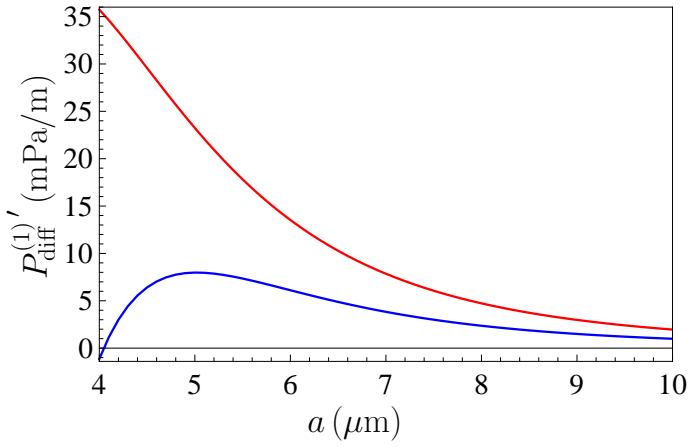
- A modified CANNEX run with a 10 K temperature offset would separate the Drude and plasma predictions for the total pressure gradient over the 4–10 µm range by factors of $10^2$ to $2\times10^3$ relative to the 1 mPa/m sensitivity.
- A measurement of the total pressure would test the separation-independent term $\frac{2\sigma}{3c}(T_2^4 - T_1^4)$, whose predicted contribution of about 0.14 µPa is far above the 1 nPa pressure sensitivity.
- The gradient measurement isolates the mean of the equilibrium pressures at the two temperatures, so a single configuration simultaneously tests the thermal Casimir prediction at two different temperatures.
- A confirmed plasma-model result would carry the agreement found in equilibrium experiments at sub-micrometer separations into a nonequilibrium setting at separations of several micrometers.
- The test complements the alternative difference-force scheme aimed at the antisymmetric term, covering the contributions that scheme deliberately screens out.
Reading between the lines
- A natural null-test extension would compare heated and unheated runs ($T_2 = T_1$), where the separation-independent term vanishes, directly verifying its $T^4$ scaling rather than relying on a single 10 K point.
- The same three-term decomposition should transfer to other metals or layered coatings such as graphene-coated plates, where the Drude-versus-plasma discrepancy may be larger or smaller; the formalism already handles layered systems.
- Coatings thinner than the thermal penetration depth would revive the antisymmetric term, turning the approximation behind Eq. (20) into an independent measurement channel instead of a screening condition.
- If the plasma model wins here as it has in equilibrium experiments, the authors' closing remark points to the deeper consequence: the postulate that a material's response to a real field equals its response to a zero-strength fluctuating field may be the assumption that needs revision.
Signed reviews
Editorial analysis
A structured set of objections, weighed in public.
Referee Report
Summary. The paper proposes a modified CANNEX experiment to measure the nonequilibrium Casimir pressure and pressure gradient between two parallel Au-coated plates held at different temperatures. Using standard Lifshitz theory for out-of-equilibrium configurations, the total pressure is decomposed into the mean of the two equilibrium pressures, an antisymmetric term ΔPneq, and a separation-independent radiation-pressure term. For identical thick plates ΔPneq vanishes; for the realistic dissimilar CANNEX plates the authors assert that the gradient of ΔPneq is more than four orders of magnitude smaller than the mean-gradient term and omit it. Numerical predictions are presented for T1 = 300 K, T2 = 310 K using both Drude and plasma extrapolations of Au optical data. The central claim is that even with a 10 K temperature difference the experiment could discriminate between the Drude and plasma model predictions for the total pressure, the pressure gradient, and the separation-independent contribution at high confidence.
Significance. If the central claim holds, the modified CANNEX test would provide a new, experimentally accessible discriminator between the Drude and plasma model extrapolations in out-of-equilibrium Casimir physics. The theoretical framework is standard, the computational setup is realistic, and the predictions are quantitative and falsifiable. The paper does not fit any parameter to the predicted outcome; the only inputs are established Au optical data and two standard model extrapolations. The main qualifications are that the quoted CANNEX sensitivities are projected rather than demonstrated, and that the numerical suppression of ΔPneq is reported only in words, without a visible computation. These points are load-bearing for the claimed high-confidence discrimination, but they are addressable within the manuscript's scope.
major comments (3)
- [Sec. IVB, Eqs. (12), (19)-(20), Figs. 7-8] The numerical evidence for dropping ΔPneq is incomplete. The text reports only that ΔP'neq is more than four orders of magnitude smaller than the first term in Eq. (19); it does not report the magnitude of ΔPneq itself. Since Eq. (12), which is used for the pressure predictions in Figs. 7 and 8, still contains ΔPneq, and since ΔPneq can contain a separation-independent part arising from the propagating-wave term in Eq. (7), the claim that the 0.14 µPa separation-independent contribution can be isolated and tested is not supported unless ΔPneq and its a-independent part are also demonstrated to be negligible for the actual CANNEX parameters (d1 = 200 nm, d2 = 1 µm, Si and SiO2 substrates). Please provide plots or tables of both ΔPneq(a,T1,T2) and ΔP'neq(a,T1,T2) for the Drude and plasma models, and state explicitly whether Eq. (12) is used with ΔPneq set to zero.
- [Sec. IVA and Fig. 6] The experimental sensitivity and stability figures (1 nPa for pressure, 1 mPa/m for gradient, 2 mPa/m for differential gradient, and better than 1 mK sensor stability) are quoted from the design proposal in Ref. [50], not from a demonstrated measurement in the modified heated configuration. The Drude differential gradient in Fig. 6 exceeds the quoted sensitivity by at most a factor of about 4, so a factor-of-5 degradation from thermal expansion of the 6-mm SiO2 cylinder, radiative heat-load gradients, patch potentials, or interferometer noise would erase the claimed discrimination. A quantitative error budget for the modified configuration, or a more cautious statement of the discrimination claim, is required.
- [Sec. III, Eq. (17), Figs. 5-8] The theoretical predictions are presented without uncertainty estimates. The values ℏωp = 9.0 eV and ℏγ = 0.035 eV at 300 K are taken as fixed inputs, and the optical data of Ref. [54] are used without a stated uncertainty. To support the claim that the two model predictions can be 'reliably discriminated' experimentally, the authors should show that the predicted pressure and gradient differences are robust against plausible variations in these inputs (e.g., literature spread in the Au relaxation parameter and optical-data uncertainties). Without such a sensitivity analysis, the statistical meaning of 'high confidence' in the discrimination claim is not established.
minor comments (3)
- [Sec. IVB] The sentence explaining the smallness of ΔP'neq says that the Au layer thicknesses are 'larger than the thermal wavelength contributing to ΔP'neq'. Since d1 = 200 nm and d2 = 1 µm are both much smaller than λT = ℏc/(kBT) ≈ 7.6 µm at 300 K, this wording is misleading; if the intended quantity is the electromagnetic penetration depth into Au at the relevant frequencies, the text should say so and justify the statement numerically.
- [Figs. 7 and 8] The vertical-axis labels appear garbled in the manuscript rendering ('/Minus6', '/Minus5', etc.); the axes should display proper powers-of-ten notation such as 10^-6.
- [Throughout] There are several typographical errors, including 'nonequlibrium' in Secs. IVB and V and 'nonqulibrium' near the end of Sec. IVB; these should be corrected.
Circularity Check
No circularity: the nonequilibrium pressures are computed from standard Lifshitz theory with fixed Drude/plasma permittivities, and the cited CANNEX sensitivities are experimental assumptions rather than fitted outputs.
full rationale
The derivation chain is self-contained. Equation (1) is the standard three-term decomposition of the nonequilibrium pressure taken from Refs. [30,34], while Eqs. (2)-(6) are the standard Lifshitz formulas. For equal Au plates, Eq. (14) gives R(1)=R(2), so Eq. (7) yields DeltaPneq=0 and Eqs. (15),(16) follow algebraically. In the CANNEX configuration, the gradient is computed by Eq. (20) as the mean of equilibrium gradients because the paper asserts, without displaying the calculation, that DeltaPneq' is more than four orders of magnitude smaller; this is an unverified numerical claim, but not a fit and not a definitional identity. The Drude and plasma permittivities in Eqs. (17),(18) are standard model extrapolations of optical data with fixed parameters, not parameters fitted to the target Casimir signal. The high-confidence discrimination claim is obtained by comparing computed model differences with the sensitivity figures quoted from Ref. [50]; those sensitivities are experimental inputs or assumptions, and the discrimination statement is conditional on them, but the theoretical predictions are not constructed from the experimental outcome. No predicted quantity is set equal to an input by construction, and no load-bearing uniqueness theorem is imported from the authors' prior work. The main caveats - unproven sensitivity performance and the numerical neglect of DeltaPneq' - are correctness and feasibility risks, not circularity.
Assumptions & free parameters
free parameters (2)
- Gold plasma frequency (hbar omega_p) =
9.0 eV
- Gold relaxation parameter (hbar gamma) at 300 K =
0.035 eV
assumptions (4)
- standard math The Lifshitz formula Eq. (2) and the nonequilibrium decomposition Eq. (1) from Refs. [30, 34] correctly describe the Casimir pressure out of thermal equilibrium.
- domain assumption The optical data of Au from Ref. [54] extrapolated to zero frequency by the Drude or plasma model accurately represent the dielectric response of gold in the relevant frequency range.
- domain assumption The metallic coatings in the CANNEX configuration (200 nm and 1 micron) are thick enough that the dielectric substrates do not contribute to the pressure and that the antisymmetric term is negligible.
- domain assumption The temperature dependence of the Drude relaxation parameter has only a minor impact on the results, as stated after Eq. (7).
Cite this review
Pith. "Pith review of The Casimir pressure between metallic plates out of thermal equilibrium: Proposed test for the relaxation properties of free electrons." pith.science (2026). https://pith.science/paper/6WQZJDUC
@misc{pith2026190800570,
  author       = {Pith},
  title        = {Pith review of: The Casimir pressure between metallic plates out of thermal equilibrium: Proposed test for the relaxation properties of free electrons},
  year         = {2026},
  howpublished = {\url{https://pith.science/paper/6WQZJDUC}},
  note         = {Machine review of arXiv:1908.00570}
}
read the original abstract
We propose a test on the role of relaxation properties of conduction electrons in the Casimir pressure between two parallel metal-coated plates kept at different temperatures. It is shown that for sufficiently thick metallic coatings the Casimir pressure and pressure gradient are determined by the mean of the equilibrium contributions calculated at temperatures of the two plates and by the term independent on separation. Numerical computations of the nonequilibrium pressures are performed for two parallel Au plates of finite thickness as a function of separation and temperature of one of the plates using the plasma and Drude models for extrapolation of the optical data of Au to low frequencies. The obtained results essentially depend on the extrapolation used. Modifications of the CANNEX setup, originally developed to measure the Casimir pressure and pressure gradient in thermal equilibrium, are suggested, which allow different temperatures of one of the plates. Computations of the nonequilibrium pressure and pressure gradient are performed for a realistic experimental configuration. According to our results, even with only a 10~K difference in temperature between the plates, the experiment could discriminate between different theoretical predictions for the total pressure and its gradient, as well as for the contributions to them due to nonequilibrium, at high confidence.
Figures

Figures from the paper (5 more)


Reference graph
Works this paper leans on
-
[50]
G. L. Klimchitskaya, V. M. Mostepanenko, R. I. P. Sedmik , and H. Abele, Prospects for Searching Thermal Effects, Non-Newtonian Gravity and Axion- Like Particles: CANNEX Test of the Quantum Vacuum, Symmetry 11, 407 (2019)
work page 2019
-
[54]
E. D. Palik (ed.), Handbook of Optical Constants of Solids (Academic Press, New York, 1985)
1985
- [1]
-
[2]
R. H. French, V. A. Parsegian, R. Podgornik, et al., Long- range interactions in nanoscale science, Rev. Mod. Phys. 82, 1887 (2010)
work page 2010
-
[3]
H. B. G. Casimir, On the attraction between two perfectly conducting plates, Proc. K. Ned. Akad. Wet. B 51, 793 (1948)
work page 1948
- [4]
-
[5]
H. B. Chan, V. A. Aksyuk, R. N. Kleiman, D. J. Bishop, and F. Capasso, Quantum mechanical actuation of microelectromechanical systems by the Casimi r force, Science 291, 1941 (2001)
work page 2001
-
[6]
R. Esquivel-Sirvent and R. P´ erez-Pasqual, Geometry an d charge carrier induced stability in Casimir actuated nanodevices, Eur. Phys. J. B 86, 467 (2013)
work page 2013
Show all 62 references
-
[7]
Broer, G
W. Broer, G. Palasantzas, J. Knoester, and V. B. Svetovoy , Significance of the Casimir force and surface roughness for actuation dynamics of MEMS, Phys. Rev. B 87, 125413 (2013)
2013
-
[8]
Sedighi, W
M. Sedighi, W. H. Broer, G. Palasantzas, and B. J. Kooi, Se nsitivity of micromechanical actuation on amorphous to crystalline phase transformatio ns under the influence of Casimir forces, Phys. Rev. B 88, 165423 (2013)
2013
-
[9]
Broer, H
W. Broer, H. Waalkens, V. B. Svetovoy, J. Knoester, and G. Palasantzas, Nonlinear Actuation Dynamics of Driven Casimir Oscillators with Rough Surfaces , Phys. Rev. Appl. 4, 054016 (2015)
2015
-
[10]
L. Tang, M. Wang, C. Y. Ng, M. Nikolic, C. T. Chan, A. W. Rod riguez, and H. B. Chan, Measurement of nonmonotonic Casimir forces between silico n nanostructures, Nat. Photonics 11, 97 (2017). 18
2017
-
[11]
G. L. Klimchitskaya, V. M. Mostepanenko, V. M. Petrov, a nd T. Tschudi, Optical Chopper Driven by the Casimir Force, Phys. Rev. Applied 10, 014010 (2018)
2018
-
[12]
E. M. Lifshitz, The theory of molecular attractive forc es between solids, Zh. Eksp. Teor. Fiz. 29, 94 (1955) [Sov. Phys. JETP 2, 73 (1956)]
1955
-
[13]
G. L. Klimchitskaya, U. Mohideen, and V. M. Mostepanenk o, The Casimir force between real materials: Experiment and theory, Rev. Mod. Phys. 81, 1827 (2009)
2009
-
[14]
Chang, A
C.-C. Chang, A. A. Banishev, R. Castillo-Garza, G. L. Kl imchitskaya, V. M. Mostepanenko, and U. Mohideen, Gradient of the Casimir force between Au sur faces of a sphere and a plate measured using an atomic force microscope in a frequency-sh ift technique, Phys. Rev. B 85, 165...
2012
-
[15]
A. A. Banishev, C.-C. Chang, G. L. Klimchitskaya, V. M. M ostepanenko, and U. Mohideen, Measurement of the gradient of the Casimir force between a no nmagnetic gold sphere and a magnetic nickel plate, Phys. Rev. B 85, 195422 (2012)
2012
-
[16]
A. A. Banishev, G. L. Klimchitskaya, V. M. Mostepanenko , and U. Mohideen, Demonstration of the Casimir Force Between Ferromagnetic Surfaces of a Ni- Coated Sphere and a Ni-Coated Plate, Phys. Rev. Lett. 110, 137401 (2013)
2013
-
[17]
A. A. Banishev, G. L. Klimchitskaya, V. M. Mostepanenko , and U. Mohideen, Casimir inter- action between two magnetic metals in comparison with nonma gnetic test bodies, Phys. Rev. B 88, 155410 (2013)
2013
-
[18]
Bimonte, D
G. Bimonte, D. L´ opez, and R. S. Decca, Isoelectronic de termination of the thermal Casimir force, Phys. Rev. B 93, 184434 (2016)
2016
-
[19]
V. B. Bezerra, G. L. Klimchitskaya, V. M. Mostepanenko, and C. Romero, Violation of the Nernst heat theorem in the theory of thermal Casimir force be tween real metals, Phys. Rev. A 69, 022119 (2004)
2004
-
[20]
G. L. Klimchitskaya and C. C. Korikov, Analytic results for the Casimir free energy between ferromagnetic metals, Phys. Rev. A 91, 032119 (2015); 92, 029902(E) (2015)
2015
-
[21]
G. L. Klimchitskaya and V. M. Mostepanenko, Low-temper ature behavior of the Casimir free energy and entropy of metallic films, Phys. Rev. A 95, 012130 (2017)
2017
-
[22]
S. M. Rytov, Theory of Electric Fluctuations and Thermal Radiation (Air Force Cambridge Research Center, Bedford, 1959)
1959
-
[23]
Polder and M
D. Polder and M. Van Hove, Theory of radiative heat trans fer between closely spaced bodies, 19 Phys. Rev. B 4, 3303 (1971)
1971
-
[24]
J. J. Loomis and H. J. Maris, Theory of heat transfer by ev anescent electromagnetic waves, Phys. Rev. B 50, 18517 (1994)
1994
-
[25]
A. I. Volokitin and B. N. J. Persson, Radiative heat tran sfer between nanostructures, Phys. Rev. B 63, 205404 (2001)
2001
-
[26]
A. I. Volokitin and B. N. J. Persson, Resonant photon tun neling enhancement of the radiative heat transfer, Phys. Rev. B 69, 045417 (2004)
2004
-
[27]
I. A. Dorofeyev, The force of attraction between two sol ids with different temperatures, J. Phys. A: Math. Gen. 31, 4369 (1998)
1998
-
[28]
Antezza, L
M. Antezza, L. P. Pitaevskii, and S. Stringari, New Asym ptotic Behavior of the Surface-Atom Force out of Thermal Equilibrium, Phys. Rev. Lett. 95, 113202 (2005)
2005
-
[29]
Antezza, L
M. Antezza, L. P. Pitaevskii, S. Stringari, and V. B. Sve tovoy, Casimir-Lifshitz Force Out of Thermal Equilibrium and Asymptotic Nonadditivity, Phys. R ev. Lett. 97, 223203 (2006)
2006
-
[30]
Antezza, L
M. Antezza, L. P. Pitaevskii, S. Stringari, and V. B. Sve tovoy, Casimir-Lifshitz force out of thermal equilibrium, Phys. Rev. A 77, 022901 (2008)
2008
-
[31]
Bimonte, Scattering approach to Casimir forces and r adiative heat transfer for nanostruc- tured surfaces out of thermal equilibrium, Phys
G. Bimonte, Scattering approach to Casimir forces and r adiative heat transfer for nanostruc- tured surfaces out of thermal equilibrium, Phys. Rev. A 80, 042102 (2009)
2009
-
[32]
Messina and M
R. Messina and M. Antezza, Scattering-matrix approach to Casimir-Lifshitz force and heat transfer out of thermal equilibrium between arbitrary bodi es, Phys. Rev. A 84, 042102 (2011)
2011
-
[33]
Kr¨ uger, T
M. Kr¨ uger, T. Emig, and M. Kardar, Nonequilibrium Elec tromagnetic Fluctuations: Heat Transfer and Interactions, Phys. Rev. Lett. 106, 210404 (2011)
2011
-
[34]
Bimonte, T
G. Bimonte, T. Emig, M. Kr¨ uger, and M. Kardar, Dilution and resonance-enhanced repulsion in nonequilibrium fluctuation forces, Phys. Rev. A 84, 042503 (2011)
2011
-
[35]
Kr¨ uger, T
M. Kr¨ uger, T. Emig, G. Bimonte, and M. Kardar, Nonequil ibrium Casimir forces: Spheres and sphere-plate, Europhys. Lett. 95, 21002 (2011)
2011
-
[36]
Messina and M
R. Messina and M. Antezza, Casimir-Lifshitz force out o f thermal equilibrium and heat transfer between arbitrary bodies, Europhys. Lett. 95, 61002 (2011)
2011
-
[37]
Kr¨ uger, G
M. Kr¨ uger, G. Bimonte, T. Emig, and M. Kardar, Trace for mulas for nonequilibrium Casimir interactions, heat radiation, and heat transfer for arbitr ary bodies, Phys. Rev. B 86, 115423 (2012)
2012
-
[38]
Messina and M
R. Messina and M. Antezza, Three-body radiative heat tr ansfer and Casimir-Lifshitz force 20 out of thermal equilibrium for arbitrary bodies, Phys. Rev. A 89, 052104 (2014)
2014
-
[39]
A. Noto, R. Messina, B. Guizal, and M. Antezza, Casimir- Lifshitz force out of thermal equi- librium between dielectric gratings, Phys. Rev. A 90, 022120 (2014)
2014
-
[40]
Latella, P
I. Latella, P. Ben-Abdallah, S.-A. Biehs, M. Antezza, a nd R. Messina, Radiative heat transfer and nonequilibrium Casimir-Lifshitz force in many-body sy stems with planar geometry, Phys. Rev. B 95, 205404 (2017)
2017
-
[41]
A. I. Volokitin and B. N. J. Persson, Near-field radiativ e heat transfer and noncontact friction, Rev. Mod. Phys. 79, 1291 (2007)
2007
-
[42]
B.-S. Lu, D. S. Dean, and R. Podgornik, Out-of-equilibr ium thermal Casimir effect between Brownian conducting plates, Europhys. Lett. 112, 20001 (2015)
2015
-
[43]
Bimonte, A Theory of Electromagnetic Fluctuations f or Metallic Surfaces and van der Waals Interaction between Metallic Bodies, Phys
G. Bimonte, A Theory of Electromagnetic Fluctuations f or Metallic Surfaces and van der Waals Interaction between Metallic Bodies, Phys. Rev. Lett . 96, 160401 (2006)
2006
-
[44]
V. B. Bezerra, G. Bimonte, G. L. Klimchitskaya, V. M. Mos tepanenko, and C. Romero, Thermal correction to the Casimir force, radiative heat tra nsfer, and an experiment, Eur. Phys. J. C 52, 701 (2007)
2007
-
[45]
Bimonte, Observing the Casimir-Lifshitz force out o f thermal equilibrium, Phys
G. Bimonte, Observing the Casimir-Lifshitz force out o f thermal equilibrium, Phys. Rev. A 92, 032116 (2015)
2015
-
[46]
Y.-J. Chen, W. K. Tham, D. E. Krause, D. L´ opez, E. Fischb ach, and R. S. Decca, Stronger Limits on Hypothetical Yukawa Interactions in the 30–8000 n m Range, Phys. Rev. Lett. 116, 221102 (2016)
2016
-
[47]
F. Chen, G. L. Klimchitskaya, U. Mohideen, and V. M. Most epanenko, New Features of the Thermal Casimir Force at Small Separations, Phys. Rev. Lett . 90, 160404 (2003)
2003
-
[48]
Almasi, P
A. Almasi, P. Brax, D. Iannuzzi, and R. I. P. Sedmik, Forc e sensor for chameleon and Casimir force experiments with parallel-plate configuration, Phys . Rev. D 91,102002 (2015)
2015
-
[49]
Sedmik and P
R. Sedmik and P. Brax, Status Report and first Light from C annex: Casimir Force Measure- ments between flat parallel Plates, J. Phys.: Conf. Ser. 1138, 012014 (2018)
2018
-
[51]
G. L. Klimchitskaya and V. M. Mostepanenko, Observabil ity of thermal effects in the Casimir interaction with graphene-coated substrates, Phys. Rev. A 89, 052512 (2014). 21
2014
-
[52]
M. S. Tomaˇ s, Casimir force in absorbing multilayers, P hys. Rev. A 66, 052103 (2002)
2002
-
[53]
Raabe, L
C. Raabe, L. Kn´ oll, and D.-G. Welsch, Three-dimension al Casimir force between absorbing multilayer dielectrics, Phys. Rev. A 68, 033810 (2003)
2003
-
[55]
Sugawara, T
H. Sugawara, T. Ohkubo, T. Fukushima, and T. Iuchi, Emis sivity Measurement of Silicon Semiconductor Wafer near Room Temperature, in: SICE 2003 An nual Conference IEEE Cat. No. 03TH8734, vol. 2, p.2201 (2003)
2003
-
[56]
I. E. Dzyaloshinskii, E. M. Lifshitz, and L. P. Pitaevsk ii, The general theory of van der Waals forces, Usp. Fiz. Nauk 73, 381 (1961) [Adv. Phys. 10, 165 (1961)]
1961
-
[57]
S. J. Rahi, T. Emig, N. Graham, R. L. Jaffe, and M. Kardar, Sc attering theory approach to electrodynamic Casimir forces, Phys. Rev. D 80, 085021 (2009)
2009
-
[58]
F. S. S. Rosa, D. A. R. Dalvit, and P. W. Milonni, Electrod ynamic energy absorption and Casimir forces: Uniform dielectric media in thermal equili brium, Phys. Rev. A 81, 033812 (2010)
2010
-
[59]
Intravaia and R
F. Intravaia and R. Behunin, Casimir effect as a sum over mo des in dissipative systems, Phys. Rev. A 86, 062517 (2012)
2012
-
[60]
Bordag, Casimir and Casimir-Polder forces with diss ipation from first principles, Phys
M. Bordag, Casimir and Casimir-Polder forces with diss ipation from first principles, Phys. Rev. A 96, 062504 (2017)
2017
-
[61]
Gu´ erout, G.-L
R. Gu´ erout, G.-L. Ingold, A. Lambrecht, and S. Reynaud , Accounting for Dissipation in the Scattering Approach to the Casimir Energy, Symmetry 10, 37 (2018)
2018
-
[62]
Bimonte, Hide It to See It Better: A Robust Setup to Pro be the Thermal Casimir Force, Phys
G. Bimonte, Hide It to See It Better: A Robust Setup to Pro be the Thermal Casimir Force, Phys. Rev. Lett. 112, 240401 (2014). 22 2 4 6 8 10 1 10 100 1000 1.6 1.8 2.0 2.2 2.4 2.6 2.8 3.0 100 50 20 200 30 15 150 70 a (µm) |P (2) tot | (µPa) FIG. 1: The magnitude of the total (C...
2014
Reviewed August 14, 2026 · model on record in the stance chip above.
Discussion (0). Continue with ORCID to comment.