REVIEW 3 major objections 8 minor 37 references
Oblate to prolate transition of a vesicle in shear flow
T0 review · 3 major / 8 minor · reviewed 2026-08-14 · deepseek-v4-flash
Pith's one-line read A deflated vesicle in shear flow leaves its flattened disk shape for a stretched cigar through a saddle-node bifurcation.
desk verdict Genuinely new (v, Ca) bistability phase diagram and saddle-node classification for a vesicle in wall-bounded shear flow, built on a validated numerical method, but the near-wall Ca_c values come from fits that may be biased by the vesicle lifting during the transition. read the letter →
The pith
A machine-rendered reading of the paper's core claim, the machinery that carries it, and where it could break.
The reading
What carries the argument
The central object is the shape parameter $\beta$, a signed measure of triaxial deformation that converts a shape transition into a zero-crossing event. The mechanism carrying the argument is the normal form of a saddle-node bifurcation, the collision in which a stable and an unstable equilibrium meet and annihilate: $\dot{x}=r+x^2$ with $r\propto Ca-Ca_c(v)$; for $r<0$ there are two fixed points, for $r>0$ none, and integrating the rescaled form $\dot{X}=1+X^2$ between fixed states gives the $1/\sqrt{r}$ divergence of the transition time. Numerically, the argument is carried by a boundary-element solution of the Stokes equations that uses the wall Green's function to include the bottom wall, together with a finite-element discretization of the Helfrich bending energy under a surface incompressibility constraint.
What would settle it
Run the same initial condition at $v=0.59$ for capillary numbers a few percent above the fitted $Ca_c\approx0.88$ and perturb the oblate shape by a small bump; if the vesicle returns to an oblate steady state rather than switching to prolate, the assumed saddle-node picture is wrong, and a free-exponent fit of $t_{tr}$ versus $Ca-Ca_c$ would settle whether the divergence is really $-1/2$.
Extended reading notes
Core claim
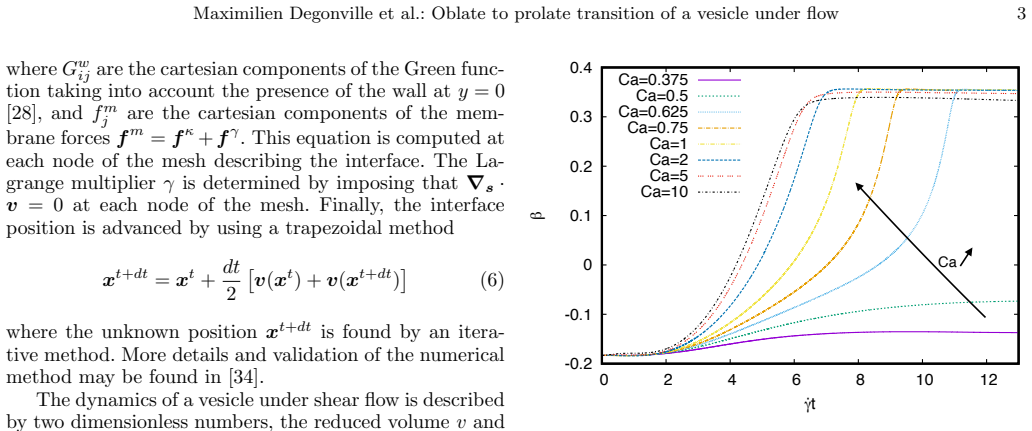
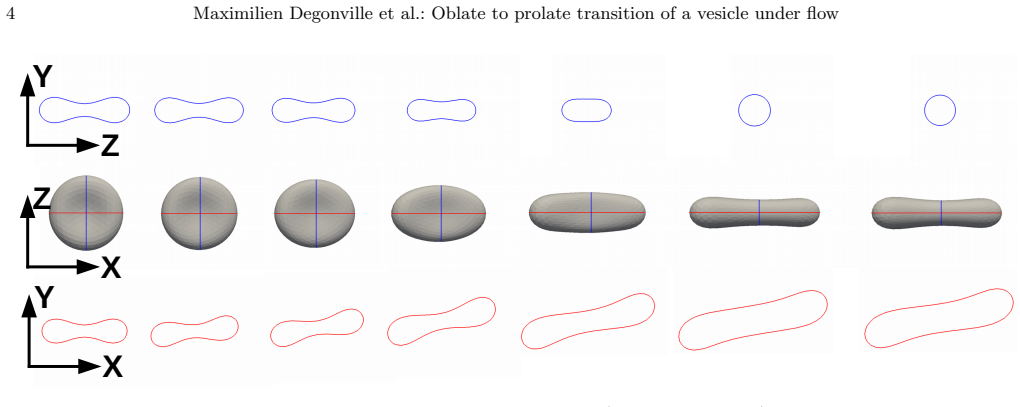
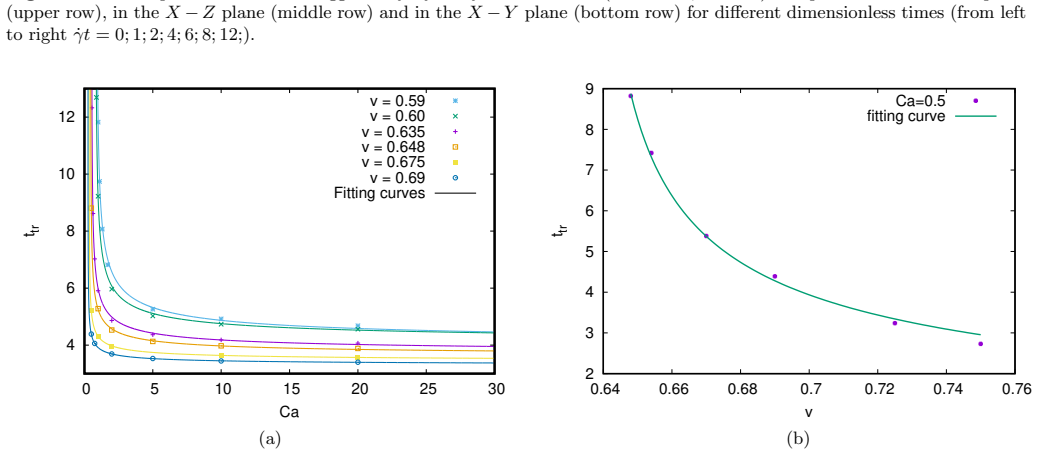
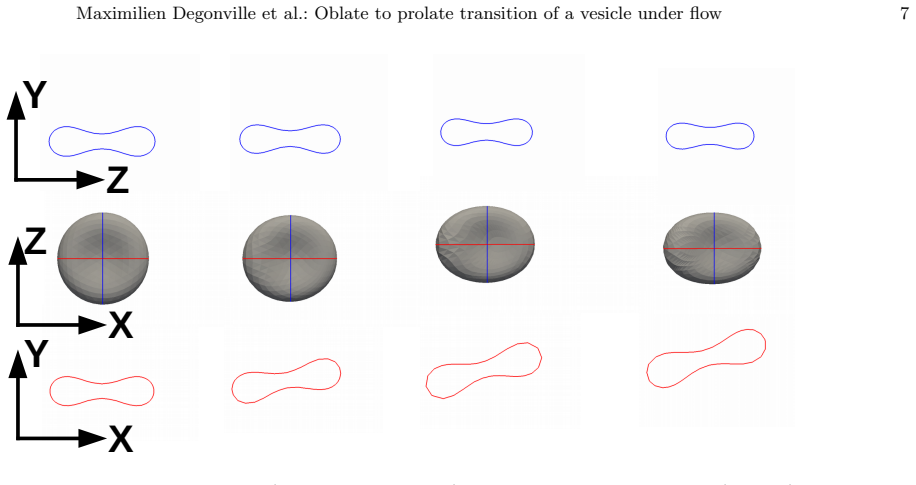
Starting each run from a relaxed oblate shape, the authors follow the shape parameter $\beta=(L_1/R_0-1)(L_2/R_0-1)(L_3/R_0-1)$, whose sign distinguishes an oblate ($\beta<0$) from a prolate ($\beta>0$) vesicle. For weak flow the vesicle stays oblate; above a critical capillary number $Ca_c(v)$ it stretches, thins in the vorticity direction, and switches sign of $\beta$. The dimensionless time $t_{tr}$ at which $\beta=0$ diverges as $Ca\to Ca_c^+$ according to $t_{tr}\sim 1/\sqrt{Ca-Ca_c}$ plus a finite reorientation time $t_\infty$; the same $1/\sqrt{}$ law is reported when the reduced volume approaches its critical value at fixed $Ca$. The paper reads this as the normal form $\dot{x}=r+x^2$ of a saddle-node bifurcation, with $r\propto Ca-Ca_c(v)$, so the oblate solution disappears discontinuously beyond $Ca_c$ while the prolate branch persists for all shear rates. A near-wall $v=0.59$ vesicle has $Ca_c\approx0.88$ in wall-bounded flow versus about $1.05$ in unbounded flow, a roughly 15% reduction attributed to the lubrication layer underneath the vesicle.
Load-bearing premise
The load-bearing premise is that the transition time diverges as $(Ca-Ca_c)^{-1/2}$, because every reported critical capillary number is obtained by fitting the simulated transition times to that assumed law, and the paper gives no confidence interval for the fitted values.
Editorial extensions
If this is right
- The bistable region in the $(v,Ca)$ plane is bounded from above by $Ca_c(v)$; within it, history matters and a vesicle can settle into either shape depending on the initial condition.
- For reduced volumes above about $0.74$, even weak hydrodynamic stress triggers the oblate-to-prolate transition, while for $v\simeq0.59$ the oblate shape survives up to $Ca_c\simeq0.9$.
- The oblate branch of solutions ceases to exist discontinuously past $Ca_c$, so the transition is an abrupt switch rather than a continuous drift of the shape.
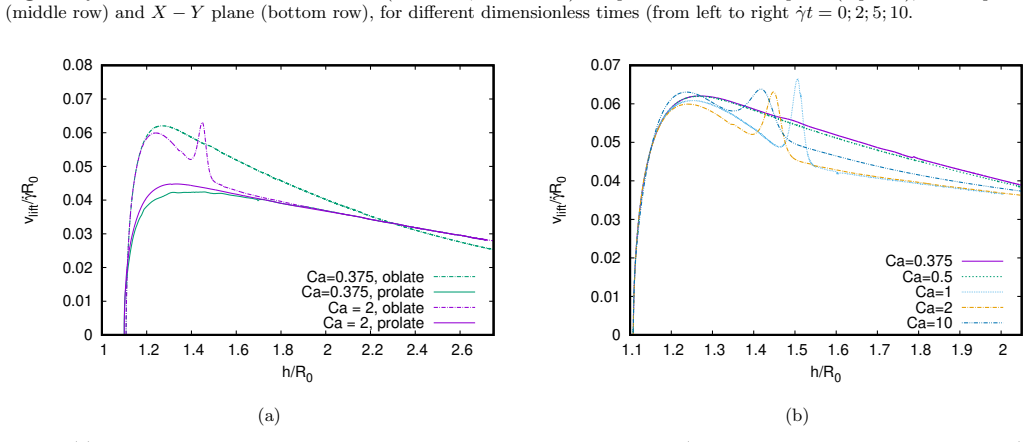
- Near a wall at the same $Ca$ and $v$, the oblate vesicle has a lift velocity about 50% higher than the prolate one close to the wall, even though its stresslet is smaller; far from the wall the ordering reverses.
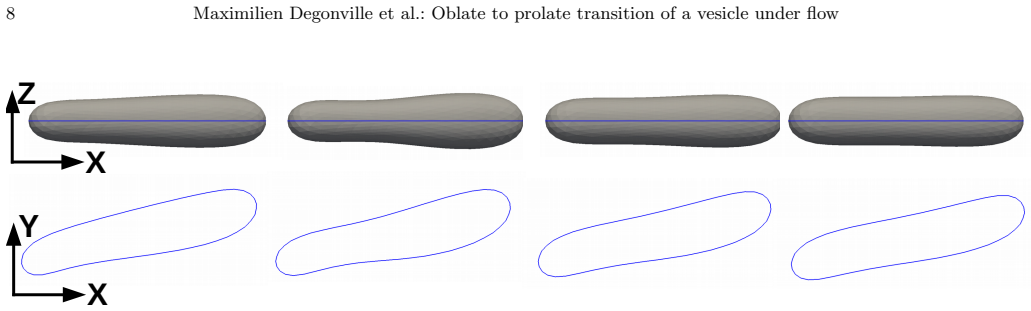
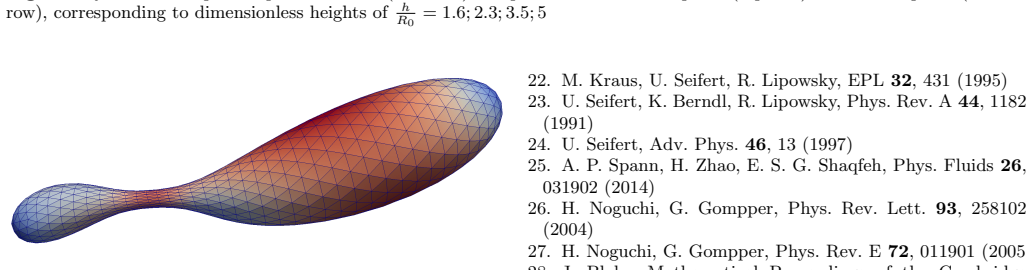
- At high capillary numbers, wall-induced asymmetry can produce transient tethered shapes independently of whether the vesicle started oblate or prolate.
Reading between the lines
- If the saddle-node normal form is exact, the basin of attraction of the oblate state should shrink as $\sqrt{Ca_c-Ca}$ near the transition, so the size of a perturbation needed to trigger the switch should vanish like $\sqrt{Ca_c-Ca}$; the paper's two perturbed runs are consistent with that but do not measure the scaling.
- A microfluidic application could exploit the boundary $Ca_c(v)$: choosing a shear rate slightly below $Ca_c$ would make identical-looking vesicles switch or not switch depending on small shape perturbations, effectively amplifying initial-condition differences.
- The reported 15% wall-induced drop in $Ca_c$ suggests confinement can be used as a control parameter; varying the wall distance should smoothly shift the bistable boundary, a prediction that could be tested in the same numerical setup.
- If the exponent $-1/2$ is confirmed experimentally, transition-time measurements could serve as a non-invasive way to infer the bending modulus $\kappa$ from the measured location of $Ca_c$.
Signed reviews
Editorial analysis
A structured set of objections, weighed in public.
Referee Report
Summary. The paper uses boundary-element simulations of a vesicle in wall-bounded shear flow to study the transition from oblate to prolate shapes. It reports a divergence of the transition time as ttr ~ 1/sqrt(Ca - Ca_c), interprets this as a saddle-node bifurcation, and constructs a phase diagram in the (v, Ca) plane separating bistable from prolate-only regions. It also studies lift dynamics, finding that near the wall an oblate vesicle lifts faster than a prolate one despite having a smaller far-field stresslet, and reports transient asymmetric and tethered shapes at high Ca.
Significance. If the reported phase diagram and bifurcation classification are correct, they provide a useful characterization of shape bistability for vesicles under shear, complementing earlier studies by Spann et al. and Noguchi and Gompper. The paper's strengths include the use of a validated numerical method (reference [34]), external comparison with Spann et al.'s capillary-number range, and the collapse of shape-parameter curves in Fig. 5a. The lift-velocity comparison between oblate and prolate initial shapes is a potentially interesting result. However, the central quantitative outputs—the critical capillary numbers and the saddle-node exponent—are obtained from fits with no error bars, no convergence study, and an assumed functional form, and the near-wall measurements are complicated by the fact that the vesicle lifts freely during the transition. These issues must be addressed before the phase diagram can be considered firmly established.
major comments (3)
- [Section 3, Fig. 4a] The critical capillary numbers Ca_c(v) are extracted by fitting the transition time to ttr = A/sqrt(Ca - Ca_c) + t_infinity, with Ca_c, A, and t_infinity as free parameters. The exponent -1/2 is assumed a priori and is then used to classify the transition as a saddle-node bifurcation. The paper reports no confidence intervals, no goodness-of-fit measures, and no test of whether the data could be described equally well by other divergences (e.g., a logarithmic divergence or an exponent -1). Because the phase boundary in Fig. 5b and the bifurcation classification both rest on this fit, the authors should provide error estimates for Ca_c and, if possible, a discriminating test of the exponent using the same simulation data.
- [Section 4, Fig. 4a (near-wall data)] The near-wall simulations release the vesicle at h = 1.1 R0 and allow it to lift freely while the shape evolves. Because the wall shifts Ca_c by about 15% (v = 0.59: Ca_c ≈ 0.88 near wall versus 1.05 in free space), Ca_c is a function of height. For Ca close to the fitted Ca_c, the transition time is long, so h increases substantially before β crosses zero, making Ca - Ca_c(h(t)) time-dependent. The measured 1/sqrt(Ca - Ca_c) divergence and the near-wall boundary in Fig. 5b may therefore reflect the non-autonomous lift trajectory rather than a genuine saddle-node of a fixed-confinement system. The paper reports no values of h at the transition time and no test with the height constrained. Please quantify the height change during the transition and provide at least one controlled-height simulation or an alternative check to separate the lift effect from the intrinsic bifurcation.
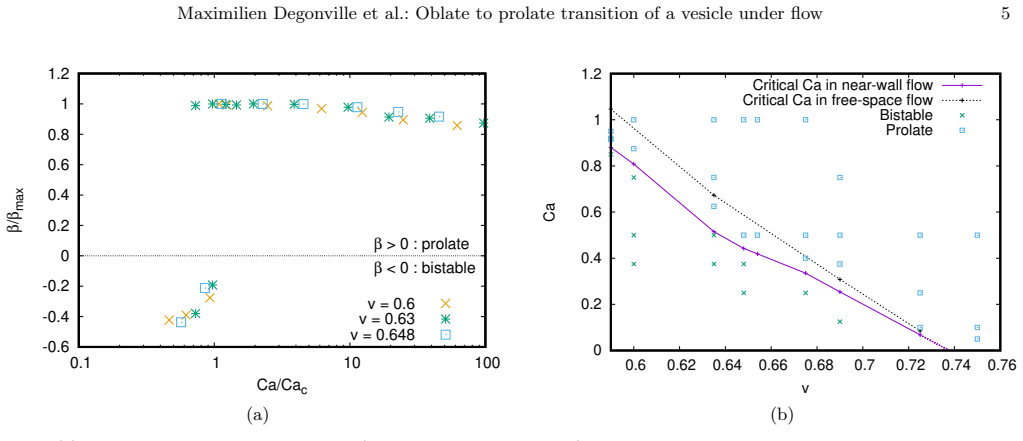
- [Fig. 5b, Section 3] The phase boundary in Fig. 5b is drawn from the fits discussed above, while the symbols indicate simulation points labeled 'bistable' or 'prolate'. The criteria for this labeling are not specified (e.g., how long a run must remain oblate to count as bistable, and how the final β sign is determined). The agreement between the fitted boundary and the simulation points is presented as good, but with no error bars on the fitted Ca_c values and no statement of run durations, this agreement is only qualitative. The manuscript should define the labeling protocol, report the number of runs per state point, and show error bars or confidence intervals on the fitted boundary.
minor comments (8)
- [Section 2] There is a typo in the sentence 'Examples of faccurate codes for three-dimensional simulations...' — 'faccurate' should be 'accurate'.
- [Abstract and Section 1] The manuscript uses nonstandard spellings such as 'bi-dimensionnal' and 'aforementionned'; these should be corrected to standard English.
- [Fig. 4b and surrounding text] The fit of ttr versus v at fixed Ca is described as also a saddle-node transition, but no critical vc value or fit parameters are reported. Please provide the fitted expression or a table of values.
- [Fig. 5a, Section 3] The collapse in Fig. 5a uses Ca_c from the fits in Fig. 4a and β/βmax, so the collapse is partly ensured by the rescaling itself. Please clarify whether the collapse is a test of the saddle-node form or merely a restatement of the fit.
- [Section 3, sensitivity check] The sensitivity check uses only two perturbation amplitudes (1% and 4%) for a single reduced volume (v = 0.63). Please report how many independent runs were performed for each amplitude and whether the perturbations were varied systematically in direction as well as amplitude.
- [Section 4, Fig. 7a] The claim that the oblate vesicle has a roughly 50% higher lift velocity near the wall is based on single trajectories. Please state whether this difference is robust to numerical noise and, if possible, provide error bars or repeated runs.
- [References] Reference [29] is incomplete: 'J. Comp. Phys. , (2011)' lacks volume and page numbers. Please update all references to complete bibliographic information.
- [Section 3, Fig. 5b and Fig. 7b caption] The critical capillary number for v = 0.635 is quoted as approximately 0.52 in the Fig. 7b caption, while Fig. 5b suggests a value near 0.515. Please ensure numerical values are consistent between the text, captions, and figures.
Circularity Check
The saddle-node classification and the Ca_c(v) phase boundary are extracted from a fit that already assumes the 1/sqrt(Ca-Ca_c) divergence; independent bistable labels provide only partial support.
-
fitted input called prediction
[Section 3, Fig. 4(a) caption, Eq. (9), and Fig. 5(b) caption]
"Symbols correspond to simulation points, solid lines corresponds to fit by 1 /√Ca −Ca c +t∞. This behavior is characteristic of a saddle-node bifurcation. ... The curve is obtained by fitting transition time divergence for various reduced volume, see figure 4."
Fig. 4(a) is fitted with the assumed law ttr = A/sqrt(Ca - Ca_c) + t∞, which is exactly the integration time of the normal form ẋ = r + x² with r ∝ Ca - Ca_c (Eq. 9). The same fit supplies Ca_c(v), which is then used to draw the bistable/prolate boundary in Fig. 5(b) and to rescale Ca/Ca_c in Fig. 5(a). The divergence exponent -1/2 is therefore an input to the fit, not an independent measurement; the claimed saddle-node classification is equivalent to the functional form chosen for the fit, and the phase boundary is a fitted curve rather than a prediction. The paper does include un-fitted simulation labels in Fig. 5(b) and compares one Ca_c value with [25], giving partial independent anchoring, but the divergence law and bifurcation type themselves are not independently tested.
full rationale
The central derivation is mostly self-contained: the vesicle dynamics are solved by boundary-element simulations, and the code validation citation [34] is not the claim under test. The bistable/prolate labels in Fig. 5(b), the finite-perturbation tests in Fig. 5(a), and the comparison with the Spann et al. range after converting capillary-number definitions provide external anchors for the boundary location. The main circular burden is local but real: the paper's headline result — that ttr diverges as 1/sqrt(Ca - Ca_c) and that this marks a saddle-node — is obtained by fitting transition times to exactly that form (Fig. 4a), then using the fitted Ca_c to construct the phase boundary and the collapse in Fig. 5a. Since the -1/2 exponent is prescribed rather than measured, the collapse and the saddle-node classification are partly ensured by the fit. This is a moderate circularity, not a forced renaming, because the raw simulation points still independently distinguish bistable from prolate regions. The skeptic's concern about h(t) changing during the near-wall transition is a physical validity issue, not a circularity, and is not scored here.
Assumptions & free parameters
free parameters (3)
- critical capillary number Ca_c(v) =
e.g., 0.52 for v=0.635; 0.88 (near wall) and 1.05 (free space) for v=0.59
- t_infinity (reorientation time) =
not reported as a single number
- fit amplitude A =
not reported
assumptions (4)
- domain assumption The vesicle membrane is an incompressible 2D fluid with Helfrich bending energy (Eqs. 1-2).
- domain assumption Flow is inertialess Stokes flow with equal inner and outer viscosities (Eq. 3).
- standard math The wall is modeled by the Blake Green function (Eq. 5).
- domain assumption The dynamics near the transition is governed by the one-dimensional normal form d x/dt = r + x^2 (Eq. 9).
Cite this review
Pith. "Pith review of Oblate to prolate transition of a vesicle in shear flow." pith.science (2026). https://pith.science/paper/42RG5WEP
@misc{pith2026190800596,
  author       = {Pith},
  title        = {Pith review of: Oblate to prolate transition of a vesicle in shear flow},
  year         = {2026},
  howpublished = {\url{https://pith.science/paper/42RG5WEP}},
  note         = {Machine review of arXiv:1908.00596}
}
read the original abstract
Vesicles are micrometric soft particles whose the membrane is a two-dimensional incompressible fluid governed by bending resistance leading to a zoology of shapes. The dynamics of deflated vesicles in shear flow with a bottom wall, a first minimal configuration to consider confined vesicles is investigated using numerical simulations. Coexistence under flow of oblate (metastable) and prolate (stable) shapes is studied in details. In particular, we discuss the boundaries of the region of coexistence in the (v, Ca) plane where v is the reduced volume of the vesicle and Ca the Capillary number. We characterize the transition from oblate to prolate and analyse the divergence of the transition time near the critical capillary number. We then analyse lift dynamics of oblate vesicle in the weak flow regime.
Figures

Figures from the paper (6 more)
Reference graph
Works this paper leans on
-
[34]
J. Gounley, G. Boedec, M. Jaeger, M. Leonetti, J. Fluid Mech. 791, 464 (2016)
work page 2016
- [1]
-
[2]
R. Dimova, U. Seifert, B. Pouligny, S. F¨ orster, H. G. D¨ obereiner, Eur. Phys. J. E7, 241 (2002) 8 Maximilien Degonville et al.: Oblate to prolate transition of a vesicle under flow X Y X Z Fig. 8. Asymmetric shape of a prolate vesicle ( Ca = 10). Snapshots in the X−Z plane (top row) and X−Y plane (bottom row), corresponding to dimensionless heights of h...
work page 2002
-
[3]
under strong shear flow (Ca = 50)
-
[4]
D. E. Disher, F. Ahmed, Ann. Rev. Biomed. Eng. 8, 323 (2006)
work page 2006
-
[5]
F. Meng, Z. Zhong, J. Feijen, Biomacromolecules 10, 323 (2006)
work page 2006
- [6]
-
[7]
C. De Loubens, J. Deschamps, F. Edwards-L´ evy, M. Leonetti, J. Fluid Mech. 789, 750 (2016)
work page 2016
Show all 37 references
-
[8]
Deschamps, V
J. Deschamps, V. Kantsler, V. Steinberg, Phys. Rev. Lett. 102, 118105 (2009)
2009
-
[9]
H. L. Goldsmith, S. G. Mason, JCIS 17, 448 (1962)
1962
-
[10]
J. R. Smart, D. T. Leighton Jr, Phys. Fluids A 3, 21 (1991)
1991
-
[11]
P. Olla, J. Phys. II, 7, 1533 (1997)
1997
-
[12]
P. M. Vlahovska, R. S. Garcia, Phys. Rev. E 75, 016313 (2007)
2007
-
[13]
farutin, C
A. farutin, C. Misbah, Phys. Rev. Lett. 110, 108104 (2013)
2013
-
[14]
H. Zhao, A. P. Spann, E. S. G. Shaqfeh, Phys. Fluids 23, 121901 (2011)
2011
-
[15]
Callens, C
N. Callens, C. Minetti, G. Coupier, M. -A. Mader, F. Dubois, C. Misbah, T. Podgorski, EPL 83, 24002 (2008)
2008
-
[16]
Cantat, C
I. Cantat, C. Misbah, Phys. Rev. Lett. 83, 880 (1999)
1999
-
[17]
Seifert, Phys
U. Seifert, Phys. Rev. Lett. 83, 876 (1999)
1999
-
[18]
Sukumaran, U
S. Sukumaran, U. Seifert, Phys. Rev. E 64, 011916 (2001)
2001
-
[19]
B. Lorz, R. Simson, J. Nardi, E. Sackmann, EPL 51, 468 (2000)
2000
-
[20]
Abkarian, C
M. Abkarian, C. Lartigue, A. Viallat, Phys. Rev. Lett. 88, 068103 (2002)
2002
-
[21]
Abkarian, A
M. Abkarian, A. Viallat, Biophys. J. 89, 1055 (2005)
2005
-
[22]
Meßlinger, B
S. Meßlinger, B. Schmidt, H. Noguchi, G. Gompper, Phys. Rev. E 80, 011901 (2009)
2009
-
[23]
Kraus, U
M. Kraus, U. Seifert, R. Lipowsky, EPL 32, 431 (1995)
1995
-
[24]
Seifert, K
U. Seifert, K. Berndl, R. Lipowsky, Phys. Rev. A 44, 1182 (1991)
1991
-
[25]
Seifert, Adv
U. Seifert, Adv. Phys. 46, 13 (1997)
1997
-
[26]
A. P. Spann, H. Zhao, E. S. G. Shaqfeh, Phys. Fluids 26, 031902 (2014)
2014
-
[27]
Noguchi, G
H. Noguchi, G. Gompper, Phys. Rev. Lett. 93, 258102 (2004)
2004
-
[28]
Noguchi, G
H. Noguchi, G. Gompper, Phys. Rev. E 72, 011901 (2005
2005
-
[29]
Blake, Mathematical Proceedings of the Cambridge Philosophical Society 70, 303 (1971)
J. Blake, Mathematical Proceedings of the Cambridge Philosophical Society 70, 303 (1971)
1971
-
[30]
Boedec, M
G. Boedec, M. Leonetti, M. Jaeger, J. Comp. Phys. , (2011)
2011
-
[31]
H. Zhao, E. S. G. Shaqfeh, J. Fluid Mech. 674, 578 (2011)
2011
-
[32]
Biben, A
T. Biben, A. Farutin, C. Misbah, Phys. Rev. E 83, 031921 (2011)
2011
-
[33]
De Loubens, J
C. De Loubens, J. Deschamps, G. Boedec, M. Leonetti, J. Fluid Mech. 767, R3 (2015)
2015
-
[35]
Boedec, M
G. Boedec, M. Leonetti, M. Jaeger, J. Comp. Phys. 342, 117 (2017)
2017
-
[36]
Jari´ c, U
M. Jari´ c, U. Seifert, W. Wintz, M. Wortis, Phys. Rev. E 52, 6623 (1995)
1995
-
[37]
Farutin, C
A. Farutin, C. Misbah, Phys. Rev. Lett. 109, 248106 (2012)
2012
Reviewed August 14, 2026 · model on record in the stance chip above.
Discussion (0). Continue with ORCID to comment.