REVIEW 3 major objections 7 minor 35 references
Sampling-free Epistemic Uncertainty Estimation Using Approximated Variance Propagation
T0 review · 3 major / 7 minor · reviewed 2026-08-14 · deepseek-v4-flash
Pith's one-line read The epistemic uncertainty that Monte-Carlo dropout estimates with many stochastic forward passes can be computed analytically in a single pass by propagating variance through the network.
desk verdict A genuinely useful sampling-free approximation of MC dropout uncertainty, with clean derivations and real runtime wins, but the diagonal-covariance assumption produces a reported 93.7% magnitude underestimation on one of its own headline architectures that the paper never fully reconciles. read the letter →
The pith
A machine-rendered reading of the paper's core claim, the machinery that carries it, and where it could break.
The reading
What carries the argument
The load-bearing mechanism is error propagation of covariance matrices through the network, $\Sigma_{\text{out}} = J\Sigma_{\text{in}}J^T$, where $J$ is the Jacobian of the layer transformation. For noise injection by elementwise multiplication, as in dropout, the covariance update uses the exact Hadamard-product formula of Goodman, and for convolutions followed by ReLU the authors specialize this to a diagonal covariance vector, squared weight matrices, and analytic moments of a Gaussian passed through ReLU. This specialization is what turns an $O(N^2)$ covariance computation into an $O(N)$ one, making single-pass uncertainty estimation practical for high-resolution images.
What would settle it
Take a trained convolutional network with dropout, compute the full activation covariance matrix after a dropout layer, and propagate both the full covariance and its diagonal to the output; if the full propagation matches Monte-Carlo dropout's output variance while the diagonal-only propagation undershoots by the reported tens of percent, the diagonal assumption, not the variance-propagation idea, is the failing piece.
Extended reading notes
Core claim
The central claim is that the epistemic uncertainty estimated by Monte-Carlo dropout is a variance-propagation computation, not an intrinsically sampling-based one. Starting from the covariance introduced by a noise layer, each affine layer transforms the covariance as $\Sigma_i = W\Sigma_{i-1}W^T$ and each nonlinearity approximately as $\Sigma_i \approx J\Sigma_{i-1}J^T$. For convolutional networks with ReLU activations, the authors assume the activation covariance is diagonal, which reduces the computation to propagating a variance vector through elementwise-squared weights and Jacobians, formally $\mathrm{Var}[\mathbf{X}_i] = (W^2)\,\mathrm{Var}[\mathbf{X}_{i-1}]$, and they give a closed-form ReLU variance under a Gaussian assumption. The result is a single forward pass that produces the same kind of epistemic uncertainty map as Monte-Carlo dropout; the paper's experiments show structural agreement, similar calibration curves, and out-of-distribution sensitivity, with the main discrepancy being a systematic underestimation of variance magnitude when the dropout layer lies far from the output.
Load-bearing premise
The load-bearing assumption is that activation covariances in a convolutional network are effectively diagonal, so all off-diagonal terms can be dropped; when they are not, the uncertainty is systematically underestimated, which the paper observes as a 93.7 percent shortfall on one segmentation architecture.
Editorial extensions
If this is right
- Epistemic uncertainty becomes available in a single forward pass, with runtime independent of the number of samples; on the tested segmentation model the approximation runs in about 0.14 s versus 0.54 s for 10 Monte-Carlo samples and 2.39 s for 50.
- On nine UCI regression benchmarks, the test log-likelihood of the analytic approximation is close to Monte-Carlo dropout's, with the single notable gap on the Naval Propulsion dataset.
- In Bayesian SegNet, the approximated uncertainty maps are structurally similar to Monte-Carlo dropout's and track pixel misclassification rates, but the magnitude is on average 93.7 percent lower because the diagonal-covariance assumption drops off-diagonal variance.
- In monocular depth regression, the analytic variance rises with depth error similarly to Monte-Carlo dropout, so it can flag likely erroneous regions at a small extra cost.
- Withheld object classes produce the largest relative increase in approximated uncertainty, indicating that the method is sensitive to out-of-distribution inputs.
Reading between the lines
- This suggests that the 93.7 percent shortfall is mostly a constant bias from dropped off-diagonal terms, so a calibrated rescaling or a low-rank off-diagonal correction could restore correct magnitudes without abandoning single-pass inference.
- One testable extension is to apply the same covariance-propagation machinery to other stochastic regularizers, such as batch-normalization noise or learned multiplicative noise, whenever their layer-wise covariance update can be written down.
- The failure mode implies an architecture-level rule: place dropout close to the output if diagonal-only propagation is used, and budget uncertainty layers accordingly.
- Because the propagated variance is an analytic function of the noise parameters, a natural follow-up is to differentiate it with respect to the dropout rate and learn the noise level during training, an avenue the paper flags for future work.
Signed reviews
Editorial analysis
A structured set of objections, weighed in public.
Referee Report
Summary. The paper proposes a sampling-free approximation of the epistemic uncertainty estimated by Monte-Carlo dropout. The method propagates activation variances through a neural network using error propagation: exact covariance updates for affine and noise layers, first-order Taylor approximations for non-linearities, and a diagonal covariance simplification for convolutional networks with ReLU activations. The authors evaluate the approach on a synthetic regression problem, nine UCI regression datasets, Bayesian SegNet on CamVid, and monocular depth regression on KITTI, comparing runtime and the rank-ordering of uncertainty against MC dropout. The central claim is that the approximation reduces the computational overhead of sampling-based epistemic uncertainty estimation while preserving the quality of the estimates.
Significance. If the approximation were faithful to MC dropout in both ranking and magnitude, the paper would make a valuable contribution: single-pass epistemic uncertainty estimation is important for real-time and safety-critical deployment, and the paper is careful to derive the variance propagation formulas and to provide the supplementary derivations for the covariance of element-wise products and the moments of ReLU under Gaussian inputs. The runtime comparison is informative and the absence of fitted parameters in the propagation is a methodological strength. However, the paper's own experimental results show that in the ENCDEC SegNet architecture the propagated variance magnitude is on average only about 6% of the MC-dropout variance, which directly undermines the abstract's claim that the approximation provides accurate uncertainty estimates. The evidence in the paper is primarily about rank-order agreement, not magnitude fidelity, and the paper does not provide a diagnostic for when the diagonal-covariance assumption is safe. The contribution is therefore promising but currently overstated.
major comments (3)
- [Section 4.3] The reported 93.7% mean absolute difference between the approximated variance and the MC-dropout variance for the ENCDEC architecture is a direct quantitative failure of the central claim that the method approximates MC-dropout epistemic uncertainty. Because the paper's goal is to estimate the uncertainty itself, and the ENCDEC setup is the best-performing Bayesian SegNet variant, a factor-of-roughly-16 underestimation in magnitude cannot be dismissed as a calibration detail. The quantile-based misclassification analysis in Fig. 6(a) only demonstrates monotone rank agreement, and for safety-critical applications a systematically low variance estimate is a qualitatively different failure from a rank-preserving rescaling. The authors should either provide a mechanism to correct the magnitude, present the method as a rank-only estimate, or clearly delimit the regimes in which magnitude fidelity holds.
- [Section 3.3 and Section 4.3] The diagonal covariance assumption is load-bearing for the convolutional case: it is what reduces the computation to the same order as a forward pass. The paper states in Section 4.3 that off-diagonal mixture terms 'primarily act as a variance bias' and cause the 93.7% gap, which means the assumption fails in the main large-scale classification experiment. The manuscript does not provide a quantitative characterization of when the off-diagonal mass is negligible. A concrete test would be to compute, on a small convolutional network or on a subset of feature maps, the fraction of total variance carried by off-diagonal entries, and to compare the propagated diagonal-only variance against full-covariance propagation on architectures with different depths between the last dropout layer and the output. Without such a diagnostic, the principal efficiency claim is tied to an unvalidated approximation.
- [Section 4.1] The statement that for the synthetic example 'our approximation is in fact exact' is not supported. The propagation through ReLU and through the nonlinear network is derived under a Gaussianity assumption and a first-order Taylor or moment-based approximation; these are approximations unless the pre-activations are exactly Gaussian and the Jacobian treatment is exact, which is not established. The supplementary convergence plot in Fig. 11 shows that the MC estimate converges to the analytic value, but that only demonstrates consistency of the MC estimator with the analytic moment computation; it does not demonstrate that the analytic moment equals the true predictive variance of the network. The claim should be rephrased to 'matches the MC estimate in the limit of many samples' or justified with a controlled comparison to an exact numerical integration.
minor comments (7)
- [Section 4.3] The sentence 'We train consider Bayesian SegNet on CamVid dataset' contains a typo; it should read 'We train Bayesian SegNet on the CamVid dataset.'
- [Section 4.3] The phrase 'groud truth' should be 'ground truth' in the qualitative-results discussion.
- [Section 4.4] The word 'uncerlying' should be 'underlying' in the description of the depth regression training method.
- [Section 4.4] The word 'exaclty' should be 'exactly' in 'our approximation will not exaclty match the sampling-based result.'
- [Table 1] The runtime column reports 0.06 for all rows and says 'due to decimal precision'; it would be clearer to report the raw values with more significant digits and to state the hardware used for the timing comparison.
- [Section 3.3] Equation (8) uses element-wise operations such as E[X_{i-1}]^2 and E[Z]^2; the text should explicitly state that squaring is element-wise to avoid confusion with matrix powers or vector outer products.
- [References] Reference [18] is cited as a preprint without a published venue; if a published version exists, it should be cited instead.
Circularity Check
No significant circularity: the method is derived from first principles and tested against MC dropout rather than fitted to it.
full rationale
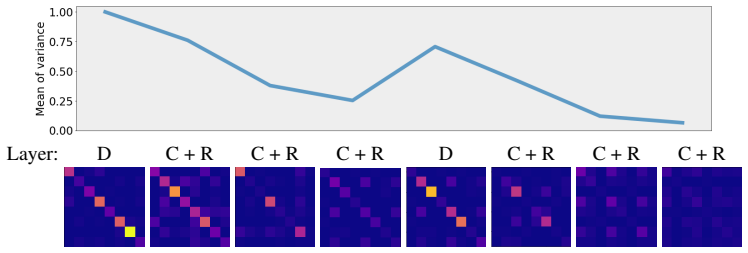
The paper's central derivation is self-contained. Equations (1)-(7) apply standard error propagation, citing Taylor's textbook for error propagation and Goodman's exact variance-of-products result for Eq. (4), to propagate noise-layer covariance through affine transformations and nonlinearities; none of these formulas contains the MC-dropout target or any fitted parameter. The diagonal-covariance simplification in Section 3.3 is explicitly introduced as an approximation motivated by a CIFAR-10 covariance visualization, not as an ansatz imported from the authors' prior work, and it is not tuned to reproduce MC-dropout outputs. The evaluation against MC dropout is the appropriate external benchmark for a claimed approximation: MC samples and MC-derived variances never enter the propagation equations, so the comparison is not circular by construction. The only self-citation (Rupprecht et al. in related work) is not load-bearing for any derivation or claim. The reported 93.7% magnitude underestimation on the ENCDEC architecture in Section 4.3 is an acknowledged empirical limitation of the diagonal-covariance assumption and a genuine accuracy concern, but it is not circularity: the propagated variance is computed from the network's weights, activations, and dropout rate, not from the MC variance it is compared against, and no fitted parameter is renamed as a prediction. Thus no circular step can be exhibited, and the appropriate finding is no significant circularity with score 0.
Assumptions & free parameters
assumptions (4)
- domain assumption Activations before ReLU are Gaussian distributed
- domain assumption First-order Taylor expansion is adequate for propagating covariance through non-linearities
- domain assumption Covariance matrix of activations in CNNs is approximately diagonal
- standard math Noise injection and activations are independent
Cite this review
Pith. "Pith review of Sampling-free Epistemic Uncertainty Estimation Using Approximated Variance Propagation." pith.science (2026). https://pith.science/paper/KM3WB42E
@misc{pith2026190800598,
  author       = {Pith},
  title        = {Pith review of: Sampling-free Epistemic Uncertainty Estimation Using Approximated Variance Propagation},
  year         = {2026},
  howpublished = {\url{https://pith.science/paper/KM3WB42E}},
  note         = {Machine review of arXiv:1908.00598}
}
read the original abstract
We present a sampling-free approach for computing the epistemic uncertainty of a neural network. Epistemic uncertainty is an important quantity for the deployment of deep neural networks in safety-critical applications, since it represents how much one can trust predictions on new data. Recently promising works were proposed using noise injection combined with Monte-Carlo sampling at inference time to estimate this quantity (e.g. Monte-Carlo dropout). Our main contribution is an approximation of the epistemic uncertainty estimated by these methods that does not require sampling, thus notably reducing the computational overhead. We apply our approach to large-scale visual tasks (i.e., semantic segmentation and depth regression) to demonstrate the advantages of our method compared to sampling-based approaches in terms of quality of the uncertainty estimates as well as of computational overhead.
Figures


Figures from the paper (10 more)


Reference graph
Works this paper leans on
-
[1]
A. Bhattacharyya, M. Fritz, and B. Schiele. Long-term on- board prediction of people in traffic scenes under uncertainty. In Proceedings of the IEEE Conference on Computer Vision and Pattern Recognition, pages 4194–4202, 2018
work page 2018
-
[2]
C. M. Bishop. Mixture density networks. Technical report, Citeseer, 1994
work page 1994
-
[3]
C. Blundell, J. Cornebise, K. Kavukcuoglu, and D. Wierstra. Weight uncertainty in neural network. In International Con- ference on Machine Learning, pages 1613–1622, 2015
work page 2015
-
[4]
G. J. Brostow, J. Fauqueur, and R. Cipolla. Semantic object classes in video: A high-definition ground truth database. Pattern Recognition Letters, 30(2):88–97, 2009
work page 2009
-
[5]
S. Choi, K. Lee, S. Lim, and S. Oh. Uncertainty-aware learning from demonstration using mixture density networks with sampling-free variance modeling. In 2018 IEEE In- ternational Conference on Robotics and Automation (ICRA), pages 6915–6922. IEEE, 2018
work page 2018
-
[6]
B. Efron and R. J. Tibshirani. An introduction to the boot- strap. CRC press, 1994
work page 1994
-
[7]
D. Feng, L. Rosenbaum, and K. Dietmayer. Towards safe autonomous driving: Capture uncertainty in the deep neural network for lidar 3d vehicle detection. In 2018 21st Inter- national Conference on Intelligent Transportation Systems (ITSC), pages 3266–3273. IEEE, 2018
work page 2018
-
[8]
Y . Gal. Uncertainty in deep learning. PhD thesis, PhD thesis, University of Cambridge, 2016
work page 2016
Show all 35 references
-
[9]
Gal and Z
Y . Gal and Z. Ghahramani. Dropout as a bayesian approxi- mation: Representing model uncertainty in deep learning. In international conference on machine learning , pages 1050– 1059, 2016
2016
-
[10]
Y . Gal, R. Islam, and Z. Ghahramani. Deep bayesian active learning with image data. In Proceedings of the 34th Inter- national Conference on Machine Learning-V olume 70, pages 1183–1192. JMLR. org, 2017
2017
-
[11]
Geiger, P
A. Geiger, P. Lenz, C. Stiller, and R. Urtasun. Vision meets robotics: The kitti dataset. The International Journal of Robotics Research, 32(11):1231–1237, 2013
2013
-
[12]
Godard, O
C. Godard, O. Mac Aodha, and G. J. Brostow. Unsuper- vised monocular depth estimation with left-right consistency. In Proceedings of the IEEE Conference on Computer Vision and Pattern Recognition, pages 270–279, 2017
2017
-
[13]
L. A. Goodman. On the exact variance of products. Journal of the American statistical association , 55(292):708–713, 1960
1960
-
[14]
J. M. Hern ´andez-Lobato and R. Adams. Probabilistic back- propagation for scalable learning of bayesian neural net- works. In International Conference on Machine Learning , pages 1861–1869, 2015
2015
-
[15]
Huang, W.-T
P.-Y . Huang, W.-T. Hsu, C.-Y . Chiu, T.-F. Wu, and M. Sun. Efficient uncertainty estimation for semantic segmentation in videos. In Proceedings of the European Conference on Com- puter Vision (ECCV), pages 520–535, 2018
2018
-
[16]
S. J. Hwang, R. Mehta, and V . Singh. Sampling-free uncer- tainty estimation in gated recurrent units with exponential families. arXiv preprint arXiv:1804.07351, 2018
2018 arXiv
-
[17]
Kampffmeyer, A.-B
M. Kampffmeyer, A.-B. Salberg, and R. Jenssen. Semantic segmentation of small objects and modeling of uncertainty in urban remote sensing images using deep convolutional neu- ral networks. In Proceedings of the IEEE conference on com- puter vision and pattern recognition works...
2016
-
[18]
Kendall, V
A. Kendall, V . Badrinarayanan, and R. Cipolla. Bayesian segnet: Model uncertainty in deep convolutional encoder- decoder architectures for scene understanding. CoRR, abs/1511.02680, 2015
2015 arXiv
-
[19]
Lakshminarayanan, A
B. Lakshminarayanan, A. Pritzel, and C. Blundell. Simple and scalable predictive uncertainty estimation using deep en- sembles. In Advances in Neural Information Processing Sys- tems, pages 6402–6413, 2017
2017
-
[20]
M. T. Le, F. Diehl, T. Brunner, and A. Knol. Uncertainty estimation for deep neural object detectors in safety-critical applications. In 2018 21st International Conference on In- telligent Transportation Systems (ITSC) , pages 3873–3878. IEEE, 2018
2018
-
[21]
Mo ˙zejko, M
M. Mo ˙zejko, M. Susik, and R. Karczewski. Inhibited soft- max for uncertainty estimation in neural networks. arXiv preprint arXiv:1810.01861, 2018
2018 arXiv
-
[22]
Osband, C
I. Osband, C. Blundell, A. Pritzel, and B. Van Roy. Deep exploration via bootstrapped dqn. In Advances in neural in- formation processing systems, pages 4026–4034, 2016
2016
-
[23]
Rupprecht, I
C. Rupprecht, I. Laina, R. DiPietro, M. Baust, F. Tombari, N. Navab, and G. D. Hager. Learning in an uncertain world: Representing ambiguity through multiple hypotheses. In Proceedings of the IEEE International Conference on Com- puter Vision, pages 3591–3600, 2017
2017
-
[24]
Snoek, H
J. Snoek, H. Larochelle, and R. P. Adams. Practical bayesian optimization of machine learning algorithms. In Advances in neural information processing systems, pages 2951–2959, 2012
2012
-
[25]
J. Taylor. Introduction to error analysis, the study of uncer- tainties in physical measurements. 1997
1997
-
[26]
M. Teye, H. Azizpour, and K. Smith. Bayesian uncertainty estimation for batch normalized deep networks. In Interna- tional Conference on Machine Learning , pages 4914–4923, 2018
2018
-
[27]
H. Wang, S. Xingjian, and D.-Y . Yeung. Natural-parameter networks: A class of probabilistic neural networks. In Ad- vances in Neural Information Processing Systems , pages 118–126, 2016
2016
-
[28]
Wang and C
S. Wang and C. Manning. Fast dropout training. In inter- national conference on machine learning , pages 118–126, 2013
2013
-
[29]
Zhang, S
G. Zhang, S. Sun, D. Duvenaud, and R. Grosse. Noisy nat- ural gradient as variational inference. In International Con- ference on Machine Learning, pages 5847–5856, 2018. Supplementary Material for ”Sampling-free Epistemic Uncertainty Estimation Using Approximated Variance Pro...
2018
-
[30]
For ReLU we assume its derivative in the ori- gin to be zero
Jacobians of Activation Functions We show the Jacobians of the activation functions - ReLU, sigmoid and softmax - that are used throughout our experiments. For ReLU we assume its derivative in the ori- gin to be zero. Then the Jacobian is given by Jij(ReLU(⃗ x)) = { 1, ifi =j ...
-
[31]
Further Σ⃗X denote the covariance matrix of ⃗X
Covariance of Hadamard Product of Ran- dom Vectors In the following X andZ denote random variables and ⃗X and ⃗Z denote random vectors, which may each have a non-diagonal covariance matrix but do not depend on each other. Further Σ⃗X denote the covariance matrix of ⃗X. We are ...
-
[32]
We are only interested in scalar inputs since we write out these formulars for the assumption of a diagonal covariance matrix
Expectation and Variance of ReLU Given a Gaussian Distribution We write down the first- and second-order moments of a f(X) =max(0,X ) where X is a scalar, normal distributed random variable. We are only interested in scalar inputs since we write out these formulars for the assu...
-
[33]
OUR is of computational advantage for more than approximately 175 samples
Comparison with Monte-Carlo (MC) Dropout of Similar Computational Cost We evaluate the predicted mean and standard deviation (STD) of our approach (OUR) and MC dropout on Boston Housing treating the result with 10000 samples as ground truth (GT). OUR is of computational advant...
-
[34]
In 11 we show empirically that the sampling-based variance esti- mate converges to our analytic expression
Absolute Variance Difference for Synthetic Data We fit a neural network to a synthetic dataset. In 11 we show empirically that the sampling-based variance esti- mate converges to our analytic expression. We observe that the relative absolute difference between the sampling-base...
-
[35]
Bayesian SegNet [18] We show more qualitative results of our approximation using Bayesian SegNet[18] on CamVid dataset [4]
Qualitative Results Including Our Predic- tion 12.1. Bayesian SegNet [18] We show more qualitative results of our approximation using Bayesian SegNet[18] on CamVid dataset [4]. These are shown in Fig. 12. We observe that the network is mostly uncertain about object boundaries....
Reviewed August 14, 2026 · model on record in the stance chip above.
Discussion (0). Continue with ORCID to comment.