REVIEW 1 major objections 5 minor 74 references
Quasi-Two-Dimensional Magnon Identification in Antiferromagnetic FePS3 via Magneto-Raman Spectroscopy
T0 review · 1 major / 5 minor · reviewed 2026-08-14 · deepseek-v4-flash
Pith's one-line read A Raman mode in FePS3 previously assigned to a phonon is actually a magnon, identified by its linear Zeeman splitting and strong temperature shift.
desk verdict Solid magneto-Raman identification of the 122 cm^-1 mode as a magnon, with Zeeman slopes matching g≈2; the 'quasi-2D magnon' title claim is inferred from bulk interlayer coupling, not demonstrated. read the letter →
The pith
A machine-rendered reading of the paper's core claim, the machinery that carries it, and where it could break.
The reading
What carries the argument
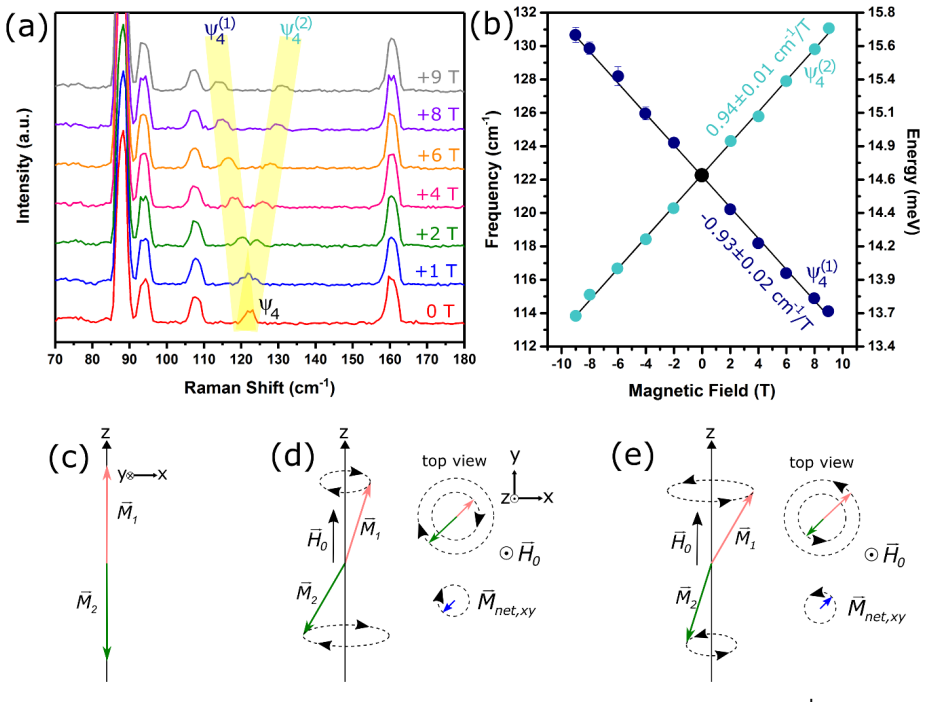
The load-bearing mechanism is the Zeeman splitting of an antiferromagnetic magnon. Using the standard two-sublattice macrospin model of antiferromagnetic resonance, the zero-field magnon frequency $\omega_{k=0}=\gamma\{(2H_E+H_A)H_A\}^{1/2}$ splits under a field $H_0$ parallel to the spins into $\omega = \omega_{k=0} \pm \gamma H_0$; because $\gamma = g\mu_B\mu_0/(2\pi\hbar)$ equals $0.9348~\mathrm{cm}^{-1}/\mathrm{T}$ for $g\approx 2.0023$, the observed slopes pin $g\approx 1.99$. This field-dependent splitting is the signature that separates a magnon from a phonon. The paper's second mechanism is the magnetic point group $2'/m$ of FePS3: the co-representation $D_{A'}$ with complex tensor elements reproduces the observed non-vanishing, two-fold-symmetric polarization intensity, whereas a real-valued antisymmetric tensor would require nodes and cross-polarized-only scattering.
What would settle it
Cool a single exfoliated layer of FePS3 below its magnetic ordering temperature and look for the $\approx 122~\mathrm{cm}^{-1}$ mode: if it disappears, changes energy by much more than weak interlayer coupling would allow, or fails to split with the same $\approx 0.93~\mathrm{cm}^{-1}/\mathrm{T}$ slope, the quasi-two-dimensional magnon identification is contradicted. Alternatively, measure the two branches with the field perpendicular to the spin axis; a spin-wave origin predicts a different, nonlinear field response, whereas a magnetoelastic artifact would not follow that pattern.
Extended reading notes
Core claim
The paper's central claim is that the $\psi_4$ mode of bulk FePS3 near $\approx 122~\mathrm{cm}^{-1}$ (3.7 THz, 15.1 meV), which appears only below the magnetic ordering temperature, is a one-magnon excitation rather than the zone-folded phonon it had been assigned to. Three independent signatures support the assignment: the mode's frequency shifts by up to 6.2% with temperature while phonons shift less than 1%; an applied magnetic field parallel to the ordered spins splits it into two branches whose frequencies change linearly at $0.93 \pm 0.02$ and $0.94 \pm 0.01~\mathrm{cm}^{-1}/\mathrm{T}$, matching the free-electron gyromagnetic ratio and yielding an effective magnon $g \approx 1.99 \pm 0.05$; and the mode sits at the same energy as the $\Gamma$-point magnon observed by neutron scattering. The paper further asserts that the magnon is quasi-two-dimensional because the weak interlayer exchange of FePS3 is expected to make the spin dynamics effectively two-dimensional, and that this is the first verification of a quasi-2D magnon in a layered material by magneto-Raman spectroscopy.
Load-bearing premise
The identification rests on the near-free-electron linear field splitting being a genuine Zeeman-split spin wave, and the quasi-two-dimensional label rests on weak interlayer exchange making the bulk magnon behave as if it lived in a plane.
Editorial extensions
If this is right
- The $\psi_4$ mode can serve as a non-destructive optical probe of magnetic order in FePS3, including in flakes too thin for neutron scattering or bulk magnetometry.
- Because the magnon sits near $122~\mathrm{cm}^{-1}$, roughly an order of magnitude higher than magnons in MnPS3, FePS3 becomes a candidate for faster magnon transport and switching in van der Waals devices.
- Observing the magnon in parallel polarization shows that the once-general rule that one-magnon scattering appears only in crossed polarization is not universal, so polarization selection rules alone cannot identify magnons in honeycomb magnets such as $\alpha$-RuCl$_3$ and CrI$_3$.
- Temperature- and magnetic-field-dependent Raman is shown to be a practical way to assign magnetic excitations in layered van der Waals magnets, complementing neutron scattering in bulk crystals.
Reading between the lines
- A direct extension would be to measure $\psi_4$ in monolayer and bilayer FePS3: persistence of the same ~$122~\mathrm{cm}^{-1}$ mode with the same field slope would confirm that the magnon is genuinely layer-confined, while a layer-dependent energy shift would let the interlayer coupling be quantified.
- The non-antisymmetric polarization pattern implies the same magneto-Raman test could help identify magnons in other magnetic van der Waals materials with complex magnetic point groups, where parallel-polarization scattering does not rule out a magnon origin.
- The lower-bound lifetime of about 10 ps estimated from the $3~\mathrm{cm}^{-1}$ linewidth suggests FePS3 magnons may be short-lived compared with transport-scale magnons, and connecting this Raman lifetime to nonlocal magnon transport measurements would test whether the high magnon frequency translates into useful device speed.
Signed reviews
Editorial analysis
A structured set of objections, weighed in public.
Referee Report
Summary. The manuscript reports magneto-Raman spectroscopy measurements on bulk FePS3 and argues that a Raman mode at approximately 122 cm^-1 (labeled ψ4) that appears below the Néel temperature is a magnon, not a zone-folded phonon as previously assigned. The evidence includes a 6.2% frequency shift with temperature, a linear Zeeman splitting into two branches with slopes of 0.93 and 0.94 cm^-1/T, an inferred g-factor of approximately 1.99, and agreement with a neutron-scattering magnon at 15.1 meV. The authors also study the polarization dependence of the mode, observe it in both parallel and crossed configurations, and use the magnetic point group 2'/m with complex tensor elements to explain the selection rules. They conclude that this constitutes the first verification of a quasi-2D magnon by magneto-Raman spectroscopy.
Significance. The central magnon assignment is well supported and is the paper's main contribution: the field-induced linear splitting with slopes matching the free-electron gyromagnetic ratio, the energy match to the neutron-scattering magnon, and the anomalously large temperature shift together make the identification of ψ4 as a magnon convincing. The polarization study provides an interesting counterexample to the Fleury-Loudon antisymmetric-tensor rule and offers a symmetry-based explanation using the magnetic point group. The paper is clearly written and the experimental data are presented in a way that is amenable to independent fitting. The main weakness is that the title's 'quasi-two-dimensional magnon' claim is not directly evidenced by the bulk measurements; the quasi-2D character is an inference from the known weak interlayer coupling and is appropriately hedged in the text but overstated in the title.
major comments (1)
- [Title; Section III (Conclusions)] The phrase 'Quasi-Two-Dimensional Magnon Identification' overstates the evidence. All magneto-Raman measurements are performed on bulk FePS3, and the quasi-2D character is inferred solely from the known weak interlayer exchange coupling of the parent compound; the text itself uses 'expected' (Introduction) and 'indicates' (Section III). No layer-resolved measurement, no c-axis magnon dispersion, and no quantitative interlayer exchange parameter for the ≈122 cm^-1 branch is reported. In an antiferromagnet with antiferromagnetic interlayer coupling, the zone-center magnon frequency depends on J_c through the exchange field, so observing a bulk magnon does not by itself establish that the magnon is dynamically two-dimensional. The magnon assignment itself is well supported, but the title and the 'first verification of a quasi-2D magnon' claim should be revised to describe a bulk magnon in quasi-two-dimensional FePS3, or be backed by additional layer-dependent or k_z-dispersive evidence.
minor comments (5)
- [Abstract] The phrase 'frequency of of approximately' contains a duplicated 'of' and should be corrected.
- [Section II.D] The conversion from the FWHM of approximately 3 cm^-1 to a magnon lifetime on the order of 10 ps should be shown explicitly, since the raw values do not make the relation transparent to readers.
- [Figure 4b] The normalization of the polar-plot intensities is unclear; the statement that the radial lines span from 0.1 to 1 should specify whether intensities are normalized to the maximum and whether any instrumental or thermal factors were removed.
- [Section II.E] The statement that 'multiple combinations of the amplitude and phase factors reproduce the polar plot' is not followed by a quantitative fit or a representative set of parameters; if this is intended as more than a qualitative demonstration, the authors should include the fit and its uncertainties.
- [Section II.E] The assertion that the magnon 'can only have the same symmetry as J_x and J_y' is presented as a deduction, but the authors immediately note that the relevant magnetic space group transformation tables are not available; this step should be explicitly labeled as an assumption or conjecture rather than a derivation.
Circularity Check
No significant circularity: the magnon assignment is tested against an external Keffer-Kittel field-splitting prediction, neutron-scattering energies, and temperature dependence; the quasi-2D title claim is an unsupported inference, not a circular derivation.
full rationale
The paper's central claim, that the Raman mode ψ4 at ≈122 cm⁻¹ is a magnon, is supported by an independently parameterized antiferromagnetic-resonance model rather than by fitting the conclusion into the input. Equation (1), ω_{k=0} = γ{(2H_E + H_A)H_A}^{1/2} ± γH_0, is taken from Keffer and Kittel with γ fixed by the free-electron gyromagnetic ratio γ ≈ 0.9348 cm⁻¹/T {g ≈ 2.0023}; the measured field-splitting slopes, 0.93 ± 0.02 cm⁻¹/T and 0.94 ± 0.01 cm⁻¹/T, are compared with this external prediction, and the extracted g ≈ 1.99 is a derived parameter, not an input. The zero-field frequency independently matches the neutron-scattering magnon at ≈15.1 meV reported in Refs. [53] and [61], and the 6.2% temperature shift is contrasted with the 0.01–0.57% shifts of the phonon modes; these are falsifiable comparisons, not tautologies. The symmetry analysis invokes the magnetic point group 2'/m with co-representations from the literature and acknowledges that 'multiple combinations of the amplitude and phase factors reproduce the polar plot,' which is an underdetermined post-hoc description rather than a circular prediction; it is not load-bearing for the magnon identification itself. The only possible concern, the title's 'quasi-two-dimensional magnon' claim, is explicitly presented as an expectation from bulk properties ('the magnon observed herein is also expected to be quasi-2D'; 'The quasi-2D magnetic nature of bulk FePS3 ... indicates that the magnon in bulk FePS3 is also quasi-2D') and is not derived from the Raman data by construction. The absence of layer-resolved or kz-dispersive evidence is a support gap and a correctness risk, but not a circular step. The paper contains self-citations only as general Raman-technique examples (e.g., Ref. [38]), not as load-bearing support for the magnon assignment. No fitted parameter is renamed as a prediction, and no load-bearing uniqueness theorem or ansatz is imported from the authors' own prior work.
Assumptions & free parameters
free parameters (3)
- slope of ψ4^(1) frequency vs field =
0.93 ± 0.02 cm^-1/T
- slope of ψ4^(2) frequency vs field =
0.94 ± 0.01 cm^-1/T
- complex Raman tensor phase factors δ_B, δ_D, δ_F =
not uniquely determined
assumptions (4)
- domain assumption Keffer-Kittel two-sublattice model gives the antiferromagnetic resonance frequencies ω = γ{(2H_E+H_A)H_A}^(1/2) ± γH_0 (Eq. 1).
- domain assumption The magnetic point group of FePS3 is 2'/m, with Raman co-representations D_A' and D_A'' as given by Cracknell.
- ad hoc to paper The magnon transforms like the rotation generators J_x, J_y in the magnetic point group.
- domain assumption Complex tensor elements with non-zero phases are required for absorbing materials (ref 70).
Cite this review
Pith. "Pith review of Quasi-Two-Dimensional Magnon Identification in Antiferromagnetic FePS3 via Magneto-Raman Spectroscopy." pith.science (2026). https://pith.science/paper/VGOFYNLU
@misc{pith2026190800608,
  author       = {Pith},
  title        = {Pith review of: Quasi-Two-Dimensional Magnon Identification in Antiferromagnetic FePS3 via Magneto-Raman Spectroscopy},
  year         = {2026},
  howpublished = {\url{https://pith.science/paper/VGOFYNLU}},
  note         = {Machine review of arXiv:1908.00608}
}
read the original abstract
Recently it was discovered that van der Waals-bonded magnetic materials retain long range magnetic ordering down to a single layer, opening many avenues in fundamental physics and potential applications of these fascinating materials. One such material is FePS3, a large spin (S=2) Mott insulator where the Fe atoms form a honeycomb lattice. In the bulk, FePS3 has been shown to be a quasi-two-dimensional-Ising antiferromagnet, with additional features in the Raman spectra emerging below the Neel temperature of approximately 120 K. Using magneto-Raman spectroscopy as an optical probe of magnetic structure, we show that one of these Raman-active modes in the magnetically ordered state is actually a magnon with a frequency of of approximately 3.7 THz (122 cm-1). Contrary to previous work, which interpreted this feature as a phonon, our Raman data shows the expected frequency shifting and splitting of the magnon as a function of temperature and magnetic field, respectively, where we determine the g-factor to be approximately 2. In addition, the symmetry behavior of the magnon is studied by polarization-dependent Raman spectroscopy and explained using the magnetic point group of FePS3.
Figures
Reference graph
Works this paper leans on
-
[1]
K. S. Novoselov, A. K. Geim, S. V. Morozov, D. Jiang, Y. Zhang, S. V. Dubonos, I. V. Grigorieva, and A. A. Firsov. Electric Field Effect in Atomically Thin Carbon Films. Science 306, 666-669 (2004)
work page 2004
-
[2]
Q. H. Wang, K. Kalantar-Zadeh, A. Kis, J. N. Coleman, and M. S. Strano. Electronics and Optoelectronics of Two-Dimensional Transition Metal Dichalcogenides. Nature Nanotechnol. 7, 699-712 (2012)
work page 2012
-
[3]
K. S. Novoselov, A. Mishchenko, A. Carvalho, and A. H. C. Neto. 2D Materials and Van der Waals Heterostructures. Science 353, aac9439 (2016)
work page 2016
-
[4]
D. S. Schulman, A. J. Arnold, A. Razavieh, J. Nasr, and S. Das. The Prospect of Two- Dimensional Heterostructures: A Review of Recent Breakthroughs. IEEE Nanotechnol. Mag. 11, 6-17 (2017)
work page 2017
-
[5]
Z. Lin, A. McCreary, N. Briggs, S. Subramanian, K. Zhang, Y. Sun, X. Li, N. J. Borys, H. Yuan, S. K. Fullteron-Shirey, et al. 2D Materials Advances: From Large Scale Synthesis and Controlled Heterostructures to Improved Characterization Techniques, Defects and Applications. 2D Mater. 3, 042001 (2016)
work page 2016
-
[6]
K. F. Mak and J. Shan. Photonics and Optoelectronics of 2D Semiconductor Transition Metal Dichalcogenides. Nat. Photonics 10, 216-226 (2016)
work page 2016
-
[7]
J. R. Schaibley, H. Yu, G. Clark, P. Rivera, J. S. Ross, K. L. Seyler, W. Yao, and X. Xu. Valleytronics in 2D Materials. Nat. Rev. Mater. 1, 16055 (2016)
work page 2016
-
[8]
S. Manzeli, D. Ovchinnikov, D. Pasquier, O. V. Yazyev, and A. Kis. 2D Transition Metal Dichalcogenides. Nat. Rev. Mater. 2, 17033 (2017)
work page 2017
Show all 74 references
-
[9]
Akinwande, C
D. Akinwande, C. J. Brennan, J. S. Bunch, P. Egberts, J. R. Felts, H. Gao, R. Huang, J. - S. Kim, T. Li, Y. Li, et al. A Review on Mechanics and Mechanical Properties of 2D Materials-Graphene and Beyond. Extreme Mech. Lett. 13, 42-77 (2017)
2017
-
[10]
K. S. Burch, D. Mandrus, and J. G. Park. Magnetism in Two-Dimensional van der Waals Materials. Nature 563, 47-52 (2018)
2018
-
[11]
Gong, and X
C. Gong, and X. Zhang. Two-Dimensional Magnetic Crystals and Emergent Heterostructure Devices. Science 363, 706-717 (2019)
2019
-
[12]
C. Lee, X. D. Wei, J. W. Kysar, and J. Hone. Measurement of the Elastic Properties and Antrinsic Strength of Monolayer Graphene. Science 321, 385-388 (2008)
2008
-
[13]
Castellanos-Gomez, M
A. Castellanos-Gomez, M. Poot, G. A. Steele, H. S. J. van der Zant, N. Agrait, and G. Rubio-Bollinger. Elastic Properties of Freely Suspended MoS2 Nanosheets. Adv. Mater. 24, 772-775 (2012)
2012
-
[14]
Huang, G
B. Huang, G. Clark, D. R. Klein, D. MacNeill, E. Navarro-Moratalla, K. L. Seyler, N. Wilson, M. A. McGuire, D. H. Cobden, D. Xiao, et al. Electrical Control of 2D Magnetism in Bilayer CrI3. Nat. Nanotechnol. 13, 544-548 (2018)
2018
-
[15]
S. W. Jiang, J. Shan, J. and K. F. Mak. Electric-Field Switching of Two-Dimensional van der Waals Magnets. Nat. Mater. 17, 406-410 (2018)
2018
-
[16]
J. S. Ross, P. Klement, A. M. Jones, N. J. Ghimire, J. Yan, D. G. Mandrus, T. Taniguchi, K. Watanabe, K. Kitamura, W. Yao, et al. Electrically Tunable Excitonic Light-Emitting Diodes Based on Monolayer WSe2 p-n Junctions. Nat. Nanotechnol. 9, 268-272 (2014)
2014
-
[17]
Akinwande, N
D. Akinwande, N. Petrone, and J. Hone. Two-Dimensional Flexible Nanoelectronics. Nat. Commun. 5, 5678 (2014). 21
2014
-
[18]
Zhang, H
S. Zhang, H. M. Hill, K. Moudgil, C. A. Richter, A. R. Hight Walker, S. Barlow, S. R. Marder, C. A. Hacker, and S. J. Pookpanratana. Controllable, Wide-Ranging n-Doping and p-Doping of Monolayer Group 6 Transition-Metal Disulfides and Diselenides. Adv. Mater. 30, 1802991 (2018)
2018
-
[19]
Y. Q. Guo, K. Xu, C. Z. Wu, J. Y. Zhao, and Y. Xie. Surface Chemical-Modification for Engineering the Intrinsic Physical Properties of Inorganic Two-Dimensional Nanomaterials. Chem. Soc. Rev. 44, 637-646 (2015)
2015
-
[20]
M. Y. Li, C. H. Chen, Y. M. Shi, and L. J. Li. Heterostructures Based on Two- Dimensional Layered Materials and Their Potential Applications. Mater. Today 19, 322- 335 (2016)
2016
-
[21]
A. V. Chumak, V. I. Vasyuchka, A. A. Serga, and B. Hillebrands, B. Magnon Spintronics. Nat. Phys. 11, 453-461 (2015)
2015
-
[22]
W. Y. Xing, L. Qiu, X. Wang, Y. Yao, Y. Ma, R. Cai, S. Jia, X. C. Xie, and W. Han. Magnon Transport in Quasi-Two-Dimensional van der Waals Antiferromagnets. Phys. Rev. X 9, 011026 (2019)
2019
-
[23]
N. D. Mermin and H. Wagner. Absence of Ferromagnetism or Antiferromagnetism in One- or Two-Dimensional Isotropic Heisenberg Models. Phys. Rev. Lett. 17, 1133-1136 (1966)
1966
-
[24]
C. Gong, L. Li, Z. Li, H. Ji, A. Stern, Y. Xia, T. Cao, W. Bao, C. Wang, Y. Wang, et al. Discovery of Intrinsic Ferromagnetism in Two-Dimensional van der Waals Crystals. Nature 546, 265-269 (2017)
2017
-
[25]
Huang, G
B. Huang, G. Clark, E. Navarro-Moratalla, D. Klein, R. Cheng, K. Seyler, D. Zhong, E. Schmidgall, M. A. McGuire, D. H. Cobden, et al. Layer-Dependent Ferromagnetism in a van der Waals Crystal Down to the Monolayer Limit. Nature 546, 270-273 (2017)
2017
-
[26]
S. W. Jiang, L. Z. Li, Z. F. Wang, K. F. Mak, and J. Shan. Controlling Magnetism in 2D CrI3 by Electrostatic Doping. Nat. Nanotechnol. 13, 549-553 (2018)
2018
-
[27]
P. A. Joy and S. Vasudevan. Magnetism in the Layered Transition-Metal Thiophosphates MPS3 (M = Mn, Fe, and Ni). Phys. Rev. B 46, 5425-5433 (1992)
1992
-
[28]
Balkanski, M
M. Balkanski, M. Jouanne, G. Ouvrard, and M. Scagliotti. Effects due to Spin Ordering in Layered MPX3 Compounds Revealed by Inelastic Light-Scattering. J. Phys. C-Solid State 20, 4397-4413 (1987)
1987
-
[29]
B. L. Chittari, Y. Park, D. Lee, M. Han, A. H. MacDonald, E. Hwang, and J. Jung. Electronic and Magnetic Properties of Single-layer MPX3 Metal Phosphorous Trichalcogenides. Phys. Rev. B 94, 184428 (2016)
2016
-
[30]
C. R. S. Haines, M. J. Coak, A. R. Wildes, G. I. Lampronti, C. Liu, P. Nahai-Williamson, H. Hamidov, D. Daisenberger, and S. S. Saxena. Pressure-Induced Electronic and Structural Phase Evolution in the van der Waals Compound FePS3. Phys. Rev. Lett. 121, 266801 (2018)
2018
-
[31]
Tsurubayashi, K
M. Tsurubayashi, K. Kodama, M. Kano, K. Ishigaki, Y. Uwatoko, T. Watanabe, K. Takase, and T. Takano. Metal-Insulator Transition in Mott-Insulator FePS3. AIP Adv. 8, 101307 (2018)
2018
-
[32]
K. C. Rule, G. J. McIntyre, S. J. Kennedy, and T. J. Hicks. Single-Crystal and Powder Neutron Diffraction Experiments on FePS3: Search for the Magnetic Structure. Phys. Rev. B 76, 134402 (2007). 22
2007
-
[33]
X. -L. Li, X. -F. Qiao, W. -P. Han, Y. Lu, Q. -H. Tan, X. -L. Liu, and P. -H. Tan. Layer Number Identification of Intrinsic and Defective Multilayered Graphenes Up to 100 Layers by the Raman Mode Intensity from Substrates. Nanoscale 7, 8135-8141 (2015)
2015
-
[34]
L. B. Liang, J. Zhang, B. G. Sumpter, Q. -H. Tan, P. -H. Tan, and V. Meunier. Low- Frequency Shear and Layer-Breathing Modes in Raman Scattering of Two-Dimensional Materials. ACS Nano 11, 11777-11802 (2017)
2017
-
[35]
T. M. G. Mohiuddin, A. Lombardo, R. R. Nair, A. Bonetti, G. Savini, R. Jalil, N. Bonini, D. M. Basko, C. Galiotis, N. Marzari, et al. Uniaxial Strain in Graphene by Raman Spectroscopy: G Peak Splitting, Gruneisen Parameters, and Sample Orientation. Phys. Rev. B 79, 205433 (2009)
2009
-
[36]
Beams, L
R. Beams, L. G. Cancado, and L. Novotny. Raman Characterization of Defects and Dopants in Graphene. J. Phys.-Condens. Mat. 27, 083002 (2015)
2015
-
[37]
del Corro, A
E. del Corro, A. Botello-Mendez, Y. Gillet, A. L. lias, H. Terrones, S. Feng, C. Fantini, D. RHodes, N. Pradhan, L. Balicas et al. Atypical Exciton-Phonon Interactions in WS2 and WSe2 Monolayers Revealed by Resonance Raman Spectroscopy. Nano Lett. 16, 2363-2368, (2016)
2016
-
[38]
McCreary, J
A. McCreary, J. R. Simpson, Y. Wang, D. Rhodes, K. Fujisawa, L. Balicas, M. Dubey, V. H. Crespi, M. Terrones, and A. R. Hight Walker. Intricate Resonant Raman Response in Anisotropic ReS2. Nano Lett. 17, 5897-5907 (2017)
2017
-
[39]
K. N. Zhang, C. Bao, Q. Gu, X. Ren, H. Zhang, K. Deng, Y. Wu, Y. Li, J. Feng, and S. Zhou. Raman Signatures of Inversion Symmetry Breaking and Structural Phase Transition in Type-II Weyl Semimetal MoTe2. Nat. Commun. 7, 13552 (2016)
2016
-
[40]
Y. Tian, M. J. Gray, H. W. Ji, R. J. Cava, K. S. Burch. Magneto-Elastic Coupling in a Potential Ferromagnetic 2D Atomic Crystal. 2D Mater. 3, 025035 (2016)
2016
-
[41]
P. A. Fleury and R. Loudon. Scattering of Light By One- and Two-Magnon Excitations. Phys. Rev. 166, 514-530 (1968)
1968
-
[42]
Sethi, T
A. Sethi, T. Byrum, R. D. McAuliffe, S. L. Gleason, J. E. Slimak, D. P. Shoemaker, and S. L. Cooper. Magnons and Magnetodielectric Effects in CoCr2O4: Raman Scattering Studies. Phy. Rev. B 95, 174413 (2017)
2017
-
[43]
Scagliotti, M
M. Scagliotti, M. Jouanne, M. Balkanski, G. Ouvrard, and G. Benedek. Raman- Scattering in Antiferromagnetic FePS3 and FePSe3 Crystals. Phys. Rev. B 35, 7097-7104 (1987)
1987
-
[44]
Bernasconi, G
M. Bernasconi, G. L. Marra, G. Benedek, L. Miglio, M. Jouanne, C. Julien, M. Scagliotti, and M. Balkanski. Lattice-Dynamics of Layered MPX3 (M=Mn, Fe, Ni, Zn, X=S, Se) Compounds. Phys. Rev. B 38, 12089-12099 (1988)
1988
-
[45]
C. -T. Kuo, M. Neumann, K. Balamurugan, H. J. Park, S. Kang, H. W. Shiu, J. H. Kang, B. H. Hong, M. Han, T. W. Noh, and J. -G. Park. Exfoliation and Raman Spectroscopic Fingerprint of Few-Layer NiPS3 van der Waals Crystals. Sci. Rep. 6, 20904 (2016)
2016
-
[46]
J. -U. Lee, S. Lee, S. H. Ryoo, S. Kang, T. Y. Kim, P. Kim, C. -H. Park, J. -G. Park, and H. Cheong. Ising-Type Magnetic Ordering in Atomically Thin FePS3. Nano Lett. 16, 7433-7438 (2016)
2016
-
[47]
X. Z. Wang, K. Du, Y. Y. F. Liu, P. Hu, J. Zhang, Q. Zhang, M. H. S. Owen, X. Lu, C. K. Gan, and P. Sengupta. Raman Spectroscopy of Atomically Thin Two-Dimensional Magnetic Iron Phosphorus Trisulfide (FePS3) Crystals. 2D Mater. 3, 031009 (2016). 23
2016
-
[48]
A. R. Wildes, B. Roessli, B. Lebech, and W. Godfrey. Spin Waves and the Critical Behaviour of the Magnetization in MnPS3. J. Phys.: Condens. Matter 10, 6417-6428 (1998)
1998
-
[49]
K. S. Novoselov, D. Jiang, F. Schedin, T. J. Booth, V. V. Khotkevich, S. V. Morozov, and A. K. Geim. Two-Dimensional Atomic Crystals. P. Natl. Acad. Sci. USA 102, 10451- 10453 (2005)
2005
-
[50]
Leflem, R
G. Leflem, R. Brec, G. Ouvard, A. Louisy, and P. Segransan. Magnetic-Interactions in the Layer Compounds MPX3 (M=Mn, Fe, Ni; X=S, Se). J. Phys. Chem. Solids 43, 455- 461 (1982)
1982
-
[51]
Kurosawa, S
K. Kurosawa, S. Saito, and Y. Yamaguchi. Neutron-Diffraction Study on MnPS3 and FePS3. J. Phys. Soc. Jpn. 52, 3919-3926 (1983)
1983
-
[52]
K. C. Rule, S. J. Kennedy, D. J. Goossens, A. M. Mulders, and T. J. Hicks. Contrasting Antiferromagnetic Order Between FePS3 and MnPS3. Appl. Phys. A-Mater. 74, S811- S813 (2002)
2002
-
[53]
Lancon, H
D. Lancon, H. C. Walker, E. Ressouche, B. Ouladdiaf, K. C. Rule, G. J. McIntyre, T. J. Hicks, H. M. Ronnow, and A. R. Wildes. Magnetic Structure and Magnon Dynamics of the Quasi-Two-Dimensional Antiferromagnet FePS3. Phys. Rev. B 94, 214407 (2016)
2016
-
[54]
Hashemi, H
A. Hashemi, H. P. Komsa, M. Puska, and A. V. Krasheninnikov. Vibrational Properties of Metal Phosphorus Trichalcogenides from First-Principles Calculations. J. Phys. Chem. C 121, 27207-27217 (2017)
2017
-
[55]
Scagliotti, M
M. Scagliotti, M. Jouanne, M. Balkanski, and G. Ouvrard. Spin Dependent Phonon Raman-Scattering in Antiferromagnetic FePS3 Layer-Type Compound. Solid State Commun. 54, 291-294 (1985)
1985
-
[56]
Sekine, M
T. Sekine, M. Jouanne, C. Julien, and M. Balkanski. Light-Scattering Study of Dynamic Behavior of Antiferromagnetic Spins in the Layered Magnetic Semiconductor FePS3. Phys. Rev. B 42, 8382-8393 (1990)
1990
-
[57]
P. A. Fleury, S. P. S. Porto, L. E. Cheesman, and H. J. Guggenheim. Light Scattering by Spin Waves in FeF2. Phys. Rev. Lett. 17, 84-87 (1966)
1966
-
[58]
R. C. Ohlmann and M. Tinkham. Antiferromagnetic Resonance in FeF2 at Far-Infrared Frequencies. Phys. Rev. 123, 425-434 (1961)
1961
-
[59]
P. A. Fleury. Paramagnetic Spin Waves and Correlation Functions in NiF2. Phys. Rev. 180, 591-593 (1969)
1969
-
[60]
F. M. Johnson and A. H. Nethercot. Antiferromagnetic Resonance in MnF2. Phys. Rev. 114, 705-716 (1959)
1959
-
[61]
A. R. Wildes, K. C. Rule, R. I. Bewley, M. Enderle and T. J. Hicks. The Magnon Dynamics and Spin Exchange Parameters of FePS3. J. Phys.-Condens. Mat. 24, 416004 (2012)
2012
-
[62]
Keffer and C
F. Keffer and C. Kittel. Theory of Antiferromagnetic Resonance. Phys. Rev. 85, 329-337 (1952)
1952
-
[63]
P. J. Mohr, D. B. Newell, and B. N. Taylor. CODATA Recommended Values of the Fundamental Physical Constants: 2014. J. Phys. Chem. Ref. Data 45, 043102 (2016)
2016
-
[64]
R. M. White, R. J. Nemanich, and C. Tsang. Raman-Scattering from Magnons in Rare- Earth Ortho-Ferrites. J. Magn. Magn. Mater. 15-18, 773-774 (1980)
1980
-
[65]
Venugopalan, A
S. Venugopalan, A. Petrou, R. R. Galazka, A. K. Ramdas, and S. Rodriguez. Raman- Scattering by Phonons and Magnons in Semimagnetic Semiconductors - Cd1-xMnxTe. Phys. Rev. B 25, 2681-2696 (1982). 24
1982
-
[66]
D. I. Khomskii. Transition Metal Compounds. (Cambridge University Press, 2014)
2014
-
[67]
J. W. Stout and S. A. Reed. The Crystal Structure of MnF2, FeF2, CoF2, NiF2 and ZnF2. J. Am. Chem. Soc. 76, 5279-5281 (1954)
1954
-
[68]
Jernberg, S
P. Jernberg, S. Bjarman, and R. Wappling. FePS3: A First-Order Phase Transition in a “2D” Ising Antiferromagnet. J. Magn. Magn. Mater. 46, 178-190 (1984)
1984
-
[69]
A. P. Cracknell. Scattering Matrices for Raman Effect in Magnetic Crystals. J. Physics Part C Solid 2, 500-511 (1969)
1969
-
[70]
H. B. Ribeiro, M. A. Pimenta, C. J. S. de Matos, R. L. Moreira, A. S. Rodin, J. D. Zapata, E. A. T. de Souza, and A. H. C. Neto. Unusual Angular Dependence of the Raman Response in Black Phosphorus. ACS Nano 9, 4270-4276 (2015)
2015
-
[71]
W. Jin, H. H. kim, Z. Ye, S. Li, P. Rezaie, F. Diaz, S. Siddiq, E. Wauer, B. Yang, C. Li, S. Tian, et al. Raman Fingerprint of Two Terahertz Spin Wave Branches in a Two- Dimensional Honeycomb Ising Ferromagnet. Nat. Commun. 9, 5122 (2018)
2018
-
[72]
M. I. Aroyo, A. Kirov, C. Capillas, J. M. Perez-Mato, and H. Wondratschek. Bilbao Crystallographic Server: II. Representations of Crystallographic Point Groups and Space Groups. Acta Crystallogr. A 62, 115-128 (2006)
2006
-
[73]
M. I. Aroyo, J. M. Perez-Mato, C. Capillas, E. Kroumova, S. Ivantchev, G. Madariaga, A. Kirov, H. Wondratschek. Bilbao Crystallographic Server: I. Databases and Crystallographic Computing Programs. Z. Kristallogr. 221, 15-27 (2006)
2006
-
[74]
M. I. Aroyo, A. Kirov, C. Capillas, J. M. Perez-Mato, and H. Wondratschek. Crystallography Online: Bilbao Crystallographic Server. Bulg. Chem. Commun. 43, 183-197 (2011)
2011
Reviewed August 14, 2026 · model on record in the stance chip above.
Discussion (0). Continue with ORCID to comment.