REVIEW 3 major objections 4 minor 28 references
Conditional Finite Mixtures of Poisson Distributions for Context-Dependent Neural Correlations
T0 review · 3 major / 4 minor · reviewed 2026-08-14 · deepseek-v4-flash
Pith's one-line read The paper establishes that context-dependent neural noise correlations can be captured by a stimulus-conditioned finite mixture of independent Poisson neurons, and that cross-validating the component count yields an estimate of…
desk verdict Solid conditional-mixture method with a clean closed-form M-step, but the V1 application leans on an acknowledged phase-pooling confound and stops short of statistical support. read the letter →
The pith
A machine-rendered reading of the paper's core claim, the machinery that carries it, and where it could break.
The reading
What carries the argument
The central object is the conditional finite mixture of independent Poisson distributions (CMP), built as an exponential-family harmonium over a Poisson family $\mathcal{M}_N$ and a categorical latent family $\mathcal{M}_C$, with the natural parameters of the Poisson family depending on the context $Z$. An exponential-family harmonium is a product exponential family whose sufficient statistics include outer products between variables, so the categorical latent variable acts as a switch selecting mixture components. The load-bearing identity is the closed-form maximization step of the hybrid EM algorithm (Theorem 2): for each component $j$ and neuron $k$, the updated rate parameter is $$\$theta^{{\dagger}}$_{N,j,k} = \log\left(\frac{\sum_i \eta_{C,i,j} N_{i,k}}{\sum_i \eta_{C,i,j} $e^{{\theta_{N|Z,k}}$(Z_i)}}\right),$$ where $\eta_{C,i,j}$ is the posterior component weight and $N_{i,k}$ is the observed spike count. This identity turns training into alternating stochastic gradient steps on context and weight parameters with exact updates for component rates, making fitting feasible with a few hundred trials for populations of tens to hundreds of neurons. The component count $m_C+1$, chosen by cross-validation, is the knob that sets correlation dimensionality.
What would settle it
Re-fit the CMP to the same V1 recordings with phase identity included as a context covariate, or fit each of the four phases separately; if the cross-validated component count falls outside 3–5 or the orientation-dependent weight structure disappears, the reported correlation structure is an artifact of phase pooling.
Extended reading notes
Core claim
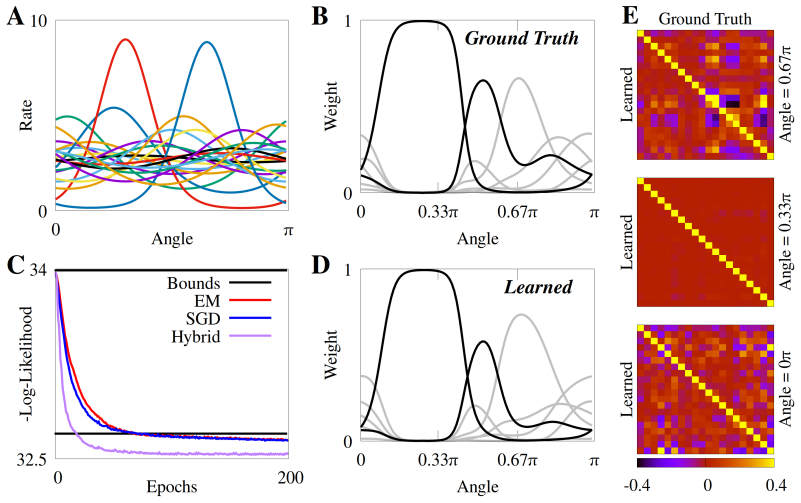
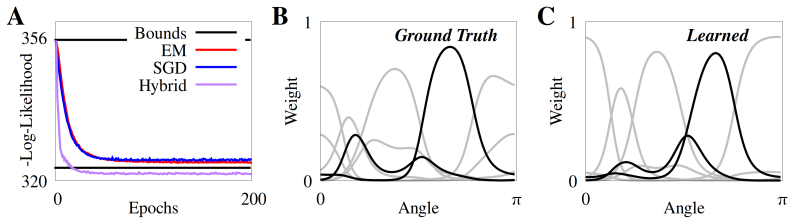
The central claim is that a CMP—a conditional maximum-entropy model in which a categorical latent variable couples otherwise conditionally independent Poisson neurons—can represent context-dependent noise correlations with a dimensionality set by the number of mixture components. The paper derives the CMP as an exponential-family harmonium, proves a closed-form maximization step for the Poisson component parameters, and demonstrates on synthetic data that the fitted model recovers ground-truth correlation matrices and mixture-weight curves. On eight macaque V1 datasets, ten-fold cross-validation selects 3–5 components, and the learned stimulus-dependent weights show that correlation structure changes with orientation while effective dimensionality does not.
Load-bearing premise
The V1 demonstration assumes that pooling four stimulus phases into the 80-trial recordings does not inflate the measured correlations, so the inferred 3–5 components reflect the neural code rather than phase mixing.
Editorial extensions
If this is right
- A cross-validated component count gives researchers a direct estimate of the dimensionality of noise correlations, replacing pairwise-structure assumptions with a data-driven latent dimension.
- Because the one-component CMP is the standard independent Poisson population code, the improvement from adding components directly quantifies how much correlated structure contributes to a rate-based code.
- Since context dependence enters through arbitrary nonlinear natural-parameter functions, the CMP can be embedded in deep neural network models so their outputs exhibit data-driven, stimulus-dependent correlations.
- On the V1 data, the model predicts that orientation changes the weights of a fixed set of 3–5 latent components, so correlation structure is context-dependent while its dimensionality is roughly stable.
Reading between the lines
- Inference: If the CMP account is right, pairwise-only characterizations of correlation structure are incomplete, because the shared latent component induces higher-order dependencies that pairwise statistics do not capture; a direct test is comparing held-out likelihoods of CMP and pairwise maximum-entropy models on the same recordings.
- Inference: The paper's phase-pooling caveat suggests a decisive re-analysis: fit the CMP separately to each of the four stimulus phases and check whether 3–5 components and orientation-dependent weights survive, separating neural correlation structure from stimulus artifact.
- Inference: The pattern of fixed dimensionality with stimulus-dependent weights implies a mode-recruitment code—orientation does not change how many shared variability sources exist, but changes which ones are engaged—and this could be tested by checking whether latent components align across recording sessions or animals.
- Inference: The paper mentions deep-network conditioning, and a testable version would attach a CMP as the output layer of a deep network and ask whether the correlated layer improves held-out log-likelihood on natural-image responses beyond conditionally independent Poisson outputs.
Signed reviews
Editorial analysis
A structured set of objections, weighed in public.
Referee Report
Summary. The paper introduces a conditional finite mixture of independent Poisson distributions (CMP) as a model for context-dependent noise correlations in neural populations. The authors present a theoretical framework connecting finite mixtures to exponential-family harmoniums, prove a closed-form EM update (Theorem 2), and propose three training algorithms (EM, SGD, Hybrid). They validate the method on synthetic data with known ground truth, and apply it to macaque V1 recordings, finding 3–5 mixture components and stimulus-dependent component weights. The paper positions the CMP as a rate-based model that is compatible with maximum-entropy approaches and extendable to deep-network predictors.
Significance. The theoretical contribution is solid: Theorem 2 gives a closed-form update for a conditional mixture of Poissons, and the synthetic experiments recover ground-truth correlations even with modest sample sizes, which is encouraging for practical use. The model offers a principled way to estimate the dimensionality and stimulus-dependence of noise correlations, and the proposed hybrid algorithm is shown to converge quickly. However, the real-data demonstration currently lacks statistical rigor, and a known phase-pooling confound in the V1 data is not quantitatively addressed, so the empirical claim that the model 'successfully captures stimulus-dependent correlations' is not yet fully supported. If these weaknesses are repaired, the paper would be a useful contribution to computational neuroscience and machine learning.
major comments (3)
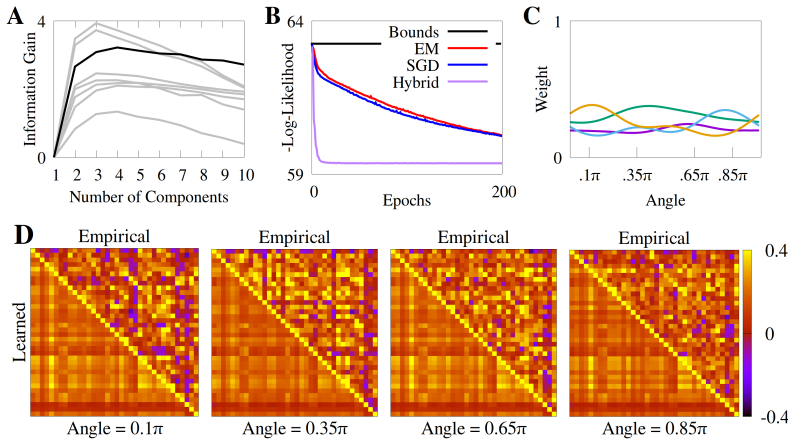
- [Section 3.2, footnote 2 and Figure 4] The footnote acknowledges that pooling four stimulus phases in the V1 dataset could inflate measured correlations, but the paper does not resolve this concern. Citing the original study's claim that recorded neurons were 'roughly phase independent' does not establish pairwise or joint phase independence; shared phase-dependent gain fluctuations, for example, could induce correlations in pooled trials while leaving single-neuron mean rates nearly unchanged. Since the inferred 3–5 component counts (Figure 4A) and the stimulus-dependent weights (Figure 4C) constitute the central real-data evidence, the load-bearing claim that the CMP captures stimulus-dependent correlations could be an artifact of stimulus-phase mixing. The authors should provide a quantitative check, such as comparing CMP fits on phase-separated trials if available, or at minimum weaken the conclusion and discuss the conditions under which pooling would not generate the observed correlation structure.
- [Section 3.2, Figure 4A] The cross-validated component counts are presented without error bars or statistical tests. The figure shows that 3–5 components are optimal for the eight datasets, but it is unclear whether the differences between, say, 3 and 5 components are meaningful relative to cross-validation variability. Without a null model or a measure of uncertainty across folds, the claim that the true correlation dimensionality is 3–5 is not well supported. The authors should report the mean and variance of the cross-validated log-likelihood, and ideally compare against a model with no correlations (e.g., the 1-component model) using a formal test.
- [Section 3.2, Figure 4C and 4D] The stimulus-dependence of the mixture weights and the correlation matrices is demonstrated only for one dataset, selected without stated criteria from the eight sessions. If this selection is not random, the displayed behavior may not be representative, and the claim that 'the effective dimensionality is largely stimulus-independent' while the structure depends on stimulus is based on a single example. Additionally, the match between empirical and learned correlations in Figure 4D is only assessed visually; a quantitative measure (e.g., mean squared error or correlation between matrix entries) would strengthen the claim that the CMP 'successfully captures' the correlations. The authors should either present results for all datasets or justify why the selected dataset is representative.
minor comments (4)
- [Section 2.3, after Equation 6] The phrase 'we can fact evaluate the maximization step in closed-form' appears to contain a typo; it should likely read 'we can in fact evaluate'.
- [Section 3.2, Figure 4A] The y-axis label indicates log-likelihood relative to the 1-component value, but the units and the direction of improvement could be clarified in the caption.
- [Section 3.1, Figure 2C] The text states that the Hybrid algorithm converges 'to a lower value' than SGD or EM, but it would be helpful to report the actual likelihood values or the number of epochs required to reach a given threshold, since visual comparison of curves can be misleading.
- [Abstract and Section 4] The abstract claims a single expectation-maximization algorithm, but the paper actually proposes three training algorithms (EM, SGD, and Hybrid). The wording should be adjusted to reflect that multiple algorithms are derived, with the Hybrid algorithm being the most efficient.
Circularity Check
No circularity: the model derivation is self-contained, and the V1 application is an in-sample demonstration with an acknowledged empirical confound, not a circular reduction.
full rationale
The paper's central derivation is self-contained. The CMP model is defined as a conditional finite mixture of independent Poisson distributions, Theorem 1 establishes an equivalence between finite mixture models and exponential-family harmoniums, and Theorem 2 derives a closed-form maximization step from the Poisson log-partition function via a Legendre transform. Component counts are selected by 10-fold cross-validation, which is out-of-sample, and Figure 4D compares empirical and learned correlations on the same fitted data as a demonstration of fit rather than as an independent prediction; no fitted parameter is renamed as a prediction. The only self-citation is the footnote in Section 3.2, which acknowledges that pooling four grating phases could inflate measured correlations and cites the original study [26] for the claim that the recorded neurons were roughly phase independent. This is an external empirical claim about the dataset, not an equation-level reduction of the model's target result to an input, and it is explicitly flagged as a limitation. The phase-pooling concern is a real correctness risk for the empirical demonstration, but it is not circularity of the derivation.
Assumptions & free parameters
free parameters (3)
- Number of mixture components m_C + 1 =
3 to 5 across V1 datasets
- Context modulation matrix Theta_NZ =
learned from data (values not reported)
- Mixture weights theta_C and component Poisson rates theta_{N,j} =
not reported individually
assumptions (3)
- domain assumption Spike counts are Poisson distributed and conditionally independent across neurons given mixture component and context.
- domain assumption Pooling four stimulus phases in the V1 data does not distort noise correlations because the recorded neurons are roughly phase independent.
- domain assumption The orientation stimulus can be represented by the harmonic feature map sZ(z) = (cos 2z, sin 2z).
invented entities (1)
-
Latent mixture component C
Cite this review
Pith. "Pith review of Conditional Finite Mixtures of Poisson Distributions for Context-Dependent Neural Correlations." pith.science (2026). https://pith.science/paper/W35DVIH5
@misc{pith2026190800637,
  author       = {Pith},
  title        = {Pith review of: Conditional Finite Mixtures of Poisson Distributions for Context-Dependent Neural Correlations},
  year         = {2026},
  howpublished = {\url{https://pith.science/paper/W35DVIH5}},
  note         = {Machine review of arXiv:1908.00637}
}
read the original abstract
Parallel recordings of neural spike counts have revealed the existence of context-dependent noise correlations in neural populations. Theories of population coding have also shown that such correlations can impact the information encoded by neural populations about external stimuli. Although studies have shown that these correlations often have a low-dimensional structure, it has proven difficult to capture this structure in a model that is compatible with theories of rate coding in correlated populations. To address this difficulty we develop a novel model based on conditional finite mixtures of independent Poisson distributions. The model can be conditioned on context variables (e.g. stimuli or task variables), and the number of mixture components in the model can be cross-validated to estimate the dimensionality of the target correlations. We derive an expectation-maximization algorithm to efficiently fit the model to realistic amounts of data from large neural populations. We then demonstrate that the model successfully captures stimulus-dependent correlations in the responses of macaque V1 neurons to oriented gratings. Our model incorporates arbitrary nonlinear context-dependence, and can thus be applied to improve predictions of neural activity based on deep neural networks.
Figures

Figures from the paper (1 more)
Reference graph
Works this paper leans on
-
[1]
Bruno B. Averbeck, Peter E. Latham, and Alexandre Pouget. Neural correlations, population coding and computation. Nature Reviews Neuroscience, 7(5):358–366, May 2006
work page 2006
-
[2]
Correlations and Neuronal Population Information
Adam Kohn, Ruben Coen-Cagli, Ingmar Kanitscheider, and Alexandre Pouget. Correlations and Neuronal Population Information. Annual Review of Neuroscience, 39(1):237–256, July 2016
work page 2016
-
[3]
Larry F. Abbott and Peter Dayan. The effect of correlated variability on the accuracy of a population code. Neural computation, 11(1):91–101, 1999
work page 1999
-
[4]
Population coding in neuronal systems with correlated noise
Haim Sompolinsky, Hyoungsoo Yoon, Kukjin Kang, and Maoz Shamir. Population coding in neuronal systems with correlated noise. Physical Review E, 64(5), October 2001
work page 2001
-
[5]
Implications of neuronal diversity on population coding
Maoz Shamir and Haim Sompolinsky. Implications of neuronal diversity on population coding. Neural computation, 18(8):1951–1986, 2006
work page 1951
-
[6]
Ecker, Philipp Berens, Andreas S
Alexander S. Ecker, Philipp Berens, Andreas S. Tolias, and Matthias Bethge. The Effect of Noise Correlations in Populations of Diversely Tuned Neurons. Journal of Neuroscience, 31(40):14272–14283, October 2011
work page 2011
-
[7]
Information-limiting correlations
Rubén Moreno-Bote, Jeffrey Beck, Ingmar Kanitscheider, Xaq Pitkow, Peter Latham, and Alexandre Pouget. Information-limiting correlations. Nature Neuroscience, 17(10):1410–1417, October 2014
work page 2014
-
[8]
Towards the design principles of neural population codes
Elad Schneidman. Towards the design principles of neural population codes. Current Opinion in Neurobi- ology, 37:133–140, April 2016
work page 2016
Show all 28 references
-
[9]
Modeling the Correlated Activity of Neural Populations: A Review
Christophe Gardella, Olivier Marre, and Thierry Mora. Modeling the Correlated Activity of Neural Populations: A Review. Neural Computation, 31(2):233–269, December 2018
2018
-
[10]
Berry, Ronen Segev, and William Bialek
Elad Schneidman, Michael J. Berry, Ronen Segev, and William Bialek. Weak pairwise correlations imply strongly correlated network states in a neural population. Nature, 440(7087):1007–1012, April 2006
2006
-
[11]
Stimulus-dependent Maximum Entropy Models of Neural Population Codes
Einat Granot-Atedgi, Gašper Tkaˇcik, Ronen Segev, and Elad Schneidman. Stimulus-dependent Maximum Entropy Models of Neural Population Codes. PLOS Computational Biology, 9(3):e1002922, March 2013
2013
-
[12]
Cowley, Matthew A
Benjamin R. Cowley, Matthew A. Smith, Adam Kohn, and Byron M. Yu. Stimulus-Driven Population Activity Patterns in Macaque Primary Visual Cortex. PLOS Computational Biology, 12(12):e1005185, December 2016
2016
-
[13]
Ecker, Philipp Berens, R
Alexander S. Ecker, Philipp Berens, R. James Cotton, Manivannan Subramaniyan, George H. Denfield, Cathryn R. Cadwell, Stelios M. Smirnakis, Matthias Bethge, and Andreas S. Tolias. State Dependence of Noise Correlations in Macaque Primary Visual Cortex. Neuron, 82(1):235–248, April 2014
2014
-
[14]
Dimensionality reduction for large-scale neural recordings
John P Cunningham and Byron M Yu. Dimensionality reduction for large-scale neural recordings. Nature Neuroscience, 17(11):1500–1509, November 2014
2014
-
[15]
Robbe L. T. Goris, J. Anthony Movshon, and Eero P. Simoncelli. Partitioning neuronal variability. Nature Neuroscience, 17(6):858–865, June 2014
2014
-
[16]
Steinmetz, Lee Cossell, M
Michael Okun, Nicholas A. Steinmetz, Lee Cossell, M. Florencia Iacaruso, Ho Ko, Péter Barthó, Tirin Moore, Sonja B. Hofer, Thomas D. Mrsic-Flogel, Matteo Carandini, and Kenneth D. Harris. Diverse coupling of neurons to populations in sensory cortex. Nature, 521(7553):511–515, May 2015
2015
-
[17]
Smith, Adam Kohn, Jonathan E
Robert Rosenbaum, Matthew A. Smith, Adam Kohn, Jonathan E. Rubin, and Brent Doiron. The spatial structure of correlated neuronal variability. Nature Neuroscience, 20(1):107–114, January 2017
2017
-
[18]
Ganmor, R
E. Ganmor, R. Segev, and E. Schneidman. Sparse low-order interaction network underlies a highly correlated and learnable neural population code. Proceedings of the National Academy of Sciences , 108(23):9679–9684, June 2011
2011
-
[19]
Finite mixtures of multivariate Poisson distributions with application
Dimitris Karlis and Loukia Meligkotsidou. Finite mixtures of multivariate Poisson distributions with application. Journal of Statistical Planning and Inference, 137(6):1942–1960, June 2007
1942
-
[20]
Bayesian inference with probabilistic population codes
Wei Ji Ma, Jeff Beck, Peter Latham, and Alexandre Pouget. Bayesian inference with probabilistic population codes. Nature Neuroscience, 9(11):1432–1438, October 2006
2006
-
[21]
From Spiking Neuron Models to Linear-Nonlinear Models
Srdjan Ostojic and Nicolas Brunel. From Spiking Neuron Models to Linear-Nonlinear Models. PLoS Computational Biology, 7(1):e1001056, January 2011. 9
2011
-
[22]
Methods of information geometry , volume 191
Shun-ichi Amari and Hiroshi Nagaoka. Methods of information geometry , volume 191. American Mathematical Soc., 2007
2007
-
[23]
Wainwright and Michael I
Martin J. Wainwright and Michael I. Jordan. Graphical models, exponential families, and variational inference. Foundations and Trends R© in Machine Learning, 1(1-2):1–305, 2008
2008
-
[24]
Exponential Family Harmoniums with an Application to Information Retrieval
Max Welling, Michal Rosen-zvi, and Geoffrey E Hinton. Exponential Family Harmoniums with an Application to Information Retrieval. In L. K. Saul, Y . Weiss, and L. Bottou, editors,Advances in Neural Information Processing Systems 17, pages 1481–1488. MIT Press, 2005
2005
-
[25]
Adam: A method for stochastic optimization
Diederik Kingma and Jimmy Ba. Adam: A method for stochastic optimization. arXiv preprint arXiv:1412.6980, 2014
2014 arXiv
-
[26]
Flexible gating of contextual influences in natural vision
Ruben Coen-Cagli, Adam Kohn, and Odelia Schwartz. Flexible gating of contextual influences in natural vision. Nature Neuroscience, 18(11):1648–1655, October 2015
2015
-
[27]
McLachlan, Sharon X
Geoffrey J. McLachlan, Sharon X. Lee, and Suren I. Rathnayake. Finite Mixture Models. Annual Review of Statistics and Its Application, 6(1):355–378, 2019
2019
-
[28]
Daniel L. K. Yamins and James J. DiCarlo. Using goal-driven deep learning models to understand sensory cortex. Nature Neuroscience, 19(3):356–365, March 2016. 10
2016
Reviewed August 14, 2026 · model on record in the stance chip above.
Discussion (0). Continue with ORCID to comment.