REVIEW 3 major objections 4 minor 45 references
Transdimensional epsilon-near-zero modes in planar plasmonic nanostructures
T0 review · 3 major / 4 minor · reviewed 2026-08-14 · deepseek-v4-flash
Pith's one-line read In transdimensional metal films, thickness alone splits the epsilon-near-zero plasmon mode and raises emitter decay rates up to 1000-fold.
desk verdict A plausible and useful extension of ENZ thin-film physics, but Eq. (1) as printed is wrong and makes the paper unreproducible until corrected. read the letter →
The pith
A machine-rendered reading of the paper's core claim, the machinery that carries it, and where it could break.
The reading
What carries the argument
The load-bearing object is the confinement-induced nonlocal Drude dielectric response, Eq. (2), with the momentum- and thickness-dependent plasma frequency of Eq. (1). The physical origin is the Keldysh-Rytova electron interaction potential: in a film only a few monolayers thick, the field outside the film makes electron-electron repulsion stronger than in bulk, shifting the plasma frequency to the red and giving it $\sqrt{k}$ spatial dispersion. This single substitution changes the pole structure of the Fresnel reflection coefficient: a zero of the dielectric function combined with finite thickness creates two ENZ modes, Eq. (9), whose analytic ultrathin forms are Eq. (11). A Lorentzian approximation to the spectral function then converts the Green tensor into the biexponential expression of Eq. (14), which directly produces the predicted decay enhancement.
What would settle it
Measure the spontaneous-emission rate of an ensemble of identical emitters, such as nitrogen-vacancy centers, as a function of distance from an atomically smooth silver or titanium-nitride film whose thickness is varied from about 5 nm to 100 nm. If the decay curve is a single exponential rather than a sum of two exponentials, or if the enhancement does not rise steeply as the film thins, then Eq. (1) cannot be the correct low-frequency response.
Extended reading notes
Core claim
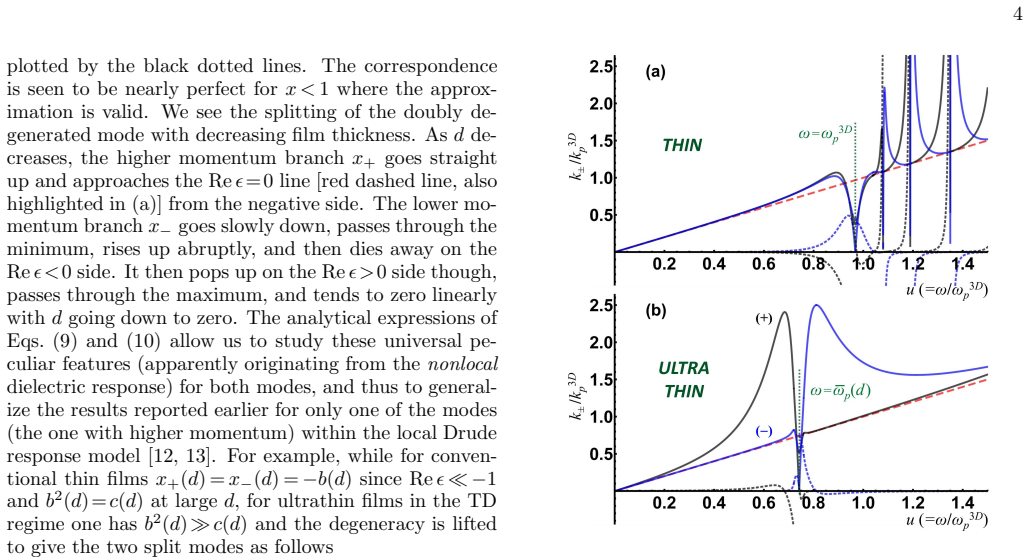
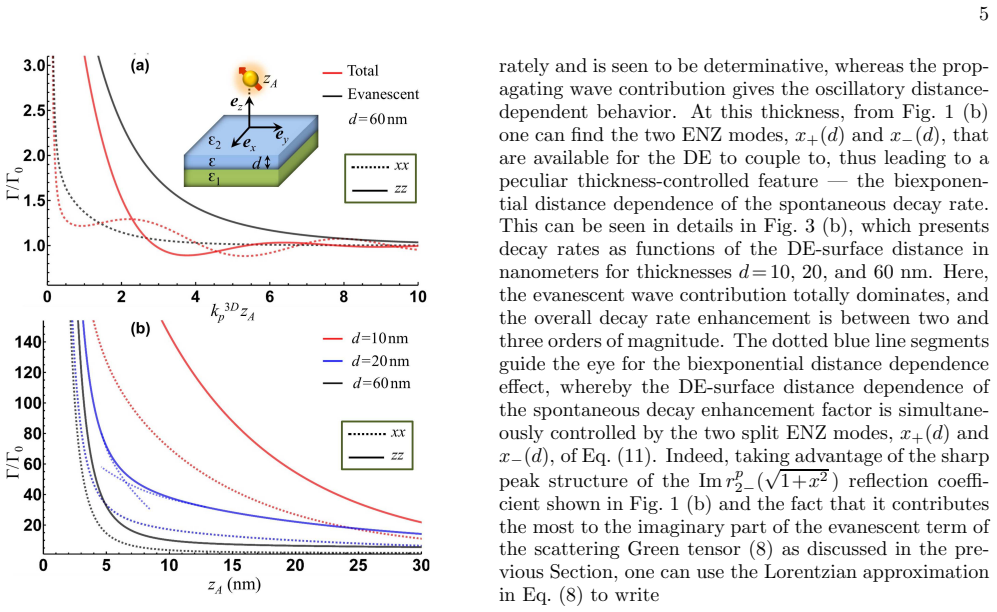
The paper's central claim is that confinement-induced nonlocality, not just geometry, governs the optical response of ultrathin metal films. In the model, vertical confinement of electrons turns the ordinary Coulomb potential into the Keldysh-Rytova electron interaction potential, making the in-plane plasma frequency $\omega_p(k)=\omega_p^{3D}\sqrt{1+(\varepsilon_1+\varepsilon_2)/\varepsilon k d}$ depend on thickness $d$ and momentum $k$. Inserting this plasma frequency into the Drude dielectric function and locating the poles of the p-polarized reflection coefficient yields two epsilon-near-zero (ENZ) branches, $x_+(d)$ and $x_-(d)$, whose degeneracy is lifted as $d$ shrinks. The upper branch reproduces the long-range plasmon of earlier local-Drude analyses, while the lower branch is the new transdimensional feature. A dipole emitter above the film couples to both branches, so the spontaneous-decay rate contains two exponentials with opposite thickness dependences; for a 10 nm film the enhancement reaches over three orders of magnitude. The authors present this as a generalization of the classic Drexhage emitter-near-interface problem to the transdimensional regime.
Load-bearing premise
The entire chain, from mode splitting to the two-to-three-order decay enhancement, rests on Eq. (1), the confinement-induced plasma frequency $\omega_p(k)=\omega_p^{3D}\sqrt{1+(\varepsilon_1+\varepsilon_2)/\varepsilon k d}$, which is taken from the authors' earlier work and not re-derived here; if that formula is wrong or inapplicable for few-nanometer films, the predicted effects disappear.
Editorial extensions
If this is right
- Film thickness becomes a practical tuning parameter for the epsilon-near-zero frequency and for spontaneous emission rates, supplementing or replacing material choice.
- Ultrathin films support two coexisting surface-plasmon branches below the plasma frequency, and the lower branch keeps the enhanced decay over emitter-film distances much larger than the short-range branch.
- Perpendicular (z-oriented) dipoles decay faster than parallel dipoles, consistent with the mirror-charge picture of an emitter near a conducting plane.
- Above the plasma frequency, the usual half-wavelength film modes disappear in ultrathin films and are replaced by a sharp, nearly flat long-range mode.
- As the film thickens toward the local-Drude limit, the mode splitting and the biexponential signature vanish, recovering conventional thin-film optics.
Reading between the lines
- If Eq. (1) survives scrutiny at few-nanometer thickness, the same nonlocal dielectric response should also modify other near-field observables, such as resonant energy transfer between emitters or forces between two ultrathin films; the paper does not compute these.
- One testable extension is a film patterned with a thickness gradient: the two split branches would shift along the film, potentially acting as a nanoscale frequency-selective coupler or a way to separate emitters by transition frequency in space.
- The biexponential decay law itself could serve as a metrology tool: fitting the two decay lengths at fixed thickness would extract the effective plasma frequency and the dielectric environment, quantities that are otherwise hard to measure directly.
Signed reviews
Editorial analysis
A structured set of objections, weighed in public.
Referee Report
Summary. The manuscript studies epsilon-near-zero (ENZ) modes in ultrathin metallic films in the transdimensional regime, using macroscopic QED and a confinement-induced nonlocal Drude dielectric function based on the Keldysh-Rytova interaction potential. From the pole structure of the p-polarized reflection coefficient of a symmetric planar film, the authors derive two ENZ dispersion branches x±(d) whose degeneracy is lifted as the film thickness d decreases (Eqs. (9) and (11)). Coupling of a point dipole emitter to these split modes is shown to produce a biexponential distance dependence of the spontaneous decay rate (Eq. (14)), with enhancements of two to three orders of magnitude over free space (Fig. 3). The effects are controlled by the thickness-dependent plasma frequency of the film, a hallmark of the nonlocal KR model, and the paper claims this provides a new thickness-based control knob for light-matter interactions.
Significance. If the predictions are correct, the paper would establish a useful generalization of Drexhage-type decay engineering and of local-Drude treatments of ultrathin films, with potential applications in tunable nanophotonics. The manuscript's explicit closed-form expressions, the clear physical interpretation of the two split modes, and the falsifiable predictions (decay-rate distance and thickness dependence) are strengths. However, the entire derivation reduces to the cited nonlocal Drude model, and the manuscript contains an internal inconsistency in the definition of the thickness-dependent plasma frequency that must be resolved before the predictions can be accepted. The central result is conditional on the correctness and applicability of the Keldysh-Rytova-based dielectric response at few-nanometer thicknesses, a condition the paper does not independently establish.
major comments (3)
- [§II, Eq. (1); §III, Eq. (10)] The printed Eq. (1) defines ωp(k) = ωp^3D √(1 + (ε1+ε2)/(ε k d)), but Eq. (10) is not derivable from this form. With the printed definition, substitution into Eq. (2) and the rescaling (7) yields ε/ε = 1 − (A u + 2)/(A u^2 (u+iδ)) with A = ε kp^3D d √(1+x^2), which differs from the printed Eq. (10). The reciprocal form ωp(k) = ωp^3D / √(1 + (ε1+ε2)/(ε k d)) reproduces Eq. (10) exactly. The printed form also contradicts the text: for fixed k it blue-shifts as d decreases, while the text states a red shift, and in the 2D limit it gives ωp(k) ∝ 1/√k, not the stated √k dispersion. Equation (1) is additionally inconsistent with the √d thickness behavior of Eq. (3). Since Eqs. (9), (11), (13), (14) and all figures explicitly use Eq. (10), a reader implementing the printed Eq. (1) would obtain opposite thickness trends and altered ENZ poles. This is a load-bearing error: the manuscript must be corrected to the reciprocal form (or an equivalent), and the authors should confirm that all subsequent results use that form.
- [§III, §IV, Eqs. (9), (13), (14)] The biexponential formula (14) follows from the Lorentzian approximation (13), the second-order Maclaurin expansion used for Eq. (9), the b^2 >> c limit in Eq. (11), the condition Im x±/Re x± ≪ 1, and a first-order Taylor expansion of arctan. The manuscript does not provide a sensitivity analysis or error estimates for these steps. In particular, for the representative parameters used in Fig. 1 (ωp = 2.79 eV, u = 0.65, d = 10 nm), the x+ branch satisfies x+ ≈ 2.8, which is outside the domain x < 1 where the expansion is stated to be valid and where the poles contribute significantly in Eq. (8). The authors should demonstrate that the predictions are robust beyond that domain, or explicitly delimit the range of d, frequency, and dipole orientation for which Eq. (14) is quantitatively accurate. Without such a check, the two-to-three-orders-of-magnitude enhancement claim rests on an uncontrolled approximation.
- [§II, Eq. (1); §III, Eq. (10)] The entire derivation is built on the confinement-induced nonlocal plasma frequency of Eq. (1)/(10), which is cited from prior work ([30]–[32]) without derivation. Given that the paper's new claims reduce to this expression, and given the inconsistency described above between the printed Eq. (1) and Eq. (10), the authors should provide a concise derivation of the reciprocal form from the Keldysh-Rytova potential, or at least state explicitly the approximations under which it holds at few-nanometer thicknesses. This is needed for readers to judge whether the model applies in the regime where the predicted splitting and decay enhancement are largest.
minor comments (4)
- [§V] In the Concluding Remarks, 'transdimentional' should be 'transdimensional'.
- [Fig. 1(b)] The black dotted lines are described as 'the real parts of the approximate modes of Eq. (9)', but the text also refers to Eq. (11) in connection with the ultra-thin limit; the authors should specify which approximate expression is used in the figure.
- [§IV] The parameters used for the figures (ωp = 2.79 eV, ε = 7.8, u = 0.65, δ = 0.01) are said to be typical of NV centers near a TiN surface, but the text does not explain how u and δ are obtained from the cited experiments; a brief justification would improve reproducibility.
- [§III, Eq. (5)-(6)] The text states that only the p-evanescent coefficient rp_2− can have poles on the real axis; the reasoning for excluding s-polarized poles and propagating-wave poles is compressed. A sentence making the argument explicit would aid the reader.
Circularity Check
No significant circularity: the central predictions are derived from an explicit nonlocal Drude input, not refit from the claimed outputs.
full rationale
The derivation chain is model-based rather than circular. The input is the confinement-induced nonlocal Drude response, Eq. (1), adopted from the authors' prior work [30-32] as an explicit constitutive assumption based on the Keldysh-Rytova pair potential; it is not a consequence of, and is not fitted to, the paper's claimed outputs. The downstream results -- the split ENZ modes in Eqs. (9) and (11), the dispersions in Eq. (12), and the biexponential decay formula in Eq. (14) -- are obtained from this input by the stated Green-tensor, pole, and Lorentzian approximations in Eqs. (5)-(13). No parameter is fitted to the mode splitting or to the decay enhancement, and no output is fed back to define the input. The paper also benchmarks the model's thermal-average limit, Eq. (3), against published TiN thickness-dependent plasma-frequency data and simulations [4,11,37], and checks the approximate modes against the exact reflection coefficient in Fig. 1(b). The self-citations [30-32] are present and load-bearing as the source of the constitutive model, but the cited model is explicit, parameter-free with respect to the new predictions, and externally benchmarked, so this does not constitute circularity under the stated rules. Separately, the printed Eq. (1) appears inconsistent with the form needed to obtain Eq. (10), a correctness/consistency concern rather than a circularity concern; it does not make the derivation equivalent to its own inputs.
Assumptions & free parameters
free parameters (3)
- delta (dimensionless damping rate) =
0.01
- u = omega / omega_p^3D =
0.65
- k_c (2D plasmon cutoff)
assumptions (3)
- domain assumption Keldysh-Rytova confinement-induced modification of the plasma frequency, Eq. (1).
- domain assumption Macroscopic local Fresnel reflection coefficients, Eq. (6), remain valid for films down to a few monolayers.
- domain assumption Drude response with a single band below interband transitions, Eq. (2).
Cite this review
Pith. "Pith review of Transdimensional epsilon-near-zero modes in planar plasmonic nanostructures." pith.science (2026). https://pith.science/paper/OCF3TZBB
@misc{pith2026190800640,
  author       = {Pith},
  title        = {Pith review of: Transdimensional epsilon-near-zero modes in planar plasmonic nanostructures},
  year         = {2026},
  howpublished = {\url{https://pith.science/paper/OCF3TZBB}},
  note         = {Machine review of arXiv:1908.00640}
}
read the original abstract
We use quantum electrodynamics and the confinement-induced nonlocal dielectric response model based on the Keldysh-Rytova electron interaction potential to study the epsilon-near-zero modes of metallic films in the transdimensional regime. New peculiar effects are revealed such as the plasmon mode degeneracy lifting and the dipole emitter coupling to the split epsilon-near-zero modes, leading to thickness-controlled spontaneous decay with up to three-orders-of-magnitude increased rates.
Figures

Reference graph
Works this paper leans on
-
[30]
I. V. Bondarev and V. M. Shalaev, Opt. Mater. Express 7, 3731 (2017)
work page 2017
-
[32]
I. V. Bondarev, Opt. Mater. Express 9, 285 (2019)
work page 2019
- [1]
- [2]
- [3]
-
[4]
D. Shah, H. Reddy, N. Kinsey, V. M. Shalaev, and A. Boltasseva, Adv. Opt. Mater. 5, 1700065 (2017)
work page 2017
-
[5]
A. Rodr ´ ıguez Echarri, J. D. Cox, and F. J. Garc ´ ıa de Abajo, Optica 6, 630 (2019). 7
work page 2019
-
[6]
Z. M. Abd El-Fattah, V. Mkhitaryan, J. Brede, L. Fern´ andez, C. Li, Q. Guo, A. Ghosh, A. Rodr ´ ıguez Echarri, D. Naveh, F. Xia, J. Enrique Ortega, and F. J. Garc ´ ıa de Abajo, ACS Nano 13, 7771 (2019)
work page 2019
Show all 45 references
-
[7]
F. Xia, H. Wang, D. Xiao, M. Dubey, and A. Ramasub- ramaniam, Nature Photon. 8, 899 (2014)
2014
-
[8]
K. F. Mak and J. Shan, Nature Photon. 10, 216 (2016)
2016
-
[9]
K. P. Kelley, T. G. Folland, J. Ryan Nolen, N. Engheta, J. D. Caldwell, and J.-P. Maria, Nano Lett. 19, 948 (2019)
2019
-
[10]
A. M. Dubrovkin, B. Qiang, H. N. S. Krishnamoorthy, N. I. Zheludev, and Q. J. Wang, Nature Commun. 9, 1762 (2018)
2018
-
[11]
D. Shah, A. Catellani, H. Reddy, N. Kinsey, V. M. Sha- laev, A. Boltasseva, and A. Calzolari, ACS Photon. 5, 2816 (2018)
2018
-
[12]
Campione, I
S. Campione, I. Brener, and F. Marquier, Phys. Rev. B 91, 121408(R) (2015)
2015
-
[13]
Vassant, J.-P
S. Vassant, J.-P. Hugonin, and J.-J. Greffet, Optics Ex- press 27, 12317 (2019)
2019
-
[14]
R. H. Ritchie, Phys. Rev. 106, 874 (1957)
1957
-
[15]
E. N. Economou, Phys. Rev. 182, 539 (1969)
1969
-
[16]
D. A. Dahl and L. J. Sham, Phys. Rev. B 16, 651 (1977)
1977
-
[17]
T. N. Theis, Surf. Sci. 98, 515 (1980)
1980
-
[18]
T. Ando, A. B. Fowler, and F. Stern, Rev. Mod. Phys. 54, 437 (1982)
1982
-
[19]
A. V. Chaplik, Surf. Sci. Rep. 5, 289 (1985)
1985
-
[20]
Z. L. Wang, Micron 27, 265 (1996)
1996
-
[21]
J. M. Pitarke1, V. M. Silkin, E. V. Chulkov, and P. M. Echenique, Rep. Prog. Phys. 70, 1 (2007)
2007
-
[22]
Politano and G
A. Politano and G. Chiarello, Frontiers in Mater. 1, 9 (2014)
2014
-
[23]
Rivera, I
N. Rivera, I. Kaminer, B. Zhen, J. D. Joannopoulos, M. Soljaˇ ci´ c, Science353, 263 (2016)
2016
-
[24]
D. N. Basov, M. M. Fogler, A. Lanzara, F. Wang, and Y. Zhang, Rev. Mod. Phys. 86, 959 (2014)
2014
-
[25]
Engheta, Science 340, 286 (2013)
N. Engheta, Science 340, 286 (2013)
2013
-
[26]
J. A. Roberts, S.-J. Yu, P.-H. Ho, S. Schoeche, A. L. Falk , and J. A. Fan, Nano Lett. 19, 3131 (2019)
2019
-
[27]
A. I. Fern´ andez-Dom ´ ınguez, S. I. Bozhevolnyi, and N.A. Mortensen, ACS Photon. 5, 3447 (2018)
2018
-
[28]
Manjavacas and F
A. Manjavacas and F. J. Garcia de Abajo, Nature Com- mun. 5, 3548 (2014)
2014
-
[29]
F. J. Garcia de Abajo and A. Manjavacas, Faraday Dis- cuss. 178, 87 (2015)
2015
-
[31]
I. V. Bondarev, H. Mousavi, and V. M. Shalaev, MRS Commun. 8, 1092 (2018)
2018
-
[33]
L. V. Keldysh, JETP Lett. 29, 658 (1980); N. S. Rytova, Mosc. Univ. Phys. Bull. 3, 30 (1967)
1980
-
[34]
K. H. Drexhage, J. Lumin. 1-2, 693 (1970)
1970
-
[35]
Chernikov, T
A. Chernikov, T. C. Berkelbach, H. M. Hill, A. Rigosi, Y. Li, O. B. Aslan, D. R. Reichman, M.S. Hybertsen, and T. F. Heinz, Phys. Rev. Lett. 113, 076802 (2014)
2014
-
[36]
Deslippe, M
J. Deslippe, M. Dipoppa, D. Prendergast, M. V. O. Mo- utinho, R. B. Capaz, and S. G. Louie, Nano Lett. 9, 1330 (2009)
2009
-
[37]
Vertchenko, L
L. Vertchenko, L. Leandro, E. Shkondin, O. Takayama, I. V. Bondarev, N. Akopian, and A. V. Lavrinenko, Opt. Mater. Express 9, 2117 (2019)
2019
-
[38]
Vogel and D.-G
W. Vogel and D.-G. Welsch, Quantum Optics (Wiley, 2006)
2006
-
[39]
Sambale, D.-G
A. Sambale, D.-G. Welsch, H. T. Dung, and S. Y. Buh- mann, Phys. Rev. A 78, 053828 (2008)
2008
-
[40]
M. S. Tomaˇ s, Phys. Rev. A 51, 2545 (1995)
1995
-
[41]
A. A. Abrikosov, L. P. Gorkov, and I. E. Dzyaloshinski, Methods of Quantum Field Theory in Statistical Physics (Prentice-Hall, 1963)
1963
-
[42]
A. A. Herzing, U. Guler, X. Zhou, A. Boltasseva, V. M. Shalaev, and T. B. Norris, Appl. Phys. Lett. 108, 171107 (2016)
2016
-
[43]
S. I. Bogdanov, M. Y. Shalaginov, A. S. Lagutchev, C.- C. Chiang, D. Shah, A. S. Baburin, I. A. Ryzhikov, I. A. Rodionov, A. V. Kildishev, A. Boltasseva, and V. M. Shalaev, Nano Lett. 18, 4837 (2018)
2018
-
[44]
Archambault, T
A. Archambault, T. V. Teperik, F. Marquier, and J. J. Greffet, Phys. Rev. B 79, 195414 (2009)
2009
-
[45]
Born and E
M. Born and E. Wolf, Principles of Optics: Electromag- netic Theory of Propagation, Interference, and Diffrac- tion of Light (Cambridge, 1999)
1999
Reviewed August 14, 2026 · model on record in the stance chip above.
Discussion (0). Continue with ORCID to comment.