REVIEW 3 major objections 4 minor 1 cited by
Unequal Mass Binary Neutron Star Simulations with Neutrino Transport: Ejecta and Neutrino Emission
T0 review · 3 major / 4 minor · reviewed 2026-08-14 · deepseek-v4-flash
Pith's one-line read Twelve unequal-mass neutron-star merger simulations find that dynamical ejecta exceed 0.01 solar masses only for the softest equation of state, with ejecta electron fraction and velocity falling as mass asymmetry grows.
desk verdict Useful new simulation set for unequal-mass BNS mergers, but the headline 'only SFHo exceeds 0.01 Msun' is not robust to the Bernoulli/ut systematic the authors themselves cite. read the letter →
The pith
A machine-rendered reading of the paper's core claim, the machinery that carries it, and where it could break.
The reading
What carries the argument
The central machinery is a gray two-moment neutrino transport scheme that evolves, for each neutrino species, the energy and momentum densities together with the neutrino number density, giving an on-the-fly estimate of the average neutrino energy and exact conservation of total lepton number. The unbound-ejecta accounting uses the relativistic Bernoulli condition $h u_t < -1$ applied to matter more than 50 solar masses from the remnant, integrated up to 7.5 ms after merger.
What would settle it
Recompute the ejected mass with the geodesic criterion $u_t < -1$ instead of $h u_t < -1$; if no SFHo model then exceeds $0.01\,M_\odot$, or a DD2 or LS220 model does, the central ejecta-mass claim fails. Evolving the non-collapsing remnants beyond 7.5 ms would also test whether matter flagged unbound near the grid edge is truly escaping.
Extended reading notes
Core claim
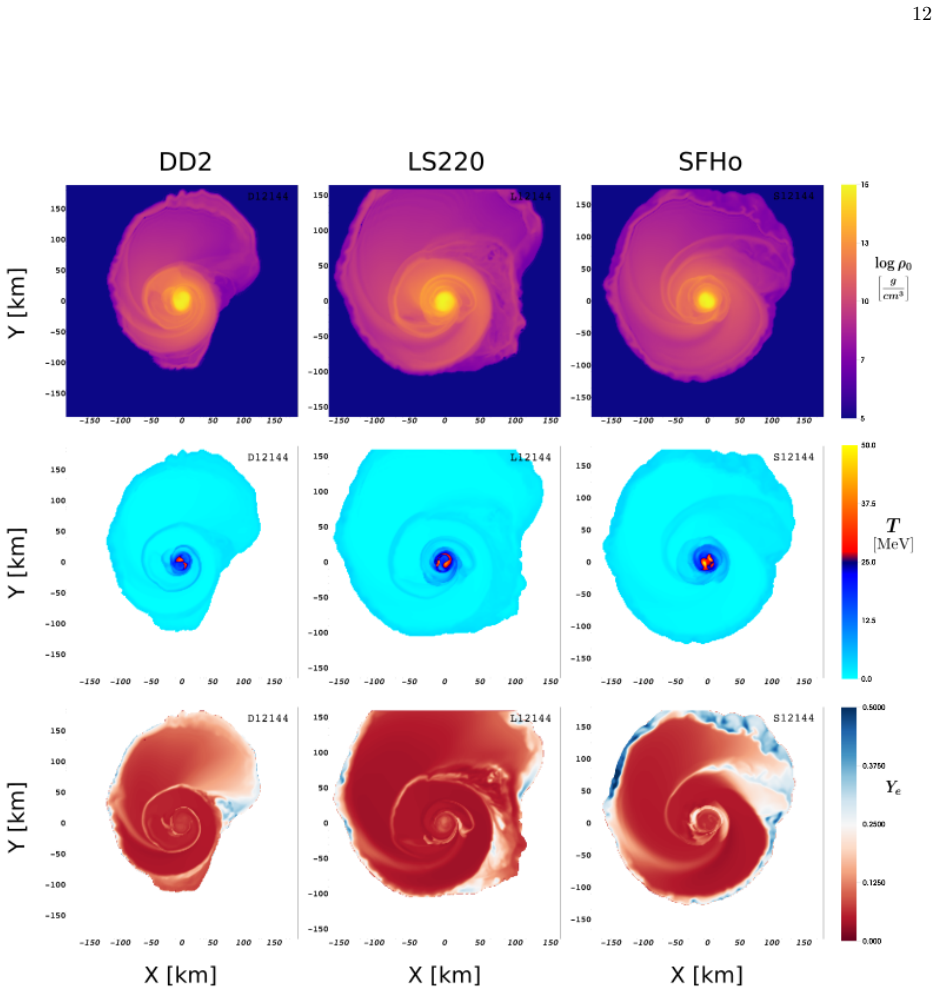
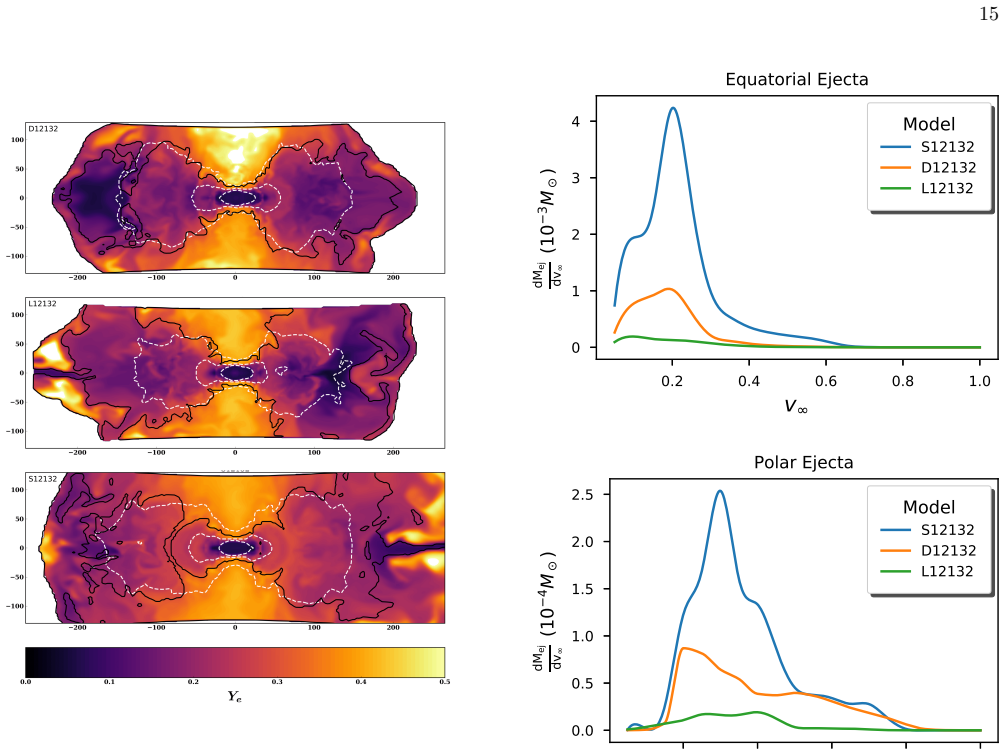
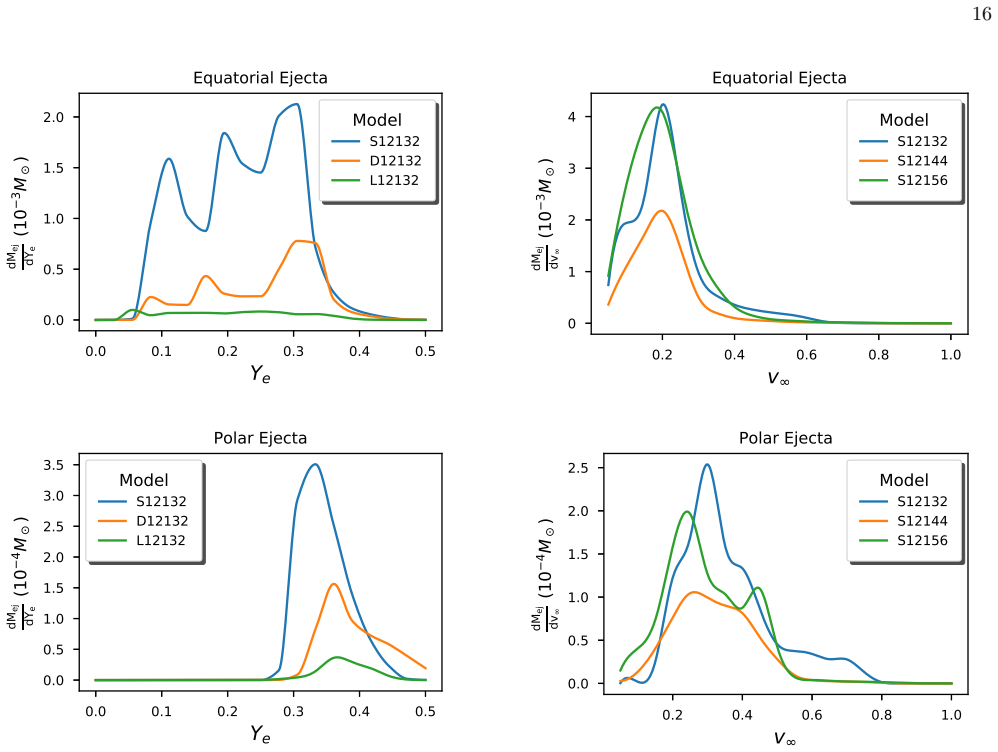
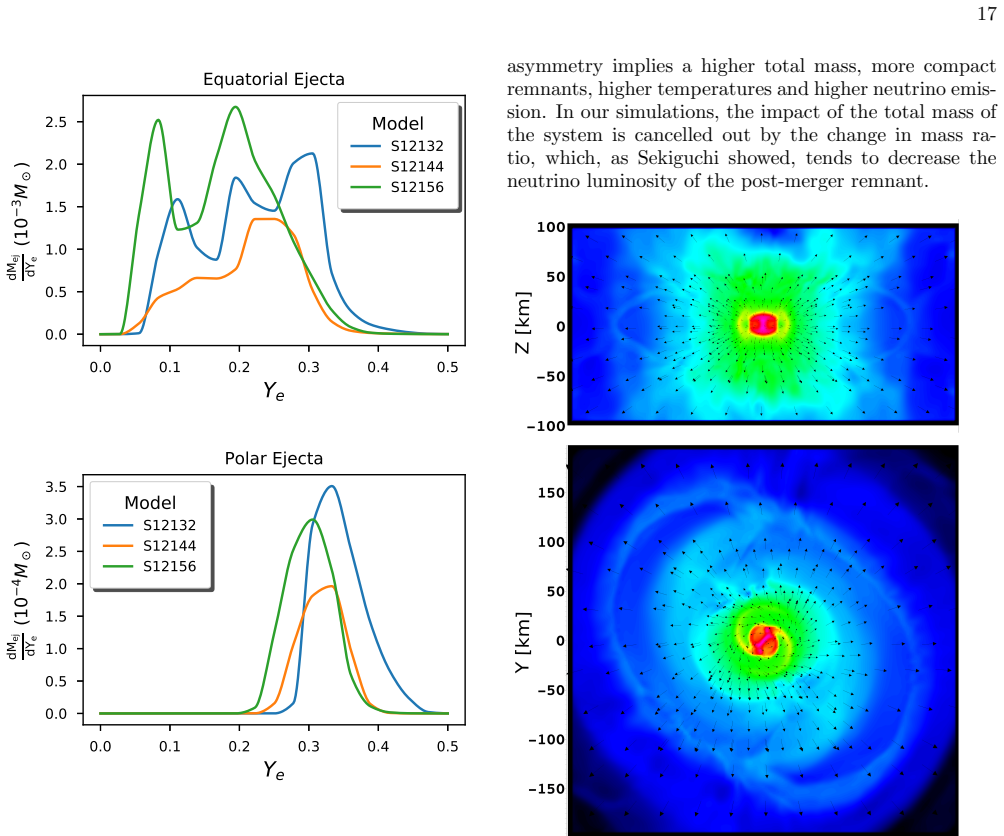
Across twelve simulations, the paper reports that the total dynamical ejecta mass exceeds $0.01\,M_\odot$ only for the SFHo equation of state, with a weak dependence on mass ratio; LS220 and DD2 eject less. Ejecta electron fractions span roughly $0.06$ to $0.48$ with a mean near $0.2$, increase over time as neutrino irradiation acts on the outflow, and decrease with binary asymmetry. Asymptotic ejecta velocities span roughly $0.05c$ to $0.7c$, with averages between $0.2c$ and $0.3c$, and also decrease with asymmetry. Remnant disk mass at 7.5 ms post-merger increases with both binary asymmetry and stiffness of the equation of state, while the disk electron fraction is higher for softer equations of state. Neutrino emission is strongest for the softest equation of state; electron-neutrino luminosity and its angular distribution show no significant mass-ratio dependence, while heavy-lepton neutrino luminosity increases with asymmetry in these models.
Load-bearing premise
The central claim depends on identifying unbound matter with the Bernoulli condition $h u_t < -1$, which the authors note can overestimate the ejected mass by as much as a factor of two relative to the alternative $u_t < -1$ criterion.
Editorial extensions
If this is right
- Kilonova models for unequal-mass binaries should use dynamical ejecta masses around $10^{-3}$ to $10^{-2}\,M_\odot$, exceeding $0.01\,M_\odot$ only when the equation of state is soft.
- Greater mass asymmetry lowers both the average velocity and electron fraction of the ejecta, which should push kilonova emission redder and shift r-process yields toward heavier, more neutron-rich elements.
- Disk masses at 7.5 ms grow with asymmetry and stiffness, and all but the promptly collapsing equal-mass LS220 model leave a disk large enough to supply the GW170817 kilonova if 25 to 50 percent of the disk is later ejected.
- Electron-neutrino luminosity is insensitive to mass ratio, so neutrino-driven wind properties may be approximately universal across mass ratio for a fixed equation of state.
- Heavy-lepton neutrino luminosity rises with mass asymmetry in this model set, although the paper attributes part of that dependence to the accompanying increase in total mass.
Reading between the lines
- Because the paper's unbound-mass criterion can overestimate ejecta by up to a factor of two, the absolute dynamical masses may be systematically high even if the ranking across equations of state survives.
- I infer from the velocity trend that core-bounce ejecta, not tidal ejecta, set the average speed in near-equal-mass mergers; if so, highly asymmetric binaries may lack the fast blue kilonova component.
- These trends imply that a gravitational-wave event with measured mass ratio could be used to predict whether its kilonova is lanthanide-rich mainly from the compactness of the neutron stars, a testable prediction once more events with broadband light curves are observed.
- A natural extension would be to run the same transport scheme beyond 7.5 ms, since the paper notes its disk mass is still growing; if disk-driven winds dominate the total ejecta, the dynamical-ejecta trends in this paper would constrain only the early kilonova peak.
Editorial analysis
A structured set of objections, weighed in public.
Referee Report
Summary. The paper presents twelve new general-relativistic binary neutron star merger simulations performed with the SpEC code, using the SFHo, LS220, and DD2 equations of state and a gray two-moment neutrino transport scheme that evolves neutrino number density in addition to energy and flux. The binary mass ratios range from about 0.76 to 1.0, and the simulations are evolved up to 7.5 ms post-merger or to collapse. The authors report the mass, electron fraction, and asymptotic velocity of the dynamical ejecta, the disk masses, and the neutrino luminosities and angular distributions. Their central claims are that total dynamical ejecta exceeds 0.01 solar masses only for the SFHo equation of state, that ejecta electron fraction and average velocity decrease with increasing mass asymmetry, that disk mass increases with mass asymmetry and equation-of-state stiffness, and that neutrino emission is strongest for the softest equation of state.
Significance. If the reported trends hold, this simulation set is a valuable addition to the effort of connecting binary parameters to kilonova-relevant ejecta properties. The strengths of the paper include the use of an established code (SpEC), a neutrino transport scheme with improved lepton-number conservation, a systematic variation of equation of state and mass ratio, and a candid discussion of numerical limitations. The authors explicitly quantify their resolution-error estimate, state that the disk mass has not converged, and describe the known systematic uncertainty in the Bernoulli unbound criterion. Those admissions are commendable, but they also directly bear on the headline quantitative claims, and the current presentation does not fully reconcile the headline statements with the stated uncertainties.
major comments (3)
- [Section II J, Eq. (60), Eq. (64), Table III] The headline claim that total dynamical ejecta exceeds 0.01 solar masses only for SFHo is not robust under the uncertainties stated in the paper. The Bernoulli criterion hut<-1 is acknowledged in Section II J to yield as much as twice the ejected mass of the ut<-1 criterion, citing Kastaun and Galeazzi 2015, yet this systematic is not included in the error estimate Delta Mej = 0.5 Mej + 1e-4 solar masses in Eq. (64), which covers only resolution and regridding effects. In Table III, S12132 and S12156 have total ejecta masses of 1.574e-2 and 1.802e-2 solar masses; if the Bernoulli criterion overestimates by a factor of two, both fall below 0.01 solar masses, while applying the 50 percent resolution error to S12144 raises it above 0.01 solar masses. The abstract and conclusion should either be reworded to present this as a tentative statement, or the analysis should report both unbound criteria and incorporate the criterion choice into the error budget.
- [Section III B 2, Figs. 8 and 9, Table I] The claimed monotonic decrease of ejecta electron fraction and average asymptotic velocity with increasing mass asymmetry is inferred from three SFHo models (S12132, S12144, S12156) and from even fewer non-collapsing runs for the other equations of state, with no measure of statistical significance. Because the lower-mass neutron star is held fixed while the higher mass is varied, total binary mass increases with mass asymmetry, so the attribute 'mass asymmetry' is not cleanly separated from total mass; Section III C correctly notes this confounding for neutrino luminosity, but the ejecta trends are presented without a similar caveat. Given the admitted non-monotonic ejecta-mass behavior in Section III B 1 and the 50 percent error estimate, the paper should either provide explicit error bars on the plotted distributions or reframe these statements as suggestive trends rather than robust findings.
- [Section III B 3, Eq. (65), Fig. 10] The conclusion that disk mass increases with mass asymmetry and equation-of-state stiffness is based on a disk-mass definition with an arbitrary density threshold, and the paper itself states that Mdisk has not converged by 7.5 ms post-merger. Since the ordering of disk masses could change if the simulations were evolved longer, and since this trend is used in the discussion of kilonova powering, the conclusion should be labeled as provisional or accompanied by a convergence check, such as a comparison at multiple post-merger times or at a second resolution.
minor comments (4)
- [Abstract and Section I] The word 'preformed' should be 'performed'; the same typo appears in both the abstract and the introduction.
- [Section II D] In the sentence introducing the number-density evolution equation, 'te evolution' should be 'the evolution'.
- [Section II J] The subscript 'Mon' in Eq. (60) appears to be a typo for 'Mej'.
- [Section III B 1] The text says 'we can make predictions on expected trends' and later describes results that do not fit the narrative; some transition between expectation and outcome would improve readability.
Circularity Check
No significant circularity: the paper reports independent simulation outputs, and its self-citations are standard code/method reuse rather than derivation-by-construction.
full rationale
This paper presents twelve new numerical-relativity simulations and reports trends in ejecta mass, electron fraction, velocity, disk mass, and neutrino emission. There is no fitted parameter that is later relabeled as a prediction, no equation whose output is equivalent to its input by construction, and no uniqueness claim imported from the authors' own prior work to force a choice. The ejecta mass is defined through the Bernoulli criterion hut < -1 in Eq. (60); the choice of this criterion is justified by the authors' earlier paper [30], which is a published, independent numerical study rather than a parameter fit to the present data, and the paper explicitly acknowledges the known factor-of-two systematic relative to the ut < -1 criterion via [78]. That acknowledged systematic is a correctness/robustness concern, not circularity. The neutrino transport scheme and SpEC infrastructure are cited from prior code papers by overlapping authors, but this is standard method reuse; the cited papers are externally published and the scheme is not tuned to reproduce the paper's reported trends. The headline claims are direct outputs of the simulations, compared with and contrasted to prior independent work such as Sekiguchi et al. and Lehner et al., which further demonstrates that the results are not forced by construction. Under the requested standard, no circular step can be exhibited with specific equations reducing to inputs, so the appropriate score is 0.
Assumptions & free parameters
free parameters (4)
- Unbound matter radius threshold =
50 M_sun
- Disk mass density threshold =
10^13 g/cm^3
- Polar versus equatorial division angle =
30 degrees
- Unbound criterion choice =
hut < -1
assumptions (5)
- domain assumption General relativity and ideal radiation hydrodynamics describe binary neutron star mergers in the first 7.5 ms.
- domain assumption The gray two-moment neutrino transport with Minerbo closure and the listed opacity reactions adequately approximates neutrino-matter interactions.
- ad hoc to paper Magnetic fields are negligible over the simulated timescales.
- ad hoc to paper The Bernoulli criterion with full conversion of thermal energy to kinetic energy and no r-process heating identifies unbound matter.
- domain assumption The three tabulated equations of state (SFHo, LS220, DD2) are representative of nuclear matter in the relevant density and temperature range.
Cite this review
Pith. "Pith review of Unequal Mass Binary Neutron Star Simulations with Neutrino Transport: Ejecta and Neutrino Emission." pith.science (2026). https://pith.science/paper/YYFWW2KX
@misc{pith2026190800655,
  author       = {Pith},
  title        = {Pith review of: Unequal Mass Binary Neutron Star Simulations with Neutrino Transport: Ejecta and Neutrino Emission},
  year         = {2026},
  howpublished = {\url{https://pith.science/paper/YYFWW2KX}},
  note         = {Machine review of arXiv:1908.00655}
}
abstract
We present twelve new simulations of unequal mass neutron star mergers. The simulations were preformed with the SpEC code, and utilize nuclear-theory based equations of state and a two-moment gray neutrino transport scheme with an improved energy estimate based on evolving the number density. We model the neutron stars with the SFHo, LS220 and DD2 equations of state (EOS) and we study the neutrino and matter emission of all twelve models to search for robust trends between binary parameters and emission characteristics. We find that the total mass of the dynamical ejecta exceeds $0.01M_\odot$ only for SFHo with weak dependence on the mass-ratio across all models. We find that the ejecta have a broad electron fraction ($Y_e$) distribution ($\approx 0.06-0.48$), with mean $0.2$. $Y_e$ increases with neutrino irradiation over time, but decreases with increasing binary asymmetry. We also find that the models have ejecta with a broad asymptotic velocity distribution ($\approx 0.05-0.7c$). The average velocity lies in the range $0.2c - 0.3c$ and decreases with binary asymmetry. Furthermore, we find that disk mass increases with binary asymmetry and stiffness of the EOS. The $Y_e$ of the disk increases with softness of the EOS. The strongest neutrino emission occurs for the models with soft EOS. For (anti) electron neutrinos we find no significant dependence of the magnitude or angular distribution or neutrino luminosity with mass-ratio. The heavier neutrino species have a luminosity dependence on mass-ratio but an angular distribution which does not change with mass-ratio.
Figures


Figures from the paper (10 more)



Forward citations
Cited by 1 Pith paper
-
Direct Measurement of the Accretion Disk Formed in Prompt Collapse Mergers with Future Gravitational-Wave Observatories
The postmerger ringdown frequency of promptly collapsing binary neutron star mergers is correlated with accretion disk mass, allowing a proposed 10 percent measurement with third-generation gravitational wave detectors.
Reference graph
Works this paper leans on
-
[1]
B. P. Abbott et al. (Virgo, LIGO Scientific), Phys. Rev. Lett. 119, 161101 (2017), arXiv:1710.05832 [gr-qc]
arXiv 2017
-
[2]
B. P. Abbott et al. (GROND, SALT Group, Oz- Grav, DFN, INTEGRAL, Virgo, Insight-Hxmt, MAXI Team, Fermi-LAT, J-GEM, RATIR, IceCube, CAAS- TRO, LWA, ePESSTO, GRAWITA, RIMAS, SKA South Africa/MeerKAT, H.E.S.S., 1M2H Team, IKI-GW Follow-up, Fermi GBM, Pi of Sky, DWF (Deeper Wider Faster Program), Dark Energy Survey, MASTER, As- troSat Cadmium Zinc Telluride I...
arXiv 2017
-
[3]
B. P. Abbott, R. Abbott, T. D. Abbott, F. Acernese, K. Ackley, C. Adams, T. Adams, P. Addesso, R. X. Ad- hikari, V. B. Adya, and et al., ”Astrophys. J. Lett.” 848, L13 (2017), arXiv:1710.05834 [astro-ph.HE]
arXiv 2017
-
[4]
Ajello, A
M. Ajello, A. Allafort, M. Axelsson, L. Baldini, G. Bar- biellini, M. Baring, D. Bastieri, R. Bellazzini, B. Berenji, E. Bissaldi, et al., The Astrophysical Journal 861, 85 (2018)
2018
-
[5]
The LIGO Scientific Collaboration, the Virgo Collabora- tion, B. P. Abbott, R. Abbott, T. D. Abbott, F. Acer- nese, K. Ackley, C. Adams, T. Adams, P. Addesso, and et al., ArXiv e-prints (2018), arXiv:1805.11579 [gr-qc]
arXiv 2018
-
[6]
Mochkovitch, M
R. Mochkovitch, M. Hernanz, J. Isern, and X. Martin, Nature 361, 236 (1993)
1993
-
[7]
W. H. Lee and W. L. Kluzniak, Astroph. J. 526, 178 (1999)
1999
-
[8]
Black Hole - Neutron Star Mergers as Central Engines of Gamma-Ray Bursts
H.-T. Janka, T. Eberl, M. Ruffert, and C. L. Fryer, Astrophys. J. 527, L39 (1999), astro-ph/9908290
work page Pith review arXiv 1999
Show all 92 references
-
[9]
K. P. Mooley, A. T. Deller, O. Gottlieb, E. Nakar, G. Hallinan, S. Bourke, D. A. Frail, A. Horesh, A. Corsi, and K. Hotokezaka, Nature (London) 561, 355 (2018), arXiv:1806.09693 [astro-ph.HE]
2018 arXiv
-
[10]
Li and B
L.-X. Li and B. Paczynski, Astrophys. J.507, L59 (1998), arXiv:astro-ph/9807272 [astro-ph]
1998 arXiv
-
[11]
J. M. Lattimer and D. N. Schramm, Astrophys. J. 210, 549 (1976)
1976
-
[12]
Rosswog, M
S. Rosswog, M. Liebendoerfer, F. Thielemann, M. Davies, W. Benz, et al., Astron.Astrophys. 341, 499 (1999), arXiv:astro-ph/9811367 [astro-ph]
1999 arXiv
-
[13]
S. R. Kulkarni, ArXiv Astrophysics e-prints (2005), astro-ph/0510256
2005 arXiv
-
[14]
B. D. Metzger, G. Mart´ ınez-Pinedo, S. Darbha, E. Quataert, A. Arcones, D. Kasen, R. Thomas, P. Nu- gent, I. V. Panov, and N. T. Zinner, Mon. Not. Roy. Astr. Soc. 406, 2650 (2010), arXiv:1001.5029 [astro-ph.HE]
2010 arXiv
-
[15]
B. D. Metzger, Living Reviews in Relativity 20, 3 (2017)
2017
-
[16]
M. M. Kasliwal, E. Nakar, L. P. Singer, D. L. Kaplan, D. O. Cook, A. Van Sistine, R. M. Lau, C. Fremling, O. Gottlieb, J. E. Jencson, S. M. Adams, U. Feindt, K. Hotokezaka, S. Ghosh, D. A. Perley, P.-C. Yu, T. Pi- ran, J. R. Allison, G. C. Anupama, A. Balasubrama- nian, K. W. ...
2017 arXiv
-
[17]
D. A. Coulter, R. J. Foley, C. D. Kilpatrick, M. R. Drout, A. L. Piro, B. J. Shappee, M. R. Siebert, J. D. Simon, N. Ulloa, D. Kasen, B. F. Madore, A. Murguia- Berthier, Y.-C. Pan, J. X. Prochaska, E. Ramirez-Ruiz, A. Rest, and C. Rojas-Bravo, Science 358, 1556 (2017), arXiv:1...
2017 arXiv
-
[18]
Chornock, E
R. Chornock, E. Berger, D. Kasen, P. S. Cowperthwaite, M. Nicholl, V. A. Villar, K. D. Alexander, P. K. Blan- chard, T. Eftekhari, W. Fong, R. Margutti, P. K. G. Williams, J. Annis, D. Brout, D. A. Brown, H.-Y. Chen, M. R. Drout, B. Farr, R. J. Foley, J. A. Frieman, C. L. Frye...
2017 arXiv
-
[19]
P. S. Cowperthwaite et al., Astrophys. J. 848, L17 (2017), arXiv:1710.05840 [astro-ph.HE]
2017 arXiv
-
[20]
Kasen, B
D. Kasen, B. Metzger, J. Barnes, E. Quataert, and E. Ramirez-Ruiz, Nature 551, 80 (2017), arXiv:1710.05463 [astro-ph.HE]
2017 arXiv
-
[21]
C. D. Kilpatrick, R. J. Foley, D. Kasen, A. Murguia- Berthier, E. Ramirez-Ruiz, D. A. Coulter, M. R. Drout, A. L. Piro, B. J. Shappee, K. Boutsia, C. Contreras, F. Di Mille, B. F. Madore, N. Morrell, Y.-C. Pan, J. X. Prochaska, A. Rest, C. Rojas-Bravo, M. R. Siebert, J. D. Sim...
2017 arXiv
-
[22]
McCully, D
C. McCully, D. Hiramatsu, D. A. Howell, G. Hossein- zadeh, I. Arcavi, D. Kasen, J. Barnes, M. M. Shara, T. B. Williams, P. V¨ ais¨ anen, S. B. Potter, E. Romero- Colmenero, S. M. Crawford, D. A. H. Buckley, J. Cooke, I. Andreoni, T. A. Pritchard, J. Mao, M. Gromadzki, and J. B...
2017 arXiv
-
[23]
Nicholl, E
M. Nicholl, E. Berger, D. Kasen, B. D. Metzger, J. Elias, C. Brice˜ no, K. D. Alexander, P. K. Blan- chard, R. Chornock, P. S. Cowperthwaite, T. Eftekhari, W. Fong, R. Margutti, V. A. Villar, P. K. G. Williams, W. Brown, J. Annis, A. Bahramian, D. Brout, D. A. Brown, H.-Y. Che...
2017 arXiv
-
[24]
E. Pian, P. D’Avanzo, S. Benetti, M. Branchesi, E. Bro- cato, S. Campana, E. Cappellaro, S. Covino, V. D’Elia, J. P. U. Fynbo, F. Getman, G. Ghirlanda, G. Ghis- ellini, A. Grado, G. Greco, J. Hjorth, C. Kouveliotou, A. Levan, L. Limatola, D. Malesani, P. A. Mazzali, A. Melandr...
2017 arXiv
-
[25]
S. J. Smartt, T.-W. Chen, A. Jerkstrand, M. Cough- lin, E. Kankare, S. A. Sim, M. Fraser, C. Inserra, K. Maguire, K. C. Chambers, M. E. Huber, T. Kr¨ uhler, G. Leloudas, M. Magee, L. J. Shingles, K. W. Smith, D. R. Young, J. Tonry, R. Kotak, A. Gal-Yam, J. D. Ly- man, D. S. Ho...
2017 arXiv
-
[26]
Soares-Santos, D
M. Soares-Santos, D. E. Holz, J. Annis, R. Chornock, K. Herner, E. Berger, D. Brout, H.-Y. Chen, R. Kessler, M. Sako, S. Allam, D. L. Tucker, R. E. Butler, A. Palmese, Z. Doctor, H. T. Diehl, J. Frieman, B. Yanny, H. Lin, D. Scolnic, P. Cowperthwaite, E. Neilsen, J. Marriner, ...
2017 arXiv
-
[27]
N. R. Tanvir, A. J. Levan, C. Gonz´ alez-Fern´ andez, O. Korobkin, I. Mandel, S. Rosswog, J. Hjorth, P. D’Avanzo, A. S. Fruchter, C. L. Fryer, T. Kan- gas, B. Milvang-Jensen, S. Rosetti, D. Steeghs, R. T. Wollaeger, Z. Cano, C. M. Copperwheat, S. Covino, V. D’Elia, A. de Ugart...
2017 arXiv
-
[28]
P. A. Evans, S. B. Cenko, J. A. Kennea, S. W. K. Emery, N. P. M. Kuin, O. Korobkin, R. T. Wollaeger, C. L. Fryer, K. K. Madsen, F. A. Harrison, Y. Xu, E. Nakar, K. Ho- tokezaka, A. Lien, S. Campana, S. R. Oates, E. Troja, A. A. Breeveld, F. E. Marshall, S. D. Barthelmy, A. P. ...
2017 arXiv
-
[29]
L. S. Collaboration, V. Collaboration, et al., arXiv preprint arXiv:1811.12907 (2018)
2018 arXiv
-
[32]
Lehner, S
L. Lehner, S. L. Liebling, C. Palenzuela, O. Caballero, E. O’Connor, M. Anderson, and D. Neilsen, arXiv preprint arXiv:1603.00501 (2016)
2016 arXiv
-
[33]
Radice, F
D. Radice, F. Galeazzi, J. Lippuner, L. F. Roberts, C. D. Ott, and L. Rezzolla, arXiv preprint arXiv:1601.02426 (2016)
2016 arXiv
-
[34]
Sekiguchi, K
Y. Sekiguchi, K. Kiuchi, K. Kyutoku, and M. Shibata, Phys. Rev. Lett. 107, 051102 (2011), arXiv:1105.2125 [gr-qc]
2011 arXiv
-
[35]
Ruffert, H.-T
M. Ruffert, H.-T. Janka, and G. Schaefer, Astron. As- trophys. 311, 532 (1996), astro-ph/9509006
1996 arXiv
-
[36]
Rosswog and M
S. Rosswog and M. Liebend¨ orfer, Mon. Not. Roy. Astr. Soc. 342, 673 (2003), arXiv:astro-ph/0302301 [astro-ph]
2003 arXiv
-
[37]
Wanajo, Y
S. Wanajo, Y. Sekiguchi, N. Nishimura, K. Kiuchi, K. Kyutoku, and M. Shibata, Astrophys.J.Lett. 789, L39 (2014), arXiv:1402.7317 [astro-ph.SR]
2014 arXiv
-
[38]
Palenzuela, S
C. Palenzuela, S. L. Liebling, D. Neilsen, L. Lehner, O. L. Caballero, E. O’Connor, and M. Anderson, Phys. Rev. D 92, 044045 (2015), arXiv:1505.01607 [gr-qc]
2015 arXiv
-
[39]
M. B. Deaton, M. D. Duez, F. Foucart, E. O’Connor, C. D. Ott, L. E. Kidder, C. D. Muhlberger, M. A. Scheel, and B. Szilagyi, The Astrophysical Journal 776, 47 (2013)
2013
-
[40]
Foucart, M
F. Foucart, M. B. Deaton, M. D. Duez, E. OConnor, C. D. Ott, R. Haas, L. E. Kidder, H. P. Pfeiffer, M. A. Scheel, and B. Szilagyi, Physical Review D 90, 024026 (2014)
2014
-
[41]
Foucart, R
F. Foucart, R. Haas, M. D. Duez, E. O’Connor, C. D. Ott, L. Roberts, L. E. Kidder, J. Lippuner, H. P. Pfeif- fer, and M. A. Scheel, Phys. Rev. D 93, 044019 (2016), arXiv:1510.06398 [astro-ph.HE]
2016 arXiv
-
[43]
K. S. Thorne, Mon. Not. Roy. Astr. Soc. 194, 439 (1981)
1981
-
[44]
Shibata, K
M. Shibata, K. Kiuchi, Y. Sekiguchi, and Y. Suwa, Progress of Theoretical Physics 125, 1255 (2011), arXiv:1104.3937 [astro-ph.HE]
2011 arXiv
-
[45]
Sekiguchi, K
Y. Sekiguchi, K. Kiuchi, K. Kyutoku, and M. Shibata, Physical Review D 91, 064059 (2015)
2015
-
[46]
Radice, A
D. Radice, A. Perego, K. Hotokezaka, S. A. Fromm, S. Bernuzzi, and L. F. Roberts, The Astrophysical Jour- nal 869, 130 (2018)
2018
-
[47]
Foucart, E
F. Foucart, E. O’Connor, L. Roberts, L. E. Kidder, H. P. Pfeiffer, and M. A. Scheel, Phys. Rev. D94, 123016 (2016), arXiv:1607.07450 [astro-ph.HE]
2016 arXiv
-
[48]
http://www.black-holes.org/SpEC.html
-
[49]
Lindblom, M
L. Lindblom, M. A. Scheel, L. E. Kidder, R. Owen, and O. Rinne, Class. Quantum Grav. 23, S447 (2006), gr- qc/0512093
2006
-
[50]
Harten, P
A. Harten, P. D. Lax, and B. van Leer, SIAM Review 25, 35 (1983)
1983
-
[51]
X.-D. Liu, S. Osher, and T. Chan, J. Comput. Phys. 115, 200 (1994)
1994
-
[52]
Jiang and C.-W
G.-S. Jiang and C.-W. Shu, J. Comput. Phys. 126, 202 (1996)
1996
-
[53]
Foucart, L
F. Foucart, L. E. Kidder, H. P. Pfeiffer, and S. A. Teukol- sky, Physical Review D 77, 124051 (2008)
2008
-
[54]
H. P. Pfeiffer, L. E. Kidder, M. A. Scheel, and S. A. Teukolsky, Comput. Phys. Commun. 152, 253 (2003), gr-qc/0202096
2003 arXiv
-
[55]
Tacik, F
N. Tacik, F. Foucart, H. P. Pfeiffer, R. Haas, S. Os- sokine, J. Kaplan, C. Muhlberger, M. D. Duez, L. E. Kid- der, M. A. Scheel, et al., Physical Review D 92, 124012 (2015)
2015
-
[56]
R. Haas, C. D. Ott, B. Szil´ agyi, J. D. Kaplan, J. Lip- 23 puner, M. A. Scheel, K. Barkett, C. D. Muhlberger, T. Dietrich, M. D. Duez, F. Foucart, H. P. Pfeiffer, L. E. Kidder, and S. A. Teukolsky, Phys. Rev. D D93, 124062 (2016), arXiv:1604.00782 [gr-qc]
2016 arXiv
-
[57]
H. P. Pfeiffer and J. W. York, Phys. Rev. D 67, 044022 (2003)
2003
-
[58]
H. P. Pfeiffer, D. A. Brown, L. E. Kidder, L. Lindblom, G. Lovelace, and M. A. Scheel, Classical and Quantum Gravity 24, S59 (2007)
2007
-
[59]
Pretorius, Classical and Quantum Gravity 22, 425 (2005)
F. Pretorius, Classical and Quantum Gravity 22, 425 (2005)
2005
-
[60]
Szil´ agyi, International Journal of Modern Physics D 23, 1430014 (2014)
B. Szil´ agyi, International Journal of Modern Physics D 23, 1430014 (2014)
2014
-
[61]
Foucart, E
F. Foucart, E. OConnor, L. Roberts, L. E. Kidder, H. P. Pfeiffer, and M. A. Scheel, Physical Review D 94, 123016 (2016)
2016
-
[62]
G. N. Minerbo, J.Quant.Spec.Radiat.Transf. 20, 541 (1978)
1978
-
[63]
Foucart, E
F. Foucart, E. O’Connor, L. Roberts, M. D. Duez, R. Haas, L. E. Kidder, C. D. Ott, H. P. Pfeiffer, M. A. Scheel, and B. Szil´ agyi, Phys. Rev. D91, 124021 (2015), arXiv:1502.04146 [astro-ph.HE]
2015 arXiv
-
[64]
Shibata, K
M. Shibata, K. Kiuchi, Y.-i. Sekiguchi, and Y. Suwa, Progress of Theoretical Physics 125, 1255 (2011)
2011
-
[65]
Burrows, S
A. Burrows, S. Reddy, and T. A. Thompson, Nuc. Phys. A 777, 356 (2006), astro-ph/0404432
2006 arXiv
-
[66]
Borges, M
R. Borges, M. Carmona, B. Costa, and W. S. Don, J. Comput. Phys. 227, 3191 (2008)
2008
-
[67]
Walecka, Annals of Physics 83, 491 (1974)
J. Walecka, Annals of Physics 83, 491 (1974)
1974
-
[68]
J. M. Lattimer and F. D. Swesty, Nuclear Physics A 535, 331 (1991)
1991
-
[69]
Hempel, T
M. Hempel, T. Fischer, J. Schaffner-Bielich, and M. Liebend¨ orfer, Astrophys.J. 748, 70 (2012), arXiv:1108.0848 [astro-ph.HE]
2012 arXiv
-
[70]
Hempel, M
M. Hempel, M. Oertel, S. Typel, and T. Klhn, Proceedings, (NIC-XIV): June 19-24, 2016, JPS Conf. Proc. 14, 010802 (2017), arXiv:1703.03772 [nucl-th]
2017 arXiv
-
[71]
A. W. Steiner, J. M. Lattimer, and E. F. Brown, ApJ Letters 765, L5 (2013), arXiv:1205.6871 [nucl-th]
2013 arXiv
-
[72]
Demorest, T
P. Demorest, T. Pennucci, S. Ransom, M. Roberts, and J. Hessels, Nature 467, 1081 (2010), arXiv:1010.5788 [astro-ph.HE]
2010 arXiv
-
[73]
The LIGO Scientific Collaboration, the Virgo Collabora- tion, B. P. Abbott, R. Abbott, T. D. Abbott, F. Acer- nese, K. Ackley, C. Adams, T. Adams, P. Addesso, and et al., ArXiv e-prints (2018), arXiv:1805.11581 [gr-qc]
2018 arXiv
-
[74]
Bauswein, T
A. Bauswein, T. Baumgarte, and H.-T. Janka, Physical review letters 111, 131101 (2013)
2013
-
[75]
J. M. Lattimer, Ann.Rev.Nucl.Part.Sci. 62, 485 (2012), arXiv:1305.3510 [nucl-th]
2012 arXiv
-
[76]
Rezzolla and O
L. Rezzolla and O. Zanotti, Relativistic hydrodynamics (Oxford University Press, 2013)
2013
-
[78]
Kastaun and F
W. Kastaun and F. Galeazzi, Phys. Rev. D 91, 064027 (2015), arXiv:1411.7975 [gr-qc]
2015 arXiv
-
[79]
Hotokezaka, K
K. Hotokezaka, K. Kiuchi, K. Kyutoku, H. Okawa, Y. Sekiguchi, M. Shibata, and K. Taniguchi, Phys. Rev. D 87, 024001 (2013), arXiv:1212.0905 [astro-ph.HE]
2013 arXiv
-
[80]
Kiuchi, K
K. Kiuchi, K. Kyutoku, Y. Sekiguchi, M. Shibata, and T. Wada, Phys. Rev. D 90, 041502 (2014), arXiv:1407.2660 [astro-ph.HE]
2014 arXiv
-
[81]
Neilsen, S
D. Neilsen, S. L. Liebling, M. Anderson, L. Lehner, E. OConnor, and C. Palenzuela, Physical Review D 89, 104029 (2014)
2014
-
[82]
Fernandez, A
R. Fernandez, A. Tchekhovskoy, E. Quataert, F. Foucart, and D. Kasen, Mon. Not. Roy. Astron. Soc. 482, 3373 (2019), arXiv:1808.00461 [astro-ph.HE]
2019 arXiv
-
[83]
Dietrich and M
T. Dietrich and M. Ujevic, Class. Quant. Grav. 34, 105014 (2017), arXiv:1612.03665 [gr-qc]
2017 arXiv
-
[84]
Barnes and D
J. Barnes and D. Kasen, Astrophys. J. 775, 18 (2013), arXiv:1303.5787 [astro-ph.HE]
2013 arXiv
-
[85]
Lippuner and L
J. Lippuner and L. F. Roberts, Astrophys. J. 815, 82 (2015), arXiv:1508.03133 [astro-ph.HE]
2015 arXiv
-
[86]
Kasen, N
D. Kasen, N. R. Badnell, and J. Barnes, Astrophys. J. 774, 25 (2013), arXiv:1303.5788 [astro-ph.HE]
2013 arXiv
-
[87]
Kawaguchi, K
K. Kawaguchi, K. Kyutoku, M. Shibata, and M. Tanaka, arXiv preprint arXiv:1601.07711 (2016)
2016 arXiv
-
[88]
Foucart, D
F. Foucart, D. Desai, W. Brege, M. D. Duez, D. Kasen, D. A. Hemberger, L. E. Kidder, H. P. Pfeiffer, and M. A. Scheel, arXiv preprint arXiv:1611.01159 (2016)
2016 arXiv
-
[89]
B. D. Metzger, (2017), arXiv:1710.05931 [astro-ph.HE]
2017 arXiv
-
[90]
Shibata, S
M. Shibata, S. Fujibayashi, K. Hotokezaka, K. Kiuchi, K. Kyutoku, Y. Sekiguchi, and M. Tanaka, Phys. Rev. D96, 123012 (2017), arXiv:1710.07579 [astro-ph.HE]
2017 arXiv
-
[91]
D. M. Siegel and B. D. Metzger, Phys. Rev. Lett. 119, 231102 (2017), arXiv:1705.05473 [astro-ph.HE]
2017 arXiv
-
[92]
O. Just, A. Bauswein, R. Ardevol Pulpillo, S. Goriely, and H.-T. Janka, Mon. Not. Roy. Astr. Soc. 448, 541 (2015), arXiv:1406.2687 [astro-ph.SR]
2015 arXiv
-
[93]
Fern´ andez and B
R. Fern´ andez and B. D. Metzger, Mon. Not. Roy. Astr. Soc. 435, 502 (2013), arXiv:1304.6720 [astro-ph.HE]
2013 arXiv
-
[94]
Hanauske, K
M. Hanauske, K. Takami, L. Bovard, L. Rezzolla, J. A. Font, F. Galeazzi, and H. St¨ ocker, Physical Review D 96, 043004 (2017)
2017
-
[95]
Sekiguchi, K
Y. Sekiguchi, K. Kiuchi, K. Kyutoku, M. Shibata, and K. Taniguchi, Phys. Rev. D93, 124046 (2016), arXiv:1603.01918 [astro-ph.HE]
2016 arXiv
-
[96]
Loken, D
C. Loken, D. Gruner, L. Groer, R. Peltier, N. Bunn, M. Craig, T. Henriques, J. Dempsey, C.-H. Yu, J. Chen, L. J. Dursi, J. Chong, S. Northrup, J. Pinto, N. Knecht, and R. V. Zon, J. Phys.: Conf. Ser. 256, 012026 (2010)
2010
Reviewed August 14, 2026 · model on record in the stance chip above.
Discussion (0). Continue with ORCID to comment.