REVIEW 3 major objections 5 minor 26 references
Heuristic Description of Perpendicular Diffusion of Energetic Particles in Astrophysical Plasmas
T0 review · 3 major / 5 minor · reviewed 2026-08-14 · deepseek-v4-flash
Pith's one-line read The paper proposes that perpendicular transport of energetic particles in a turbulent magnetized plasma is controlled by just three effects: motion along the mean field, random walk of magnetic field lines, and transverse complexity.
desk verdict Plausible new heuristic for perpendicular diffusion, but a factor-2 inconsistency in the derivation of the central CLRR formula leaves the a^2 explanation unfixed. read the letter →
The pith
A machine-rendered reading of the paper's core claim, the machinery that carries it, and where it could break.
The reading
What carries the argument
The central object is the threshold condition $\langle (\Delta x)^2 \rangle \ge 2\ell_\perp^2$, marking the onset of transverse complexity, i.e. the scale at which a particle can no longer be treated as tied to a single magnetic field line. Around this threshold the paper constructs a case table of eight combinations of ballistic or diffusive parallel motion with ballistic or diffusive field-line random walk; the normal-diffusion endpoints are the field-line random walk limit $\kappa_\perp = (v/2)\kappa_{FL}$ and the collisionless Rechester-Rosenbluth limit $\kappa_\perp = (\kappa_{FL}/\ell_\perp)^2 \kappa_\parallel$. The heuristic rule that carries the argument is that the final diffusion coefficient is determined by whichever transport regime is active when the threshold is crossed, and the quantitative link to spectral parameters comes from the ultra-scale identity $L_U = \sqrt{(s-1)/(q-1)}\,\ell_\perp$ for two-component 2D-dominated turbulence.
What would settle it
Run test-particle simulations in two-component turbulence with a known bendover scale $\ell_\perp$, measure the field-line diffusion coefficient $\kappa_{FL}$ and the parallel diffusion coefficient $\kappa_\parallel$, and check whether the perpendicular diffusion coefficient in the short-mean-free-path regime satisfies $\kappa_\perp/\kappa_\parallel = (\kappa_{FL}/\ell_\perp)^2$; if the measured ratio instead follows the fluid limit $(\delta B_x/B_0)^2$ with a different prefactor, the central claim is falsified.
Extended reading notes
Core claim
The central claim is that the perpendicular diffusion coefficient is fixed by the state of parallel and field-line transport at the moment transverse complexity first becomes significant, meaning $\langle (\Delta x)^2 \rangle \ge 2\ell_\perp^2$. Combining that threshold with diffusive parallel motion and diffusive field-line random walk gives $\kappa_\perp \approx (\kappa_{FL}/\ell_\perp)^2 \kappa_\parallel$, the collisionless Rechester-Rosenbluth limit, with the Kolmogorov length satisfying $\kappa_{FL} = \ell_\perp^2/L_K$. For two-component turbulence dominated by 2D modes, the paper uses the field-line diffusion coefficient in the large-Kubo-number limit together with the ultra-scale formula $L_U = \sqrt{(s-1)/(q-1)}\,\ell_\perp$ to obtain $a^2 = (L_U/\ell_\perp)^2 = (s-1)/(q-1)$; with $s = 5/3$ and $q = 3$, this is exactly $a^2 = 1/3$, the value earlier theories had to insert by hand to match simulations. The heuristic therefore claims to explain the previously empirical factor $a^2$ as a consequence of the turbulence spectrum.
Load-bearing premise
The load-bearing premise is that at the moment a particle first strays far enough sideways to feel the turbulence's transverse complexity, the distance it has travelled along the mean magnetic field is a fixed length, and that this length is related to the field-line diffusion coefficient by exactly $\kappa_{FL} = \ell_\perp^2/L_K$; the paper offers no independent derivation of that relation, and if it fails, the new formula and the explanation of $a^2$ do not follow.
Editorial extensions
If this is right
- In the short-parallel-mean-free-path, small-Kubo-number regime, perpendicular diffusion is predicted to scale as $(L_\parallel/\ell_\perp)^2 (\delta B_x/B_0)^4 \kappa_\parallel$ rather than the fluid limit $(\delta B_x/B_0)^2 \kappa_\parallel$.
- The parameter $a^2$ in non-linear transport theories is no longer free: for two-component 2D-dominated turbulence it equals $(s-1)/(q-1)$, so the common value $a^2 = 1/3$ follows from the spectral indices $s=5/3$, $q=3$.
- The composite formula for the perpendicular mean free path interpolates between the collisionless Rechester-Rosenbluth limit at short parallel mean free paths and the field-line random walk limit at long parallel mean free paths.
- For slab turbulence the threshold condition is never met, so the final state remains compound subdiffusion rather than normal perpendicular diffusion.
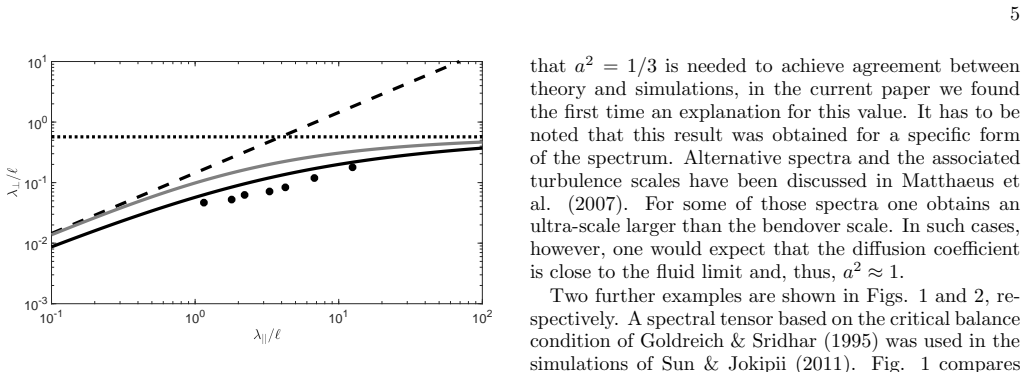
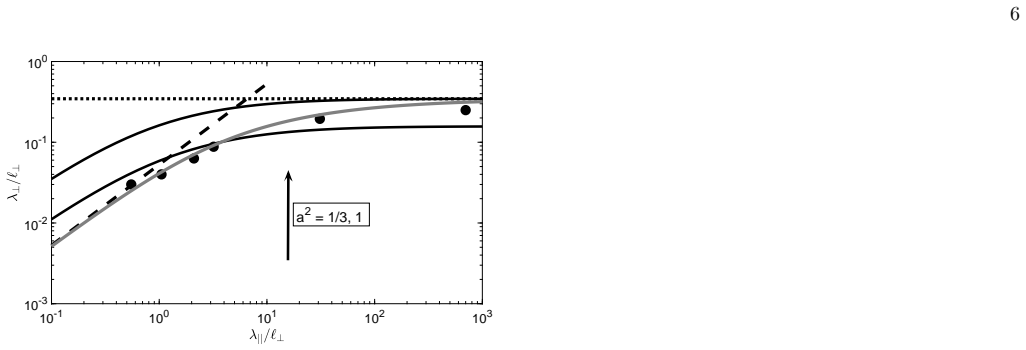
- Comparisons with existing test-particle simulations for two-component and critical-balance turbulence are consistent with the predicted asymptotic limits and the composite interpolation.
Reading between the lines
- If the identification $a^2 = (s-1)/(q-1)$ holds, measurements of perpendicular diffusion at different particle energies could be used to infer the inertial-range and energy-range spectral indices of the ambient turbulence, turning transport observations into a turbulence diagnostic.
- The same threshold argument may transfer to other problems where particles decorrelate from magnetic field lines, such as cosmic-ray transport in the interstellar medium or energetic electron transport in fusion devices, provided the relevant field-line diffusion coefficient is replaced appropriately.
- A direct test of the threshold picture would be to measure the running perpendicular diffusion coefficient at intermediate times: the heuristic predicts a subdiffusive $d_\perp(t) \sim t^{-1/2}$ plateau before normal diffusion is restored in the collisionless Rechester-Rosenbluth regime.
- The paper leaves the large-Kubo-number discrepancy with systematic theory open; if the collisionless Rechester-Rosenbluth interpretation is correct, the missing ingredient is likely a first-principles derivation of the field-line diffusion coefficient at high Kubo numbers rather than another fitted factor.
Signed reviews
Editorial analysis
A structured set of objections, weighed in public.
Referee Report
Summary. The manuscript presents a heuristic theory of perpendicular diffusion for energetic particles moving collisionlessly in turbulent magnetic fields. Three rules are stated: perpendicular transport is governed by parallel transport, field-line random walk, and transverse complexity; the relevant turbulence scales are finite; and normal diffusion is restored when the transverse displacement satisfies <(Δx)^2> >= 2 ℓ_perp^2 (Eq. (3)). From these rules the author derives several asymptotic limits, the most important being the collisionless Rechester-Rosenbluth (CLRR) limit, Eq. (9), κ_perp ≈ (κ_FL/ℓ_perp)^2 κ_par. A composite formula Eq. (20) interpolates between the CLRR and field-line-random-walk limits. The paper then identifies the previously empirical factor a^2 in UNLT theory as a^2 = (L_U/ℓ_perp)^2, which for the Shalchi-Weinhorst spectrum gives a^2 = (s-1)/(q-1) and hence a^2 = 1/3 for s=5/3, q=3. Comparisons with test-particle simulations for two turbulence models are shown in Figs. 1 and 2. The text explicitly states that the heuristic cannot substitute for systematic theories.
Significance. If the central formula survives scrutiny, the paper would supply a simple physical interpretation of the parameter a^2 and establish a collisionless analogue of Rechester-Rosenbluth diffusion, a result of genuine interest for cosmic-ray transport in the heliosphere and beyond. The paper's strengths are its explicit derivation from stated rules, the use of no fitted parameters in the a^2 explanation, the transparent comparison with two sets of simulations, and its clear acknowledgment of the heuristic character of the arguments. However, the central quantitative prediction and the a^2 explanation depend on a prefactor that is not fixed by the rules and on an auxiliary relation that is not independently justified. The result is therefore potentially important but, in its current form, not fully established.
major comments (3)
- [§III C, Eq. (9)] The two derivations of the CLRR limit are not equivalent. The first derivation uses κ⊥/κ∥ = ⟨Δx²⟩/⟨Δz²⟩ = ℓ⊥²/L_K² with κ_FL = ℓ⊥²/L_K. However, Rule 3 fixes the onset by ⟨Δx²⟩ = 2ℓ⊥², so the same algebra gives κ⊥ = 2(κ_FL/ℓ⊥)²κ∥. The second derivation instead sets the running subdiffusion coefficient d⊥(t_d) = κ_FL√(κ∥/2t_d) equal to the final κ⊥, which reproduces Eq. (9) but assumes without proof that the instantaneous running coefficient at the transition equals the asymptotic diffusion coefficient. Since a subdiffusive precursor can leave a residual offset, the prefactor of Eq. (9) is not determined by the stated rules. Because Eq. (15) and the identification a² = (s-1)/(q-1) inherit this prefactor linearly, the claimed explanation a² = 1/3 could become a² = 2/3 if the factor 2 is included. The heuristic must be modified to determine the prefactor from a stated rule.
- [§III C] The relation κ_FL = ℓ⊥²/L_K is used to eliminate L_K, but it is not a consequence of Rule 3. The rule fixes only the parallel distance at which the MSD satisfies ⟨Δx²⟩ = 2ℓ⊥²; it says nothing about whether the field-line random walk has already attained its asymptotic diffusive regime at that distance. Using the asymptotic κ_FL in κ_FL = ⟨Δx²⟩/(2|z|) at the onset therefore presupposes that the field lines are diffusive at the Kolmogorov scale, which is precisely the kind of statement the heuristic needs to establish. If this relation is instead intended as a separate postulate, it should be stated as such and its consequences for the numerical prefactor should be worked out. Without this step, the transition from the qualitative threshold to the quantitative Eq. (9) is incomplete.
- [§IV, Figs. 1-2] The simulation comparisons do not currently provide a test of the prefactor in Eq. (9). In both figures the CLRR limit is shown as an asymptotic dashed line without uncertainty bands, and in Fig. 2 the two UNLT curves (a²=1/3 and a²=1) differ by a factor of three, so a factor of two in the CLRR prefactor could easily be hidden in the scatter. Please compare the CLRR and composite predictions against the statistical uncertainty of the simulation data, or state the uncertainty in the simulation points. Such a comparison is necessary to support the claim that the heuristic actually explains the numerical value a²=1/3 rather than merely being consistent with a range of values.
minor comments (5)
- [§II, Rule 3] The phrase 'In principle this could be a different scale such as the integral scale L⊥' acknowledges ambiguity, but the choice ℓ⊥ is then used for all subsequent formulas; please state what evidence from UNLT or simulations fixes this choice.
- [§III H, Eq. (20)] The composite formula is presented as 'chosen so that' it has the two limits, but the interpolation coefficients (9/16 and 8/3 inside the square root) are not derived from the heuristic. Please label Eq. (20) as an interpolation formula and note that it does not contain the fluid limit.
- [Table I] Cases 7 and 8 are marked 'Only for small Kubo numbers' in the UNLT column, but Section III G states that similar reasoning applies for large Kubo numbers. Please clarify the intended domain of validity of the CLRR row.
- [Fig. 2 caption] The label 'a2 = 1/3, 1' should identify which of the two solid lines corresponds to which value.
- [General] The text contains many ligature/OCR artifacts (e.g., 'diffusion', 'v2'); please ensure the production version is clean.
Circularity Check
No circular reduction: a² = (s-1)/(q-1) is derived from the spectrum via parameter-free ultra-scale mathematics and checked against an externally fitted value; the flagged factor-2 ambiguity in Eq. (9) is a correctness risk, not circularity.
full rationale
The derivation chain does not reduce its conclusion to its inputs. The previously fitted value a² = 1/3 (from Matthaeus et al. 2003, external to this author) is not an input; it is reproduced only at the end by the independent identification a² = (LU/ℓ⊥)², with LU = √((s-1)/(q-1)) ℓ⊥ being a parameter-free integral of the two-component spectrum (Shalchi & Weinhorst 2009) evaluated at the standard spectral indices s = 5/3, q = 3 — turbulence parameters not fitted to transport data. Rule 3's threshold ⟨(Δx)²⟩ ≥ 2ℓ⊥² is load-bearing for Eq. (9) and is motivated by the author's own time-dependent UNLT theory (Shalchi 2017); that is self-citation, but the threshold is a mathematical consequence of a systematically derived evolution equation and does not depend on the target value of a², so it functions as real evidence rather than a circular premise. The CLRR limit is explicitly acknowledged to agree with the external results of Rechester & Rosenbluth (1978) and Krommes et al. (1983), and the paper candidly calls itself heuristic, stating that it 'cannot substitute systematic theories due to the lack of accuracy in the general case.' Two flagged concerns are weighed and found to be non-circular. First, Section III C derives Eq. (9) in two nonequivalent ways: the first route writes κ⊥/κ‖ = ⟨(Δx)²⟩/⟨(Δz)²⟩ = ℓ⊥²/LK² although Rule 3 fixes the onset at ⟨(Δx)²⟩ = 2ℓ⊥² (consistent algebra gives κ⊥ = 2(κFL/ℓ⊥)²κ‖), while the second route identifies the running subdiffusion coefficient d⊥(t_d) with the asymptotic κ⊥, an unstated additional assumption. The prefactor of Eq. (9), inherited linearly by Eq. (15) and by the claimed explanation a² = (s-1)/(q-1), is therefore not uniquely fixed by the stated rules; with the standard spectrum the alternative prefactor would give a² = 2/3 instead of 1/3. This is a correctness and robustness flag, not a circular reduction. Second, the composite formula Eq. (20) is, by the paper's own statement, 'chosen so that' it reproduces the two target limits, so agreement with simulations in those asymptotic limits is by construction; this is disclosed, and the intermediate-regime comparisons against external Sun & Jokipii (2011) and self Shalchi & Hussein (2014) simulations remain informative. Overall score 2: self-citations are present and the heuristic postulates stem from the author's own UNLT framework, but the central a² explanation has independent content and is checked against an externally anchored fitted value.
Assumptions & free parameters
free parameters (2)
- Composite formula interpolation coefficients =
9/16 and 8/3 in Eq. (20)
- Threshold factor 2 in condition (3) =
2
assumptions (4)
- domain assumption The bendover scales, integral scales, ultra-scale, and Kolmogorov scale are finite and nonzero; parallel motion is ballistic then diffusive; field line random walk is ballistic then diffusive.
- ad hoc to paper Normal diffusion is restored exactly when the condition <(Delta x)^2> >= 2 ell_perp^2 is satisfied, with ell_perp the scale of transverse complexity.
- ad hoc to paper The field line diffusion coefficient at the threshold equals the asymptotic kappa_FL, giving L_K = ell_perp^2 / kappa_FL.
- domain assumption For small Kubo numbers kappa_FL = L_par deltaB_x^2 / B_0^2 and for large Kubo numbers kappa_FL = L_U deltaB_x / B_0.
Cite this review
Pith. "Pith review of Heuristic Description of Perpendicular Diffusion of Energetic Particles in Astrophysical Plasmas." pith.science (2026). https://pith.science/paper/VUBPTK57
@misc{pith2026190800694,
  author       = {Pith},
  title        = {Pith review of: Heuristic Description of Perpendicular Diffusion of Energetic Particles in Astrophysical Plasmas},
  year         = {2026},
  howpublished = {\url{https://pith.science/paper/VUBPTK57}},
  note         = {Machine review of arXiv:1908.00694}
}
abstract
A heuristic approach for collisionless perpendicular diffusion of energetic particles is presented. Analytic forms for the corresponding diffusion coefficient are derived. The heuristic approach presented here explains the parameter $a^2$ used in previous theories in order to achieve agreement with simulations and its relation to collisionless Rechester & Rosenbluth diffusion. The obtained results are highly relevant for applications because previously used formulas are altered significantly in certain situations.
Figures
Reference graph
Works this paper leans on
-
[1]
Perpendicular transport is only controlled by three effects, namely parallel transport, the random walk of magnetic field lines, as well as transverse com- plexity. The last of these three effects leads to the particles getting scattered away from the original magnetic field lines they were tied to
-
[2]
We assume that the bendover scales ℓ‖ and ℓ⊥, the integral scales L‖ and L⊥, the ultra-scale LU , as well as the Kolmogorov scale LK are finite and non- zero. Furthermore, the parallel motion is assumed to be ballistic at early times and thereafter turns into a diffusive motion described by the parallel diffusion coefficient κ‖ . The FLR W is initially bal- li...
-
[3]
In order to obtain normal diffusion, the particles need to leave the original magnetic field lines they followed. This happens as soon as transverse com- plexity becomes significant corresponding to ⟨( ∆ x ) 2⟩ ≥ 2ℓ2 ⊥. (3) It is assumed here that ℓ⊥ is the scale at which transverse complexity becomes significant. In prin- ciple this could be a different scale...
work page 1978
-
[4]
Combining the latter two equations leads to κ⊥ = √ 2 3 vℓ⊥ δBx B0
as well as κ⊥ = v2δB 2 xtd/(3B2 0). Combining the latter two equations leads to κ⊥ = √ 2 3 vℓ⊥ δBx B0 . (19) A similar result can be derived from Eq. (2) by assuming a ballistic perpendicular motion. G. Time-scale Arguments In order to determine which case is valid for which sce- nario, one needs to explore at which time a certain pro- cess takes place. I...
-
[5]
For t‖ < t F luid < t FL the final state is the fluid limit because then we find that parallel transport becomes diffusive first and then we meet condition (3). If, on the other hand, t‖ < t FL < t F luid the field lines become diffusive before condition (3) is met. This means that we find com- pound sub-diffusion first. At even later time condition (3) is eventual...
work page 2018
- [6]
- [7]
- [8]
Show all 26 references
-
[9]
Jokipii, J. R. 1966, ApJ, 146, 480
1966
-
[10]
B., & Pogutse, O
Kadomtsev, B. B., & Pogutse, O. P. 1979, Proceed- ings of 7th International Conference on Plasma Physics and Controlled Fusion, Innsbruck , p. 649. International Atomic Energy Agency
1979
-
[11]
A., Oberman, C., & Kleva, R
Krommes, J. A., Oberman, C., & Kleva, R. G. 1983, J. Plasma Phys., 30, 11
1983
-
[12]
Kubo, R. 1963, J. Math. Phys., 4, 174
1963
-
[13]
W., Gray, P
Matthaeus, M. W., Gray, P. C., Pontius Jr., D. H., & Bieber, J. W. 1995, PhRvL, 75, 2136
1995
-
[14]
H., Qin, G., Bieber, J
Matthaeus, W. H., Qin, G., Bieber, J. W., & Zank, G. P. 2003, ApJL, 590, L53
2003
-
[15]
H., Bieber, J
Matthaeus, W. H., Bieber, J. W., Ruffolo, D., Chuychai, P., & Minnie, J. 2007, ApJ, 667, 956
2007
-
[16]
H., & Bieber, J
Qin, G., Matthaeus, W. H., & Bieber, J. W. 2002, ApJL, 578, L117
2002
-
[17]
Rechester, A. B. & Rosenbluth, M. N. 1978, PhRvL, 40, 38
1978
-
[18]
& Matthaeus, W
Ruffolo, D. & Matthaeus, W. H. 2013, PhPl, 20, 012308
2013
-
[19]
Shalchi, A., Bieber, J. W. & Matthaeus, W. H., 2004, ApJ, 604, 675
2004
-
[20]
& Weinhorst, B., 2009, AdSpR, 43, 1429
Shalchi, A. & Weinhorst, B., 2009, AdSpR, 43, 1429
2009
-
[21]
Shalchi, A., 2010, ApJL, 720, L127
2010
-
[22]
& Hussein, M., 2014, ApJ, 794, 56
Shalchi, A. & Hussein, M., 2014, ApJ, 794, 56
2014
-
[23]
Shalchi, A., 2015, PhPl, 22, 010704
2015
-
[24]
Shalchi, A., 2017, PhPl, 24, 050702
2017
-
[25]
& Jokipii, J
Sun, P. & Jokipii, J. R. 2011, 32nd ICRC, Beijing 2011
2011
-
[26]
P., Li, G., Florinski, V., Matthaeus, W
Zank, G. P., Li, G., Florinski, V., Matthaeus, W. H., Webb, G. M., & Le Roux, J. A. 2004, JGR, 109, A04107 6 10-1 100 101 102 10310-3 10-2 10-1 100 a2 = 1/3, 1 FIG. 2. Results for a spectral tensor based on the NRMHD model of Ruffolo & Matthaeus (2013). For δB/B 0 = 1 the field ...
2013
Reviewed August 14, 2026 · model on record in the stance chip above.
Discussion (0). Continue with ORCID to comment.