REVIEW 2 major objections 4 minor 29 references
Interleaved Polar (I-Polar) Codes
T0 review · 2 major / 4 minor · reviewed 2026-08-14 · deepseek-v4-flash
Pith's one-line read Interleaved polar codes get an exact ensemble-average weight enumerator, making high-SNR block error rates analytically predictable.
desk verdict Solid ensemble-WEF analysis for a new interleaved-polar-code family; the BLER upper-bound claim has a rigor gap that a referee should push on. read the letter →
The pith
A machine-rendered reading of the paper's core claim, the machinery that carries it, and where it could break.
The reading
What carries the argument
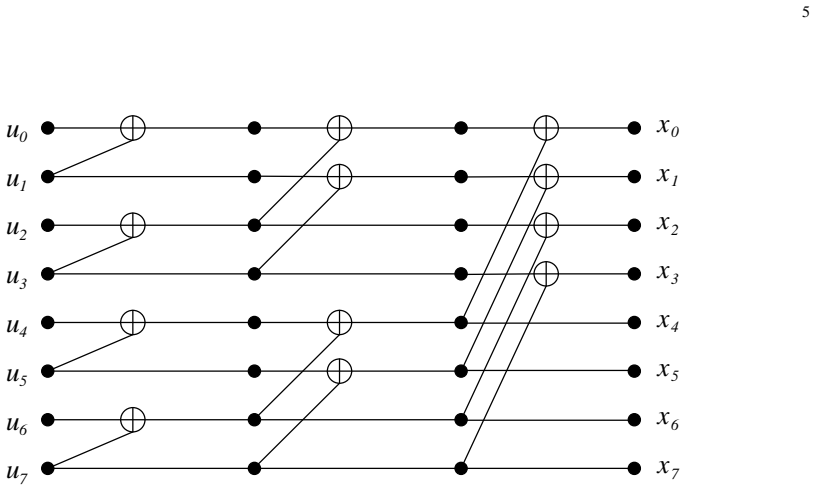
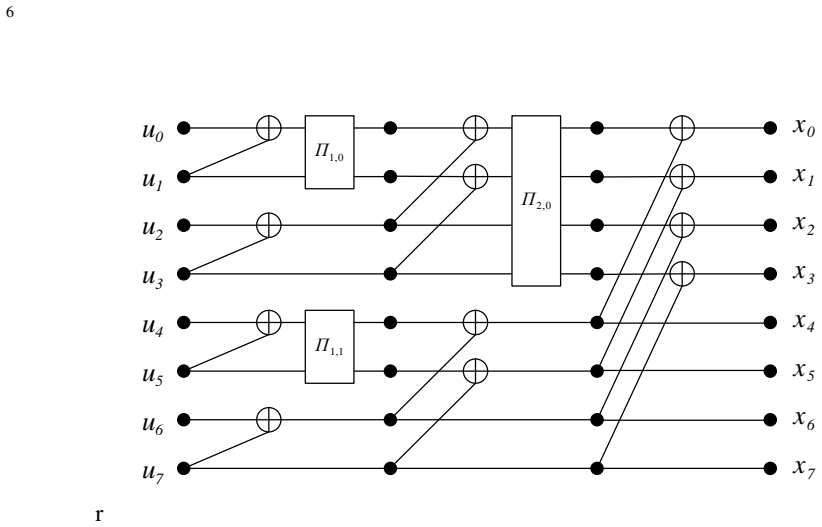
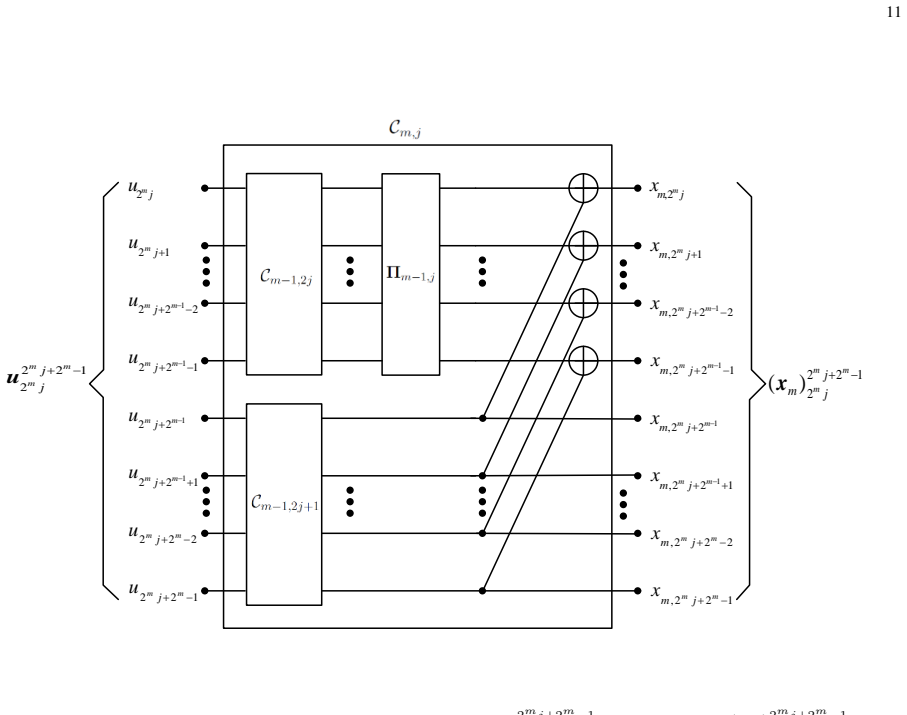
The load-bearing object is the uniform interleaver of length n, a random permutation device that maps any weight-d input to all $\binom{n}{d}$ permutations with equal probability. Lemma 2 and Theorem 3 define an operator $H_m$ acting on the two half-code WEFs: for codewords of weights $d_1,d_2$, the averaged weight enumerator of the joined stage is $$\sum_{k=\max(0,d_1+d_2-n)}^{\min(d_1,d_2)} \frac{\binom{d_2}{k}\binom{n-d_2}{d_1-k}}{\binom{n}{d_1}} $Y^{{d_1+2d_2-2k}}$,$$ with $n=2^{m-1}$, and $F_m$ is the same operation on IOWEFs. Recursing from length-1 base codes $1+Y$ or $1$ computes the exact ensemble-average WEF and IOWEF without exhaustive interleaver enumeration. Theorem 1 shows the interleavers do not change the synthesized channels, so the same frozen-bit selection applies while the weight spectrum changes.
What would settle it
For a small ensemble such as (16,8) or (32,16), enumerate all interleaver realizations, compute the true mean BLER under maximum-likelihood decoding, and compare it with the simple bound evaluated on the ensemble-average WEF at several SNRs; any violation at high SNR would disprove the bound-as-average claim, as would a direct check that expectation does not commute with the min-expression in Eq. (8).
Extended reading notes
Core claim
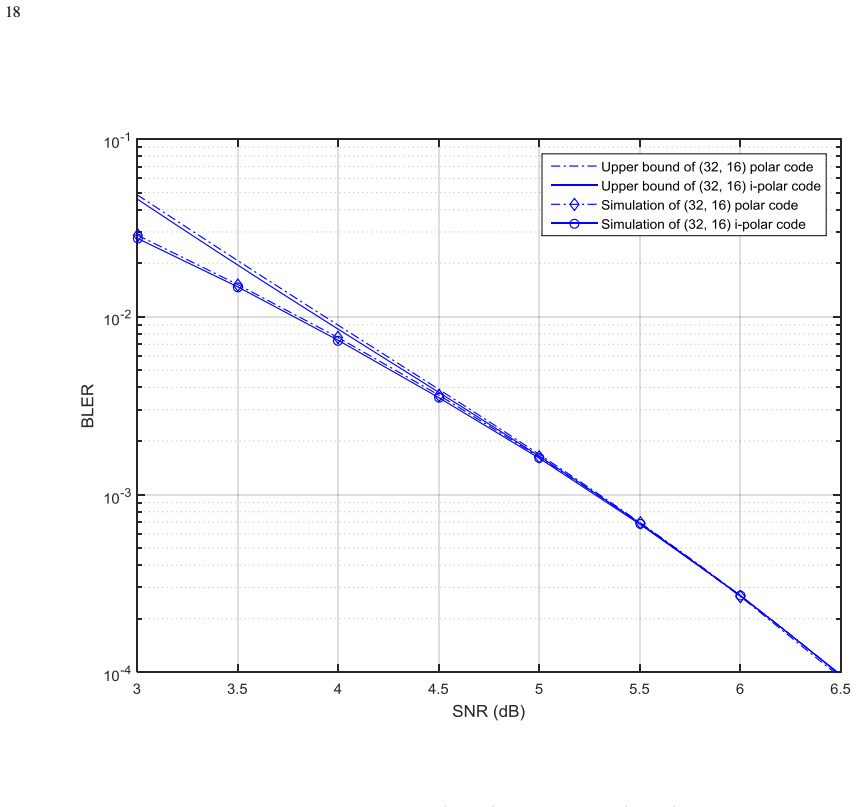
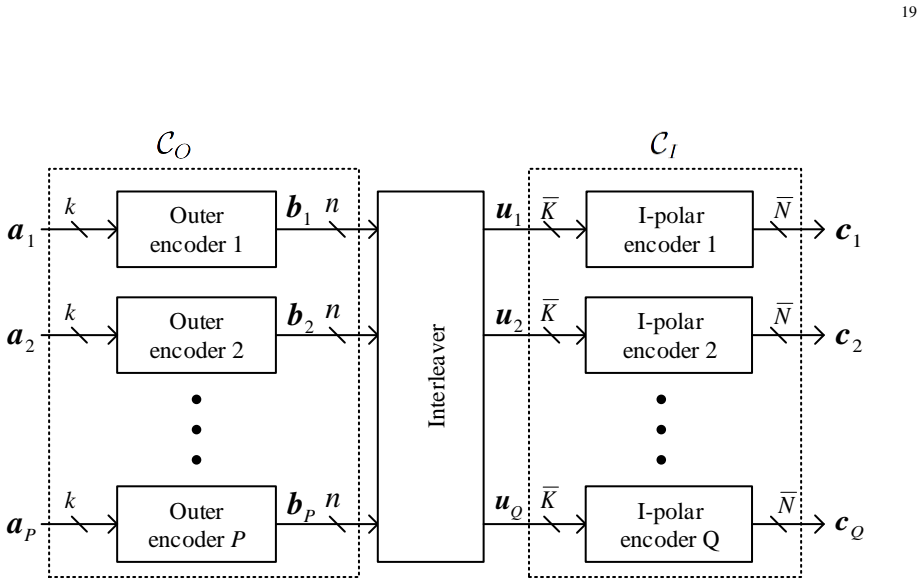
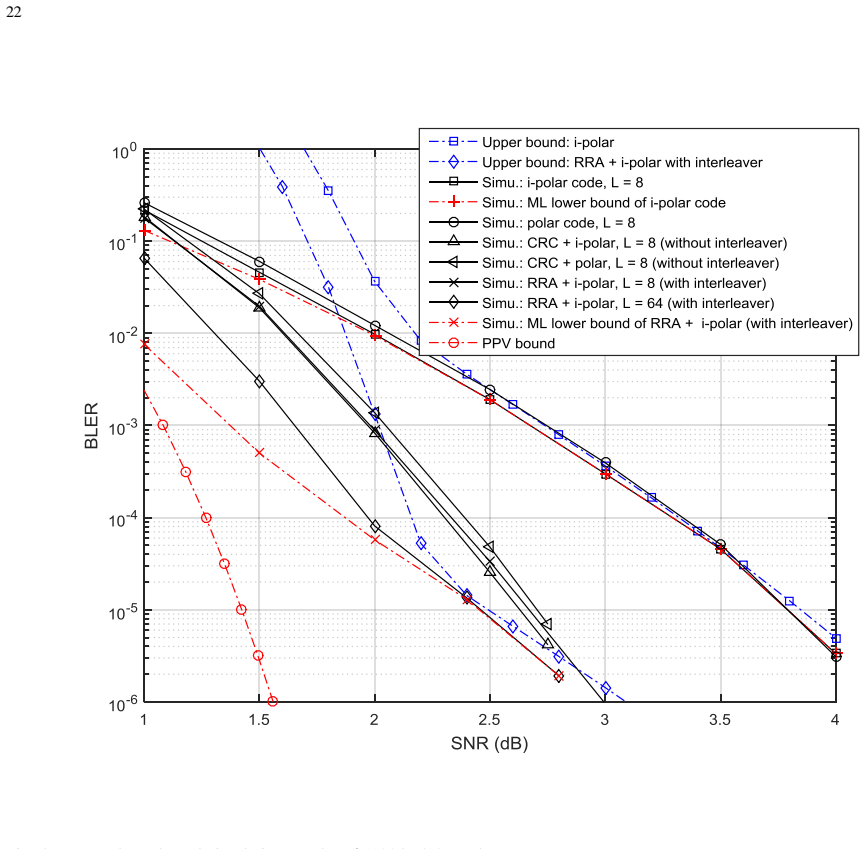
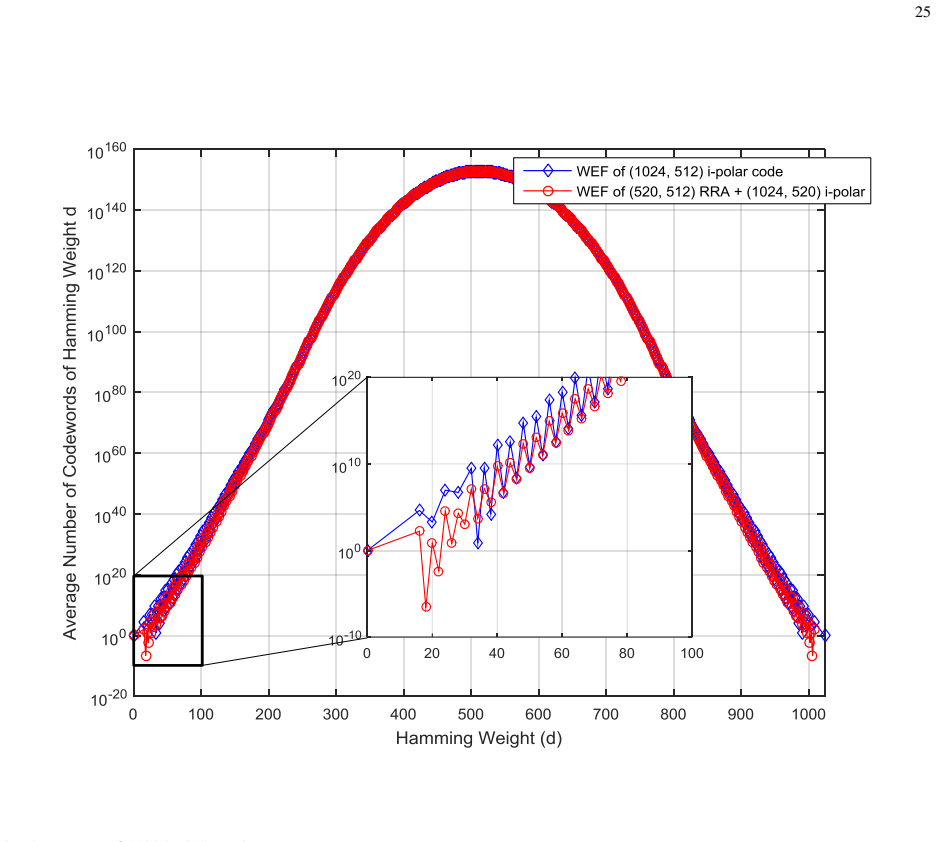
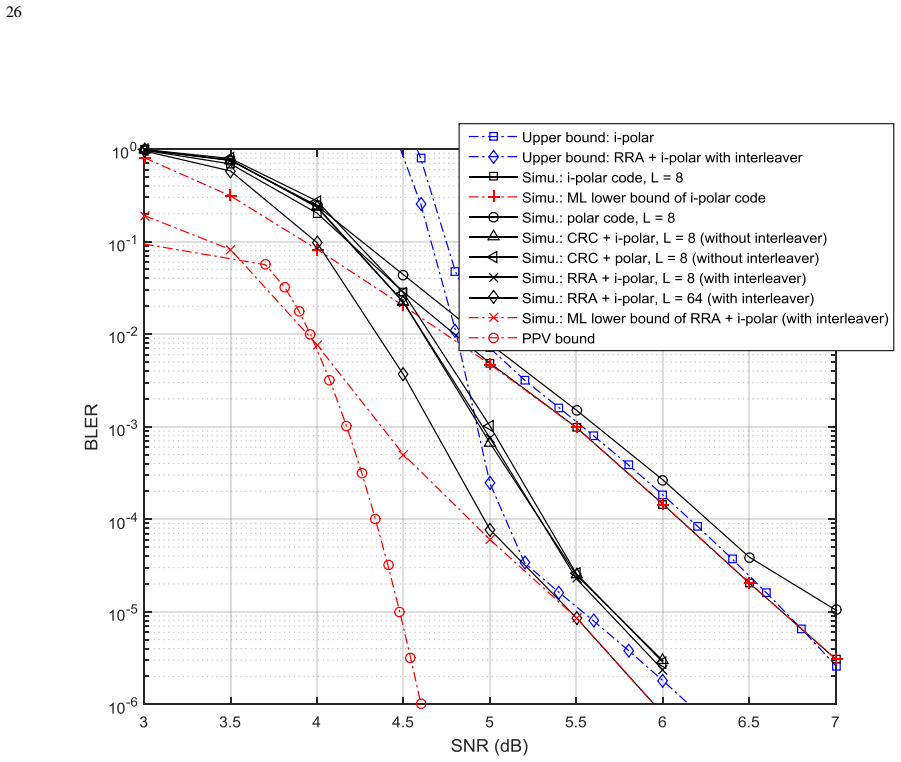
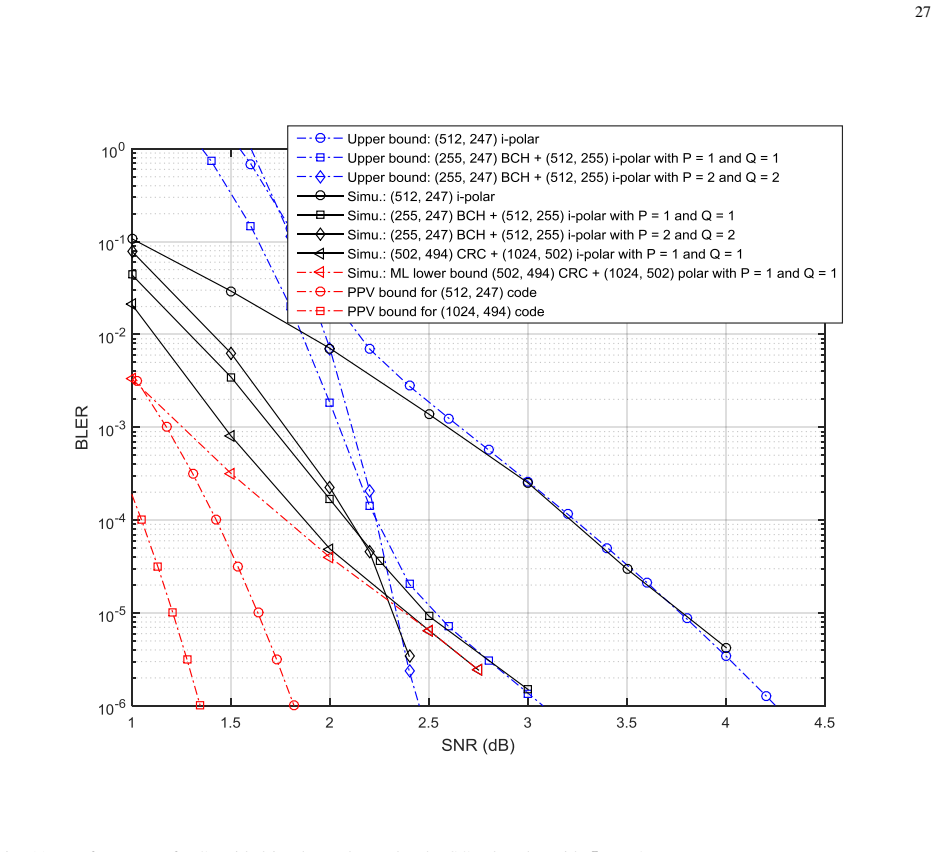
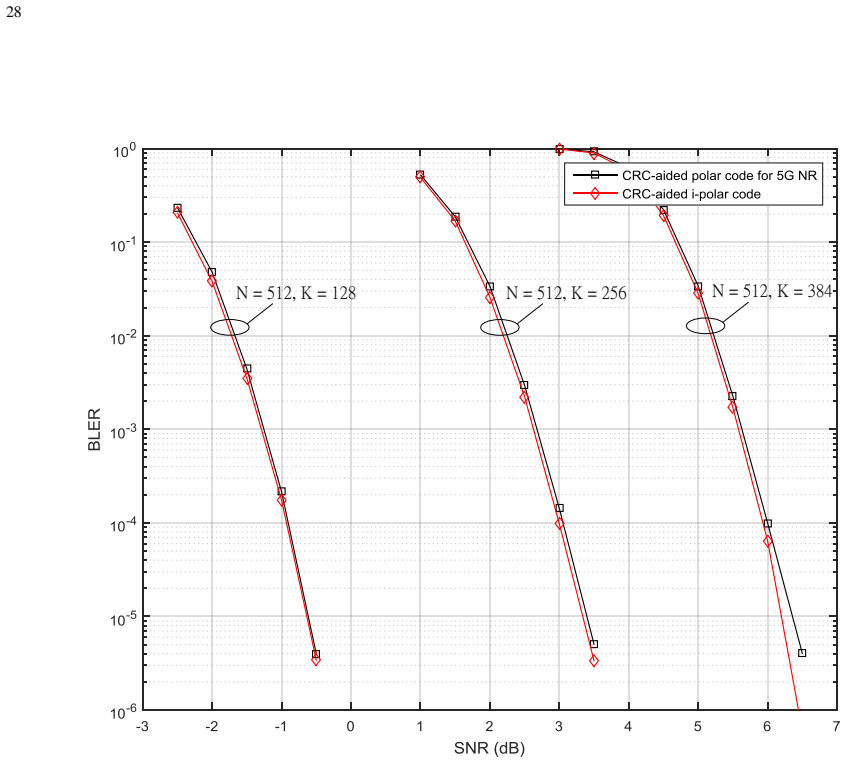
The central claim is that the weight enumerating function and input-output weight enumerating function averaged over the (N,K,A) ensemble of i-polar codes can be computed exactly by recursive operators applied to the two half-code enumerators, using the uniform interleaver assumption. This average WEF, not an approximation to any particular code, is then used with the simple bound of [8] to upper-bound the average BLER of a random ensemble member. For concatenated schemes with P parallel outer codes and Q parallel i-polar inner codes separated by a uniform interleaver, the average WEF is obtained by raising component WEFs to powers and applying the serial-concatenation formula, so bounds can be evaluated without simulating the code. The paper reports that the resulting bounds track simulated SCL performance at high SNR, and that P=Q=2 gives a steeper BLER slope than P=Q=1 at the same length and rate, outperforming CRC-aided i-polar with P=Q=1 at high SNR while Q decoders run in parallel.
Load-bearing premise
The load-bearing premise is that evaluating the simple BLER bound on the ensemble-average weight enumerator still gives a valid upper bound on the average block error rate, since the bound is nonlinear in the enumerator coefficients and averaging is taken before, not after, that nonlinearity.
Editorial extensions
If this is right
- The exact ensemble-average WEF of the (N,K,A) i-polar ensemble is computable by recursion, giving an analytical predictor of ML BLER at high SNR that ordinary polar codes lack.
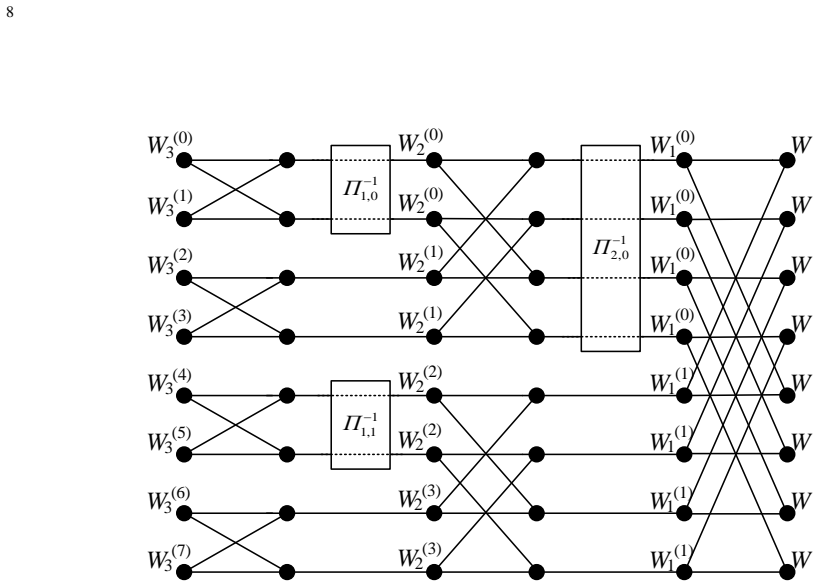
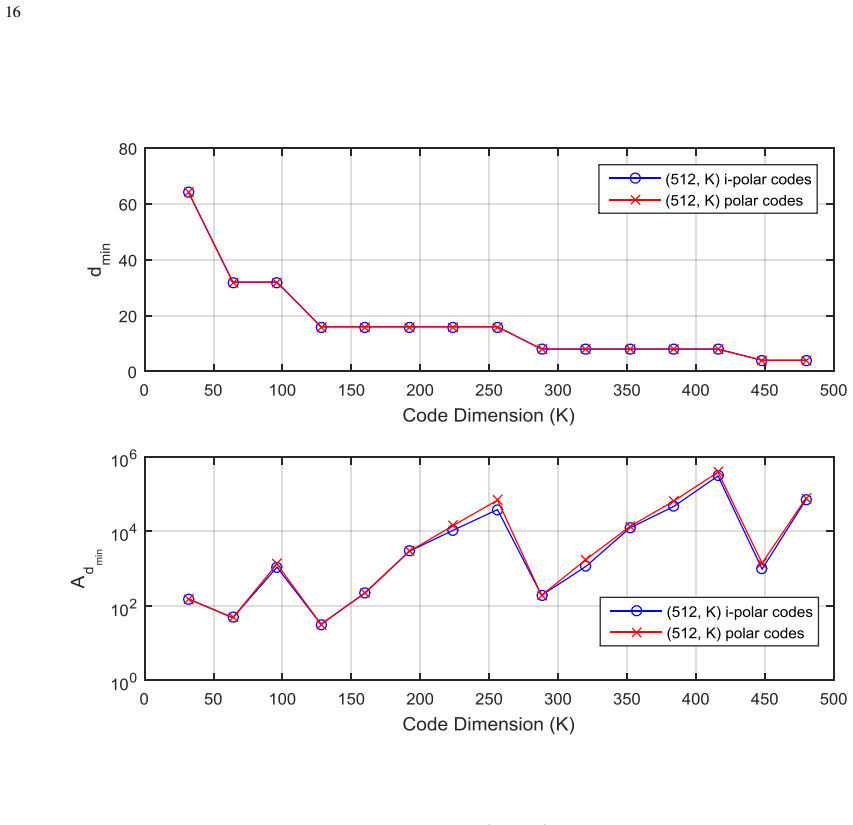
- Because Theorem 1 shows polarization is unchanged, i-polar codes inherit polar bit-channel selection; the interleavers only redistribute codeword weights, which can lower the multiplicity of minimum-weight codewords.
- The concatenated scheme's average WEF is derived from the outer WEF and inner IOWEF via the serial-concatenation formula, so BLER upper bounds can be evaluated for CRC-, RRA-, or BCH-style outer codes without simulation.
- For the (1024,494) code with P=Q=2, the BLER curve has a steeper high-SNR slope than the P=Q=1 CRC-aided i-polar code of the same length and rate, and the paper reports it beats the P=Q=1 ML lower bound at high SNR.
- With Q i-polar decoders operating in parallel, decoding latency is reduced compared to a single longer polar decoder, which the paper identifies as a practical benefit for ultra-reliable low-latency communication.
Reading between the lines
- The same recursive averaging could be applied to any code family built from the x+y|y construction, such as Reed-Muller-style supercodes, giving exact ensemble WEFs wherever the base code WEFs are known.
- The paper's WEF-based greedy unfrozen-bit selection could be benchmarked against Gaussian-approximation and 5G sequences by checking whether the selected set changes at finite list sizes; a testable prediction is that WEF-selected sets improve SCL performance beyond the gains shown for fixed A.
- A second-moment or variance analysis of the WEF over the ensemble would quantify how representative the average is for long block lengths, since the paper only demonstrates concentration indirectly through 1000 realizations at N=32.
- For Q>1, the L^Q combined-candidate step limits practical parallelism; combining the suggested local error detection with list pruning could trade a small BLER loss for much lower decoder complexity, an extension the paper sketches but does not simulate.
Signed reviews
Editorial analysis
A structured set of objections, weighed in public.
Referee Report
Summary. This paper introduces interleaved polar (i-polar) codes, obtained by inserting interleavers between consecutive stages of the polar encoder, and analyzes the ensemble average of their weight enumerating function (WEF) and input-output weight enumerating function (IOWEF) under the uniform-interleaver assumption. Theorems 3 and 4 give recursions for the average WEF/IOWEF, Theorem 5 gives WEF expressions for parallel concatenations, and the paper evaluates the Divsalar simple bound on the resulting average WEF to obtain claimed BLER upper bounds. A concatenated scheme with P outer codes and Q i-polar inner codes is also proposed; simulations show that the P=Q=2 BCH-aided construction outperforms a same-rate CRC-aided P=Q=1 construction at high SNR, and the paper argues for a parallel-decoding latency advantage.
Significance. If the core derivations are correct, the paper provides a parameter-free, exact ensemble-average weight spectrum for a randomized polar-code family, which is a useful analytical tool for short-blocklength code design and for concatenated-code analysis. The numerical validation in Table I (the analytical average matching a 1000-realization sample average for the (32,16) code) and the falsifiable high-SNR comparison between P=Q=2 and P=Q=1 constructions are concrete strengths, and the proposed parallel SCL decoding structure is a sensible latency-reduction idea. However, the central claim that the simple-bound evaluation on the ensemble-average WEF is an upper bound on the average BLER is not established, and one displayed formula appears truncated; these issues affect most of the analytical plots and the abstract's main claim.
major comments (2)
- [Section IV-D (Eq. (8))] The simple bound is evaluated at the ensemble-averaged coefficients A_bar_d = E[A_d(C)], and the result is labeled an upper bound on the average BLER. The simple bound is nonlinear in A_d: it contains min{...}, and the exponent E(rho, delta) depends on r(delta)=ln(A_d)/N through c0(delta) and f(rho,delta). For a random code C the quantity that must be bounded is E_C[ sum_d min{ exp(-N E(rho,d/N,ln A_d(C)/N)), A_d(C) Q(sqrt(2 d rho)) } ], whereas the paper plots sum_d min{ exp(-N E(rho,d/N,ln A_bar_d/N)), A_bar_d Q(sqrt(2 d rho)) }. These two expressions are not equal in general, and no concavity or monotonicity argument is supplied that would make the latter dominate the former. The linear union bound in Eq. (7) would commute with expectation, but the simple-bound curves in Figures 6, 8, 10, and 11 are therefore not established as upper bounds on the average BLER. This directly affects the abstract claim and the discussion in Sections IV-D and VI. At minimum, the authors should prove the needed inequality or replace the simple-bound evaluation by a bound that is linear (or otherwise proven to commute with expectation) in the WEF coefficients.
- [Section IV-D, Eq. (8)] The displayed simple bound sums over d = d_min to N-K+1. In the reference [8], the simple bound sums over all nonzero codeword weights, i.e., d = d_min, ..., N (equivalently all d with A_d > 0). A binary linear (N,K) code can contain codewords of weight greater than N-K+1; the (32,16) example in Table I has nonzero A_d for d = 28 and d = 32, both beyond N-K+1 = 17. Since all summands are nonnegative, truncating the sum at N-K+1 can only decrease the right-hand side, so without an additional argument the truncated expression is not an upper bound. Please either correct the summation range to match [8] or justify the truncation explicitly; if the actual computations used all weights, the displayed formula should be corrected.
minor comments (4)
- [Section IV-C] The statement that the observation of only two WEF types among 1000 realizations means 'with high probability, any realizations are as good as the ensemble average' is an empirical observation, not a proven concentration result; please soften the wording or state it as a numerical observation.
- [Section V] The text says that Q parallel SCL decoders each outputting L candidates produce 'LQ combined message vectors'; the number of combinations is L^Q, not LQ. Please correct the notation or define it clearly.
- [Throughout] There are several typographical errors: 'inferier' should be 'inferior' in Section V, 'calso' should be 'also' in Section III, and 'Polyanskyi' should be 'Polyanskiy' in Section VI-A. Please proofread.
- [Figures 6, 8, 10, 11] The captions and text should state explicitly that the curves labeled 'upper bounds' are computed from the ensemble-average WEF, so that readers do not interpret them as bounds on the BLER of the single simulated realization.
Circularity Check
No material circularity: the WEF recursions are derived from the i-polar construction under the uniform-interleaver model, and the sole self-citation is not load-bearing.
full rationale
The central WEF/IOWEF derivation (Theorems 3–5) and the concatenated-code WEF (Eq. 11) are obtained by applying the uniform-interleaver probability model to the recursive code construction (Eq. 2); they are exact ensemble averages, not quantities fitted to the simulated BLER curves. No parameter is adjusted to match the target performance, and the BLER bounds in Section IV-D are standard simple bounds from [8] evaluated on the computed average WEF. The only self-citation is [14], used for frozen-bit selection; this is an independent design step and does not drive the central claim. A potential technical gap is that Eq. (8) is nonlinear in the WEF coefficients, so a Jensen-type argument would be needed to justify applying it to the ensemble-average WEF as an upper bound on the average BLER; absent that, the plotted bounds may not be guaranteed, but this is a correctness concern rather than circularity. Score 2 reflects the minor, non-load-bearing self-citation.
Assumptions & free parameters
assumptions (5)
- domain assumption All interleavers in the ensemble are selected uniformly at random and independently (Definition 1), and every input vector of weight d maps to all C(n,d) permutations with equal probability.
- standard math The simple bound of Divsalar [8] (Eq. 8) is a valid upper bound on BLER for a fixed code with a given WEF.
- domain assumption The LLRs at the bit channels are Gaussian with mean/variance relation sigma^2 = 2 beta, so mutual information evolves via the J-function recursions (3)-(4).
- domain assumption The interleavers at different branches and stages are selected independently, so the average WEF of C_{m,j} factorizes as the product of the average WEFs of its two child codes.
- standard math The PPV bound [26],[27] provides a finite-blocklength lower bound for the (N,K) BI-AWGN channel.
Cite this review
Pith. "Pith review of Interleaved Polar (I-Polar) Codes." pith.science (2026). https://pith.science/paper/ATATBNO2
@misc{pith2026190800708,
  author       = {Pith},
  title        = {Pith review of: Interleaved Polar (I-Polar) Codes},
  year         = {2026},
  howpublished = {\url{https://pith.science/paper/ATATBNO2}},
  note         = {Machine review of arXiv:1908.00708}
}
read the original abstract
By inserting interleavers between intermediate stages of the polar encoder, a new class of polar codes, termed interleaved polar (i-polar) codes, is proposed. By the uniform interleaver assumption, we derive the weight enumerating function (WEF) and input-output weight enumerating function (IOWEF) averaged over the ensemble of i-polar codes. The average WEF can be used to calculate the upper bound on the average block error rate (BLER) of a code selected at random from the ensemble of i-polar codes. Also, we propose a concatenated coding scheme that employs P high rate codes as the outer code and Q i-polar codes as the inner code with an interleaver in between. The average WEF of the concatenated code is derived based on the uniform interleaver assumption. Simulation results show that BLER upper bounds can well predict BLER performance levels of the concatenated codes. The results show that the performance of the proposed concatenated code with P=Q=2 is better than that of the CRC-aided i-polar code with P=Q=1 of the same length and code rate at high signal-to-noise ratios (SNRs). Moreover, the proposed concatenated code allows multiple decoders to operate in parallel, which can reduce the decoding latency and hence is suitable for ultra-reliable low-latency communications (URLLC).
Figures
Figures from the paper (9 more)
Reference graph
Works this paper leans on
-
[8]
A simple tight bound on error probability of block codes with application to turbo codes,
D. Divsalar, “A simple tight bound on error probability of block codes with application to turbo codes,” TMO Progress Rep, vol. 42-139, Nov. 1999
work page 1999
-
[1]
E. Arıkan, “Channel polarization: A method for constructing capacity-achieving codes for symmetric binary-input memoryless channels,” IEEE Trans. Inf. Theory , vol. 55, no. 7, pp. 3051–3073, Jul. 2009
work page 2009
-
[2]
I. Tal and A. Vardy, “List decoding of polar codes,” IEEE Trans. Inf. Theory , vol. 61, no. 5, pp. 2213–2226, May 2015
work page 2015
-
[3]
An adaptive successive cancellation list decoder for polar codes with cyclic redundancy check,
B. Li, H. Shen, and D. Tse, “An adaptive successive cancellation list decoder for polar codes with cyclic redundancy check,” IEEE Commun. Lett. , vol. 16, pp. 2044–2047, Dec. 2012
work page 2012
-
[4]
Unveiling turbo codes: Some results on parallel concatenated coding schemes,
S. Benedetto and G. Montorsi, “Unveiling turbo codes: Some results on parallel concatenated coding schemes,” IEEE Trans. Inf. Theory , vol. 42, no. 2, pp. 409–428, Mar. 1996
work page 1996
-
[5]
On probabilistic weight distribution of polar codes,
M. Valipour and S. Yousefi, “On probabilistic weight distribution of polar codes,” IEEE Commun. Lett. , vol. 17, no. 11, pp. 2120–2123, Nov. 2013
work page 2013
-
[6]
An enhanced probabilistic computation method for the weight distribution of polar codes,
Q. Zhang, A. Liu, and X. Pan, “An enhanced probabilistic computation method for the weight distribution of polar codes,” IEEE Commun. Lett. , vol. 21, no. 12, pp. 2562–2565, Dec. 2017
work page 2017
-
[7]
A probabilistic computation method for the weight distribution of low-density parity-check codes,
M. Hirotomo, M. Mohri, and M. Morii, “A probabilistic computation method for the weight distribution of low-density parity-check codes,” in Proc. IEEE International Symposium on Information Theory (ISIT) , Sep. 2005, pp. 2166–2170
work page 2005
Show all 29 references
-
[9]
Irregular repeat-accumulate codes,
H. Jin, A. Khandekar, and R. McEliece, “Irregular repeat-accumulate codes,” in Proc. 2nd Int. Symp. Turbo Codes Related Topics, Sep. 2000, pp. 1–8
2000
-
[10]
ITU-R M.[IMT-2020.TECH PERF REQ] - Minimum Requirements Related to Technical Performance for IMT2020 Radio Interface(s),
ITU-R, “ITU-R M.[IMT-2020.TECH PERF REQ] - Minimum Requirements Related to Technical Performance for IMT2020 Radio Interface(s),” Report ITU-R M.2410-0 , Nov. 2017
2020
-
[11]
Performance of polar codes for channel and source coding,
N. Hussami, S. Korada, and R. Urbanke, “Performance of polar codes for channel and source coding,” in Proc. IEEE International Symposium on Information Theory (ISIT) , Jul. 2009, pp. 1488–1492
2009
-
[12]
LLR-based successive cancellation list decoding of polar codes,
A. Balatsoukas-Stimming, M. Parizi, and A. Burg, “LLR-based successive cancellation list decoding of polar codes,” IEEE Trans. Signal Processing , vol. 63, no. 19, pp. 5165–5179, Oct. 2015. 31
2015
-
[13]
Efficient design and decoding of polar codes,
P. Trifonov, “Efficient design and decoding of polar codes,” IEEE Trans. Commun. , vol. 60, no. 11, pp. 3221–3227, Nov. 2012
2012
-
[14]
Polynomial representations of polar codes and decoding under overcomplete representations,
M. C. Chiu, “Polynomial representations of polar codes and decoding under overcomplete representations,” IEEE Commun. Lett., vol. 17, no. 12, pp. 2340–2343, Dec. 2013
2013
-
[15]
Does Gaussian approximation work well for the long-length polar code construction?
J. Dai, K. Niu, Z. Si, C. Dong, and J. Lin, “Does Gaussian approximation work well for the long-length polar code construction?” IEEE Access , vol. 5, pp. 7950–7963, 2017
2017
-
[16]
Designs of Bhattacharyya parameter in the construction of polar codes,
S. Zhao, P. Shi, and B. Wang, “Designs of Bhattacharyya parameter in the construction of polar codes,” in 2011 7th International Conference on Wireless Communications, Networking and Mobile Computing , Sep. 2011, pp. 1–4
2011
-
[17]
Convergence behavior of iteratively decoded parallel concatenated codes,
S. ten Brink, “Convergence behavior of iteratively decoded parallel concatenated codes,” IEEE Trans. Commun. , vol. 49, no. 10, pp. 1727 –1737, Oct. 2001
2001
-
[18]
Stack decoding of polar codes,
K. Niu and K. Chen, “Stack decoding of polar codes,” Electron. Lett., vol. 48, no. 12, pp. 695 –697, Jun. 2012
2012
-
[19]
CRC-aided decoding of polar codes,
——, “CRC-aided decoding of polar codes,” IEEE Commun Lett , vol. 16, no. 10, pp. 1668–1671, Oct. 2012
2012
-
[20]
Performance limits and practical decoding of interleaved Reed-Solomon polar concatenated codes,
H. Mahdavifar, M. El-Khamy, J. Lee, and I. Kang, “Performance limits and practical decoding of interleaved Reed-Solomon polar concatenated codes,” IEEE Trans. Commun. , vol. 62, no. 5, pp. 1406–1417, May 2014
2014
-
[21]
Interleaved concatenations of polar codes with BCH and convolutional codes,
Y . Wang, K. R. Narayanan, and Y . Huang, “Interleaved concatenations of polar codes with BCH and convolutional codes,” IEEE J. Sel. Areas Commun. , vol. 34, no. 2, pp. 267–277, Feb. 2016
2016
-
[22]
Enhanced belief propagation decoding of polar codes through concatenation,
J. Guo, M. Qin, A. Guill ´en i F `abregas, and P. H. Siegel, “Enhanced belief propagation decoding of polar codes through concatenation,” in Proc. IEEE International Symposium on Information Theory (ISIT) , Jun. 2014, pp. 2987–2991
2014
-
[23]
Serial concatenation of interleaved codes: Performance analysis, design, and iterative decoding,
S. Benedetto, D. Divsalar, G. Montorsi, and F. Pollara, “Serial concatenation of interleaved codes: Performance analysis, design, and iterative decoding,” IEEE Trans. Inf. Theory , vol. 44, no. 3, pp. 909–926, May 1998
1998
-
[24]
http://isec.ec.okayama-u.ac.jp/kusaka/wd/index.html
-
[25]
Structured IRA codes: Performance analysis and construction,
Y . Zhang and W. E. Ryan, “Structured IRA codes: Performance analysis and construction,” IEEE Trans. Commun., vol. 55, no. 5, pp. 837–844, May 2007
2007
-
[26]
Channel coding rate in the finite blocklength regime,
Y . Polyanskiy, H. V . Poor, and S. Verdu, “Channel coding rate in the finite blocklength regime,” IEEE Trans. Inf. Theory , vol. 56, no. 5, pp. 2307–2359, May 2010
2010
-
[27]
Coding in the finite-blocklength regime: Bounds based on Laplace integrals and their asymptotic approxima- tions,
T. Erseghe, “Coding in the finite-blocklength regime: Bounds based on Laplace integrals and their asymptotic approxima- tions,” IEEE Trans. Inf. Theory , vol. 62, no. 12, pp. 6854–6883, Dec 2016
2016
-
[28]
https://github.com/yp-mit/spectre
-
[29]
3GPP TS 38.212 version 15.2.0 Release 15 (available on line: https://www.etsi.org/deliver/etsi ts/138200 138299/138212/15.02.00 60/ts 138212v150200p.pdf), Jul
3GPP, Multiplexing and channel coding . 3GPP TS 38.212 version 15.2.0 Release 15 (available on line: https://www.etsi.org/deliver/etsi ts/138200 138299/138212/15.02.00 60/ts 138212v150200p.pdf), Jul. 2018
2018
Reviewed August 14, 2026 · model on record in the stance chip above.
Discussion (0). Continue with ORCID to comment.