REVIEW 4 major objections 5 minor 42 references
Light scattering through the graphene oxide liquid crystal in a micro-channel
T0 review · 4 major / 5 minor · reviewed 2026-08-14 · deepseek-v4-flash
Pith's one-line read Flow through a micro-channel tunes how graphene-oxide liquid crystals scatter light: scattered intensity rises with injection rate and saturates sooner at higher volume fraction.
desk verdict Plausible flow-tunable scattering in GO-NLC, but missing baselines and a shaky fluctuation theory keep this from being more than a preliminary report. read the letter →
The pith
A machine-rendered reading of the paper's core claim, the machinery that carries it, and where it could break.
The reading
What carries the argument
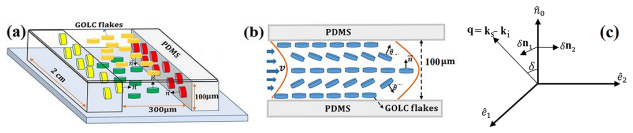
The argument rests on the standard nematic light-scattering cross-section. With the director (the local average orientation axis of the nematic) written as $\mathbf{n}(r) = \mathbf{n}_0 + \delta\mathbf{n}(r)$, only the two components of the director fluctuation $\delta\mathbf{n}$ perpendicular to $\mathbf{n}_0$ matter, and the differential scattering cross-section is proportional to $(\varepsilon_a \omega^2/c^2)^2 V \sum_{\alpha=1,2} \langle |\delta n_\alpha(\mathbf{q})|^2 \rangle$ times polarization factors, where $\varepsilon_a$ is the dielectric anisotropy and $\langle |\delta n_\alpha(\mathbf{q})|^2 \rangle$ is the thermal fluctuation spectrum of the director in Fourier space. The paper couples this to a second mechanism: flow tilts the director, and the refractive-index difference $n_o - n_e$ grows through an angle-dependent extraordinary index, with a saturation angle set by the Leslie viscosity coefficients. Together, these give increasing scattered intensity with flow rate and a route to saturation.
What would settle it
Fill the same PDMS channel with pure water, and also run an empty channel, at the same flow rates and compare the normalized off-axis signal at 633 nm; if the signal rises comparably without graphene oxide, the central claim collapses. A second check is to measure depolarized scattering or a direct birefringence map as a function of flow rate: if the director fluctuation amplitude decreases under shear, the proposed mechanism is wrong even if the empirical trend survives.
Extended reading notes
Core claim
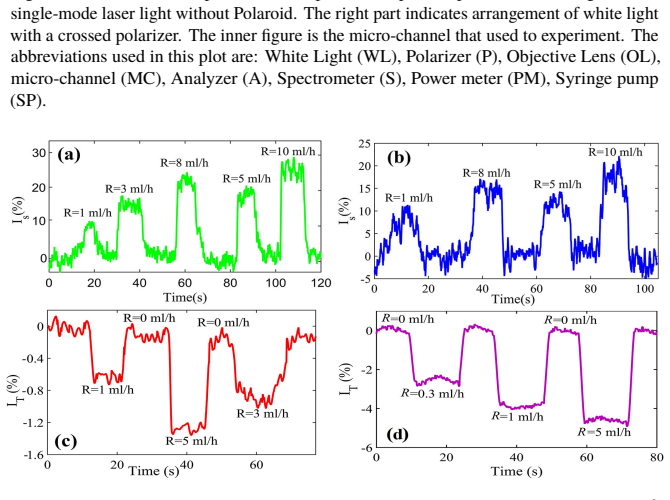
The paper's central claim is that the flow rate of graphene-oxide liquid crystal through a polydimethylsiloxane (PDMS) micro-channel is a control parameter for its optical response. In their measurements, the normalized scattered light intensity grows with injection rate at both studied volume fractions, 0.17 Vol% and 0.53 Vol%, and the time-averaged scattered intensity increases with volume fraction. The normalized scattered intensity saturates sooner at the higher volume fraction, while the transmitted 633 nm intensity decreases complementarily as scattering increases. White-light transmission through crossed polarizers rises with flow rate, which the authors attribute to flow-induced birefringence: flow tilts the director away from its initial orientation, increasing the difference between ordinary and extraordinary refractive indices. They conclude that a mechanical-hydrodynamical approach can tune the alignment and optical anisotropy of the graphene-oxide nematic liquid crystal in a channel.
Load-bearing premise
The load-bearing premise is that the off-axis power-meter signal is dominated by light scattered from the graphene-oxide liquid crystal rather than by channel walls, solvent, or flow-induced refractive-index gradients, together with the assertion that shear flow increases the amplitude of thermal director fluctuations rather than reducing them.
Editorial extensions
If this is right
- Flow rate becomes a mechanical control knob for the optical response of graphene-oxide liquid crystals, offering a route to optical switching, smart windows, and reflective displays without external electric or magnetic fields.
- Increasing the graphene-oxide volume fraction speeds up the response: at 0.53 Vol% the normalized scattered intensity saturates sooner than at 0.17 Vol%, so concentration can set the device time constant.
- Scattering and birefringence both saturate at high flow rates, defining a reproducible operating range rather than an unbounded response.
- Because transmitted light through crossed polarizers increases with flow while direct transmission falls, the same flow can be read in two complementary optical channels.
- The authors propose that this mechanical-hydrodynamical approach is a feasible alternative to field-based alignment, avoiding issues such as graphene-oxide accumulation at electrodes.
Reading between the lines
- The empirical trend could survive even if the director-fluctuation mechanism fails: flow-induced alignment that raises birefringence alone would also increase off-axis scattering, so a measurement separating these two channels would sharpen the claim.
- If the response time is fast enough, the setup suggests a rheo-optical sensor that reads flow-induced alignment of two-dimensional materials from scattered light, a use the paper mentions only as future work.
- The saturation-angle formula offers a way to extract Leslie viscosity coefficients from optical scattering data, but the paper does not fit the model quantitatively, so this remains a testable extension.
Signed reviews
Editorial analysis
A structured set of objections, weighed in public.
Referee Report
Summary. The paper reports an experimental study of light scattering and transmission through a graphene oxide liquid crystal (GO-NLC) flowing in a PDMS-glass micro-channel. The authors measure the normalized intensity of scattered laser light (at φ = 45° and 90°) and the transmitted white-light intensity under crossed polarizers for two GO volume fractions (0.17 and 0.53 Vol%) and several syringe-pump flow rates. They observe that the normalized scattered intensity increases with injection rate and that the higher concentration saturates sooner, while the transmitted intensity under crossed polarizers increases with flow rate. The manuscript interprets these observations using standard nematic light-scattering theory (director fluctuations and dielectric tensor fluctuations) and argues that flow increases both director fluctuations and birefringence, with a saturation described by Leslie viscosity coefficients.
Significance. If the empirical trends are robust, the paper offers a simple, low-cost mechanical method to tune the optical properties of a graphene-oxide liquid crystal, with potential relevance for optical switching, smart windows, and reflective displays. The experimental setup is simple and the raw qualitative trend is plausible. Credit is due for using standard, cited theoretical expressions for the scattering cross-section and thermal director-fluctuation spectrum, and for not fitting parameters to the data. However, the current support is qualitative: the paper lacks baseline controls, error bars, and a quantitative theory-experiment comparison, and one of the key interpretive assumptions (that flow increases director fluctuations) is asserted rather than derived. The significance is therefore conditional on additional experimental and theoretical work.
major comments (4)
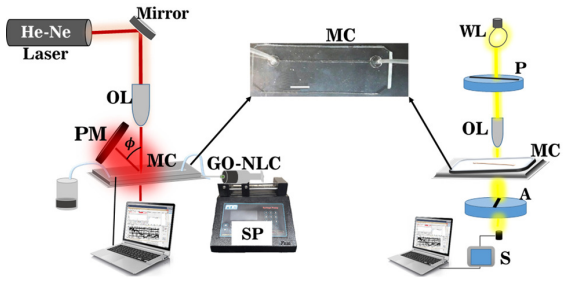
- [§2.2 and §3, Eq. (1)] No baseline measurements with an empty channel or with pure solvent at the same flow rates are reported. The off-axis power meter is placed 5 cm away with a 10° collection angle, so any flow-induced refractive-index gradient, channel deformation, bubbles, or PDMS wall scattering would be captured in the measured signal. Without a solvent-only or empty-channel control, the claim that the observed changes are dominated by light scattering from the GO-NLC is not established. The authors should report absolute intensities and control experiments with the pure solvent and empty channel at identical flow rates.
- [§3, Eq. (6) and Fig. 8] The normalized transmitted intensity defined by Eq. (6) divides by I0,λ, the zero-flow transmitted intensity under crossed polarizers. The text states that at zero flow the GO-NLC sample is isotropic and appears dark; a near-zero denominator makes Iλ ill-conditioned, so small absolute changes in polarizer leakage, detector noise, or stray light can produce large normalized values such as those in Fig. 8. The claim that flow-induced birefringence increases with injection rate therefore needs direct reporting of the absolute I0,λ values, dark subtraction, and ideally a measurement of the extinction ratio of the crossed-polarizer setup.
- [§3, Eqs. (4)-(5)] The theoretical interpretation relies on the assumption, stated in the text near Eq. (5), that increasing the injection rate increases the amplitude of director fluctuations ⟨|δnα(q)|²⟩ and modifies the elastic constants K1, K2, K3. This is asserted without derivation, and for simple shear flow director fluctuations are often suppressed rather than enhanced by the flow field. Since this premise is load-bearing for explaining the experimental trend, either a derivation from nematohydrodynamics or a clear statement that this is a tentative interpretive assumption is needed. In addition, no quantitative comparison is made between the measured intensities and the predicted dependence on q, interaction volume, or material parameters in Eqs. (4)-(5).
- [§3, Figs. 4-6] The paper reports only two volume fractions and a small number of flow rates, with no error bars, standard deviations, or number of repetitions for the normalized intensities. The conclusion that the higher volume fraction reaches saturation sooner than the lower one is based on comparing two curves without uncertainty estimates. The manuscript acknowledges shot noise and outliers but does not quantify their effect on the reported trends. Error bars or confidence intervals are required to support the central claims about increasing, saturating, and concentration-dependent behavior.
minor comments (5)
- [Fig. 4] The caption and the text refer to parts (c) and (d) as 'transmittance intensity' and 'transmitted intensity', but the axis labels are not described; please specify the plotted quantity and its normalization for all four panels.
- [§3, Eq. (7)] The definition of θ as the angle between the wave vector and the optical axis should be reconciled with the expression for ne; also clarify how θ is expected to vary with flow rate beyond the statement that it 'deviates from its initial value'.
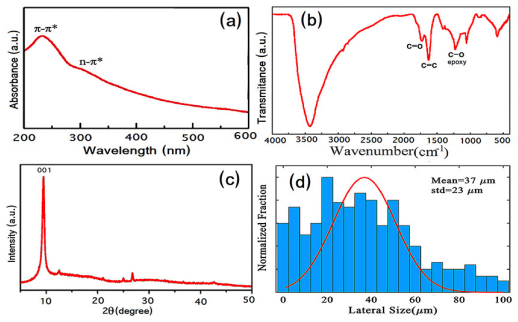
- [§2.1] The text uses both 'Vol%' and 'volume fraction' inconsistently, and the relation between the stated concentrations (0.17 and 0.53 Vol%) and the Onsager phase boundaries (CIB = 0.03 Vol%, CBN = 0.1 Vol%) should be stated more clearly, especially given the polydispersity noted by the authors.
- [§3, Eq. (8)] The saturation angle formula is introduced without derivation or a specific reference; please provide a citation or a brief derivation showing how it follows from the Leslie-Ericksen theory.
- [Throughout] There are numerous typographical and formatting issues, including missing spaces after colons (e.g., 'as:n(r)') and inconsistent use of 'equates to'; a careful proofread would improve readability.
Circularity Check
No circularity: the paper reports an empirical trend and explains it with standard, externally cited scattering theory; no fitted parameter is renamed as a prediction.
full rationale
The measurement definitions (Eqs. 1 and 6) are normalizations to the zero-flow intensity and do not encode the claimed outcome; the increase of Is,T with injection rate and the earlier saturation at higher volume fraction are measured trends, not identities. The theoretical part (Eqs. 2-5) is taken from standard textbooks and independent literature (Khoo, de Gennes-Prost, Leslie, Marusii et al.), and no parameters are fitted to the data. Eqs. 7-8 are standard birefringence and Leslie-viscosity relations used for interpretation, not fitted. The paper's assumption that flow increases director fluctuations is an unsupported physical premise and may be wrong, but it is not circular because it is not derived from the data or from a self-citation. The reader-mentioned lack of empty-channel/pure-solvent baselines and the near-dark I0,lambda reference are experimental validity and robustness concerns, not circular derivation chains. No self-citation is load-bearing; indeed no reference in the paper overlaps with the authorship of this paper. Therefore no circular step meets the evidence standard of quoting an equation that reduces to its inputs.
Assumptions & free parameters
assumptions (5)
- standard math Differential light scattering cross-section for a nematic liquid crystal (Eq. 4, after Khoo [1])
- domain assumption Thermal director fluctuation spectrum, Eq. (5), after Marusii et al. [10]
- domain assumption Onsager phase transition volume fractions C_IB = 0.03 Vol% and C_BN = 0.1 Vol%
- ad hoc to paper Flow increases the amplitude of director fluctuations and the birefringence in GO-NLC
- domain assumption Saturation angle formula cos(2*theta_s) = -(gamma_2-gamma_3)/(gamma_5-gamma_6), Eq. (8), after Leslie [42]
Cite this review
Pith. "Pith review of Light scattering through the graphene oxide liquid crystal in a micro-channel." pith.science (2026). https://pith.science/paper/LVCA46JI
@misc{pith2026190800725,
  author       = {Pith},
  title        = {Pith review of: Light scattering through the graphene oxide liquid crystal in a micro-channel},
  year         = {2026},
  howpublished = {\url{https://pith.science/paper/LVCA46JI}},
  note         = {Machine review of arXiv:1908.00725}
}
read the original abstract
In this paper, we examine the light scattering by the flow of levitated flakes in a micro-channel to characterize the tunable functionality of the graphene oxide liquid crystal in the nematic phase. Light interaction with the mentioned material is decomposed to the scattered and transmitted parts and they can determine the orientation of the flakes. Our results demonstrate that, pumping the graphene oxide sample through the micro-channel leads to increase the amplitude of scattered light. The time averaged of scattered light intensity grows by increasing volume fraction. We also find that, the higher volume fraction, the sooner reaching to saturated normalized scattered intensity is. To get deep insight about our experimental results, we rely on the general theoretical properties of the light scattering cross-section incorporating the fluctuation of director vector and dielectric tensor. Our proposal is a promising approach to carry out the mechanical-hydrodynamical approach for controlling the orientation of a typical liquid crystal.
Figures
Figures from the paper (5 more)



Reference graph
Works this paper leans on
-
[1]
Khoo, Liquid crystals(John Wiley & Sons, 2007)
I.-C. Khoo, Liquid crystals(John Wiley & Sons, 2007)
work page 2007
-
[2]
L. M. Blinov,Structure and properties of liquid crystals(Springer Science & Business Media, 2010)
work page 2010
-
[3]
S. Li, M. Fu, H. Sun, Y. Zhao, Y. Liu, D. He, and Y. Wang, “Enhanced photorefractive and third-order nonlinear optical properties of 5cb-based polymer-dispersed liquid crystals by graphene doping,” J. Phys. Chem. C118, 18015–18020 (2014)
work page 2014
-
[4]
Dynamic in-situ sensing of fluid-dispersed 2d materials integrated on microfluidic si chip,
B. T. Hogan, S. A. Dyakov, L. J. Brennan, S. Younesy, T. S. Perova, Y. K. Gun’ko, M. F. Craciun, and A. Baldycheva, “Dynamic in-situ sensing of fluid-dispersed 2d materials integrated on microfluidic si chip,” Sci. Rep.7, 42120 (2017)
work page 2017
-
[5]
Graphene chiral liquid crystals and macroscopic assembled fibres,
Z. Xu and C. Gao, “Graphene chiral liquid crystals and macroscopic assembled fibres,” Nat. Commun.2, 571 (2011)
work page 2011
-
[6]
Liquid crystals of carbon nanotubes and graphene,
C. Zakri, C. Blanc, E. Grelet, C. Zamora-Ledezma, N. Puech, E. Anglaret, and P. Poulin, “Liquid crystals of carbon nanotubes and graphene,” Philos. Trans. R. Soc. A371, 20120499 (2013)
work page 2013
-
[7]
2d material liquid crystals for optoelectronics and photonics,
B. T. Hogan, E. Kovalska, M. F. Craciun, and A. Baldycheva, “2d material liquid crystals for optoelectronics and photonics,” J. Mater. Chem. C5, 11185–11195 (2017)
work page 2017
-
[8]
A decade of graphene research: production, applications and outlook,
E. P. Randviir, D. A. Brownson, and C. E. Banks, “A decade of graphene research: production, applications and outlook,” Mater. Today17, 426–432 (2014)
work page 2014
Show all 42 references
-
[9]
Light scattering in nematic liquid crystals in a nonequilibrium steady state,
H. Pleiner and H. Brand, “Light scattering in nematic liquid crystals in a nonequilibrium steady state,” Phys. Rev. A 27, 1177–1183 (1983)
1983
-
[10]
Scattering of light by nematic liquid crystals in cells with a finite energy of the anchoring of the director to the wails,
T. Y. Marusii, Y. A. Reznikov, V. Y. Reshetnyak, M. Soskin, and A. Khizhnyak, “Scattering of light by nematic liquid crystals in cells with a finite energy of the anchoring of the director to the wails,” Zh. Eksp. Teor. Fiz.91, 851–860 (1986)
1986
-
[11]
Graphene oxide liquid crystals for reflective displays without polarizing optics,
L. He, J. Ye, M. Shuai, Z. Zhu, X. Zhou, Y. Wang, Y. Li, Z. Su, H. Zhang, Y. Chen, Z. Liu, Z. Cheng, and J. Bao, “Graphene oxide liquid crystals for reflective displays without polarizing optics,” Nanoscale7, 1616–1622 (2015)
2015
-
[12]
Effect of solvents on the electro-optical switching of graphene oxide dispersions,
R. T. M. Ahmad, S.-H. Hong, T.-Z. Shen, A. R. Masud, and J.-K. Song, “Effect of solvents on the electro-optical switching of graphene oxide dispersions,” Appl. Phys. Lett.108, 251903 (2016)
2016
-
[13]
Optimization of particle size for high birefringence and fast switching time in electro-optical switching of graphene oxide dispersions,
R. T. M. Ahmad, S.-H. Hong, T.-Z. Shen, and J.-K. Song, “Optimization of particle size for high birefringence and fast switching time in electro-optical switching of graphene oxide dispersions,” Opt. Express23, 4435–4440 (2015)
2015
-
[14]
Electric field-induced ordering of reduced graphene oxide particles in colloid,
R. T. M. Ahmad, S.-H. Hong, T.-Z. Shen, Y.-S. Kim, and J.-K. Song, “Electric field-induced ordering of reduced graphene oxide particles in colloid,” J. Nanosci. Nanotechnol.16, 11364–11368 (2016)
2016
-
[15]
Manipulation of structural color reflection in graphene oxide dispersions using electric fields,
S.-H. Hong, T.-Z. Shen, and J.-K. Song, “Manipulation of structural color reflection in graphene oxide dispersions using electric fields,” Opt. Express23, 18969–18974 (2015)
2015
-
[16]
Analysis of weak-boundary-coupling effects in liquid-crystal displays,
J. Nehring, A. R. Kmetz, and T. J. Scheffer, “Analysis of weak-boundary-coupling effects in liquid-crystal displays,” J. Appl. Phys.47, 850–857 (1976)
1976
-
[17]
Multistable orientation in a nematic liquid crystal cell induced by external field and interfacial interaction,
H. L. Ong, R. B. Meyer, and A. J. Hurd, “Multistable orientation in a nematic liquid crystal cell induced by external field and interfacial interaction,” J. Appl. Phys.55, 2809–2815 (1984)
1984
-
[18]
Dynamics of the orientation of a nematic-liquid-crystal film in a variable magnetic field,
F. Brochard, P. Pieranski, and E. Guyon, “Dynamics of the orientation of a nematic-liquid-crystal film in a variable magnetic field,” Phys. Rev. Lett.28, 1681–1683 (1972)
1972
-
[19]
Transient behaviour of a twisted nematic liquid-crystal layer in an electric field,
C. Z. Van Doorn, “Transient behaviour of a twisted nematic liquid-crystal layer in an electric field,” J. Phys. (Paris) 36, C1–261 (1975)
1975
-
[20]
Graphene alignment technique holds promise for nanophotonics,
J. Bao, F. Lin, and J. Hu, “Graphene alignment technique holds promise for nanophotonics,” Photonics Spectra51, 38–40 (2017)
2017
-
[21]
Graphene oxide liquid crystals,
J. E. Kim, T. H. Han, S. H. Lee, J. Y. Kim, C. W. Ahn, J. M. Yun, and S. O. Kim, “Graphene oxide liquid crystals,” Angew. Chem. Int. Ed. Engl.50, 3043–3047 (2011)
2011
-
[22]
Room-temperature ferromagnetism of graphene,
Y. Wang, Y. Huang, Y. Song, X. Zhang, Y. Ma, J. Liang, and Y. Chen, “Room-temperature ferromagnetism of graphene,” Nano Lett.9, 220–224 (2008)
2008
-
[23]
Graphene oxide liquid crystals: synthesis, phase transition, rheological property, and applications in optoelectronics and display,
F. Lin, X. Tong, Y. Wang, J. Bao, and Z. M. Wang, “Graphene oxide liquid crystals: synthesis, phase transition, rheological property, and applications in optoelectronics and display,” Nanoscale Res. Lett.10, 435 (2015)
2015
-
[24]
Orientation control of graphene flakes by magnetic field: broad device applications of macroscopically aligned graphene,
F. Lin, Z. Zhu, X. Zhou, W. Qiu, C. Niu, J. Hu, K. Dahal, Y. Wang, Z. Zhao, Z. Ren, D. Litvinov, Z. Liu, Z. M. Wang, and J. Bao, “Orientation control of graphene flakes by magnetic field: broad device applications of macroscopically aligned graphene,” Adv. Mater.29, 1604453 (2017)
2017
-
[25]
Sengupta,Topological microfluidics: nematic liquid crystals and nematic colloids in microfluidic environment (Springer Science & Business Media, 2013)
A. Sengupta,Topological microfluidics: nematic liquid crystals and nematic colloids in microfluidic environment (Springer Science & Business Media, 2013)
2013
-
[26]
The effect of anchoring on the nematic flow in channels,
V. M. O. Batista, M. L. Blow, and M. M. T. da Gama, “The effect of anchoring on the nematic flow in channels,” Soft Matter 11, 4674–4685 (2015)
2015
-
[27]
Light scattering from a nematic liquid crystal in the presence of an electric field,
F. M. Leslie and C. M. Waters, “Light scattering from a nematic liquid crystal in the presence of an electric field,” Mol. Cryst. Liq. Cryst.123, 101–117 (1985)
1985
-
[28]
de Gennes and J
P.-G. de Gennes and J. Prost,The physics of liquid crystals(Oxford University Press, 1995)
1995
-
[29]
Magnetic-field dependence of the order parameter in a nematic single crystal,
Y. Poggi and J. C. Filippini, “Magnetic-field dependence of the order parameter in a nematic single crystal,” Phys. Rev. Lett.39, 150–152 (1977)
1977
-
[30]
Electric field quenching of thermal fluctuations of orientation in a nematic liquid crystal,
J. L. Martinand and G. Durand, “Electric field quenching of thermal fluctuations of orientation in a nematic liquid crystal,” Solid State Commun.10, 815–818 (1972)
1972
-
[31]
Alight-induceddecreaseofthelight-scattering in nematic liquid-crystals,
Y.A.Reznikov,V.Y.Reshetnyak,M.S.Soskin,andA.I.Khizhnyak,“Alight-induceddecreaseofthelight-scattering in nematic liquid-crystals,” Ukr. Fiz. Zh.29, 1269–1272 (1984)
1984
-
[32]
One-pot, green, rapid synthesis of flowerlike gold nanoparticles/reduced graphene oxide composite with regenerated silk fibroin as efficient oxygen reduction electrocatalysts,
S. Xu, L. Yong, and P. Wu, “One-pot, green, rapid synthesis of flowerlike gold nanoparticles/reduced graphene oxide composite with regenerated silk fibroin as efficient oxygen reduction electrocatalysts,” ACS Appl. Mater. Interfaces5, 654–662 (2013)
2013
-
[33]
A green approach to the synthesis of graphene nanosheets,
H.-L. Guo, X.-F. Wang, Q.-Y. Qian, F.-B. Wang, and X.-H. Xia, “A green approach to the synthesis of graphene nanosheets,” ACS Nano3, 2653–2659 (2009)
2009
-
[34]
Preparation of functionalized graphene sheets by a low-temperature thermal exfoliation approach and their electrochemical supercapacitive behaviors,
Q. Du, M. Zheng, L. Zhang, Y. Wang, J. Chen, L. Xue, W. Dai, G. Ji, and J. Cao, “Preparation of functionalized graphene sheets by a low-temperature thermal exfoliation approach and their electrochemical supercapacitive behaviors,” Electrochim. Acta55, 3897–3903 (2010)
2010
-
[35]
Electro-opticalswitchingofgrapheneoxideliquidcrystalswithanextremely large kerr coefficient,
T.-Z.Shen,S.-H.Hong,andJ.-K.Song,“Electro-opticalswitchingofgrapheneoxideliquidcrystalswithanextremely large kerr coefficient,” Nat. Mater.13, 394–399 (2014)
2014
-
[36]
Aqueous liquid crystals of graphene oxide,
Z. Xu and C. Gao, “Aqueous liquid crystals of graphene oxide,” ACS Nano5, 2908–2915 (2011)
2011
-
[37]
Rapid prototyping of microfluidic systems in poly (dimethylsiloxane),
D. C. Duffy, J. C. McDonald, O. J. A. Schueller, and G. M. Whitesides, “Rapid prototyping of microfluidic systems in poly (dimethylsiloxane),” Anal. Chem.70, 4974–4984 (1998)
1998
-
[38]
Poly (dimethylsiloxane) as a material for fabricating microfluidic devices,
J. C. McDonald and G. M. Whitesides, “Poly (dimethylsiloxane) as a material for fabricating microfluidic devices,” Acc. Chem. Res.35, 491–499 (2002)
2002
-
[39]
Determination of the structural properties of a columnar hexagonal liquid crystal by light scattering,
S. Yilmaz, “Determination of the structural properties of a columnar hexagonal liquid crystal by light scattering,” J. Mod. Opt.59, 912–916 (2012)
2012
-
[40]
Functionalization of microfluidic devices for investigation of liquid crystal flows,
A. Sengupta, B. Schulz, E. Ouskova, and C. Bahr, “Functionalization of microfluidic devices for investigation of liquid crystal flows,” Microfluid. Nanofluid.13, 941–955 (2012)
2012
-
[41]
Opto-fluidic velocimetry using liquid crystal microfluidics,
A. Sengupta, S. Herminghaus, and C. Bahr, “Opto-fluidic velocimetry using liquid crystal microfluidics,” Appl. Phys. Lett. 101, 164101 (2012)
2012
-
[42]
Some constitutive equations for liquid crystals,
F. M. Leslie, “Some constitutive equations for liquid crystals,” Arch. Ration. Mech. Anal.28, 265–283 (1968)
1968
Reviewed August 14, 2026 · model on record in the stance chip above.
Discussion (0). Continue with ORCID to comment.