REVIEW 2 major objections 5 minor 35 references
Double bracket formulation for the distribution function approach to multibead-chain suspensions
T0 review · 2 major / 5 minor · reviewed 2026-08-14 · deepseek-v4-flash
Pith's one-line read Modelling a bead chain as a higher-order jet bundle yields exact finite moment closures for Hookean suspensions and predicts an angular-momentum flux that is absent for two-bead pairs.
desk verdict A formally clean geometric-mechanics paper whose physical claim depends on treating a chain as a jet; worth refereeing, but the couple-stress result is an artifact of that idealization. read the letter →
The pith
A machine-rendered reading of the paper's core claim, the machinery that carries it, and where it could break.
The reading
What carries the argument
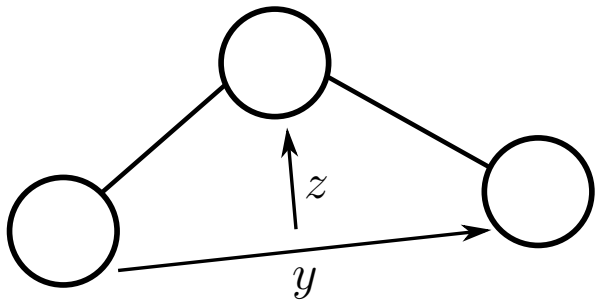
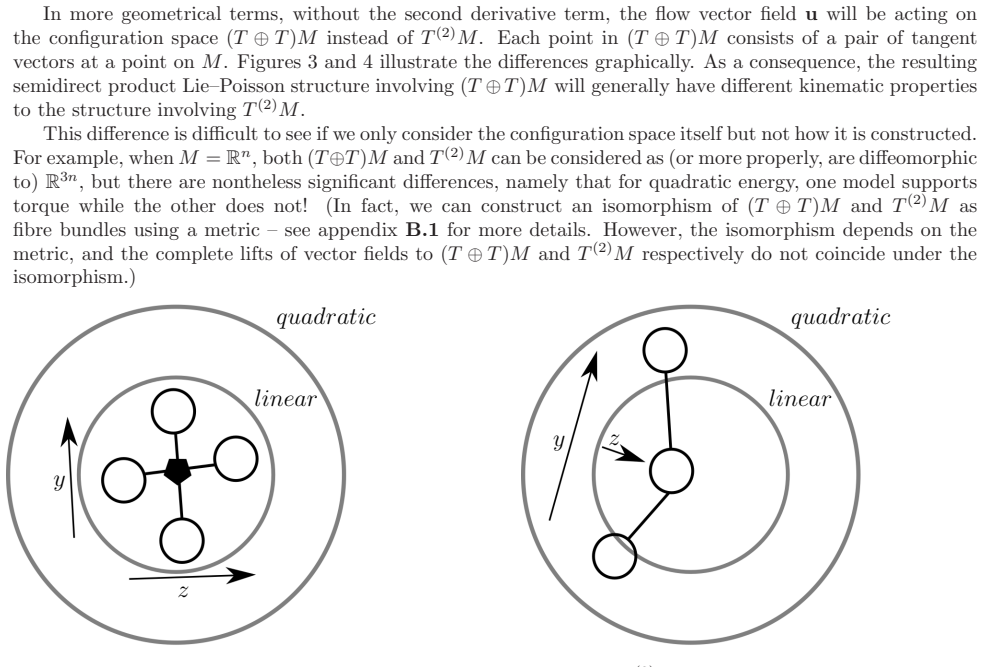
The load-bearing object is the $N$th-order tangent bundle $T^{(N)}M$, the space of $N$-jets of curves into $M$, whose points encode the Taylor data (position, first derivative, and so on up to the $N$th derivative) of a chain and thereby represent an $(N+1)$-bead chain as one smooth path rather than as separate connector vectors. The complete lift $u^\#$ of the fluid velocity field to this bundle gives the Lagrangian advection law, generating a semidirect-product Lie--Poisson bracket; a metric dissipation bracket supplies relaxation and diffusion. Closure is carried by an order-counting argument: under the complete lift and the drift/diffusion terms, homogeneous polynomial moments of order $b$ couple only to moments of order at most $b$, and the stress only needs moments up to order $2N$. A supplementary classification result identifies the admissible energies for which this order-counting works: they are precisely sums over $a$ of linear-quadratic functions of $y_{(a)}$, the Hookean-like form.
What would settle it
Take a three-bead chain in a steady flow with a nonzero second velocity gradient, for example a parabolic channel profile, and compare the predicted stress torque from the jet model, which has an antisymmetric part of the form the divergence of a rank-3 tensor, with the two-spring common-centre model, which has no such term. If no antisymmetric stress of divergence-of-rank-3 form appears, or if the moment hierarchy couples $\langle y^j y^k\rangle$ differently than the complete-lift advection law predicts, the $T^{(2)}M$ description is falsified.
Extended reading notes
Core claim
The central discovery is that the multibead-chain model with linear dissipation has a finite exact closure for quadratic energy, and that this closure produces generalisations of the upper-convected Maxwell model to Hookean bead-spring chains. With the configuration space taken to be $T^{(N)}M$, the moment of a homogeneous polynomial of order $b$ evolves under the conservative part without coupling to higher-order moments, and the metric dissipation bracket lowers or preserves moment order; hence collecting moments up to the maximum order appearing in the stress, at most $2N$, gives closed evolution equations. For $N\ge 2$ the resulting stress tensor $\sigma^{jk}$ contains an antisymmetric part expressible as the divergence of a rank-3 tensor, so total fluid angular momentum is conserved despite the absence of any internal angular momentum density. The paper also proves that among rotationally invariant energy functions, only the Hookean-like sum of linear-quadratic terms in each jet coordinate admits this closure, so exact closure is a special, albeit exactly computable, property.
Load-bearing premise
The argument rests on modelling an $(N+1)$-bead chain as the $N$-jet of a smooth path through a point, so the bending degree of freedom is a second derivative of the path rather than an independent discrete connector; change that kinematic choice and the advection law, the torque, and the closure all change.
Editorial extensions
If this is right
- For any $N$, a Hookean chain with linear mobility can be simulated by evolving a finite set of $x$-dependent tensor fields instead of a high-dimensional distribution function; no Fokker--Planck solution is required.
- For the three-bead chain the closed moment set is explicit: $\langle 1\rangle$, $\langle y^j y^k\rangle$, $\langle z^j z^k\rangle$, $\langle y^i y^l z^k\rangle$, $\langle y^m y^n y^j y^l\rangle$, and $\langle z^k\rangle$, and it determines the stress.
- For $N\ge 2$ the antisymmetric part of the elastic stress is a divergence of a rank-3 tensor, so the model conserves fluid angular momentum while transmitting it across material surfaces; the resulting continuum theory is a couple-stress, asymmetric-stress fluid.
- When the internal energy contains any cross term between different jet orders, exact finite closure fails; only rotationally invariant admissible energies are Hookean-like sums of linear and quadratic terms in each jet coordinate.
- The exactly closable systems reproduce and generalise the upper-convected Maxwell model, with the two-bead case recovered when the extra bending moments are forgotten by integrating over $z$.
Reading between the lines
- If the jet description is right, the bending coordinate is not a second independent connector vector: a three-bead chain is kinematically different from two bead-spring pairs sharing a centre, and this difference should be visible in flows whose velocity has a nonzero second derivative.
- The moment set that closes under the double-bracket dynamics suggests a natural, microphysics-free choice of internal state variables for more complex polymer models, thereby reducing the arbitrariness the author notes in the phenomenological state-variable approach.
- The admissibility theorem implies that non-Hookean spring potentials, for example finite-extensible springs, will require approximate closures; the order counting used here gives a systematic place to insert a Peterlin-type pre-averaging assumption.
- Because the stress asymmetry is generated solely by the $\partial^2 u$ term in the complete lift, its magnitude is controlled by velocity curvature; experiments in curved microchannels could separate this contribution from ordinary viscoelastic stress.
Signed reviews
Editorial analysis
A structured set of objections, weighed in public.
Referee Report
Summary. The paper develops a double-bracket (Poisson plus dissipation bracket) formulation for suspensions of multibead chains, taking the configuration space of an (N+1)-bead chain to be the Nth-order tangent bundle T^(N)M. The conservative dynamics is built from the complete lift of the fluid velocity to T^(N)M, giving a semidirect-product Lie--Poisson bracket; a metric dissipation bracket supplies relaxation and diffusion. The author derives the particle-contributed stress from the Hamiltonian, shows that for N>=2 the stress is generically asymmetric with the antisymmetric part a divergence of a rank-3 tensor, and proves exact finite moment closure for quadratic (Hookean-like) internal energies. The 3-bead case is worked out explicitly, with the closed system of moment equations (5.17)--(5.22), and the general order-counting argument in Section 6 establishes the same closure for arbitrary N. The paper also characterizes admissible energies via a proposition showing that admissible polynomial energies are at most linear-quadratic in each separate order.
Significance. If correct, the paper provides a useful and nontrivial extension of the upper-convected Maxwell closure to multibead chains, and gives a concrete kinetic model whose stress has an asymmetric (couple-stress) part. The central derivations are transparent and checkable: the moment equations for the 3-bead chain are explicit, and the order-counting argument for general N is clean. A notable strength is that the paper is honest about the modeling choice: it explicitly distinguishes T^(N)M from (T oplus ... oplus T)M and notes that the complete lifts differ, which is exactly the point on which the asymmetric stress rests. The paper also gives a clear sufficient condition for closure and proves that admissible energies are of a very restricted form. These features make the formal content reliable and reproducible.
major comments (2)
- [§6.3, Eq. (6.21)] Equation (6.21) contains a sign error that is inconsistent with the explicit 3-bead result (5.13). With R_a^jl defined by Eq. (6.22), specializing (6.21) to N=2 gives the final term +kappa_2 partial_l <y_j y_l z_k>, whereas Eq. (5.13) and a direct integration by parts from Eq. (6.12) give -kappa_2 partial_l <y_j y_l z_k>. The divergence term in (6.21) should carry a minus sign. Please correct this and re-check any downstream signs, since the direction of the couple-stress flux depends on this term.
- [§5 (Eq. (5.2)) and Appendix B.1] The physical status of the jet-bundle modeling premise needs a justification or an explicit caveat. The paper is transparent that T^(N)M and (T oplus ... oplus T)M have different complete lifts and that quadratic energy on (T oplus T)M gives a symmetric stress, but it does not provide a controlled limit (for example, bead spacing going to zero with finite-difference coordinates and suitably scaled spring constants) under which a discrete multibead chain is represented by the complete lift on T^(N)M. Since the asymmetric-stress conclusion depends entirely on this modeling choice, the paper should either supply such a limiting argument or explicitly restrict the physical claims to the jet-chain idealization rather than to generic discrete bead-spring chains.
minor comments (5)
- [§4.2, Eq. (4.6)] In the displayed formula for tilde{y}^{(2)}(s), the right-hand side should begin with y^{(2)}, not y^{(1)}; as written it appears to be a typographical transcription of the second-order lift.
- [§3.4, §6.3] The dissipation bracket in the general multibead model uses unit coefficients in all fibre blocks, whereas the bead-pair benchmark in §3.4 deliberately chooses lambda = 1/2 in the metric to match Ref. [3,28]. This is presumably absorbed by rescaling kappa_a or zeta, but the paper should state explicitly that the general model reduces to the benchmark only after such a rescaling.
- [§2, §A] The suppression of smoothness and decay hypotheses is acknowledged, but a single sentence in Section 2 stating that all functionals are assumed sufficiently regular and that boundary terms vanish would help the reader distinguish technical assumptions from physical content.
- [§3.4, Eq. (3.31)] The displayed expression for the Oseen--Burgers tensor, Omega_ij = (|y|^2 delta_ij + y_i y_j)/|y|^3, does not appear to have the standard dimensional form; if this is a deliberate convention, a brief comment would avoid confusion.
- [Miscellaneous] There are minor typographical issues, including 'Ackowledgements' in the acknowledgements heading, 'Hamiltonain' in the conclusion, and the abstract's 'This flux appear' which should be 'appears'.
Circularity Check
No circularity: all central results are derived from explicit model assumptions plus external benchmark calibration.
full rationale
The paper's derivation chain is self-contained in the relevant sense. The model is constructed from explicit choices: configuration space T^(N)M, complete lift of the fluid velocity field, semidirect-product Lie-Poisson bracket, metric dissipation bracket, and quadratic internal energy. Eq. (5.2), the advection equation for the 3-bead distribution, is the coordinate expression of that complete lift; the stress (5.13) is obtained by substituting the quadratic energy into the general force expression (5.3), and its antisymmetric part being a divergence of a rank-3 tensor is a direct algebraic consequence, not an imposed target. The finite closure result is proven by an order-counting argument: each P_a is homogeneous of degree a, and the drift/diffusion terms couple moments only to moments of equal or lower order, so the monomial moments up to order 2N close exactly. The only calibrated quantity is lambda = 1/2 in the Sasaki metric (3.27), chosen so the pair equations coincide with the known bead-spring kinetic equation in [3,28]; this is an external benchmark, and the multibead closure does not depend on lambda. The paper explicitly acknowledges that T^(N)M and (T⊕T)M are noncanonically isomorphic and have different complete lifts (Appendix B.1), so the jet modeling choice is stated rather than smuggled in. No fitted input is renamed as a prediction, and no load-bearing self-citation chain appears. The physical applicability of the jet idealization to discrete chains is a modeling and correctness question, not a circularity.
Assumptions & free parameters
free parameters (3)
- Metric coefficient lambda in dissipation bracket =
1/2 (chosen)
- Mobility parameter 1/zeta =
unspecified positive constant
- Spring and bending stiffness constants kappa_a =
unspecified positive constants, a = 1,...,N
assumptions (6)
- standard math Smoothness, decay and orientability hypotheses on all infinite-dimensional spaces are assumed.
- standard math The complete lift u -> u# is a Lie algebra homomorphism from Vect(M) to Vect(T^(N)M).
- domain assumption The configuration space of an (N+1)-bead chain is T^(N)M, the space of jets of paths.
- domain assumption Beads are advected as Lagrangian markers in a Stokes flow, and chains have no inertia or internal angular momentum density.
- domain assumption Dissipation is given by a Riemannian-metric bracket implementing a linear mobility relation.
- domain assumption The internal energy E(y) is quadratic, or admissible in the sense of Eq. (6.23), for the closure theorem.
Cite this review
Pith. "Pith review of Double bracket formulation for the distribution function approach to multibead-chain suspensions." pith.science (2026). https://pith.science/paper/PTGSV6IH
@misc{pith2026190800798,
  author       = {Pith},
  title        = {Pith review of: Double bracket formulation for the distribution function approach to multibead-chain suspensions},
  year         = {2026},
  howpublished = {\url{https://pith.science/paper/PTGSV6IH}},
  note         = {Machine review of arXiv:1908.00798}
}
abstract
A suspension of elastic chains of small beads in a Newtonian fluid is a common model for a viscoelastic polymer solution. The configuration of these multibead chains can be described by a distribution function that evolves according to a Liouville or Fokker--Planck equation. For example, when we consider a suspension of Hookean bead-spring pairs, this approach leads to the well-known upper-convected Maxwell model. This is done by taking the second moment of the Fokker--Planck equation that governs the distribution function, which describes the stress of the bead-spring pairs on the fluid. The evolution of these multibead-chain suspensions can be described using a double bracket formulation with a Hamiltonian functional. The conservative part of the dynamics is described by a Poisson bracket, and the dissipative part by an additional symmetric bracket. We treat the configuration space of multibead chains as a higher order tangent bundle. Lifting the fluid velocity field to the bundle leads naturally to a semidirect product Lie--Poisson bracket for the conservative dynamics. The elastic stress exerted by the chains then follows directly from the Hamiltonian functional. For chains with three or more beads, the possible bending of the chain introduces an angular momentum flux that is absent for chains with two beads. This flux appear as an asymmetric elastic stress whose antisymmetric part is the divergence of a rank-$3$ tensor, as in the Cosserats' theory of couple stresses. We investigate the possibility of an exact closure, passing from a distribution function description to a closed internal state variable description of the fluid suspension, and obtain some sufficient conditions for their existence. The resulting exactly closable models are generalisations of the upper-convected Maxwell model to Hookean bead-spring chains.
Figures

Reference graph
Works this paper leans on
-
[1]
A. N. Beris and B. J. Edwards. Poisson bracket formulation of vis coelastic flow equations of differential type: A unified approach. J. Rheol., 34:503–538, 1990
work page 1990
-
[2]
A. N. Beris and B. J. Edwards. Thermodynamics of Flowing Systems . Oxford University Press, Oxford, 1994
work page 1994
-
[3]
R. Bird, C. Curtiss, R. Armstrong, and O. Hassager. Dynamics of Polymeric Liquids, Volume 2: Kinetic Theory. Wiley, New York, 1987
work page 1987
-
[4]
D. W. Condiff and J. S. Dahler. Fluid mechanical aspects of antisym metric stress. Phys. Fluids , 7:842–854, 1964
work page 1964
-
[5]
E. Cosserat and F. Cosserat. Th´ eorie des Corps D´ eformables,. A. Hermann et fils, Paris, 1909
work page 1909
-
[6]
C. T. J. Dodson and M. S. Radivoiovici. Second-order tangent st ructures. Int. J. Theor. Phys. , 21:151–161, Feb 1982
work page 1982
-
[7]
C. T. J. Dodson and M. S. Radivoiovici. Tangent and frame bundles of order two. An. Stiint. Univ.“Al. I. Cuza” Iasi Sect. I a Mat.(NS) , 28:63–71, 1982
work page 1982
-
[8]
D. G. Ebin and J. Marsden. Groups of diffeomorphisms and the mot ion of an incompressible fluid. Ann. Math., 92:102–163, 1970
work page 1970
Show all 35 references
-
[9]
B. J. Edwards, A. N. Beris, and M. Grmela. Generalized constitut ive equation for polymeric liquid crystals. Part 1. Model formulation using the Hamiltonian (Poisson bracket) f ormulation. J. Non-Newton. Fluid Mech., 35:51–72, 1990
1990
-
[10]
C. P. Enz and L. A. Turski. On the Fokker–Planck description of compressible fluids. Physica A, 96:369–378, 1979
1979
-
[11]
Gay-Balmaz and T
F. Gay-Balmaz and T. S. Ratiu. The geometric structure of com plex fluids. Adv. Appl. Math. , 42:176–275, 2009
2009
-
[12]
M. Grmela. Hamiltonian dynamics of incompressible elastic fluids. Phys. Lett. A , 130:81–86, 1988
1988
-
[13]
M. Grmela. Hamiltonian dynamics of elastic fluids: Ericksen stress es. Phys. Lett. A , 137:342–348, 1989
1989
-
[14]
D. D. Holm. Euler–Poincar´ e dynamics of perfect complex fluids. In J. Marsden, P. Newton, P. Holmes, and A. Weinstein, editors, Geometry, Mechanics, and Dynamics: Volume in Honor of the 60 th Birthday of J.E. Marsden , pages 114–168, New York, 2002. Springer
2002
-
[15]
D. D. Holm, J. E. Marsden, and T. S. Ratiu. The Euler–Poincar´ e equations and semidirect products with applications to continuum theories. Adv. Math., 137:1–81, 1998
1998
-
[16]
J. Jost. Riemannian Geometry and Geometric Analysis . Springer, Berlin; Heidelberg, 2006
2006
-
[17]
Khesin and R
B. Khesin and R. Wendt. The Geometry of Infinite-Dimensional Groups . Springer, Berlin; Heidelberg, 2008
2008
-
[18]
Kim and S
S. Kim and S. J. Karrila. Microhydrodynamics. Dover, New York, 2005
2005
-
[19]
A. T. Mackay and T. N. Phillips. On the derivation of macroscopic m odels for compressible viscoelastic fluids using the generalized bracket framework. J. Non-Newton. Fluid Mech. , 266:59–71, 2019
2019
-
[20]
J. E. Marsden, T. Ratiu, and A. Weinstein. Semidirect products and reduction in mechanics. T. Am. Math. Soc. , 281:147–177, 1984. 33
1984
-
[21]
J. E. Marsden, T. Ratiu, and A. J. Weinstein. Reduction and Ham iltonian structures on duals of semidirect product Lie algebras. Contemp. Math. , 28:55–100, 01 1984
1984
-
[22]
J. E. Marsden and T. S. Ratiu. Introduction to Mechanics and Symmetry . Springer, New York, 2013
2013
-
[23]
J. E. Marsden, A. Weinstein, T. Ratiu, R. Schmid, and R. G. Spen cer. Hamiltonian systems with sym- metry, coadjoint orbits and plasma physics. In Proceedings of the IUTAM-ISIMM symposium on modern developments in analytical mechanics, Vol. I (Torino, 1982 ), pages 289–340, 1983
1982
-
[24]
P. J. Morrison. Some observations regarding brackets and dis sipation. Center for Pure and Applied Mathematics Report PAM-228, University of California, Berkeley, 1 984
-
[25]
P. J. Morrison. A paradigm for joined Hamiltonian and dissipative s ystems. Physica D , 18:410–419, 1986
1986
-
[26]
P. J. Morrison. Hamiltonian description of the ideal fluid. Rev. Mod. Phys. , 70:467–521, 1998
1998
-
[27]
P. J. Morrison and J. M. Greene. Noncanonical Hamiltonian dens ity formulation of hydrodynamics and ideal magnetohydrodynamics. Phys. Rev. Lett. , 45:790–794, Sep 1980
1980
-
[28]
M. Renardy. Mathematical Analysis of Viscoelastic Flows . Society for Industrial and Applied Mathematics, Philadelphia, 2000
2000
-
[29]
R. E. Rosensweig. Ferrohydrodynamics. Cambridge University Press, Cambridge, 1985
1985
-
[30]
R. Salmon. Hamiltonian fluid mechanics. Annu. Rev. Fluid Mech. , 20:225–256, 1988
1988
-
[31]
M. I. Shliomis. Magnetic fluids. Soviet Phys. Uspekhi , 17:153–169, 1974
1974
-
[32]
L. W. Tu. Differential Geometry . Springer International Publishing, Cham, Switzerland, 2017
2017
-
[33]
Weinstein
A. Weinstein. The local structure of Poisson manifolds. J. Differ. Geom. , 18:523–557, 1983
1983
-
[34]
Yano and S
K. Yano and S. Ishihara. Tangent and Cotangent Bundles: Differential Geometry . Dekker, New York, 1973
1973
-
[35]
V. E. Zakharov and E. A. Kuznetsov. Hamiltonian formalism for n onlinear waves. Physics–Uspekhi, 40:1087–1116, 1997. 34
1997
Reviewed August 14, 2026 · model on record in the stance chip above.
Discussion (0). Continue with ORCID to comment.