REVIEW 3 major objections 4 minor 26 references
Learning Lightweight Lane Detection CNNs by Self Attention Distillation
T0 review · 3 major / 4 minor · reviewed 2026-08-14 · deepseek-v4-flash
Pith's one-line read A lane-detection CNN can teach itself from its own attention maps, matching much larger models.
desk verdict Solid empirical paper with a genuinely novel self-distillation twist; the main caveat is that Eq. (1) leaves the direction of distillation ambiguous because no detach is specified. read the letter →
The pith
A machine-rendered reading of the paper's core claim, the machinery that carries it, and where it could break.
The reading
What carries the argument
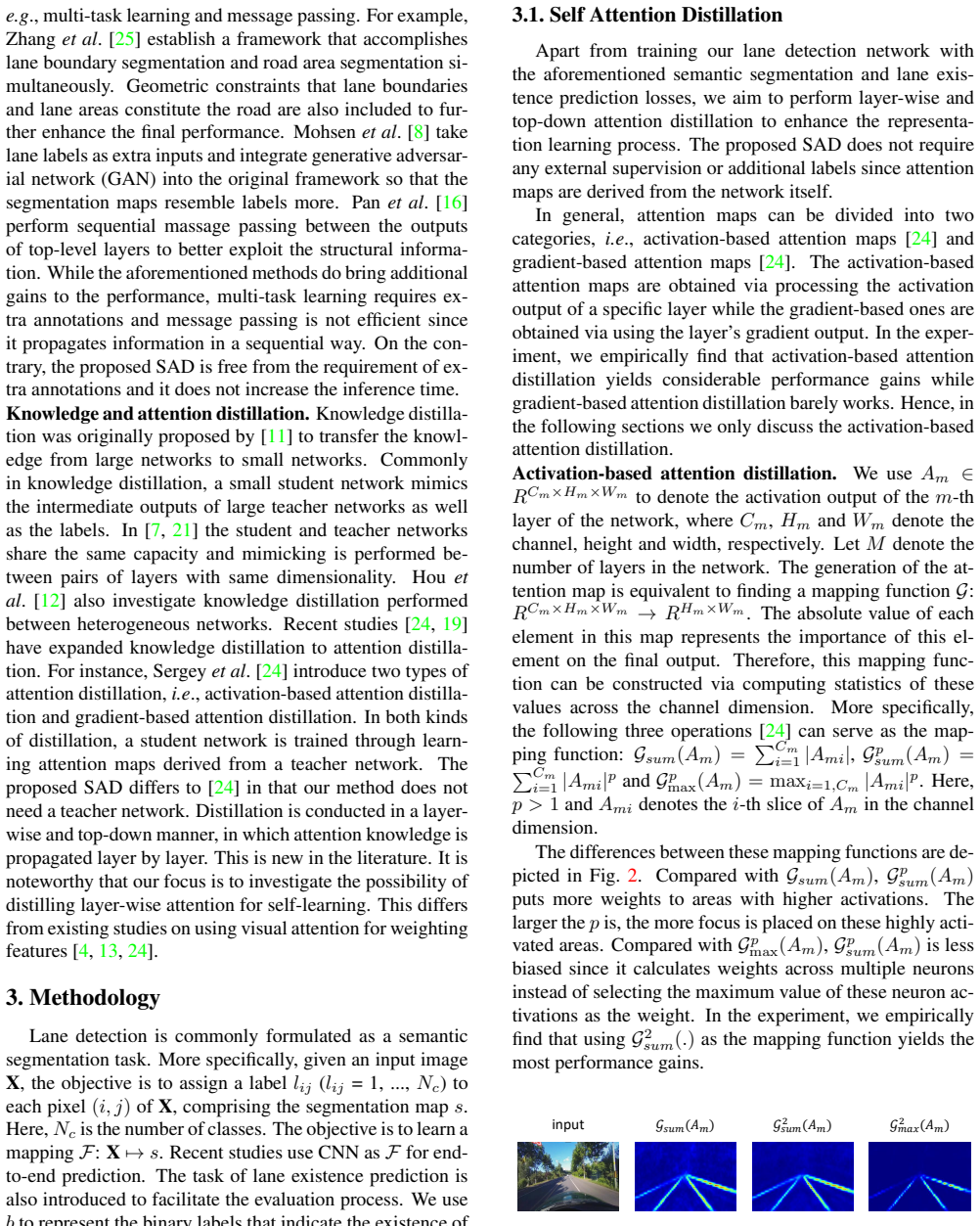
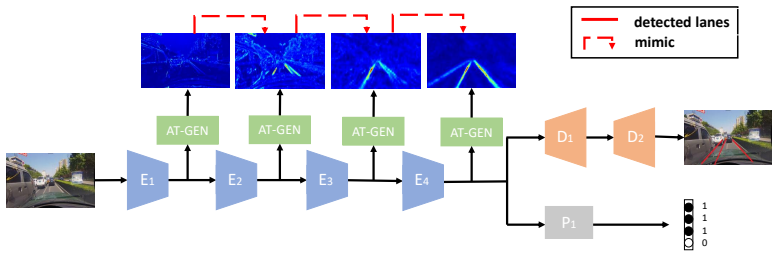
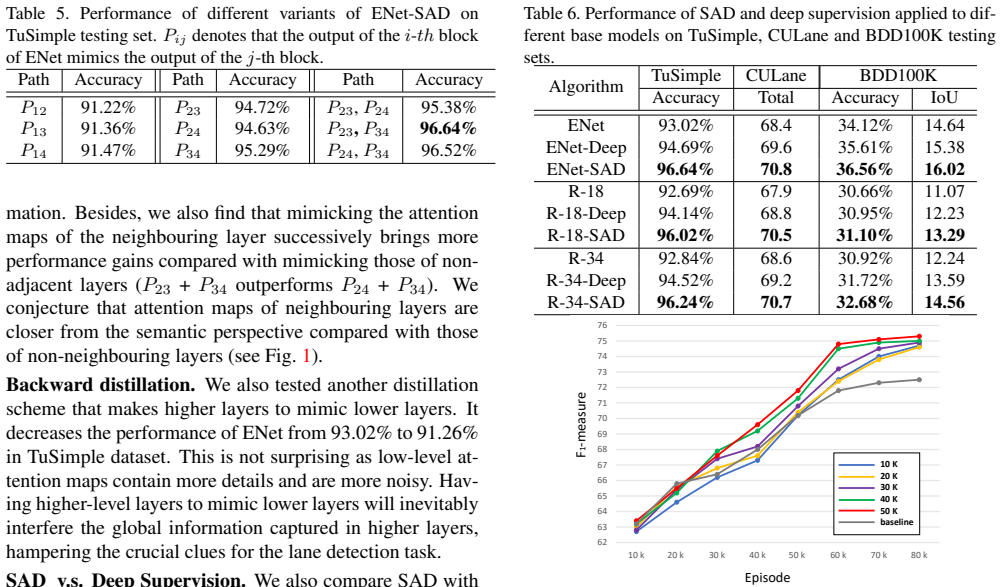
The key mechanism is the self-attention distillation loss added to the total training loss. Attention maps are generated by taking the sum of squared activations across channels for a block, then applying spatial softmax (with bilinear upsampling if needed). The distillation loss is an L2 distance between attention maps of successive blocks, with deeper blocks serving as targets for shallower ones. The paper finds that adjacent-block paths (mimicking the next higher block) work best, and that low-level blocks should not mimic high-level blocks because it hurts local detail detection.
What would settle it
Train the same network with SAD but replace the deeper-block attention targets with attention maps from a randomly initialized network or with fixed random heatmaps; if performance stays the same as normal SAD, then the specific content of the attention maps is not what drives the gains, and the 'self-teaching' explanation is wrong.
Extended reading notes
Core claim
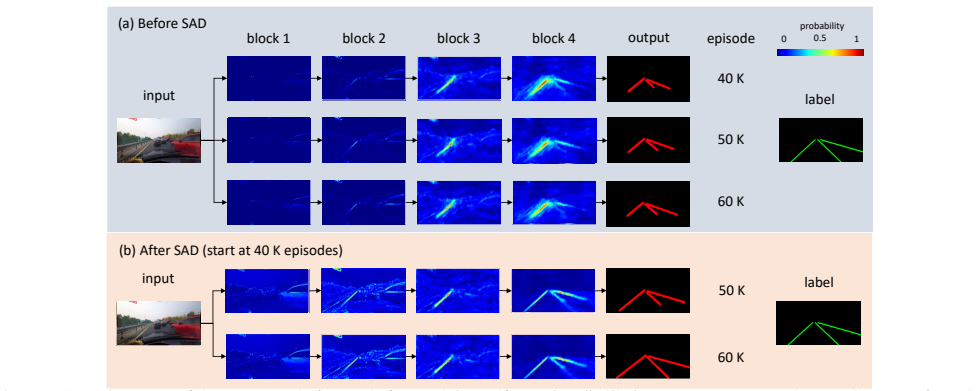
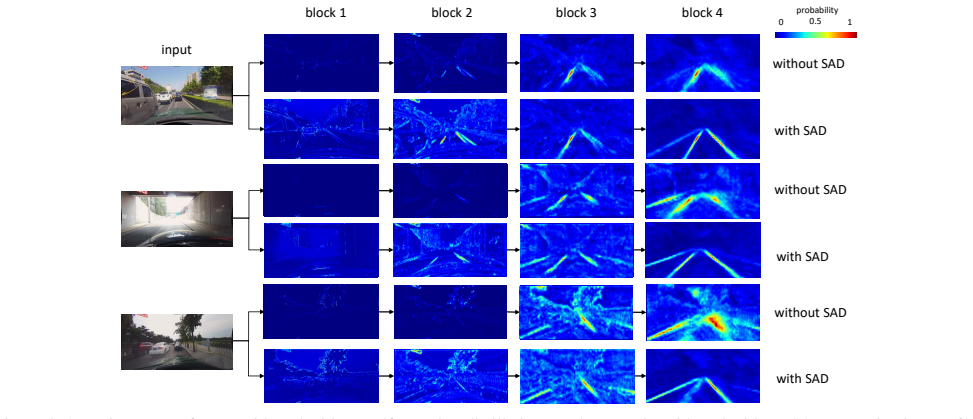
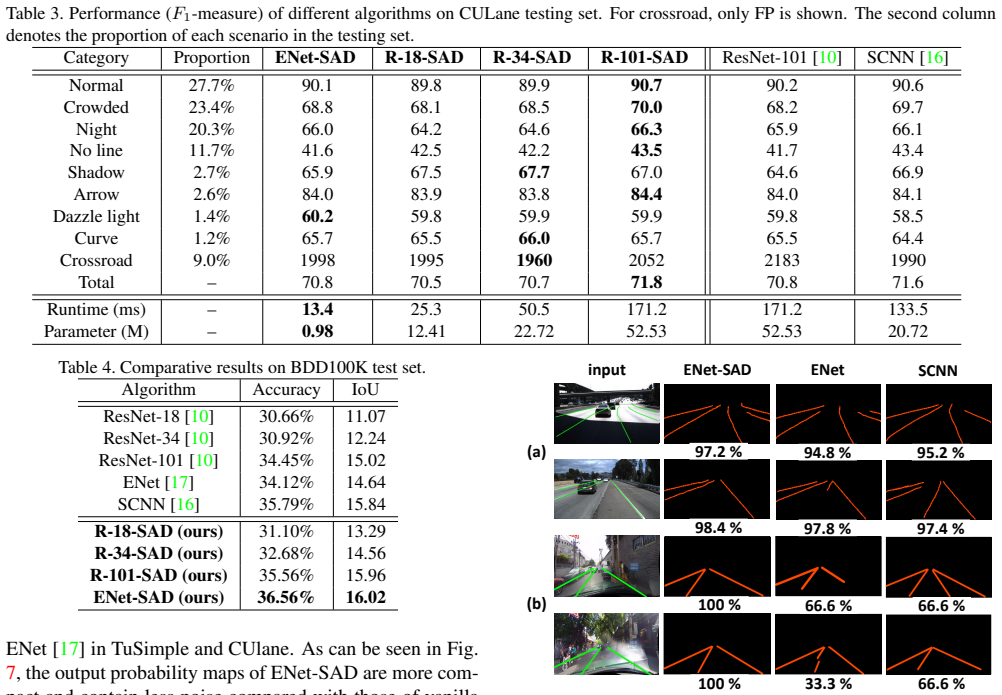
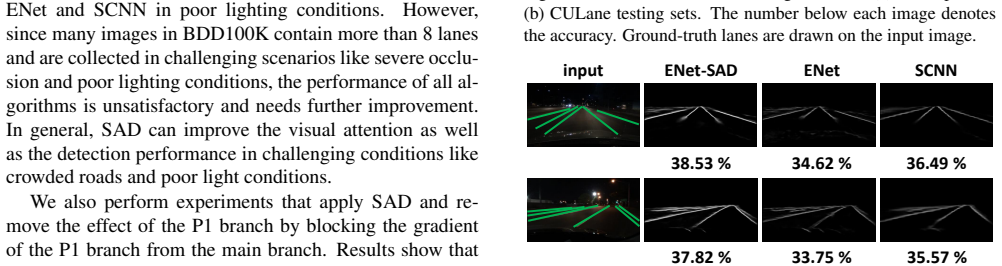
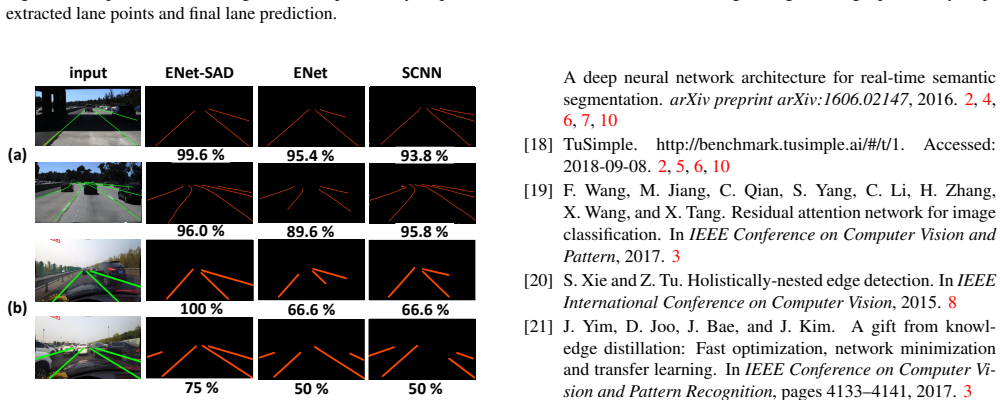
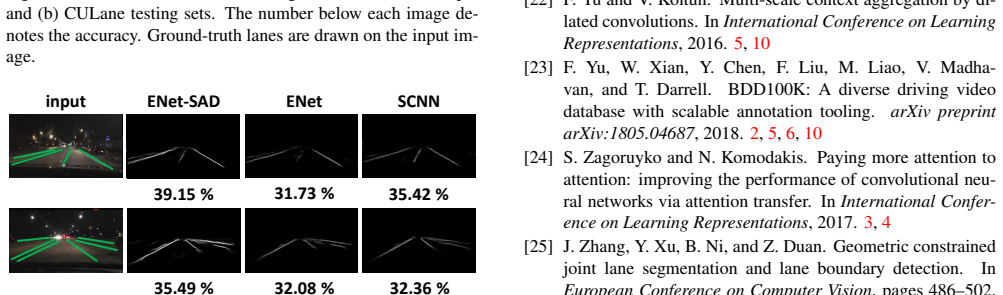
The central claim is that a lane-detection network can use its own mid- and high-level attention maps as 'free' supervision to improve itself. The authors show that a small ENet-based model with SAD reaches 96.64% accuracy on TuSimple, a 70.8 F1 score on CULane, and 36.56% accuracy on BDD100K, comparing favorably with the much larger SCNN despite having about 20 times fewer parameters and running about 10 times faster. The improvement comes from the layer-wise top-down distillation, not from the auxiliary lane-existence branch, since blocking that branch's gradient still gives nearly identical results.
Load-bearing premise
The method assumes that attention maps from deeper layers of a partially trained lane network are informative enough to teach earlier layers; if those maps are noisy or not better than random, the distillation loss would not improve accuracy.
Editorial extensions
If this is right
- Lane detection can be made substantially cheaper: a 0.98 million parameter model with SAD approaches or beats a 20.7 million parameter spatial-CNN model on three benchmarks.
- The method is plug-and-play for feedforward CNNs, so existing lightweight lane-detection models could be retrained with SAD without changing their inference code.
- SAD provides an alternative to multi-task learning and message passing: it gives the benefit of extra context without extra annotations and without the inference slowdown of message passing.
- The ablation shows most of the gain comes from the distillation itself, not the auxiliary lane-existence branch, so the approach should transfer to lane detection models that omit that branch.
Reading between the lines
- If the attention-as-supervision premise generalizes, SAD should transfer to other sparse-label tasks like crack detection or vessel segmentation; a quick controlled test would be to replace the lane labels with those tasks and see whether the same layer-wise loss yields gains.
- The paper's choice of L2 loss and uniform weighting is simple, but a learned weighting or a temperature-scaled softmax might extract more from the attention maps; the paper does not explore these.
- Because SAD is applied after 40K episodes, the initial training schedule matters; an adaptive schedule that turns SAD on when attention maps stabilize could make it parameter-free.
- A potential risk is that SAD mainly helps when the backbone is underparameterized; for very deep networks (ResNet-101) gains are smaller, suggesting diminishing returns.
Signed reviews
Editorial analysis
A structured set of objections, weighed in public.
Referee Report
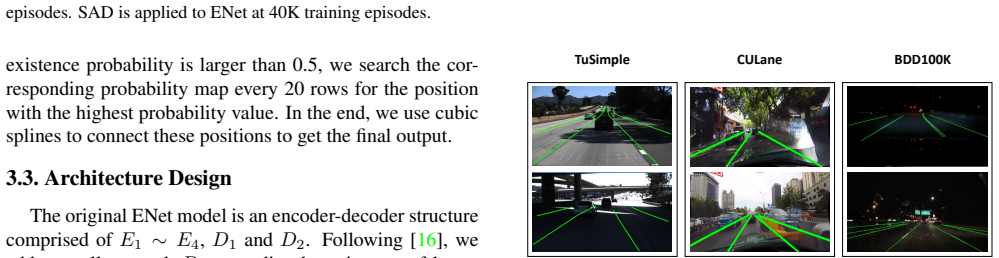
Summary. The paper proposes Self Attention Distillation (SAD), a training-only method for lane detection networks. The idea is to extract activation-based attention maps from several blocks of a CNN, spatially normalize them, and add an L2 loss that encourages shallower blocks to imitate the attention maps of deeper blocks. This self-distillation requires no additional labels or teacher network and does not increase inference cost. The method is evaluated on TuSimple, CULane, and BDD100K using ENet and ResNet backbones. The lightweight ENet-SAD attains 96.64% accuracy on TuSimple, 70.8 F1 on CULane, and 36.56% accuracy on BDD100K, which is competitive with the much heavier SCNN while running substantially faster. Ablations compare SAD with deep supervision, study different distillation paths, test backward distillation, and vary the timepoint at which SAD is introduced.
Significance. If the central mechanism is correctly implemented, this is a solid empirical contribution: it shows that a lane detection network can improve itself through internal attention imitation without extra supervision, and it does so under a mostly careful experimental protocol. The code is released, baselines are retrained with the same segmentation losses and augmentation, and the deep-supervision ablation is a good control that supports the claim that the gains come from SAD itself rather than from auxiliary losses alone. The efficiency comparison against SCNN is compelling: ENet-SAD has roughly 20x fewer parameters and nearly 10x lower runtime. The main risk is not circularity or overfitting to benchmarks but a lack of precision about the exact loss implementation, which bears directly on whether the reported mechanism is actually top-down distillation or merely symmetric attention regularization.
major comments (3)
- [§3.1, Eq. (1)] The text states that Ψ(Am+1) is the target of the distillation loss, but Eq. (1) as written does not specify that gradients are detached from the target. Under standard autograd, an L2 loss between Ψ(Am) and Ψ(Am+1) is symmetric and updates both attention maps, making the loss an attention-alignment regularizer rather than the claimed top-down layer-wise distillation. The 'backward distillation' ablation in §4.2 (higher layers mimicking lower layers) is only meaningfully different if the target is detached; with a symmetric loss, forward and backward paths are mathematically identical. This is a load-bearing detail for the paper's central mechanism. Please state explicitly whether a stop-gradient/detach operation is applied to Ψ(Am+1) and provide the exact loss code or pseudocode. If no detach is used, the claimed top-down mechanism is unsupported and the gains could instead arise from representation smoothing.
- [§3.1, Eq. (1) and Fig. 3] Eq. (1) sums m from 1 to M-1, which for the M=4 ENet example includes the path block1→block2. However, Fig. 3 and the ablation study in §4.2 indicate that SAD is only applied from block 2 onward: the best configuration uses P23 and P34, while Table 5 shows that including P12 degrades accuracy to 91.22% from the 93.02% baseline. The equation therefore does not describe the implemented system unless M is defined differently from the four encoder blocks E1–E4. Please correct the summation range or define M consistently with the actual SAD paths used in the experiments.
- [§4, Implementation details] The paper does not specify the SAD insertion timepoint for TuSimple. Section 3.1 assumes a model half-trained to 40K episodes, and Fig. 8 studies timepoints between 10K and 50K on CULane, but Section 4 states that TuSimple is trained for only 1800 episodes total. This is inconsistent as written and makes the TuSimple experiments hard to reproduce. Please clarify whether SAD is applied from the start for TuSimple and whether the 40K warmup is used only for CULane and BDD100K. Also, please define the term 'episode' (iteration, epoch, or something else) explicitly.
minor comments (4)
- [§4.1, Results] There is a typo in the sentence 'The is because ResNet-18 and ResNet-34 only use spatial upsampling as the decoder' — 'The' should be 'This'.
- [§4, Implementation details] The phrase 'dilate ground-truth lanes of the training set of BDD100K as 8 pixels' should be 'by 8 pixels' for clarity.
- [Fig. 8] The x-axis label 'Episode' should be defined; if it denotes optimization iterations, that should be stated in the caption or text.
- [Abstract and §4.1] The abstract says ENet-SAD 'performs comparatively or even surpasses existing algorithms,' which is accurate when efficiency is considered, but on CULane total F1 ENet-SAD (70.8) is slightly below SCNN (71.6). A sentence making this trade-off explicit would strengthen the presentation.
Circularity Check
No significant circularity: SAD's gains are measured on held-out benchmarks and its self-distillation loss is an auxiliary regularizer, not a fitted prediction.
full rationale
The paper's central claim is that self attention distillation improves lane detection by letting shallower blocks imitate the attention maps of deeper blocks within the same network. This claim is tested on held-out test sets of three public benchmarks (TuSimple, CULane, BDD100K), so the reported accuracies are not predetermined by the loss design or by the choice of loss weights. The distillation loss in Eq. (1) is an auxiliary training signal derived from the network's own activations; it is not a fitted quantity that is later renamed as a prediction. No load-bearing self-citation appears: the authors' prior work [12] is mentioned only as related work on heterogeneous knowledge distillation, and the attention-transfer formulation follows the external work [24]. The only notable caveat is that Eq. (1) does not explicitly specify a stop-gradient on the target term Psi(A_{m+1}), so the implemented mechanism could differ from the stated top-down distillation; that is an implementation-clarity and verification concern, not a circular reduction of the paper's results to its inputs.
Assumptions & free parameters
free parameters (6)
- alpha (segmentation cross-entropy loss weight) =
0.1
- beta (IoU loss weight) =
0.1
- gamma (distillation loss weight) =
0.1
- Attention mapping function exponent p =
p=2 (G^2_sum)
- Background pixel cross-entropy weight =
0.4
- BDD100K training ground-truth dilation =
8 pixels
assumptions (3)
- ad hoc to paper Attention maps from deeper blocks of a partially trained lane-detection network encode rich contextual information about lanes and scene structure.
- ad hoc to paper Minimizing the L2 distance between spatial-softmax attention maps of adjacent blocks improves representation learning and final segmentation accuracy.
- domain assumption The evaluation protocol of the three public benchmarks, including the modified BDD100K ground truth, is a valid measure of lane detection performance.
Cite this review
Pith. "Pith review of Learning Lightweight Lane Detection CNNs by Self Attention Distillation." pith.science (2026). https://pith.science/paper/PZG7FRYS
@misc{pith2026190800821,
  author       = {Pith},
  title        = {Pith review of: Learning Lightweight Lane Detection CNNs by Self Attention Distillation},
  year         = {2026},
  howpublished = {\url{https://pith.science/paper/PZG7FRYS}},
  note         = {Machine review of arXiv:1908.00821}
}
read the original abstract
Training deep models for lane detection is challenging due to the very subtle and sparse supervisory signals inherent in lane annotations. Without learning from much richer context, these models often fail in challenging scenarios, e.g., severe occlusion, ambiguous lanes, and poor lighting conditions. In this paper, we present a novel knowledge distillation approach, i.e., Self Attention Distillation (SAD), which allows a model to learn from itself and gains substantial improvement without any additional supervision or labels. Specifically, we observe that attention maps extracted from a model trained to a reasonable level would encode rich contextual information. The valuable contextual information can be used as a form of 'free' supervision for further representation learning through performing topdown and layer-wise attention distillation within the network itself. SAD can be easily incorporated in any feedforward convolutional neural networks (CNN) and does not increase the inference time. We validate SAD on three popular lane detection benchmarks (TuSimple, CULane and BDD100K) using lightweight models such as ENet, ResNet-18 and ResNet-34. The lightest model, ENet-SAD, performs comparatively or even surpasses existing algorithms. Notably, ENet-SAD has 20 x fewer parameters and runs 10 x faster compared to the state-of-the-art SCNN, while still achieving compelling performance in all benchmarks. Our code is available at https://github.com/cardwing/Codes-for-Lane-Detection.
Figures
Figures from the paper (8 more)

Reference graph
Works this paper leans on
-
[1]
M. Bertozzi and A. Broggi. Gold: A parallel real-time stereo vision system for generic obstacle and lane detection. IEEE Transactions on Image Processing, 7(1):62–81, 1998. 1
work page 1998
- [2]
-
[3]
L. Bottou. Large-scale machine learning with stochastic gra- dient descent. InInternational Conference on Computational Statistics, pages 177–186. Springer, 2010. 6
work page 2010
-
[4]
L.-C. Chen, Y . Yang, J. Wang, W. Xu, and A. L. Yuille. At- tention to scale: scale-aware semantic image segmentation. In IEEE Conference on Computer Vision and Pattern Recog- nition, pages 3640–3649, 2016. 3
work page 2016
-
[5]
Z. Chen and Z. Chen. Rbnet: A deep neural network for unified road and road boundary detection. In International Conference on Neural Information Processing , pages 677–
- [6]
-
[7]
T. Furlanello, Z. Lipton, M. Tschannen, L. Itti, and A. Anandkumar. Born-again neural networks. In Interna- tional Conference on Machine Learning , pages 1602–1611,
-
[8]
M. Ghafoorian, C. Nugteren, N. Baka, O. Booij, and M. Hof- mann. EL-GAN: embedding loss driven generative adversar- ial networks for lane detection. In European Conference on Computer Vision, pages 256–272. Springer, 2018. 1, 2, 3, 5, 6
work page 2018
Show all 26 references
-
[9]
B. He, R. Ai, Y . Yan, and X. Lang. Accurate and robust lane detection based on dual-view convolutional neutral network. In IEEE Intelligent Vehicles Symposium, pages 1041–1046. IEEE, 2016. 2
2016
-
[10]
K. He, X. Zhang, S. Ren, and J. Sun. Deep residual learning for image recognition. In IEEE Conference on Computer Vision and Pattern Recognition, pages 770–778, 2016. 2, 6, 7, 10
2016
-
[11]
Hinton, O
G. Hinton, O. Vinyals, and J. Dean. Distilling the knowledge in a neural network. STAT, 1050:9, 2015. 3
2015
-
[12]
Y . Hou, Z. Ma, C. Liu, and C. C. Loy. Learning to steer by mimicking features from heterogeneous auxiliary networks. In Association for the Advancement of Artificial Intelligence,
-
[13]
Jaderberg, K
M. Jaderberg, K. Simonyan, A. Zisserman, et al. Spatial transformer networks. In Advances in Neural Information Processing Systems, pages 2017–2025, 2015. 3
2017
-
[14]
S. Lee, J. Kim, J. S. Yoon, S. Shin, O. Bailo, N. Kim, T.- H. Lee, H. S. Hong, S.-H. Han, and I. S. Kweon. Vpgnet: Vanishing point guided network for lane and road marking Figure 9. The process of obtaining lanes from probability maps on the CULane dataset. From left to right:...
-
[15]
Neven, B
D. Neven, B. De Brabandere, S. Georgoulis, M. Proesmans, and L. Van Gool. Towards end-to-end lane detection: an instance segmentation approach. InIEEE Intelligent Vehicles Symposium, pages 286–291. IEEE, 2018. 2, 5, 6
2018
-
[16]
X. Pan, J. Shi, P. Luo, X. Wang, and X. Tang. Spatial as deep: Spatial CNN for traffic scene understanding. In Association for the Advancement of Artificial Intelligence, 2018. 1, 2, 3, 4, 5, 6, 7, 10
2018
-
[17]
Paszke, A
A. Paszke, A. Chaurasia, S. Kim, and E. Culurciello. ENet: A deep neural network architecture for real-time semantic segmentation. arXiv preprint arXiv:1606.02147, 2016. 2, 4, 6, 7, 10
2016 arXiv
-
[18]
http://benchmark.tusimple.ai/#/t/1
TuSimple. http://benchmark.tusimple.ai/#/t/1. Accessed: 2018-09-08. 2, 5, 6, 10
2018
-
[19]
F. Wang, M. Jiang, C. Qian, S. Yang, C. Li, H. Zhang, X. Wang, and X. Tang. Residual attention network for image classification. In IEEE Conference on Computer Vision and Pattern, 2017. 3
2017
-
[20]
Xie and Z
S. Xie and Z. Tu. Holistically-nested edge detection. In IEEE International Conference on Computer Vision, 2015. 8
2015
-
[21]
J. Yim, D. Joo, J. Bae, and J. Kim. A gift from knowl- edge distillation: Fast optimization, network minimization and transfer learning. In IEEE Conference on Computer Vi- sion and Pattern Recognition, pages 4133–4141, 2017. 3
2017
-
[22]
Yu and V
F. Yu and V . Koltun. Multi-scale context aggregation by di- lated convolutions. In International Conference on Learning Representations, 2016. 5, 10
2016
-
[23]
F. Yu, W. Xian, Y . Chen, F. Liu, M. Liao, V . Madha- van, and T. Darrell. BDD100K: A diverse driving video database with scalable annotation tooling. arXiv preprint arXiv:1805.04687, 2018. 2, 5, 6, 10
2018 arXiv
-
[24]
Zagoruyko and N
S. Zagoruyko and N. Komodakis. Paying more attention to attention: improving the performance of convolutional neu- ral networks via attention transfer. In International Confer- ence on Learning Representations, 2017. 3, 4
2017
-
[25]
Zhang, Y
J. Zhang, Y . Xu, B. Ni, and Z. Duan. Geometric constrained joint lane segmentation and lane boundary detection. In European Conference on Computer Vision, pages 486–502,
-
[687]
Springer, 2017. 1, 2
2017
Reviewed August 14, 2026 · model on record in the stance chip above.
Discussion (0). Continue with ORCID to comment.