REVIEW 2 major objections 4 minor 27 references
Massless fermions localization on domain walls
T0 review · 2 major / 4 minor · reviewed 2026-08-14 · deepseek-v4-flash
Pith's one-line read A normalizable massless fermion on a domain wall can still peak off the wall.
desk verdict A small, correct result about a double-peaked fermion zero mode in two wall backgrounds, with an overbroad abstract claiming more generality than the two worked examples prove. read the letter →
The pith
A machine-rendered reading of the paper's core claim, the machinery that carries it, and where it could break.
The reading
What carries the argument
The central object is the zero-mode wavefunction $\psi_L(y)=e^{-2A(y)-\lambda\int\phi(y)\,dy}$, obtained by separating the Dirac equation in the warped metric $ds^2=e^{2A(y)}\eta_{\mu\nu}dx^\mu dx^\nu+dy^2$ into four-dimensional chiral modes and a fifth-coordinate profile. The argument is carried by two thresholds: the normalizability threshold $\lambda_1$ from the asymptotic decay of $\psi_L$, and the on-wall threshold $\lambda_2=2|A''(0)|/\phi'(0)$ from requiring that a saddle-point evaluation of the normalization integral be real. The migratory regime is the interval in between, where the profile is normalizable but the maximum of the probability density has split into two symmetric or asymmetric peaks. This splitting is the fingerprint of the competition between the Yukawa attraction and the repulsive warping $e^{2A}$.
What would settle it
Take any other explicit thick-brane background, read off its asymptotic data $k_\pm$ and $|\phi_\pm|$ to form $\lambda_1=\max(2k_+/|\phi_+|,2k_-/|\phi_-|)$, and compute $\lambda_2=2|A''(0)|/\phi'(0)$. If for that background $\lambda_2\le\lambda_1$, then the migratory interval is empty, and the paper's claim of symmetry independence fails for that case; one such example would settle the question.
Extended reading notes
Core claim
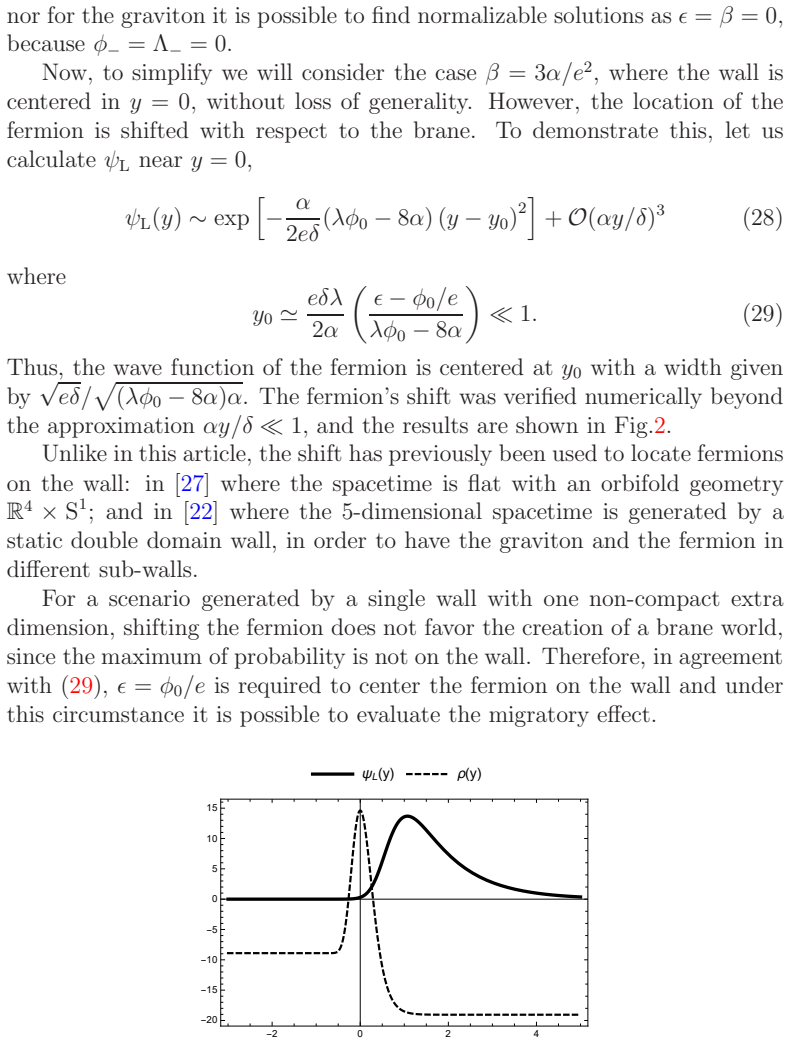
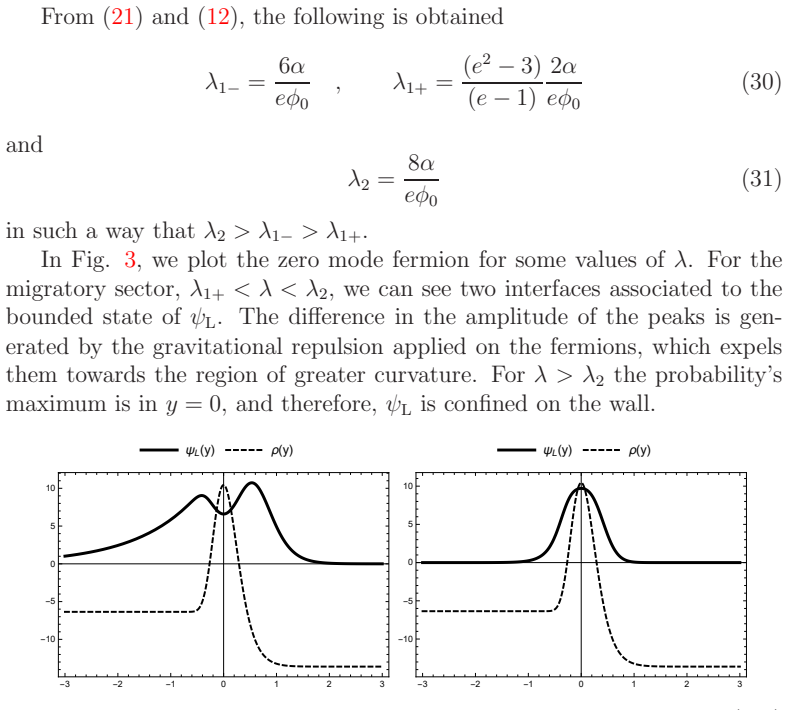
On the paper's own terms, the discovery is that the usual localization criterion for massless chiral fermions on thick branes is incomplete. The condition $\lambda>\lambda_1$, where $\lambda_1=2k/\phi_0$ comes from the asymptotic behaviour $\psi_L\sim e^{(2k-\lambda\phi_0)|y|}$, only guarantees that one chiral component is normalizable; it does not guarantee that the fermion sits on the wall. The paper shows that for $\lambda_1<\lambda<\lambda_2$, with $\lambda_2=2|A''(0)|/\phi'(0)$ obtained from a saddle-point evaluation of the normalization integral, the zero mode $\psi_L(y)=e^{-2A(y)-\lambda\int \phi\,dy}$ has two probability maxima on either side of the wall and a minimum at the wall. This migratory regime is computed explicitly for the symmetric wall solution of Section 3, where $\lambda_2=(\pi/2)\lambda_1$, and for the intrinsically asymmetric wall of Section 4 with $\beta=3\alpha/e^2$ and $\epsilon=\phi_0/e$, where $\lambda_2>\lambda_{1-}>\lambda_{1+}$; in the asymmetric case the two peaks have unequal amplitudes because gravitational repulsion pushes the fermion toward the side of larger curvature.
Load-bearing premise
The argument that the two-peak regime is independent of the wall's symmetry rests on the unverified assumption that the on-wall threshold always lies above the normalizability threshold for domain-wall solutions; only two particular walls are checked.
Editorial extensions
If this is right
- For the symmetric wall of Section 3, the explicit relation $\lambda_2=(\pi/2)\lambda_1$ means the double-peak regime occupies a nonempty interval of Yukawa couplings, so the phenomenon is not confined to a single tuned value.
- For the asymmetric wall of Section 4, the ordering $\lambda_2>\lambda_{1-}>\lambda_{1+}$ reproduces the same regime without reflection symmetry, with unequal peak amplitudes reflecting the different cosmological constants on the two sides.
- A practical criterion follows for brane models: a fermion is concentrated on the wall only for $\lambda>\lambda_2$, while $\lambda_1<\lambda<\lambda_2$ describes a normalizable fermion whose probability density is largest just off the wall.
- A fermion in the migratory window has a reduced overlap with fields strictly confined to the wall, which would change effective four-dimensional Yukawa and gauge couplings in brane-world constructions.
Reading between the lines
- If the ordering $\lambda_2>\lambda_1$ is generic, the two-peak window offers a mechanism for generating hierarchies in effective fermion couplings: changing $\lambda$ within the window moves probability density off the brane and smoothly suppresses overlap integrals without changing the fermion mass.
- The same two-threshold analysis can be applied to other soliton profiles, such as double walls, sine-Gordon type kinks, or higher-codimension branes; a concrete prediction is that the peak separation grows as $\lambda\to\lambda_1^+$ and disappears at $\lambda_2$.
- Since only two walls are computed, the symmetry-independence claim would be strengthened by a general argument showing that $\lambda_2>\lambda_1$ follows from the local data $|A''(0)|$, $\phi'(0)$, and the asymptotic values $k_\pm/|\phi_\pm|$ for all thick-brane solutions.
Signed reviews
Editorial analysis
A structured set of objections, weighed in public.
Referee Report
Summary. The paper studies massless chiral fermions coupled to scalar domain walls in five-dimensional asymptotically AdS spacetime. For a Yukawa coupling λ, the zero-mode profile is ψL ~ exp(-2A - λ∫φ). The authors define two thresholds: λ1, required for normalizability, and λ2, the threshold above which the profile's maximum lies on the wall. Their central claim is that for λ1 < λ < λ2 the fermion is normalizable but exhibits two probability maxima flanking the wall, a 'migratory regime'. They compute λ1 and λ2 explicitly for two backgrounds: the Z2-symmetric Gremm wall (Section 3) and an intrinsically asymmetric Castillo-Felisola wall with tuned parameters (Section 4), verifying λ2 > λ1 in both cases.
Significance. If the claims hold, the paper provides a clean, analytic example of a fermion localization profile that is normalizable yet peaked away from the brane center, arising from competition between the Yukawa attraction and gravitational repulsion. The explicit formulas for λ1 and λ2 are checkable, and the hierarchy λ2 > λ1 is demonstrated algebraically for the two presented solutions. The comparison of a symmetric and an asymmetric wall is a useful way to show that the double-peak effect is not intrinsically tied to Z2 symmetry. The main weakness is that the paper extrapolates from two examples to a general statement about domain walls without proving the required inequality for arbitrary backgrounds.
major comments (2)
- [Abstract and Section 5] The abstract states that the migration effect 'is independent of the Z2 symmetry of the wall', and Section 5 concludes that 'regardless of the scenario's symmetry, the migratory effect could be present'. This general claim is not established by the two worked examples. The existence of the interval λ1 < λ < λ2 is equivalent to the inequality λ2 > λ1, which the paper verifies only for the Gremm wall and the tuned Castillo-Felisola wall. For a generic domain wall, λ2 > λ1 is not guaranteed; using the relation A'' = -(1/3)φ'^2, the inequality can be recast as a condition on the central slope φ'(0) relative to k/|φ∞|. A sufficiently broad wall with small φ'(0) would violate it, making the migratory sector empty and every normalizable fermion peak on the wall. Please either provide a general argument that λ2 > λ1 holds under explicit assumptions or temper the claim to 'present in the symmetric and asymmetric walls considered here'.
- [Section 4] The text near Eq. (30) says 'For the migratory sector, λ1+ < λ < λ2', but because normalizability requires λ > λ1− and the paper has established λ1− > λ1+, the interval λ1+ < λ < λ1− is not normalizable. The correct migratory interval is λ1− < λ < λ2, i.e., λ1 < λ < λ2 with λ1 = max{λ1±}. This is a substantive error in the definition of the sector that the paper claims to plot, and it should be corrected.
minor comments (4)
- [Section 2, Eq. (11)] The phrase 'to preserve it as a real amount' is misleading: the integral of a positive function is real regardless of λ. The condition λ > λ2 is instead the condition for the saddle-point (Gaussian) approximation around y = 0 to be valid, i.e., for the second derivative of the exponent at y = 0 to be negative. Please rephrase.
- [Section 3] The notation φ0 is used inconsistently. In Eq. (10) φ0 denotes the asymptotic value of the scalar field, but in Eq. (14) φ0 is the amplitude multiplying arctan(sinh αy/δ), whose asymptotic value is πφ0/2. Please clarify the notation so the reader can match λ1 in Eq. (18) to the general formula in Eq. (10).
- [Section 4] The statement that the shift was 'verified numerically beyond the approximation' is not accompanied by any numerical method, parameters, or error estimate. Please either provide the numerical details or state that the plot in Fig. 2 is based on the analytic approximation plus the qualitative form of Eq. (27).
- [Section 3, Eq. (16)] There is a typographical issue in Eq. (16): 'arccoteαy/δ' should presumably be 'arccot(e^{αy/δ})' or similar. The appearance of polylogarithm terms in a supposedly real probability profile should also be checked or explained.
Circularity Check
No significant circularity: the migratory regime is derived algebraically from the Dirac equation and known background solutions, with no fitted parameter or self-referential definition.
full rationale
The paper's central claim is that a massless chiral fermion zero mode can be normalizable yet peaked away from the wall when the Yukawa coupling lies in λ1 < λ < λ2. The thresholds are derived, not assumed: λ1 follows from asymptotic normalizability of the analytical zero-mode profile ψL = e^{−2A − λ∫φ}, and λ2 follows from the sign of ψL''(0) via the saddle-point condition. In the symmetric Gremm wall the explicit formulas λ1 = 4α/(π√(3δ)) and λ2 = (π/2)λ1 give the required hierarchy; in the asymmetric Castillo-Felisola wall the specific parameter choice β = 3α/e^2, ε = φ0/e yields λ2 > λ1− > λ1+ and hence a nonempty migratory interval. These are concrete algebraic consequences of the cited background solutions, not quantities fitted to reproduce the double-peak profile. The self-citations to [4], [9], [21], and [22] are used for established background solutions and standard Yukawa localization setups, not to import the migratory effect itself. The paper's broader statement that the effect is 'independent of the Z2 symmetry of the wall' is supported only by two worked examples, so the generality of λ2 > λ1 for arbitrary walls is an extrapolation and a potential correctness limitation; however, that is not a circularity because no target result is folded into the assumptions and no equation reduces to an equivalent input. The derivation chain is self-contained: given the warping A(y), the scalar profile φ(y), and the Yukawa coupling, the zero-mode shape and the two thresholds are computed directly.
Assumptions & free parameters
free parameters (3)
- Yukawa constant λ =
λ1 < λ < λ2 (not fitted)
- Asymmetric wall parameter β/α =
3/e^2
- Asymmetric wall parameter ε/φ0 =
1/e
assumptions (3)
- standard math The Dirac equation in the curved background (2) separates as (7) with the mode profile (8).
- domain assumption The background domain-wall solutions (13)-(15) and (22)-(25) are exact solutions of the Einstein-Klein-Gordon system.
- domain assumption Fermions are test fields; their backreaction on the metric and scalar is neglected.
Cite this review
Pith. "Pith review of Massless fermions localization on domain walls." pith.science (2026). https://pith.science/paper/3OLBEWSU
@misc{pith2026190800915,
  author       = {Pith},
  title        = {Pith review of: Massless fermions localization on domain walls},
  year         = {2026},
  howpublished = {\url{https://pith.science/paper/3OLBEWSU}},
  note         = {Machine review of arXiv:1908.00915}
}
abstract
Massless fermions on scalar domain walls are considered. Two walls are established, corresponding to 5-dimensional static spacetime asymptotically Anti de-Sitter, differentiated by the symmetry around the wall, and in each case massless chiral fermions are coupled to the wall by a Yukawa term. We identify a normalizable state associated to the migration of fermions toward the edge of the wall. This effect is generated by the competition between the Yukawa interaction and the gravitational repulsion on the matter fields, and it is independent of the $Z_2$ symmetry of the wall.
Figures

Reference graph
Works this paper leans on
- [1]
- [2]
- [3]
- [4]
-
[5]
O. DeWolfe, D. Z. Freedman, S. S. Gubser, A. Karch, Phys. Rev . D, 62, 046008 (2000) 10
work page 2000
- [6]
- [7]
- [8]
Show all 27 references
-
[9]
Castillo-Felisola, A
O. Castillo-Felisola, A. Melfo, N. Pantoja, A. Ramirez, Phys. Rev. D, 70, 104029 (2004)
2004
-
[10]
Guerrero, R
R. Guerrero, R. Ortiz, R. O. Rodriguez and R. S. Torrealba, Ge n. Rel. Grav. 38, 845 (2006)
2006
-
[11]
Guerrero, R
R. Guerrero, R. O. Rodriguez, R. S. Torrealba, Phys. Rev. D, 72, 124012 (2005)
2005
-
[12]
Pantoja and A
N. Pantoja and A. Sanoja, J. Math. Phys. 46, 033509 (2005)
2005
-
[13]
V. A. Rubakov, M. E. Shaposhnikov, Phys. Lett. B, 125, 136 ( 1983)
1983
-
[14]
Arkani-Hamed and M
N. Arkani-Hamed and M. Schmaltz, Phys. Rev. D 61, 033005 (2000)
2000
-
[15]
Randjbar-Daemi and M
S. Randjbar-Daemi and M. E. Shaposhnikov, Phys. Lett. B 492, 361 (2000)
2000
-
[16]
S. L. Dubovsky, V. A. Rubakov and P. G. Tinyakov, Phys. Rev. D 62, 105011 (2000)
2000
-
[17]
Kehagias and K
A. Kehagias and K. Tamvakis, Phys. Lett. B 504, 38 (2001)
2001
-
[18]
B. Bajc, G. Gabadadze, Phys. Lett. B, 474, 282 (2000)
2000
-
[19]
Ringeval, P
C. Ringeval, P. Peter, J. P. Uzan, Phys. Rev. D, 65, 044016 (2 002)
-
[20]
Koley and S
R. Koley and S. Kar, Class. Quant. Grav., 22, 753 (2005)
2005
-
[21]
Melfo, N
A. Melfo, N. Pantoja, J. D. Tempo, Phys. Rev. D, 73, 044033 ( 2006)
2006
-
[22]
Guerrero, A
R. Guerrero, A. Melfo, N. Pantoja, R. O. Rodriguez, Phys. Re v. D, 74, 084025 (2006)
2006
-
[23]
Y. X. Liu, C. E. Fu, L. Zhao and Y. S. Duan, Phys. Rev. D 80, 065020 (2009) 11
2009
-
[24]
Y. X. Liu, Z. H. Zhao, S. W. Wei and Y. S. Duan, JCAP 0902, 003 (2009)
2009
-
[25]
Y. X. Liu, J. Yang, Z. H. Zhao, C. E. Fu and Y. S. Duan, Phys. Re v. D 80, 065019 (2009)
2009
-
[26]
Bazeia, A
D. Bazeia, A. Mohammadi and D. C. Moreira, Chin. Phys. C 43, no. 1, 013101 (2019)
2019
-
[27]
G. A. Palma, Phys. Rev. D 73, 045023 (2006) 12
2006
Reviewed August 14, 2026 · model on record in the stance chip above.
Discussion (0). Continue with ORCID to comment.