REVIEW 4 major objections 4 minor 4 references
Quantifying Exchange Forces of a Non-Collinear Magnetic Structure on the Atomic Scale
T0 review · 4 major / 4 minor · reviewed 2026-08-14 · deepseek-v4-flash
Pith's one-line read On a cycloidal Mn spin spiral, the atomic-scale magnetic exchange force field measured with a combined force-and-current probe is more sensitive to local magnetization than the spin-polarized tunneling current.
desk verdict Solid experimental extension of SPEX to a chiral spin spiral; the exchange-force extraction rests on a plausible but unverified cancellation assumption. read the letter →
The pith
A machine-rendered reading of the paper's core claim, the machinery that carries it, and where it could break.
The reading
What carries the argument
The central object is the frequency-shift difference $\Delta f_{\mathrm{ex},i}$ recorded at two crystallographically equivalent sites ($t_i$ and $t'_i$) in each magnetic unit cell at constant height; because the Mn layer is planar and chemical forces are assumed identical at these sites, this difference isolates the magnetic exchange interaction. The paper combines this with simultaneous current detection (SPEX) and distance-dependent MExFIS spectroscopy, converts $\Delta f_{\mathrm{ex}}$ into exchange forces $F_{\mathrm{ex}}$ using a standard frequency-shift-to-force inversion, and compares the result against DFT supercell calculations that define the exchange energy as $E_{\mathrm{ex}} = E_{\mathrm{ap}} - E_{\mathrm{p}}$.
What would settle it
Apply the same constant-height SPEX protocol to a non-magnetic monolayer with the same lattice structure on W(110): if the frequency-shift difference between $t_i$ and $t'_i$ does not vanish, the $\Delta f_{\mathrm{ex}}$ channel is contaminated by non-magnetic interactions, and the quoted exchange forces would not be purely magnetic.
Extended reading notes
Core claim
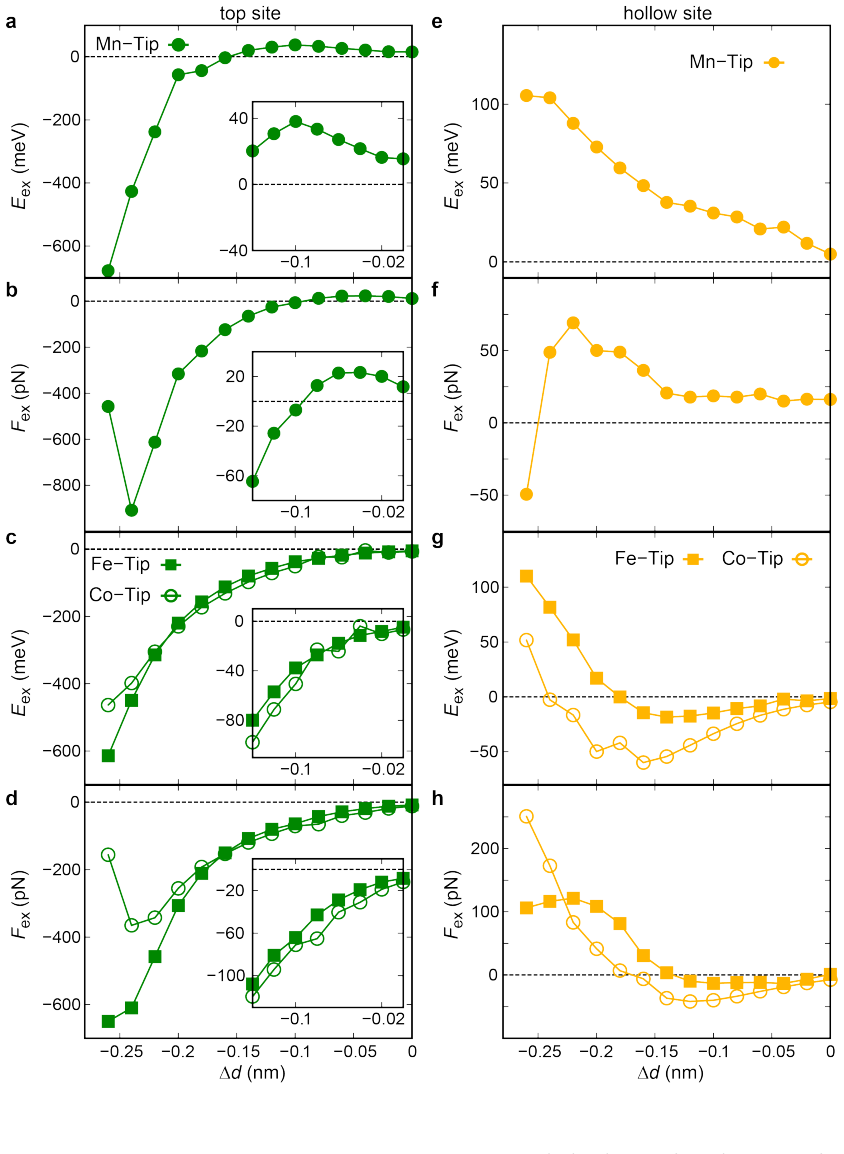
On a single Mn layer on W(110), the frequency-shift difference between two crystallographically equivalent atomic sites within the c(2 x 2) magnetic unit cell, namely $\Delta f_{\mathrm{ex},i} = \Delta f_i - \Delta f'_i$, traces the out-of-plane component of the cycloidal spin spiral, reaching exchange forces up to 40 pN. The exchange force field varies between top and hollow sites and with tip-sample distance, indicating that different exchange mechanisms dominate at different atomic positions, while the spin polarization of the tunneling current stays small and site-independent. First-principles calculations reproduce the site- and distance-dependent exchange forces when the tip apex is manganese-terminated, and attribute the observed behavior to a competition between short-range antiferromagnetic direct d-d exchange and longer-range ferromagnetic Zener-type exchange mediated by s electrons.
Load-bearing premise
The extraction of the exchange force rests on the assumption that the chemical (non-magnetic) force is identical at the two sites $t_i$ and $t'_i$, so that only magnetic exchange contributes to the measured frequency-shift difference.
Editorial extensions
If this is right
- The exchange force channel resolves the atomic lattice in both surface directions within the magnetic unit cell, where the constant-height current resolves only one direction.
- The exchange force field at top and hollow sites shows distinct distance dependences, revealing that different exchange mechanisms (direct d-d versus indirect Zener-type) dominate at different sites.
- Along the spin spiral, both the exchange force magnitude and the current asymmetry decay gradually from the parallel to the perpendicular magnetic alignment, tracking the out-of-plane magnetization component.
- The weak spin polarization of the tunneling current is explained by the dominance of weakly spin-polarized pz states at the Fermi energy, a consequence of the large exchange splitting of Mn d-bands.
Reading between the lines
- If exchange forces are systematically more sensitive than tunneling current to local magnetization, force-based detection could characterize antiferromagnetic or chiral textures even on samples where spin-polarized STM contrast vanishes, including insulating magnets.
- Since DFT predicts distinct distance-dependent force curves for Fe-, Co-, and Mn-terminated tips, site- and distance-resolved exchange force measurements might serve as a fingerprint of the tip apex chemistry.
- The same SPEX/MExFIS protocol could be extended to measure anisotropic (Dzyaloshinskii–Moriya) exchange forces by probing along different crystallographic directions, potentially quantifying spin-orbit contributions to the force field.
Signed reviews
Editorial analysis
A structured set of objections, weighed in public.
Referee Report
Summary. The manuscript reports combined scanning tunneling and atomic force microscopy (SPEX) measurements on a Mn monolayer on W(110) exhibiting a cycloidal spin spiral. From constant-height images, the authors extract a site-resolved frequency-shift difference Δfex,i = Δfi - Δf'i between crystallographically equivalent top and hollow sites, assign it to magnetic exchange, and convert it to exchange forces Fex,i(z) as a function of tip-sample distance. They compare these forces with the spin-polarized current asymmetry Ai(z) and conclude that the exchange force field is more sensitive to atomic-scale magnetization variations than the tunneling current, particularly at top versus hollow sites and along the spin spiral. Density functional theory calculations for Fe-, Co-, and Mn-terminated tips are used to reproduce the site- and distance-dependent exchange forces; only the Mn-terminated tip gives qualitative agreement, which the authors interpret as evidence for a crossover between direct antiferromagnetic and Zener-type ferromagnetic exchange. The weak spin polarization of the tunneling current is explained by the dominance of low-spin-polarized pz states near the Fermi energy.
Significance. If the central claim holds, this would be the first quantitative atomic-scale exchange force field measurement on a chiral spin spiral and would establish a force-based route complementary to spin-polarized current methods for studying chiral magnetic structures. The experimental work has notable strengths: the measurements use careful constant-height imaging with simultaneous current and frequency-shift detection, the raw Δfex and IT quantities are reported with explicit error margins, and data affected by tip magnetization changes are identified and excluded. The DFT calculations are genuinely first-principles and the comparison across three tip terminations is systematic, though the theory-experiment match ultimately depends on an assumed apex termination. The significance of the result, if confirmed, is high for the MExFM and spintronics communities.
major comments (4)
- [Section 4, p. 6] The central quantity Δfex,i = Δfi - Δf'i is interpreted as the magnetic exchange contribution only because the two sites ti and t'i are assumed to have identical chemical forces. The manuscript argues that the Mn layer is planar and therefore chemical contrast is identical, but this is not independently verified. A non-collinear spin spiral with DMI could in principle induce site-dependent magnetoelastic displacements or electronic reorganizations that break the chemical equivalence even in a nominally planar layer, and the DFT calculations use a collinear c(2x2) antiferromagnetic cell, so they cannot capture such spiral-induced symmetry breaking. This assumption is load-bearing for all quantitative exchange-force magnitudes, including the reported 40 pN values. Please provide a concrete test of chemical equivalence (for example, a non-magnetic reference measurement, a z-dependent chemical contrast analysis, or a non-collinear calculation of the chemical force), or explicitly rephrase the results as exchange-force differences under an unverified equivalence assumption.
- [Section 4, p. 8-9] The data for i = 7 to i = 14 were excluded because of a spontaneous change of the tip magnetization during acquisition. Consequently, the claim that the exchange force varies monotonically across the spin spiral is supported only by the half-period i = 1 to i = 7, and the full-period behavior was not experimentally demonstrated. The manuscript acknowledges this exclusion in the text, but the abstract and discussion nevertheless state a general sensitivity to atomic-scale magnetization variations along the spiral. Please state explicitly in the abstract or conclusions that the full-period dependence was not obtained, and temper the claim to the measured half-period.
- [Section 4, Figure 2] The reported exchange forces Fex,i(Δz) are derived from Δfex,i using the Sader-Jarvis inversion, but no uncertainty is propagated to the force values. The manuscript gives ±0.2 Hz for Δfex and ±3% for IT, yet the central 'exchange force is more sensitive than the current' conclusion is based on comparisons of Fex and A without error bars on Fex. Please propagate the Δfex uncertainty through the force inversion, or provide a sensitivity analysis showing that the stated uncertainties translate into a force uncertainty small enough to support the site-dependent and distance-dependent claims.
- [Section 5, p. 9-11] The agreement between experiment and DFT is established only after choosing a Mn-terminated tip and a distance offset Δd = 0.0 nm ↔ Δz = -0.16 nm. The manuscript states that Fe- and Co-terminated tips cannot explain the observations, but the experimental tip is not chemically characterized at the atomic scale, so the Mn-terminated assignment is selected by qualitative agreement rather than independently determined. This makes the claim that first-principles calculations 'reveal' the exchange mechanisms contingent on an untested assumption about the tip apex. Please present the tip-termination dependence as a model-dependent interpretation rather than a confirmed identification, or provide independent evidence for the Mn termination, for example from the measured total-force magnitude or from adsorption experiments.
minor comments (4)
- [Methods, p. 15] There is a typo in the sentence about the symmetric slab: 'modelled using by a symmetric slab' should be 'modelled using a symmetric slab'.
- [Figure 4 caption] The caption is inconsistent with the panel labels: it says 'Mn-terminated (a, c) tips' but panels (a) and (c) are both top-site results, while the hollow-site results appear in (e) and (g). Please correct the caption so that each tip termination is assigned to the correct panel.
- [Section 5, p. 9] The DFT model approximates the spin spiral as a collinear c(2x2) antiferromagnetic order. This is a practical approximation, but its effect on the calculated exchange forces, especially for the hollow sites where multiple neighbors contribute, should be stated more prominently as a limitation.
- [Supplementary Note 2] The discussion of the surface tilt and its influence on Δfex is mentioned in the main text, but the resulting uncertainty on the absolute distance scale is not quantified in the main text. A brief quantitative statement would help the reader assess the robustness of the distance-dependent comparison with DFT.
Assumptions & free parameters
free parameters (2)
- Theory-experiment distance offset =
-0.16 nm
- Tip apex termination =
Mn (Fe and Co also considered)
assumptions (3)
- domain assumption Chemical forces are identical at crystallographically equivalent sites ti and t'i, so the frequency-shift difference is purely magnetic exchange.
- domain assumption The Mn/W(110) spin spiral can be approximated as a collinear antiferromagnetic structure in the DFT supercell.
- domain assumption The Tersoff-Hamann model applies for comparing the measured current asymmetry A(Δz) to the spin polarization of the vacuum LDOS.
Cite this review
Pith. "Pith review of Quantifying Exchange Forces of a Non-Collinear Magnetic Structure on the Atomic Scale." pith.science (2026). https://pith.science/paper/TAMIAWBT
@misc{pith2026190800959,
  author       = {Pith},
  title        = {Pith review of: Quantifying Exchange Forces of a Non-Collinear Magnetic Structure on the Atomic Scale},
  year         = {2026},
  howpublished = {\url{https://pith.science/paper/TAMIAWBT}},
  note         = {Machine review of arXiv:1908.00959}
}
read the original abstract
The large interest in chiral magnetic structures for realization of nanoscale magnetic storage or logic devices has necessitated methods which can quantify magnetic interactions at the atomic scale. To overcome the limitations of the typically used current-based sensing of atomic-scale exchange interactions, a force-based detection scheme is highly advantageous. Here, we quantify the atomic-scale exchange force field between a ferromagnetic tip and a cycloidal spin spiral using our developed combination of current and exchange force detection. Compared to the surprisingly weak spin polarization, the exchange force field is more sensitive to atomic-scale variations in the magnetization. First-principles calculations reveal that the measured atomic-scale variations in the exchange force originate from different contributions of direct and indirect (Zener) type exchange mechanisms, depending on the chemical tip termination. Our work opens the perspective of quantifying different exchange mechanisms of chiral magnetic structures with atomic-scale precision using 3D magnetic exchange force field measurements.
Figures

Reference graph
Works this paper leans on
-
[10]
Tuning the Exchange Bias on a Single Atom from 1 mT to 10 T
Yang K., et al. Tuning the Exchange Bias on a Single Atom from 1 mT to 10 T. Phys. Rev. Lett. 122, 227203 (2019), doi: 10.1103/PhysRevLett.122.227203. 11. Baumann S., Paul W., Choi T., Lutz C.P., Ardavan A., Heinrich A.J. Electron paramagnetic resonance of individual atoms on a surface. Science 350, 417-420, (2015), doi: 10.1126/science.aac8703. 12. Meier...
arXiv 2019
-
[26]
Spin Resolution and Evidence for Superexchange on NiO(001) Observed by Force Microscopy
Pielmeier F., Giessibl F.J. Spin Resolution and Evidence for Superexchange on NiO(001) Observed by Force Microscopy. Phys. Rev. Lett. 110, 266101, (2013), doi: 10.1103/PhysRevLett.110.266101. 27. Hauptmann N., Gerritsen J., Wegner D., Khajetoorians A.A. Sensing Noncollinear Magnetism at the Atomic Scale Combining Magnetic Exchange and Spin-Polarized Imagi...
-
[41]
Theory of the scanning tunneling microscope
Tersoff J., Hamann D.R. Theory of the scanning tunneling microscope. Phys. Rev. B 31, 805-813, (1985), doi: 10.1103/PhysRevB.31.805. 42. Tersoff J., Hamann D.R. Theory and Application for the Scanning Tunneling Microscope. Phys. Rev. Lett. 50, 1998-2001, (1983), doi: 10.1103/PhysRevLett.50.1998. 43. Néel N., Ferriani P., Ziegler M., Heinze S., Kröger J., ...
-
[57]
Feynman R.P. Forces in Molecules. Phys. Rev. 56, 340-343, (1939), doi: 10.1103/PhysRev.56.340. Figure 1: Atomic-resolution SPEX imaging of the Mn spin spiral. (a) Sketches of the antiferromagnetic c(2 x 2) unit cell which locally approximates the spin spiral. The extracted lattice constants from the experiment (Δx1 and Δx2), the tip-Mn distance d, the dif...
Reviewed August 14, 2026 · model on record in the stance chip above.
Discussion (0). Continue with ORCID to comment.