REVIEW 1 major objections 6 minor 11 cited by
Consistent Calibration of the Tip of the Red Giant Branch in the Large Magellanic Cloud on the Hubble Space Telescope Photometric System and a Re-determination of the Hubble Constant
T0 review · 1 major / 6 minor · reviewed 2026-08-14 · deepseek-v4-flash
Pith's one-line read The TRGB distance-ladder anchor in the LMC is miscalibrated by mixed ground photometry; correcting it yields H0 = 72.4 km/s/Mpc.
desk verdict A careful empirical recalibration that moves TRGB-based H0 closer to the Cepheid-SNIa value; the main vulnerability is an unverifiable assumption about Freedman et al.'s SMC photometry, but an independent check in the paper largely mitigates it. read the letter →
The pith
A machine-rendered reading of the paper's core claim, the machinery that carries it, and where it could break.
The reading
What carries the argument
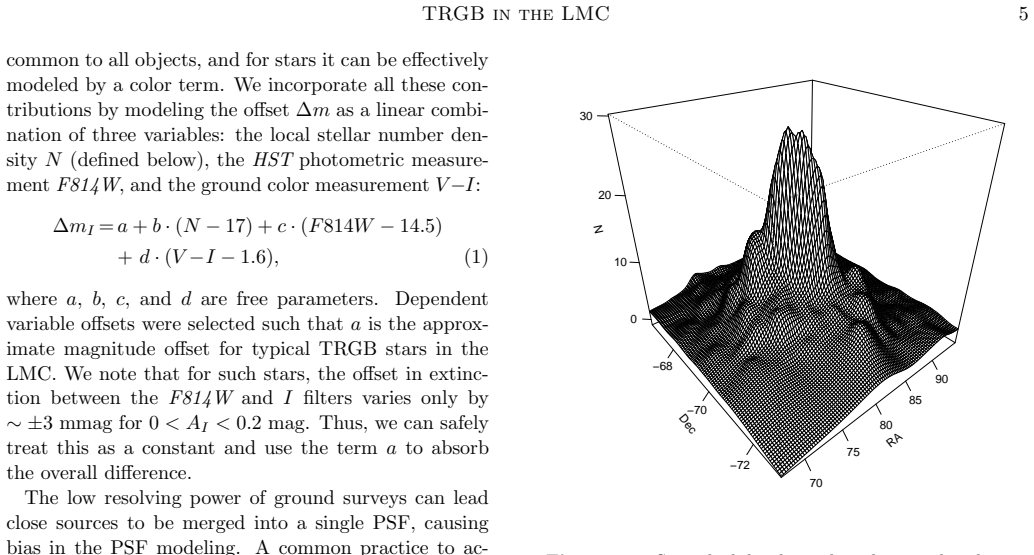
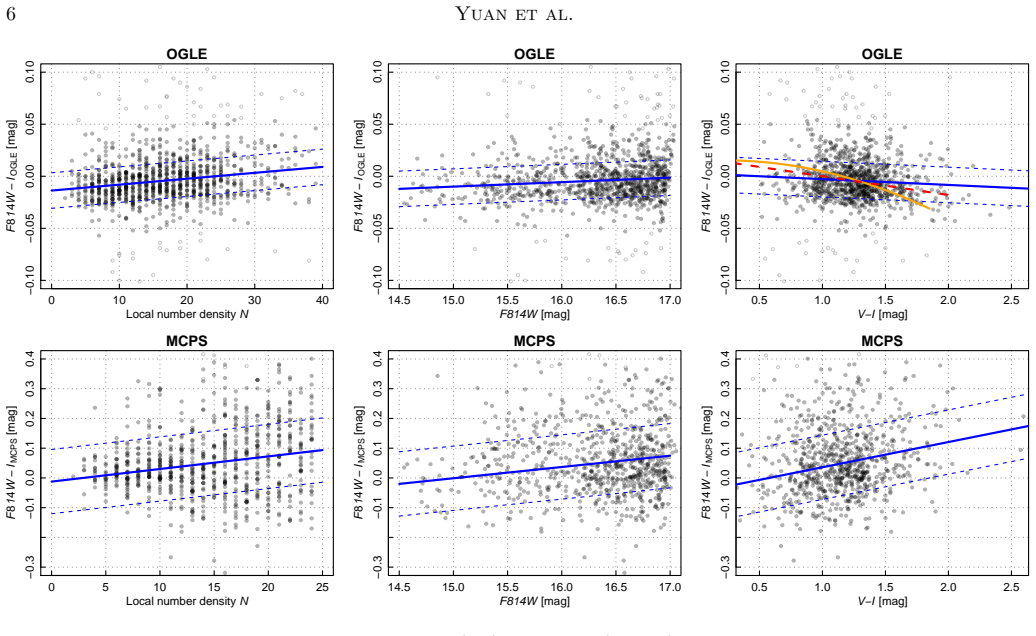
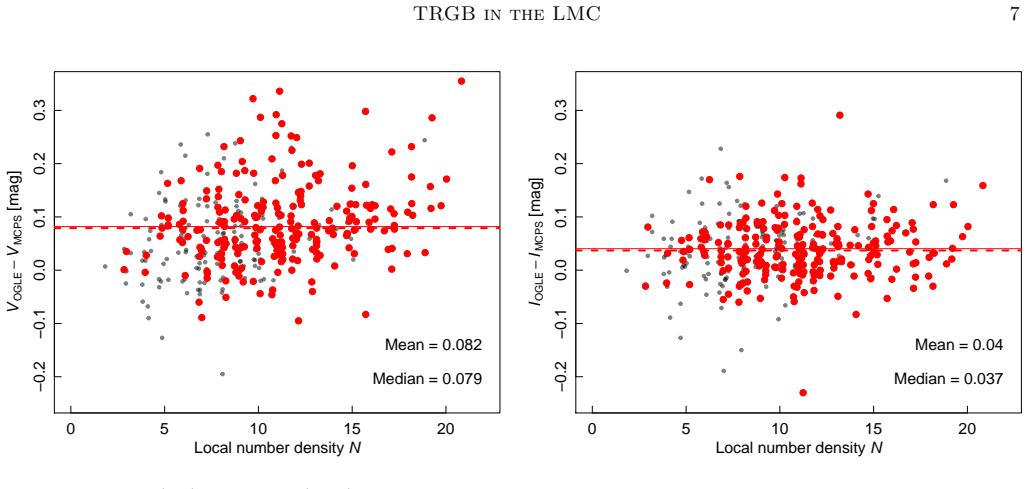
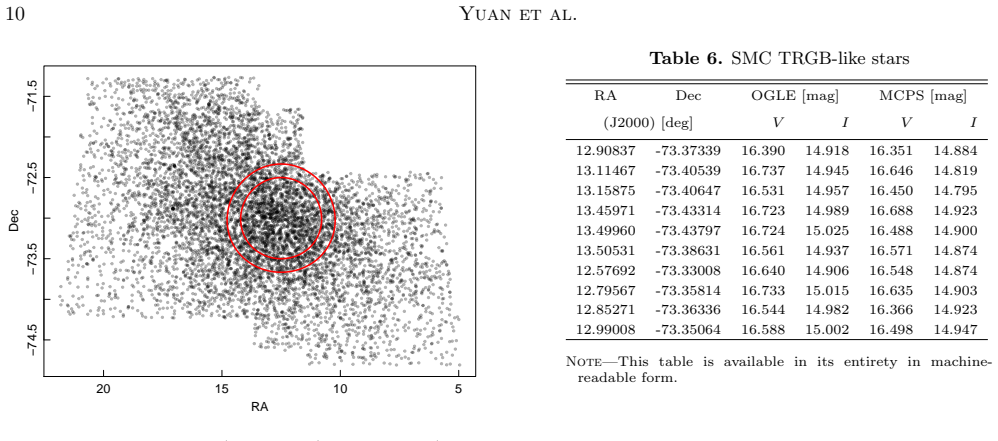
The load-bearing device is an empirical linear offset model: $\Delta$ m = a + b(N - 17) + c(F814W - 14.5) + d(V - I - 1.6), fitted to about 1,200 OGLE and 1,000 MCPS stars matched between ground catalogs and archival HST ACS images. N is the local stellar density within 20 arcsec; the density term captures blending, while the magnitude and color terms capture filter-response differences. The same matched-star machinery produces the OGLE-minus-MCPS offsets in the SMC (about 0.08 mag in V and 0.04 mag in I near the center) that drive the extinction correction and the new Hubble constant.
What would settle it
Publish the exact star list from the earlier TRGB extinction fit and recompute the OGLE-minus-MCPS V and I offsets for exactly those SMC stars. If the offsets are not roughly 0.08 and 0.04 mag, the inferred LMC extinction shift of 0.06 mag and the resulting H0 = 72.4 would change.
Extended reading notes
Core claim
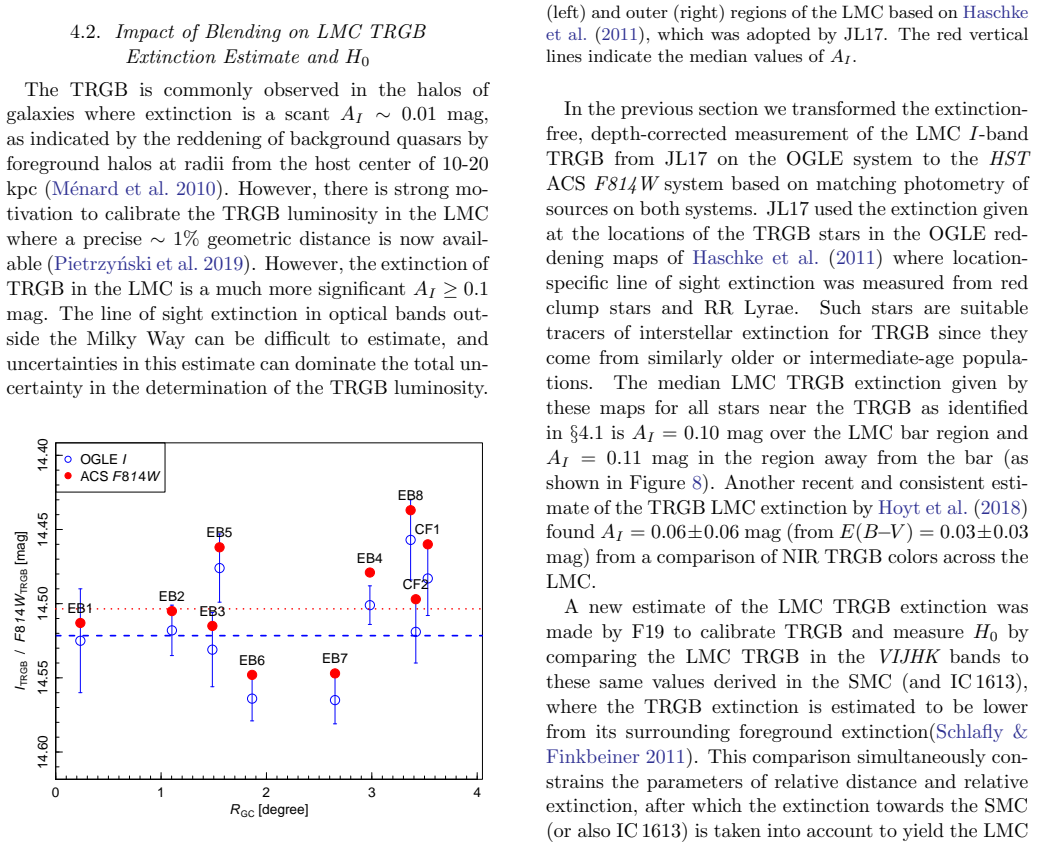
The paper's central claim is that the previously published TRGB calibration of the LMC was biased bright by about 0.06 mag of extinction because the SMC comparison photometry came from a different ground system than the LMC photometry. Using OGLE photometry for both Clouds removes the inconsistency and yields A_I(LMC) = 0.10 mag, consistent with independent reddening maps. The authors transform the corrected LMC TRGB from the OGLE I band to the HST ACS F814W system via an empirical offset, obtaining M_F814W = -3.97 +/- 0.046 mag, and show that the Freedman et al. (2019) TRGB+SN Ia ladder then yields H0 = 72.4 +/- 2.0 km/s/Mpc.
Load-bearing premise
The paper assumes that the SMC region used in the comparison it criticizes is the same region where it measured the OGLE-minus-MCPS offsets; the original star list has never been published, so the offsets could be different for the stars actually used.
Editorial extensions
If this is right
- If the TRGB anchor is -3.97 on ACS F814W, the TRGB distance ladder with SNe Ia gives H0 = 72.4, bringing it into agreement with the Cepheid distance ladder.
- The MCPS catalog should not be used for precision TRGB work in the Magellanic Clouds; future calibrations should use OGLE or space-based photometry.
- Consistent photometry between the Clouds lowers the inferred LMC TRGB extinction to A_I = 0.10 mag, matching red clump reddening maps.
- The filter transformation from OGLE I to ACS F814W is -0.023 mag for TRGB stars, a non-negligible correction at current precision.
- The empirical color relation F555W - F814W = 1.082(V - I) provides a tool for future color-dependent TRGB calibrations.
Reading between the lines
- If the exact star list from the earlier SMC extinction comparison becomes available, the OGLE-minus-MCPS offsets can be recomputed on that list, directly confirming or revising the 0.06 mag extinction shift.
- The same density-dependent blending correction could be applied to other ground surveys, such as near-infrared surveys of the Magellanic Clouds, to test whether NIR TRGB anchors need similar corrections.
- A Gaia-based parallax calibration of halo TRGB stars, where extinction is tiny, would provide an independent check of the -3.97 mag anchor.
- If the higher H0 value stands, the TRGB and Cepheid ladders agree, suggesting that the earlier TRGB extinction treatment carried the systematic error rather than new physics being required.
Editorial analysis
A structured set of objections, weighed in public.
Referee Report
Summary. The paper calibrates the LMC TRGB on the HST/ACS F814W system by comparing archival ACS F555W/F814W photometry in 12 LMC fields with OGLE-III and MCPS ground catalogs. It models the ground-to-HST offset as a linear function of local density, F814W magnitude, and V-I color (Eq. 1), finds that MCPS photometry is biased bright by up to ~0.1 mag and OGLE by ~0.01 mag, and applies the OGLE-based correction to the ten JL17 LMC TRGB fields. Combining with the Pietrzynski et al. (2019) distance gives M_F814W = -3.97 +/- 0.046 mag. In Section 4.2, it revises the F19 LMC extinction from A_I = 0.16 to 0.10 mag by applying OGLE-minus-MCPS offsets to the SMC TRGB photometry, and then claims H0 = 72.4 +/- 2.0 km/s/Mpc for the F19 TRGB+SN Ia ladder, which is 3.7% above F19's value.
Significance. If the calibration holds, the paper provides a valuable empirical cross-instrument correction and moves the TRGB-based Hubble constant closer to the Cepheid-based value, which is relevant to the current H0 tension. Notable strengths are the direct use of archival HST data, the density-dependent blending model, the explicit tests of cuts and clipping, the machine-readable photometry tables, and the independent OGLE-only cross-check using DEB relative distances. The central caveat is that the headline H0 shift depends on an identification of F19's SMC sample that the paper itself states is not directly provided; this makes the main numerical claim conditional on an external, unverifiable input.
major comments (1)
- [§4.2, Fig. 10, Table 4] The revision of A_I(LMC) from 0.16 to 0.10 mag, and hence the 3.7% increase in H0, rests on the assertion that F19 measured the SMC TRGB with MCPS photometry near the SMC center and the LMC TRGB with OGLE away from the bar; this is supported only by a private communication from Madore, and the paper itself notes that F19's star list has not been provided. The offsets applied (Delta-V ~ 0.07-0.08 and Delta-I ~ 0.04 mag) are averages over r < 30' and r < 40' circular regions around the SMC center, computed for all TRGB-like stars, not necessarily for the exact magnitude/color/spatial selection used by F19. Since the extinction solution is most sensitive to V, a 0.02 mag error in the assumed offset corresponds to roughly 1% in H0, comparable to the quoted 2.0 km/s/Mpc uncertainty. To make the central result robust, the authors need to obtain F19's actual SMC star list, or quantify how the inferred A_I(LMC) changes for plausible alternative selections (e.g., smaller radii, off-center fields, different color cuts). The independent OGLE-only estimate in Section 4.2 supports a low A_I(LMC), but it does not verify the offset applied to F19's specific SMC photometry.
minor comments (6)
- [Figure 5 caption] The caption contains a typo: 'I-bang' should read 'I-band'.
- [Section 5] The sentence 'For OGLE V and ACS F555W the the offset is strongly color-dependent' contains a duplicated 'the'.
- [Table 3] The note that coefficient values are multiplied by 1000 should appear in the table caption rather than in the surrounding text, to prevent readers from misreading the model coefficients.
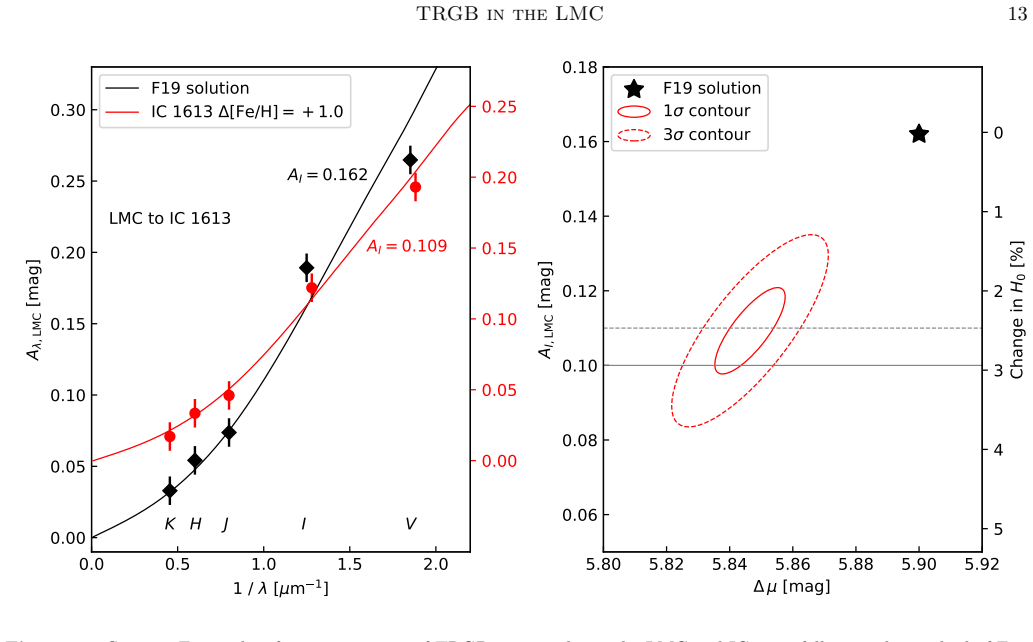
- [§4.3 and Fig. 11] The metallicity-corrected LMC-IC1613 comparison is explicitly labeled 'naive' and 'illustrative' and is not used in the final H0; moving it to an appendix or describing it solely as a consistency check would make it clearer that the main result does not depend on it.
- [Section 4.2] The paper should clarify how the quoted error of +/- 2.0 km/s/Mpc on H0 is formed, namely whether it is taken from F19 unchanged or includes the new 0.046 mag zero-point uncertainty of the LMC TRGB calibration.
- [Figure 10, right panel] The x-axis label of the right panel is not visible in the text; please add a label, since the text implies it is the relative distance modulus between the Clouds.
Circularity Check
No circularity: the calibration is anchored to independent HST photometry, external TRGB detections, and geometric distances.
full rationale
The derivation chain is self-contained against external data. The ground-to-HST correction (Eq. 1) is fitted to per-star photometric differences between archival ACS F814W/F555W observations and OGLE/MCPS catalogs over 14.5<I<17 mag; it is not fitted to the JL17 TRGB magnitude itself, and the final F814W TRGB is obtained by adding the predicted mean correction to the externally measured JL17 TRGB values. The LMC anchor uses the geometric distance of Pietrzynski et al. (2019), and the F19 host TRGB magnitudes are used as independent apparent measurements, so the H0=72.4 result is not equivalent to any fitted parameter. The largest assumption, that F19's SMC photometry corresponds to the central MCPS region based on a private communication from Madore (Sec. 4.2), is an unverifiable external-validity concern rather than a circular reduction; the paper itself discloses that F19's star list was not provided. No self-citation carries the argument, and no equation defines its output in terms of its target.
Assumptions & free parameters
free parameters (4)
- OGLE I-band ground-to-HST offset a_I =
-0.014 +/- 0.003 mag
- OGLE I-band density slope b_I =
(0.57 +/- 0.08) x 10^-3 per star
- OGLE I-band magnitude slope c_I =
(4.3 +/- 1.1) x 10^-3 per mag
- OGLE I-band color slope d_I =
(-5.6 +/- 2.2) x 10^-3 per mag
assumptions (5)
- domain assumption The I-band TRGB is a stable standard candle across the metallicity and star formation histories spanned by the LMC, SMC, IC 1613, and SN Ia hosts.
- ad hoc to paper The ground-to-HST photometric offset is exactly described by a linear function of local number density, F814W magnitude, and V-I color, and this model extrapolates to the TRGB edge.
- domain assumption Haschke et al. (2011) OGLE reddening maps correctly trace the line-of-sight extinction for TRGB stars in the LMC fields.
- ad hoc to paper The SMC OGLE-MCPS photometric offsets measured over r < 30' and r < 40' circles represent the offset in F19's actual SMC TRGB sample.
- ad hoc to paper The OGLE density sample with I < 18 mag and a 20'' counting radius traces the local stellar density relevant to blending.
Cite this review
Pith. "Pith review of Consistent Calibration of the Tip of the Red Giant Branch in the Large Magellanic Cloud on the Hubble Space Telescope Photometric System and a Re-determination of the Hubble Constant." pith.science (2026). https://pith.science/paper/YDE634AN
@misc{pith2026190800993,
  author       = {Pith},
  title        = {Pith review of: Consistent Calibration of the Tip of the Red Giant Branch in the Large Magellanic Cloud on the Hubble Space Telescope Photometric System and a Re-determination of the Hubble Constant},
  year         = {2026},
  howpublished = {\url{https://pith.science/paper/YDE634AN}},
  note         = {Machine review of arXiv:1908.00993}
}
read the original abstract
We present a calibration of the Tip of the Red Giant Branch (TRGB) in the Large Magellanic Cloud (LMC) on the HST/ACS F814W system. We use archival HST observations to derive blending corrections and photometric transformations for two ground-based wide-area imaging surveys of the Magellanic Clouds. We show that these surveys are biased bright by up to ~0.1 mag in the optical due to blending, and that the bias is a function of local stellar density. We correct the LMC TRGB magnitudes from Jang & Lee (2017) and use the geometric distance from Pietrzynski et al. (2019) to obtain an absolute TRGB magnitude of M_F814W=-3.97+/-0.046 mag. Applying this calibration to the TRGB magnitudes from Freedman et al. (2019) in SN Ia hosts yields a value for the Hubble constant of H_0=72.4+/-2.0 km/s/Mpc for their TRGB+SNe Ia distance ladder. The difference in the TRGB calibration and the value of H_0 derived here and by Freedman et al. (2019) primarily results from their overestimate of the LMC extinction, caused by inconsistencies in their different sources of TRGB photometry for the Magellanic Clouds. Using the same source of photometry (OGLE) for both Clouds and applying the aforementioned corrections yields a value for the LMC I-band TRGB extinction that is lower by 0.06 mag, consistent with independent OGLE reddening maps used by us and by Jang & Lee (2017) to calibrate TRGB and determine H_0.
Figures


Figures from the paper (8 more)



Forward citations
Cited by 11 Pith papers
-
Hubble Space Telescope Observations of Mira Variables in the Type Ia Supernova Host NGC 1559: An Alternative Candle to Measure the Hubble Constant
The first Mira-variable-based calibration of a Type Ia supernova yields a distance to NGC 1559 and a Hubble constant of about 73 km/s/Mpc, consistent with Cepheid-based values.
-
Oscillating scalar fields and the Hubble tension: a resolution with novel signatures
A subdominant oscillating scalar field with about 10% energy density at redshift 3500 and a potential ∝ φ^{2n} (n≈3) can resolve the Hubble tension, with CMB-S4-detectable polarization signatures and self-resonance for n≈2.
-
Gravitational waves, CMB polarization, and the Hubble tension
The B-mode recombination peak, tied to the light horizon at last scattering, can act as an independent early-universe standard ruler, measurable to about 2% with stage-IV CMB experiments.
-
An Improved Distance to NGC 4258 and its Implications for the Hubble Constant
Improved maser-based geometric distance to NGC 4258 (7.576 +/- 0.112 Mpc total error) yields H0 = 73.5 +/- 1.4 km/s/Mpc when combined with other anchors, maintaining a roughly 4.2 sigma tension with Planck.
-
The Hubble constant tension with next-generation galaxy surveys
Forecast: Euclid-like and SKA-like BAO surveys, combined with Gaussian-process regression, could measure H0 to about 1% precision and discriminate between Planck and Riess values at roughly 5 sigma.
-
Analytic Calculation of Covariance between Cosmological Parameters from Correlated Data Sets, with an Application to SPTpol
An analytic Fisher-based formula computes the covariance between parameters from two correlated data sets; applied to SPTpol TE and EE spectra, it shows the constraints are weakly positively correlated and that ignori...
-
Dark Neutrino interactions phase out the Hubble tension
Dark matter-neutrino interactions that block neutrino free streaming shift CMB acoustic peaks and reduce the Hubble tension from about 3.8σ to about 2.1σ in a fit to Planck and WiggleZ data.
-
Resolving Hubble Tension with Quintom Dark Energy Model
A small negative-density component with equation of state 1/3≤w≤1 can lift H0 from 67.4 to about 74, but the coupled quintom model realizing it either misses the CMB peak or gives H0=68.55.
-
Late Time Dynamical Dark Energy and the CMB-Distance Ladder Tension
The SNIa absolute-magnitude tension between the distance ladder (−19.204) and CMB+ΛCDM (−19.430) is independent of late-time expansion history, and DESI's w0–wa dark-energy hints shift H0 by only ~0.3–0.4 km/s/Mpc.
-
Quasar X-ray and UV flux, baryon acoustic oscillation, and Hubble parameter measurement constraints on cosmological model parameters
Quasar X-ray and UV flux data are weak but consistent with BAO and H(z) data, and the joint data mildly favor closed spatial geometry and dynamical dark energy over flat LambdaCDM.
-
Cosmology With Low-Redshift Observations: No Signal For New Physics
Combining SN, BAO, lensing, cosmic chronometer, and growth data, the authors find ΛCDM remains the best dark energy model, with H0 and S8 consistent with most early and late universe probes within 2σ.
Reference graph
Works this paper leans on
-
[1]
, " * write output.state after.block = add.period write newline
ENTRY address archivePrefix author booktitle chapter doi edition editor eprint howpublished institution journal key month number organization pages publisher school series title misctitle type volume year version url label extra.label sort.label short.list INTEGERS output.state before.all mid.sentence after.sentence after.block FUNCTION init.state.consts ...
-
[2]
write newline
" write newline "" before.all 'output.state := FUNCTION format.url url empty "" new.block "" url * "" * if FUNCTION format.eprint eprint empty "" archivePrefix empty "" archivePrefix "arXiv" = new.block " " eprint * " " * new.block " " eprint * " " * if if if FUNCTION format.doi doi empty "" " " doi * " " * if FUNCTION format.pid doi empty eprint empty ""...
-
[3]
7JkՊR[ s =! č l*8 T n6ຸV#
thebibliography [1] 20pt to REFERENCES 6pt =0pt 10pt plus 3pt =0pt =0pt =1pt plus 1pt =0pt =0pt -12pt =13pt plus 1pt =20pt =13pt plus 1pt \@M =10000 =-1.0em =0pt =0pt 0pt =0pt =1.0em @enumiv\@empty 10000 10000 `\.\@m \@noitemerr \@latex@warning Empty `thebibliography' environment \@ifnextchar \@reference \@latexerr Missing key on reference command Each re...
2017
-
[4]
Alcock , C., Allsman , R. A., Alves , D. R., et al. 2000, , 542, 281, 10.1086/309512
doi:10.1086/309512 2000
-
[5]
Bhardwaj , A., Macri , L. M., Rejkuba , M., et al. 2017, , 153, 154, 10.3847/1538-3881/aa5e4f
-
[6]
Choudhury , S., Subramaniam , A., & Cole , A. A. 2016, , 455, 1855, 10.1093/mnras/stv2414
-
[7]
Cioni , M. R. L., Clementini , G., Girardi , L., et al. 2011, , 527, A116, 10.1051/0004-6361/201016137
-
[8]
Dalcanton , J. J., Williams , B. F., Melbourne , J. L., et al. 2012, , 198, 6, 10.1088/0067-0049/198/1/6
Show all 50 references
-
[9]
P., Hughes , A., et al
Dobashi , K., Bernard , J. P., Hughes , A., et al. 2008, , 484, 205, 10.1051/0004-6361:20079151
2008 doi
-
[10]
2009, , 137, 5099, 10.1088/0004-6256/137/6/5099
Dobashi , K., Bernard , J.-P., Kawamura , A., et al. 2009, , 137, 5099, 10.1088/0004-6256/137/6/5099
2009 doi
-
[11]
Fitzpatrick , E. L. 1999, , 111, 63, 10.1086/316293
1999 doi
-
[12]
L., Madore , B
Freedman , W. L., Madore , B. F., Gibson , B. K., et al. 2001, , 553, 47, 10.1086/320638
2001 doi
-
[13]
L., Madore , B
Freedman , W. L., Madore , B. F., Hatt , D., et al. 2019, , 882, 34, 10.3847/1538-4357/ab2f73
2019 doi
-
[14]
Gallart , C., Aparicio , A., & Vilchez , J. M. 1996, , 112, 1928, 10.1086/118153
1996 doi
-
[15]
B., et al
Graczyk , D., Pietrzy \'n ski , G., Thompson , I. B., et al. 2018, , 860, 1, 10.3847/1538-4357/aac2bf
2018 doi
-
[16]
Groenewegen , M. A. T., Cioni , M. R. L., Girardi , L., et al. 2018, arXiv e-prints, arXiv:1812.02581. 1812.02581
2018 arXiv
-
[17]
K., & Duffau , S
Haschke , R., Grebel , E. K., & Duffau , S. 2011, , 141, 158, 10.1088/0004-6256/141/5/158
2011 doi
-
[18]
L., Freedman , W
Hatt , D., Beaton , R. L., Freedman , W. L., et al. 2017, , 845, 146, 10.3847/1538-4357/aa7f73
2017 doi
-
[19]
A., Afonso , C., & Dolphin , A
Holtzman , J. A., Afonso , C., & Dolphin , A. 2006, , 166, 534, 10.1086/507074
2006 doi
-
[20]
J., Freedman , W
Hoyt , T. J., Freedman , W. L., Madore , B. F., et al. 2018, , 858, 12, 10.3847/1538-4357/aab7ed
2018 doi
- [21]
-
[22]
M., Ngeow , C.-C., Kanbur , S
Macri , L. M., Ngeow , C.-C., Kanbur , S. M., Mahzooni , S., & Smitka , M. T. 2015, , 149, 117, 10.1088/0004-6256/149/4/117
2015 doi
-
[23]
F., Mager , V., & Freedman , W
Madore , B. F., Mager , V., & Freedman , W. L. 2009, , 690, 389, 10.1088/0004-637X/690/1/389
2009 doi
-
[24]
A., Madore , B
Mager , V. A., Madore , B. F., & Freedman , W. L. 2008, , 689, 721, 10.1086/592563
2008 doi
-
[25]
2006, , 132, 2729, 10.1086/508925
Makarov , D., Makarova , L., Rizzi , L., et al. 2006, , 132, 2729, 10.1086/508925
2006 doi
-
[26]
McQuinn , K. B. W., Boyer , M., Skillman , E. D., & Dolphin , A. E. 2019, arXiv e-prints, arXiv:1904.01571. 1904.01571
2019 arXiv
-
[27]
McQuinn , K. B. W., Boyer , M. L., Mitchell , M. B., et al. 2017, , 834, 78, 10.3847/1538-4357/834/1/78
2017 doi
-
[28]
2010, , 405, 1025, 10.1111/j.1365-2966.2010.16486.x
M \'e nard , B., Scranton , R., Fukugita , M., & Richards , G. 2010, , 405, 1025, 10.1111/j.1365-2966.2010.16486.x
2010
-
[29]
L., Hasselquist , S., Hayes , C
Nidever , D. L., Hasselquist , S., Hayes , C. R., et al. 2019, arXiv e-prints, arXiv:1901.03448. 1901.03448
2019
-
[30]
2019, , 567, 200, 10.1038/s41586-019-0999-4
Pietrzy \'n ski , G., Graczyk , D., Gallenne , A., et al. 2019, , 567, 200, 10.1038/s41586-019-0999-4
2019 doi
-
[31]
G., Casertano , S., Yuan , W., Macri , L
Riess , A. G., Casertano , S., Yuan , W., Macri , L. M., & Scolnic , D. 2019, , 876, 85, 10.3847/1538-4357/ab1422
2019 doi
-
[32]
G., Macri , L., Casertano , S., et al
Riess , A. G., Macri , L., Casertano , S., et al. 2011, , 730, 119, 10.1088/0004-637X/730/2/119
2011 doi
-
[33]
G., Macri , L
Riess , A. G., Macri , L. M., Hoffmann , S. L., et al. 2016, , 826, 56, 10.3847/0004-637X/826/1/56
2016 doi
-
[34]
A., Saha , A., et al
Sandage , A., Tammann , G. A., Saha , A., et al. 2006, , 653, 843, 10.1086/508853
2006 doi
-
[35]
F., & Finkbeiner , D
Schlafly , E. F., & Finkbeiner , D. P. 2011, , 737, 103, 10.1088/0004-637X/737/2/103
2011 doi
-
[36]
J., Ben \' tez , N., et al
Sirianni , M., Jee , M. J., Ben \' tez , N., et al. 2005, , 117, 1049, 10.1086/444553
2005 doi
-
[37]
2008, , 58, 163
Soszynski , I., Poleski , R., Udalski , A., et al. 2008, , 58, 163. 0808.2210
2008 arXiv
-
[38]
K., et al
Soszy \'n ski , I., Udalski , A., Szyma \'n ski , M. K., et al. 2009 a , , 59, 239. 0910.1354
2009 arXiv
- [39]
-
[40]
Stetson , P. B. 1987, , 99, 191, 10.1086/131977
1987 doi
- [41]
-
[42]
2015, Baltic Astronomy, 24, 314, 10.1515/astro-2017-0232
Stonkut \.e , R., & Vansevi c ius , V. 2015, Baltic Astronomy, 24, 314, 10.1515/astro-2017-0232
2015 doi
-
[43]
2005, , 430, 421, 10.1051/0004-6361:20041279
Subramaniam , A. 2005, , 430, 421, 10.1051/0004-6361:20041279
2005 doi
-
[44]
1997, , 47, 319
Udalski , A., Kubiak , M., & Szymanski , M. 1997, , 47, 319. astro-ph/9710091
1997 arXiv
-
[45]
K., Soszynski , I., & Poleski , R
Udalski , A., Szymanski , M. K., Soszynski , I., & Poleski , R. 2008 a , , 58, 69. 0807.3884
2008 arXiv
-
[46]
K., et al
Udalski , A., Soszynski , I., Szymanski , M. K., et al. 2008 b , , 58, 89. 0807.3889
2008 arXiv
-
[47]
2017, , 842, 116, 10.3847/1538-4357/aa7565
Wielg \'o rski , P., Pietrzy \'n ski , G., Gieren , W., et al. 2017, , 842, 116, 10.3847/1538-4357/aa7565
2017 doi
-
[48]
M., He , S., et al
Yuan , W., Macri , L. M., He , S., et al. 2017, , 154, 149, 10.3847/1538-3881/aa86f1
2017 doi
-
[49]
B., & Grebel , E
Zaritsky , D., Harris , J., Thompson , I. B., & Grebel , E. K. 2004, , 128, 1606, 10.1086/423910
2004 doi
-
[50]
B., Grebel , E
Zaritsky , D., Harris , J., Thompson , I. B., Grebel , E. K., & Massey , P. 2002, , 123, 855, 10.1086/338437
2002 doi
Reviewed August 14, 2026 · model on record in the stance chip above.
Discussion (0). Continue with ORCID to comment.