REVIEW 4 minor 67 references
Critical Response of a Quantum van der Pol Oscillator
T0 review · 0 major / 4 minor · reviewed 2026-08-14 · deepseek-v4-flash
Pith's one-line read Quantum oscillator keeps critical sensitivity down to one quantum
desk verdict A solid, honest theory paper on the quantum vdP critical response, with clean analytics matched to numerics; the main soft spot is the unquantified robustness and Markov assumptions, but the central claims hold. read the letter →
The pith
A machine-rendered reading of the paper's core claim, the machinery that carries it, and where it could break.
The reading
What carries the argument
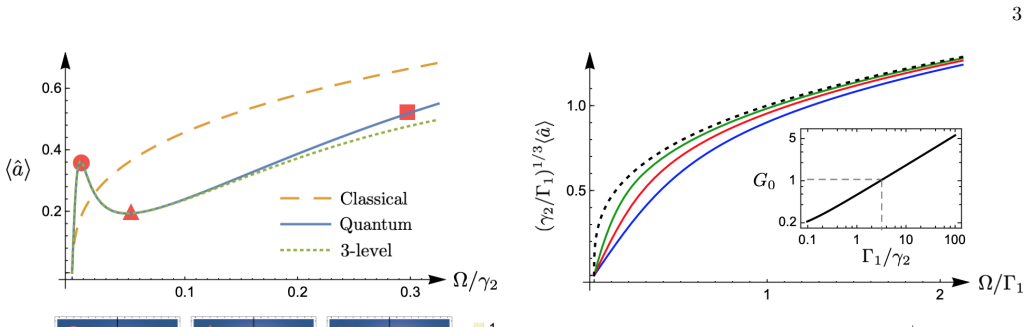
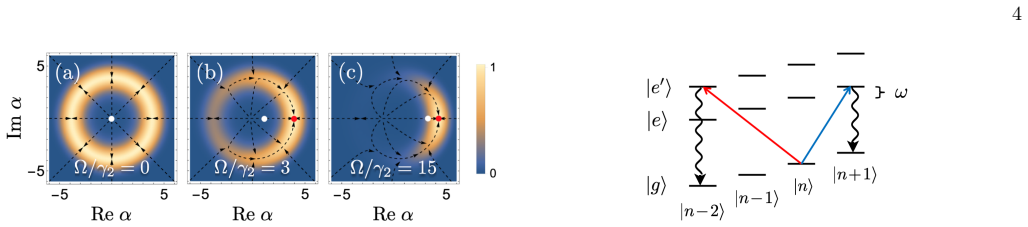
The central object is the steady state of the Lindblad master equation $\dot{\hat\rho}=-i[\hat H,\hat\rho]+\gamma_1^+\mathcal D[\hat a^\dagger]\hat\rho+\gamma_1^-\mathcal D[\hat a]\hat\rho+\gamma_2\mathcal D[\hat a^2]\hat\rho$, with $\hat H=i\Omega(\hat a^\dagger-\hat a)$ and $\mathcal D[\hat x]\hat\rho\equiv\hat x\hat\rho\hat x^\dagger-\{\hat x^\dagger\hat x,\hat\rho\}/2$. The work is done in the Fock basis, the number-of-quanta basis, where the response $\langle\hat a\rangle$ is read from nearest-neighbor coherences. At weak drive the dynamics are confined to the lowest three Fock states, producing the closed-form approximation $\langle\hat a\rangle\approx\frac{2\Omega}{\gamma_2}\frac{(\gamma_1^++\gamma_1^-)\gamma_2+8\Omega^2}{(3\gamma_1^++\gamma_1^-)^2+8\Omega^2}$, Eq. (5), which reproduces the linear, negative, and quantum response regimes; a continuum treatment for large occupation yields the Gaussian steady states and the limit-cycle susceptibility.
What would settle it
Measure the steady-state amplitude $\langle\hat a\rangle$ as a function of drive $\Omega$ in a trapped-ion or circuit-QED realization with $\gamma_1^\pm/\gamma_2\simeq0.02$: the prediction is a nonmonotonic response with a local minimum and negative slope in $\gamma_1^\pm\lesssim\Omega\lesssim(\gamma_1^\pm\gamma_2)^{1/2}$. If the response is monotonic, or if the zero-drive susceptibility does not grow as $\gamma_1^\pm$ is reduced, the central claim fails.
Extended reading notes
Core claim
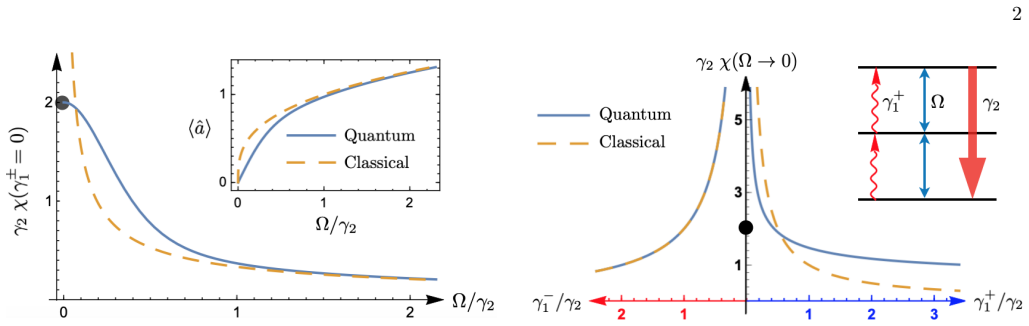
The central claim is that the driven quantum van der Pol oscillator reproduces the classical critical response, $\langle \hat a\rangle\propto\Omega^{1/3}$ at criticality, all the way down to $\langle \hat a\rangle\sim 1$, and that below this scale genuine quantum features appear. Solving the steady state of the master equation in the Fock-number basis, the paper finds four response regimes for weak one-body rates: linear response for $\Omega\lesssim\gamma_1^\pm$, negative susceptibility for $\gamma_1^\pm\lesssim\Omega\lesssim(\gamma_1^\pm\gamma_2)^{1/2}$, an extended quantum response for $(\gamma_1^\pm\gamma_2)^{1/2}\lesssim\Omega\lesssim\gamma_2$, and classical response for $\Omega\gtrsim\gamma_2$. The zero-drive susceptibility diverges as $1/\gamma_1^\pm$ as either rate vanishes, even though exactly at $\gamma_1^\pm=0$ it saturates at a finite value, so the two limits do not commute. Deep in the limit-cycle phase the linear susceptibility approaches $\chi\approx\frac{2}{3\gamma_2}\left(1-\frac{2\gamma_1^-}{3\gamma_1^+}\right)$, so the response is set by two-particle loss rather than one-particle damping, giving a sensitivity gain over a passive oscillator of up to $\gamma_1^-/(3\gamma_2)$.
Load-bearing premise
The argument assumes a Markovian environment and gain, loss, and two-body-loss rates that do not depend on the oscillator's Fock-state occupation; if non-Markovian effects or level-dependent rates become significant at the very weak drives where the negative susceptibility appears, the predicted signatures could be washed out.
Editorial extensions
If this is right
- Below $\langle\hat a\rangle\sim 1$ the classical $\Omega^{-2/3}$ susceptibility divergence is replaced by a finite linear response, so the detector remains usable at the single-phonon or single-photon level.
- Close to criticality, $\gamma_1^\pm\to0$, the zero-drive susceptibility diverges as $2/\gamma_1^-$ on the quiescent side and $2/(9\gamma_1^+)$ on the limit-cycle side, though the linear region itself narrows to zero width.
- A window of negative susceptibility appears for $\gamma_1^\pm\lesssim\Omega\lesssim(\gamma_1^\pm\gamma_2)^{1/2}$, a quantum signature with no classical counterpart for this model.
- With strong incoherent pumping in the limit-cycle phase the susceptibility is limited only by two-body loss, giving a gain $G_0\simeq\gamma_1^-/(3\gamma_2)$ over a passive oscillator while retaining a signal-to-noise ratio of order one.
- The principal signatures are robust to anharmonicity and detuning and are within reach of trapped-ion, optomechanical, and superconducting-circuit architectures.
Reading between the lines
- The paper does not explore the quantum Fisher information, but a natural extension is to compute the fundamental sensitivity limit; the strong noise divergence at exact criticality suggests the practical advantage lies in the finite signal-to-noise at single-quantum amplitudes rather than in raw susceptibility.
- The four-regime response should appear in any driven-dissipative resonator with a similar competition between coherent drive and incoherent rates, so measuring the nonmonotonic response in an anharmonic oscillator beyond the paper's robustness check would test the claimed genericity.
- The non-commuting limits near criticality suggest a crossover scaling function that has not been written down; extracting that function could connect the negative-susceptibility window to standard critical-phenomena scaling.
Signed reviews
Editorial analysis
A structured set of objections, weighed in public.
Referee Report
Summary. The manuscript studies the steady-state response of a driven-dissipative quantum van der Pol oscillator, governed by the Lindblad master equation Eq. (3) with one-phonon gain, one-phonon loss, and two-phonon loss. It identifies four response regimes as a function of drive amplitude: linear response, negative susceptibility, extended quantum response, and classical response, and provides closed-form approximations, most notably Eq. (5) for weak drives and Eq. (6) for the limit-cycle phase. The central findings are that the classical cubic response survives down to order-one excitation number; that at the critical point the zero-drive susceptibility saturates; that near criticality it diverges with an order-of-limits caveat; and that in the limit-cycle phase the linear susceptibility is set by the two-body loss rate rather than one-body damping.
Significance. The paper is significant because it extends the classical critical-sensor paradigm of the van der Pol oscillator into the quantum regime and predicts experimentally accessible signatures, namely divergent and negative susceptibilities, that are absent in the classical model. Its main strengths are the self-contained analytic derivations in the Supplement (three-level truncation and continuum expansions) and the direct numerical solution of the full master equation, with no fitted parameters; the agreement between the two is documented in Figs. 1–5 and S1–S5. The derived scaling laws, chi ≈ 2/sqrt(pi Gamma1 gamma2) and chi ≈ 2/(3 gamma2), are concrete and falsifiable in trapped-ion, optomechanical, and circuit-QED platforms.
minor comments (4)
- [Main text, final paragraph before the summary] The claim that 'Numerics show that the key features are unaffected' for the alternative model with energy-dependent one-body loss is not documented anywhere in the main text or the Supplement; please either present the supporting numerics or qualify the statement, since the abstract's 'largely generic' wording rests on this assertion.
- [Main text, paragraph after Eq. (5)] The statement that the divergent and negative susceptibilities 'are robust to anharmonicity and detuning' is made without supporting data or derivation; a brief discussion in the Supplement would allow readers to judge the scope of this claim.
- [Main text near Eq. (3)] The Markov approximation is invoked with a standard reference, but the specific requirement that the bath correlation time be much shorter than all relevant system timescales is not stated quantitatively; one sentence relating the validity regime to the sideband parameters in the experimental section would strengthen the applicability discussion.
- [Supplement SII C] The continuum expansion leading to Eq. (S30) assumes Gamma1 >> gamma2; the crossover between the two asymptotes in Fig. S3(b) is shown numerically but not described analytically, and a sentence noting the crossover scale would help the reader.
Circularity Check
No significant circularity: all analytic predictions are derived from the stated Lindblad master equation and checked against independent numerics on the same model.
full rationale
The paper's derivation chain is self-contained and non-circular. The central model is the Lindblad master equation (Eq. 3) with explicitly stated gain, loss, and two-particle-loss dissipators. The classical van der Pol limit is obtained by replacing the operator a-hat with a c-number alpha in Eq. (4), an explicit and standard reduction that the paper itself presents, and it is used only as an external benchmark, not as an input for the quantum predictions. All analytic results are derived from the same master equation under stated approximations: Eq. (5) follows from a three-level truncation of the Fock-space equations of motion, derived in detail in Supplemental Eq. (S19), and Eq. (6) follows from a continuum expansion of the population and coherence rate equations, derived in Supplemental Eq. (S39). These approximations are validated against exact numerical solution of the full master equation (e.g., Figs. 1-4 and Supplemental Figs. S2-S4), with no fitted parameters. The negative-susceptibility region arises from the closed-form nonmonotonic response (Supplemental Eq. S17) rather than from a fit, and the divergent linear susceptibility is explicitly discussed as an order-of-limits effect (Omega->0 then gamma±->0). The experimental section cites specific sideband-based schemes (Refs. 21, 22) only to justify the Markov approximation and experimental feasibility; those citations are not used to import the theoretical results. The paper even notes explicitly that Eq. (3) is not the only quantum model reproducing the classical vdP limit, acknowledging the modeling choice rather than hiding it. There is no fitted input renamed as a prediction, no load-bearing self-citation, and no uniqueness theorem imported from the authors' prior work. Statistical forcing is absent because the analytic expressions are compared with independent numerical solutions of the same equation rather than calibrated to data. The honest finding is therefore no significant circularity, score 0.
Assumptions & free parameters
assumptions (4)
- domain assumption Markovian environment: the bath relaxes much faster than the oscillator dynamics, so the master equation (3) is of Lindblad form.
- domain assumption The classical vdP limit is recovered by factorizing the three-operator expectation value: ⟨a†aa⟩ ≈ |α|²α in Eq. (4).
- domain assumption Low-Fock-state truncation is valid for the weak-drive analytic results in the supplement (SII A/B): states above n=2 are negligible.
- standard math The steady-state density matrix of the Lindblad equation is unique for the driven cases considered.
Cite this review
Pith. "Pith review of Critical Response of a Quantum van der Pol Oscillator." pith.science (2026). https://pith.science/paper/NGBGIFUX
@misc{pith2026190801002,
  author       = {Pith},
  title        = {Pith review of: Critical Response of a Quantum van der Pol Oscillator},
  year         = {2026},
  howpublished = {\url{https://pith.science/paper/NGBGIFUX}},
  note         = {Machine review of arXiv:1908.01002}
}
read the original abstract
Classical dynamical systems close to a critical point are known to act as efficient sensors due to a strongly nonlinear response. We explore such systems in the quantum regime by modeling a quantum version of a driven van der Pol oscillator. We find the classical response survives down to one excitation quantum. At very weak drives, genuine quantum features arise, including diverging and negative susceptibilities. Further, the linear response is greatly enhanced by using a strong incoherent pump. These results are largely generic and can be probed in current experimental platforms suited for quantum sensing.
Figures

Figures from the paper (1 more)
Reference graph
Works this paper leans on
-
[1]
Note that it coincides with the classical result for⟨ˆa⟩ & 1
Figure 1 shows the susceptibility χ≡ d⟨ˆa⟩/dΩ as a function of drive. Note that it coincides with the classical result for⟨ˆa⟩ & 1. However, at weaker drives, the classi- cal divergence is cut off and χ saturates, producing a lin- ear response. We can understand this low-energy cutoff FIG. 2. Zero-drive susceptibility as a function of damping γ− 1 (with γ+ ...
-
[2]
Kardar, Statistical Physics of Fields (Cambridge Uni- versity Press, Cambridge, UK, 2007)
M. Kardar, Statistical Physics of Fields (Cambridge Uni- versity Press, Cambridge, UK, 2007)
work page 2007
-
[3]
S. H. Strogatz, Nonlinear Dynamics and Chaos (West- view Press, Cambridge, MA, 1994)
work page 1994
-
[4]
J. E. Marsden and M. McCracken, The Hopf Bifurcation and its Applications (Springer-Verlag, New York, 1976)
work page 1976
-
[5]
LXXXVIII. On “relaxation- oscillations
B. van der Pol, Jun., “LXXXVIII. On “relaxation- oscillations”,” Philos. Mag. 2, 978 (1926)
work page 1926
-
[6]
Critical Oscillators as Ac- tive Elements in Hearing,
T. A. J. Duke and F. J¨ ulicher, “Critical Oscillators as Ac- tive Elements in Hearing,” in Active Processes and Otoa- coustic Emissions in Hearing (Springer, 2008) p. 63
work page 2008
-
[7]
Essential Nonlinearities in Hearing,
V. M. Egu´ ıluz, M. Ospeck, Y. Choe, A. J. Hudspeth, and M. O. Magnasco, “Essential Nonlinearities in Hearing,” Phys. Rev. Lett. 84, 5232 (2000)
work page 2000
-
[8]
Are Biological Systems Poised at Criticality?
T. Mora and W. Bialek, “Are Biological Systems Poised at Criticality?” J. Stat. Phys. 144, 268 (2011)
work page 2011
Show all 67 references
-
[9]
Colloquium: Criticality and dynamical scaling in living systems,
M. A. Mun˜ oz, “Colloquium: Criticality and dynamical scaling in living systems,” Rev. Mod. Phys. 90, 031001 (2018)
2018
-
[10]
Dynam- ical Criticality: Overview and Open Questions,
A. Roli, M. Villani, A. Filisetti, and R. Serra, “Dynam- ical Criticality: Overview and Open Questions,” J. Syst. Sci. Complex. 31, 647 (2018)
2018
-
[11]
Quantum sensing,
C. L. Degen, F. Reinhard, and P. Cappellaro, “Quantum sensing,” Rev. Mod. Phys. 89, 035002 (2017)
2017
-
[12]
Quantum- enhanced measurements without entanglement,
D. Braun, G. Adesso, F. Benatti, R. Floreanini, U. Mar- zolino, M. W. Mitchell, and S. Pirandola, “Quantum- enhanced measurements without entanglement,” Rev. Mod. Phys. 90, 035006 (2018)
2018
-
[13]
Keldysh field theory for driven open quantum systems,
L. M. Sieberer, M. Buchhold, and S. Diehl, “Keldysh field theory for driven open quantum systems,” Rep. Prog. Phys. 79, 096001 (2016)
2016
-
[14]
A review of progress in the physics of open quantum systems: theory and experi- ment,
I. Rotter and J. P. Bird, “A review of progress in the physics of open quantum systems: theory and experi- ment,” Rep. Prog. Phys. 78, 114001 (2015)
2015
-
[15]
En- gineered open systems and quantum simulations with atoms and ions,
M. M¨ uller, S. Diehl, G. Pupillo, and P. Zoller, “En- gineered open systems and quantum simulations with atoms and ions,” Adv. At. Mol. Opt. Phys. 61, 1 (2012)
2012
-
[16]
On-chip quantum simulation with superconducting circuits,
A. A. Houck, H. E. T¨ ureci, and J. Koch, “On-chip quantum simulation with superconducting circuits,” Nat. Phys. 8, 292 (2012)
2012
-
[17]
Cavity optomechanics,
M. Aspelmeyer, T. J. Kippenberg, and F. Marquardt, “Cavity optomechanics,” Rev. Mod. Phys. 86, 1391 (2014)
2014
-
[18]
Quantum simulations and many-body physics with light,
C. Noh and D. G. Angelakis, “Quantum simulations and many-body physics with light,” Rep. Prog. Phys. 80, 016401 (2017)
2017
-
[19]
Quantum simulation,
I. M. Georgescu, S. Ashhab, and F. Nori, “Quantum simulation,” Rev. Mod. Phys. 86, 153 (2014)
2014
-
[20]
A phonon laser,
K. Vahala, M. Herrmann, S. Kn¨ unz, V. Batteiger, G. Saathoff, T. W. H¨ ansch, and Th. Udem, “A phonon laser,” Nat. Phys. 5, 682 (2009)
2009
-
[21]
Sargent III, M
M. Sargent III, M. O. Scully, and W. E. Lamb Jr., Laser Physics (Addison-Wesley, Reading, MA, 1974)
1974
-
[22]
Quantum synchro- nization of quantum van der Pol oscillators with trapped ions,
T. E. Lee and H. R. Sadeghpour, “Quantum synchro- nization of quantum van der Pol oscillators with trapped ions,” Phys. Rev. Lett. 111, 234101 (2013)
2013
-
[23]
Quan- tum synchronization of a driven self-sustained oscillator,
S. Walter, A. Nunnenkamp, and C. Bruder, “Quan- tum synchronization of a driven self-sustained oscillator,” Phys. Rev. Lett. 112, 094102 (2014)
2014
-
[24]
Genuine quantum signatures in synchronization of an- harmonic self-oscillators,
N. L¨ orch, E. Amitai, A. Nunnenkamp, and C. Bruder, “Genuine quantum signatures in synchronization of an- harmonic self-oscillators,” Phys. Rev. Lett. 117, 073601 (2016)
2016
-
[25]
Entanglement tongue and quantum synchronization of disordered oscil- lators,
T. E. Lee, C.-K. Chan, and S. Wang, “Entanglement tongue and quantum synchronization of disordered oscil- lators,” Phys. Rev. E 89, 022913 (2014)
2014
-
[26]
Quantum synchronization of two Van der Pol oscillators,
S. Walter, A. Nunnenkamp, and C. Bruder, “Quantum synchronization of two Van der Pol oscillators,” Ann. Phys. 527, 131 (2015)
2015
-
[27]
Oscillation collapse in coupled quantum van der Pol oscillators,
K. Ishibashi and R. Kanamoto, “Oscillation collapse in coupled quantum van der Pol oscillators,” Phys. Rev. E 96, 052210 (2017)
2017
-
[28]
Spectral functions and negative density of states of a driven- dissipative nonlinear quantum resonator,
O. Scarlatella, A. A. Clerk, and M. Schiro, “Spectral functions and negative density of states of a driven- dissipative nonlinear quantum resonator,” New J. Phys. 21, 043040 (2019)
2019
-
[29]
See Supplemental Material for exact classical solution, analytic results for the quantum response at weak drives, mapping between density matrix and the Wigner func- tion, and signal-to-noise ratio estimates
-
[30]
On exact master equation for an open system,
R.R. Puri and S.V. Lawande, “On exact master equation for an open system,” Phys. Lett. A 62, 143 (1977)
1977
-
[31]
Quantum trajectories and open many-body quantum systems,
A. J. Daley, “Quantum trajectories and open many-body quantum systems,” Adv. Phys. 63, 77 (2014)
2014
-
[32]
Markovian master equations: a critical study,
´A. Rivas, A. D. K. Plato, S. F. Huelga, and M. B. Plenio, “Markovian master equations: a critical study,” New J. Phys. 12, 113032 (2010)
2010
-
[33]
Quantum non-Markovianity: characterization, quantification and detection,
´A. Rivas, S. F. Huelga, and M. B. Plenio, “Quantum non-Markovianity: characterization, quantification and detection,” Rep. Prog. Phys. 77, 094001 (2014)
2014
-
[34]
Breuer and F
H.-P. Breuer and F. Petruccione, The theory of open quantum systems (Oxford University Press, Oxford, UK, 2002)
2002
-
[35]
Gardiner and P
C. Gardiner and P. Zoller, Quantum noise (Springer, New York, 2004)
2004
-
[36]
Atom in a damped cavity,
S. Sachdev, “Atom in a damped cavity,” Phys. Rev. A 29, 2627 (1984)
1984
-
[37]
Quantum statistics of single-beam two-photon absorption,
H. D. Simaan and R. Loudon, “Quantum statistics of single-beam two-photon absorption,” J. Phys. A 8, 539 (1975)
1975
-
[38]
Exact stationary pho- ton distributions due to competition between one- and two-photon absorption and emission,
V. V. Dodonov and S. S. Mizrahi, “Exact stationary pho- ton distributions due to competition between one- and two-photon absorption and emission,” J. Phys. A 30, 5657 (1997)
1997
-
[39]
Wigner function for a driven anhar- monic oscillator,
K. V. Kheruntsyan, “Wigner function for a driven anhar- monic oscillator,” J. Opt. B 1, 225 (1999)
1999
-
[40]
Perturba- tive approach to Markovian open quantum systems,
A. C. Y. Li, F. Petruccione, and J. Koch, “Perturba- tive approach to Markovian open quantum systems,” Sci. Rep. 4, 4887 (2014)
2014
-
[41]
Ge- ometry and response of Lindbladians,
V. V. Albert, B. Bradlyn, M. Fraas, and L. Jiang, “Ge- ometry and response of Lindbladians,” Phys. Rev. X 6, 041031 (2016)
2016
-
[42]
Quantum response theory for nonequilibrium steady states,
M. Konopik and E. Lutz, “Quantum response theory for nonequilibrium steady states,” Phys. Rev. Research 1, 033156 (2019)
2019
-
[43]
Confining the state of light to a quan- 6 tum manifold by engineered two-photon loss,
Z. Leghtas et al., “Confining the state of light to a quan- 6 tum manifold by engineered two-photon loss,” Science 347, 853 (2015)
2015
-
[44]
Detec- tion of weak forces based on noise-activated switching in bistable optomechanical systems,
S. Aldana, C. Bruder, and A. Nunnenkamp, “Detec- tion of weak forces based on noise-activated switching in bistable optomechanical systems,” Phys. Rev. A 90, 063810 (2014)
2014
-
[45]
Fundamental limits and non-reciprocal approaches in non-Hermitian quantum sensing,
H.-K. Lau and A. A. Clerk, “Fundamental limits and non-reciprocal approaches in non-Hermitian quantum sensing,” Nat. Commun. 9, 4320 (2018)
2018
-
[46]
Continuous-variable optical quantum-state tomography,
A. I. Lvovsky and M. G. Raymer, “Continuous-variable optical quantum-state tomography,” Rev. Mod. Phys. 81, 299 (2009)
2009
-
[47]
Direct probing of quantum phase space by photon counting,
K. Banaszek and K. W´ odkiewicz, “Direct probing of quantum phase space by photon counting,” Phys. Rev. Lett. 76, 4344 (1996)
1996
-
[48]
Direct measurement of the Wigner function by photon counting,
K. Banaszek, C. Radzewicz, K. W´ odkiewicz, and J. S. Krasi´ nski, “Direct measurement of the Wigner function by photon counting,” Phys. Rev. A 60, 674 (1999)
1999
-
[49]
Experimental de- termination of the motional quantum state of a trapped atom,
D. Leibfried, D. M. Meekhof, B. E. King, C. Monroe, W. M. Itano, and D. J. Wineland, “Experimental de- termination of the motional quantum state of a trapped atom,” Phys. Rev. Lett. 77, 4281 (1996)
1996
-
[50]
Method for direct measurement of the Wigner function in cavity QED and ion traps,
L. G. Lutterbach and L. Davidovich, “Method for direct measurement of the Wigner function in cavity QED and ion traps,” Phys. Rev. Lett. 78, 2547 (1997)
1997
-
[51]
Direct mea- surement of the Wigner function of a one-photon Fock state in a cavity,
P. Bertet, A. Auffeves, P. Maioli, S. Osnaghi, T. Meunier, M. Brune, J. M. Raimond, and S. Haroche, “Direct mea- surement of the Wigner function of a one-photon Fock state in a cavity,” Phys. Rev. Lett. 89, 200402 (2002)
2002
-
[52]
Optomechanical-like coupling between superconducting resonators,
J. R. Johansson, G. Johansson, and F. Nori, “Optomechanical-like coupling between superconducting resonators,” Phys. Rev. A 90, 053833 (2014)
2014
-
[53]
Towards strongly correlated photons in arrays of dissipative non- linear cavities under a frequency-dependent incoherent pumping,
J. Lebreuilly, M. Wouters, and I. Carusotto, “Towards strongly correlated photons in arrays of dissipative non- linear cavities under a frequency-dependent incoherent pumping,” C. R. Phys. 17, 836 (2016)
2016
-
[54]
Autonomous stabilizer for incompressible photon fluids and solids,
R. Ma, C. Owens, A. Houck, D. I. Schuster, and J. Si- mon, “Autonomous stabilizer for incompressible photon fluids and solids,” Phys. Rev. A 95, 043811 (2017)
2017
-
[55]
A strongly interacting polaritonic quantum dot,
N. Jia, N. Schine, A. Georgakopoulos, A. Ryou, L. W. Clark, A. Sommer, and J. Simon, “A strongly interacting polaritonic quantum dot,” Nat. Phys. 14, 550 (2018)
2018
-
[56]
Quantum synchronization blockade: Energy quantization hinders synchronization of identical oscilla- tors,
N. L¨ orch, S. E. Nigg, A. Nunnenkamp, R. P. Tiwari, and C. Bruder, “Quantum synchronization blockade: Energy quantization hinders synchronization of identical oscilla- tors,” Phys. Rev. Lett. 118, 243602 (2017)
2017
-
[57]
Observing quantum synchronization block- ade in circuit quantum electrodynamics,
S. E. Nigg, “Observing quantum synchronization block- ade in circuit quantum electrodynamics,” Phys. Rev. A 97, 013811 (2018)
2018
-
[58]
Phonon- number-sensitive electromechanics,
J. J. Viennot, X. Ma, and K. W. Lehnert, “Phonon- number-sensitive electromechanics,” Phys. Rev. Lett. 121, 183601 (2018)
2018
-
[59]
Steady-state negative Wigner functions of non- linear nanomechanical oscillators,
S. Rips, M. Kiffner, I. Wilson-Rae, and M. J. Hart- mann, “Steady-state negative Wigner functions of non- linear nanomechanical oscillators,” New J. Phys. 14, 023042 (2012)
2012
-
[60]
On the Lagrangian and Hamiltonian descrip- tion of the damped linear harmonic oscillator,
V. K. Chandrasekar, M. Senthilvelan, and M. Laksh- manan, “On the Lagrangian and Hamiltonian descrip- tion of the damped linear harmonic oscillator,” J. Math. Phys. 48, 032701 (2007)
2007
-
[61]
Comment on “On the Lagrangian and Hamilto- nian description of the damped linear harmonic oscilla- tor
C. M. Bender, M. Gianfreda, N. Hassanpour, and H. F. Jones, “Comment on “On the Lagrangian and Hamilto- nian description of the damped linear harmonic oscilla- tor” [J. Math. Phys. 48, 032701 (2007)],” J. Math. Phys. 57, 084101 (2016)
2007
-
[62]
Exact quantization of a PT-symmetric (re- versible) Li´ enard-type nonlinear oscillator,
V. Chithiika Ruby, M. Senthilvelan, and M. Laksh- manan, “Exact quantization of a PT-symmetric (re- versible) Li´ enard-type nonlinear oscillator,” J. Phys. A 45, 382002 (2012)
2012
-
[63]
From quantum to classical: Schrdinger cats, entanglement, and decoherence,
L. Davidovich, “From quantum to classical: Schrdinger cats, entanglement, and decoherence,” Phys. Scr. 91, 063013 (2016)
2016
-
[64]
Quantum decoherence,
M. A. Schlosshauer, “Quantum decoherence,” Phys. Rep. 831, 1 (2019). 1 Supplemental Material for “Critical response of a quantum van der Pol oscillator” CONTENTS SI. Steady state of a classical van der Pol oscillator 1 SII. Response of a quantum van der Pol oscillator at weak ...
2019
-
[65]
γ+ 1 = 0, 0<γ− 1 ≪γ2 Two-level approximation.— As the system is fully damped, we can project the dynamics at weak drives onto the manifold spanned by n = 0 and 1. Then Eq. (S6) reduces to ˙ρ11 = 2Ωρ10−γ− 1 ρ11 , (S8a) ˙ρ10 = Ω(ρ00−ρ11)− (γ− 1 /2)ρ10 , (S8b) where ρ00 = 1−ρ11. ...
-
[66]
This nonmonotonic variation is evident in Fig
and increases linearly with drive at large Ω. This nonmonotonic variation is evident in Fig. S2
-
[67]
minimum detectable signal per unit time,
0≤γ+ 1,γ− 1 ≪γ2 In the presence of one-particle gain ( γ+ 1 > 0), the undriven steady state corresponds to a dynamic equilibrium where particles flow in and out of the oscillator. When γ2≫ γ± 1 , the dynamics are confined to the levels n = 0, 1, and 2 for weak drives. We conside...
2000
Reviewed August 14, 2026 · model on record in the stance chip above.
Discussion (0). Continue with ORCID to comment.