REVIEW 3 major objections 4 minor 45 references
Tunable Electronic Structure in Gallium Chalcogenide van der Waals Compounds
T0 review · 3 major / 4 minor · reviewed 2026-08-14 · deepseek-v4-flash
Pith's one-line read Potassium dosing reshapes bulk GaSe's valence band into a monolayer-like dispersion.
desk verdict Solid ARPES measurements of GaSe and GaS_xSe_1-x alloys, with a credible alloy gap-shift result, but the headline K-decoupling claim is inferred rather than pinned down and the HRSTEM stacking assignment is internally inconsistent. read the letter →
The pith
A machine-rendered reading of the paper's core claim, the machinery that carries it, and where it could break.
The reading
What carries the argument
The machinery is angle-resolved photoemission spectroscopy combined with photon-energy scans that map the out-of-plane momentum $k_z$, giving the full three-dimensional valence band structure and letting the authors isolate tetralayer-related dispersion. The load-bearing comparison is the inverted-sombrero band inversion at the top of the valence band: its magnitude on K-dosed GaSe, $(48 \pm 12)$ meV, is benchmarked against a calculated value of 80 meV for the monolayer and a measured value of 120 meV for monolayer GaSe on a substrate. Supporting machinery includes high-resolution scanning transmission electron microscopy to identify stacking phases by atomic-column intensity, core-level photoemission to track potassium-induced chemical changes and alloy composition, and photoluminescence to connect valence-band shifts to the optical gap.
What would settle it
A $k_z$-resolved ARPES scan of the K-dosed surface would settle it: if the top layer is truly decoupled, the inverted-sombrero band should show negligible dispersion along $k_z$, whereas band bending or an inner-potential shift would leave the out-of-plane dispersion essentially intact and only move the bands in energy. Alternatively, cross-sectional scanning transmission electron microscopy of the dosed crystal should reveal potassium atoms sitting in the van der Waals gap or an increased interlayer spacing; if neither is present, the decoupling claim fails.
Extended reading notes
Core claim
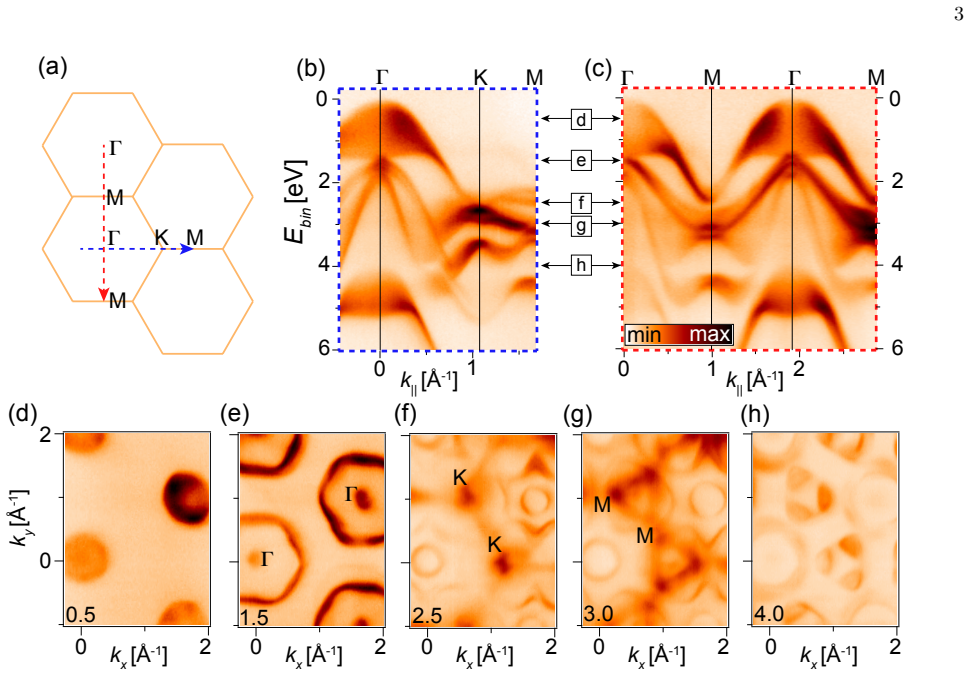
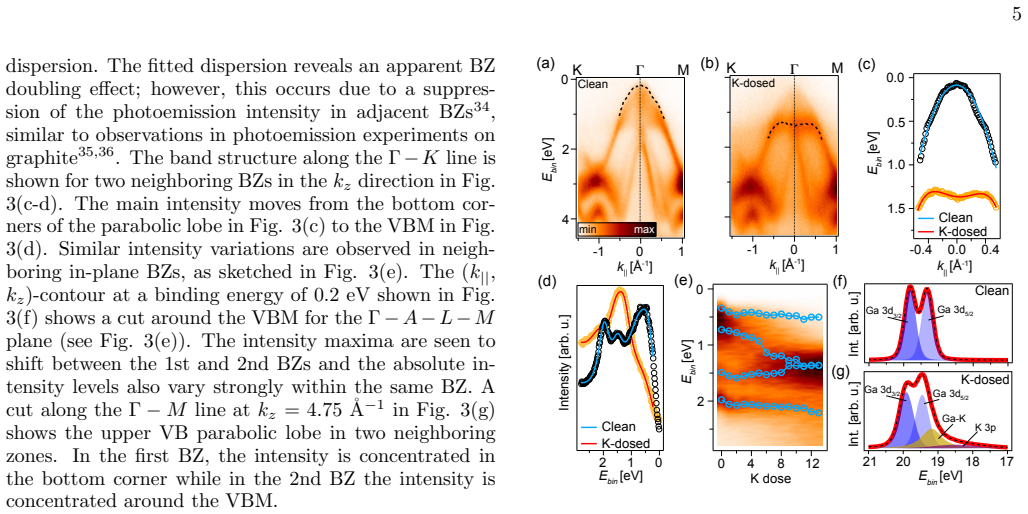
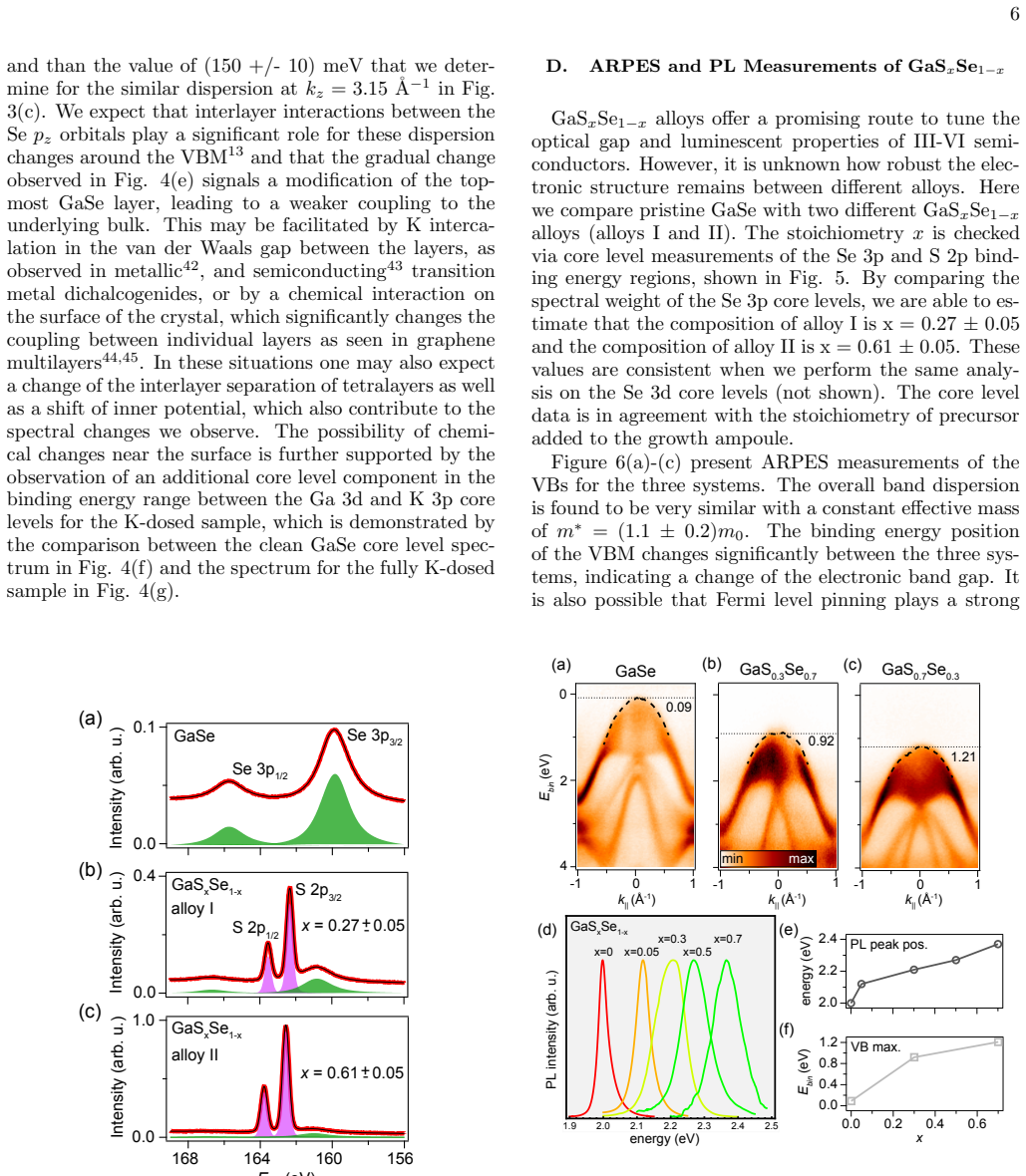
The central claim is that the valence band maximum of K-dosed bulk GaSe has a dispersion inconsistent with the bulk and consistent with a single tetralayer: instead of one maximum at $\Gamma$ with effective mass $(1.1 \pm 0.2)m_0$, the dosed surface has two maxima at $\pm 0.3$ Å$^{-1}$ with effective mass $(1.7 \pm 0.2)m_0$ and a local minimum at $\Gamma$ that sits $(48 \pm 12)$ meV below them. That inverted-bow dispersion is the shape expected for monolayer GaSe, so the gap should switch from direct in the bulk to indirect in the dosed surface layer. The paper further claims that this change is caused by a strong modification of the top-most GaSe tetralayer, likely through potassium entering the van der Waals gap or reacting with the surface, leading to weaker coupling to the underlying bulk. For the alloys, the paper claims that increasing sulfur content shifts the valence band maximum to higher binding energy while leaving the dispersion and effective mass essentially unchanged, and that the alloy stacking switches from the AB (ε) sequence to the AA′ (β) sequence above roughly 30 percent sulfur.
Load-bearing premise
The load-bearing premise is that the new dispersion seen after potassium dosing is caused by the top-most GaSe tetralayer becoming electronically decoupled from the bulk, rather than by the alternative mechanisms the paper itself lists, such as surface band bending, chemical reaction, a shift of the inner potential, or altered final-state effects.
Editorial extensions
If this is right
- Potassium dosing offers a route to monolayer-like electronic structure, including a likely direct-to-indirect gap transition, on a bulk crystal without exfoliating or growing a monolayer.
- Sulfur alloying tunes the valence-band edge and the optical gap over a wide compositional range while leaving the dispersion and effective mass around the valence band maximum essentially unchanged.
- The stacking phase of GaS$_x$Se$_{1-x}$ alloys can be selected by composition, with the AB-to-AA′ transition occurring near $x \approx 0.3$.
- K-dosed GaSe degrades under prolonged synchrotron exposure, so studies of the dosed surface require gentler probes or lower photon flux than the full photon-energy scans used on pristine GaSe.
- The same ARPES strategy can be applied to other layered monochalcogenides to test whether alkali dosing generically produces a decoupled top tetralayer.
Reading between the lines
- If potassium decouples only the top-most tetralayer, the dosed crystal becomes a platform for studying monolayer physics on a robust bulk substrate, without transfer or encapsulation.
- A direct structural test is available: imaging the K-dosed surface with scanning tunneling microscopy or cross-sectional electron microscopy should reveal potassium atoms in the van der Waals gap or an enlarged interlayer spacing, which would confirm the decoupling mechanism the paper infers from the band shape.
- The inverted-sombrero criterion could be applied to other alkali metals and other III-VI chalcogenides; if the measured band-inversion energy tracks ionic radius or intercalation propensity, that would independently strengthen the decoupling interpretation.
- Because potassium dosing shifts the valence band by only about 0.1 eV without populating the conduction band, an electron-doping strategy that fills the conduction band would be needed to verify the indirect-gap conclusion by directly imaging the conduction-band minimum.
Signed reviews
Editorial analysis
A structured set of objections, weighed in public.
Referee Report
Summary. The paper combines HRSTEM, ARPES, and PL to study GaSe and GaS_xSe_{1-x} alloys. The authors report that in-situ potassium deposition on bulk GaSe transforms the valence-band dispersion from a bulk-like parabola into a bow-shaped ('inverted sombrero') dispersion reminiscent of single-layer GaSe, which they interpret as potassium decoupling the topmost GaSe tetralayer and changing the gap from direct to indirect. They also report, from HRSTEM, a sulfur-concentration-dependent phase transition from AB (ε) stacking in GaSe to AA′ (β) stacking in sulfur-rich alloys, and show from ARPES and PL that alloying rigidly shifts the VBM to higher binding energy with a corresponding blue shift of the photoluminescence, while leaving the dispersion around the VBM largely unchanged.
Significance. If the central claims hold, the work is significant in two respects: it suggests a controllable, surface-based route to monolayer-like electronic structure on a bulk crystal, and it demonstrates that the electronic gap of gallium chalcogenides can be tuned by alloying without substantially altering the VBM dispersion. The paper's strengths include the systematic mapping of the kz-dependent band structure of bulk GaSe, the explicit comparison of measured band inversions against independent DFT and prior ARPES values, and the use of core-level spectroscopy to determine alloy composition. The data are presented with stated energy and momentum resolutions and with error bars on the fitted quantities. However, the causal interpretation of the potassium experiment and the internal consistency of the stacking-phase assignment need attention before the conclusions can be accepted.
major comments (3)
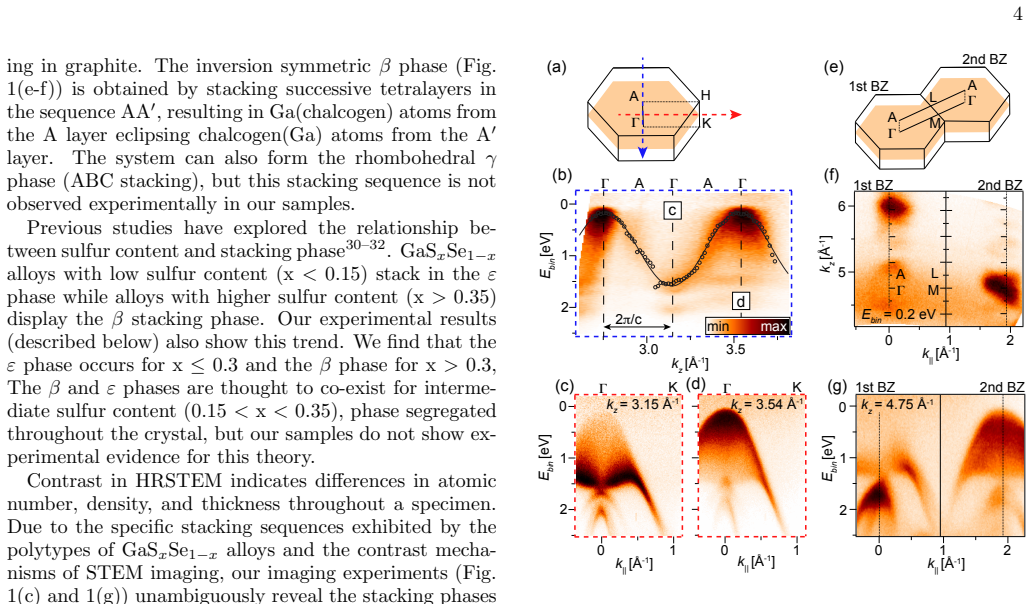
- [Section III A and Fig. 1] The HRSTEM phase assignments are internally contradictory. The text states that Fig. 1(c) is an image of a high-sulfur alloy (x = 0.75) that shows a trigonal lattice with alternating bright and dim columns, 'consistent with the stacking geometry of the ε phase' (i.e., AB stacking). It also states that Fig. 1(g) is pure GaSe, showing a honeycomb mesh with uniform column intensity, 'consistent with AA′ stacking exhibited by the β phase.' These assignments are opposite to the phase boundary stated earlier in the same section, where the ε phase is assigned to x ≤ 0.3 and the β phase to x > 0.3. Pure GaSe should be ε, and a high-sulfur alloy should be β. As written, the evidence contradicts the claimed ε-to-β transition with increasing sulfur content, and this contradiction propagates to the abstract and conclusion. The authors must correct either the sample labels or the phase assignments, and reconcile the interpretation with the known literature phase diagram.
- [Section III C and Fig. 4] The central claim that potassium 'decouples the top-most tetra-layer' is not uniquely supported by the data. The K-dosed dispersion is measured at a single photon energy (94 eV), and the paper explicitly notes in Section II that the fully K-dosed sample could not be scanned in photon energy because of beam-induced degradation. Figure 3(c) shows that bulk GaSe already displays a bow-shaped dispersion with a band inversion of (150 ± 10) meV at kz = 3.15 Å^-1, whereas a different kz slice (Fig. 3(d)) is bulk-like. If potassium deposition changes the inner potential V0 (as the authors themselves list in Section III C), the same 94 eV photon energy would probe a different kz after dosing, and the observed bow shape could be a kz re-sampling of the bulk band structure rather than true top-layer decoupling. The alternative mechanisms mentioned in Section III C — surface band bending, chemical reaction, inner-potential shift, and final-state effects — are not excluded. The measured (48 ± 12) meV inversion differs from the bulk kz-slice value, but final-state broadening or a mixture of kz states could still mimic the observation. To support the causal 'decouples' language in the abstract and conclusion, either a kz-resolved measurement of the K-dosed sample or direct structural evidence of potassium intercalation and interlayer separation is needed.
- [Section III C, paragraph on band inversion] The statement that the measured (48 ± 12) meV band inversion 'compares well with a value of 80 meV obtained from recent DFT calculations' is an overstatement: the two values differ by approximately 2.7 times the stated experimental uncertainty. The disagreement may be physically meaningful (e.g., due to incomplete decoupling at the surface), but the manuscript should either quantify the comparison more carefully or discuss possible reasons for the discrepancy rather than describing it as good agreement.
minor comments (4)
- [Introduction] There is a typo in Section I: 'mobilities on the order of of 0.1 cm2V−1s−1' has a duplicated 'of.'
- [Fig. 6 caption and text] The alloy labels in Fig. 6(a)-(c) are given as 'GaS0.3Se0.7' and 'GaS0.7Se0.3', while the text and Fig. 5 quote compositions of x = 0.27 ± 0.05 and x = 0.61 ± 0.05. The notation should be made consistent, for example by using the fitted values in the figure labels or stating that the labels are nominal values.
- [Fig. 6 panel (c)] The vertical-axis label 'E_nib' in Fig. 6(c) appears to be a typo for 'E_bin' (or 'Binding energy').
- [Section III A] The sentence 'The β and ε phases are thought to co-exist for intermediate sulfur content (0.15 < x < 0.35)' is followed by 'our samples do not show experimental evidence for this theory'; the latter phrase is vague and would be more informative if the authors stated, for example, that all measured intermediate-composition samples fell into a single phase or that no phase coexistence was observed within the resolution of the measurements.
Circularity Check
No significant circularity: the K-dosing and alloying conclusions are benchmarked against independent DFT, prior ARPES, PL and HRSTEM data; the few self-citations are background, not load-bearing.
full rationale
The paper's central claims are measurements compared with external benchmarks. The K-dosed band inversion of (48 ± 12) meV is compared with 80 meV from independent DFT (Ref. 40) and with 120–150 meV from prior monolayer ARPES, none of which are outputs of the present fit. The inner potential V0 = 10.2 eV is fitted to the kz periodicity, but it is used only to label bulk kz slices and does not enter the K-dosing or alloying conclusions. The alloy VBM shifts and PL blueshift are correlated independently, and the ε-to-β stacking assignment rests on HRSTEM images interpreted via known stacking geometry. The self-citations (Refs. 36, 42, 44, 45, involving Bostwick/Rotenberg) are used only as background examples of kz intensity suppression, alkali intercalation, and graphene multilayer decoupling; they are not used to prove the GaSe decoupling claim. The paper explicitly acknowledges in Sec. II that beam damage led to 'broadening and significant deterioration of the quality of the spectral features, preventing detailed photon energy or angle scans for the K-dosed samples,' and Sec. III C lists alternative mechanisms such as surface band bending, chemical reaction, inner-potential shift, and final-state effects. Those caveats make the causal 'decouples' interpretation less than uniquely established, but that is an experimental-completeness concern, not a circular derivation. No equation or fitted parameter is reused as a predicted output.
Assumptions & free parameters
free parameters (1)
- Inner potential V0 =
10.2 eV
assumptions (4)
- domain assumption Free-electron final-state approximation with constant inner potential V0 relates photoelectron kinetic energy to out-of-plane momentum kz.
- domain assumption The monolayer GaSe valence band has the 'inverted sombrero' shape with inversion energy around 80 meV from DFT and 120 to 150 meV from ARPES on supported monolayers.
- domain assumption HRSTEM intensity of atomic columns is directly proportional to the number of atoms in the column (Z-contrast), so alternating bright and dim columns identify AB stacking and uniform columns identify AA' stacking.
- domain assumption Alloy composition x is obtained from the ratio of Se 3p and S 2p core-level spectral weights with Doniach-Sunjic fits.
Cite this review
Pith. "Pith review of Tunable Electronic Structure in Gallium Chalcogenide van der Waals Compounds." pith.science (2026). https://pith.science/paper/D6V3L25T
@misc{pith2026190801003,
  author       = {Pith},
  title        = {Pith review of: Tunable Electronic Structure in Gallium Chalcogenide van der Waals Compounds},
  year         = {2026},
  howpublished = {\url{https://pith.science/paper/D6V3L25T}},
  note         = {Machine review of arXiv:1908.01003}
}
abstract
Transition metal monochalcogenides comprise a class of two-dimensional materials with electronic band gaps that are highly sensitive to material thickness and chemical composition. Here, we explore the tunability of the electronic excitation spectrum in GaSe using angle-resolved photoemission spectroscopy. The electronic structure of the material is modified by $\textit{in-situ}$ potassium deposition as well as by forming GaS$_{x}$Se$_{1-x}$ alloy compounds. We find that potassium decouples the top-most tetra-layer of the GaSe unit cell, leading to a substantial change of the dispersion around the valence band maximum (VBM). The observed band dispersion of a single tetralayer is consistent with a transition from the direct gap character of the bulk to the indirect gap character expected for monolayer GaSe. Upon alloying with sulfur, we observe a phase transition from AB to $\text{AA}^{\prime}$ stacking. Alloying also results in a rigid energy shift of the VBM towards higher binding energies which correlates with a blue shift in the luminescence. The increase of the band gap upon sulfur alloying does not appear to change the dispersion or character of the VBM appreciably, implying that it is possible to engineer the gap of these materials while maintaining their salient electronic properties.
Figures

Figures from the paper (2 more)
Reference graph
Works this paper leans on
-
[1]
author author M. Wasala , author H. I. \ Sirikumara , author Y. Raj Sapkota , author S. Hofer , author D. Mazumdar , author T. Jayasekera , \ and\ author S. Talapatra ,\ 10.1039/C7TC02866K journal journal J. Mater. Chem. C \ volume 5 ,\ pages 11214 ( year 2017 ) NoStop
-
[2]
author author K. S. \ Novoselov , author A. K. \ Geim , author S. V. \ Morozov , author D. Jiang , author Y. Zhang , author S. V. \ Dubonos , author I. V. \ Grigorieva , \ and\ author A. A. \ Firsov ,\ 10.1126/science.1102896 journal journal Science \ volume 306 ,\ pages 666 ( year 2004 ) NoStop
-
[3]
author author J. Feng , author X. Sun , author C. Wu , author L. Peng , author C. Lin , author S. Hu , author J. Yang , \ and\ author Y. Xie ,\ 10.1021/ja207176c journal journal Journal of the American Chemical Society \ volume 133 ,\ pages 17832 ( year 2011 ) NoStop
-
[4]
author author K. F. \ Mak , author C. Lee , author J. Hone , author J. Shan , \ and\ author T. F. \ Heinz ,\ @noop journal journal Phys. Rev. Lett. \ volume 105 ,\ pages 136805 ( year 2010 ) NoStop
work page 2010
-
[5]
author author A. Splendiani , author L. Sun , author Y. Zhang , author T. Li , author J. Kim , author C.-Y. \ Chim , author G. Galli , \ and\ author F. Wang ,\ @noop journal journal Nano Lett. \ volume 10 ,\ pages 1271 ( year 2010 ) NoStop
work page 2010
-
[6]
author author K. Watanabe , author T. Taniguchi , \ and\ author H. Kanda ,\ @noop journal journal Nat. Mater. \ volume 3 ,\ pages 404 ( year 2004 ) NoStop
work page 2004
-
[7]
author author I. Guillam \'o n , author H. Suderow , author S. Vieira , author L. Cario , author P. Diener , \ and\ author P. Rodi \`e re ,\ @noop journal journal Phys. Rev. Lett. \ volume 101 ,\ pages 166407 ( year 2008 ) NoStop
work page 2008
-
[8]
author author E. Navarro-Moratalla , author J. O. \ Island , author S. Ma \ n as-Valero , author E. Pinilla-Cienfuegos , author A. Castellanos-Gomez , author J. Quereda , author G. Rubio-Bollinger , author L. Chirolli , author J. A. \ Silva-Guill \'e n , author N. Agra \" t , author G. A. \ Steele , author F. Guinea , author H. S. J. \ van der Zant , \ an...
work page 2016
Show all 45 references
-
[9]
author author M. M. \ Ugeda , author A. J. \ Bradley , author Y. Zhang , author S. Onishi , author Y. Chen , author W. Ruan , author C. Ojeda-Aristizabal , author H. Ryu , author M. T. \ Edmonds , author H.-Z. \ Tsai , author A. Riss , author S.-K. \ Mo , author D. Lee , autho...
2015
-
[10]
Liu , author S
author author G. Liu , author S. Rumyantsev , author M. A. \ Bloodgood , author T. T. \ Salguero , \ and\ author A. A. \ Balandin ,\ @noop journal journal Nano Lett. \ ( year 2018 ) NoStop
2018
-
[11]
Xi , author L
author author X. Xi , author L. Zhao , author Z. Wang , author H. Berger , author L. Forr \'o , author J. Shan , \ and\ author K. F. \ Mak ,\ @noop journal journal Nat. Nanotechnol. \ volume 10 ,\ pages 765 ( year 2015 ) NoStop
2015
-
[12]
Choi , author N
author author W. Choi , author N. Choudhary , author G. H. \ Han , author J. Park , author D. Akinwande , \ and\ author Y. H. \ Lee ,\ @noop journal journal Materials Today \ volume 20 ,\ pages 116 ( year 2017 ) NoStop
2017
-
[13]
author author D. V. \ Rybkovskiy , author A. V. \ Osadchy , \ and\ author E. D. \ Obraztsova ,\ @noop journal journal Phys. Rev. B Condens. Matter \ volume 90 ,\ pages 235302 ( year 2014 ) NoStop
2014
-
[14]
Cai , author E
author author H. Cai , author E. Soignard , author C. Ataca , author B. Chen , author C. Ko , author T. Aoki , author A. Pant , author X. Meng , author S. Yang , author J. Grossman , author F. D. \ Ogletree , \ and\ author S. Tongay ,\ @noop journal journal Advanced Materials ...
2016
-
[15]
Robertson ,\ @noop journal journal J
author author J. Robertson ,\ @noop journal journal J. Phys. C: Solid State Phys. \ volume 12 ( year 2001 ) NoStop
2001
-
[16]
Lei , author L
author author S. Lei , author L. Ge , author Z. Liu , author S. Najmaei , author G. Shi , author G. You , author J. Lou , author R. Vajtai , \ and\ author P. M. \ Ajayan ,\ @noop journal journal Nano Letters \ volume 13 ,\ pages 2777 ( year 2013 ) NoStop
2013
-
[17]
Ben Aziza , author D
author author Z. Ben Aziza , author D. Pierucci , author H. Henck , author M. G. \ Silly , author C. David , author M. Yoon , author F. Sirotti , author K. Xiao , author M. Eddrief , author J.-C. \ Girard , \ and\ author A. Ouerghi ,\ @noop journal journal Phys. Rev. B \ volum...
2017
-
[18]
Hu , author Z
author author P. Hu , author Z. Wen , author L. Wang , author P. Tan , \ and\ author K. Xiao ,\ @noop journal journal ACS Nano \ volume 6 ,\ pages 5988 ( year 2012 ) NoStop
2012
-
[19]
Zhou , author Y
author author Y. Zhou , author Y. Nie , author Y. Liu , author K. Yan , author J. Hong , author C. Jin , author Y. Zhou , author J. Yin , author Z. Liu , \ and\ author H. Peng ,\ @noop journal journal ACS Nano \ volume 8 ,\ pages 1485 ( year 2014 ) NoStop
2014
-
[20]
author author D. J. \ Late , author B. Liu , author J. Luo , author A. Yan , author H. S. S. R. \ Matte , author M. Grayson , author C. N. R. \ Rao , \ and\ author V. P. \ Dravid ,\ @noop journal journal Advanced Materials \ volume 24 ,\ pages 3549 ( year 2012 ) NoStop
2012
-
[21]
Serizawa , author Y
author author H. Serizawa , author Y. Sasaki , \ and\ author Y. Nishina ,\ @noop journal journal Journal of the Physical Society of Japan \ volume 48 ,\ pages 490 ( year 1980 ) NoStop
1980
-
[22]
author author C. S. \ Jung , author F. Shojaei , author K. Park , author J. Y. \ Oh , author H. S. \ Im , author D. M. \ Jang , author J. Park , \ and\ author H. S. \ Kang ,\ 10.1021/acsnano.5b04876 journal journal ACS Nano \ ( year 2015 ),\ 10.1021/acsnano.5b04876 NoStop
-
[23]
Chen , author Y
author author H. Chen , author Y. Li , author L. Huang , \ and\ author J. Li ,\ 10.1039/C5RA08329J journal journal Rsc Adv \ volume 5 ,\ pages 50883 ( year 2015 ) NoStop
2015 doi
-
[24]
Del Pozo-Zamudio , author S
author author O. Del Pozo-Zamudio , author S. Schwarz , author M. Sich , author I. A. \ Akimov , author M. Bayer , author R. C. \ Schofield , author E. A. \ Chekhovich , author B. J. \ Robinson , author N. D. \ Kay , author O. V. \ Kolosov , author A. I. \ Dmitriev , author G....
2015
-
[25]
Kim , author C
author author W. Kim , author C. Li , author F. A. \ Chaves , author D. Jiménez , author R. D. \ Rodriguez , author J. Susoma , author M. A. \ Fenner , author H. Lipsanen , \ and\ author J. Riikonen ,\ @noop journal journal Advanced Materials \ volume 28 ,\ pages 1845 ( year 2...
2016
-
[26]
Ben Aziza , author H
author author Z. Ben Aziza , author H. Henck , author D. Pierucci , author M. G. \ Silly , author E. Lhuillier , author G. Patriarche , author F. Sirotti , author M. Eddrief , \ and\ author A. Ouerghi ,\ @noop journal journal ACS Nano \ ( year 2016 ) NoStop
2016
-
[27]
Li , author L
author author X. Li , author L. Basile , author B. Huang , author C. Ma , author J. Lee , author I. Vlassiouk , author A. Puretzky , author M. Lin , author M. Yoon , author M. Chi , author J. Idrobo , author C. Rouleau , author B. Sumpter , author D. Geohegan , \ and\ author K...
-
[28]
Ni , author H
author author Y. Ni , author H. Wu , author C. Huang , author M. Mao , author Z. Wang , \ and\ author X. Cheng ,\ @noop journal journal Journal of Crystal Growth \ volume 381 ,\ pages 10 ( year 2013 ) NoStop
2013
-
[29]
H\"ufner ,\ @noop title Photoelectron Spectroscopy ,\ edition 3rd \ ed.\ ( publisher Springer ,\ address Berlin ,\ year 2003 ) NoStop
author author S. H\"ufner ,\ @noop title Photoelectron Spectroscopy ,\ edition 3rd \ ed.\ ( publisher Springer ,\ address Berlin ,\ year 2003 ) NoStop
2003
-
[30]
Whitehouse \ and\ author A
author author C. Whitehouse \ and\ author A. Balchin ,\ @noop journal journal Journal of Materials Science \ volume 13 ,\ pages 2394 ( year 1978 ) NoStop
1978
-
[31]
Terhell , author V
author author J. Terhell , author V. Brabers , \ and\ author G. van Egmond ,\ @noop journal journal Journal of Solid State Chemistry \ volume 41 ,\ pages 97 ( year 1982 ) NoStop
1982
-
[32]
Arancia , author M
author author G. Arancia , author M. Grandolfo , author C. Manfredotti , \ and\ author A. Rizzo ,\ @noop journal journal physica status solidi (a) \ volume 33 ,\ pages 563 ( year 1976 ) NoStop
1976
-
[33]
Olgu \'i n , author A
author author D. Olgu \'i n , author A. Rubio-Ponce , \ and\ author A. Cantarero ,\ 10.1140/epjb/e2013-40141-1 journal journal Eur. Phys. J. B \ volume 86 ,\ pages 350 ( year 2013 ) NoStop
2013 doi
-
[34]
Plucinski , author R
author author L. Plucinski , author R. Johnson , author B. Kowalski , author K. Kopalko , author B. Orlowski , author Z. Kovalyuk , \ and\ author G. Lashkarev ,\ @noop journal journal Physical Review B \ volume 68 ,\ pages 125304 ( year 2003 ) NoStop
2003
-
[35]
author author E. L. \ Shirley , author L. J. \ Terminello , author A. Santoni , \ and\ author F. J. \ Himpsel ,\ 10.1103/PhysRevB.51.13614 journal journal Physical Review B \ volume 51 ,\ pages 13614 ( year 1995 ) NoStop
1995 doi
-
[36]
Mucha-Kruczy\'nski , author O
author author M. Mucha-Kruczy\'nski , author O. Tsyplyatyev , author A. Grishin , author E. McCann , author V. I. \ Fal'ko , author A. Bostwick , \ and\ author E. Rotenberg ,\ 10.1103/PhysRevB.77.195403 journal journal Physical Review B \ volume 77 ,\ pages 195403 ( year 2008 ) NoStop
-
[37]
Camara , author A
author author M. Camara , author A. Mauger , \ and\ author I. Devos ,\ @noop journal journal Physical Review B \ volume 65 ,\ pages 125206 ( year 2002 ) NoStop
2002
-
[38]
Nagel , author A
author author S. Nagel , author A. Baldereschi , \ and\ author K. Maschke ,\ @noop journal journal Journal of Physics C: Solid State Physics \ volume 12 ,\ pages 1625 ( year 1979 ) NoStop
1979
-
[39]
Rybkovskiy , author N
author author D. Rybkovskiy , author N. Arutyunyan , author A. Orekhov , author I. Gromchenko , author I. Vorobiev , author A. Osadchy , author E. Y. \ Salaev , author T. Baykara , author K. Allakhverdiev , \ and\ author E. Obraztsova ,\ @noop journal journal Physical Review B...
2011
-
[40]
Ben Aziza , author V
author author Z. Ben Aziza , author V. Zólyomi , author H. Henck , author D. Pierucci , author M. G. \ Silly , author J. Avila , author S. J. \ Magorrian , author J. Chaste , author C. Chen , author M. Yoon , author K. Xiao , author F. Sirotti , author M. C. \ Asensio , author...
-
[41]
\ Chen , author H
author author M.-W. \ Chen , author H. Kim , author D. Ovchinnikov , author A. Kuc , author T. Heine , author O. Renault , \ and\ author A. Kis ,\ 10.1038/s41699-017-0047-x journal journal npj 2D Materials and Applications \ ,\ pages 1 ( year 2018 ) NoStop
-
[42]
Rossnagel , author E
author author K. Rossnagel , author E. Rotenberg , author H. Koh , author N. V. \ Smith , \ and\ author L. Kipp ,\ @noop journal journal Physical Review Letters \ volume 95 ,\ pages 126403 ( year 2005 ) NoStop
2005
-
[43]
Eknapakul , author P
author author T. Eknapakul , author P. D. C. \ King , author M. Asakawa , author P. Buaphet , author R.-H. \ He , author S.-K. \ Mo , author H. Takagi , author K. M. \ Shen , author F. Baumberger , author T. Sasagawa , author S. Jungthawan , \ and\ author W. Meevasana ,\ 10.10...
-
[44]
Ohta , author A
author author T. Ohta , author A. Bostwick , author T. Seyller , author K. Horn , \ and\ author E. Rotenberg ,\ 10.1126/science.1130681 journal journal Science \ volume 313 ,\ pages 951 ( year 2006 ) NoStop
2006 doi
-
[45]
Ohta , author A
author author T. Ohta , author A. Bostwick , author J. L. \ McChesney , author T. Seyller , author K. Horn , \ and\ author E. Rotenberg ,\ 10.1103/PhysRevLett.98.206802 journal journal Physical Review Letters \ volume 98 ,\ eid 206802 ( year 2007 ) NoStop
Reviewed August 14, 2026 · model on record in the stance chip above.
Discussion (0). Continue with ORCID to comment.