REVIEW 36 references
Elucidating plasma dynamics in Hasegawa-Wakatani turbulence by information geometry
T0 review · reviewed 2026-08-14 · deepseek-v4-flash
Pith's one-line read Information length computed from time-dependent probability distributions of Hasegawa-Wakatani turbulence increases with adiabaticity and shows sharp increases during sudden changes in the plasma dynamics.
The pith
A machine-rendered reading of the paper's core claim, the machinery that carries it, and where it could break.
The reading
Extended reading notes
Core claim
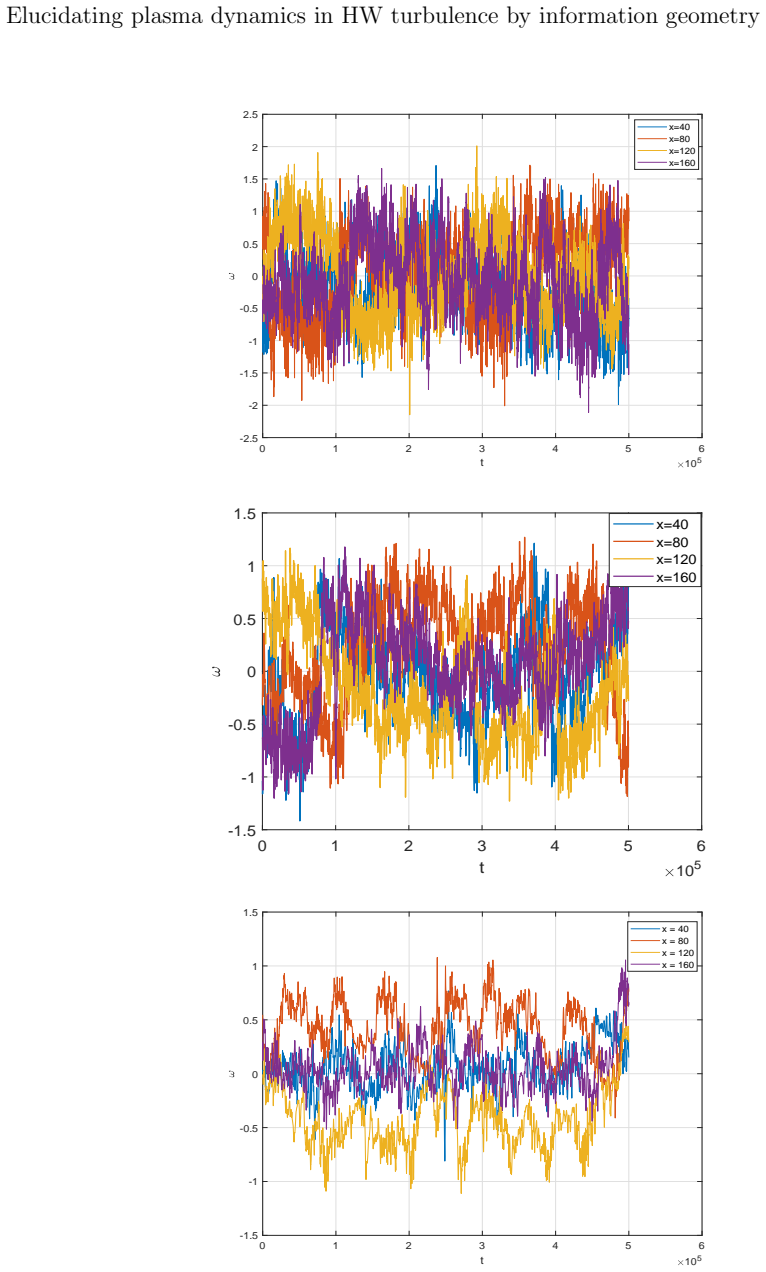
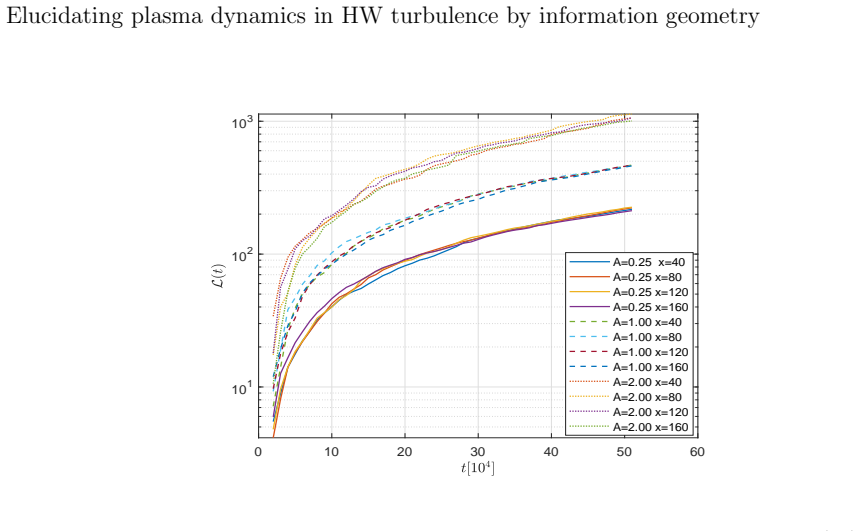
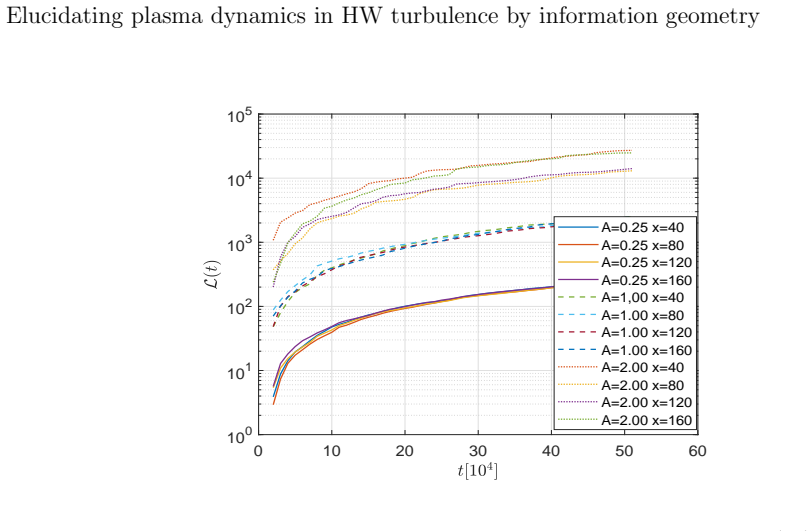
The central claim is that the information length L, computed from time-dependent PDFs of Hasegawa-Wakatani turbulence, provides a useful diagnostic for intermittent dynamics: a sudden change in the dynamic time E = 1/τ² marks a rapid change in the fluctuation statistics (as seen in Figure 5 for A = 0.25 at x = 40), and L is systematically larger for larger adiabaticity A.
Load-bearing premise
The load-bearing assumption is that the time derivative ∂p/∂t of the probability density can be accurately estimated from finite-length sliding windows (10,000 samples) of a single time series; if the PDF or its derivative is noisy, the computed spikes in E and the values of L are artifacts. This enters in Section III (Eq. 10) and the PDF construction in Section IV, but the numerical differentiation scheme is not specified and no error bars are given.
Signed reviews
Editorial analysis
A structured set of objections, weighed in public.
Assumptions & free parameters
free parameters (2)
- PDF sliding window length =
10000 time steps
- Histogram bin size =
Not fixed (500, 1000, 5000, 10000 tested)
assumptions (4)
- domain assumption The sliding-window histogram of 10000 consecutive samples represents the instantaneous probability distribution of the fluctuation.
- domain assumption The time derivative of the PDF can be accurately estimated by comparing PDFs at successive times.
- domain assumption The HW simulation with the prescribed forcing and dissipation produces time series whose statistics are representative of drift-wave turbulence.
- domain assumption The information length from Eq. (10) is a meaningful measure of statistical distance for non-equilibrium processes.
Cite this review
Pith. "Pith review of Elucidating plasma dynamics in Hasegawa-Wakatani turbulence by information geometry." pith.science (2026). https://pith.science/paper/EN2LKT5F
@misc{pith2026190801006,
  author       = {Pith},
  title        = {Pith review of: Elucidating plasma dynamics in Hasegawa-Wakatani turbulence by information geometry},
  year         = {2026},
  howpublished = {\url{https://pith.science/paper/EN2LKT5F}},
  note         = {Machine review of arXiv:1908.01006}
}
abstract
The impact of adiabatic electrons on drift-wave turbulence, modelled by the Hasegawa-Wakatani equations, is studied using information length. Information length is a novel theoretical method for measuring distances between statistical states represented by different probability distribution functions (PDFs) along the path of a system. Specifically, the time-dependent PDFs of turbulent fluctuations for a given adiabatic index $A$ is computed. The changes in fluctuation statistics are then quantified in time by using information length. The numerical results provide time traces exhibiting intermittent plasma dynamics, and such behaviour is identified by a rapid change in the information length. The effects of $A$ are discussed.
Figures


Figures from the paper (6 more)



Reference graph
Works this paper leans on
- [1]
- [2]
- [3]
-
[4]
A. Hasegawa, C. G. Maclennan and Y. Kodama, Phys. Fluids, 22 , 2122 (1979)
work page 1979
- [5]
- [6]
-
[7]
J. M. Dewhurst, B. Hnat, N. Ohno, R. O. Dendy, S. Masuzaki, T. Morisaki and A. Komori, Plasma Phys. Contr. Fusion 50 , 095013 (2008)
work page 2008
-
[8]
J. M. Dewhurst, B. Hnat and R. O. Dendy, Phys. Plasmas 16 , 072306 (2009)
work page 2009
Show all 36 references
-
[9]
Stoltzfus-Dueck, B
T. Stoltzfus-Dueck, B. D. Scott and J. A. Krommes, Phys. Plasmas 20 , 082314 (2013)
2013
-
[10]
Anderson and B
J. Anderson and B. Hnat, Physics of Plasmas 24 (6), 062301 (2017)
2017
-
[11]
Horton and Y.-H
W. Horton and Y.-H. Ichikawa, Chaos and Structures in Nonlinear Plasmas (World Scientific, Singapore, 1996), Sections 6.1 & 6.2, p.221
1996
-
[12]
Zweben, J
S. Zweben, J. A. Boedo, O. Grulke, C. Hidalgo, B. LaBombard, R. J. Maqueda, P. Scarin and J. L. Terry, Plasma Phys. Contr. Fusion 49 , S1 (2007)
2007
-
[13]
P. A. Politzer, Phys. Rev. Lett. 84 , 1192 (2000)
2000
-
[14]
Beyer, S
P. Beyer, S. Benkadda, X. Garbet and P. H. Diamond, Phys. Rev. Lett. 85 , 4892 (2000)
2000
-
[15]
J. F. Drake, P. N. Guzdar and A. B. Hassam, Phys. Rev. Lett. 61 , 2205 (1988)
1988
-
[16]
G. Y. Antar, S. I. Krasheninnikov, P. Devynck, R. P. Doerner, E. M. Hollman, J. A. Boedo, S. C. Luckhardt and R. W. Conn, Phys. Rev. Lett. 87 , 065001 (2001)
2001
-
[17]
B. A. Carreras, C. Hidalgo, E. Sanchez, M. A. Pedrosa, R. Balbin, I. Garcia-Cortes, B. van Milligen. D. E. Newman and V. E. Lynch, Phys. Plasmas 3 (7),(1996)
1996
-
[18]
Anderson and P
J. Anderson and P. Xanthopoulos, Phys. Plasmas 17 , 110702 (2010)
2010
-
[19]
Kim and J
E. Kim and J. Anderson, Phys. Plasmas 15 , 114506 (2008)
2008
-
[20]
Anderson, E
J. Anderson, E. Kim and S. Moradi, Phys. Plasmas, 21 , 122109 (2014)
2014
-
[21]
Anderson, S
J. Anderson, S. Moradi, T. Rafiq, Entropy, 20(10), 760 (2018)
2018
-
[22]
P. H. Diamond, S.-I. Itoh, K. Itoh and T. S. Hahn, Plasma Phys. Contr. Fusion 47 , R35 (2005)
2005
-
[23]
J. W. Connor, T. Fukuda, X. Garbet, C. Gormezano, V. Mukhovatov, M. Wakatani, the ITB Database Group and the ITPA Topical Group on Transport and Internal Barrier Physics, Nucl. Fusion 44 , R1 (2004)
2004
-
[24]
Itoh, S.-I
K. Itoh, S.-I. Itoh, P. H. Diamond, T. S. Hahn, A. Fujisawa, G. R. Tynan, M. Yagi and Y. Nagashima, Phys. Plasmas 13 , 055502 (2006)
2006
-
[25]
J. W. Connor and T. J. Martin, Plasma Phys. Contr. Fusion 49 , 1497 (2007)
2007
-
[26]
Weinhold, Z
F. Weinhold, Z. Phys. Chem., 63 , 2479 (1975)
1975
-
[27]
Rupeiner, Phys
G. Rupeiner, Phys. Rev. Lett. 20 , 1608 (1979)
1979
-
[28]
Schl\" o gl, Z
F. Schl\" o gl, Z. Phys. B 59 , 449–454 (1985)
1985
-
[29]
Di\' o si, K
L. Di\' o si, K. Kulacsy, B. Luk\' a cs, A. R\' a cz, Z. Phys. Chem. 105 11220 (1996)
1996
-
[30]
G. E. Crooks, Phys. Rev. Lett. 99 100602 (2007)
2007
-
[31]
E. H. Feng, G. E. Crooks, Phys. Rev. E 79 012104 (2009)
2009
-
[32]
S. B. Nicholson, E. Kim, Phys. Lett. A 379 83 (2015)
2015
-
[33]
Kim and R
E. Kim and R. Hollerbach, Phys. Rev. E 95 , 022137 (2017)
2017
-
[34]
Kim and R
E. Kim and R. Hollerbach, Phys. Rev. E 95 , 062107 (2017)
2017
-
[35]
E. Kim, Q. Jacquet and R. Hollerbach, J. Stat. Mech., 023204 (2019)
2019
-
[36]
Kim, Entropy 20 (8), 574 (2018)
E. Kim, Entropy 20 (8), 574 (2018)
2018
Reviewed August 14, 2026 · model on record in the stance chip above.
Discussion (0). Continue with ORCID to comment.