REVIEW 3 major objections 3 minor 27 references
Theoretical prediction of a highly responsive material: Spin fluctuations and superconductivity in FeNiB2 system
T0 review · 3 major / 3 minor · reviewed 2026-08-14 · deepseek-v4-flash
Pith's one-line read FeNiB2 is predicted to be a stable phase whose antiferromagnetic spin fluctuations can mediate superconductivity with a critical temperature estimated at 20–30 K.
desk verdict A credible structure-prediction paper whose spin-fluctuation superconductivity estimate is clearly labeled qualitative but rests on under-specified parameters. read the letter →
The pith
A machine-rendered reading of the paper's core claim, the machinery that carries it, and where it could break.
The reading
What carries the argument
The load-bearing object is the spin-fluctuation-renormalized Stoner criterion: an RPA expression for the zero-point spin-fluctuation energy that renormalizes the static Stoner parameter $I$ to $I^*$, changing the condition for magnetic instability from $I\chi_0>1$ to $I^*\chi_0>1$. The same spin-fluctuation susceptibility enters a self-energy expression, from which the electron–spin coupling constant $\lambda$ is obtained as an energy derivative evaluated at the Fermi level; feeding $\lambda=0.6$ and an effective spin-fluctuation frequency $\omega=0.2$ eV into the McMillan formula yields the estimated $T_c$. This machinery links the magnetic near-instability directly to both the suppression of magnetic order and the pairing strength.
What would settle it
Grow or synthesize FeNiB2 and measure its normal-state magnetism and superconductivity. If neutron scattering shows no strong antiferromagnetic spin-fluctuation spectral weight in the 0–0.3 eV range, or if the compound orders magnetically at low temperature instead of remaining highly responsive, the spin-fluctuation mechanism is contradicted; likewise, if it does superconduct but with a transition temperature far outside 20–30 K, the specific pairing estimate is wrong.
Extended reading notes
Core claim
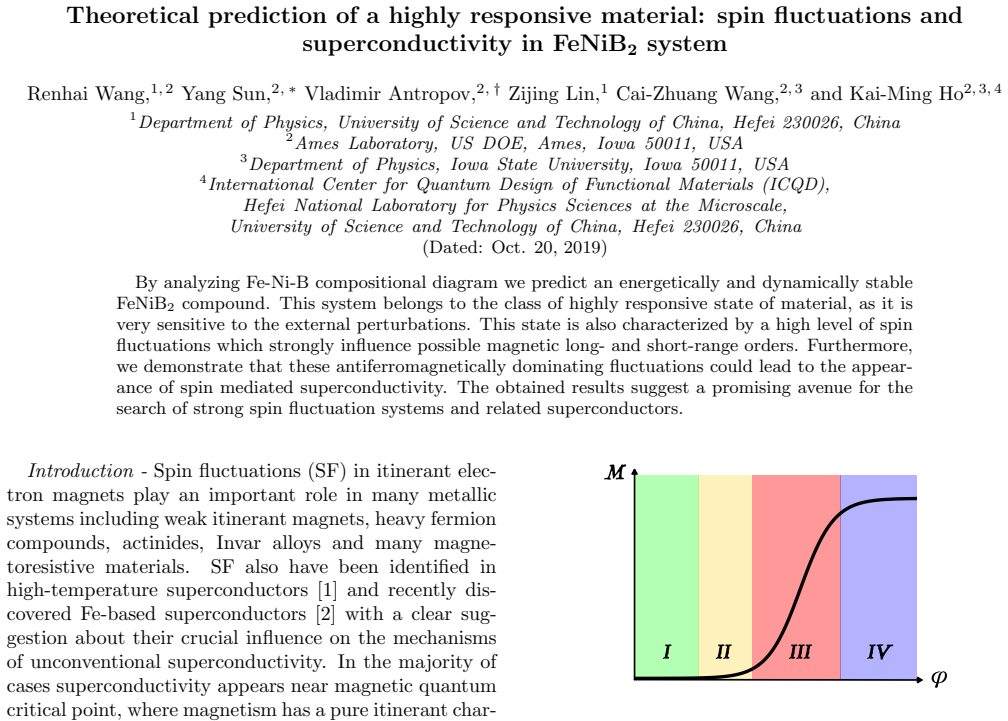
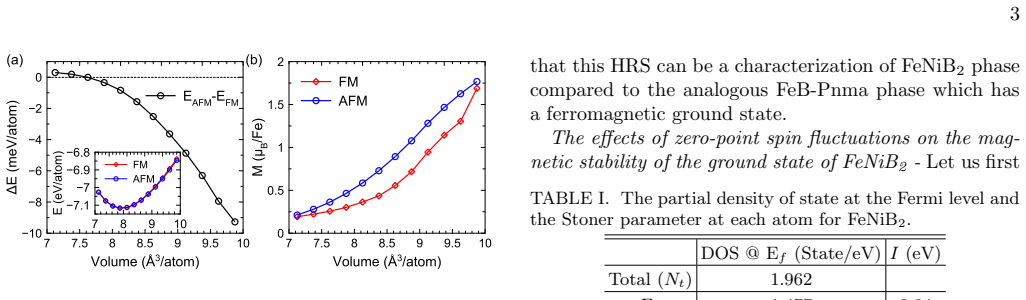
The central claim is that the ordered compound FeNiB2 (space group P21/m, two formula units per cell) is thermodynamically stable below the 0 K convex hull of the Fe–Ni–B system and dynamically stable, with no soft phonon modes. Its ferromagnetic and antiferromagnetic states are nearly degenerate, with the antiferromagnetic state lower by about 0.45 meV/atom, and the ordered moment grows rapidly with volume, signaling proximity to a magnetic instability. Quantum zero-point spin fluctuations, computed from an RPA form of the spin-fluctuation energy, renormalize the Stoner parameter downward by nearly 7%, which can suppress long-range magnetic order and leave the system dominated by antiferromagnetic spin fluctuations. Using an s–d exchange model for the electron–spin coupling averaged over the Brillouin zone and the McMillan formula, the paper estimates a superconducting critical temperature of 20–30 K.
Load-bearing premise
The prediction's weakest point is the assumption that the Brillouin-zone-averaged electron–spin coupling $\lambda=0.6$ and the effective spin-fluctuation frequency $\omega=0.2$ eV, fed into the McMillan formula with no stated Coulomb pseudopotential, give a reliable estimate of $T_c$; changing these numbers changes the answer substantially.
Editorial extensions
If this is right
- FeNiB2 should be added to the Fe–Ni–B phase diagram as a stable ternary phase, updating previous databases that list no stable ternary compound at this composition.
- Because the ferromagnetic and antiferromagnetic states are nearly degenerate, external pressure, strain, or magnetic field can switch or strongly alter the magnetic order, making FeNiB2 a magnetic chameleon.
- Zero-point spin fluctuations of about 7% renormalization can kill long-range magnetic order, leaving strong antiferromagnetic fluctuations at low temperatures; neutron scattering should see them.
- If the pairing estimate holds, FeNiB2 is a candidate spin-fluctuation-mediated superconductor with $T_c$ near 20–30 K, a case where superconductivity arises without phonons.
Reading between the lines
- If the 20–30 K estimate survives more detailed Fermi-surface calculations, the same logic would motivate searching other 3d-metal borides with Fe/Ni substitutions near magnetic instabilities for spin-fluctuation superconductivity.
- The near-degeneracy of FM and AFM states suggests that modest pressure or epitaxial strain could tune FeNiB2 through a magnetic quantum critical point; in that region $T_c$ may be maximized or suppressed, a testable prediction.
- The paper averages the coupling over the whole Brillouin zone; a calculation that resolves the Fermi surface could shift $\lambda$ noticeably, and the provenance of $\omega=0.2$ eV would need to be pinned down to sharpen the $T_c$ estimate.
Signed reviews
Editorial analysis
A structured set of objections, weighed in public.
Referee Report
Summary. The paper predicts a new ternary phase FeNiB2 in space group P21/m using an adaptive genetic algorithm structure search and DFT (VASP/PBE). It reports that the phase lies below the 0 K convex hull of the Fe-Ni-B system and is dynamically stable by phonon calculations. The authors find a near degeneracy between ferromagnetic and a simple antiferromagnetic state, with AFM slightly lower in energy, and describe the system as a highly responsive state with strong spin fluctuations. Using RPA-based spin-fluctuation theory they estimate a ~7% renormalization of the Stoner parameter, and from an electron-magnon coupling estimate λ=0.6 with an effective spin-fluctuation frequency ω=0.2 eV they obtain via the McMillan formula a superconducting critical temperature of 20–30 K.
Significance. If the structural and magnetic stability claims hold, the paper provides a concrete new candidate phase in the Fe-Ni-B system and demonstrates a first-principles route to identify magnetically responsive materials. The convex-hull and phonon analyses are standard, reproducible DFT checks, and the Stoner parameters and spin-fluctuation renormalization are computed rather than fitted, which is a strength. However, the central quantitative prediction of superconductivity at 20–30 K is not supported by the manuscript as written: the derivation of λ, the definition of ω, and the value of μ* are all missing. The qualitative statement that antiferromagnetic spin fluctuations could induce superconductivity is plausible, but the specific Tc range should not be regarded as a robust prediction without additional details.
major comments (3)
- [Superconductivity estimate, near Eq. (8)] The central claim of spin-fluctuation superconductivity at 20–30 K is not substantiated because the derivation of λ=0.6 is absent: the text states only that the Fermi-surface average in Eq. (8) was replaced by a Brillouin-zone average, but no k-mesh, no q-integration details, and no evaluation of the self-energy derivative are reported. For a quasi-1D system such as this Fe/Ni/B chain compound, the uncontrolled Brillouin-zone average can differ substantially from the Fermi-surface average, so the numerical value of λ should be treated as tentative until the calculation is specified.
- [Superconductivity estimate, following Eq. (8)] The effective spin-fluctuation frequency ω=0.2 eV is introduced without a definition or a derivation; it is not shown how it is extracted from the computed susceptibility, which frequency moment is used, or how it relates to the q-range of the calculation. Since the McMillan formula depends on the pre-factor and logarithm through ω, the quoted Tc range is not reproducible from the information given.
- [Superconductivity estimate, following Eq. (8)] The McMillan formula requires a Coulomb pseudopotential μ*, but no value is stated anywhere in the manuscript. The exponential sensitivity of Tc to μ* means that an unstated μ* leaves the 20–30 K range unconstrained; for example, the same λ and ω with μ* in the typical range 0.1–0.2 can move Tc by more than an order of magnitude. The authors should either specify μ* and show the sensitivity of Tc to it, or remove the numerical Tc range from the conclusions.
minor comments (3)
- [Eq. (1)] Equation (1) writes the Stoner criterion as 1−Iχ0 > 0, but the surrounding text and Eq. (2) correctly indicate that magnetic instability requires Iχ0 > 1, i.e., 1−Iχ0 < 0. The sign in Eq. (1) appears to be a typo and should be corrected.
- [Introduction, CoB phase description] The text describes the CoB phase as 'tetragonal, space group Pnma', but Pnma is an orthorhombic space group; this should be corrected to avoid confusion.
- [Superconductivity estimate, McMillan reference] The name McMillan is misspelled as 'MacMillan' in the sentence introducing the McMillan formula; this should be corrected.
Circularity Check
No significant circularity: structural and spin-fluctuation findings are first-principles outputs; the 20-30 K estimate is under-specified but not fitted to its own target.
full rationale
The paper's central structural claim (FeNiB2 is thermodynamically and dynamically stable) is derived from an adaptive genetic algorithm search, DFT total energies, a convex-hull comparison (-340.9 meV/atom versus -326.57 meV/atom), and phonon calculations with no soft modes. These are independent first-principles outputs, not quantities fitted to any experimental result. The magnetic and spin-fluctuation analysis uses Eq. (3)-(6) to compute a 7% Stoner-parameter renormalization from RPA susceptibilities, and the electron-magnon coupling lambda = 0.6 is stated to follow from Eqs. (7)-(8) with calculated spin susceptibilities; no experimental superconducting transition temperature or magnetic ordering temperature is used as an input to obtain these numbers. The final McMillan estimate (20-30 K) is indeed presented with very little detail: the effective spin-fluctuation frequency omega = 0.2 eV is asserted, the Coulomb pseudopotential mu* is not stated, and the Brillouin-zone average is acknowledged as a simplification. However, this is a transparency and robustness concern rather than circularity: the quoted numbers are not defined in terms of the predicted Tc, and no equation in the paper reduces the prediction to its own input. The citations to prior work by the same authors (AGA method, RPA-based spin-fluctuation formalism, Liechtenstein parameters) are methodological in nature and are applied to a previously unstudied compound, so they do not import the paper's conclusion through an unverified self-citation chain. No self-definitional step, fitted-input-called-prediction step, imported uniqueness theorem, or renaming of a known result was found.
Assumptions & free parameters
free parameters (2)
- Effective spin-fluctuation frequency omega =
0.2 eV
- Coulomb pseudopotential mu* =
not stated
assumptions (5)
- domain assumption DFT-PBE provides reliable total energies and phonons for Fe-Ni-B compounds.
- domain assumption The AGA search over the listed compositions and cell sizes covers the relevant structural candidates.
- domain assumption The two-sublattice collinear AFM state is sufficient to represent the magnetic ground state.
- domain assumption The RPA-based spin-fluctuation theory from Ref. [22] and the s-d exchange model from Ref. [25] describe the relevant physics for FeNiB2.
- domain assumption The McMillan formula with an effective frequency is a valid way to estimate Tc for this system.
Cite this review
Pith. "Pith review of Theoretical prediction of a highly responsive material: Spin fluctuations and superconductivity in FeNiB2 system." pith.science (2026). https://pith.science/paper/LDM22QMX
@misc{pith2026190801025,
  author       = {Pith},
  title        = {Pith review of: Theoretical prediction of a highly responsive material: Spin fluctuations and superconductivity in FeNiB2 system},
  year         = {2026},
  howpublished = {\url{https://pith.science/paper/LDM22QMX}},
  note         = {Machine review of arXiv:1908.01025}
}
read the original abstract
By analyzing Fe-Ni-B compositional diagram we predict an energetically and dynamically stable FeNiB2 compound. This system belongs to the class of highly responsive state of material, as it is very sensitive to the external perturbations. This state is also characterized by a high level of spin fluctuations which strongly influence possible magnetic long- and short-range orders. Furthermore, we demonstrate that these antiferromagnetically dominating fluctuations could lead to the appearance of spin mediated superconductivity. The obtained results suggest a promising avenue for the search of strong spin fluctuation systems and related superconductors.
Figures

Reference graph
Works this paper leans on
-
[1]
Moriya and K
T. Moriya and K. Ueda, Adv. Phys. 49, 555 (2000)
2000
-
[2]
D. C. Johnston, Adv. Phys. 59, 803 (2010)
2010
-
[3]
S. Q. Wu, M. Ji, C. Z. Wang, M. C. Nguyen, X. Zhao, K. Umemoto, R. M. Wentzcovitch, and K. M. Ho, J. Phys. Condens. Matter 26, 035402 (2014)
work page 2014
-
[4]
X. Zhao, M. C. Nguyen, W. Y. Zhang, C. Z. Wang, M. J. Kramer, D. J. Sellmyer, X. Z. Li, F. Zhang, L. Q. Ke, V. P. Antropov, and K. M. Ho, Phys. Rev. Lett. 112, 045502 (2014)
work page 2014
-
[5]
P. E. Blchl, Phys. Rev. B 50, 17953 (1994)
work page 1994
-
[6]
Kresse and J
G. Kresse and J. Furthmller, Comput. Mater. Sci. 6, 15 (1996)
1996
- [7]
-
[8]
J. P. Perdew, K. Burke, and M. Ernzerhof, Phys. Rev. Lett. 77, 3865 (1996)
1996
Show all 27 references
-
[9]
The energy convergence criterion is 10−4 eV
was adopted for Brillouin zone sampling with a k- point grid of 2 π× 0.033 ˚A −1 , and the ionic relaxations stopped when the forces on every atom became smaller than 0.01 eV/˚A. The energy convergence criterion is 10−4 eV. The phonon calculations were performed with the finite...
-
[10]
H. J. Monkhorst and J. D. Pack, Phys. Rev. B 13, 5188 (1976)
1976
-
[11]
Togo and I
A. Togo and I. Tanaka, Scr. Mater. 108, 1 (2015)
2015
-
[12]
A. Jain, S. P. Ong, G. Hautier, W. Chen, W. D. Richards, S. Dacek, S. Cholia, D. Gunter, D. Skinner, G. Ceder, and K. A. Persson, APL Mater. 1, 011002 (2013)
2013
-
[13]
Hellenbrandt, Crystallogr
M. Hellenbrandt, Crystallogr. Rev. 10, 17 (2004)
2004
-
[14]
Y. Khan, Z. Met. 74, 385 (1983)
1983
-
[15]
Gianoglio and C
C. Gianoglio and C. Badini, J. Mater. Sci. 21, 4331 (1986)
1986
-
[16]
Kolmogorov, S
A.N. Kolmogorov, S. Shah, E.R. Margine, A.F. Bialon, T. Hammerschmidt, and R. Drautz, Phys. Rev. Lett. 105, 217003 (2010)
2010
-
[17]
Liechtenstein, M.I
A.I. Liechtenstein, M.I. Katsnelson, V.P. Antropov, and V.A. Gubanov, J. Magn. Magn. Mater. 67, 65 (1987)
1987
-
[18]
Samolyuk and V.P
G.D. Samolyuk and V.P. Antropov, Phys. Rev. B 79, 052505 (2009)
2009
-
[19]
Jarlborg and A
T. Jarlborg and A. J. Freeman, Phys. Rev. B 22, 2332 (1980)
1980
-
[20]
Anderson, Phys
P.W. Anderson, Phys. Rev. 124, 41 (1961)
1961
-
[21]
Moriya and A
T. Moriya and A. Kawabata, J. Phys. Soc. Japan 34, 639 (1973)
1973
-
[22]
Englert and R
F. Englert and R. Brout, Phys. Rev. 120, 1085 (1960)
1960
-
[23]
A. L. Wysocki, V. N. Valmispild, A. Kutepov, S. Sharma, J. K. Dewhurst, E. K. U. Gross, A. I. Lichtenstein, and V. P. Antropov, Phys. Rev. B 96, 184418 (2017)
2017
-
[24]
V. P. Antropov and A. Solontsov, J. Appl. Phys. 109, 07E116 (2011)
2011
-
[25]
V. P. Antropov, J. Magn. Magn. Mater. 262, L192 (2003)
2003
-
[26]
V. Y. Irkhin and M. I. Katsnelson, Z. Phys. B 75, 67 (1989)
1989
-
[27]
W. L. McMillan, Phys. Rev. 167, 331 (1968)
1968
Reviewed August 14, 2026 · model on record in the stance chip above.
Discussion (0). Continue with ORCID to comment.