REVIEW 4 major objections 3 minor 45 references
Analytical estimates of secular frequencies for binary star systems
T0 review · 4 major / 3 minor · reviewed 2026-08-14 · deepseek-v4-flash
Pith's one-line read A modified Laplace-Lagrange model yields quantitatively correct secular precession frequencies for test particles in multi-star systems.
desk verdict A short proceedings paper that honestly proposes an ad hoc eccentricity factor for Laplace-Lagrange secular frequencies, but the new formula never gets an isolated head-to-head test. read the letter →
The pith
A machine-rendered reading of the paper's core claim, the machinery that carries it, and where it could break.
The reading
What carries the argument
The load-bearing object is the modified Laplace-Lagrange frequency (LLM): the classical single-perturber secular frequency $g_{\mathrm{LL}}=\frac{1}{4}\mu\alpha^2 n b_{3/2}^{(1)}(\alpha)$ multiplied by Heppenheimer's eccentricity factor $(1-e_B^2)^{-3/2}$. The Laplace coefficient $b_{3/2}^{(1)}(\alpha)$, defined by an integral over the perturbing body's orbital phase, carries the full dependence on the semi-major axis ratio $\alpha$, while the added factor carries the binary's eccentricity $e_B$. Equation (11) then exploits the linear additivity of Laplace-Lagrange secular theory, summing the modified single-perturber frequencies of every massive companion to obtain a multi-perturber estimate.
What would settle it
Numerically integrate the planar restricted three-body problem for an equal-mass binary with $\alpha=0.1$ and $e_B=0.6$, extract the apsidal precession frequency by Fourier analysis of $e\sin\varpi$ and $e\cos\varpi$, and compare it with $g_{\mathrm{LLM}}$; a deviation that grows faster than $(1-e_B^2)^{-3/2}$ with $e_B$ would falsify the factorized ansatz.
Extended reading notes
Core claim
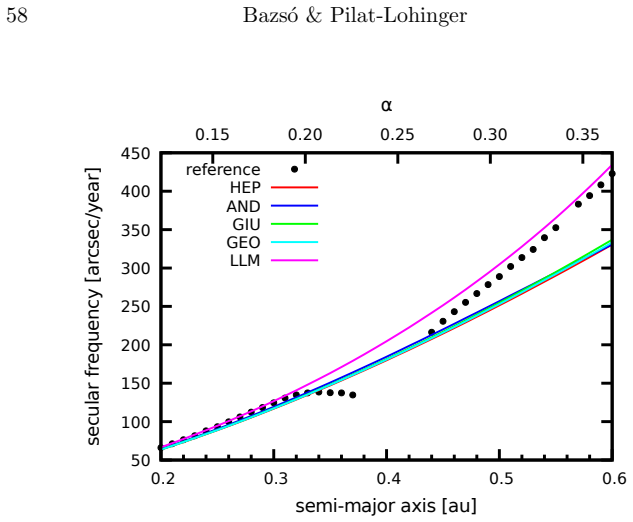
The central assertion is that $g_{\mathrm{LLM}} = \frac{1}{4}\mu\alpha^2 n b_{3/2}^{(1)}(\alpha)(1-e_B^2)^{-3/2}$ provides quantitatively correct estimates of a test particle's secular frequency in a binary system, and that summing this term over perturbing companions, as in Eq. (11), extends the estimate to four-body and multi-perturber systems. The construction is an interpolation: as $e_B\to0$ the formula reduces to the Laplace-Lagrange frequency, and as $\alpha\to0$ it reduces to the Heppenheimer frequency. In the HD 41004 restricted four-body test the LLM tracks the numerical reference values, with only a small systematic overestimate at larger $\alpha$, whereas the Heppenheimer, Giuppone, Andrade-Ines, and Georgakarakos models, all built for a single external perturber, fail to reproduce the secondary star's contribution in that regime.
Load-bearing premise
The load-bearing premise is that the Heppenheimer eccentricity factor $(1-e_B^2)^{-3/2}$ can be attached as a simple multiplier to the full Laplace-Lagrange frequency, even though that factor is derived only in the small-$\alpha$ quadrupole limit; if the true eccentricity dependence does not factor this way, the LLM will misestimate at large $e_B$ and larger $\alpha$.
Editorial extensions
If this is right
- Because the LLM reduces to the standard Laplace-Lagrange model when $e_B\to0$ and to the Heppenheimer model when $\alpha\to0$, it provides one interpolation formula that covers both classical limits.
- The linear summation in Eq. (11) applies to any number of perturbing companions, so multi-star systems with additional planets can be treated without new numerical integrations.
- In the HD 41004 restricted four-body system the LLM matches the numerical secular frequencies outside the resonance gaps, while the three-body models deviate increasingly for larger $\alpha$.
- The formula makes fast parameter studies of secular resonance locations, including resonances inside habitable zones, feasible for large samples of observed binary systems.
Reading between the lines
- If the factorized eccentricity correction is more than an interpolation, a similar $(1-e_B^2)^{-3/2}$ multiplier might apply to higher-order terms in the Laplace-coefficient expansion, a possibility the paper does not test.
- The reported systematic overestimate at larger $\alpha$ suggests the true frequency is bracketed by the LLM and the small-$\alpha$ Heppenheimer value, so the two could be used together as an error estimate.
- Since the summation in Eq. (11) is linear, the same formula could in principle also treat giant planets as perturbers of a massless test particle, extending the approach from multi-star to multi-planet secular dynamics.
Editorial analysis
A structured set of objections, weighed in public.
Referee Report
Summary. The paper reviews several analytical models for the secular precession frequency of a circumstellar planet in a binary star system (Heppenheimer, Giuppone, Andrade-Ines & Eggl, Georgakarakos, and the Laplace-Lagrange theory), applies them to synthetic and observed systems, and introduces a 'modified Laplace-Lagrange model' (LLM). The LLM is defined in Eq. (10) as the standard Laplace-Lagrange frequency multiplied by the Heppenheimer eccentricity factor (1 - e_B^2)^(-3/2), and is generalized to multiple perturbers via linear superposition in Eq. (11). The central claim is that this ad hoc modification gives 'quantitatively correct estimates' of the secular frequency, supported by a comparison with numerical integrations of the restricted four-body problem for the HD 41004 system (Figure 3).
Significance. If the central claim holds, the paper provides a simple closed-form extension of the Laplace-Lagrange theory that accounts for eccentric perturbers and can be applied to multiple perturbers, which would be useful for parameter surveys and secular resonance studies. The paper's strengths are that no parameters are fitted to the reference data, the proposed model has the correct limiting behavior (reducing to LL for e_B=0 and to HEP for small alpha), and the numerical reference is obtained from independent direct integrations. However, the validation is incomplete: the new eccentricity factor is never tested in isolation, and the quantitative claim is not backed by a defined error metric. The contribution is modest but potentially useful if the identified gaps are addressed.
major comments (4)
- [Section 4, Eq. (10)] The eccentricity factor (1 - e_B^2)^(-3/2) is introduced 'ad hoc' (the paper's own wording) and is not derived from the secular perturbation equations. The two limiting cases (e_B -> 0 and alpha -> 0) do not establish that the factorized form is valid at intermediate alpha and large e_B. In fact, the higher-order model in Eq. (5) (Georgakarakos) shows e_B-dependent corrections that do not simply factor out of the alpha-dependence, so the factorization in Eq. (10) is a genuinely load-bearing assumption. Since the central claim of 'quantitatively correct estimates' depends on this factorization, the paper should either provide a derivation or a clean numerical test that isolates the factor.
- [Section 4, Figure 3] The comparison in Figure 3 does not isolate the new ingredient of the LLM. The LLM curve is computed in the R4BP with the sum over both perturbers (Eq. 11), while all competing models are computed in the ER3BP with only the secondary star. The unmodified Laplace-Lagrange model (Eq. 6) evaluated in the same R4BP setup (i.e., summed over both perturbers but without the eccentricity factor) is not shown. Without this benchmark, the agreement of the LLM with the reference could be attributable to the linear superposition property of the LL theory rather than to the ad hoc factor. The authors should add the conventional LL model (summed over both perturbers) to Figure 3.
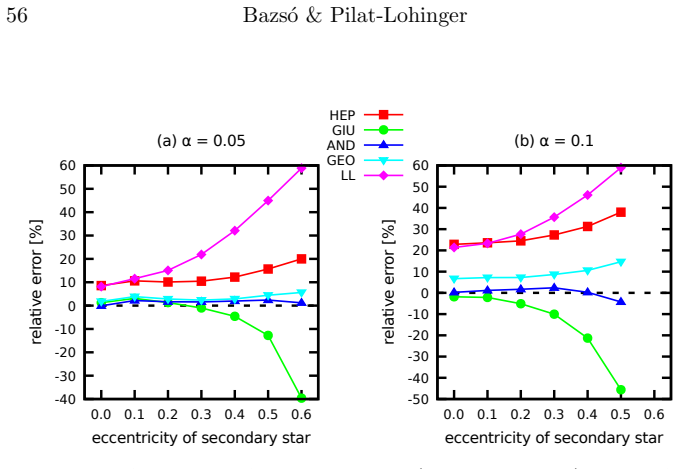
- [Section 3, Figure 2] Figure 2 is the only experiment that directly varies the perturber's eccentricity, and it shows that the conventional LL model fails for e_B > 0.1. However, the LLM is not included in this figure. To support the claim that Eq. (10) improves the LL model, the authors should show the LLM curve in the ER3BP comparison (Figure 2), where the only difference from LL is the eccentricity factor. This would provide a direct, controlled test of the load-bearing assumption.
- [Section 4, final paragraph and Figure 3] The statement that the LLM gives 'quantitatively correct estimates' is not supported by a quantitative measure. Figure 3 shows a visible systematic overestimate for larger alpha, and no error bars, RMS differences, or relative error values are provided. The authors should present a quantitative comparison (e.g., relative error as a function of alpha) for the LLM against the numerical reference, and ideally also against the unmodified LL model in the same setup, to substantiate the central claim.
minor comments (3)
- [Section 2.1.4 and Figure 3] The symbol alpha is defined in Section 2.1.4 as a_P/a_B, but in Figure 3 and its description it is reused for a/a_P (the ratio of the test particle's semi-major axis to that of the giant planet). This notational conflict is confusing and should be resolved, for example by using a different symbol for the test-particle ratio.
- [Abstract and Section 4] The abstract claims 'better frequency estimates than the traditional model for large eccentricities of the perturber,' but the only application of the new model (Figure 3) uses e_B = 0.2, which is not 'large' in the context of the paper (Figure 2 covers up to e_B = 0.6). Either test the LLM at larger e_B or soften the claim.
- [Section 2.2.5, Eq. (7)] The notation for the Laplace coefficient b^{(1)}_{3/2} is introduced without explicitly stating that the superscript (1) denotes the order k in Eq. (7). This should be stated for clarity, especially for readers not familiar with Laplace coefficients.
Circularity Check
No significant circularity: the modified Laplace-Lagrange model is an explicitly ad hoc interpolation tested against independent numerical integrations, and the paper's self-citations are motivational only.
full rationale
The paper introduces Eq. (10) by multiplying the textbook Laplace-Lagrange frequency (Eq. 6) with the Heppenheimer (1978) eccentricity factor. Section 4 states this is done 'ad hoc' and the formula is described as an interpolating limit between LL and HEP. No parameter is fitted to the reference integrations in this paper. The reference values in Figs. 2 and 3 come from direct numerical integration of the full 3BP / R4BP, so the comparison is an external, independent benchmark rather than a restatement of the model's inputs. The multi-perturber sum in Eq. (11) is a standard Laplace-Lagrange property cited to Murray & Dermott (1999), an external textbook. Self-citations to Pilat-Lohinger et al. (2016) and Bazsó et al. (2017) provide motivation and system parameters but do not carry the derivation of Eq. (10). The weakest point is that the eccentricity correction is an ansatz, not derived, and Fig. 2 omits the LLM while Fig. 3 compares LLM in a different dynamical model (R4BP) than the other analytical curves (ER3BP); however, these are validation/comparison concerns, not circularity. The central claim would be circular only if the numerical reference had been generated from Eq. (10) or if the Heppenheimer factor had been fitted to the same data, which is not the case.
Assumptions & free parameters
assumptions (4)
- domain assumption The system is coplanar: all objects move in a common plane.
- domain assumption The planet is treated as massless (restricted problem); it does not perturb the binary.
- standard math Secular contributions from multiple perturbers add linearly.
- ad hoc to paper The HEP factor (1 - e_B^2)^(-3/2) can be applied as a multiplicative correction to the full LL frequency.
Cite this review
Pith. "Pith review of Analytical estimates of secular frequencies for binary star systems." pith.science (2026). https://pith.science/paper/7RRBGR4L
@misc{pith2026190801048,
  author       = {Pith},
  title        = {Pith review of: Analytical estimates of secular frequencies for binary star systems},
  year         = {2026},
  howpublished = {\url{https://pith.science/paper/7RRBGR4L}},
  note         = {Machine review of arXiv:1908.01048}
}
read the original abstract
Binary and multiple star systems are extreme environments for the formation and long-term presence of extrasolar planets. Circumstellar planets are subject to gravitational perturbations from the distant companion star, and this interaction leads to a long-period precession of their orbits. We investigate analytical models that allow to quantify these perturbations and calculate the secular precession frequency in the dynamical model of the restricted three-body problem. These models are applied to test cases and we discuss some of their shortcomings. In addition, we introduce a modified Laplace-Lagrange model which allows to obtain better frequency estimates than the traditional model for large eccentricities of the perturber. We then generalize this model to any number of perturbers, and present an application to the four-body problem.
Figures
Reference graph
Works this paper leans on
- [1]
-
[2]
Secular Orbit Evolution in Systems with a Strong External Perturber - A Simple and Accurate Model
Andrade-Ines, E., & Eggl, S. 2017, ArXiv e-prints, arXiv:1701.03425 Bazs´ o,´A., Pilat-Lohinger, E., Eggl, S., et al. 2017, MNRAS, 466, 1555 Beaug´ e, C., & Nesvorn´ y, D. 2012, ApJ, 751, 119
work page Pith review arXiv 2017
- [3]
-
[4]
Brouwer, D., & Clemence, G. M. 1961, Methods of Celestial Mechanics (Academic
work page 1961
-
[5]
Chambers, J. E. 1999, MNRAS, 304, 793
1999
-
[6]
Dodson-Robinson, S. E., Veras, D., Ford, E. B., & Beichman, C. A. 2009, ApJ, 707, 79 Duchˆ ene, G., & Kraus, A. 2013, ARA&A, 51, 269
work page 2009
-
[7]
1991, A&A, 248, 485
Duquennoy, A., & Mayor, M. 1991, A&A, 248, 485
1991
- [8]
Show all 45 references
-
[9]
2010, in Lecture Notes in Physics, Berlin Springer Ver- lag, Vol
Eggl, S., & Dvorak, R. 2010, in Lecture Notes in Physics, Berlin Springer Ver- lag, Vol. 790, Dynamics of Small Solar System Bodies and Exoplanets, ed. J. Souchay & R. Dvorak, 431–480
2010
-
[10]
2013, ApJ, 764, 130
Eggl, S., Haghighipour, N., & Pilat-Lohinger, E. 2013, ApJ, 764, 130
2013
-
[11]
1974, Cel
Everhart, E. 1974, Cel. Mech., 10, 35
1974
-
[12]
A., Anglada-Escude, G., Arriagada, P., et al
Fischer, D. A., Anglada-Escude, G., Arriagada, P., et al. 2016, PASP, 128, 066001 60 Bazs´ o & Pilat-Lohinger
2016
-
[13]
Program Generation, Optimization, and Platform Adaptation
Frigo, M., & Johnson, S. G. 2005, Proceedings of the IEEE, 93, 216, special issue on “Program Generation, Optimization, and Platform Adaptation”
2005
-
[14]
2017, in Proceedings of the First Greek-Austrian Workshop on Extrasolar Planetary Systems, ed
Funk, B., Pilat-Lohinger, Bazs´ o,´A., & Bancelin, D. 2017, in Proceedings of the First Greek-Austrian Workshop on Extrasolar Planetary Systems, ed. T. I
2017
-
[15]
2002, MNRAS, 337, 559 —
Georgakarakos, N. 2002, MNRAS, 337, 559 —. 2003, MNRAS, 345, 340 —. 2006, MNRAS, 366, 566 —. 2009, MNRAS, 392, 1253
2002
-
[16]
A., Leiva, A
Giuppone, C. A., Leiva, A. M., Correa-Otto, J., & Beaug´ e, C. 2011, A&A, 530, A103
2011
-
[17]
1984, A&A, 132, 203
Hanslmeier, A., & Dvorak, R. 1984, A&A, 132, 203
1984
-
[18]
Heppenheimer, T. A. 1978, A&A, 65, 421
1978
-
[19]
J., & Wiegert, P
Holman, M. J., & Wiegert, P. A. 1999, AJ, 117, 621
1999
-
[20]
2015, ApJ, 799, 147
Jang-Condell, H. 2015, ApJ, 799, 147
2015
-
[21]
M., & Sandford, E
Kipping, D. M., & Sandford, E. 2016, MNRAS, 463, 1323
2016
-
[22]
L., Ireland, M
Kraus, A. L., Ireland, M. J., Huber, D., Mann, A. W., & Dupuy, T. J. 2016, AJ, 152, 8
2016
-
[23]
Lin, D. N. C., & Papaloizou, J. 1986, ApJ, 309, 846
1986
-
[24]
1990, The three-body problem (Elsevier, Amsterdam)
Marchal, C. 1990, The three-body problem (Elsevier, Amsterdam)
1990
-
[25]
2008, Science, 322, 1348
Marois, C., Macintosh, B., Barman, T., et al. 2008, Science, 322, 1348
2008
-
[26]
S., & Papaloizou, J
Masset, F. S., & Papaloizou, J. C. B. 2003, ApJ, 588, 494
2003
-
[27]
2009, A&A, 494, 373
Mugrauer, M., & Neuh¨ auser, R. 2009, A&A, 494, 373
2009
-
[28]
D., & Dermott, S
Murray, C. D., & Dermott, S. F. 1999, Solar system dynamics (Cambridge Uni- versity Press)
1999
-
[29]
M., & Rasio, F
Naoz, S., Farr, W. M., & Rasio, F. A. 2012, ApJL, 754, L36
2012
-
[30]
2011, The Exoplanet Handbook (Cambridge University Press)
Perryman, M. 2011, The Exoplanet Handbook (Cambridge University Press)
2011
-
[31]
2016, AJ, 152, 139
Pilat-Lohinger, E., Bazs´ o,´A., & Funk, B. 2016, AJ, 152, 139
2016
-
[32]
2002, Cel
Pilat-Lohinger, E., & Dvorak, R. 2002, Cel. Mech. Dyn. Astron., 82, 143
2002
-
[33]
1988, A&A, 191, 385
Rabl, G., & Dvorak, R. 1988, A&A, 191, 385
1988
-
[34]
J., Mason, B
Raghavan, D., Henry, T. J., Mason, B. D., et al. 2006, ApJ, 646, 523
2006
-
[35]
A., Henry, T
Raghavan, D., McAlister, H. A., Henry, T. J., et al. 2010, ApJS, 190, 1
2010
-
[36]
2012, A&A, 542, A92
Roell, T., Neuh¨ auser, R., Seifahrt, A., & Mugrauer, M. 2012, A&A, 542, A92
2012
-
[37]
2011, A&A, 532, A79
Schneider, J., Dedieu, C., Le Sidaner, P., Savalle, R., & Zolotukhin, I. 2011, A&A, 532, A79
2011
-
[38]
2015, MNRAS, 453, 2308
Schwarz, R., Bazs´ o,´A., Funk, B., & Zechner, R. 2015, MNRAS, 453, 2308
2015
-
[39]
2017, in Proceedings of the First Greek-Austrian Workshop on Extrasolar Planetary Systems, ed
Schwarz, R., Funk, B., Bazs´ o, ´A., & Eggl, S. 2017, in Proceedings of the First Greek-Austrian Workshop on Extrasolar Planetary Systems, ed. T. I. Maindl, H. Varvoglis, & R. Dvorak, 155–179
2017
-
[40]
2016, MNRAS, 460, 3598
Schwarz, R., Funk, B., Zechner, R., & Bazs´ o,´A. 2016, MNRAS, 460, 3598
2016
-
[41]
1967, Theory of orbits
Szebehely, V. 1967, Theory of orbits. The restricted problem of three bodies (Aca- demic Press, New York) —. 1984, Celestial Mechanics, 34, 49
1967
-
[42]
2015, in Planetary Exploration and Science: Analytical estimates of secular frequencies 61 Recent Results and Advances, ed
Thebault, P., & Haghighipour, N. 2015, in Planetary Exploration and Science: Analytical estimates of secular frequencies 61 Recent Results and Advances, ed. S. Jin, N. Haghighipour, & W.-H. Ip, Springer Geophysics, Springer-Verlag, Berlin Heidelberg, 309–340
2015
-
[43]
2014, AJ, 147, 87 ˇSidlichovsk´ y, M., & Nesvorn´ y, D
Tokovinin, A. 2014, AJ, 147, 87 ˇSidlichovsk´ y, M., & Nesvorn´ y, D. 1996, Cel. Mech. Dyn. Astron., 65, 137
2014
-
[44]
A., Xie, J.-W., & Ciardi, D
Wang, J., Fischer, D. A., Xie, J.-W., & Ciardi, D. R. 2014, ApJ, 791, 111
2014
-
[45]
Ward, W. R. 1998, in Astronomical Society of the Pacific Conference Series, Vol. 148, Origins, ed. C. E. Woodward, J. M. Shull, & H. A. Thronson, Jr., 338 62
1998
Reviewed August 14, 2026 · model on record in the stance chip above.
Discussion (0). Continue with ORCID to comment.