REVIEW 3 major objections 5 minor 46 references
Calculating n-Point Charge Correlations in Evolving Systems
T0 review · 3 major / 5 minor · reviewed 2026-08-14 · deepseek-v4-flash
Pith's one-line read This paper claims that, under local chemical equilibrium, every non-local n-point charge correlation in a diffusing, expanding system is fixed by the equilibrium susceptibilities and the two-point correlation, and it gives a diagrammatic…
desk verdict A genuine extension of the two-point charge-correlation formalism to three points, with the arbitrary-n claim more programmatic than proven, but worth a careful referee. read the letter →
The pith
A machine-rendered reading of the paper's core claim, the machinery that carries it, and where it could break.
The reading
What carries the argument
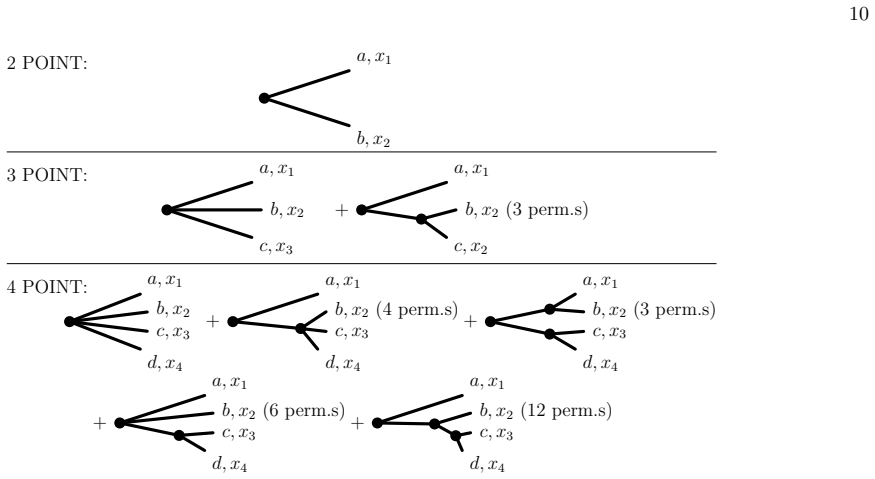
The central object is a diagrammatic expansion whose elements are charge-propagation Green's functions $G_{ab}$ and local vertices $V^{(0\to n)}$ and $V^{(1\to n)}$. A vertex with zero incoming lines and n outgoing lines deposits the source that appears when an n-particle susceptibility changes along the fluid trajectory; a vertex $V^{(1\to n)}$ acts when an equilibrium response coefficient $L^{(n)}$ changes, splitting a single-particle charge into the charges of several particles. The load-bearing identity is Eq. (15), which expresses the two-charges-on-one-particle correlation $C^{(2;1)}_{ab;c}$ as $L^{(2)}_{ab,e} C^{(1;1)}_{e;c}$, with $L^{(2)} = \chi^{(3)}[\chi^{(2)}]^{-1}$; this is what converts equilibrium susceptibilities into source terms at every order and makes the equations close.
What would settle it
Evolve the same initial conditions with this diagrammatic scheme and with an explicit hadronic cascade that includes chemical reactions; if the three-point correlators, or the derived three-charge cumulants in a fixed acceptance, disagree by more than Monte Carlo errors, the equilibrium slave relation in Eq. (15) is wrong.
Extended reading notes
Core claim
The paper argues that the three-point correlation can be split into a local same-particle piece $\chi^{(3)}$, pieces where two charges sit on one particle ($C^{(2;1)}$), and a fully non-local piece ($C^{(1;1;1)}$); assuming chemical equilibrium makes the $C^{(2;1)}$ pieces proportional to $C^{(1;1)}$ via $L^{(2)} = \chi^{(3)}[\chi^{(2)}]^{-1}$ (Eq. 15). Writing the total correlation's time derivative from local charge conservation and subtracting the two-point terms yields Eq. (23), a closed evolution equation for $C^{(1;1;1)}$ in which the only inputs are the equilibrium susceptibilities, the two-point correlator, and diffusive currents. The paper then states that all n-point correlators can be generated from the same building blocks: Green's functions for diffusive charge propagation, sources $V^{(0\to n)}$ for the same-particle correlations feeding the non-local hierarchy, and vertices $V^{(1\to n)}$ that split one particle's charge into several as the $L^{(n)}$ response changes along the flow. The central discovery, on the paper's terms, is that the entire non-local correlation hierarchy is slaved to equilibrium local physics and the two-point function.
Load-bearing premise
The chain collapses if a small charge added to a fluid element does not immediately repartition among particle species according to chemical equilibrium, because then two charges carried by one particle are no longer slaved to the single-charge correlation, and all higher-order vertices lose their input.
Editorial extensions
If this is right
- Cumulants of conserved charge up to arbitrary order can be computed for an expanding, diffusing system without evolving n-body dynamics; one needs only the equilibrium susceptibilities and the two-point correlator.
- Measured fluctuation data from heavy-ion collisions, including third- and fourth-order baryon or charge cumulants, can be confronted with predictions that include finite-size and diffusion effects rather than only equilibrium expectations.
- The method splits off short-range, chemically equilibrated correlation from the long-range balancing correlation, so it can be grafted onto hydrodynamic treatments of critical or phase-separating regions to estimate the 'background' from charge conservation.
- A random-walk Monte Carlo implementation is natural for the diagrams, and because only charges originating from the same source cluster are correlated, the combinatorial noise that would plague direct n-particle sampling is avoided.
- If the diffusive current involves a nondiagonal diffusivity matrix, the sampling charges can be reassigned among its eigenvectors with adjusted weights, keeping the method applicable to hadronic matter where u, d, s charges are mixed.
Reading between the lines
- Because the whole hierarchy rests on linear response at a point, one could test the scheme's range by replacing the equilibrium susceptibilities with time-dependent effective ones and checking whether the same diagram topology still reproduces a microscopic simulation; the paper does not perform that test.
- The formalism suggests a natural consistency check: the three- and four-point cumulants measured in different rapidity or momentum windows must satisfy integral relations set by charge conservation, so deviations from those relations would quantify how strongly the local-equilibrium assumption is violated.
- The same vertex structure could be transferred to other locally conserved quantities, such as energy or momentum currents, wherever short-range equilibrium fluctuations relax into long-range diffusive tails.
- If applied to critical-point searches, the method gives a concrete way to estimate how much of an observed higher-order fluctuation signal is merely the consequence of charge conservation and finite time, rather than critical dynamics.
Editorial analysis
A structured set of objections, weighed in public.
Referee Report
Summary. This manuscript presents a diagrammatic formalism for evolving n-point charge correlation functions in a dynamically expanding medium, with the stated goal of treating arbitrary n. The author starts by reviewing the two-point case, where the local (single-particle) susceptibility chi^(2) is assumed equilibrated and the non-local part C^(1;1) evolves diffusively under charge conservation. The core derivation is for the three-point function: using local chemical equilibrium, the two-charge-on-one-particle correlator C^(2;1) is related to C^(1;1) through L^(2)=chi^(3)[chi^(2)]^{-1} (Eq. 15). Surface-integral arguments lead to an evolution equation for D_t C^(tot) (Eqs. 18-20), which is combined with the evolution of C^(2;1) to yield a closed equation for D_t C^(1;1;1) (Eq. 23). The paper then defines graphical vertices V^(0->n) and V^(1->n) and claims these extend the construction to arbitrary n, discusses the connection to charge fluctuations, and proposes random-walk Monte Carlo algorithms for implementation. Section VII carefully delineates the assumptions: local chemical equilibrium is critical, and the approach fails for long-range critical correlations.
Significance. If the central claims are correct, this would be a useful formal tool, as existing treatments of charge fluctuations in heavy-ion collisions are largely limited to two-point correlations. The manuscript is commendably concrete: the inputs (chi^(n), diffusivity D) are stated as external and the evolution equations are initial-value problems with no hidden free parameters, and the proposed Monte Carlo algorithm (Sec. VI) offers a practical path to implementation. The paper also makes a falsifiable prediction by giving explicit source terms for three- and four-point correlators. However, the advertised 'arbitrary n' result is not actually proven in the text, and the three-point derivation contains transcription errors that make the cancellation leading to Eq. (23) unreliable as written. These issues are central rather than cosmetic, so the significance of the manuscript can only be assessed after the derivation is repaired and the recursion is either proven or explicitly stated as a conjecture.
major comments (3)
- [Section III, Eqs. (18)-(20)] The transcription of the surface-integral conservation law into the differential form is not consistent as written. In Eq. (19) the second-to-last line uses L^(2)_bc,d(r13) with <delta_rho_d(r23) j_a(r1)>, whereas the corresponding term in Eq. (18) has L^(2)_bc,d(r23); a similar argument mismatch appears in the last line of Eq. (19). More seriously, the last three lines of Eq. (20) contain <j_d delta_rho> where the corresponding terms in Eq. (19) (and Eq. (18)) have <delta_rho_d j_c> and derivatives with respect to the appropriate coordinate, so the bracketed factors in Eq. (20) duplicate the earlier three terms rather than representing the three distinct flux contributions. Because Eq. (23) is obtained by cancellation between Eq. (19) and Eq. (21), these inconsistencies mean the central three-point evolution equation is not established by the text. The author should re-derive Eqs. (19)-(20) carefully and correct the index/argument typos before the derivation can be endorsed.
- [Section IV and Eq. (16)] The abstract claims the formalism provides correlations 'for arbitrary n', but the extension beyond n=3 is asserted rather than proven. Equation (16) is stated as 'one can readily show' for any product of m charge densities, yet no proof is given, and it is not obvious that the same slaving relation holds for mixed cluster types such as C^(2;2) (two charges on one particle and two on another) that appear for n>=4. The graphical vertices V^(0->4) and V^(1->3) are written down, but the general inclusion-exclusion cancellation that produced Eq. (23) for the three-point case is not demonstrated for all partitions of n points. To support the arbitrary-n claim, the author should either provide a general combinatorial/inductive proof of the diagrammatic recursion, or explicitly state that the extension is a plausible construction and limit the abstract and conclusions to the n=3 and n=4 cases that are actually derived.
- [Section III, Eq. (22)] The definition of the derivative d_t is not a conventional local operator: it is defined through the ratio <j_d(r,t)X>/<delta_rho_d(r,t)X>, which depends on the operator X to its right. In Eq. (21) this ratio is evaluated for X = delta_rho_c(r3), but in the general vertices V^(1->n) of Eq. (28) the same symbol d_t is used without specifying which correlator supplies the denominator. As a result, the source terms S^(2;1) and the vertices V^(1->n) are not uniquely defined local functions of r and t unless the ratio is assumed to be the same for all X (e.g., equal to the fluid velocity plus a diffusive drift). The author should clarify whether d_t is intended as an operator acting on L with the ratio supplied by the attached correlation function, and explain how this is handled in the Monte Carlo representation, since as written the closed form of the evolution equations is ambiguous.
minor comments (5)
- [Eq. (23)] The last source term on the right-hand side is written as S^(2;1)_ab;c(r23,r1,t) delta(r2-r3), but for r2=r3 the pair on one particle is (b,c), so this should be S^(2;1)_bc;a(r23,r1,t); the same notational slip also appears in the corresponding line of Eq. (19) and Eq. (20).
- [Eq. (28)] The definition of V^(0->3) has a dangling '(r,t)' at the end of the last line, so the expression as printed is not well-formed.
- [Eq. (30)] The first term in the definition of F^(4) reads '1/V<delta Q_a Q_b delta Q_c delta Q_d>' and is missing a delta on the second charge; it should be <delta Q_a delta Q_b delta Q_c delta Q_d>.
- [Section VI.A, Eqs. (32)-(33)] The basis-rotation algorithm contains typos: in the definition of Z, the symbols n' and v' appear where b' and c' are intended, and the first condition in Eq. (33) mixes the interval condition with an '<r' in an inconsistent manner.
- [References] Reference [19] is incomplete, listing only 'D. McDonald' with no title, journal, or arXiv identifier; please supply the full citation.
Circularity Check
No significant circularity: the derivation evolves correlation functions as initial-value problems from equilibrium susceptibilities and diffusive transport, with no fitted parameter or self-citation chain doing the work.
full rationale
The paper derives Eq. (23) for D_t C(1;1;1) by applying charge conservation, Eqs. (18)-(20), to the decomposition of the three-point function, Eq. (9), and then comparing with the time derivative of the two-point-slaved term, Eq. (21). The resulting source terms S(3) and S(2;1) are expressed through -D_t chi^(3), L^(2), and [d_t L^(2)] C(1;1), all of which are either external equilibrium inputs or already-evolved lower-order correlation functions. Equation (15) is a physical closure relation, not a definitional identity: it follows from the local-chemical-equilibrium assumption in Eq. (11), and Sec. VII explicitly states 'Local chemical equilibrium was critical in deriving Eq. (15).' No parameter is fitted to the n-point correlations that the paper claims to predict, and no n-point output is used to define any input. The main mathematical caveat is that Eq. (16) is asserted as a generalization of Eq. (15) and the diagrammatic vertices are explicitly written only through fourth order, so the 'arbitrary n' claim rests on an extrapolation that is not fully proved; however, an unproved generalization is a completeness or correctness concern, not circularity. Prior work in Refs. [22-24] supplies the two-point method and applications, but the central three-point derivation in Sec. III is performed in this paper, and the equilibrium susceptibilities chi^(n) are taken from lattice and hadron-gas physics rather than from a same-author uniqueness theorem. The paper is therefore self-contained with respect to its central evolution equations and does not reduce its predictions to its inputs by construction.
Assumptions & free parameters
assumptions (5)
- domain assumption Local charge correlations are equilibrated, so the local susceptibility χ(n) is a known external input.
- domain assumption Particle multiplicities respond linearly and in chemical equilibrium to local charge perturbations: δN_s = ⟨N_s⟩ δµ_a q_s,a (Eq. 11).
- domain assumption Non-local correlations evolve diffusively with a known diffusivity tensor D, with j_a = -D_ab ∇ δρ_b.
- domain assumption Short-range and long-range parts of the correlation are cleanly separable; the non-local part extends beyond the quasi-particle size.
- standard math Charge conservation: the evolution of density correlations is governed by continuity equations for the charge currents (Eq. 3).
Cite this review
Pith. "Pith review of Calculating n-Point Charge Correlations in Evolving Systems." pith.science (2026). https://pith.science/paper/7GWVT3SQ
@misc{pith2026190801053,
  author       = {Pith},
  title        = {Pith review of: Calculating n-Point Charge Correlations in Evolving Systems},
  year         = {2026},
  howpublished = {\url{https://pith.science/paper/7GWVT3SQ}},
  note         = {Machine review of arXiv:1908.01053}
}
abstract
In dynamic systems, charge susceptibilities and local charge correlations change with time. These changes are accompanied by non-local correlations which spread diffusively with time and are constrained by local charge conservation. Assuming the local features of the correlation, which for a gas would be the correlation of charges within the same particle, are equilibrated, a diagrammatic formalism is presented for calculating the evolution of the associated non-local correlations. These provide correlations of $n$ density operators at different positions for arbitrary $n$. The techniques were developed with an eye towards relativistic heavy-ion collisions, and can account for correlations indexed by up, down and strange charges. Understanding the evolution of such correlations is crucial if one is to interpret measurements of charge fluctuations from the Relativistic Heavy-Ion Collider.
Figures

Reference graph
Works this paper leans on
-
[1]
Koch, Relativistic Heavy Ion Physics , R
V. Koch, Relativistic Heavy Ion Physics , R. Stock (Ed.), Springer, Heidelberg, 2010, p. 626-652. (Landolt-Boernstein New Series I, v. 23). (ISBN: 978-3-642-01538-0, 978-3-642-01539-7 (eBook)). 14
work page 2010
- [2]
-
[3]
S. Borsanyi, Z. Fodor, S. D. Katz, S. Krieg, C. Ratti and K. Szabo, JHEP 1201, 138 (2012) doi:10.1007/JHEP01(2012)138 [arXiv:1112.4416 [hep-lat]]
arXiv 2012
-
[4]
A. Bazavov et al. [HotQCD Collaboration], Phys. Rev. D 86, 034509 (2012) doi:10.1103/PhysRevD.86.034509 [arXiv:1203.0784 [hep-lat]]
arXiv 2012
-
[5]
A. Bazavov et al. , Phys. Rev. Lett. 113, no. 7, 072001 (2014) doi:10.1103/PhysRevLett.113.072001 [arXiv:1404.6511 [hep- lat]]
arXiv 2014
-
[6]
P. Romatschke and U. Romatschke, Phys. Rev. Lett. 99, 172301 (2007) doi:10.1103/PhysRevLett.99.172301 [arXiv:0706.1522 [nucl-th]]
arXiv 2007
-
[7]
H. Song, S. A. Bass, U. Heinz, T. Hirano and C. Shen, Phys. Rev. Lett. 106, 192301 (2011) Erratum: [Phys. Rev. Lett. 109, 139904 (2012)] doi:10.1103/PhysRevLett.106.192301, 10.1103/PhysRevLett.109.139904 [arXiv:1011.2783 [nucl-th]]
arXiv 2011
- [8]
Show all 46 references
-
[9]
Auvinen, J
J. Auvinen, J. E. Bernhard, S. A. Bass and I. Karpenko, Phys. Rev. C 97, no. 4, 044905 (2018) doi:10.1103/PhysRevC.97.044905 [arXiv:1706.03666 [hep-ph]]
2018 arXiv
-
[10]
V. Koch, A. Majumder and J. Randrup, Phys. Rev. Lett. 95, 182301 (2005)
2005
-
[11]
Athanasiou, K
C. Athanasiou, K. Rajagopal and M. Stephanov, Phys. Rev. D 82, 074008 (2010)
2010
-
[12]
M. A. Stephanov, Phys. Rev. Lett. 102, 032301 (2009)
2009
-
[13]
M. A. Stephanov, Phys. Rev. Lett. 107, 052301 (2011). doi:10.1103/PhysRevLett.107.052301 [arXiv:1104.1627 [hep-ph]]
2011 arXiv
-
[14]
Vovchenko, D
V. Vovchenko, D. V. Anchishkin, M. I. Gorenstein and R. V. Poberezhnyuk, Phys. Rev. C 92, no. 5, 054901 (2015) doi:10.1103/PhysRevC.92.054901 [arXiv:1506.05763 [nucl-th]]
2015 arXiv
-
[15]
M. M. Aggarwal et al. [STAR Collaboration], Phys. Rev. Lett. 105, 022302 (2010) doi:10.1103/PhysRevLett.105.022302 [arXiv:1004.4959 [nucl-ex]]
2010 arXiv
-
[16]
Adamczyk et al
L. Adamczyk et al. [STAR Collaboration], Phys. Rev. Lett. 112, 032302 (2014) doi:10.1103/PhysRevLett.112.032302 [arXiv:1309.5681 [nucl-ex]]
2014 arXiv
-
[17]
Adamczyk et al
L. Adamczyk et al. [STAR Collaboration], Phys. Rev. Lett. 113, 092301 (2014) doi:10.1103/PhysRevLett.113.092301 [arXiv:1402.1558 [nucl-ex]]
2014 arXiv
-
[18]
Adamczyk et al
L. Adamczyk et al. [STAR Collaboration], Phys. Lett. B 785, 551 (2018) doi:10.1016/j.physletb.2018.07.066 [arXiv:1709.00773 [nucl-ex]]
2018 arXiv
-
[20]
Stephanov and Y
M. Stephanov and Y. Yin, Phys. Rev. D 98, no. 3, 036006 (2018) doi:10.1103/PhysRevD.98.036006 [arXiv:1712.10305 [nucl-th]]
2018 arXiv
-
[21]
Stephanov and Y
M. Stephanov and Y. Yin, Nucl. Phys. A 967, 876 (2017) doi:10.1016/j.nuclphysa.2017.06.051 [arXiv:1704.07396 [nucl-th]]
2017 arXiv
-
[22]
Pratt, J
S. Pratt, J. Kim and C. Plumberg, Phys. Rev. C 98, no. 1, 014904 (2018)
2018
-
[23]
Pratt and C
S. Pratt and C. Plumberg, Phys. Rev. C 99, no. 4, 044916 (2019)
2019
- [24]
-
[25]
M. A. Stephanov and Y. Yin, Phys. Rev. Lett. 109, 162001 (2012) doi:10.1103/PhysRevLett.109.162001 [arXiv:1207.0747 [hep-th]]
2012 arXiv
-
[26]
Pratt, Phys
S. Pratt, Phys. Rev. C 96, no. 4, 044903 (2017)
2017
-
[27]
Paech, H
K. Paech, H. Stoecker and A. Dumitru, Phys. Rev. C 68, 044907 (2003)
2003
-
[28]
Paech and A
K. Paech and A. Dumitru, Phys. Lett. B 623, 200 (2005)
2005
-
[29]
Nahrgang, S
M. Nahrgang, S. Leupold, C. Herold and M. Bleicher, Phys. Rev. C 84, 024912 (2011)
2011
-
[30]
J. I. Kapusta and C. Young, Phys. Rev. C 90, no. 4, 044902 (2014)
2014
-
[31]
J. I. Kapusta, B. Mueller and M. Stephanov, Nucl. Phys. A 904-905, 499c (2013)
2013
-
[32]
Young, J
C. Young, J. I. Kapusta, C. Gale, S. Jeon and B. Schenke, Phys. Rev. C 91, no. 4, 044901 (2015)
2015
-
[33]
B. Ling, T. Springer and M. Stephanov, Phys. Rev. C 89, no. 6, 064901 (2014)
2014
-
[34]
Steinheimer, J
J. Steinheimer, J. Randrup and V. Koch, Phys. Rev. C 89, no. 3, 034901 (2014)
2014
-
[35]
Steinheimer and J
J. Steinheimer and J. Randrup, Phys. Rev. C 87, no. 5, 054903 (2013)
2013
-
[36]
Steinheimer and J
J. Steinheimer and J. Randrup, Phys. Rev. Lett. 109, 212301 (2012)
2012
-
[37]
Randrup, Phys
J. Randrup, Phys. Rev. C 82, 034902 (2010)
2010
-
[38]
Heiselberg, C.J
H. Heiselberg, C.J. Pethick, and D.G. Ravenhall, Ann. Phys. 223, 37 (1993)
1993
-
[39]
Heiselberg, C
H. Heiselberg, C. J. Pethick and D. G. Ravenhall, Phys. Rev. Lett. 61, no. 7, 818 (1988)
1988
-
[40]
Napolitani, M
P. Napolitani, M. Colonna and V. de la Mota, EPJ Web Conf. 88, 00003 (2015)
2015
-
[41]
Chomaz, M
P. Chomaz, M. Colonna and J. Randrup, Phys. Rept. 389, 263 (2004)
2004
-
[42]
Borderie et al
B. Borderie et al. [INDRA Collaboration], Phys. Rev. Lett. 86, 3252 (2001)
2001
-
[43]
Colonna, P
M. Colonna, P. Chomaz and S. Ayik, Phys. Rev. Lett. 88, 122701 (2002)
2002
-
[44]
Guarnera, M
A. Guarnera, M. Colonna and P. Chomaz, Phys. Lett. B 373, 267 (1996)
1996
-
[45]
Pratt, Phys
S. Pratt, Phys. Rev. C 85, 014904 (2012)
2012
-
[46]
Pratt, W
S. Pratt, W. P. McCormack and C. Ratti, Phys. Rev. C 92, 064905 (2015)
2015
-
[47]
Gavin, G
S. Gavin, G. Moschelli and C. Zin, Phys. Rev. C 94, no. 2, 024921 (2016)
2016
Reviewed August 14, 2026 · model on record in the stance chip above.
Discussion (0). Continue with ORCID to comment.