REVIEW 3 major objections 6 minor 22 references
Eccentricities and the Stability of Closely-Spaced Five-Planet Systems
T0 review · 3 major / 6 minor · reviewed 2026-08-14 · deepseek-v4-flash
Pith's one-line read Relative eccentricity, not individual eccentricity, controls the lifetime of closely packed five-planet systems; aligned eccentric orbits are nearly as stable as circular ones.
desk verdict A transparent numerical extension of the circular-orbit stability results to eccentric systems; the main quantitative caveat is the exclusion of first-synodic-period collisions from the fits, which needs a robustness check. read the letter →
The pith
A machine-rendered reading of the paper's core claim, the machinery that carries it, and where it could break.
The reading
What carries the argument
The machinery is a set of N-body integrations using a symplectic Wisdom-Holman integrator. Systems of five equal-mass (one Earth-mass) planets around a one-solar-mass star are initialized coplanar with semi-major axes spaced by a fixed multiple β of their mutual Hill radius, with one planet given an initial eccentricity e up to 0.05 or with all planets eccentric. Lifetime is defined as the time until any two objects come within 0.01 AU, and the resulting close-encounter times are fit to the log-linear relation log T = b'β' + c', where β' = β - 2√3, the two-planet Hill stability limit. A second tool is the angular momentum deficit (AMD), the amount by which each orbit's angular momentum falls short of a circular orbit of the same semi-major axis; comparing batches with equal AMD isolates whether total AMD or the location of the eccentricity controls stability.
What would settle it
Run the same batches of simulations (e.g., e1=0.05) with hundreds of randomly chosen initial longitudes instead of the golden-ratio set. If close-encounter times under ten years still occur at the same rate for small β, the excluded runs are real and the fitted slopes for eccentric systems would steepen; if they disappear, the paper's exclusion is justified.
Extended reading notes
Core claim
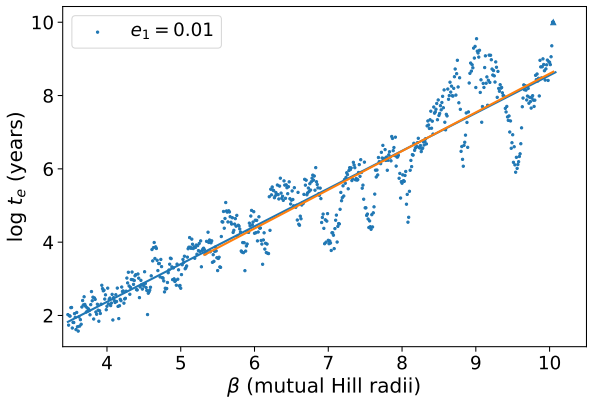
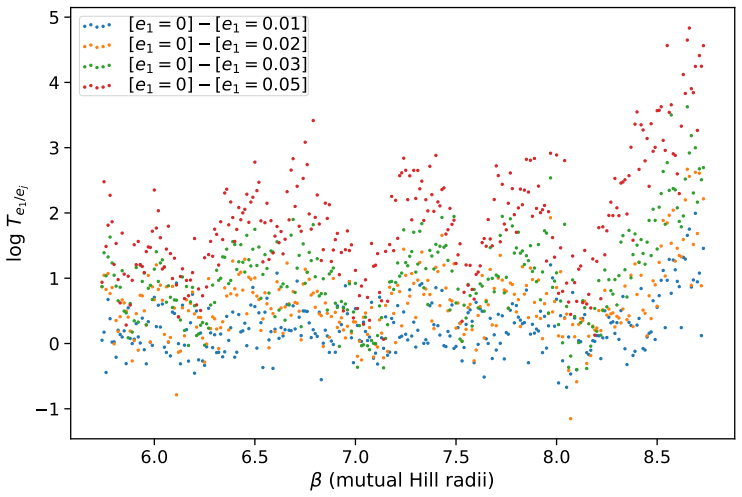
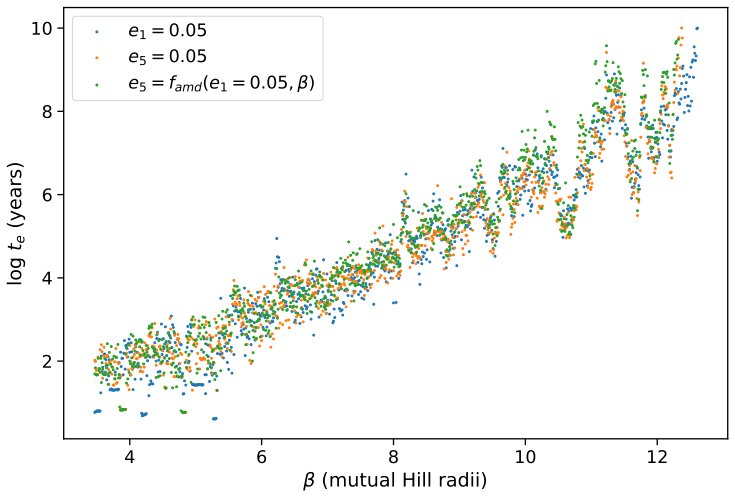
The central claim is that in these idealized planar five-planet systems, the quantity controlling dynamical lifetime is the difference between neighboring planets' eccentricity vectors—their relative eccentricity—rather than the individual eccentricity values. A single planet at e=0.05 reduces the system's close-encounter time by roughly a factor of 75 at a given spacing, with intermediate planets causing slightly more damage than inner or outer ones. But when all planets start at e=0.05 with aligned periapses, lifetimes are far longer than the single-eccentric-planet case and close to the circular baseline, whereas randomly oriented periapses over 360 degrees cut lifetimes dramatically and flatten the exponential fit. The interpretation is that aligned eccentric orbits reduce the minimum initial separation between neighboring orbits less than random phases do, matching the idea that minimum initial orbital separation is the key stability parameter. The paper also shows that lifetimes do not scale with total angular momentum deficit, arguing that mean motion resonances, not secular effects, dominate the destabilization.
Load-bearing premise
The fixed initial longitudes (golden-ratio phases and zero periapsis angles) are assumed representative, and the very short lifetimes seen in high-eccentricity runs at close spacing are judged to be phase artifacts and excluded from the fits; if those runs are physically meaningful, the reported slopes and the conclusion that eccentricity mainly shortens lifetimes at wide spacings would need revision.
Editorial extensions
If this is right
- At a fixed initial spacing, raising one planet's eccentricity from 0 to 0.05 shortens the system's lifetime by roughly two orders of magnitude, averaged over the β range studied.
- The exponential relationship between initial spacing and close-encounter time holds for all eccentric setups tested, with slopes that decrease as eccentricity rises, so a single fitted line per configuration still predicts stability.
- Systems with all five planets at e=0.05 and aligned periapses have lifetimes close to those of initially circular systems with the same spacing, so moderate aligned eccentricity does not force a system to be more spread out.
- Mean motion resonances destabilize eccentric systems too, but by smaller factors than circular ones, making the resonance dips in the lifetime-versus-spacing curves less pronounced.
Reading between the lines
- If relative eccentricity is the true control parameter, then a system's stability boundary may be determined by the distribution of periapsis separations across adjacent pairs; a direct test would be to run five-planet systems with the same minimum periapsis gap but different absolute eccentricities and check that lifetimes match.
- The paper excludes very short lifetimes that occur during the first synodic period as artifacts of the chosen initial longitudes; an ensemble with randomized initial longitudes would quantify how often such prompt instabilities actually occur and whether the fitted slopes for e=0.05 change.
- Because aligned periapses are strongly stabilizing, any physical process that aligns orbits—such as disk damping or tidal circularization—could permit more tightly packed planet systems than circular-orbit stability maps suggest; this is a testable prediction for observed multi-planet systems with moderate eccentricities.
Signed reviews
Editorial analysis
A structured set of objections, weighed in public.
Referee Report
Summary. This paper uses N-body integrations (REBOUND/WHFast) to study the dynamical stability of idealized systems of five equal-mass (1 M_Earth) planets orbiting a solar-mass star, uniformly spaced in mutual Hill radii (separation parameter β). It extends prior work on circular orbits by giving one planet an initial eccentricity up to e=0.05, by examining which planet is eccentric, by including AMD-matched outer-planet runs, and by considering all-planet eccentric configurations with aligned or randomly distributed periapses. The main findings are that (i) for fixed β, larger eccentricity generally shortens the close-encounter time; (ii) the log-linear (exponential) scaling of lifetime with β persists for eccentric systems but with shallower slopes; (iii) there is little systematic dependence on which planet is initially eccentric; and (iv) systems with all planets at e=0.05 and aligned periapses are much longer-lived than single-eccentric systems but somewhat shorter-lived than circular systems. Quantitative results are presented as log-linear fit coefficients in Table 3 and average lifetime ratios in Table 2.
Significance. If the results hold, the paper provides a useful quantitative mapping of how initial eccentricity and periapse alignment affect the stability of tightly packed multi-planet systems. It successfully reproduces the circular-orbit fits of Smith and Lissauer (2009) and Obertas et al. (2017) with small uncertainties, giving confidence in the methodology. The conclusion that relative eccentricity (alignment) matters more than absolute eccentricity is directly relevant to interpreting Kepler multi-planet systems and to TTV-based eccentricity constraints. The AMD-matched comparison is a clever control and the randomized-periapse series brackets the phase dependence for the all-eccentric case. The simulation setup is standard and reproducible using the open-source REBOUND code.
major comments (3)
- [Section 4, Eq. (6), Table 3] The exclusion of first-synodic-period collisions from the log-linear fits is not justified by any control experiment. For the e1 = 0.05 batch, 22 systems with lifetimes under ten years are discarded because they are described as 'direct consequences of our initial longitudes', and the fit begins 'just after the widest separation system that has a collision during the first synodic period' (Figure 3 caption, Section 4). The fitted slope b' = 0.785 for e1 = 0.05 in Table 3, and the claim in Section 9 that the exponential trend persists for eccentric systems, therefore depend on a post-hoc choice of β-range. Please add at least one batch with randomly drawn initial longitudes (or an alternative deterministic phase) to show that those collisions are phase artifacts rather than physical outcomes for the stated initial conditions, or present the fits including those systems and discuss how the conclusions change.
- [Section 2.2.2, Table 3] The stopping criteria (10^10-year cap and termination of a batch after five systems exceed 2×10^9 years) censor the lifetime distribution at the upper end, and the fits in Table 3 use lifetime = 10^10 years for surviving systems. Because the fit range for each batch is set by these censoring rules, the reported slopes b' and intercepts c' are range-dependent; the paper notes this but does not quantify it. A sensitivity analysis (e.g., refitting over a common β-range for all batches, or excluding censored systems) is needed to show that the conclusions—slopes decreasing with eccentricity, and aligned-eccentric systems being longer-lived than single-eccentric systems—are not driven by the censoring treatment.
- [Section 2.2.1, Sections 4-9] All single-eccentric-planet batches use a single initial-phase prescription (θ_i = 2πiλ with the golden ratio λ, and ω = 0 for all planets). The claim of 'little systematic dependence of which planet is initially on an eccentric orbit' and the ordering of lifetimes for e1, e2, e3, e5 eccentricities are based on this one geometry. At e = 0.05, the radial excursion is roughly 5% of the semi-major axis, so the phase at first conjunction can materially affect the initial encounter. The manuscript should test at least one alternative phase choice (or a small set of random phases) for the e = 0.05 batches to confirm that the qualitative ordering and the log-linear slopes are not artifacts of the golden-ratio phasing.
minor comments (6)
- [Section 2.2.1] The text reads 'we also set the argument of peripasisω = 0'; this should be 'periapsis' with a space before the equation.
- [Section 8] The sentence '(eq. 7. Table 3 also gives the values of σb′ and σc′...' is missing a closing parenthesis after 'eq. 7'.
- [Table 3] The notation 'e5 = eamd 1 |0.05' is not defined in the table caption; please clarify how the AMD-matched eccentricity values are denoted and computed.
- [Figure 13] The axis label 'logte' appears to be a typo for 'log t_e'.
- [Section 7] The paper reports R² values only for three batches; consider tabulating R² for all fits in Table 3 to allow a more direct comparison of the quality of the log-linear approximation.
- [Table 2] The 'average multiplicative factor' values are given without uncertainties; since they are computed from a finite range of β, providing standard errors or bootstrap intervals would strengthen the quantitative comparisons.
Circularity Check
No significant circularity: the paper's results are empirical fits to N-body simulation output, not derivations that reduce to their inputs.
full rationale
The paper's central claims are empirical descriptions of the authors' own N-body integrations: close encounter times as a function of initial separation, fit to log-linear relations (Eqs. 6 and 8). These fits are outputs of the simulations, not inputs, so there is no circular reduction. The reproduction of the circular-orbit coefficients and the comparison with prior work (Smith & Lissauer 2009; Obertas et al. 2017) is a benchmark, not a load-bearing input; the eccentric-orbit lifetime trends are new results from new integrations. The beta-prime shift in Eq. 7 follows Quarles and Lissauer (2018) as a convention, but the fits themselves are independent of whether the shift is used. The exclusion of systems that collide during the first synodic period is a modeling judgment about which initial conditions are representative; it affects the fitted slopes, but it is not an instance of predicting a quantity that was used as input. No parameter is fitted to a subset of data and then presented as a prediction of the same quantity; no uniqueness theorem from the authors is invoked to forbid alternatives; and no known result is renamed as a new organization. Therefore the derivation chain is self-contained with respect to its simulation data, and the circularity score is 0.
Assumptions & free parameters
free parameters (2)
- b' (log-linear slope) =
Varies by batch: 1.080 (circular) to 0.479 (eall|360deg)
- c' (log-linear intercept) =
Varies by batch: 1.85 (circular) down to 0.69 (eall|360deg)
assumptions (5)
- domain assumption WHFast symplectic integration accurately tracks the relevant dynamics over 10^10 orbits with an 18-day time step.
- domain assumption Close encounter time is a valid proxy for system instability.
- domain assumption The golden-ratio initial longitudes with zero periapses are representative of physical initial conditions.
- standard math The two-planet Hill stability limit beta = 2*sqrt(3) is an appropriate starting point for scanning five-planet systems.
- domain assumption Coplanar equal-mass systems with zero inclination capture the stability behavior relevant to observed multi-planet systems.
Cite this review
Pith. "Pith review of Eccentricities and the Stability of Closely-Spaced Five-Planet Systems." pith.science (2026). https://pith.science/paper/TWYNOG32
@misc{pith2026190801117,
  author       = {Pith},
  title        = {Pith review of: Eccentricities and the Stability of Closely-Spaced Five-Planet Systems},
  year         = {2026},
  howpublished = {\url{https://pith.science/paper/TWYNOG32}},
  note         = {Machine review of arXiv:1908.01117}
}
abstract
Observations of exoplanets have revealed that systems with planets on closely-spaced orbits are common, which motivates the question "How closely can planets orbit to one another and still be dynamically-stable for very long times?". To address this question, we investigate the stability of idealized planetary systems consisting of five planets, each equal in mass to the Earth, orbiting a one solar mass star. All planets orbit in the same plane and in the same direction, and the planets are uniformly spaced in units of mutual Hill Sphere radii. Most of the systems that we integrate begin with one or more planets on eccentric orbits, with eccentricities $e$ as large as $e= 0.05$ being considered. For a given initial orbital separation, larger initial eccentricity of a single planet generally leads to shorter system lifetime, with little systematic dependence of which planet is initially on an eccentric orbit. The approximate trend of instability times increasing exponentially with initial orbital separation of the planets found previously for planets with initially circular orbits is also present for systems with initially eccentric orbits. Mean motion resonances also tend to destabilize these systems, although the reductions in system lifetimes are not as large as for initially circular orbits. Systems with all planets having initial $e= 0.05$ and aligned periapse angles typically survive far longer than systems with the same spacing in initial semi-major axis and one planet with $e= 0.05$, but they have slightly shorter lifetimes than those with planets initially on circular orbits.
Figures


Figures from the paper (10 more)




Reference graph
Works this paper leans on
-
[1]
Chambers , J. E., Wetherill , G. W., and Boss , A. P. (1996). The Stability of Multi-Planet Systems . , 119:261--268. doi: https://doi.org/10.1006/icar.1996.0019
arXiv 1996
-
[2]
Fabrycky , D. C., Lissauer , J. J., Ragozzine , D., Rowe , J. F., Steffen , J. H., Agol , E., Barclay , T., Batalha , N., Borucki , W., Ciardi , D. R., Ford , E. B., Gautier , T. N., Geary , J. C., Holman , M. J., Jenkins , J. M., Li , J., Morehead , R. C., Morris , R. L., Shporer , A., Smith , J. C., Still , M., and Van Cleve , J. (2014). Architecture of...
-
[3]
Gladman , B. (1993). Dynamics of systems of two close planets . , 106:247. doi: https://doi.org/10.1006/icar.1993.1169
arXiv 1993
-
[4]
Hadden, S. and Lithwick, Y. (2016). Numerical and analytical modeling of transit timing variations. The Astrophysical Journal , 828(1):44
work page 2016
-
[5]
Hill, G. W. (1878). Researches in the lunar theory. American journal of Mathematics , 1(1):5--26. doi: https://doi.org/10.2307/2369430
-
[6]
Jontof-Hutter, D., Ford, E. B., Rowe, J. F., Lissauer, J. J., Fabrycky, D. C., Van Laerhoven, C., Agol, E., Deck, K. M., Holczer, T., and Mazeh, T. (2016). Secure mass measurements from transit timing: 10 kepler exoplanets between 3 and 8 m _ with diverse densities and incident fluxes. The Astrophysical Journal , 820(1):39
work page 2016
-
[7]
Laskar, J. (1997). Large scale chaos and the spacing of the inner planets. Astronomy and Astrophysics , 317:L75--L78
work page 1997
-
[8]
Laskar, J. and Petit, A. (2017). Amd-stability and the classification of planetary systems. Astronomy & Astrophysics , 605:A72
work page 2017
Show all 22 references
-
[9]
J., Fabrycky, D
Lissauer, J. J., Fabrycky, D. C., Ford, E. B., Borucki, W. J., Fressin, F., Marcy, G. W., Orosz, J. A., Rowe, J. F., Torres, G., Welsh, W. F., Batalha, N. M., Bryson, S. T., Buchhave, L. A., Caldwell, D. A., Carter, J. A., Charbonneau, D., Christiansen, J. L., Cochran, W. D., ...
2011
-
[10]
J., Ragozzine, D., Fabrycky, D
Lissauer, J. J., Ragozzine, D., Fabrycky, D. C., Steffen, J. H., Ford, E. B., Jenkins, J. M., Shporer, A., Holman, M. J., Rowe, J. F., Quintana, E. V., Batalha, N. M., Borucki, W. J., Bryson, S. T., Caldwell, D. A., Carter, J. A., Ciardi, D., Dunham, E. W., Fortney, J. J., Tho...
2011
-
[11]
and Weidenschilling, S
Marzari, F. and Weidenschilling, S. (2002). Eccentric extrasolar planets: the jumping jupiter model. Icarus , 156(2):570--579. doi: https://doi.org/10.1006/icar.2001.6786
2002
-
[12]
Morrison, S. J. and Kratter, K. M. (2016). Orbital stability of multi-planet systems: behavior at high masses. The Astrophysical Journal , 823(2):118. doi: https://doi.org/10.3847/0004-637X/823/2/118
2016 doi
-
[13]
Obertas, A., Van Laerhoven , C., and Tamayo, D. (2017). The stability of tightly-packed, evenly-spaced systems of earth-mass planets orbiting a sun-like star. Icarus , 293:52 -- 58. doi: https://doi.org/10.1016/j.icarus.2017.04.010
2017 doi
-
[14]
C., Laskar, J., and Bou \'e , G
Petit, A. C., Laskar, J., and Bou \'e , G. (2018). Hill stability in the amd framework. arXiv preprint arXiv:1806.08869
2018 arXiv
-
[15]
and Wu, Y
Pu, B. and Wu, Y. (2015). Spacing of kepler planets: Sculpting by dynamical instability. The Astrophysical Journal , 807(1):44. doi: https://doi.org/10.1088/0004-637X/807/1/44
2015 doi
-
[16]
and Lissauer, J
Quarles, B. and Lissauer, J. J. (2018). Long-term stability of tightly packed multi-planet systems in prograde, coplanar, circumstellar orbits within the centauri ab system. The Astronomical Journal , 155(3):130. doi: https://doi.org/10.3847/1538-3881/aaa966
2018 doi
-
[17]
and Liu, S.-F
Rein, H. and Liu, S.-F. (2012). Rebound: an open-source multi-purpose n-body code for collisional dynamics. Astronomy & Astrophysics , 537:A128. doi: https://doi.org/10.1051/0004-6361/201118085
2012 doi
-
[18]
and Tamayo, D
Rein, H. and Tamayo, D. (2015). Whfast: a fast and unbiased implementation of a symplectic wisdom--holman integrator for long-term gravitational simulations. Monthly Notices of the Royal Astronomical Society , 452(1):376--388. doi: https://doi.org/10.1093/mnras/stv1257
2015 doi
-
[19]
R., Rasio, F
Rice, D. R., Rasio, F. A., and Steffen, J. H. (2018). Survival of non-coplanar, closely packed planetary systems after a close encounter. Monthly Notices of the Royal Astronomical Society , 481(2):2205--2212. doi: https://doi.org/10.1093/mnras/sty2418
2018 doi
-
[20]
F., Bryson , S
Rowe , J. F., Bryson , S. T., Marcy , G. W., Lissauer , J. J., Jontof-Hutter , D., Mullally , F., Gilliland , R. L., Issacson , H., Ford , E., Howell , S. B., Borucki , W. J., Haas , M., Huber , D., Steffen , J. H., Thompson , S. E., Quintana , E., Barclay , T., Still , M., Fo...
2014
-
[21]
Smith , A. W. and Lissauer , J. J. (2009). Orbital stability of systems of closely-spaced planets . , 201:381--394. doi: https://doi.org/10.1016/j.icarus.2008.12.027
2009 doi
-
[22]
N., and Sun, Y.-S
Zhou, J.-L., Lin, D. N., and Sun, Y.-S. (2007). Post-oligarchic evolution of protoplanetary embryos and the stability of planetary systems. The Astrophysical Journal , 666(1):423
2007
Reviewed August 14, 2026 · model on record in the stance chip above.
Discussion (0). Continue with ORCID to comment.