REVIEW 3 major objections 5 minor 31 references
Muon spin relaxation study of the spin correlation in the overdoped regime of electron-doped high-Tc cuprate superconductors
T0 review · 3 major / 5 minor · reviewed 2026-08-14 · deepseek-v4-flash
Pith's one-line read Using muon spin relaxation, this paper shows that in overdoped electron-doped cuprates the low-energy copper-spin correlation weakens with electron doping and is negligibly small in the heavily overdoped sample where superconductivity…
desk verdict New muSR data on overdoped PLCCO, but the x=0.17 claim rests on measurements that never enter the superconducting state. read the letter →
The pith
A machine-rendered reading of the paper's core claim, the machinery that carries it, and where it could break.
The reading
What carries the argument
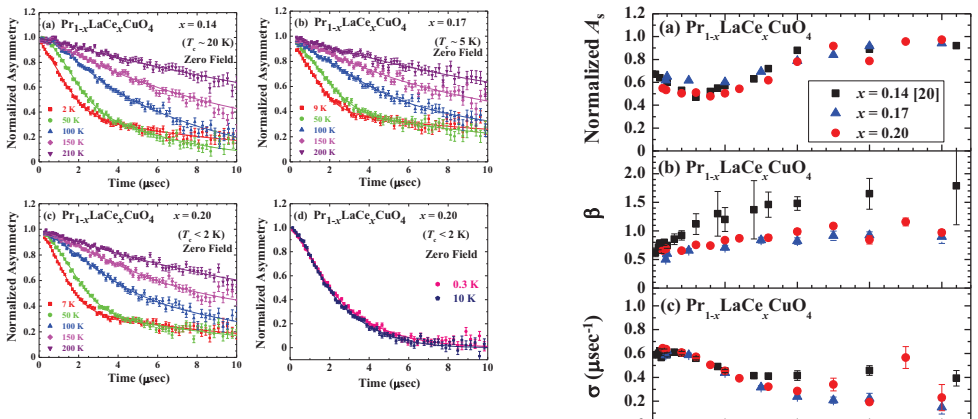
The load-bearing object is the two-component function used to fit the zero-field muon spin relaxation spectra, $$A(t) = A_s\exp[-(\$\lambda$ t)^\$\beta$] + A_G\exp[-\$sigma^{2}$ $t^{2}$] + A_{\mathrm{base}},$$ where the stretched-exponential term carries the combined nuclear and Cu-spin signal and the Gaussian term isolates the static Pr$^{3+}$ moments. The physics of the paper is carried by the temperature dependence of $\lambda$, the stretched-exponential rate, and of the long-time asymmetry: a steep low-temperature increase of $\lambda$ with recovery of the asymmetry toward 1/3 signals the development (slowing down) of Cu-spin fluctuations, while flat behavior indicates negligible correlation. The interpretation relies on the muon stopping-site assignment from a first-principles calculation that places one muon site near the CuO$_2$ plane (sensing Cu spins) and another near the (Pr,La,Ce)-O layer (sensing Pr$^{3+}$ moments), which makes the two-component decomposition physical rather than purely empirical.
What would settle it
Measure the same $x = 0.20$ crystal with a probe that sees Cu-spin fluctuations directly, such as inelastic neutron scattering or $^{63}$Cu NMR, looking for low-energy antiferromagnetic fluctuations near $(\pi, \pi)$. Clear low-energy Cu-spin fluctuations coexisting with flat muSR parameters would indicate that the muon-site or decomposition assumption, not the spin physics, produced the negative result; their absence would confirm it.
Extended reading notes
Core claim
The paper's central claim is that the development of low-energy antiferromagnetic Cu-spin correlation in Pr$_{1-x}$LaCe$_x$CuO$_4$ is doping-dependent in the overdoped regime: it is present where superconductivity appears ($x = 0.14$, $T_c \simeq 20$ K, and $x = 0.17$, $T_c \simeq 5$ K), weakens with increasing $x$, and is negligibly small at $x = 0.20$, where the Meissner signal is unobservable. The evidence comes from zero-field and longitudinal-field muon spin relaxation spectra fitted with a two-component function that separates a stretched-exponential contribution (nuclear and Cu-spin fields) from a Gaussian contribution (static Pr$^{3+}$ moments). The absence at $x = 0.17$ and $0.20$ of a low-temperature steep increase in the relaxation rate $\lambda$ and of a recovery of the asymmetry toward 1/3 is read as the absence of appreciable Cu-spin correlation development. Combined with earlier results in the undoped and underdoped regimes, the authors conclude that low-energy Cu-spin correlation is intimately related to superconductivity in the entire doping range of the electron-doped cuprates.
Load-bearing premise
The conclusion depends on the stretched-exponential component being a faithful measure of Cu-spin fluctuations, which rests in turn on the muon stopping-site assignment and on the two-component decomposition being unique; the site calculation is cited as unpublished, so the negative result at $x = 0.20$ could in principle reflect a muon-site or fitting artifact rather than the disappearance of Cu-spin correlation.
Editorial extensions
If this is right
- The electron-doped cuprate phase diagram gains a magnetic counterpart to the hole-doped one: Cu-spin correlations appear across the superconducting region and die out as superconductivity disappears in the overdoped regime.
- At $x = 0.20$ the muSR data imply a nearly paramagnetic Cu-spin state down to 0.3 K, so the loss of superconductivity in heavily overdoped PLCCO is accompanied by the disappearance of fluctuating spin correlations, not by a frozen magnetic state.
- A theory of electron-doped high-$T_c$ superconductivity that omits low-energy Cu-spin fluctuations would leave this doping-axis correlation unexplained, since the magnetic signal tracks $T_c$ from the undoped parent to the overdoped endpoint.
- The two-site muon interpretation makes a concrete prediction: a direct measure of the Cu-spin contribution (for example NMR or neutron scattering on the same crystals) should show the same doping trend as the muSR parameter $\lambda$.
Reading between the lines
- A quantitative test would map the doping interval between $x = 0.17$ and $0.20$: if the spin-correlation development vanishes at the same $x$ as $T_c$, the link is quantitative, not merely qualitative.
- If the same muon-site assignment holds in other T'-structure electron-doped cuprates such as Nd$_{2-x}$Ce$_x$CuO$_4$, the same overdoped suppression should be observable there, which would make the effect a generic property of the family rather than specific to PLCCO.
- The result sharpens the debate over superconductivity in undoped (Ce-free) T'-cuprates: whatever microscopic doping mechanism applies, the superconducting state would still require the same Cu-spin correlations seen in the doped crystals.
Signed reviews
Editorial analysis
A structured set of objections, weighed in public.
Referee Report
Summary. This manuscript reports muon spin relaxation (µSR) measurements on the electron-doped cuprate Pr1−xLaxCexCuO4 (PLCCO) at overdoped concentrations x = 0.17 and 0.20, with x = 0.14 results from prior work included for comparison. The authors observe that, unlike the x = 0.14 sample, the x = 0.17 and x = 0.20 samples do not show a low-temperature increase in the stretched-exponential relaxation rate λ or a recovery of the initial asymmetry As. They interpret this as evidence that the development of low-energy Cu-spin correlation weakens with increasing electron doping and is negligibly small in the heavily overdoped non-superconducting x = 0.20 sample. Combining this with earlier work on the undoped and underdoped regimes, they argue that the Cu-spin correlation is intimately related to superconductivity across the entire doping range of electron-doped cuprates, paralleling the behavior in hole-doped cuprates.
Significance. If the conclusions are correct, the paper provides a useful extension of the muon spin relaxation results from the underdoped/slightly overdoped regime into the heavily overdoped regime of an electron-doped cuprate, and it strengthens the case for a universal connection between the development of low-energy Cu-spin correlations and superconductivity in both electron- and hole-doped cuprates. The new x = 0.20 data, which extend to 0.3 K across the composition where superconductivity disappears, are a valuable addition. The comparison between the overdoped electron-doped and hole-doped phase diagrams is physically motivated and timely. The paper does not present new formalism or code, but the experimental data and the qualitative trend are of interest to the cuprate community.
major comments (3)
- [Section III, Fig. 2(b) and Fig. 3] The x = 0.17 ZF-µSR data are measured only down to 9 K, which is above the superconducting transition temperature Tc ≈ 5 K reported in Fig. 1 for this sample. The x = 0.14 comparison, by contrast, is deep in its superconducting state at 9 K (Tc ≈ 20 K), where its λ and As are already enhanced. Therefore, the comparison at 9 K is uncontrolled: the absence of a low-temperature increase in λ and As for x = 0.17 cannot be distinguished from the possibility that such a development would set in below Tc. The central statement that the Cu-spin correlation 'weakens with increasing x' is thus empirically supported only by the x = 0.20 data, and the intermediate-x part of the trend rests on a null result that does not probe the superconducting state of x = 0.17. The authors should either provide ZF-µSR data for x = 0.17 at temperatures below 5 K or substantially soften the doping-dependence claim in the abstract and conclusions.
- [Section III, Fig. 3] The temperature dependences of the fitted parameters As, β, σ, and λ are shown without error bars or confidence intervals. Because the main inference is a null result—the absence of a steep increase in λ and of an enhancement in As at low temperatures—the reader cannot assess whether the small variations seen in Fig. 3 for x = 0.17 and x = 0.20 are statistically meaningful. The authors should report uncertainties on these fit parameters, or at least provide a representative fit with error bars, so that the null claim is quantified rather than visual.
- [Section III, Eq. (1) and muon stopping-site discussion] The two-component decomposition of the spectra into a stretched exponential attributed to Cu-spin–related relaxation and a Gaussian component attributed to static Pr3+ moments is justified by a two-muon-stopping-site picture, but this picture relies on an unpublished first-principles calculation (Ref. [29]) and is in tension with earlier one-site dipole-field calculations (Refs. [26,27]). If the muon stopping sites are not as assumed, the physical assignment of λ and As to the Cu-spin correlation is not unique, and the negative result for the heavily overdoped sample would not be specifically diagnostic of the Cu-spin correlation. The authors should make the muon-site calculation available (e.g., as a preprint or supplementary material) or provide an independent validation of the two-component decomposition, such as a consistent analysis with different fitting forms.
minor comments (5)
- [Section IV heading] The heading 'SUMMAR Y' contains an erroneous space and should be 'SUMMARY'.
- [Title] The title contains an apparent typo, 'ove rdoped', which should be corrected to 'overdoped'.
- [Figure 2] In Fig. 2(d), the panel for x = 0.20 at 10 K and 0.3 K is informative, but the label '(Tc < 2 K)' is redundant with the text and should be consistent with Section II, where the x = 0.20 sample is described as showing no observable Meissner diamagnetism.
- [References] Reference [29] is cited as 'unpublished'. Since this calculation is used to justify the two-site decomposition central to the interpretation, the authors should either replace it with a published or preprint version or include the calculation details in an appendix.
- [Section III, LF-µSR paragraph] The text says the LF-µSR results for x = 0.20 indicate 'fluctuating internal fields at the muon site due to Cu spins'. This is consistent with the authors' earlier work, but the wording 'negligibly small development' should be clarified to mean the absence of growth in the low-energy Cu-spin correlation, not the absence of Cu-spin fluctuations altogether, which the LF data actually confirm.
Circularity Check
No circularity: the doping trend is read directly from new muSR spectra; Eq. (1) and the earlier x=0.14 data are empirical inputs, not fitted predictions.
full rationale
The derivation chain is experimental and self-contained. New ZF- and LF-muSR spectra for x=0.17 and x=0.20 are fit with the same two-component function Eq. (1) used in the authors' prior work [20], but the fit is applied independently to each sample and the central claim (stronger Cu-spin correlation development at x=0.14 than at x=0.17/0.20) is read directly from the temperature dependence of the parameters lambda and A_s. No parameter is fitted to one subset and then used to predict the same or a closely related quantity; the x=0.14 comparison is an earlier external data set, not an output of the present fits. The identification of the stretched-exponential term with Cu-spin fluctuations and the Gaussian term with Pr3+ moments is an interpretive assumption supported by prior muon-site calculations [26-29], one of which is unpublished [29]; if that site assignment were wrong the physical conclusion would be weakened, but that is a correctness/validity issue, not circularity. Several cited works are by the present group, but they are experimental data or empirical analyses, not uniqueness theorems invoked to forbid alternatives. A genuine empirical caveat is that the x=0.17 data stop at 9 K, above its Tc approximately 5 K, so the absence of a low-temperature rise in lambda and A_s for that doping is less well constrained than for x=0.20; this affects the strength of the doping-trend conclusion but is not a circular step. No load-bearing derived quantity reduces to an input by construction.
Assumptions & free parameters
free parameters (3)
- Stretched-exponential rate lambda =
Not tabulated; temperature dependent
- Initial asymmetry As =
Not tabulated
- Power beta, Gaussian rate sigma, background Abase =
Not tabulated
assumptions (4)
- domain assumption The two-component function A(t)=As exp[-(lambda t)^beta] + AG exp[-sigma^2 t^2] + Abase describes the muon spin relaxation spectra.
- domain assumption Muons stop at two sites, one near the CuO2 plane sensing Cu spins and one near the (Pr,La,Ce)-O layer sensing Pr3+ moments.
- domain assumption Pr3+ moments produce static random magnetism and contribute a Gaussian component, while Cu spins produce a fluctuating contribution.
- domain assumption The superconducting transition temperatures are correctly characterized by the susceptibility measurements: Tc about 5 K for x=0.17 and Tc below 2 K, non-superconducting, for x=0.20.
Cite this review
Pith. "Pith review of Muon spin relaxation study of the spin correlation in the overdoped regime of electron-doped high-Tc cuprate superconductors." pith.science (2026). https://pith.science/paper/ZJAJISDD
@misc{pith2026190801159,
  author       = {Pith},
  title        = {Pith review of: Muon spin relaxation study of the spin correlation in the overdoped regime of electron-doped high-Tc cuprate superconductors},
  year         = {2026},
  howpublished = {\url{https://pith.science/paper/ZJAJISDD}},
  note         = {Machine review of arXiv:1908.01159}
}
read the original abstract
In order to investigate the low-energy antiferromagnetic Cu-spin correlation and its relation to the superconductivity, we have performed muon spin relaxation (muSR) measurements using single crystals of the electron-doped high-Tc cuprate Pr_1-x_LaCe_x_CuO_4_ in the overdoped regime. The muSR spectra have revealed that the Cu-spin correlation is developed in the overdoped samples where the superconductivity appears. The development of the Cu-spin correlation weakens with increasing x and is negligibly small in the heavily overdoped sample where the superconductivity almost disappears. Considering that the Cu-spin correlation also exist in the superconducting electron-doped cuprates in the undoped and underdoped regimes [T. Adachi et al., J. Phys. Soc. Jpn. 85, 114716 (2016)], our findings suggest that the mechanism of the superconductivity is related to the low-energy Cu-spin correlation in the entire doping regime of the electron-doped cuprates.
Figures


Figures from the paper (1 more)

Reference graph
Works this paper leans on
-
[29]
L. P. Le, G. M. Luke, B. J. Sternlieb, Y. J. Uemura, J. H. Brewer, T. M. Riseman, D. C. Johnston, L. L. Miller, Y. Hidaka, and H. Murakami, Hyperfine Interact. 63, 279 (1990)
work page 1990
-
[1]
Yamada, C
K. Yamada, C. H. Lee, K. Kurahashi, J. Wada, S. Waki- moto, S. Ueki, H. Kimura, Y. Endoh, S. Hosoya, G. Shi- rane, R. J. Birgeneau, M. Greven, M. A. Kastner, and Y. J. Kim, Phys. Rev. B 57, 6165 (1998)
1998
-
[2]
S. Wakimoto, H. Zhang, K. Yamada, I. Swainson, H. Kim, and R. J. Birgeneau, Phys. Rev. Lett. 92, 217004 (2004)
work page 2004
- [3]
- [4]
-
[5]
H. J. Kang, P. Dai, H. A. Mook, D. N. Argyriou, V. Sikolenko, J. W. Lynn, Y. Kurita, S. Komiya, and Y. Ando, Phys. Rev. B 71, 214512 (2005)
work page 2005
-
[6]
S. D. Wilson, S. Li, P. Dai, W. Bao, J.-H. Chung, H. J. Kang, S.-H. Lee, S. Komiya, Y. Ando, and Q. Si, Phys. Rev. B 74, 144514 (2006). 5
work page 2006
-
[7]
A. Tsukada, Y. Krockenberger, M. Noda, H. Yamamoto, D. Manske, L. Alff, and M. Naito, Solid State Commun. 133, 427 (2005)
work page 2005
Show all 31 references
-
[8]
Matsumoto, A
O. Matsumoto, A. Utsuki, A. Tsukada, H. Yamamoto, T. Manabe, and M. Naito, Physica C 469, 924 (2009)
2009
-
[9]
S. Asai, S. Ueda, and M. Naito, Physica C 471, 682 (2011)
2011
-
[10]
Takamatsu, M
T. Takamatsu, M. Kato, T. Noji, and Y. Koike, Appl. Phys. Express 5, 073101 (2012)
2012
-
[11]
Horio, Y
M. Horio, Y. Krockenberger, K. Yamamoto, Y. Yokoyama, K. Takubo, Y. Hirata, S. Sakamoto, K. Koshiishi, A. Yasui, E. Ikenaga, S. Shin, H. Yamamoto, H. Wadati, and A. Fujimori, Phys. Rev. Lett. 120, 257001 (2018)
2018
-
[12]
Adachi, Y
T. Adachi, Y. Mori, A. Takahashi, M. Kato, T. Nishizaki, T. Sasaki, N. Kobayashi, and Y. Koike, J. Phys. Soc. Jpn 82, 063713 (2013)
2013
-
[13]
Brinkmann, T
M. Brinkmann, T. Rex, H. Bach, and K. Westerholt, Phys. Rev. Lett. 74, 4927 (1995)
1995
-
[14]
Horio, T
M. Horio, T. Adachi, Y. Mori, A. Takahashi, T. Yoshida, H. Suzuki, L.C.C. Ambolode II, K. Okazaki, K. Ono, H. Kumigashira, H. Anzai, M. Arita, H. Namatame, M. Taniguchi, D. Ootsuki, K. Sawada, M. Takahashi, T. Mi- zokawa, Y. Koike, and A. Fujimori, Nat. Commun. 7, 10567 (2016)
2016
-
[15]
Adachi, T
T. Adachi, T. Kawamata, and Y. Koike, Condens. Matter 2, 23 (2017)
2017
-
[16]
Adachi, A
T. Adachi, A. Takahashi, K. M. Suzuki, M. A. Baqiya, T. Konno, T. Takamatsu, M. Kato, I. Watanabe, A. Koda, M. Miyazaki, R. Kadono, and Y. Koike, J. Phys. Soc. Jpn 85, 114716 (2016)
2016
-
[17]
K. M. Kojima, Y. Krockenberger, I. Yamauchi, M. Miyazaki, M. Hiraishi, A. Koda, R. Kadono, R. Kumai, H. Yamamoto, A. Ikeda, and M. Naito, Phys. Rev. B 89, 180508 (2014)
2014
-
[18]
[19] From the former µ SR measurements in the SC polycrystal of PLCCO with x = 0
This is different from the results of the hole-doped cuprates in which the characteristic energy of the Cu- spin correlation is unchanged but the spectral weight de- creases with hole doping, [2] suggesting the occurrence of a phase separation into SC and normal-state regions i...
-
[19]
Tanabe, T
Y. Tanabe, T. Adachi, T. Noji, and Y. Koike, J. Phys. Soc. Jpn 74, 2893 (2005)
2005
-
[20]
It is noted that the change of the spectra above 100 K shown in Fig
At high temperatures above 100 K, all parameters seem to be almost independent of temperature and the normalized As is nearly one. It is noted that the change of the spectra above 100 K shown in Fig. 2 for all sam- 0 0.2 0.4 0.6 0.8 1.0 1.2 0 0.5 1.0 1.5 2.0 0 0.2 0.4 0.6 0.8 ...
-
[21]
Fujita, M
M. Fujita, M. Matsuda, S.-H. Lee, M. Nakagawa, and K. Yamada, Phys. Rev. Lett. 101, 107003 (2008)
2008
-
[22]
Adachi, N
Risdiana, T. Adachi, N. Oki, Y. Koike, T. Suzuki, and I. Watanabe, Phys. Rev. B 82, 014506 (2010)
2010
-
[23]
Yamamoto, Y
M. Yamamoto, Y. Kohori, H. Fukazawa, A. Takahashi, T. Ohgi, T. Adachi, and Y. Koike, J. Phys. Soc. Jpn 85, 024708 (2016)
2016
-
[24]
Lambacher, T
M. Lambacher, T. Helm, M. Kartsovnik, and A. Erb, Euro. Phys. J. Special Topics 188, 61 (2010)
2010
-
[25]
M. A. Baqiya, T. Adachi, A. Takahashi, T. Prombood, M. Watanabe, K. Fukumoto, Y. Tanabe, and Y. Koike, J. Phys.: Conf. Ser. 568, 022002 (2014)
2014
-
[26]
F. L. Pratt, Physica B 289-290, 710 (2000)
2000
-
[27]
Kadono, K
R. Kadono, K. Ohishi, A. Koda, W. Higemoto, K. M. Kojima, S. Kuroshima, M. Fujita, and K. Yamada, J. Phys. Soc. Jpn 72, 2955 (2003)
2003
-
[28]
G. M. Luke, L. P. Le, B. J. Sternlieb, Y. J. Uemura, J. H. Brewer, R. Kadono, R. F. Kiefl, S. R. Kreitzman, T. M. Riseman, C. E. Stronach, M. R. Davis, S. Uchida, H. Tak- agi, Y. Tokura, Y. Hidaka, T. Murakami, J. Gopalakr- ishnan, A. W. Sleight, M. A. Subramanian, E. A. Early,...
1990
-
[30]
Tsutsumi, M
K. Tsutsumi, M. Fujita, K. Sato, M. Miyazaki, R. Kadono, and K. Yamada, Key Eng. Mater. 616, 297 (2014)
2014
-
[31]
Tsutsumi, M
K. Tsutsumi, M. Fujita, and K. M. Kojima, unpublished
Reviewed August 14, 2026 · model on record in the stance chip above.
Discussion (0). Continue with ORCID to comment.