REVIEW 3 major objections 5 minor 51 references
CRNet: Image Super-Resolution Using A Convolutional Sparse Coding Inspired Network
T0 review · 3 major / 5 minor · reviewed 2026-08-14 · deepseek-v4-flash
Pith's one-line read By unrolling convolutional sparse coding into a recurrent CNN, CRNet beats deeper super-resolution models on standard benchmarks.
desk verdict Decent empirical SR paper whose CISTA 'theoretical guarantee' is overclaimed; the architecture is worth a reviewer's time, the theory section needs to be rewritten as inspiration rather than guarantee. read the letter →
The pith
A machine-rendered reading of the paper's core claim, the machinery that carries it, and where it could break.
The reading
What carries the argument
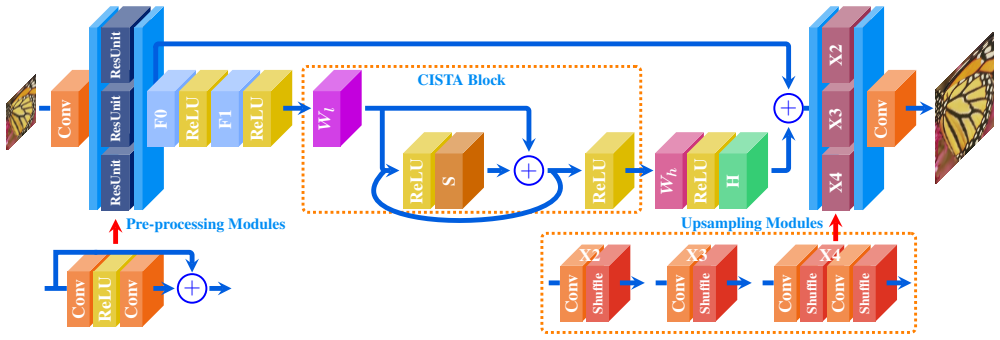
The CISTA block is the central object: a recurrence $z_{k+1} = \operatorname{ReLU}(W \otimes y + S \otimes z_k)$ in which $W$ and $S$ are trainable convolution filters and $S$ is shared across all $K$ recursions. It is derived from an ISTA step by replacing matrix products with convolutions and identifying the ReLU activation with nonnegative soft-thresholding, turning the sparse-coding solver into a recurrent CNN layer. Residual learning wraps the block so the network predicts only the residual image, and in CRNet-B scale-specific pre-processing and upsampling modules allow a single model to handle multiple upscaling factors.
What would settle it
Retrain CRNet-B and RDN on the same DIV2K training split with identical augmentation, patch sampling, and self-ensemble protocol, then compare PSNR on Set5 ×4 and Urban100 ×4: if CRNet-B+ does not retain its reported lead, the paper's central performance claim is falsified. Separately, evaluating the original CSC objective (3) at the CRNet-B fixed point would test whether the sparse-coding interpretation is real.
Extended reading notes
Core claim
The discovery is that the iterative soft-thresholding update for convolutional sparse coding can be written as a pure convolutional recurrence, $z_{k+1} = \operatorname{ReLU}(W \otimes y + S \otimes z_k)$, which is exactly a stack of CNN layers with a weight $S$ shared across recursions. Under the assumption that low-resolution and high-resolution feature maps share the same convolutional sparse codes, the high-resolution image is recovered by convolving the learned codes with HR filters and adding the result as a residual. Trained end-to-end, CRNet-A and CRNet-B achieve the reported PSNR/SSIM values, with the self-ensembled CRNet-B+ surpassing RDN on nearly every tested scale-dataset combination and CRNet-B reaching these results with substantially fewer parameters and layers than EDSR or RDN.
Load-bearing premise
The method's claim to inherit ISTA's theoretical guarantee assumes that the ReLU-based recurrence exactly matches the soft-thresholding algorithm on the original convolutional sparse coding objective; if that match fails, the network is an empirically tuned recurrent model rather than a principled CSC solver.
Editorial extensions
If this is right
- If the central claim is right, a CSC-inspired recurrent architecture can reach the top of super-resolution benchmark tables without the extreme depth of dense or residual mega-networks.
- Because the recurrence weight $S$ is shared, parameter count grows with filter width rather than recursion depth, and performance continues to improve as recursions increase up to the tested limits.
- The same framework extends naturally to multi-scale SR, with CRNet-B training one model for all scales while matching the multi-scale capability of MDSR.
- Since the CISTA block is a generic CNN layer, other convolutional inverse problems such as denoising or deblurring could adopt the same architecture, as the paper states for CSC-based tasks generally.
Reading between the lines
- If the strict ISTA guarantee is not inherited, the practical lesson is that the CISTA derivation acts as an architecture prior rather than a convergence proof; the gains may come from the recurrent residual design rather than from exactly solving the CSC objective.
- A control experiment that replaces the CISTA recurrence with a randomly initialized recurrent block of the same depth, trained on the same data, would isolate how much of CRNet's improvement is actually due to the sparse-coding prior.
- One testable extension is to learn the threshold parameter instead of fixing it at zero; if a soft-threshold CISTA variant performs as well or better, the ReLU simplification is not the source of the gain, and if it performs worse, the zero threshold is load-bearing.
- Inspecting the learned filters $W$ and $S$ for interpretable structures such as oriented edges would show whether the 'dictionary' reading of the network is functional or merely rhetorical.
Signed reviews
Editorial analysis
A structured set of objections, weighed in public.
Referee Report
Summary. The paper proposes CRNet-A and CRNet-B, two CNN architectures for image super-resolution motivated by convolutional sparse coding (CSC). The authors introduce a recurrence called CISTA (Eq. 10) as a convolutional form of ISTA for solving the CSC objective (Eq. 3), and implement it with convolutional layers, residual learning, and scale-specific multi-path learning. CRNet-A is a pre-upsampling model and CRNet-B is a post-upsampling model; CRNet-B+ is a self-ensembled variant. The paper reports extensive experiments on Set5, Set14, B100, Urban100, and Manga109 for scales ×2, ×3, and ×4, claiming superior performance over recent state-of-the-art methods including EDSR, MDSR, and RDN, as well as large gains over the previous CSC-based method CSC-SR.
Significance. If the CISTA derivation were valid and the comparisons were on equal footing, the paper would provide a useful bridge between CSC theory and CNN-based super-resolution, with competitive results at moderate parameter counts. The empirical study is broad and includes a parameter study, training-stability analysis, and visual comparisons. However, the central theoretical claim that recurrence (10) solves the L1-regularized CSC objective (3) is not correct as stated, and the headline performance claim is weakened by the asymmetric use of self-ensemble for CRNet-B+ only. The contribution is therefore best seen as an empirically tuned recurrent CNN inspired by CSC, rather than a method with inherited ISTA guarantees.
major comments (3)
- [Section 3, Eqs. (9)-(10)] The claim that recurrence (10) 'provides the solution of (3) with theoretical guarantees [5]' is not supported by the derivation. ISTA uses the signed soft-threshold operator h_θ(α)=sign(α)max(|α|-θ,0), but the paper replaces it with the nonnegative threshold h_θ⁺(α)=max(α-θ,0) and then sets θ=0, obtaining ReLU(α). The ReLU is the projection onto the nonnegative orthant, not the proximal operator of λ‖·‖₁ for any λ>0. Consequently, the fixed point of (10) is a stationary point of min_z ‖y-Fz‖₂² subject to z≥0, not of the L1-regularized objective (3). In addition, Eq. (7) asserts the existence of a filter n with I z = n⊗z; under the zero-padding strategy described in Section 4.2 this identity holds only approximately at image boundaries. These two gaps break the logical chain from (3) to (10), so the theoretical-guarantee statement should be removed or replaced by a corrected statement about nonnegative sparse coding.
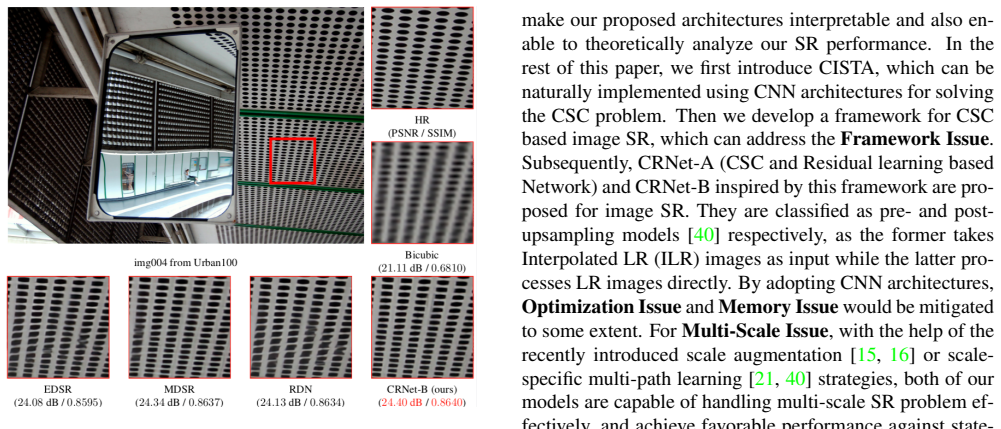
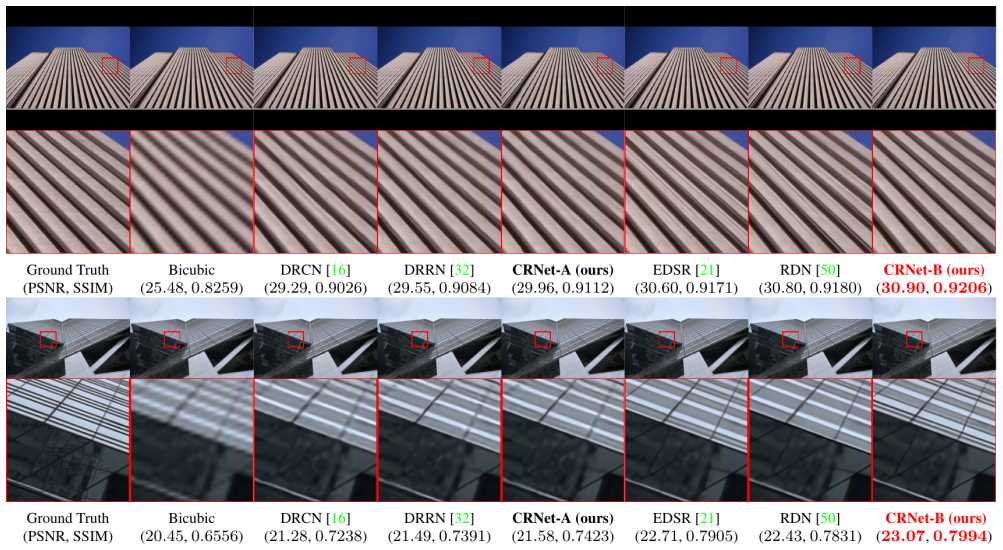
- [Section 5.4, Table 3] The comparison between CRNet-B+ and the post-upsampling baselines is not on equal footing. CRNet-B+ is explicitly a self-ensembled version of CRNet-B, whereas the baseline columns labeled EDSR, MDSR, and RDN report plain numbers without self-ensemble. Since self-ensemble typically improves PSNR by 0.1-0.3 dB, the claimed superiority of CRNet-B+ over RDN is confounded. Moreover, the abstract's assertion that 'both of our proposed models show superior performance' is too strong even for the non-ensembled model: CRNet-B trails RDN on several entries (e.g., Set5 ×2 38.13 vs 38.24, Set14 ×4 28.79 vs 28.81, B100 ×2 32.32 vs 32.34, Manga109 ×2 39.07 vs 39.18). The authors should report self-ensembled baselines or compare CRNet-B without self-ensemble against the plain baselines.
- [Section 4.2, Eqs. (12)-(14)] The relationship between the trainable parameters Wl and S and the CSC dictionary f is left unspecified. In the derivation, W = (1/L) flip(f) and S = n - (1/L) flip(f)⊗f, so W and S are both determined by a single dictionary f. In the implemented networks, Wl and S are independent, unconstrained trainable filters (e.g., 1,024 filters in CRNet-B). Thus the learned recurrence is not constrained to be the CISTA iteration for any CSC problem, which further weakens the paper's interpretability claim. The authors should either impose the dictionary consistency (or a soft penalty) or explicitly state that the network is a deep unfolding architecture whose learned parameters are not guaranteed to correspond to any CSC dictionary, and remove the claim that the network solves (3).
minor comments (5)
- [Section 2.2, Eq. (2)] The displayed objective contains malformed norm notation with extra vertical bars ('‖‖‖‖‖y−...'); this should be cleaned up to a standard norm expression.
- [References] Reference [31] has a typo in the arXiv identifier: it should be 1602.07261, not 11602.07261.
- [Section 1, paragraph 4] The sentence 'Its worth to note' should be 'It is worth to note'.
- [Section 5.2, Recursion] The choice K = 25 is reported, but the paper does not discuss whether the learned recurrence is stable or convergent for this depth, nor how the initialization z0 = ReLU(Wl⊗y) relates to the ISTA initialization; a brief comment would help.
- [Figure 1 and caption] The figure caption uses 'PSNRs' and the legend labels are quite dense; consider using a standard abbreviation and a more readable layout, especially since the figure is referenced in the abstract's performance claim.
Circularity Check
No significant circularity: the SR results are measured against external benchmarks, and the CISTA derivation relies on external published results rather than the authors' own fitted quantities.
full rationale
The paper's central empirical claim is that CRNet-A and CRNet-B outperform existing SR methods on public benchmarks (Set5, Set14, B100, Urban100, Manga109). These comparisons are external, using standard training/test data and PSNR/SSIM metrics, so the reported performance is not a quantity fitted by the model being renamed as a prediction. The CISTA recurrence is derived from ISTA [5] through Eqs. (5)-(10), with the ReLU/soft-threshold equivalence credited to the external paper [26] (Papyan et al.), not to the authors' own prior work. There are no load-bearing self-citations: the cited CSC-SR method [10], EDSR/MDSR [21], and RDN [50] are all external works, and none of the central claims reduces to a self-citation chain. The reader's skeptic concern is a mathematical correctness issue: setting θ=0 in Eq. (9) and replacing the signed soft-threshold with ReLU means Eq. (10) is not exactly ISTA for the ℓ1-regularized objective (3), so the claimed theoretical guarantee may not hold. But this is a validity or correctness risk, not circularity, because the network is not being justified by predicting results that are already contained in its inputs. The empirical results stand independently of whether the CISTA label is fully justified. Accordingly, no circular step is exhibited and the score is 0.
Assumptions & free parameters
free parameters (4)
- K (number of CISTA recursions) =
25
- n0 (base filter count) =
128 for CRNet-A, 64 for CRNet-B
- m0 (CISTA filter count) =
256 for CRNet-A, 1024 for CRNet-B
- Loss function choice =
L2 for CRNet-A, L1 for CRNet-B
assumptions (5)
- domain assumption LR and HR feature maps share the same convolutional sparse codes z.
- domain assumption ReLU is an exact nonnegative soft-thresholding operator with threshold theta=0, and restricting coefficients to nonnegative does not reduce expressiveness.
- domain assumption The identity operator can be represented as a convolution with a fixed filter n under zero-padding (Iz = n ⊗ z).
- ad hoc to paper ISTA convergence guarantees transfer to the finite-horizon learned unrolling with shared S.
- domain assumption Training on 291 images (CRNet-A) or DIV2K (CRNet-B) generalizes to the test benchmarks.
Cite this review
Pith. "Pith review of CRNet: Image Super-Resolution Using A Convolutional Sparse Coding Inspired Network." pith.science (2026). https://pith.science/paper/42FRGV2S
@misc{pith2026190801166,
  author       = {Pith},
  title        = {Pith review of: CRNet: Image Super-Resolution Using A Convolutional Sparse Coding Inspired Network},
  year         = {2026},
  howpublished = {\url{https://pith.science/paper/42FRGV2S}},
  note         = {Machine review of arXiv:1908.01166}
}
read the original abstract
Convolutional Sparse Coding (CSC) has been attracting more and more attention in recent years, for making full use of image global correlation to improve performance on various computer vision applications. However, very few studies focus on solving CSC based image Super-Resolution (SR) problem. As a consequence, there is no significant progress in this area over a period of time. In this paper, we exploit the natural connection between CSC and Convolutional Neural Networks (CNN) to address CSC based image SR. Specifically, Convolutional Iterative Soft Thresholding Algorithm (CISTA) is introduced to solve CSC problem and it can be implemented using CNN architectures. Then we develop a novel CSC based SR framework analogy to the traditional SC based SR methods. Two models inspired by this framework are proposed for pre-/post-upsampling SR, respectively. Compared with recent state-of-the-art SR methods, both of our proposed models show superior performance in terms of both quantitative and qualitative measurements.
Figures


Figures from the paper (7 more)





Reference graph
Works this paper leans on
-
[5]
I. Daubechies, M. Defrise, and C. De Mol. An iterative thresholding algorithm for linear inverse problems with a sparsity constraint. Communications on Pure and Applied Mathematics, 57(11):1413–1457, 2004. 3, 4
work page 2004
-
[1]
N. Ahn, B. Kang, and K.-A. Sohn. Fast, accurate, and lightweight super-resolution with cascading residual net- work. In ECCV, 2018. 1
work page 2018
-
[2]
M. Bevilacqua, A. Roumy, C. Guillemot, and M.-L. Alberi- Morel. Low-Complexity Single-Image Super-Resolution based on Nonnegative Neighbor Embedding. BMVC, pages 135.1–135.10, 2012. 1, 5
work page 2012
-
[3]
S. Boyd, N. Parikh, E. Chu, B. Peleato, J. Eckstein, et al. Distributed optimization and statistical learning via the al- ternating direction method of multipliers. Foundations and Trends in Machine learning, 3(1):1–122, 2011. 2
work page 2011
-
[4]
H. Bristow, A. Eriksson, and S. Lucey. Fast Convolutional Sparse Coding. In CVPR, 2013. 2
work page 2013
-
[6]
C. Dong, C. C. Loy, K. He, and X. Tang. Image super- resolution using deep convolutional networks. TPAMI, 38(2):295–307, 2016. 1, 2, 6
work page 2016
-
[7]
C. Garcia-Cardona and B. Wohlberg. Convolutional Dictio- nary Learning: A Comparative Review and New Algorithms. IEEE Transactions on Computational Imaging , 4(3):366– 381, 2018. 2
work page 2018
-
[8]
C. Garcia-Cardona and B. Wohlberg. Convolutional dictio- nary learning: A comparative review and new algorithms. IEEE Transactions on Computational Imaging , 4(3):366– 381, 2018. 2
work page 2018
Show all 51 references
-
[9]
Gregor and Y
K. Gregor and Y . LeCun. Learning Fast Approximations of Sparse Coding. In ICML, 2010. 1, 3
2010
-
[10]
S. Gu, W. Zuo, Q. Xie, D. Meng, X. Feng, and L. Zhang. Convolutional Sparse Coding for Image Super-Resolution. In ICCV, 2015. 1, 2, 3, 5, 6
2015
-
[11]
Haris, G
M. Haris, G. Shakhnarovich, and N. Ukita. Deep back- projection networks for super-resolution. In CVPR, 2018. 1, 5, 6
2018
-
[12]
K. He, X. Zhang, S. Ren, and J. Sun. Identity mappings in deep residual networks. In ECCV, 2016. 8
2016
-
[13]
Heide, W
F. Heide, W. Heidrich, and G. Wetzstein. Fast and flexible convolutional sparse coding. In CVPR, 2015. 2
2015
-
[14]
Huang, A
J.-B. Huang, A. Singh, and N. Ahuja. Single image super- resolution from transformed self-exemplars. In CVPR, 2015. 1, 2, 5
2015
-
[15]
J. Kim, J. Kwon Lee, and K. Mu Lee. Accurate image super- resolution using very deep convolutional networks. InCVPR,
-
[16]
J. Kim, J. K. Lee, and K. M. Lee. Deeply-Recursive Con- volutional Network for Image Super-Resolution. In CVPR,
-
[17]
D. P. Kingma and J. Ba. Adam: A method for stochastic optimization. In ICLR, 2014. 6
2014
-
[18]
LeCun, L
Y . LeCun, L. Bottou, Y . Bengio, P. Haffner, et al. Gradient- based learning applied to document recognition. Proceed- ings of the IEEE, 86(11):2278–2324, 1998. 5
1998
-
[19]
Ledig, L
C. Ledig, L. Theis, F. Huszar, J. Caballero, A. Cunning- ham, A. Acosta, A. Aitken, A. Tejani, J. Totz, Z. Wang, and W. Shi. Photo-Realistic Single Image Super-Resolution Us- ing a Generative Adversarial Network. In CVPR, 2017. 5
2017
-
[20]
J. Li, F. Fang, K. Mei, and G. Zhang. Multi-scale residual network for image super-resolution. In ECCV, 2018. 1, 2, 5, 6, 7
2018
-
[21]
B. Lim, S. Son, H. Kim, S. Nah, and K. M. Lee. Enhanced deep residual networks for single image super-resolution. In CVPR Workshops, 2017. 1, 2, 5, 6, 7
2017
-
[22]
X. Mao, C. Shen, and Y .-B. Yang. Image restoration us- ing very deep convolutional encoder-decoder networks with symmetric skip connections. In NIPS, 2016. 1, 2, 6
2016
-
[23]
Martin, C
D. Martin, C. Fowlkes, D. Tal, and J. Malik. A database of human segmented natural images and its application to evaluating segmentation algorithms and measuring ecologi- cal statistics. In ICCV, 2001. 5
2001
-
[24]
Matsui, K
Y . Matsui, K. Ito, Y . Aramaki, A. Fujimoto, T. Ogawa, T. Ya- masaki, and K. Aizawa. Sketch-based manga retrieval us- ing manga109 dataset. Multimedia Tools and Applications,
-
[25]
Nair and G
V . Nair and G. E. Hinton. Rectified linear units improve re- stricted boltzmann machines. In ICML, 2010. 4
2010
-
[26]
Papyan, Y
V . Papyan, Y . Romano, and M. Elad. Convolutional neu- ral networks analyzed via convolutional sparse coding. The Journal of Machine Learning Research , 18(1):2887–2938,
-
[27]
Papyan, Y
V . Papyan, Y . Romano, J. Sulam, and M. Elad. Theoreti- cal foundations of deep learning via sparse representations: A multilayer sparse model and its connection to convolu- tional neural networks. IEEE Signal Processing Magazine , 35(4):72–89, 2018. 1, 2
2018
-
[28]
Papyan, J
V . Papyan, J. Sulam, and M. Elad. Working locally thinking globally: Theoretical guarantees for convolutional sparse coding. IEEE Transactions on Signal Processing , 65(21):5687–5701, 2017. 1, 2, 3
2017
-
[29]
Paszke, S
A. Paszke, S. Gross, S. Chintala, G. Chanan, E. Yang, Z. De- Vito, Z. Lin, et al. Automatic differentiation in pytorch. In NIPS-W, 2017. 6
2017
-
[30]
Sreter and R
H. Sreter and R. Giryes. Learned convolutional sparse cod- ing. In ICASSP, 2018. 2
2018
-
[31]
Szegedy, S
C. Szegedy, S. Ioffe, and V . Vanhoucke. Inception-v4, inception-resnet and the impact of residual connections on learning. arXiv:11602.07261, 2018. 7
2018 arXiv
-
[32]
Y . Tai, J. Yang, and X. Liu. Image Super-Resolution via Deep Recursive Residual Network. In CVPR, 2017. 1, 2, 4, 5, 6, 7, 8
2017
-
[33]
Y . Tai, J. Yang, X. Liu, and C. Xu. Memnet: A persistent memory network for image restoration. In ICCV, 2017. 1, 2, 6
2017
-
[34]
Timofte, E
R. Timofte, E. Agustsson, L. Van Gool, M.-H. Yang, L. Zhang, et al. Ntire 2017 challenge on single image super- resolution: Methods and results. In CVPR Workshops, 2017. 1, 5
2017
-
[35]
Timofte, V
R. Timofte, V . De Smet, and L. Van Gool. A+: Adjusted anchored neighborhood regression for fast super-resolution. In ACCV, 2014. 1
2014
-
[36]
Timofte, S
R. Timofte, S. Gu, J. Wu, and L. Van Gool. NTIRE 2018 challenge on single image super-resolution: methods and re- sults. In CVPR Workshops, 2018. 1
2018
-
[37]
T. Tong, G. Li, X. Liu, and Q. Gao. Image super-resolution using dense skip connections. In ICCV, 2017. 2, 5, 6
2017
-
[38]
S. Wang, L. Zhang, Y . Liang, and Q. Pan. Semi-coupled dic- tionary learning with applications to image super-resolution and photo-sketch synthesis. In CVPR, pages 2216–2223,
-
[39]
Z. Wang, A. C. Bovik, H. R. Sheikh, E. P. Simoncelli, et al. Image quality assessment: from error visibility to structural similarity. IEEE TIP, 13(4):600–612, 2004. 5
2004
-
[40]
Z. Wang, J. Chen, and S. C. Hoi. Deep learning for image super-resolution: A survey. arXiv:1902.06068, 2019. 2, 5
1902 arXiv
-
[41]
Z. Wang, D. Liu, J. Yang, W. Han, and T. Huang. Deep networks for image super-resolution with sparse prior. In ICCV, 2015. 1, 2, 7, 8
2015
-
[42]
Wohlberg
B. Wohlberg. Efficient convolutional sparse coding. In ICASSP, 2014. 2, 3
2014
-
[43]
Wohlberg
B. Wohlberg. Boundary handling for convolutional sparse representations. In ICIP, 2016. 2
2016
-
[44]
C.-Y . Yang, C. Ma, and M.-H. Yang. Single-image super- resolution: A benchmark. In ECCV, 2014. 1
2014
-
[45]
J. Yang, Z. Wang, Z. Lin, S. Cohen, and T. Huang. Coupled dictionary training for image super-resolution. IEEE TIP , 21(8):3467–3478, 2012. 3
2012
-
[46]
J. Yang, J. Wright, T. Huang, and Y . Ma. Image super- resolution as sparse representation of raw image patches. In CVPR, 2008. 1, 2
2008
-
[47]
J. Yang, J. Wright, T. S. Huang, and Y . Ma. Im- age super-resolution via sparse representation. IEEE TIP , 19(11):2861–2873, 2010. 1, 2, 5
2010
-
[48]
M. D. Zeiler, D. Krishnan, G. W. Taylor, and R. Fergus. De- convolutional networks. In CVPR, 2010. 1, 2, 3
2010
-
[49]
Zeyde, M
R. Zeyde, M. Elad, and M. Protter. On single image scale-up using sparse-representations. In International conference on curves and surfaces, pages 711–730. Springer, 2010. 5
2010
-
[50]
Zhang, Y
Y . Zhang, Y . Tian, Y . Kong, B. Zhong, and Y . Fu. Residual dense network for image super-resolution. In CVPR, 2018. 1, 2, 5, 6
2018
-
[51]
Zhang, Y
Z. Zhang, Y . Xu, J. Yang, X. Li, and D. Zhang. A Survey of Sparse Representation - Algorithms and Applications. IEEE Access, 3:490–530, 2015. 2
2015
Reviewed August 14, 2026 · model on record in the stance chip above.
Discussion (0). Continue with ORCID to comment.