REVIEW 5 minor 43 references
Finite-temperature dynamics of a Tonks-Girardeau gas in a frequency-modulated harmonic trap
T0 review · 0 major / 5 minor · reviewed 2026-08-14 · deepseek-v4-flash
Pith's one-line read This paper proves that the finite-temperature dynamics of a periodically modulated Tonks-Girardeau gas collapses into a single scaling parameter whose stability boundaries are those of Mathieu's equation.
desk verdict Clean exact finite-T solution for driven TG gas with a solid Mathieu stability mapping; worth refereeing, with the unstable-regime validity issue properly flagged. read the letter →
The pith
A machine-rendered reading of the paper's core claim, the machinery that carries it, and where it could break.
The reading
What carries the argument
The load-bearing device is the scaling solution for a time-dependent harmonic trap: $\varphi_j(x,t)=\lambda^{-1/2}\varphi_j(x/\lambda,0)\exp\left[\frac{imx^2}{2\hbar}\frac{\dot\lambda}{\lambda}-iE_j(t)t\right]$, together with the Ermakov-Pinney equation and Pinney's construction of $\lambda$ as $\sqrt{A\lambda_1^2+B\lambda_2^2+2C\lambda_1\lambda_2}$ from two independent solutions of the homogeneous oscillator equation. Under the change of variable $\Omega t=\pi/2-2\tau$, that homogeneous equation becomes Mathieu's equation, an ordinary linear oscillator with periodic coefficients of the form $\ddot z+(a-2q\cos 2\tau)z=0$. The Floquet stability chart of this equation then determines whether the gas's density and momentum distributions stay bounded or grow exponentially.
What would settle it
Drive a finite-$\gamma$ Lieb-Liniger gas (or a time-dependent matrix-product-state simulation of the same protocol) with the same sinusoidal trap modulation, fix a parameter point $(a,\alpha)$ predicted to be stable and one predicted unstable, and compare the measured $\lambda(t)$ and momentum width against the Mathieu-based prediction. A clear failure is if the $\Omega=2\omega_0$ resonance requires a nonzero threshold amplitude or if the $j=3$ resonance appears at $a=9$ rather than shifted upward; either observation would show that the Tonks-Girardeau scaling mapping stops capturing the boundaries before the gas leaves the infinite-repulsion regime.
Extended reading notes
Core claim
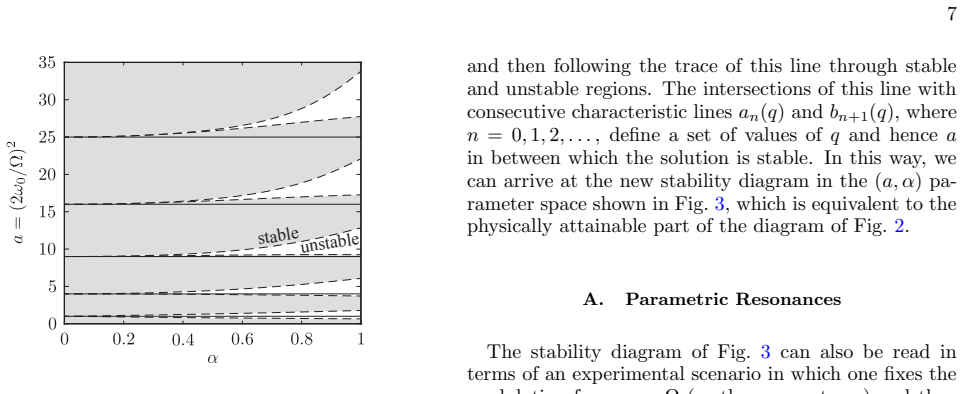
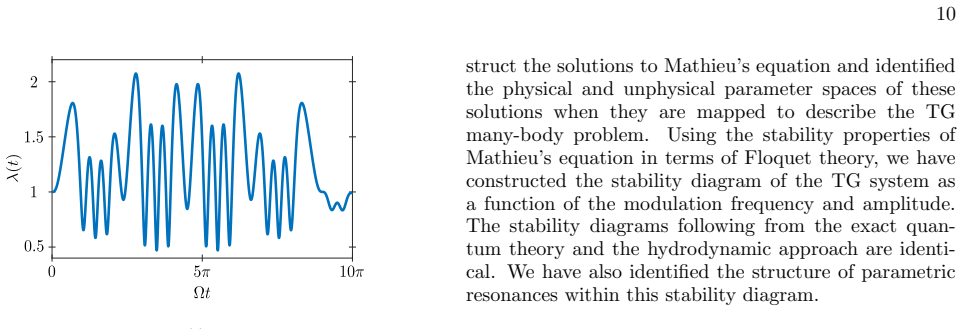
The central claim is that for $\omega^2(t)=\omega_0^2(1-\alpha\sin\Omega t)$, the exact finite-temperature many-body dynamics of the trapped Tonks-Girardeau gas is fully determined by $\lambda(t)$, the positive solution of the Ermakov-Pinney equation $\ddot\lambda+\omega^2(t)\lambda=\omega_0^2/\lambda^3$. The paper constructs $\lambda(t)$ from two independent Mathieu functions $C$ and $S$ via Pinney's formula and proves that the long-time behavior is in direct bijection with the stability of Mathieu's equation with $a=(2\omega_0/\Omega)^2$ and $q=2\omega_0^2\alpha/\Omega^2$. The same $\lambda(t)$ appears in the finite-temperature hydrodynamic theory, so the stability diagram and the structure of parametric resonances are exactly the same in both descriptions. The paper also provides closed-form expressions for the Floquet exponent $\nu(a,q)$, which sets the rate of exponential growth in the unstable regions.
Load-bearing premise
The central assumption is that the gas remains in the Tonks-Girardeau (infinite-repulsion) regime at all times; in unstable parameter regions the density peaks grow exponentially, so the local dimensionless interaction strength can fall to order one or below and the model stops being valid there.
Editorial extensions
If this is right
- A gas driven at $\Omega=2\omega_0$, the primary breathing-mode resonance, is unstable for every modulation amplitude $\alpha>0$; the higher resonances $\Omega_j=2\omega_0/j$ require a finite $\alpha$ and their centers shift downward in frequency.
- Because the hydrodynamic equations share the same scaling parameter and the same Mathieu map, the stability boundaries and resonance widths are identical between the classical-fluid and exact-quantum descriptions, not merely approximately equal.
- The collective many-body bounce, an extra narrowing of the momentum distribution within each breathing cycle, persists under periodic driving in both stable and unstable regimes, and increasing temperature blurs it.
- The Floquet exponent $\nu(a,q)$ is the single number controlling the long-time fate of every observable: a real $\nu$ means bounded oscillations, while a complex $\nu$ means exponential growth with a known rate.
Reading between the lines
- If the same Ermakov-Pinney structure survives in a weakly anharmonic trap, the Mathieu stability boundaries themselves could serve as an observable signature of integrability; testing them with finite-$g$ Lieb-Liniger gases would quantify how quickly beyond-Tonks-Girardeau corrections destroy the exact resonance geometry.
- The closed-form Floquet exponent could be used to define a heating rate per driving cycle in the unstable regime, giving a quantitative figure of merit for future quantum heat engine proposals on this system; the paper gestures at that direction but does not develop it.
- Cosine modulation, obtainable from these solutions by a time shift and $q\to -q$, makes the same stability diagram apply to experiments that switch the drive on smoothly, so the resonance structure is likely insensitive to the exact turn-on waveform.
Signed reviews
Editorial analysis
A structured set of objections, weighed in public.
Referee Report
Summary. The manuscript studies a one-dimensional gas of hard-core bosons in a harmonic trap whose frequency is modulated as ω²(t)=ω0²(1−α sin Ωt). The authors use the Fermi–Bose mapping and the scaling solution for harmonic trapping to show that the finite-temperature reduced one-body density matrix, and hence the density and momentum distributions, are governed by a single scaling parameter λ(t) satisfying the Ermakov–Pinney equation. They map the linearized equation for λ to Mathieu's equation with parameters a=(2ω0/Ω)² and q=2ω0²α/Ω², construct λ(t) from even and odd Mathieu functions via Pinney's formula, and compute Floquet exponents to obtain the stability diagram in the (a,α) plane. They show that the finite-temperature hydrodynamic equations admit the same scaling parameter and therefore the same stability diagram. Numerical examples in stable and unstable regimes compare the exact many-body dynamics with the hydrodynamic approximation at two temperatures, and the paper discusses parametric resonances and the many-body bounce.
Significance. This is a clean and useful result. If accepted, it reduces a nontrivial finite-temperature interacting many-body problem to a single linear ODE with a well-known stability chart, with no fitted parameters. The central mapping is internally consistent: Eqs. (22)–(26) follow from the Schrödinger equation and Pinney's construction, and the positive-definite constraint AB−C²=ω0²/W² in Eq. (14) rules out cancellation of the growing Floquet component in unstable Mathieu bands, so the λ-stability bijection is sound. The paper also makes a valuable methodological point that the hydrodynamic approach reproduces the exact stability diagram exactly. The numerical work is honest about the Lorentzian approximation in the hydrodynamic momentum distribution (Appendix A) and about the breakdown of the TG description at exponentially growing densities in the unstable regime (Sec. VII). The latter is a physical applicability limit explicitly acknowledged by the authors, not an internal inconsistency. The stability diagram in Fig. 3 and the resonance condition Ω_j=2ω0/j are crisp falsifiable predictions for experiments.
minor comments (5)
- [II.B, Eq. (10)] The phase factor in the scaling solution for the single-particle orbitals should read −iE_j(t)t/ℏ; as typeset, −iE_j(t)t is dimensionally incorrect.
- [V, Eq. (36)] The relation between Mathieu parameters is written q=α/2 a, which is ambiguous; it should be q=α a/2.
- [II.B, Eq. (14), and III, Eqs. (24)–(25)] The symbol C is used both for the Pinney coefficient in Eq. (14) and for the even Mathieu function C(a,q,τ); please disambiguate for clarity.
- [IV.B] The sentence that stable solutions correspond to ν being real is imprecise at integer ν=0,1, where the second solution is nonperiodic and unbounded; the surrounding discussion handles this, but the statement should be qualified.
- [VI.A] The reference to Fig. 3(a) should be to Fig. 3, since that figure has no panel (a).
Circularity Check
No significant circularity: the Ermakov-Pinney-to-Mathieu mapping is derived from the Schrödinger equation in the text, and the stability diagram is imported from standard Mathieu-function theory rather than fitted.
full rationale
The paper's central derivation is self-contained and non-circular. The scaling solution (10) with λ(t) satisfying the Ermakov-Pinney equation (11) is a known harmonic-oscillator result cited to external references [27,33,34]; the paper then performs the change of variables Ωt = π/2 − 2τ in Eqs. (21)-(23) algebraically to obtain Mathieu's equation (22) with a = (2ω0/Ω)^2 and q = 2ω0^2 α/Ω^2. The stability diagram is taken from the standard Floquet theory of Mathieu's equation (Secs. IV and V), and the physical stability diagram in Fig. 3 is obtained by restricting to the line q = αa/2, which is an explicit mapping, not a fit. No parameter is fitted to a subset of observables and then used to 'predict' a closely related quantity; α and Ω are free protocol parameters. The citations to the authors' own earlier works [23,24,26] supply the determinant representation of the one-body density matrix and the finite-temperature hydrodynamic scaling solutions, but the new claim—that λ(t) maps to Mathieu's equation and that stability of λ is the stability of Mathieu's equation—does not reduce to those citations; it is established in-text from Eq. (11). The hydrodynamic stability diagram is stated to be the same only because the hydrodynamic λ(t) satisfies the same Eq. (11) (Sec. II.C); this is an explicit, logically transparent consequence rather than a hidden identification or a renamed fitted result. The acknowledged breakdown of the TG model in the unstable regime (Sec. VII) is a physical applicability limitation, not a circular step.
Assumptions & free parameters
assumptions (6)
- standard math Fermi-Bose mapping for hard-core bosons in one dimension, Eq. (1) of the paper.
- domain assumption Initial state is a grand-canonical ensemble at temperature T0 and chemical potential mu0, with Fermi-Dirac occupancies of the initial trap orbitals.
- standard math Scaling solution for single-particle orbitals in a time-dependent harmonic trap, Eq. (10), with the scaling parameter satisfying the Ermakov-Pinney equation, Eq. (11).
- standard math Stability theory of Mathieu's equation: Floquet exponents, characteristic values an(q) and bn(q), and Ince's theorem for non-periodic second solutions.
- domain assumption Hydrodynamic equations for the TG gas with the local pressure of an ideal Fermi gas, Eqs. (15)-(17).
- domain assumption Lorentzian model for the equilibrium momentum distribution of a uniform TG gas, Eq. (A3), and Thomas-Fermi semicircle density profile, Eq. (A1).
Cite this review
Pith. "Pith review of Finite-temperature dynamics of a Tonks-Girardeau gas in a frequency-modulated harmonic trap." pith.science (2026). https://pith.science/paper/QZQGVGB4
@misc{pith2026190801291,
  author       = {Pith},
  title        = {Pith review of: Finite-temperature dynamics of a Tonks-Girardeau gas in a frequency-modulated harmonic trap},
  year         = {2026},
  howpublished = {\url{https://pith.science/paper/QZQGVGB4}},
  note         = {Machine review of arXiv:1908.01291}
}
read the original abstract
We study the out-of-equilibrium dynamics of a finite-temperature harmonically trapped Tonks-Girardeau gas induced by periodic modulation of the trap frequency. We give explicit exact solutions for the real-space density and momentum distributions of this interacting many-body system and characterize the stability diagram of the dynamics by mapping the many-body solution to the solution and stability diagram of Mathieu's differential equation. The mapping allows one to deduce the exact structure of parametric resonances in the parameter space characterized by the driving amplitude and frequency of the modulation. Furthermore, we analyze the same problem within the finite-temperature hydrodynamic approach and show that the respective solutions to the hydrodynamic equations can be mapped to the same Mathieu equation. Accordingly, the stability diagram and the structure of resonances following from the hydrodynamic approach is exactly the same as those obtained from the exact many-body solution.
Figures


Figures from the paper (5 more)



Reference graph
Works this paper leans on
-
[23]
Zerbe, P
C. Zerbe, P. Jung, and P. H¨ anggi, Phys. Rev. E49, 3626 (1994)
1994
- [24]
-
[1]
Con- sequently, the fundamental solution (28) is not neces- sarily a real function
Case when ν is complex (ν = 1−iη) When (a,q ) lies in between b2n+1(q) anda2n+1(q), the Floquet exponent has the form ν = 1−iη, which ulti- mately results in complex Fourier coefficients cn. Con- sequently, the fundamental solution (28) is not neces- sarily a real function. We can however use the prop- erties of the Fourier coefficients to get a real solution...
-
[2]
1 t ´t 0 dt′/λ2(t′), and the scal- ing functionλ(t) satisfies a second-order nonlinear differ- ential equation known as the Ermakov-Pinney equation [28, 29], ¨λ +ω2(t)λ = ω2(0) λ3 , (11) with the initial conditions λ(0)=1 and ˙λ(0)=0. The scaling transformation (10) leads to a simple scal- ing solution for the evolution of the reduced one-body density matri...
work page 1991
-
[3]
Case when ν is pure imaginary (ν =iη) When (a,q ) lies betweenb2n(q) anda2n(q), the Floquet exponent is a pure imaginary number ν = iη with η > 0 and therefore the Fourier coefficients are complex in this case as well. By inserting the Floquet exponent into the recurrence relation (B1) and setting n→− n, along with the complex conjugate transformation, we d...
-
[4]
Case when ν is real but not integer (ν∈ ]0, 1[) When the pair (a,q ) lies in the stable region between an(q) and bn+1(q), the Fourier coefficients are real and do not present any particular symmetry. The real valued even and odd solutions take the following form: C(a,q,τ ) = ∞∑ n=−∞ cn cos ((2n +ν)τ), (C7) S(a,q,τ ) = ∞∑ n=−∞ cn sin ((2n +ν)τ), (C8) with 0 ...
-
[5]
Case when ν is integer (ν = 0, 1) As discussed above, ν = 0, 1 correspond to real inte- ger values of the Floquet exponent and in this case only 14 one solution can be periodic, in accordance with Ince’s theorem [22]. The second independent solution is con- structed following a different scheme compared to the ones discussed previously. When ( a,q ) lies e...
-
[6]
Girardeau, Journal of Mathematical Physics 1, 516 (1960)
M. Girardeau, Journal of Mathematical Physics 1, 516 (1960)
1960
Show all 43 references
-
[7]
Paredes, A
B. Paredes, A. Widera, V. Murg, O. Mandel, S. F¨ olling, I. Cirac, G. V. Shlyapnikov, T. W. H¨ ansch, and I. Bloch, Nature 429, 277 (2004)
2004
-
[8]
Kinoshita, T
T. Kinoshita, T. Wenger, and D. S. Weiss, Science 305, 1125 (2004)
2004
-
[9]
Kinoshita, T
T. Kinoshita, T. Wenger, and D. S. Weiss, Nature 440, 900 (2006)
2006
-
[10]
Haller, M
E. Haller, M. Gustavsson, M. J. Mark, J. G. Danzl, R. Hart, G. Pupillo, and H.-C. N¨ agerl, Science 325, 1224 (2009)
2009
-
[11]
Meinert, M
F. Meinert, M. Panfil, M. J. Mark, K. Lauber, J.-S. Caux, and H.-C. N¨ agerl, Phys. Rev. Lett.115, 085301 (2015)
2015
-
[12]
Bloch, J
I. Bloch, J. Dalibard, and W. Zwerger, Rev. Mod. Phys. 80, 885 (2008)
2008
-
[13]
M. A. Cazalilla and M. Rigol, New Journal of Physics 12, 055006 (2010)
2010
-
[14]
Polkovnikov, K
A. Polkovnikov, K. Sengupta, A. Silva, and M. Vengalat- tore, Rev. Mod. Phys. 83, 863 (2011)
2011
-
[15]
M. A. Cazalilla, R. Citro, T. Giamarchi, E. Orignac, and M. Rigol, Rev. Mod. Phys. 83, 1405 (2011)
2011
-
[16]
Lamacraft and J
A. Lamacraft and J. Moore, in Ultracold bosonic and fermionic gases, Vol. 5 (Contemporary Concepts in Con- densed Matter Science), Eds. K. Levin, A. L. Fetter, and D. M. Stamper-Kurn (Elsevier, The Netherlands, 2012)
2012
-
[17]
Husimi, Progress of Theoretical Physics 9, 381 (1953)
K. Husimi, Progress of Theoretical Physics 9, 381 (1953)
1953
-
[18]
H. P. Breuer and M. Holthaus, Zeitschrift f¨ ur Physik D Atoms, Molecules and Clusters 11, 1 (1989)
1989
-
[19]
K. He, J. Brown, S. Haas, and M. Rigol, Phys. Rev. A 89, 033634 (2014)
2014
-
[20]
L. S. Brown, Phys. Rev. Lett. 66, 527 (1991). 15
1991
-
[21]
Hnggi and C
P. Hnggi and C. Zerbe, AIP Conference Proceedings 285, 481 (1993)
1993
-
[22]
Kohler, T
S. Kohler, T. Dittrich, and P. H¨ anggi, Phys. Rev. E 55, 300 (1997)
1997
-
[25]
Quinn and M
E. Quinn and M. Haque, Phys. Rev. A90, 053609 (2014)
2014
-
[26]
Mathieu, Journal de Math´ ematiques Pures et Ap- pliqu´ ees13, 137 (1868)
E. Mathieu, Journal de Math´ ematiques Pures et Ap- pliqu´ ees13, 137 (1868)
-
[27]
McLachlan, Theory and Application of Mathieu Func- tions, Dover Publications (Dover, 1964)
N. McLachlan, Theory and Application of Mathieu Func- tions, Dover Publications (Dover, 1964)
1964
-
[28]
Y. Y. Atas, D. M. Gangardt, I. Bouchoule, and K. V. Kheruntsyan, Phys. Rev. A 95, 043622 (2017)
2017
-
[29]
Y. Y. Atas, I. Bouchoule, D. M. Gangardt, and K. V. Kheruntsyan, Phys. Rev. A 96, 041605 (2017)
2017
-
[30]
B. Fang, G. Carleo, A. Johnson, and I. Bouchoule, Phys. Rev. Lett. 113, 035301 (2014)
2014
-
[31]
Bouchoule, S
I. Bouchoule, S. S. Szigeti, M. J. Davis, and K. V. Kheruntsyan, Phys. Rev. A 94, 051602 (2016)
2016
-
[32]
Minguzzi and D
A. Minguzzi and D. M. Gangardt, Phys. Rev. Lett. 94, 240404 (2005)
2005
-
[33]
V. P. Ermakov, Univ. Izv. Kiev 20, 1 (1880)
-
[34]
Pinney, Proc
E. Pinney, Proc. Amer. Math. Soc. 1, 681 (1950)
1950
-
[35]
E. H. Lieb and W. Liniger, Phys. Rev. 130, 1605 (1963)
1963
-
[36]
M. D. Girardeau and E. M. Wright, Phys. Rev. Lett. 84, 5691 (2000)
2000
-
[37]
K. K. Das, M. D. Girardeau, and E. M. Wright, Phys. Rev. Lett. 89, 170404 (2002)
2002
-
[38]
Popov and A
V. Popov and A. Perelomov, Soviet Physics JETP 30, 910 (1969)
1969
-
[39]
Perelomov and Y
A. Perelomov and Y. Zel’dovich, Quantum Mechanics (World Scientific, Singapore, 1998)
1998
-
[40]
F. M. Arscott, Periodic differential equations: an intro- duction to Mathieu, Lam´ e, and allied functions, Vol. 66 (Elsevier, 2014)
2014
-
[41]
L. D. Landau and E. M. Lifshitz, Mechanics (Pergamon Press Oxford, 1976)
1976
-
[42]
Bell, Glasgow Mathematical Journal 3, 132 (1957)
M. Bell, Glasgow Mathematical Journal 3, 132 (1957)
1957
-
[43]
K. V. Kheruntsyan, D. M. Gangardt, P. D. Drummond, and G. V. Shlyapnikov, Phys. Rev. A 71, 053615 (2005)
2005
Reviewed August 14, 2026 · model on record in the stance chip above.
Discussion (0). Continue with ORCID to comment.