REVIEW 3 major objections 6 minor 41 references
Semi-supervised Thai Sentence Segmentation Using Local and Distant Word Representations
T0 review · 3 major / 6 minor · reviewed 2026-08-14 · deepseek-v4-flash
Pith's one-line read Thai sentence segmentation errors drop 10.5 percent with a local-plus-distant sequence tagger.
desk verdict Solid Thai segmentation paper; n-gram local features are the real win, while the CVT semi-supervised gain is modest and rests on an unvalidated softmax proxy. read the letter →
The pith
A machine-rendered reading of the paper's core claim, the machinery that carries it, and where it could break.
The reading
What carries the argument
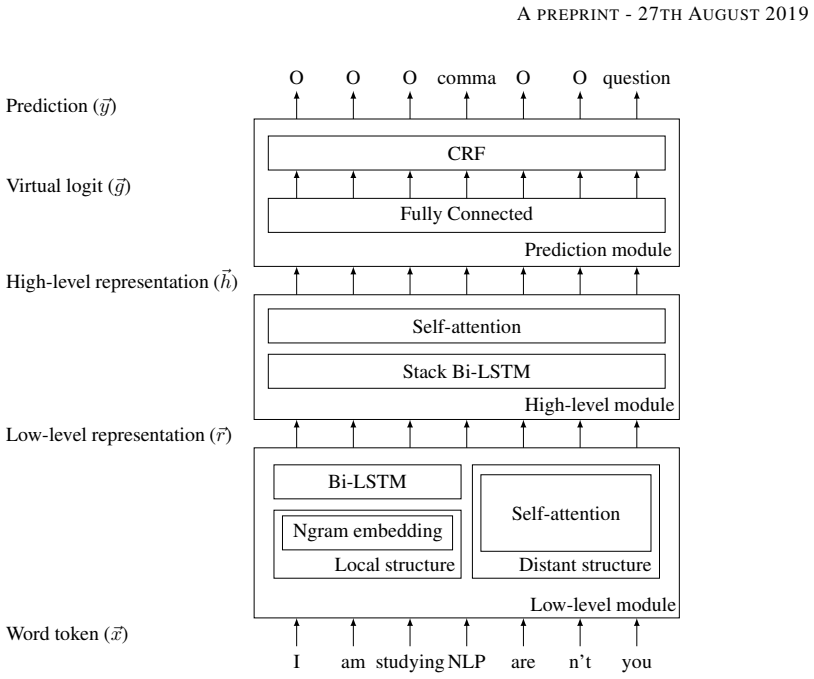
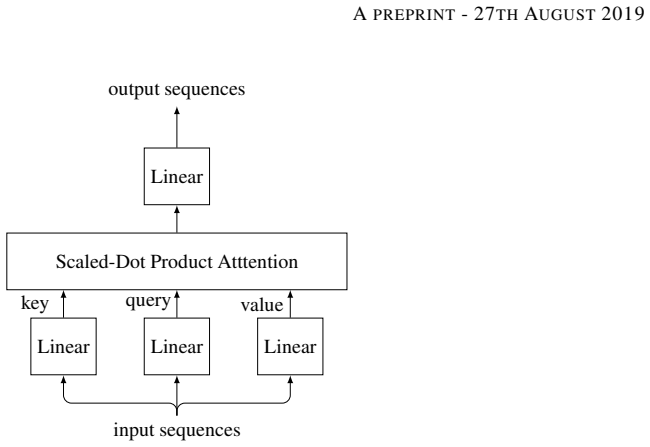
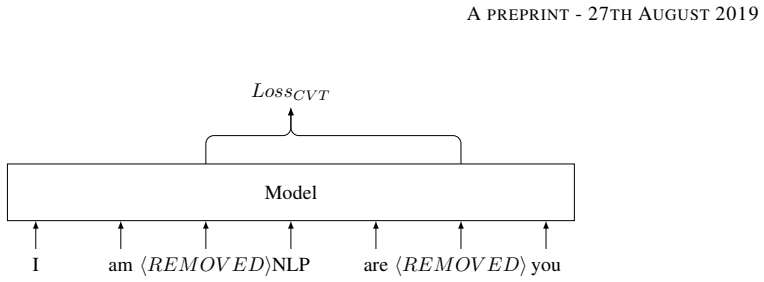
The load-bearing object is a two-view encoder followed by a CRF decoder. The local view concatenates unigram, bigram, and trigram embeddings, each built from word, part-of-speech, and token-type inputs, over a three-word window, so the network can see boundary-signaling phrases directly. The distant view is a scaled dot-product self-attention module applied both at the low level and above a stacked Bi-LSTM, so clause-opening trigger words can influence the prediction at a later word. For semi-supervised learning, the paper modifies Cross-View Training: the primary prediction is taken from the softmax of the final virtual logits rather than from the CRF marginal, to avoid the slow forward-backward computation, and two auxiliary modules, one reading the recurrent representation and one reading the low-level distant representation, are trained on randomly masked timesteps to match that primary softmax through KL divergence. This masked-language-model-style agreement loss is what transfers knowledge from unlabeled passages into the shared encoder.
What would settle it
Train the same UGWC and IWSLT configurations with the Cross-View loss computed from exact CRF marginals (for the two-tag Thai setting this is cheap) and compare F1 scores; if the exact-marginal model does not reproduce or beat the reported 88.9% and 65.2% results, the claimed semi-supervised gain is an artifact of the softmax proxy rather than a property of the model.
Extended reading notes
Core claim
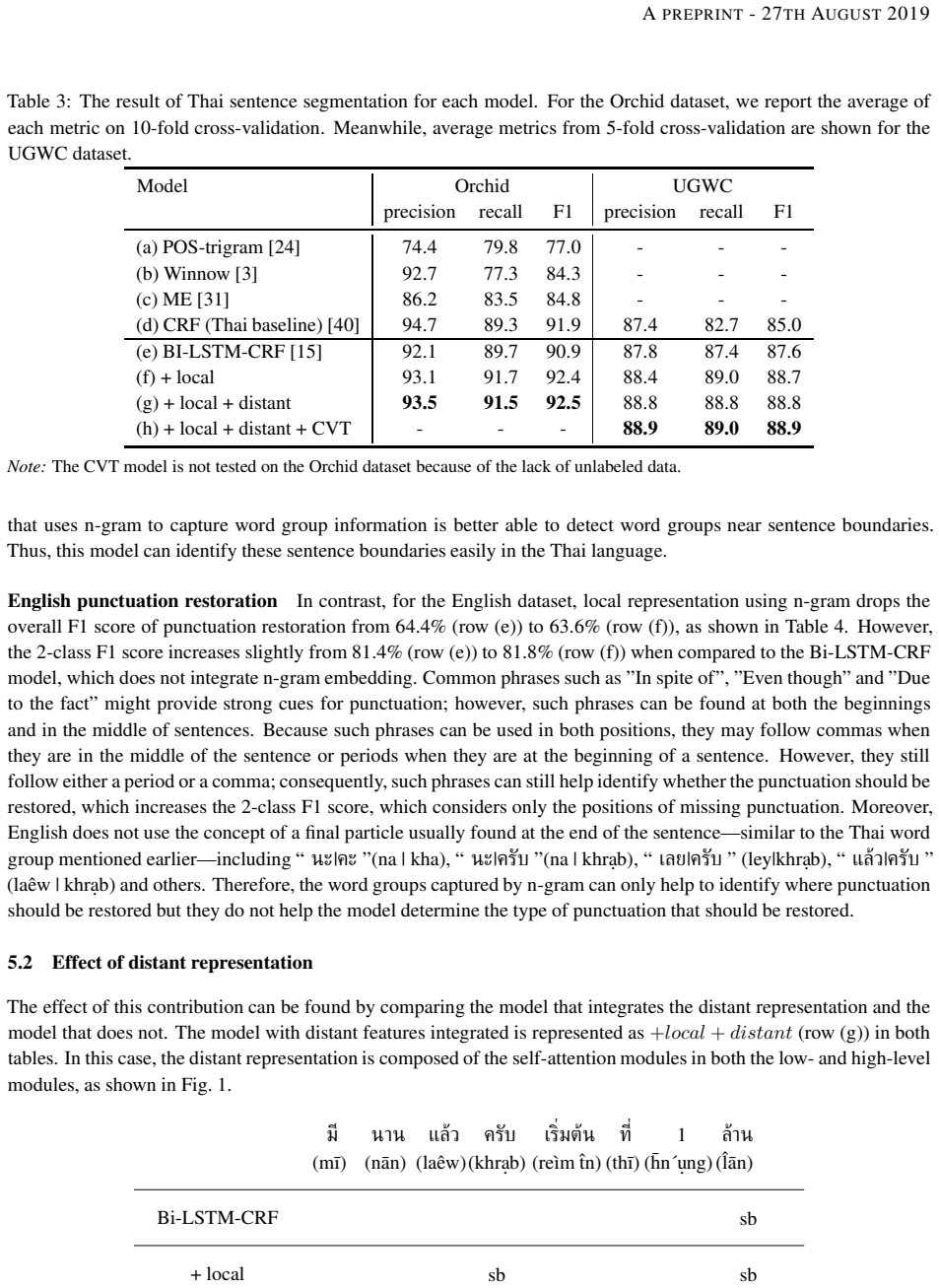
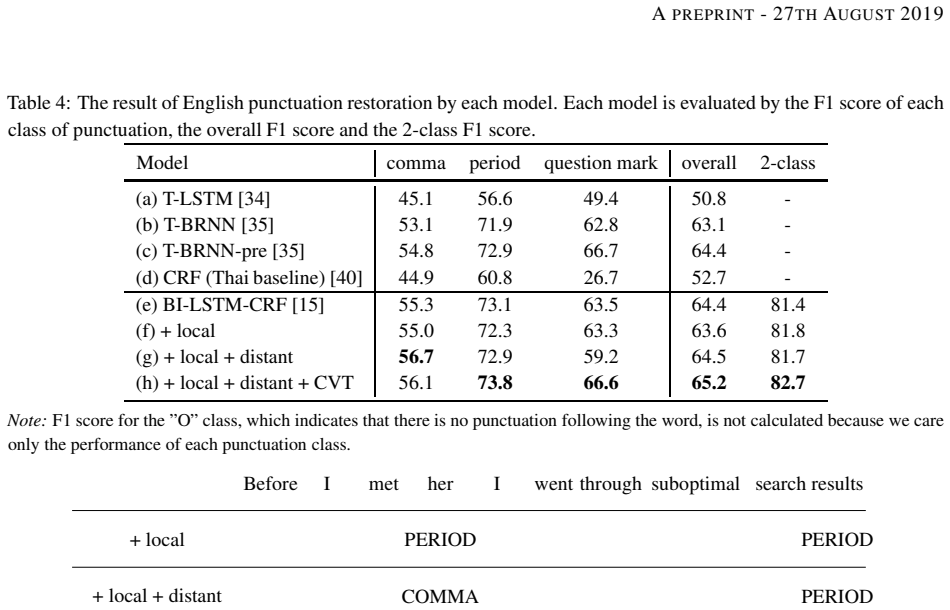
On its own terms, the paper's central claim is that a Bi-LSTM-CRF sequence tagger can be made state of the art for Thai sentence segmentation by adding an n-gram-based local representation that catches word groups such as final particles and clause-initial conjunctions that cluster around sentence boundaries, and a self-attention-based distant representation that lets the model attend to clause-opening cues such as "Before", "If", and "Although". The full supervised model scores 92.5% F1 on Orchid and 88.8% F1 on UGWC; adding the adapted Cross-View Training with unlabeled in-domain text raises UGWC to 88.9% F1. On IWSLT English punctuation restoration, the same architecture reaches 65.2% overall F1, beating the pretrained-vector baseline by 0.8 points, with a 2-class F1 of 82.7%. The authors conclude that the local representation is the main driver for Thai, while the distant representation and semi-supervised training matter most for English.
Load-bearing premise
The unlabeled-data boost rests on treating the network's own per-word softmax score as a trustworthy stand-in for what the full CRF model would predict, because the auxiliary modules are trained against that score and not against the CRF's final output.
Editorial extensions
If this is right
- If the central claim holds, Thai sentence segmentation now has a single model that beats both the CRF-n-gram baseline and the Bi-LSTM-CRF baseline on the standard Orchid and UGWC benchmarks.
- The same architecture, without pretrained word vectors, would also be a competitive English punctuation restorer, which matters for speech transcripts that arrive as unpunctuated word streams.
- Because the semi-supervised component is the decisive factor on the English task, collecting raw unlabeled text in the target domain should yield further gains wherever labeled boundary data are scarce.
- The authors state as a next step that the model should transfer to elementary discourse unit segmentation, while noting that downstream-task evaluation is still needed.
Reading between the lines
- If the softmax-proxy assumption holds, the same masked-agreement recipe could be grafted onto any CRF-based sequence tagger, not just sentence segmentation, whenever labeled data are scarce.
- The Thai results suggest a testable linguistic prediction: languages whose boundaries are marked by reusable multi-word particles should benefit more from the local n-gram view, while languages with clause-initial discourse markers should benefit more from the self-attention view.
- Because the gains on UGWC and IWSLT are driven mostly by unlabeled in-domain data, the method's value is likely to grow with the size and topical diversity of the unlabeled pool, not simply with model size.
Signed reviews
Editorial analysis
A structured set of objections, weighed in public.
Referee Report
Summary. The paper proposes a Bi-LSTM-CRF model for Thai sentence segmentation and English punctuation restoration, with three claimed contributions: local n-gram embeddings, distant self-attention representations, and an adaptation of Cross-View Training (CVT) for semi-supervised learning. The model is evaluated on the Orchid and UGWC Thai datasets (10-fold and 5-fold cross-validation, respectively) and on the IWSLT English punctuation-restoration dataset, reporting F1 scores of 92.5%, 88.9%, and 65.2%, which the authors state are state-of-the-art. Ablations analyze the local, distant, and CVT contributions, and paired t-tests in Appendix C assess significance on the Thai datasets.
Significance. If the claims are fully supported, the work would provide a useful low-resource sentence-segmentation recipe, with the interesting result that n-gram embeddings help substantially for Thai while self-attention and CVT help more for English. The paper's strengths are its cross-validated Thai experiments, the inclusion of paired t-tests in Appendix C, and direct comparison with the prior CRF-ngram and Bi-LSTM-CRF baselines. However, the significance evidence is partial: the distant representation is not significant on either Thai dataset, the CVT effect on UGWC is not significant at the 0.05 level, and the English results come from a single test split without significance testing. The paper also releases no code, which limits reproducibility.
major comments (3)
- [Section 3.2.1, Eq. (13)] The CVT primary prediction is computed with Softmax(g_t) instead of the CRF marginal distribution, as the forward-backward algorithm is considered too slow. This is a load-bearing approximation because the reported CVT gains on IWSLT (64.5 to 65.2 in Table 4) and UGWC (88.8 to 88.9) are small, and the auxiliary modules are trained to match a softmax proxy rather than the actual CRF output. The paper provides no experiment showing that the softmax proxy tracks the CRF marginal on held-out data. I ask the authors to add a comparison of the CVT objective computed from the softmax proxy versus the CRF marginal (or at least report their agreement on a development set), and to discuss what happens to the CVT gains if the proxy is unfaithful.
- [Appendix C, Tables 7 and 8] The statistical tests undermine the claimed contributions of the distant representation and of CVT. On Orchid, adding the distant representation improves F1 by only 0.068% with p=0.370; on UGWC, the improvement is 0.110% with p=0.182. The CVT increment on UGWC is +0.145% with p=0.065, which is not significant at the 0.05 level. Nevertheless, Sections 5.2 and 5.3 and the abstract state that these additions improve accuracy and are contributions. The manuscript should either report these non-significant results as such and temper the contribution claims, or provide additional evidence (e.g., larger-scale experiments or a different evaluation protocol) that the small observed improvements are reliable.
- [Section 5.4 and Table 4] The English punctuation restoration state-of-the-art claim rests on a single test split (IWSLT2011 reference set) with no repeated runs, no confidence intervals, and no significance test. The margin over T-BRNN-pre is 64.4 vs. 65.2 overall F1, and the CVT increment over row (g) is 64.5 to 65.2; these differences are within the range that could arise from small test-set variation. The authors should provide significance testing or error bars for the IWSLT results, or explicitly frame the English result as preliminary, since the abstract and conclusions currently state a definitive outperformance.
minor comments (6)
- [Section 5.3 and Table 4] There is a numerical inconsistency: Table 4 shows the IWSLT overall F1 for the CVT model as 65.2%, while Section 5.3 states 65.3%. The authors should reconcile these numbers.
- [Section 4.2] The optimizer name is misspelled as 'Adagard'; it should be AdaGrad.
- [Abstract] 'n-gram presentations' should be 'n-gram representations'.
- [Figure 5 and surrounding text] The Thai examples, such as 'แล/uni0E49.lowว', appear to contain encoding artifacts that make them difficult to read; the authors should use proper Unicode or transliteration.
- [Conclusions] The statement that the model 'can also be applied to elementary discourse unit (EDU) segmentation' is presented without supporting experiments; it should be marked as future work, as the authors themselves acknowledge in the following sentence.
- [Section 4.1.1] The UGWC dataset is self-collected and the reference [21] shares authors with the present paper; this is not circular, but the evaluation on a dataset that the authors built would benefit from an independent external evaluation to support the state-of-the-art claim.
Circularity Check
No significant circularity: reported results rest on held-out evaluation of independently specified modules.
full rationale
The paper's central claims are empirical: adding n-gram-based local representations, self-attention-based distant representations, and a modified CVT objective is evaluated on held-out folds of Orchid, UGWC, and IWSLT. The Thai baselines (CRF-ngram and Bi-LSTM-CRF) and English baselines (T-LSTM, T-BRNN, T-BRNN-pre) are external prior systems, not defined in terms of the proposed model. The only overlapping-author citation is [21], which supplies the UGWC dataset; this is a data resource, not a theorem or fitted value, and the dataset is independently reproducible from crawled social text with linguist annotations. The Section 3.2.1 substitution of Softmax(virtual logits) for CRF marginals is an approximation and a possible validity concern, but it is not circular: the CVT loss is an additional training objective on unlabeled data, and its reported effect is measured on held-out data rather than being forced by the approximation. No equation in the paper reduces to a fitted parameter renamed as a prediction, and no load-bearing claim is justified solely by a self-citation chain. Therefore, the derivation chain is self-contained with respect to circularity.
Assumptions & free parameters
free parameters (10)
- C_word (unigram min frequency) =
2 (all datasets)
- C_ngram (bigram/trigram min frequency) =
2 (Thai), 13 (IWSLT)
- Learning rate =
0.02 (Thai), 0.001 (IWSLT)
- LSTM hidden size =
25 (Thai), 256 (IWSLT)
- Number of LSTM layers K =
2 (Thai), 4 (IWSLT)
- Self-attention output size =
50 (Thai), 256 (IWSLT)
- High-level self-attention projection size =
25 (Thai), 128 (IWSLT)
- CVT masked-language drop rate =
0.30 (UGWC, IWSLT)
- Number of unlabeled mini-batches B =
1 (UGWC), 2 (IWSLT)
- Dropout of unlabeled input =
0.50 (UGWC), 0.30 (IWSLT)
assumptions (4)
- domain assumption Thai sentence boundaries can be modeled as word-level tags (sb/nsb).
- domain assumption Randomly initialized word/POS/type embeddings are sufficient for the task.
- ad hoc to paper CVT losses on masked timesteps improve shared representations.
- domain assumption spaCy POS tags are accurate enough for IWSLT transcripts.
Cite this review
Pith. "Pith review of Semi-supervised Thai Sentence Segmentation Using Local and Distant Word Representations." pith.science (2026). https://pith.science/paper/BCYFYYLI
@misc{pith2026190801294,
  author       = {Pith},
  title        = {Pith review of: Semi-supervised Thai Sentence Segmentation Using Local and Distant Word Representations},
  year         = {2026},
  howpublished = {\url{https://pith.science/paper/BCYFYYLI}},
  note         = {Machine review of arXiv:1908.01294}
}
read the original abstract
A sentence is typically treated as the minimal syntactic unit used for extracting valuable information from a longer piece of text. However, in written Thai, there are no explicit sentence markers. We proposed a deep learning model for the task of sentence segmentation that includes three main contributions. First, we integrate n-gram embedding as a local representation to capture word groups near sentence boundaries. Second, to focus on the keywords of dependent clauses, we combine the model with a distant representation obtained from self-attention modules. Finally, due to the scarcity of labeled data, for which annotation is difficult and time-consuming, we also investigate and adapt Cross-View Training (CVT) as a semi-supervised learning technique, allowing us to utilize unlabeled data to improve the model representations. In the Thai sentence segmentation experiments, our model reduced the relative error by 7.4% and 10.5% compared with the baseline models on the Orchid and UGWC datasets, respectively. We also applied our model to the task of pronunciation recovery on the IWSLT English dataset. Our model outperformed the prior sequence tagging models, achieving a relative error reduction of 2.5%. Ablation studies revealed that utilizing n-gram presentations was the main contributing factor for Thai, while the semi-supervised training helped the most for English.
Figures

Figures from the paper (3 more)
Reference graph
Works this paper leans on
-
[1]
Mahsa Afsharizadeh, Hossein Ebrahimpour-Komleh, and A youb Bagheri, Query-oriented text summarization using sentence extraction technique , 2018 4th International Conference on Web Research (ICWR), IEEE, 2018, pp. 128–132
work page 2018
-
[2]
Wirote Aroonmanakun et al., Thoughts on word and sentence segmentation in thai , Proceedings of the Seventh Symposium on Natural language Processing, Pattaya, Thaila nd, December 13–15, 2007, pp. 85–90
work page 2007
-
[3]
Paisarn Charoenpornsawat and Virach Sornlertlamvanic h, Automatic sentence break disambiguation for thai , International Conference on Computer Processing of Orient al Languages (ICCPOL), 2001, pp. 231–235
work page 2001
-
[4]
Xiaoyin Che, Cheng Wang, Haojin Y ang, and Christoph Mein el, Punctuation prediction for unsegmented tran- script based on word vector , Proceedings of the Tenth International Conference on Lang uage Resources and Evaluation (LREC 2016), 2016, pp. 654–658
work page 2016
-
[5]
Eunah Cho, Jan Niehues, Kevin Kilgour, and Alex Waibel, Punctuation insertion for real-time spoken language translation, Proceedings of the Eleventh International Workshop on Spo ken Language Translation, 2015
work page 2015
- [6]
-
[7]
Jacob Devlin, Ming-Wei Chang, Kenton Lee, and Kristina T outanova, Bert: Pre-training of deep bidirectional transformers for language understanding , arXiv preprint arXiv:1810.04805 (2018)
arXiv 2018
-
[8]
John Duchi, Elad Hazan, and Y oram Singer, Adaptive subgradient methods for online learning and stoch astic optimization, Journal of Machine Learning Research 12 (2011), no. Jul, 2121–2159
work page 2011
Show all 41 references
-
[9]
Marcello Federico, Mauro Cettolo, Luisa Bentivogli, Pa ul Michael, and Stüker Sebastian, Overview of the iwslt 2012 evaluation campaign , IWSLT-International Workshop on Spoken Language Translation, 2012, pp. 12–33
2012
-
[10]
Dan Gillick, Sentence boundary detection and the problem with the us , Proceedings of Human Language Tech- nologies: The 2009 Annual Conference of the North American C hapter of the Association for Computational Linguistics, Companion V olume: Short Papers, 2009, pp. 241–244
2009
-
[11]
Y oshihiko Gotoh and Steve Renals, Sentence boundary detection in broadcast speech transcrip ts, ASR2000- Automatic Speech Recognition: Challenges for the new Mille nium ISCA Tutorial and Research Workshop (ITRW), 2000
2000
-
[12]
4741–4744
Agustin Gravano, Martin Jansche, and Michiel Bacchian i, Restoring punctuation and capitalization in tran- scribed speech, 2009 IEEE International Conference on Acoustics, Speech a nd Signal Processing, IEEE, 2009, pp. 4741–4744
2009
-
[13]
8, 1735– 1780
Sepp Hochreiter and Jürgen Schmidhuber, Long short-term memory , Neural computation 9 (1997), no. 8, 1735– 1780
1997
-
[14]
Matthew Honnibal and Ines Montani, spacy 2: Natural language understanding with bloom embeddi ngs, convo- lutional neural networks and incremental parsing , To appear (2017)
2017
-
[15]
16 A PREPRINT - 27 TH AUGUST 2019
Zhiheng Huang, Wei Xu, and Kai Y u, Bidirectional lstm-crf models for sequence tagging , arXiv preprint arXiv:1508.01991 (2015). 16 A PREPRINT - 27 TH AUGUST 2019
2015 arXiv
-
[16]
Alon Jacovi, Oren Sar Shalom, and Y oav Goldberg, Understanding convolutional neural networks for text clas - sification , arXiv preprint arXiv:1809.08037 (2018)
2018 arXiv
-
[17]
Diederik P Kingma and Jimmy Ba, Adam: A method for stochastic optimization , arXiv preprint arXiv:1412.6980 (2014)
2014 arXiv
-
[18]
Jáchym Kolá ˇr and Lori Lamel, Development and evaluation of automatic punctuation for fr ench and english speech-to-text, Thirteenth Annual Conference of the International Speech Communication Association, 2012
2012
-
[19]
Jáchym Kolá ˇr, Elizabeth Shriberg, and Y ang Liu, Using prosody for automatic sentence segmentation of multi - party meetings, International Conference on Text, Speech and Dialogue, Sp ringer, 2006, pp. 629–636
2006
-
[20]
John Lafferty, Andrew McCallum, and Fernando CN Pereir a, Conditional random fields: Probabilistic models for segmenting and labeling sequence data , (2001)
2001
-
[21]
Anuruth Lertpiya, Teerapat Chaiwachirasak, Nattasit Maharattanamalai, Theerapat Lapjaturapit, Tawunrat Chalo- thorn, Nutcha Tirasaroj, and Ekapol Chuangsuwanich, A preliminary study on fundamental thai nlp tasks for user-generated web content, 2018 International Joint Symposiu...
2018
-
[22]
Wei Lu and Hwee Tou Ng, Better punctuation prediction with dynamic conditional ra ndom fields , Proceedings of the 2010 conference on empirical methods in natural langu age processing, 2010, pp. 177–186
2010
-
[23]
Rada Mihalcea, Graph-based ranking algorithms for sentence extraction, a pplied to text summarization , Pro- ceedings of the ACL Interactive Poster and Demonstration Se ssions, 2004
2004
-
[24]
Pradit Mittrapiyanuruk and Virach Sornlertlamvanich , The automatic thai sentence extraction , Proceedings of the fourth symposium on Natural Language Processing, 2000, pp. 23–28
2000
-
[25]
Takeru Miyato, Andrew M Dai, and Ian Goodfellow, Adversarial training methods for semi-supervised text classification , arXiv preprint arXiv:1605.07725 (2016)
2016 arXiv
-
[26]
Takeru Miyato, Shin-ichi Maeda, Shin Ishii, and Masano ri Koyama, Virtual adversarial training: a regulariz- ation method for supervised and semi-supervised learning , IEEE transactions on pattern analysis and machine intelligence (2018)
2018
-
[27]
Stephan Peitz, Markus Freitag, Arne Mauser, and Herman n Ney, Modeling punctuation prediction as machine translation, International Workshop on Spoken Language Translation (I WSLT) 2011, 2011
2011
-
[28]
Jonathan Raiman and John Miller, Globally normalized reader, arXiv preprint arXiv:1709.02828 (2017)
2017 arXiv
-
[29]
3546–3554
Antti Rasmus, Mathias Berglund, Mikko Honkala, Harri V alpola, and Tapani Raiko, Semi-supervised learning with ladder networks, Advances in neural information processing systems, 2015, pp. 3546–3554
2015
-
[30]
Sebastian Ruder and Barbara Plank, Strong baselines for neural semi-supervised learning unde r domain shift , arXiv preprint arXiv:1804.09530 (2018)
2018 arXiv
-
[31]
Glenn Slayden, Mei-Y uh Hwang, and Lee Schwartz, Thai sentence-breaking for large-scale smt, Proceedings of the 1st Workshop on South and Southeast Asian Natural Langua ge Processing, 2010, pp. 8–16
2010
-
[32]
Virach Sornlertlamvanich, Thatsanee Charoenporn, an d Hitoshi Isahara, Orchid: Thai part-of-speech tagged corpus, National Electronics and Computer Technology Center Tech nical Report (1997), 5–19
1997
-
[33]
cloze procedure
Wilson L Taylor, “cloze procedure”: A new tool for measuring readability , Journalism Bulletin 30 (1953), no. 4, 415–433
1953
-
[34]
Ottokar Tilk and Tanel Alumäe, Lstm for punctuation restoration in speech transcripts , Sixteenth annual confer- ence of the international speech communication associatio n, 2015
2015
-
[35]
, Bidirectional recurrent neural network with attention mec hanism for punctuation restoration. , 2016
2016
-
[36]
, Interspeech, 2013, pp
Nicola Ueffing, Maximilian Bisani, and Paul V ozila, Improved models for automatic punctuation prediction for spoken and written text. , Interspeech, 2013, pp. 3097–3101. 17 A PREPRINT - 27 TH AUGUST 2019
2013
-
[37]
5998– 6008
Ashish V aswani, Noam Shazeer, Niki Parmar, Jakob Uszkoreit, Llion Jones, Aidan N Gomez, Łukasz Kaiser, and Illia Polosukhin, Attention is all you need , Advances in neural information processing systems, 2017, pp. 5998– 6008
2017
-
[38]
Feng Wang, Wei Chen, Zhen Y ang, and Bo Xu, Self-attention based network for punctuation restoration , 2018 24th International Conference on Pattern Recognition (ICP R), 2018
2018
-
[39]
Suphawut Wathabunditkul, Spacing in the thai language , 2003
2003
-
[40]
Nina Zhou, AiTi A w, Nattadaporn Lertcheva, and Xuancon g Wang, A word labeling approach to Thai sentence boundary detection and POS tagging, Proceedings of COLING 2016, the 26th International Confer ence on Com- putational Linguistics: Technical Papers (Osaka, Japan), The COL...
2016
-
[41]
report, University of Wisconsin-Madison Department of Computer Sciences, 2005
Xiaojin Jerry Zhu, Semi-supervised learning literature survey , Tech. report, University of Wisconsin-Madison Department of Computer Sciences, 2005. APPENDIX A Hyperparameters The hyperparameter values were determined through a grid se arch to find their optimal values on the d...
2005
Reviewed August 14, 2026 · model on record in the stance chip above.
Discussion (0). Continue with ORCID to comment.